
Key Takeaways
- Audit where drafts stall using Forrester's six infrastructure categories and time recent pieces stage by stage, because unmapped bottlenecks reappear no matter which tools you buy 18.
- Redesign routing, ownership, and handoff artifacts before procurement, since McKinsey finds automation programs fail when software is layered onto broken processes instead of aligned to them 17.
- Treat the brief as a control point with seven mandatory fields and a single named approver, because expertise gets encoded here or generic output leaks downstream 16.
- Place AI drafting inside the workflow against an approved brief, not on top of it, to capture McKinsey's 10 to 15x acceleration without eroding brand discipline 14.
- Route reviews through three time-boxed gates with one approver of record and logged decisions, so bottlenecks become visible and auditable rather than rumored 15.
- Publish from a single approved record that pushes to CMS, email, and social without re-keying, preserving activation gains Deloitte builds into its supply chain framework 1.
- Pull performance data at 30, 60, and 90 days against each brief's success metric and attach written notes to topic clusters that shape the next planning cycle 1.
Why content teams stall at 20 pieces a month
Most in-house content teams do not stall because their writers are slow. They stall because the operating model connecting strategy, drafting, review, and publishing was never designed to scale past a handful of pieces a week. Add a fifth freelancer to a broken workflow and the team gets the same output at a higher cost.
The pattern is consistent. Briefs arrive in three different formats. Drafts sit in a review queue for six days because no one owns the approval sequence. SEO edits happen after publishing instead of before. Performance data lives in a dashboard nobody opens during the next planning cycle. Forrester's audit of content operations found that most organizations are missing core infrastructure across planning, calendaring, workflow optimization, distribution, asset management, and analytics 18. The gap is not talent. It is the plumbing.
McKinsey makes the same argument from a different angle: automation and AI programs fail when teams bolt tools onto broken processes instead of redesigning the process first 17. A content team that hires two more writers before fixing routing, briefs, and gates will hit the same ceiling at a larger payroll.
The seven steps that follow treat content as a governed supply chain, not a linear handoff. Each step names the control point, the responsible role, and what data flows out of it into the next cycle.
The payoff from treating content as a supply chain
Deloitte's content supply chain framework organizes marketing content around four pillars: planning, creation and storage, activation, and measurement and optimization, all underpinned by automation and governance 1. When teams operationalize those pillars instead of running a linear brief-write-edit-publish loop, the outcome numbers move in ways that hiring cannot match.
Deloitte's benchmarks on marketers running optimized content supply chains report a 50% reduction in timelines, 75% cost savings, and 310% ROI 1. Those three figures set the ceiling for what workflow redesign, not headcount expansion, can deliver against the same output goals.
Two implications matter for an in-house manager sizing the investment. First, timeline compression comes from removing rework and idle queue time, not from writing faster. A brief that clears strategy, SEO, and legal input before it reaches a writer will not bounce back three times during review. Second, cost savings show up as capacity, not layoffs. The same four-person team produces measurably more, which is the outcome a VP or CMO is asking for when they say scale without new headcount.
Deloitte pairs these outcomes with a governance requirement, not an automation-only story 1. That framing matters. Teams that chase the timeline number by removing review steps trade throughput for brand risk, and the ROI figure collapses when off-brand or thin content underperforms in market. The seven steps that follow are structured to protect all three numbers at once: faster, cheaper, and higher-return, with control points intact.
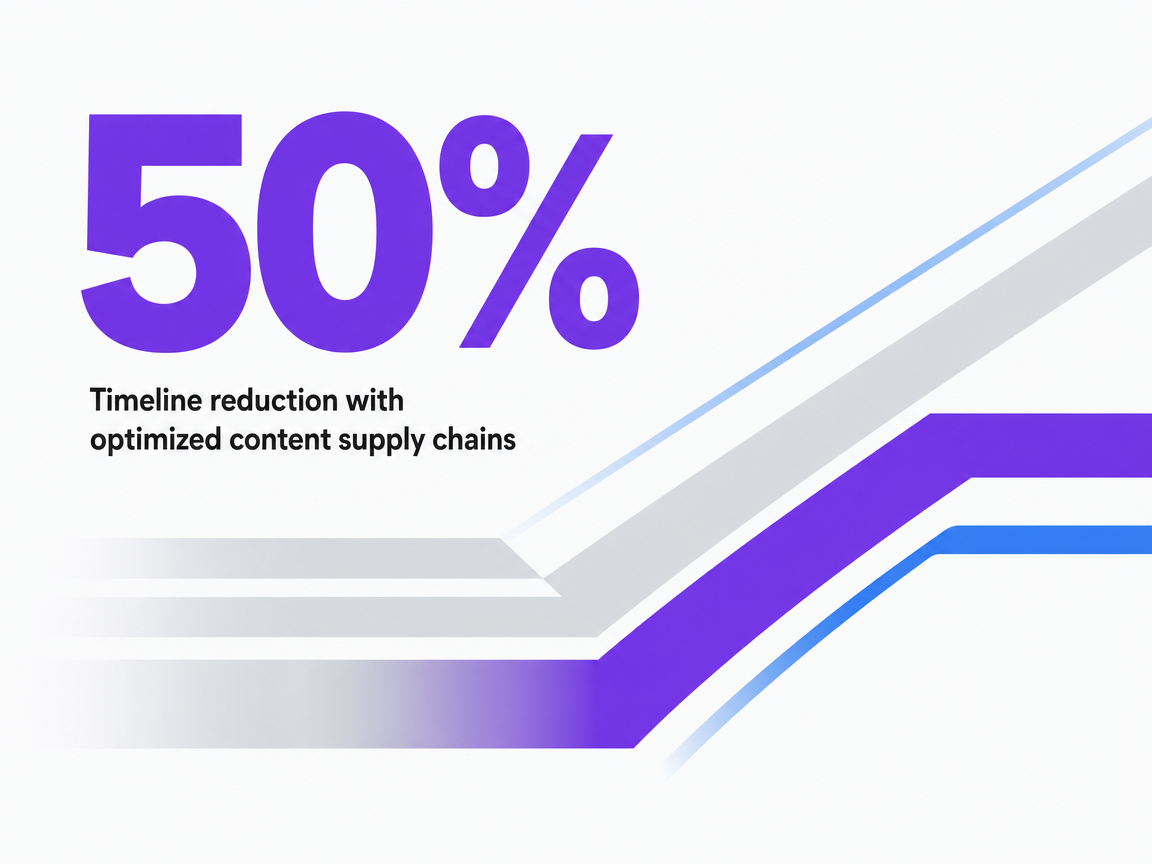 Timeline reduction with optimized content supply chains
Timeline reduction with optimized content supply chains
Step 1: Diagnose where your current workflow breaks
Before redesigning anything, a content manager needs a written account of where the current workflow actually loses time. Not where it feels slow, but where drafts sit, where briefs get sent back, and where publishing waits on a single person's inbox. Diagnosis precedes design because tooling investments applied to an unmapped process reproduce the same bottlenecks with a bigger license fee. McKinsey's automation research reaches the same conclusion from a larger sample: organizations that treat automation as a strategic priority and redesign processes before deploying tools outperform those that bolt software onto existing handoffs 17.
Forrester's audit of content operations gives an in-house manager a ready-made checklist. Most organizations, per Forrester, are missing infrastructure across six areas:
- planning
- calendaring
- workflow optimization
- distribution
- asset management
- analytics 18
Run the current operation against those six categories and score each one honestly. A team can have a strong calendar and no analytics, or excellent asset management and no defined workflow optimization. The pattern of missing pieces tells the manager which step in the seven-step model to build first.
The diagnostic itself is short. For each of the six Forrester categories, answer three questions:
- Who owns it?
- What system holds the source of truth?
- What data comes out of it that the next step uses?
A category with no named owner is a queue. A category with three systems and no source of truth is a rework generator. A category that produces no downstream data is a black box the next planning cycle cannot learn from.
Time the actual cycle, too. Pick five recent pieces and log the calendar days spent in each stage: brief drafted, brief approved, draft written, draft reviewed, edits closed, SEO applied, published, measured. Idle time between stages usually accounts for more than the writing itself. That gap is the target for the next six steps, not the writing speed of the team.
Step 2: Redesign the process before you buy more tools
Once the diagnosis is on paper, the temptation is to shop. A new project management tool, a new AI drafting license, a new SEO suite. McKinsey's automation research is direct on this point: successful programs treat automation as a strategic priority and redesign processes to align with what automation and AI can actually do, rather than layering software on top of the existing sequence 17. Buying first locks the team into whatever assumptions the tool makes about roles, handoffs, and approvals.
Redesign starts with the routing map, not the tech stack. For each stage identified in the diagnostic, decide three things:
- who initiates the stage
- who approves the exit from it
- what artifact moves to the next stage
A brief exits planning as an approved document with a named strategist attached. A draft exits creation as a versioned file with SEO fields already populated. If any stage produces something the next stage has to reformat or re-request, that is a redesign target before any procurement happens.
McKinsey's enterprise AI workflow guidance adds a second requirement: be explicit about how roles will change 2. A content manager cannot redesign around a strategist role, an editor role, and a publisher role if those responsibilities still overlap in practice. Cross-functional ownership needs to be hardwired into the routing map before tools are chosen, because the tools will encode whatever role ambiguity survives the redesign.
The output of this step is a one-page process document that names every stage, its owner, its approval exit, and its output artifact. That document is what a tool evaluation should be measured against, not the other way around.
Test a Scalable Workflow With Real Campaigns
Experience a measurable boost in content output and workflow efficiency before you commit.
Step 3: Standardize briefs as the first control point
The brief is where a scalable workflow either compounds or leaks. A brief that reaches a writer with unresolved strategy, missing SEO targets, or unclear approvers guarantees a rework loop later. The fix is not a longer template. It is treating the brief as a control point that cannot exit planning until specific fields are populated and signed off by a named owner.
A standardized brief carries seven fields at minimum:
- primary keyword and secondary targets
- search intent and audience
- angle and thesis
- mandatory internal points of view
- format and word count
- distribution channels
- success metric
Each field ties to a downstream stage. The keyword field feeds SEO. The angle feeds the writer. The distribution channels feed activation. The success metric feeds measurement. If any field is blank, the brief has not exited planning, regardless of calendar pressure.
Forrester's operating model research is direct about why this matters at scale. In an environment where AI makes generic content cheap, organizations that do not redesign roles, governance, and workflows around expertise-driven content lose brand differentiation and audience trust 16. The brief is where expertise gets encoded before drafting begins. Skip that encoding and the workflow produces volume that reads like everyone else's volume.
Two operational rules keep this step honest. First, one person owns brief approval, and that person is not the writer. Second, briefs are versioned, so a mid-draft scope change is visible, not verbal. Without those two rules, standardization drifts back to preference within a quarter.
Step 4: Use AI drafting as one node, not the centerpiece
AI drafting belongs inside the workflow, not on top of it. McKinsey estimates that agentic AI systems will come to power as much as two-thirds of current marketing activities and accelerate the creation and execution of marketing campaigns by 10 to 15 times 14. Those numbers describe a ceiling for what workflow-embedded AI can address across content generation, testing, and media planning, not a mandate to hand a blank brief to a model and publish the result.
The practical translation for a content manager: AI takes a completed brief and produces a first draft, section outlines, alternate headlines, meta descriptions, and structured formats like FAQ blocks. It does not exit the drafting stage on its own. The artifact that moves to review is a versioned draft with the model, prompt, and source brief attached, so the editor knows what was generated and against what inputs. Peer-reviewed work on AI-enabled marketing functions similarly classifies AI's role as creative content generation and multichannel support inside a larger operating system, not as a standalone producer 8.
Two guardrails keep this node from swallowing the workflow. First, AI drafts against the standardized brief from Step 3, never against a headline or a keyword alone. A model given a thin prompt produces the generic output that Forrester warns erodes brand differentiation when scaled without governance 16. Second, the drafting stage has a fixed exit criterion: the draft covers every mandatory point of view named in the brief, matches the required format, and carries populated SEO fields. If any of those are missing, the draft returns to the writer or the prompt, not to review.
Handled this way, AI compresses the drafting stage from days to hours while the surrounding gates continue to enforce brand and strategy discipline. That is where the 10 to 15x figure actually lives in an in-house operation.
Step 5: Route reviews through gates that log every decision
Review is where most workflows either compound velocity or generate the rework loops that make Step 1's diagnostic ugly. The fix is not fewer reviewers. It is fewer, better-defined gates, each with a named approver, a fixed checklist, and a logged decision. Forrester's guidance on content marketing technology is explicit that workflow templates, review-only seats, audit trails, and workflow analytics are what let teams find and resolve bottlenecks, particularly in operations that carry legal or regulatory exposure 15.
Three gates cover most in-house operations:
- The editorial gate confirms the draft matches the brief's angle, mandatory points of view, and format.
- The SEO gate confirms keyword targeting, internal linking targets, and meta fields.
- The brand and compliance gate confirms voice, claims substantiation, and any legal review required for the vertical.
Each gate has one approver of record. Parallel commenters are welcome; parallel approvers are not, because two approvers with equal authority produce the six-day queue Step 1 was designed to kill.
Every gate decision gets logged: who approved, when, against which checklist version, and what changed on exit. NIST's AI Risk Management Framework treats that kind of process log as baseline practice for any workflow that includes model-generated outputs, precisely because it makes lifecycle validation and human oversight auditable rather than assumed 4. The NIST Playbook reinforces the same posture, framing governance actions as ongoing rather than one-time 6. For a content manager, the operational value is simpler: when a piece underperforms or a claim gets challenged, the log shows exactly which gate cleared it and on what basis.
Two rules keep gates from calcifying into bureaucracy. Time-box each gate with a service level, typically 24 to 48 hours, and publish the workflow analytics Forrester recommends so the team sees which gate is actually slow 15. Approval authority stays with humans, but the routing, reminders, and logs run on the system.
Step 6: Publish and activate without re-keying work
Publishing is where a governed workflow either pays off or leaks the gains from the first five steps. If an approved draft has to be copied into the CMS, reformatted for email, rewritten for social, and re-tagged for analytics, the team has quietly rebuilt the linear handoff the workflow was designed to kill. Deloitte's supply chain framework treats activation as its own pillar for that reason: creation and activation are connected stages, not separate projects, and the artifacts that exit review need to carry the metadata activation depends on 1.
The operational rule is single-source. The approved draft, its SEO fields, its assets, and its channel variants live in one record that pushes to the CMS, the email platform, and the social scheduler without a human retyping anything. McKinsey's work on generative AI in marketing describes this as the connective tissue between content production and downstream activation, where personalized follow-ups, automated distribution, and dynamic variants run off the same governed source rather than parallel copies 3.
Two practical checks keep this step from becoming another queue. First, channel variants are generated inside the approved record and versioned against it, so a change to the master headline propagates instead of orphaning three off-brand copies. Second, publishing itself is a logged action with a named owner, matching the audit trail Forrester recommends for review workflows 15. Activation runs on the system; accountability stays with a person.
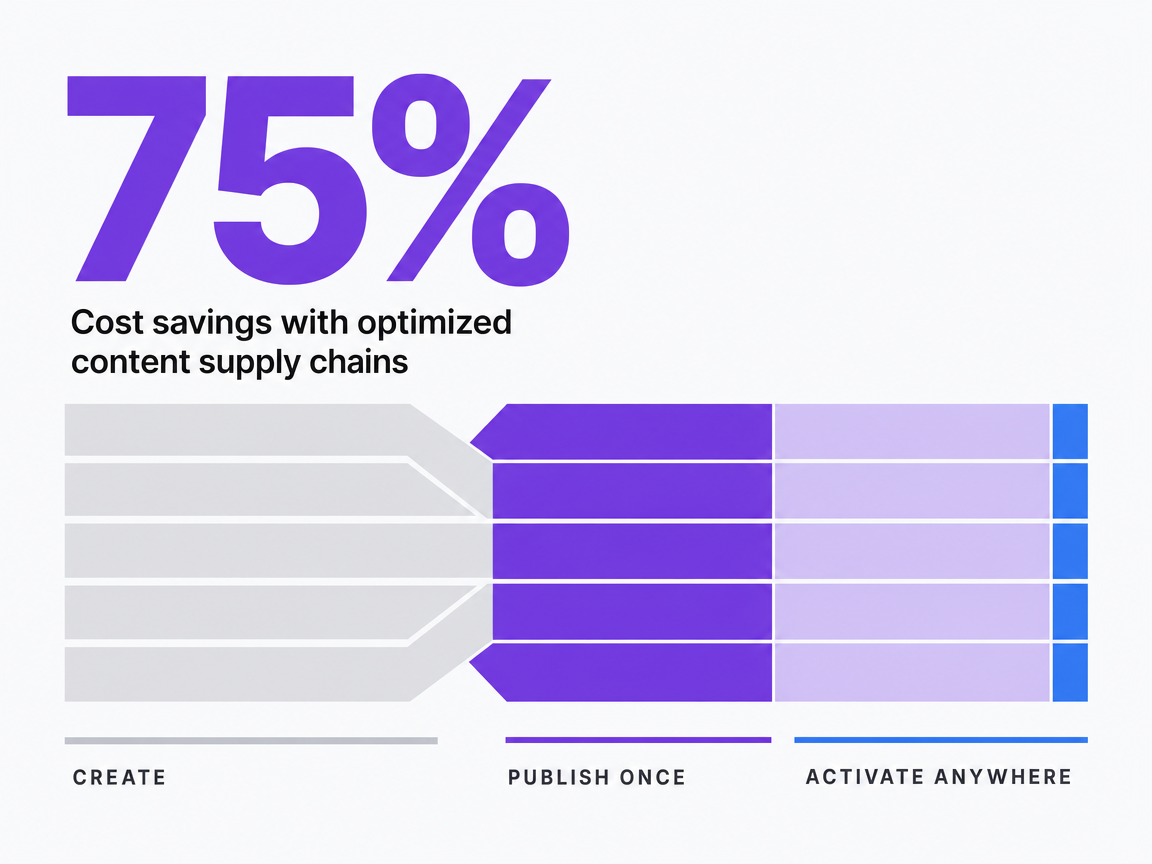 Cost savings with optimized content supply chains
Cost savings with optimized content supply chains
Centralize and Accelerate Your Content Workflow—Backed by Data
Connect with specialists to see how unified approval dashboards eliminate production bottlenecks and improve governance across multi-channel content teams—without increasing headcount or losing control of brand standards.
Step 7: Route performance data back into briefing
Most content workflows treat publishing as the finish line. That is where the ROI number Deloitte reports gets lost. Deloitte's supply chain framework closes with measurement and optimization as a full pillar, not a dashboard bolted to the end of the process 1. The operational meaning is specific: performance data has to flow back into the planning stage that produces the next brief, or the team keeps commissioning the same underperforming angles at higher speed.
The mechanic is a scheduled review of what shipped against the success metric named in each brief from Step 3. Traffic, ranking movement, conversion, and pipeline influence, whichever the brief committed to, get pulled at a fixed cadence, typically 30, 60, and 90 days post-publish. The output is not a dashboard. It is a written note attached to the topic cluster that tells the next planner which angles cleared the metric, which stalled, and which briefs should be retired.
McKinsey's work on generative AI in marketing treats this loop as the connective tissue between production and activation, where dynamic content and automated variants get tuned against downstream signals rather than published once and forgotten 3. NIST's guidance reinforces the same posture from the risk side: outputs need to be measured against real-world outcomes on an ongoing basis, not signed off once at review 12. For an in-house manager, the practical rule is simpler. No planning meeting starts without last cycle's performance notes on the table.
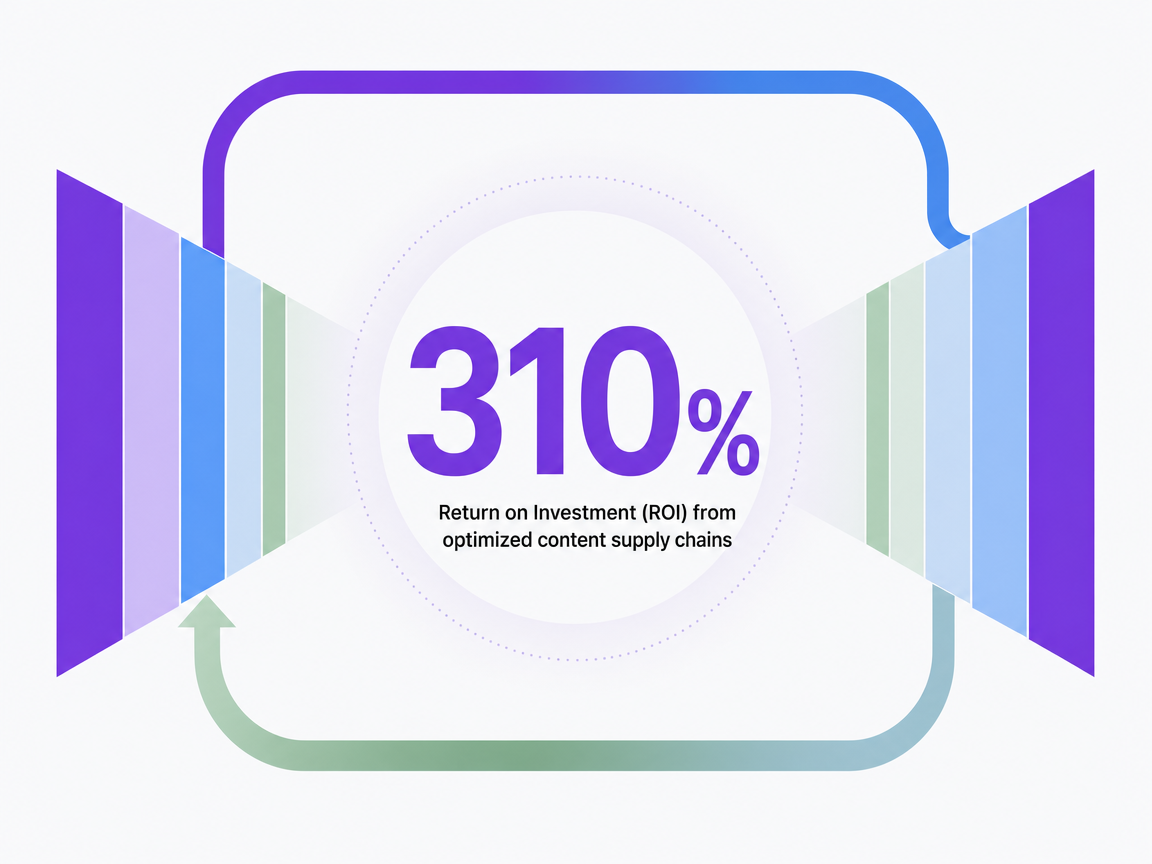 Return on Investment (ROI) from optimized content supply chains
Return on Investment (ROI) from optimized content supply chains
A role matrix that keeps a small team from becoming the bottleneck
A four- to eight-person team can run the seven steps above without new hires, but only if four roles are named and non-overlapping. McKinsey's enterprise AI workflow research is explicit on this point: sustainable gains require being direct about how roles change, not layering new tools on ambiguous ownership 2.
The minimum matrix carries:
Strategist : Owns planning and brief approval.
Editor : Owns the editorial and SEO gates.
Producer : Owns drafting (with or without AI) and channel variants.
Analyst : Owns measurement and feeds performance notes back into planning.
On a five-person team, the manager typically holds strategist and analyst; on an eight-person team, those split. Writers sit inside the producer role, not above or beside it.
Two rules keep the matrix from collapsing. No single person holds both drafting and approval on the same piece, which is the shortcut that quietly reintroduces the rework loop from Step 1. And every gate has one approver of record, not a committee. Forrester's workflow analytics guidance shows that logged, single-owner gates are what surface bottlenecks the manager can actually fix 15.
What to build first if you have 90 days
A content manager with one quarter to show measurable throughput gains should not attempt all seven steps in parallel. The sequencing that actually holds is diagnosis, briefs, gates, in that order.
- Days 1 to 30 go to the diagnostic from Step 1 and the standardized brief from Step 3. Score the operation against Forrester's six infrastructure categories, time five recent pieces stage by stage, and ship a versioned brief template with a single named approver 18. Nothing else changes yet.
- Days 31 to 60 install the three review gates from Step 5 with time-boxed service levels and logged decisions. Publish the gate analytics to the team weekly so the slow gate is visible, not rumored 15.
- Days 61 to 90 add AI drafting against the standardized brief and wire the performance loop back into planning. By day 90, the manager should be able to point to specific cycle-time drops per stage, not a general sense that things feel faster. That evidence is what funds the next quarter's build.
Frequently Asked Questions
References
- 1.Turn marketing into a performance-driven growth engine.
- 2.Transforming the enterprise through AI-powered workflows.
- 3.AI-powered marketing and sales reach new heights with generative AI.
- 4.Artificial Intelligence Risk Management Framework (AI RMF 1.0).
- 5.NIST Artificial Intelligence Update.
- 6.Playbook - AIRC.
- 7.Secure Software Development Practices for Generative AI and Dual-Use Foundation Models.
- 8.The impact of AI-enabled CRM systems on organizational ....
- 9.From Words to Workflows: Automating Business Processes.
- 10.Accelerating the Adoption of Software and AI Agent Identity and Authorization.
- 11.AI Risk Management Framework: Second Draft - August 18, 2022.
- 12.The IIA's Artificial Intelligence Framework: Practical ....
- Trustworthy AI in Critical Infrastructure Profile. https://www.nist.gov/system/files/documents/2026/04/08/Concept%20Note%20Development%20of%20the%20NIST%20AI%20RMF%20Trustworthy%20Use%20of%20AI%20in%20Critical%20Infrastructure%20Profile.pdf
- 14.Reinventing marketing workflows with agentic AI.
- 15.Content Marketing Tech Workflow Considerations.
- 16.To Survive The Content Apocalypse, Reinvent Your Content Operating Model Now.
- 17.The Imperatives for Automation Success.
- 18.Five Keys to Successful Content Operations.