
Key Takeaways
- Content workflow software functions as a governance surface, not a productivity utility, so define decision rights and approval gates before evaluating any platform.
- Distinguish the four stack functions—CMP, CMS, DAM, and orchestration layer—because approval routing rarely lives natively in any single system and often requires a dedicated layer.
- Five decision points need named owners: brief, draft, review, publish, and measure, with review lanes separated so legal, SEO, brand, and SME sign-offs run in parallel.
- Embed AI as production scaffolding beneath each approval gate, then track cost-per-asset variables and KPI contribution at 30 and 90 days to convert quality gains into measurable throughput 15.
The Operating Model Beats the Tool
Content workflow software is a control layer, performing only as well as the operating model wrapped around it. Teams that consistently out-publish their peers treat workflow platforms as approval and orchestration systems, where production scaffolding supports human decision rights.
This shift changes the diagnostic question for content managers. Instead of asking "which tool," which often leads to inheriting coordination problems on a new interface, effective managers ask: "what gets approved, by whom, against what KPI, before it ships." This reframes workflow software from a productivity utility into a governance surface.
A content operations framework aligns people, processes, and platforms to produce quality content at scale 12. The platform is the third variable, not the first. Tendo emphasizes that a framework "outlines the people, processes, and tools that your company must implement to drive and integrate content strategy, planning, creation, and management" 2. Tool selection is a consequence of this framework, not its starting point.
This article serves as an operating-model design brief for content managers seeking to consolidate disconnected tools into a coordinated system. It diagnoses workflow failures, clarifies vendor categories, and maps approval architecture, AI integration, and KPIs to a 90-day implementation path.
Why Workflow Software Fails Without an Operating Model
The Quality-Coordination Gap in B2B Content
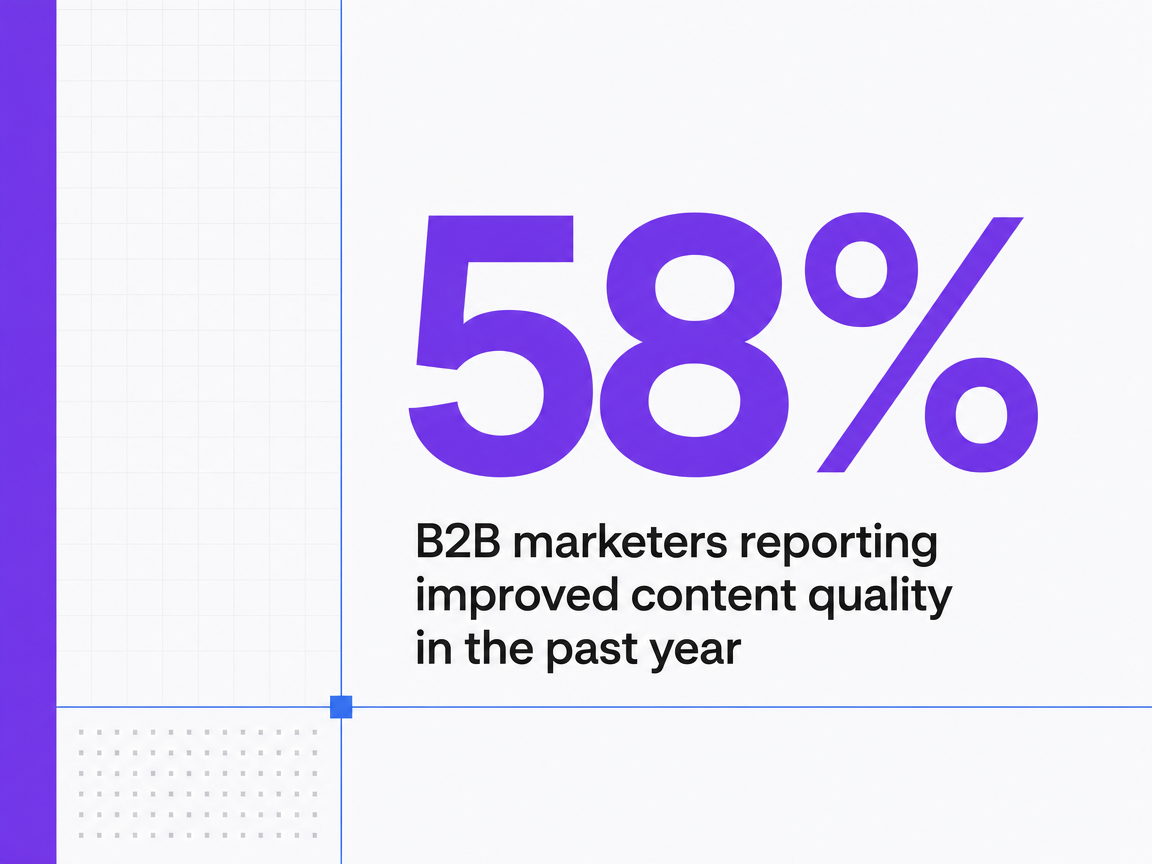
B2B content teams often excel at content creation but struggle with coordination. The Content Marketing Institute's B2B benchmark survey revealed that 58% of respondents improved content quality, yet challenges in measurement, internal alignment, and process maturity persist 3. This indicates that while the content itself is sharper, the systems supporting its production are not.
This gap explains why workflow software frequently underdelivers. A platform reflects the decision logic of the team using it. Implementing a project management tool without a defined review process merely highlights existing dysfunctions faster, rather than resolving them. Common issues include incomplete briefs, subjective feedback loops, and post-publication SEO checks, which are costly to fix.
The 58% quality improvement figure is notable for what it doesn't imply: it doesn't suggest improved throughput, reduced cost-per-asset, or clearer links to pipeline generation. Quality is largely within a content team's direct control. Coordination, measurement, and resourcing, however, depend on broader systems that workflow software is intended to formalize.
Therefore, the critical operating-model question is not "how do we produce better content," but "how do we coordinate existing production to translate quality into measurable outcomes."
Symptoms of a Missing Control Layer
A workflow lacking a control layer exhibits consistent symptoms across teams. Editorial calendars show unstaffable commitments, drafts languish in review queues without named approvers, and brief revisions occur in informal channels like Slack, never updating the system of record. SEO recommendations from external tools are applied inconsistently, depending on individual writers.
Three key symptoms are diagnostic:
- Review cycles expand without explicit decisions, as new stakeholders are added due to undefined approval authority.
- The same defects reappear across assets because there's no feedback loop between publishing and brief templates.
- Status meetings become a substitute for transparent status visibility.
Brafton notes that a workflow should streamline tasks into manageable stages with clear roles and timelines, not create additional coordination overhead 13.
Each symptom points to a missing governance decision, not a missing software feature. Approval authority, defect feedback, and visibility are operating-model choices that software can enforce once established, but cannot make independently. The following sections address these choices, beginning with clarifying common category confusion.
Category Clarity: CMP, CMS, DAM, and the Orchestration Layer
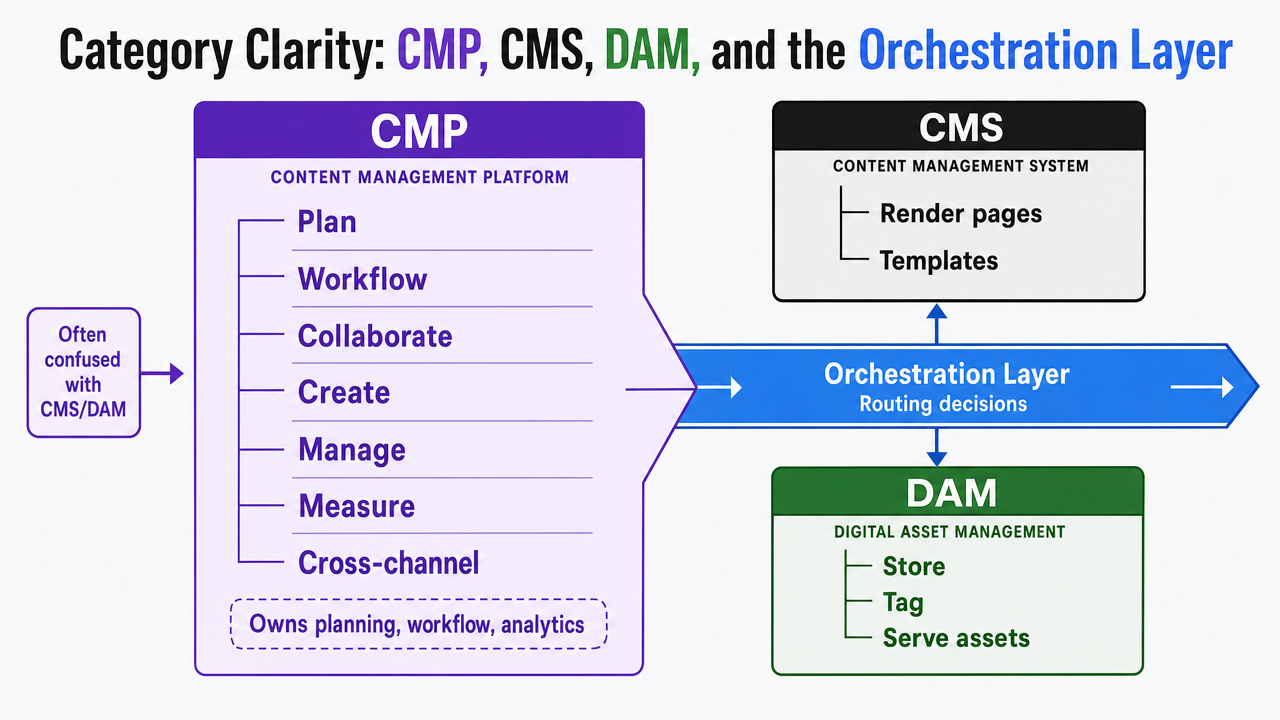
Content managers evaluating workflow strategies must distinguish four functions before selecting tools:
- CMP — the marketing platform for planning and production
- CMS — the publishing system for rendering content
- DAM — the asset library for storage
- Orchestration layer — for routing decisions
Gartner defines content marketing platforms (CMPs) as software supporting content marketing by helping teams create, manage, and measure content across channels, increasingly with generative AI 8. Forrester adds that CMPs facilitate collaboration on strategy, orchestrate activities across creators and distributors, and optimize cross-channel distribution 9. Both definitions place workflow, planning, and analytics within the CMP, which often causes confusion. A CMS, in contrast, renders pages and manages templates. A DAM stores, tags, and serves binary assets to other systems.
The orchestration layer is often underspecified. It is the interface where briefs are approved, drafts routed, SEO checks signed off, and publish decisions recorded with a named owner. For small teams, a CMP might handle this. However, for teams managing parallel campaigns across multiple brands or locations, the orchestration logic typically exceeds a single CMP's capabilities, requiring a dedicated approval layer above the CMP, CMS, and DAM.
The practical test is identifying where decision records reside. If approvals are scattered across Slack, email, or meeting notes, the stack lacks an orchestration layer. Content operations leaders emphasize integration, not just feature parity, as crucial for scaling AI-assisted production 10. Category distinctions are valuable only if they clarify which system owns which decision.
 Clarify the four distinct stack functions and which decisions each owns, directly supporting the section's category-distinction argument
Test Your End-to-End Content Workflow in Real Time
Experience faster content production and measurable workflow improvements with live publishing during your trial period.
Approval Architecture as the Real Differentiator
Decision Rights at Each Stage: Brief, Draft, Review, Publish, Measure
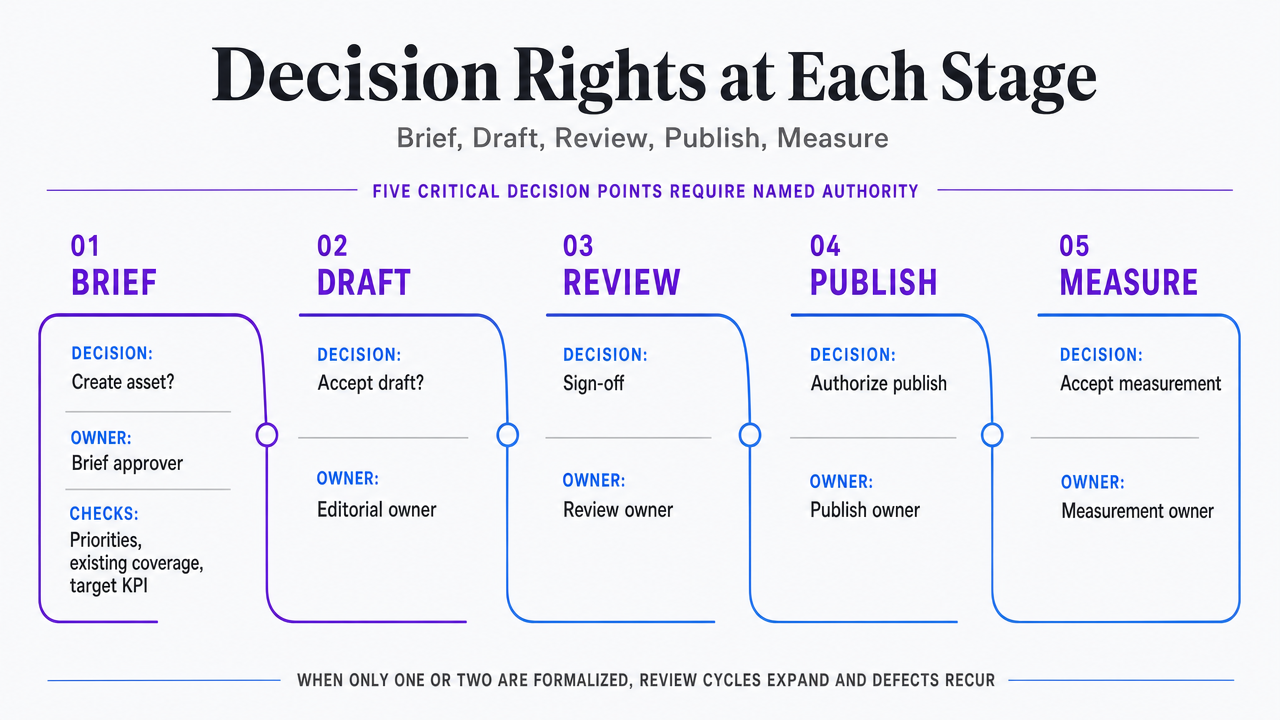
Approval architecture distinguishes scalable content workflows from those that stall. A workflow has five critical decision points requiring named authority: brief approval, draft approval, review sign-off, publish authorization, and measurement acceptance. Most teams formalize only one or two, leading to expanding review cycles and recurring defects.
- At the brief stage, the decision is whether an asset should be created. The approver confirms alignment with priorities, checks for existing coverage, and identifies the target KPI. Without a named brief approver, calendars fill with assets that cannot be justified by pipeline contribution. Content operations frameworks consistently prioritize this decision before resource allocation 2.
- Draft approval is an editorial decision, where an owner accepts the draft against the brief's requirements, not personal preference.
- Review sign-off is a parallel, narrower process: legal, SEO, brand, and subject-matter experts each clear their specific lanes without blocking others. When these lanes merge into a single "review" step, assets are delayed by the slowest reviewer, and feedback becomes muddled without an audit trail.
- Publish authorization is the operational gate, confirming that the rendered page, metadata, schema, and distribution plan match approvals.
- Measurement acceptance, often skipped, involves an owner verifying whether the asset met its brief-defined KPI 30, 60, and 90 days post-publish, feeding results back into the brief template. This step ensures the workflow learns and improves with each cycle 15.
Software enforces these rights only after the team defines them, recording who approved what and when, but not determining who should approve.
 Visualize the five sequential approval gates and their named decision owners, which is the core framework the section defines
Centralized, Decentralized, or Hybrid Approval Models
Three approval models are common, each with predictable failure modes, chosen based on brand surface area, regulatory exposure, and production volume.
A centralized model routes all approvals through a single editorial owner or small council. This ensures tight brand consistency and clear defect feedback but limits throughput to the approver's capacity. Teams with a single brand producing fewer than fifty assets quarterly often outgrow this model, hitting a throughput ceiling that tool upgrades cannot resolve.
A decentralized model distributes approval authority to channel or product leads. This scales throughput but increases variance, leading to recurring defects across different areas due to a lack of cross-lead feedback. CMI's content operations framework highlights that choosing an approval structure is a strategic decision, not a default 4.
A hybrid model centralizes brief approval and measurement acceptance while decentralizing draft and review sign-off to named lane owners. This maintains throughput during production and protects strategic decisions: what content is created and whether it achieved its goals. Most teams managing multiple parallel campaigns or brands adopt this model after outgrowing centralized limitations.
AI as Embedded Production Scaffolding
From Pilots to Baseline: Where AI Sits in the Workflow
AI-assisted production is now integral to the workflow, not an optional experiment. McKinsey's 2024 survey found 65% of organizations regularly use generative AI in at least one business function, nearly doubling from the previous year, with marketing and sales showing the highest adoption increase 6. This trajectory indicates that workflow strategies assuming AI is optional are misaligned with current industry practices.
The strategic question is AI placement. AI should function as production scaffolding beneath human decision points, not as a parallel channel. Four placements offer significant leverage:
- Brief generation — drafting outlines, keywords, and success criteria for editor approval
- Draft assistance — producing first passes against approved briefs
- Optimization — running SEO, readability, and brand-voice checks before review
- Tagging/metadata population — at publish, aligned with DAM taxonomy
Crucially, each AI placement occurs before an approval gate. This sequencing is what content operations leaders identify as the difference between scalable AI and AI that generates rework 10.
The Ambition-Execution Gap and What Closes It
Organizational AI adoption doesn't automatically translate to integration within campaign workflows. Despite high ambition, a modest share of marketers actually use AI in their campaign processes 14. This gap is operational. Teams license tools and run isolated pilots, but often fail to integrate AI output into their editorial calendars.
Three conditions bridge this gap:
- Each AI placement needs a named owner who accepts the output against a written standard. Without this, AI output becomes another draft requiring evaluation from scratch, doubling review time.
- A feedback loop into the prompt or template library is essential. Rejected AI-generated briefs should update templates, and failed SEO checks should revise optimization prompts. Content leaders see this loop as key to integrated operations 10.
- AI placements must be measured at the same cadence as the rest of the workflow, tracking metrics like time-to-publish, rework rate, or KPI contribution. Without measurement, AI use risks becoming a novelty rather than a core function.
See How Leading Teams Streamline Content Production at Scale
Request a walkthrough of approval-first content workflow software built for agencies and enterprise brands managing high-volume, multi-channel campaigns.
KPIs and Throughput Economics
The Cost-Per-Published-Asset Equation
Content workflow software justifies its place by impacting the fully loaded cost to move an approved asset from brief to publish. This metric, rarely tracked directly, is crucial because a workflow platform can either compress or expose its variables.
Five variables drive this equation:
- Writer hours per asset — including research, drafting, revision
- Review cycles — draft movements between author and approver
- Time-to-publish — elapsed days from brief approval to live
- Rework rate — post-publish edits within 30 days
- Reviewer hours per asset — often underestimated
The interaction of these variables is more important than any single one. For example, reducing writer hours with AI without compressing review cycles can increase cost-per-asset due to increased reviewer time. Publishing faster but increasing rework creates visible velocity at the cost of invisible debt. Standardized stage gates with documented exit criteria make this equation transparent 15.
Two derived metrics extend this framework: throughput per approver per week identifies queue bottlenecks, and KPI contribution per asset (measured at 30 and 90 days against the brief's goal) distinguishes published volume from published value 4.
Sizing the Upside Before Sizing the Stack
Before consolidating tools, content managers need a defensible business case. McKinsey estimates generative AI could add $2.6 trillion to $4.4 trillion annually to the global economy, with marketing and sales being prime use cases due to content generation and personalization 7. While a macro projection, it highlights the potential scale and value of AI in marketing.
Marketing and sales are top categories because tasks like drafting, optimizing, personalizing, and tagging align well with generative AI's capabilities. A workflow strategy that embeds AI as production scaffolding under human approval is the operational approach that converts this potential into measurable throughput gains.
The local calculation is more specific. A content manager projects how the five cost-per-asset variables will shift with a proposed stack. For instance, if writer hours drop by 15%, review cycles reduce from three to two, and rework rate falls by four points, these changes in cost-per-asset and KPI contribution form the basis of the business case. The macro estimates provide context, while the local model determines the value of changing a specific team's stack.
Sequencing the Stack: A 90-Day Implementation Path
Consolidating disconnected tools into a coordinated workflow begins not with platform selection, but with defining decision rights, and concludes with measurement. The platform is the final component.
- Days 1-30: Operating Model Definition. The team documents the five approval gates—brief, draft, review, publish, measure—and assigns an accountable owner to each. Review lanes are separated (legal, SEO, brand, subject-matter experts), each with documented exit criteria to prevent single-point bottlenecks. The brief template is revised to require the target KPI, keyword cluster, and measurement cadence at the request's origin. No tools are purchased during this phase.
- Days 31-60: Category Sorting and Pilot. The manager maps current tools against the four functions: CMP, CMS, DAM, and orchestration layer, identifying where decisions currently lack a system of record 8, 9. One workflow stream, typically the highest-volume content type, is run end-to-end on the proposed stack, with AI placements active for brief generation, draft assistance, and optimization. Each AI placement has a named approver and a written acceptance standard, which content leaders identify as crucial for integrated operations versus isolated experiments 10.
- Days 61-90: Measurement Loop Closure. The five cost-per-asset variables—writer hours, review cycles, time-to-publish, rework rate, and reviewer hours—are tracked against the pre-pilot baseline. KPI contribution per asset is measured 30 days post-publish and fed back into the brief template, ensuring subsequent cycles start with improved inputs 15. The final stack decision is made based on pilot data, not vendor demonstrations.
Platforms like Vectoron function at the orchestration layer in this sequence, routing approvals across the existing stack rather than replacing the underlying CMS or DAM.
 B2B marketers reporting improved content quality in the past year
B2B marketers reporting improved content quality in the past year
Frequently Asked Questions
References
- 1.What Is Content Workflow?.
- 2.Content Operations Framework.
- 3.B2B Content and Marketing Trends: Insights for 2026.
- 4.Don't Avoid Content Ops — Use This Helpful Framework Now.
- 5.The state of AI in 2023: Generative AI's breakout year.
- 6.The state of AI in early 2024.
- 7.The economic potential of generative AI: The next productivity frontier.
- 8.Magic Quadrant for Content Marketing Platforms – Market Definition.
- 9.Introducing the Forrester Wave for Content Marketing Platforms.
- 10.Content Operations in the Age of AI: Insights from Top Leaders.
- 11.What is content operations?.
- 12.Content Operations Framework: A Foundation for Better Results.
- 13.Why Workflows Are Critical for Successful Content Marketing.
- 14.McKinsey frames AI 2.0; Positionless Marketing delivers it.
- 15.B2B Guide to Building a Content Operations Workflow.