
Key Takeaways
- Approval-first workflows define reviewer roles, decision criteria, and evidence standards before any draft is written, then calibrate production capacity to what reviewers can actually clear each week.
- A numbered claim register built at the brief stage lets reviewers verify execution against pre-agreed assertions and their evidence sources, matching the FTC's pre-dissemination substantiation standard 11.
- Running brand, subject-matter, and legal/compliance lanes in parallel, then consolidating sign-off under a single Approver of Record, creates a defensible audit trail and prevents post-approval drift.
- Focus next on the five artifacts that operationalize the model: exposure-tagged intake, brief with embedded claim register, reviewer role matrix, decision-log schema, and per-lane SLAs.
Why Production-First Workflows Stall in Regulated Verticals
Most content operations are built around the writer's calendar. A brief goes out, a draft comes back, an editor cleans it up, and only then does anyone ask the legal reviewer, the clinical lead, or the compliance officer to weigh in. That sequence works in low-stakes categories. It breaks in law firms, behavioral health networks, dental groups, senior living operators, and healthcare systems, where the last stage is the one that carries the most risk and takes the most time.
The stall is predictable. A draft lands in a reviewer's inbox with no claim register, no evidence citations, and no record of which assertions the writer intended as express versus implied. The reviewer has to reverse-engineer what needs substantiation, which is precisely the work the FTC expects marketers to complete before dissemination, not after 11. Health, financial, and professional-services claims must be truthful, non-deceptive, and evidence-based at the point of publication 12. A workflow that treats those checks as a final polish creates rework, missed deadlines, and reviewer fatigue.
Process-mapping research in healthcare operations points to the same pattern: bottlenecks tend to sit at handoffs between roles, not inside any single role's work 4. Production-first workflows concentrate handoffs at the end. Content managers running regulated verticals need the opposite shape.
The Inversion: Designing the Approval Layer Before the Production Layer
An approval-first workflow starts by answering a different question. Instead of asking what the team will write next, it asks who has to sign off on what, against which criteria, before anything moves to production. The reviewer roles, decision rules, and evidence standards are defined first. Production capacity is then calibrated to what those reviewers can actually clear in a week.
The shift produces three operational changes. Reviewers stop receiving finished drafts and start receiving structured claim registers that name every express and implied assertion the piece will make, which is the substantiation standard the FTC applies to advertising before dissemination 11. Writers draft against an approved register rather than against a topic, so the reviewer's job narrows to verifying execution against pre-agreed criteria. And the queue itself becomes the unit of measurement, because throughput is bounded by approval capacity, not by writing capacity.
Process-mapping evidence from healthcare operations supports the inversion: mapped workflows expose where handoffs concentrate and where decisions actually get made, which is the prerequisite for any real improvement action 4. In an approval-first design, the map is drawn around the reviewer's decision points, and the writing tasks fill in behind them.
The Regulatory Stakes That Make Approval-First Non-Negotiable
The cost of a missed approval gate is not theoretical. In 2025, the FDA and HHS announced a coordinated enforcement action against misleading direct-to-consumer pharmaceutical advertising, issuing thousands of warning letters and approximately 100 cease-and-desist orders to companies whose promotional materials crossed the line 3. The scale matters: warning letters signal broad surveillance across the market, while cease-and-desist orders name specific advertisers and demand immediate takedown. Both outcomes trace back to promotional content that reached the public without adequate review against the standards the FDA applies to prescription drug advertising 2.
The regulatory perimeter is wider than pharma. FTC substantiation principles require that every express and implied claim in an advertisement be supported by competent and reliable evidence before dissemination, not gathered after a regulator asks 11. Health-product marketers face additional evidentiary expectations around clinical studies, disclosures, and how efficacy is characterized 1. Law firms, financial services, and other professional categories operate under the same truthful-and-evidence-based standard the FTC applies across advertising and marketing broadly 12.
Layered on top of the advertising rules is HIPAA. The Privacy Rule generally requires written authorization from the individual before their protected health information is used for marketing, which creates a distinct review gate for any content that draws on patient stories, testimonials, or engagement data from covered entities 8. And beyond the statutes, ethical review has its own weight: the AMA has documented how direct-to-consumer prescription drug advertising can strain the patient-physician relationship when it promotes inappropriate use, which means reviewers in health-adjacent verticals are checking for reputational and ethical exposure alongside legal exposure 7.
A production-first workflow treats these requirements as final-stage checks. An approval-first workflow treats them as the design specification the entire pipeline is built to satisfy.
The Seven-Stage Approval-First Template
Stage One: Intake and Priority Assignment
Intake is where the workflow assigns risk before it assigns effort. Every request enters a single queue with four fields the Content Lead sets on receipt: content type, regulatory exposure category, target audience, and business owner. A blog post explaining a treatment protocol carries different exposure than a location page or a paid social ad, and each triggers a different reviewer path downstream.
Priority is not a subjective ranking. It follows exposure category and campaign deadline, in that order. Requests without a named business owner or a defined audience are rejected back to the requester rather than parked, because ambiguous intake is the most common source of downstream rework in mapped healthcare workflows 4.
Stage Two: Brief and Claim Register
The brief is where an approval-first workflow diverges most visibly from a production-first one. Alongside the standard elements—angle, keyword target, audience, length, format—the brief includes a claim register: a numbered list of every express and implied assertion the piece intends to make, each paired with the evidence source that will support it. The register is drafted before writing begins and reviewed by the Content Lead against a substantiation checklist.
The register exists because the FTC requires advertisers to possess appropriate substantiation for all express and implied claims before dissemination, not after 11. Health-product claims carry the additional expectation that supporting evidence reflect tests and research conducted by qualified professionals using procedures accepted in the relevant field 1. Building the register at Stage Two means Stage Six reviewers verify execution against a pre-approved set of claims rather than hunting for hidden ones in prose.
Claims flagged as high-exposure at this stage—efficacy language, outcome comparisons, professional credentials, financial results—route to Legal/Compliance for a substantiation preview before drafting starts.
Stage Three: Draft Against the Register
Writers draft against the approved register, not against the topic. Every claim in the copy maps to a numbered entry in the register, and inline annotations link assertions back to their evidence sources. The draft is not a creative exploration of the subject; it is an execution of a document the reviewers have already agreed to in principle.
This narrows the writer's decision surface and shortens the review cycle. Reviewers at later stages check whether the draft honors the register, not whether the underlying claims are defensible. When a writer needs to introduce a new claim mid-draft, the register is amended and rerouted, which surfaces scope changes at the moment they happen instead of at final review.
Stages Four Through Six: Brand, Subject-Matter, and Legal/Compliance Review
Stages Four through Six run as parallel review lanes rather than a sequential chain, which is where mapped workflows produce their largest velocity gains. Process-mapping research in healthcare operations concludes that visualizing where handoffs concentrate—and monitoring the improvement actions that come out of that mapping—is what turns a workflow map into throughput 4. Parallel lanes shorten the elapsed time from draft to sign-off by removing serial dependencies between reviewers who examine different dimensions of the same asset.
The Brand Reviewer checks voice, positioning, and consistency with editorial standards. Their sign-off is scoped to whether the piece sounds like the organization and reinforces the intended market position. The Subject-Matter Reviewer—a clinician, attorney, financial professional, or licensed operator depending on vertical—verifies technical accuracy of every claim tied to their domain in the register. Their sign-off is scoped to correctness, not to compliance framing.
The Legal/Compliance Reviewer examines each claim against the substantiation record, disclosure requirements, and any category-specific regulations that apply. For prescription drug promotion, that includes verifying that the piece meets FDA standards for accuracy and non-misleading presentation of efficacy and risk information 2. For any advertising claim, it includes confirming that the evidence on file meets the substantiation standard 11. Each lane produces a decision-log entry with disposition (approved, approved with revisions, rejected) and evidence references before Stage Seven begins.
Stage Seven: Approver of Record, Publish, and Log
The Approver of Record is a single named individual who confirms that Stages Four through Six each closed with an approved disposition and that the final asset matches the version those reviewers signed. This role does not re-review the substance. It verifies the record and authorizes publication.
Consolidating final authorization in one role produces two operational effects. It creates a defensible audit trail with one accountable name attached to every published asset, which is the artifact regulators, plaintiffs, and internal auditors look for when a claim is later challenged. And it prevents the drift that occurs when late edits are made after reviewer sign-off but before publication, because any post-approval change resets the piece to the affected review lane.
Publication triggers the final decision-log entry: publish timestamp, canonical URL, and the Approver of Record's name.
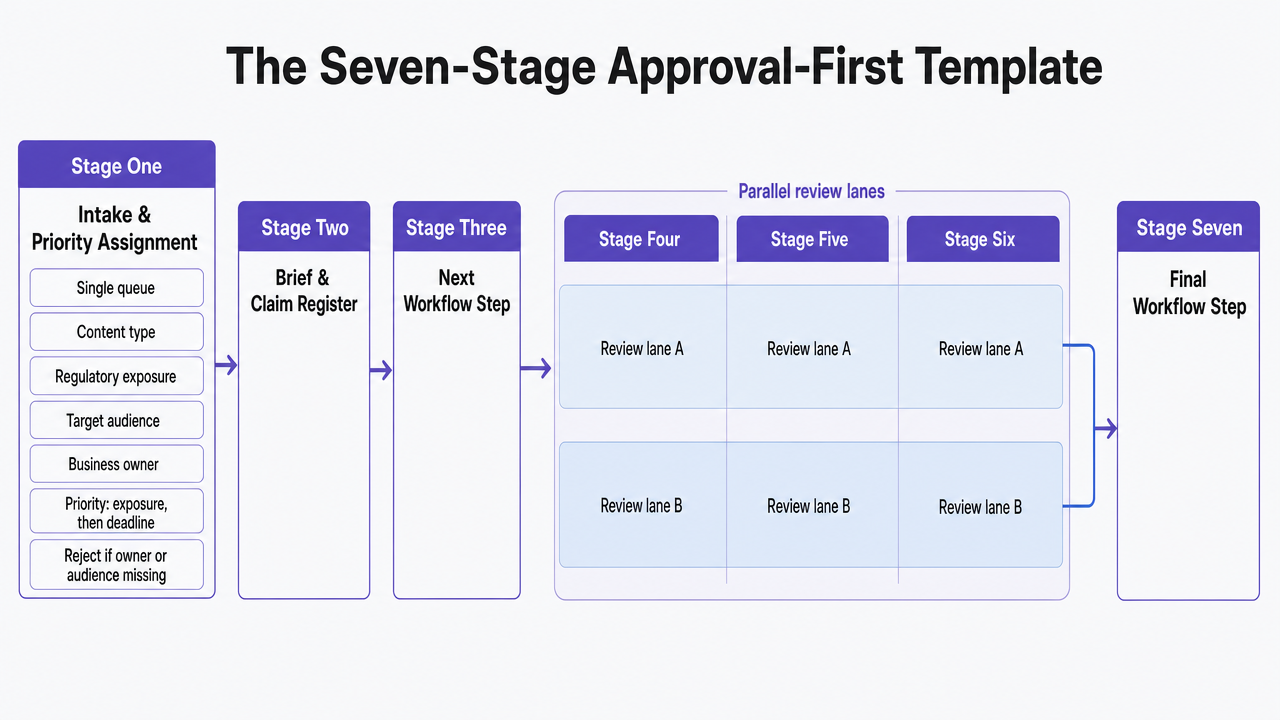 Visualize the seven sequential stages of the approval-first workflow described in this section, showing parallel review lanes at stages four through six
Test an Approval-First Workflow on Live Content
Experience centralized review, approval, and publishing for real campaigns before making a commitment.
The Reviewer Role Matrix
The template only holds together if each reviewer signs off on a scoped slice of the asset, backed by a specific evidence type. A vague "stakeholder review" step is where accountability dissolves. Naming the role, the decision, and the evidence source removes that ambiguity.
| Role | What they sign off on | Evidence they require |
|---|---|---|
| Content Lead | Brief integrity, claim register completeness, routing to correct review lanes | Approved brief, numbered claim register, exposure category assignment |
| Brand Reviewer | Voice, positioning, editorial standards, market consistency | Style guide, positioning document, prior approved assets in the same category |
| Subject-Matter Reviewer | Technical accuracy of domain-specific claims (clinical, legal, financial) | Source documents, professional standards, current practice guidelines in the reviewer's field |
| Legal/Compliance Reviewer | Substantiation of every express and implied claim, required disclosures, category-specific regulations | Substantiation file meeting FTC evidence standards 11, FDA promotional requirements where applicable 2, HIPAA authorization records where PHI is involved 8 |
| Approver of Record | Confirmation that all prior lanes closed with approved dispositions and the final asset matches the reviewed version | Complete decision log with reviewer names, timestamps, and dispositions |
Two design rules keep the matrix functional. Reviewers do not cross scope: the Brand Reviewer does not adjudicate substantiation, and the Legal/Compliance Reviewer does not rewrite voice. And each row names a single accountable individual per asset, not a committee, because mapped healthcare workflows show that decision authority concentrated in one named role produces faster and more consistent outcomes than distributed sign-off 4.
The Decision-Log Schema That Creates an Audit Trail by Default
The audit trail is not a document produced after the fact. It is the byproduct of a decision log that reviewers fill in as they work, one row per claim, one entry per disposition. When the schema is designed correctly, the trail assembles itself.
Five fields carry the operational weight:
- claim ID (mapped to the numbered entry in the register)
- evidence source (citation, study, internal document, or authorization record)
- reviewer name and role
- timestamp of disposition
- disposition itself (approved, approved with revisions, rejected, escalated)
A sixth optional field—reviewer note—captures the reasoning behind a non-approval, which is what makes the log useful in a later challenge rather than just complete.
The schema serves two audiences. Regulators and plaintiffs examining a contested claim get a defensible record showing that substantiation existed before dissemination, which is the standard the FTC applies to every express and implied claim 11. Internal operators reviewing throughput get a queryable dataset showing where dispositions concentrate, which reviewer lanes generate the most revisions, and which claim categories trigger the most escalations—the raw material for the improvement actions that mapped workflows are supposed to produce 4.
The PHI-Screening Gate for Behavioral Health, Dental, and Senior Living Content
Behavioral health operators, dental groups, and senior living communities generate content that draws on the sharpest edge of HIPAA: patient stories, before-and-after imagery, resident testimonials, engagement data pulled from care management systems, and social posts written by clinicians who also treat the people in the frame. The PHI-screening gate is a dedicated review lane that sits inside Stage Six and asks one question per asset: does this content use protected health information for marketing, and if it does, is written authorization on file?
The HIPAA Privacy Rule generally requires an individual's written authorization before their PHI is used or disclosed for marketing, with only narrow exceptions 8. Any direct-to-consumer communication that relies on identifiable health information—a testimonial naming a condition, a case study describing a treatment outcome, a social post tagging a resident—falls inside that requirement unless a specific exception applies, and other HIPAA rules may layer on depending on the channel 9. Social content raises the risk further because posts can be drafted and published on channels where the usual editorial controls are thinner, which is why current HIPAA social media guidance calls for explicit internal policies and pre-publication vetting 5.
The gate's decision-log entry names three artifacts: the authorization document (or the exception cited), the individual whose PHI appears, and the reviewer confirming both. Assets without a matching authorization on file are rejected at the gate, not revised in place.
See a Live Approval-First Content Workflow in Action
Request a walkthrough of a real-world content workflow template that centralizes approvals, streamlines cross-channel execution, and maintains brand governance at scale.
Running One Approval Queue Across Locations
The template so far assumes a single content operation. Multi-location operators—DSO groups running content for dozens of practices, behavioral health networks with regional clinics, senior living portfolios with community-specific pages, law firms with branch offices under different bar jurisdictions—face a different problem. Each location generates its own requests, its own subject-matter reviewers, and its own local variations, which multiplies review touches unless the queue itself is centralized.
Two coordination models exist. A decentralized model routes each location's requests to its own reviewer chain, which preserves local ownership but fragments the audit trail and duplicates review work when the same claim appears in twelve location pages. A centralized queue routes every request through one intake, applies role-based routing (brand and legal centralized, subject-matter routed to the location's clinician or attorney), and consolidates the decision log in one system.
| Dimension | Decentralized (per-location) | Centralized queue |
|---|---|---|
| Review touches per shared claim | N locations × reviewers per lane | One brand and legal review; SME touch per location only where required |
| Reviewer utilization | Uneven; small locations idle, large locations backlogged | Balanced across the reviewer pool |
| Audit trail completeness | Distributed across location systems | Single decision log per asset |
| Time-to-publish variance | High; depends on slowest local reviewer | Low; bounded by centralized SLA |
The centralized model matches what process-mapping research recommends: visualize the full workflow, identify where handoffs concentrate, and implement improvement actions against the map rather than against any single location's process 4. Location-specific review remains—the practice's clinician still signs off on domain claims tied to that practice—but brand and substantiation reviews happen once per claim, not once per location.
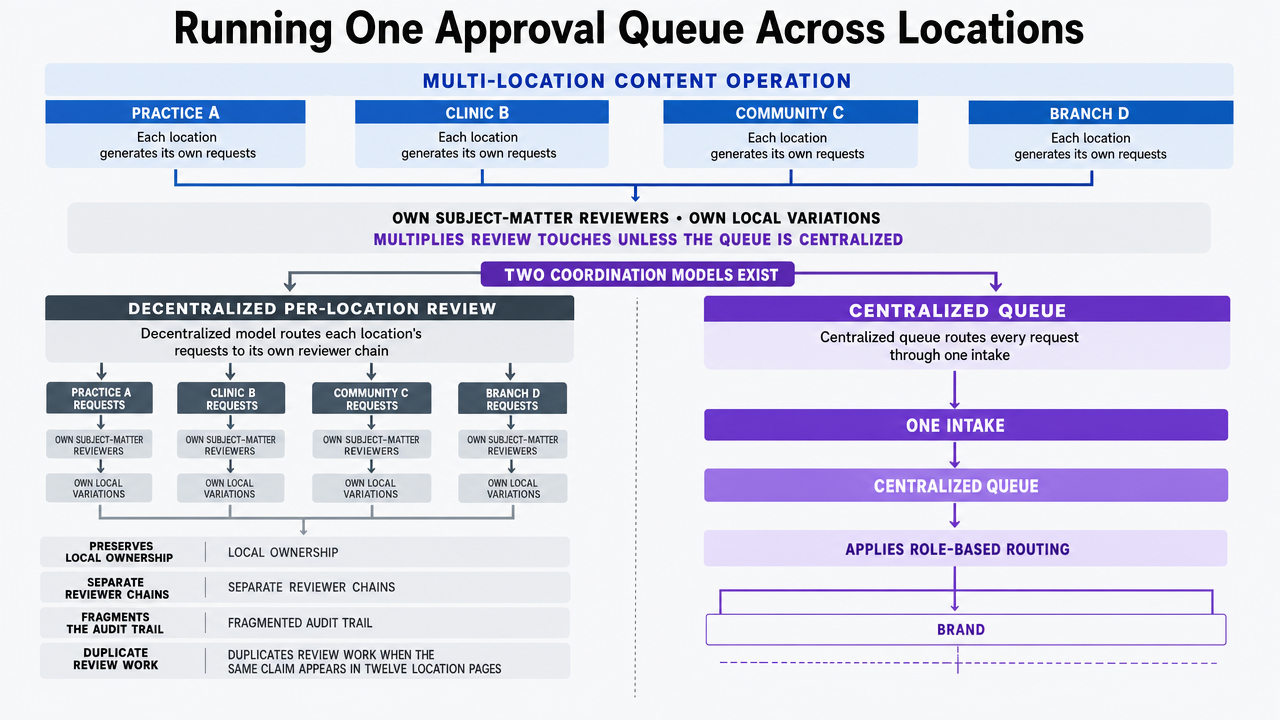 Compare the decentralized per-location model against the centralized queue model described in this section's comparison table
SLAs, Throughput, and How to Tune the Queue Without Adding Headcount
Throughput in an approval-first workflow is bounded by the slowest reviewer lane, not by writing capacity. Tuning starts with per-lane SLAs measured in business hours from receipt to disposition:
- 24 hours for Brand Review
- 48 hours for Subject-Matter Review
- 72 hours for Legal/Compliance Review on standard exposure
- same-day for the Approver of Record once prior lanes close
High-exposure claims flagged at Stage Two carry longer Legal/Compliance windows because substantiation review takes real time when evidence has to meet the standard the FTC applies to every express and implied claim before dissemination 11.
Three levers move the queue without adding reviewers:
- The first is register quality: drafts that arrive with complete, well-cited claim registers clear Legal/Compliance in a fraction of the time drafts requiring reverse-engineering do.
- The second is exposure routing: low-exposure assets bypass Legal/Compliance entirely when the claim register contains no substantiation-bearing assertions, freeing the reviewer for high-exposure work.
- The third is disposition analytics: the decision log identifies which claim categories trigger the most revisions, and the brief template is updated so those failure modes get caught at Stage Two rather than Stage Six.
Mapped workflows produce their gains from implemented, monitored improvement actions—not from the map itself 4.
Operationalizing the Template: What to Build This Quarter
The template is not a document. It is five artifacts the content operation produces and maintains:
- an intake form with exposure categories
- a brief template with an embedded claim register
- a reviewer role matrix with named individuals
- a decision-log schema wired into whatever system holds the queue
- a set of per-lane SLAs the team commits to publicly
A quarter is enough time to ship all five if the work is sequenced correctly.
- Weeks one through three: map the current workflow against the seven stages and identify where handoffs concentrate, which is the mapping exercise process-improvement research treats as the prerequisite for any real change 4.
- Weeks four through six: name the Approver of Record, publish the reviewer role matrix, and migrate one content type—usually location pages or educational blog posts—onto the new intake and brief.
- Weeks seven through ten: extend the register and decision log across remaining content types, tune SLAs against actual disposition data, and retire the parallel legacy process.
Centralized orchestration platforms such as Vectoron's Command Center exist to hold the queue, the log, and the role-based routing in one place, but the operating model is what determines whether the artifacts get used.
Frequently Asked Questions
References
- 1.Health Products Compliance Guidance.
- 2.Drug Promotion.
- 3.FDA Launches Crackdown on Deceptive Drug Advertising.
- 4.Process mapping in healthcare: a systematic review.
- 5.HIPAA Social Media Guidelines - Updated for 2026.
- 6.Lessons Learned: Avoiding Risks When Using Social Media.
- 7.Direct-to-Consumer Advertisements of Prescription Drugs.
- 8.Marketing | HHS.gov.
- 9.What are the HIPAA Marketing Rules?.
- 10.Journal of Marketing Special Issue: Marketing in the Health Care Sector: Disrupted Exchanges and New Research Directions.
- 11.Advertising Substantiation Principles.
- 12.Advertising and Marketing.