
Key Takeaways
- Orchestration is the connective layer that assigns work, carries context between systems, and tracks state, deciding whether the other four tools compound or cancel each other out.
- Governance tooling embeds NIST AI RMF controls like provenance, citation integrity, and structured approval logs directly into review, so checks run without a dedicated compliance role 1.
- Generation-with-voice tools earn their slot only when they enforce brand terminology inline and log prompts, sources, and model versions for later reproducibility 3.
- Distribution tooling closes the gap between publish and pipeline signal by treating the URL as a trigger and writing performance data back into the orchestration record.
- Measurement matters when it joins content records to CRM and conversion data automatically, so planning cycles prioritize what produced pipeline rather than what got clicks 9.
- Unified execution platforms collapse point-tool sprawl into one connected record for brief, draft, review, URL, and performance, replacing manual reconciliation between five vendors 5.
The bottleneck isn't writing speed
A two-person content team can now draft a 1,500-word article in under an hour. The same team still takes two weeks to publish it. The gap between those two numbers is the actual problem, and no faster writer solves it.
What sits inside that gap is a chain of handoffs: strategy to brief, brief to draft, draft to legal or brand review, review to CMS, CMS to distribution, distribution to reporting. Each transition loses context, adds a wait state, and quietly re-does work already completed upstream. Adding a more powerful generation tool at the front of that chain compresses one step and leaves the other six untouched. McKinsey has been explicit about the failure mode: pilots stitched together "out of bubble gum and duct tape" or built around new manual steps end up undermining the productivity gains AI was supposed to deliver 6. The 2025 State of AI survey reinforces the direction of travel, noting that organizations capturing real value have moved past standalone experiments and are embedding AI into core business processes rather than running it alongside them 7.
That reframes the tool selection question for lean teams. The right filter is not "which platform writes the best first draft." It is "which platform removes a handoff, enforces a governance step without adding review time, or connects a published asset to a business signal that used to require a separate report." A tool that fails all three tests is overhead, no matter how good its output looks in a demo.
The five categories that follow are organized around that filter. Each one targets a specific point in the chain where lean teams currently lose days, not minutes, and each is evaluated against a governance baseline drawn from the NIST AI Risk Management Framework 1.
How to evaluate a workflow tool before it enters the stack
Before naming categories, it helps to fix the evaluation criteria. Lean teams already have a stack. The question is whether a new tool earns its slot or becomes another tab someone forgets to open.
Three tests separate content workflow tools from productivity theater:
- Does the tool remove a handoff, or does it insert one? A drafting assistant that requires a separate copy-paste into the CMS has added a step, not eliminated one.
- Does it enforce a governance control automatically, or does it push that work back onto a human reviewer? A brand-voice checker that flags drift inside the draft is governance embedded in the workflow. A checklist emailed to editors is not.
- Does it produce or consume a signal that ties published work to a business outcome? If the tool ends at "publish" and the next report gets built by hand, the measurement handoff is still broken.
McKinsey's warning about pilots stitched together "out of bubble gum and duct tape," or those that quietly add manual steps, is the operational filter behind all three tests 6. The five functions covered in the sections that follow, orchestration, governance, generation-with-voice, distribution, and measurement, each map to one of the handoffs that most lean teams currently patch with a shared doc, a Slack channel, or a Monday-morning status call. A tool that fails to remove its assigned handoff does not belong in the stack, regardless of how strong its individual output looks.
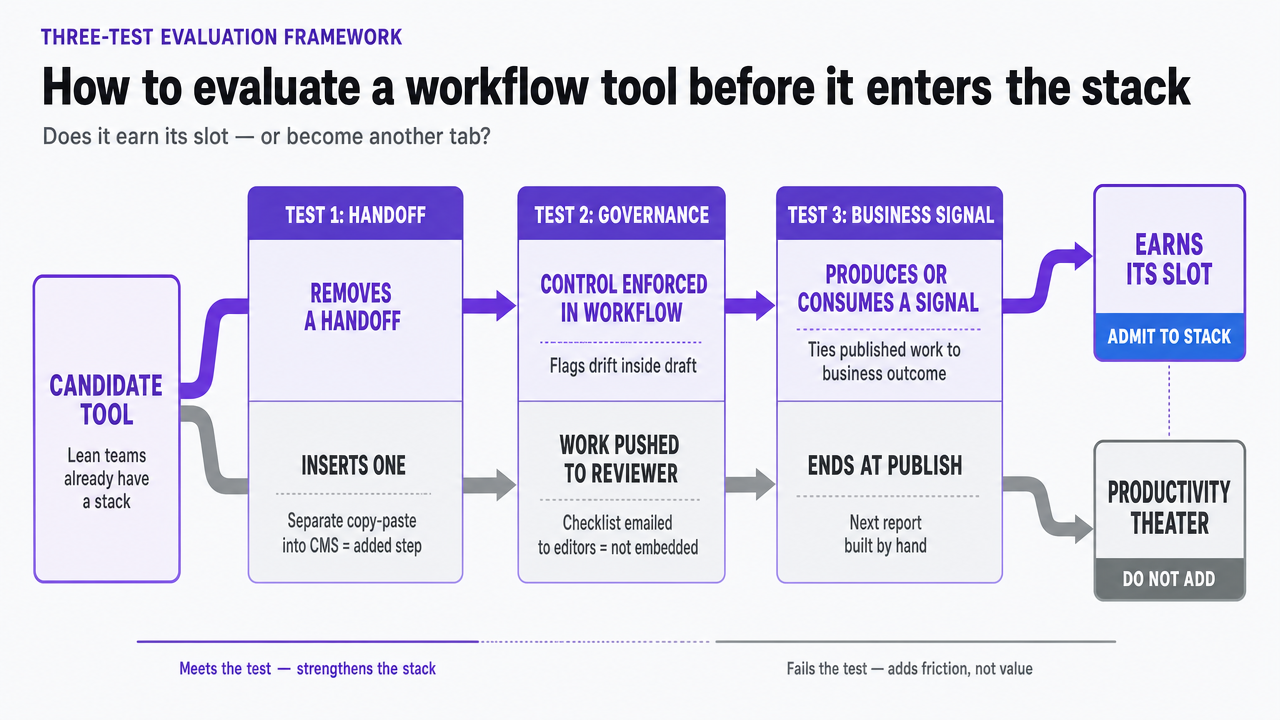 Visualize the three-test evaluation framework the section explicitly defines for admitting a tool into the stack
Orchestration: the layer that decides whether the other four tools pay off
Orchestration is the least glamorous line item in a content stack and the one that most often decides whether the rest of the tools actually compound. It is the layer that assigns work, carries context between systems, tracks state, and surfaces what is blocked. Without it, a team with a strong AI writer, a governance checker, a CMS, and an analytics dashboard still runs its calendar out of a spreadsheet and its status updates out of a Monday-morning meeting. Each tool works in isolation. None of them talk to each other.
The macro case for getting this layer right is larger than most content leads assume. McKinsey has sized the long-term productivity opportunity from corporate AI use cases at roughly $4.4 trillion, a figure that spans the entire economy of enterprise use cases rather than marketing operations specifically 8. The scope matters. That number is not a forecast for a two-person content team's output. It is a directional signal that the productivity gains show up when AI is embedded into the workflow that connects people, data, and downstream systems, not when it sits next to that workflow as a separate tab.
Practically, orchestration for a lean content team means three things:
- It routes an approved brief directly into a drafting environment with the strategy context attached, so the writer, human or AI, is not rebuilding intent from a Slack thread.
- It carries the draft through review with the reviewer's edits, comments, and approval state preserved as structured data, not free-text notes that get lost.
- It hands the approved asset off to the CMS and the reporting layer without a human copy-pasting anything.
The failure mode is well documented. McKinsey's guidance to organizations building AI workflows is explicit that pilots stitched together "out of bubble gum and duct tape," or those that quietly introduce new manual steps between existing systems, tend to erase the productivity gain the AI was supposed to deliver 6. A drafting tool that produces a 1,200-word draft in eight minutes is a net loss if the editor then spends 40 minutes re-entering metadata, tags, and internal links the strategy brief already specified.
Two evaluation criteria separate real orchestration from dressed-up project tracking:
- Does the platform store the brief, the draft, the review state, and the published URL as connected records, or as separate documents a human has to reconcile?
- Does it expose those records to the tools downstream, so a governance check or a performance report can read them without a manual export?
A tool that answers yes to both compresses the calendar. A tool that answers no to either is a nicer-looking spreadsheet.
For teams already running a project tracker, the honest question is not whether to add orchestration but whether the existing tracker is doing the job. Most are not. They track tasks. They do not carry content context between systems, and they do not close the loop back to measurement. That gap is where the other four tools in this list either pay off or quietly cancel each other out.
Test Seamless Content Workflows With Full Access
Experience streamlined content approvals and publishing with your own live workflows—no commitment required.
Governance tooling: the review layer that keeps AI drafts publishable
The uncomfortable question for any content lead running AI-assisted drafts is what happens when a hallucinated statistic, a mis-cited source, or an off-brand claim reaches the live site. On a lean team, there is no dedicated editorial risk function to catch it. Governance tooling is the layer that answers that question by moving review controls out of a shared checklist and into the workflow itself, so the checks run whether or not anyone remembers to run them.
The NIST AI Risk Management Framework gives lean teams a usable spine for this. It organizes AI risk management into four functions, Govern, Map, Measure, and Manage, and treats trustworthy AI as a lifecycle problem rather than a pre-publish checkbox 1. Translated into a content workflow:
Govern : The documented policy layer: which models are approved, what data can be fed to them, who signs off on what.
Map : The context each draft carries: the prompt, the source material, the intended audience, the claims that need substantiation.
Measure : The review gate itself, where outputs are checked for accuracy, brand voice, and citation integrity before they move forward.
Manage : The incident response and monitoring layer, what happens when something slips and how the team prevents the same failure twice 10.
The companion AI RMF Playbook makes the operational demand concrete. It recommends policies for model documentation, output validation, ongoing monitoring, incident response, and staff training on legal and regulatory considerations 2. For a two-to-five person team, that reads like a full-time compliance role. It is not. It is a set of controls that a governance tool embeds into the drafting and review environment so the reviewer sees flagged claims, missing citations, and brand-voice drift inline, without opening a second system. An earlier NIST response document reinforced the same point from a different angle: AI workflows need to enable reproducibility and explainability, meaning the team can reconstruct which model produced which draft from which inputs, months later, if a claim is challenged 3.
Practically, a governance tool earns its slot when it does three things a checklist cannot:
- It attaches provenance to every AI-generated passage, so a fact-check reviewer can see the source the model was working from, not just the sentence it produced.
- It enforces citation integrity automatically, flagging statistics or attributions that lack a linked source rather than trusting a reviewer to catch them.
- It logs every human approval as structured data, so the audit trail is a queryable record rather than a Slack thread.
Those three functions cover the Measure and Manage stages of the NIST loop without adding a separate review meeting to the calendar.
The failure mode to avoid is treating governance as a document. A brand-voice PDF and a legal-review email thread are not governance. They are the artifacts governance produces. The tool has to be the place where the check actually happens, or the check does not happen when a Tuesday deadline hits. For regulated verticals, that distinction is the difference between a defensible workflow and a compliance incident waiting for the wrong audit.
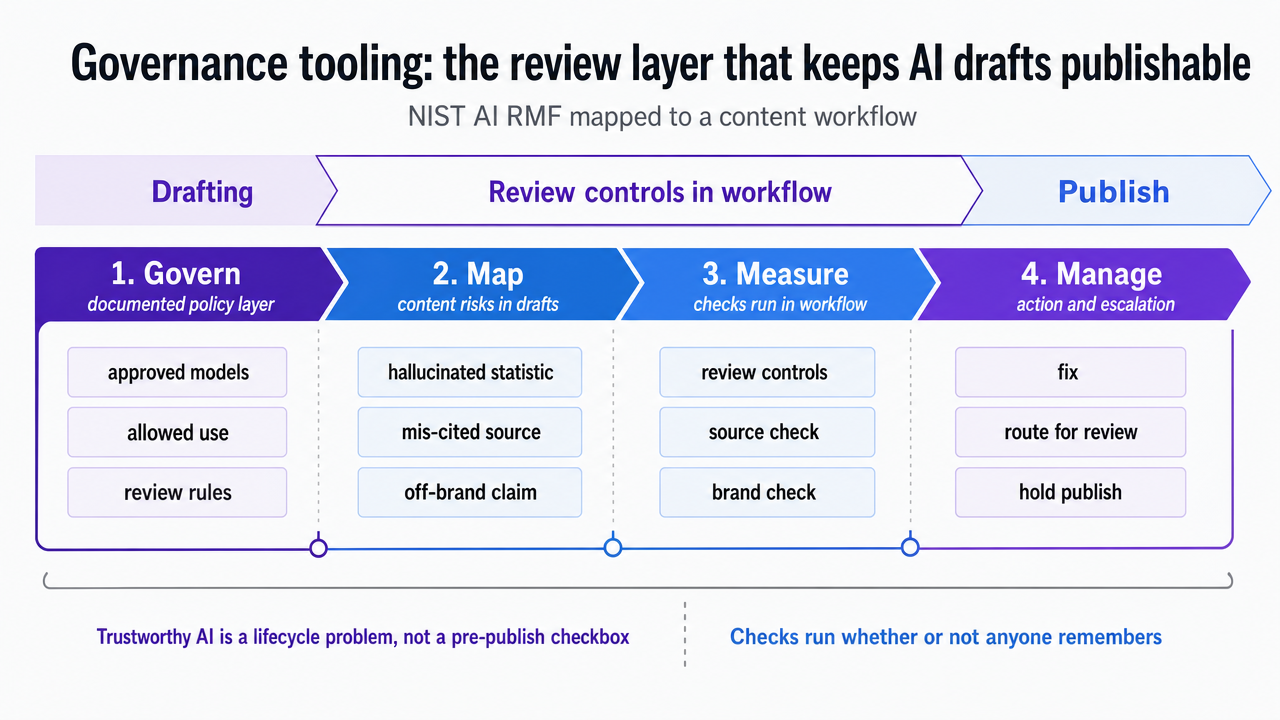 Map the NIST AI RMF four-function lifecycle (Govern, Map, Measure, Manage) onto a content workflow, as explicitly described in the section prose
Generation-with-voice: brand-tuned drafting instead of another generic writer
Every AI writing tool on the market can produce a 1,200-word draft in eight minutes. That is not a differentiator anymore. What separates a generation tool worth a stack slot from a generic writer is whether the output reads like the brand or reads like every other AI-drafted post on the internet. For a lean team, voice drift is not a stylistic complaint. It is a rework tax that eats the time the AI was supposed to save.
The mechanics of voice-tuning matter more than the marketing copy around them. A drafting tool that accepts a style guide as a PDF attachment and then ignores it under load is not brand-tuned. A tool that learns from a corpus of approved published assets, enforces terminology and prohibited-phrase lists at the sentence level, and persists those constraints across every draft is. The distinction shows up in the editor's actual workload. When voice controls are embedded in generation, the reviewer edits for accuracy and argument. When they are not, the reviewer rewrites tone from scratch, and the drafting speed advantage collapses into a copy-editing bottleneck.
Generation-with-voice also has to carry the governance context established upstream. The NIST RFI response made the operational demand explicit: AI workflows need to enable reproducibility and explainability, meaning any draft produced today should be reconstructable from its inputs months later if the claim inside it is challenged 3. Practically, that means the drafting tool logs the prompt, the source material, the model version, and the voice profile applied, and it hands those records forward to the review layer as structured data rather than as a chat transcript no one will ever open again.
Three functional tests separate a generation tool that earns its slot from one that adds cleanup work:
- Does it ingest the strategy brief as structured input, so the writer, human or AI, is not reconstructing intent from a Slack thread?
- Does it enforce voice, terminology, and prohibited-claim rules inline during drafting, not after the fact in a separate review pass?
- Does it produce provenance metadata alongside the draft, so the governance layer downstream has something to check against?
The failure pattern is a tool that generates fluent, generic prose and pushes all the brand-fit work into the editing pass. On a two-person team, that pattern quietly turns the writer into a full-time rewriter and leaves the strategy work no one has time for. The right generation tool moves brand voice from a document the team hopes reviewers remember to a constraint the draft is built around.
Distribution: closing the gap between publish and pipeline signal
Publish is not the finish line. It is the point where most lean content operations quietly hand the asset off to a distribution routine that runs on manual reminders, a shared spreadsheet of social copy, and someone remembering to add the URL to next month's newsletter. The drafting and review time saved upstream evaporates in the days it takes to actually get the piece in front of an audience.
Distribution tooling earns its stack slot when it treats the published URL as a trigger, not an endpoint. The approved asset should fan out into the channels it belongs in, social scheduling, email queues, syndication feeds, internal enablement, without a human rebuilding copy for each surface. More importantly, each of those channels should write back a signal the orchestration layer can read: opens, clicks, referrals, time-on-page from the traffic that landed. Without that return path, distribution is a broadcast, and the team learns nothing it can act on next month.
The pattern to avoid is the one McKinsey flagged when it warned against pilots that add new manual steps between existing systems 6. A distribution tool that requires the editor to paste the headline into a scheduler, then paste the UTM-tagged link into a second dashboard, then export a weekly CSV into a reporting deck, has added three handoffs to the workflow. The productivity gain from faster drafting is spent, and then some, on distribution ops.
Two functional tests separate distribution tooling that closes the loop from tooling that widens it:
- Does the tool pull the approved asset and its metadata directly from the orchestration layer, or does it require a manual re-entry?
- Does it push performance data back into the same record the strategy brief lives in, so the next planning cycle sees what worked without a separate report?
If the answer to either is no, the gap between publish and pipeline signal stays open, and the measurement layer covered next has nothing structured to work with.
See How Top Agencies Streamline Content Workflows at Scale
Request a walkthrough of unified approval workflows and data-driven content automation designed for high-volume, multi-channel teams seeking measurable efficiency gains.
Measurement: connecting published output to business outcomes
Most content measurement stops at traffic. Sessions, rankings, and time-on-page get reported monthly, and the team learns whether pages were read, not whether they moved anything. For a lean operation running under a headcount cap, that gap is where tooling spend either justifies itself or quietly becomes hard to defend at the next budget cycle.
A measurement tool earns its slot when it closes the loop between a published asset and a business signal the rest of the company already tracks: qualified leads, booked calls, pipeline influenced, revenue attributed. That means pulling data from the CRM, the call system, and the analytics stack into the same record the strategy brief and the published URL already live in, so a content lead can answer "which pieces produced pipeline" without commissioning a one-off report. The point is not a prettier dashboard. It is a return path structured enough that the next planning cycle uses evidence instead of intuition.
The directional case for getting this right is worth stating once. McKinsey's work on generative AI adoption notes that early adopters tend to see materially higher growth contributions over time compared with organizations that treat the technology as a productivity accessory rather than a source of measurable business impact 9. The scope there is broad and economy-wide, not marketing-specific, but the operational implication for a content team is direct: without measurement wired into the workflow, there is no way to distinguish an early-adopter outcome from a busier team producing more of the same.
Two functional tests separate a measurement layer that pays off from a reporting tool that just consumes time:
- Does it join content records to downstream conversion data automatically, or does the analyst still export CSVs and reconcile them by hand?
- Does it surface the joined signal back into the orchestration layer, so the next brief can be prioritized against what actually produced pipeline, not against what got clicks?
A tool that fails either test leaves the measurement handoff open, and the team keeps flying on last month's assumptions.
Unified execution platforms: the emerging category replacing point-tool sprawl
The five functions covered so far, orchestration, governance, generation-with-voice, distribution, and measurement, can be assembled from five separate vendors. That is how most lean teams got here. Each tool was bought to solve a specific pain, each one works in isolation, and the integration layer between them is a combination of Zapier rules, weekly exports, and one person on the team who remembers how everything connects. The result is a stack that technically covers every function and operationally still leans on manual reconciliation between them.
Unified execution platforms are the category that has emerged to collapse that sprawl. Deloitte's 2026 Tech Trends analysis frames the shift directly: as AI agents and workflow automation mature, successful organizations are moving from experimentation to impact by consolidating capabilities rather than adding more standalone tools to the stack 5. McKinsey's guidance on AI-powered workflows reinforces the same direction, recommending that organizations build AI workflow MVPs designed for scale from the start, with strong data and analytical foundations, rather than assembling pilots ad hoc 6. Read together, the two reports point at the same operational conclusion. A team running five vendors across five functions has five vendor relationships, five data models, five approval interfaces, and five reporting exports to reconcile. A team running one platform across the same five functions has one.
The category is not defined by feature parity with every point tool it replaces. It is defined by what happens between the tools. A unified platform carries the strategy brief, the draft, the review state, the published URL, and the performance signal as one connected record, and it routes every decision through a single approval interface rather than five. That structure is what makes governance enforceable without a separate compliance role and what makes measurement queryable without a separate analyst. The NIST AI RMF Playbook's operational demands, model documentation, output validation, ongoing monitoring, and incident response, become checkboxes inside one workflow rather than four documents scattered across four vendors 2.
Named examples in this category include Vectoron, which coordinates content, SEO, PPC, backlinks, social, and call intelligence through a single approval workflow rather than as separate point products. The distinction that matters for lean teams is not the vendor name. It is whether the platform actually removes the handoffs between functions or whether it bundles the same handoffs under one login. A platform that stores each function's output in a separate module and still requires manual reconciliation between them is a suite, not a unified workflow. The evaluation tests from earlier sections, handoffs removed, governance enforced inline, and business signals wired back to the brief, apply here with more weight, not less, because a single platform failing those tests concentrates the failure instead of distributing it.
If you manage multiple locations: the stack-consolidation math
The economics change for operators running content across multiple locations, whether that is a law firm with regional offices, a DSO with dozens of practices, a behavioral health network, or a home services franchise. Content workflow costs no longer scale as a fixed line item. They scale per location, per channel, and per approval cycle, and the point-tool sprawl described above compounds accordingly.
The systematic review of lean implementation in hospitals is worth citing once here, because the pattern transfers: lean workflow design improves complex, regulated processes, but the review also flagged that outcomes vary and require context-specific adaptation rather than a copy-paste rollout 4. Translated to multi-location content operations, that means the consolidation math is directional, not universal, and each operator should substitute their actual line items.
The table below uses variables for point-tool and agency figures because those numbers vary by market and by contract, and the only concrete anchor supplied is the unified-platform trial figure.
| Function | Point-tool monthly cost | Agency retainer allocation | Consolidated platform |
|---|---|---|---|
| Content | X1 | Y1 | $599/mo after trial |
| SEO | X2 | Y2 | |
| PPC | X3 | Y3 | |
| Backlinks | X4 | Y4 | |
| Social | X5 | Y5 | |
| Call Intelligence | X6 | Y6 |
Footnote: X1-X6 and Y1-Y6 vary by market and vendor. Substitute the reader's actual line items before making a decision. The consolidated figure reflects Vectoron's post-trial platform price and is used here as the single anchored data point, not as a claim about competing vendors.
Frequently Asked Questions
References
- 1.AI Risk Management Framework | NIST.
- 2.AI RMF Playbook - NIST AI Resource Center.
- 3.Artificial Intelligence Risk Management Framework - Request for Information response.
- 4.A Systematic Review of Lean Implementation in Hospitals.
- 5.Tech Trends 2026 | Deloitte Insights.
- 6.Transforming the enterprise through AI-powered workflows.
- 7.The State of AI: Global Survey 2025.
- 8.AI in the workplace: A report for 2025.
- 9.What is the future of Generative AI? - McKinsey.
- 10.Artificial Intelligence Risk Management Framework (AI RMF 1.0).