
Key Takeaways
- The 45-point gap between content demand and delivery is a workflow architecture problem, not a staffing shortfall that more writers or freelancers can resolve 5.
- Before removing any bottleneck, test whether it aggregates information, coordinates decisions, or enforces quality, because coordination stages prevent costly downstream rework 1.
- Classify every pipeline stage as preserve, parallelize, or eliminate, then assign one named approver per gate so decision rights stop diffusing across committees 4.
- Approval-first AI orchestration, recommend, rank, approve, execute, measure, converts recovered drafting hours into shipped assets while keeping IP and brand sign-off with a named role 3.
The 45-Point Demand Gap Hiding in Most Content Pipelines
Deloitte Digital's survey of marketing teams found that content demand grew 1.5x while teams met only 55% of that demand, with generative AI users reclaiming 11.4 hours per week once the tools were embedded in their daily work 5. That 45-point gap between what stakeholders ask for and what actually ships is the operating reality most in-house content managers inherit. It is also the number that exposes a flawed assumption: that the fix is more writers.
The gap is not a staffing arithmetic problem. It is a workflow architecture problem. Briefs queue behind subject-matter expert reviews. Drafts wait for legal redlines that arrive in batches. Editorial calendars drift because publishing handoffs sit in shared inboxes. Each delay is small. Stacked across an eight-stage pipeline, they compound into a backlog that no hiring plan resolves quickly enough to matter.
Management research on bottlenecks reframes the diagnosis. Some chokepoints in a workflow exist because they aggregate information, coordinate decisions, or protect quality, and removing them creates new failures downstream 1. Others are pure drag. Telling them apart is the first job of any redesign.
The argument that follows treats the 45-point shortfall as evidence that content operations need systems thinking, not headcount math. Three redesigns close most of the gap: production architecture, decision rights, and an approval-first governance loop for AI execution. Each rests on a specific intervention point most pipelines already have but rarely measure.
Why Headcount Math Fails as a Bottleneck Diagnosis
Task Bottlenecks vs. Resource Bottlenecks
Management science draws a sharp line between two kinds of chokepoints, and that line determines whether hiring will help. MIT Sloan's analysis of workflow design separates task bottlenecks, where a specific step holds up the sequence regardless of who staffs it, from resource bottlenecks, where a constrained person, role, or tool throttles everything routed through it 1.
The distinction matters because the interventions diverge. A resource bottleneck responds to capacity changes: another editor, an additional reviewer, a second instance of a tool. A task bottleneck does not. Adding writers to a pipeline blocked by a single weekly legal review meeting produces more drafts waiting for the same meeting. The queue lengthens. The cycle time does not improve.
The framework goes further. Some bottlenecks aggregate information, coordinate decisions across functions, or enforce quality standards that protect downstream work, and removing them creates new failures the redesign did not anticipate 1. A brand voice review that looks like a delay may be the only stage where positioning, legal, and SEO inputs reconcile before publication. Eliminate it and the team ships faster, then spends the recovered hours fixing inconsistencies in market.
Diagnosis precedes redesign. Mislabel a coordination checkpoint as drag and the workflow loses the very stage that kept quality predictable.
Bottlenecks That Add Coordination Value
Not every delay is waste. Sloan's workflow research is explicit: before removing a bottleneck, managers should evaluate whether the step aggregates information for better coordination, decision-making, or quality assessment 1. The slow stage may be the one preventing rework.
Three checkpoints in most content pipelines tend to earn their cycle time:
- The editorial brief approval consolidates strategy, audience, and SEO inputs into a single artifact writers can execute against.
- The subject-matter expert review verifies claims that protect the brand from accuracy complaints.
- The pre-publish quality gate reconciles tone, structure, and metadata before the asset goes live.
Each of these costs hours. Each also prevents a class of downstream failure that costs more: drafts written against the wrong audience, factual errors that surface after publication, on-page SEO gaps that require a second editorial pass. The PLoS One study of 263 senior marketers found that strategic clarity, audience-aligned production, and systematic performance measurement were all positively associated with content effectiveness 4. The coordination stages are where that clarity gets enforced.
A Methodological Parallel from Clinical Workflow Research
Bottleneck analysis is not a marketing invention. A systematic review of nursing workflows identified staffing, work environment, and medical devices as the structural constraints most often limiting hospital efficiency and care quality 2. The conditions differ from content operations, but the diagnostic method transfers cleanly.
The clinical literature studies workflow by isolating the structural factor causing variance, then testing targeted interventions against that factor rather than against the symptom. A unit short on devices does not get more nurses. A unit short on nurses does not get more devices. The intervention follows the constraint.
Content managers can borrow the discipline. Map where assets stall. Identify whether the stall reflects a missing input, a constrained reviewer, or a sequencing decision that batches work into a weekly cycle. The redesign that follows in the next section depends on that diagnosis being right.
Three System Redesigns That Recover Throughput
Production Architecture: Preserve, Parallelize, or Eliminate
Sloan's framework offers three levers for redesigning a pipeline once the diagnosis is in: change which steps run in sequence, change which steps run in parallel, and change the length of the sequence itself 1. Translated into content operations, that yields a working rule: every stage in the pipeline should be classified as preserve, parallelize, or eliminate before any new tool or hire is approved.
Preserve applies to stages that aggregate coordination value. The editorial brief approval, the subject-matter expert review, and the pre-publish quality gate usually qualify. They cost cycle time and earn it back by preventing rework downstream.
Parallelize applies to stages currently sequenced for convenience rather than necessity. SEO keyword research does not need to wait for a finished outline. Legal review of evergreen claim libraries does not need to happen per-asset when the same claims recur across briefs. Image sourcing, metadata drafting, and internal link mapping can run alongside drafting rather than after it. The PLoS One survey of 263 senior marketers found that structural specialization and specialization-enabling systems were positively associated with content effectiveness 4, which is the academic case for letting specialists work concurrently instead of in queue.
Eliminate applies to stages that exist by inertia. Weekly status meetings that duplicate a project board. Approval layers where the reviewer has never returned a substantive edit. Brief templates that ask for inputs no writer uses. Each of these consumes hours without producing coordination value, and removing them does not create downstream failure because no downstream stage depends on what they generate.
Mapping the Eight-Stage Pipeline Against the Framework
Most in-house content pipelines run eight stages: intake, brief, draft, edit, SME review, legal or compliance check, approve, publish, and distribute. Applying the preserve/parallelize/eliminate lens to each stage produces a redesign that compounds.
Intake is almost always a candidate for elimination of redundant fields and parallelization of stakeholder inputs. Brief earns preserve status because it is where strategy, audience, and SEO reconcile. Draft and edit are where Deloitte Digital's productivity finding lands hardest: generative AI users in marketing roles recovered 11.4 hours per week once the tools were embedded in daily work 5. Those hours come from drafting, outlining, and first-pass editing, not from coordination stages.
SME review parallelizes well when the SME receives the draft alongside the editor rather than after. Legal check parallelizes through claim libraries and pre-cleared modules that handle the recurring 80% of language, leaving per-asset review for the genuinely novel claims. Approve preserves when the approver holds strategic authority and eliminates when the approver is rubber-stamping work already cleared upstream. Publish is mostly a tooling question, not a workflow question. Distribute parallelizes against draft and edit when channel-specific variants are scoped at brief stage.
The pipeline that emerges runs shorter than its predecessor on the critical path even though it contains the same number of stages. The recovered time does not appear because the team works faster. It appears because fewer stages sit on the critical path.
Decision Rights: Where Strategic Clarity Beats Speed
A redesigned pipeline still stalls if decision rights are unclear. The PLoS One study of 263 senior marketers found that clarity and commitment regarding content marketing strategy, alongside specialized structures and systems, were positively associated with content effectiveness 4. Translated into operations, that means each stage needs a named decision-maker with explicit authority over what passes through.
Three decision rights tend to be miscast in stalled pipelines:
- Brief approval often sits with whoever requested the asset rather than with the strategist who owns audience fit, which produces drafts that satisfy the requester and miss the audience.
- Quality gate authority often splits across editor, SEO lead, and brand reviewer with no tiebreaker, which converts the gate into a negotiation.
- Publication authority often rests with a marketing operations role that has no view into strategic priority, which produces a calendar driven by whoever escalates loudest.
Assigning decision rights is not the same as adding approvers. The redesign reduces the number of people who can block an asset and increases the authority of the ones who remain. A single strategist owning audience fit, a single editor owning quality, and a single approver owning strategic priority will move more assets through the system than three overlapping committees, because cycle time at each gate falls from days to hours.
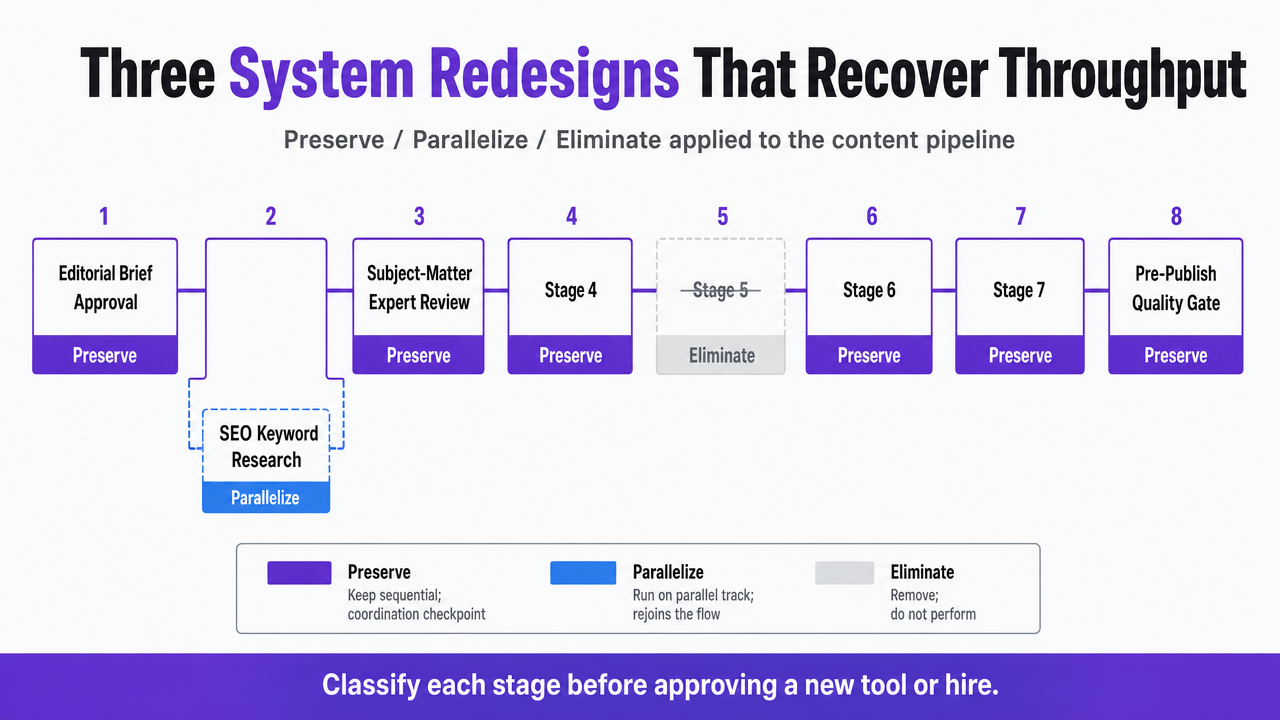 Visualize the preserve/parallelize/eliminate framework applied to the eight-stage content pipeline, supporting the section's core redesign argument
Test a centralized workflow with live content
Experience production-ready, multi-channel content approvals using your actual campaigns before you commit.
Comparing Three Workflow Models for a 20-Asset Month
A mid-market content team producing 20 assets per month operates under three dominant workflow models: traditional in-house plus freelance, agency-led, and AI-orchestrated with human approval. The variables that separate them are not creative quality. They are cycle time per asset, the share of demand actually fulfilled, and the hours of operator attention each asset consumes before publication.
Deloitte Digital's research on marketing teams found that content demand has been growing at roughly 1.5x while teams fulfill only 55% of it, and that generative AI users in content roles recover 11.4 hours per week once the tools sit inside daily work 5. Those two numbers reshape the comparison.
| Variable | In-house + freelance | Agency-led | AI-orchestrated + approval |
|---|---|---|---|
| Critical-path stages per asset | 8 (sequential) | 8 (sequential, plus vendor handoff) | 8 (with parallelization across brief, draft, SEO, distribution scoping) |
| Operator hours per asset | Baseline (1.0x) | Lower production hours, higher coordination hours | Lower production hours, recovered ~11.4 hrs/week per AI user 5 |
| Demand fulfillment rate | ~55% benchmark 5 | Constrained by briefing and revision cycles | Higher fulfillment when approvals are governed, not bypassed |
| Governance locus | Internal editor + brand reviewer | Account manager + internal approver | Approval-first loop with named decision rights |
| Primary failure mode | Capacity ceiling at editor stage | Briefing latency and vendor coordination overhead | Ungoverned output if approval gates are weak |
The in-house plus freelance model hits a capacity ceiling at the editor stage. The agency-led model trades production hours for coordination hours, which is why briefing cycles dominate its cycle time. The AI-orchestrated model recovers hours at draft and edit but only converts those hours into throughput when decision rights and approval gates stay intact. Remove the gates and the model produces volume without governance, which is the failure mode the next section addresses.
Approval-First AI Orchestration
The Governance Loop: Recommend, Rank, Approve, Execute, Measure
An approval-first orchestration model treats AI as an execution layer that operates inside named decision rights, not around them. The loop has five stages:
- A strategist surfaces a recommendation.
- The system ranks it against current priorities.
- A human approver signs off.
- Execution proceeds.
- The resulting KPI impact feeds back into the next ranking cycle (measure).
Each stage exists for a reason the prior section already established. The recommendation stage compresses the diagnostic work that used to live in scattered status meetings. The ranking stage enforces strategic priority, which the PLoS One survey of 263 senior marketers identified as one of the strongest predictors of content effectiveness 4. The approval stage preserves the coordination bottleneck Sloan's framework warned against removing 1. Execution is where the recovered hours land. Measurement closes the loop and prevents the team from optimizing for output volume without checking whether the output earned attention.
The governance argument is not theoretical. McKinsey's analysis of generative AI in consumer marketing makes the case that capturing the productivity gains requires data foundations, governance discipline, and workflow redesign in the same motion, not in sequence 3. A loop that produces ranked recommendations without an approval gate generates volume the brand cannot defend. A loop with an approval gate but no ranking generates approvals for whichever asset escalates loudest. Both halves are load-bearing.
Why Adoption Has Outpaced Maturity
AI tools are in the building. Operating maturity is not. McKinsey's workplace research found that 92 percent of companies plan to increase AI investment, while only 1 percent of leaders describe their organizations as mature in AI deployment 6. The gap is the entire story.
Adoption shows up as license counts, prompt libraries, and a handful of users who recover real hours. Maturity shows up as workflow redesign that puts AI output inside the same decision rights, brand voice rules, and quality gates the team already trusts. Deloitte's enterprise AI tracking notes that realized impact diverges sharply from adoption when talent and governance lag the tooling 8. A content team that buys access without redesigning intake, brief, and approval stages will produce more drafts and approve them at the same rate the editor approved drafts before. The bottleneck moves; it does not dissolve.
The implication for content managers is direct. Tool selection is a smaller decision than where AI output enters the approval queue, who holds rejection authority, and which KPI the team uses to decide whether an approved asset earned its slot.
The 65% IP Concern as a Design Constraint
Deloitte Digital's survey of marketing teams found that 65 percent of companies were very or extremely concerned about intellectual property or legal risk tied to generative AI in content operations 5. That number is not a footnote. It is a design constraint that shapes which stages of the workflow can be automated and which must hold a human signature.
An approval-first loop answers the IP concern operationally rather than rhetorically. Claim libraries pre-cleared by legal handle the recurring language that drives most exposure. Source attribution and citation checks sit inside the pre-publish quality gate rather than as a separate downstream audit. Named approvers carry the sign-off authority, which means liability tracks to a role rather than diffusing across a tool.
The academic literature anticipated this. Content became the new bottleneck in digital marketing precisely because rules are easier to automate than production 9. Approval-first design accepts that asymmetry and routes the production gains through the rule layer the brand already maintains. The Vectoron Command Center applies that same approval-first logic across content, SEO, and adjacent channels for teams that want orchestration without surrendering sign-off.
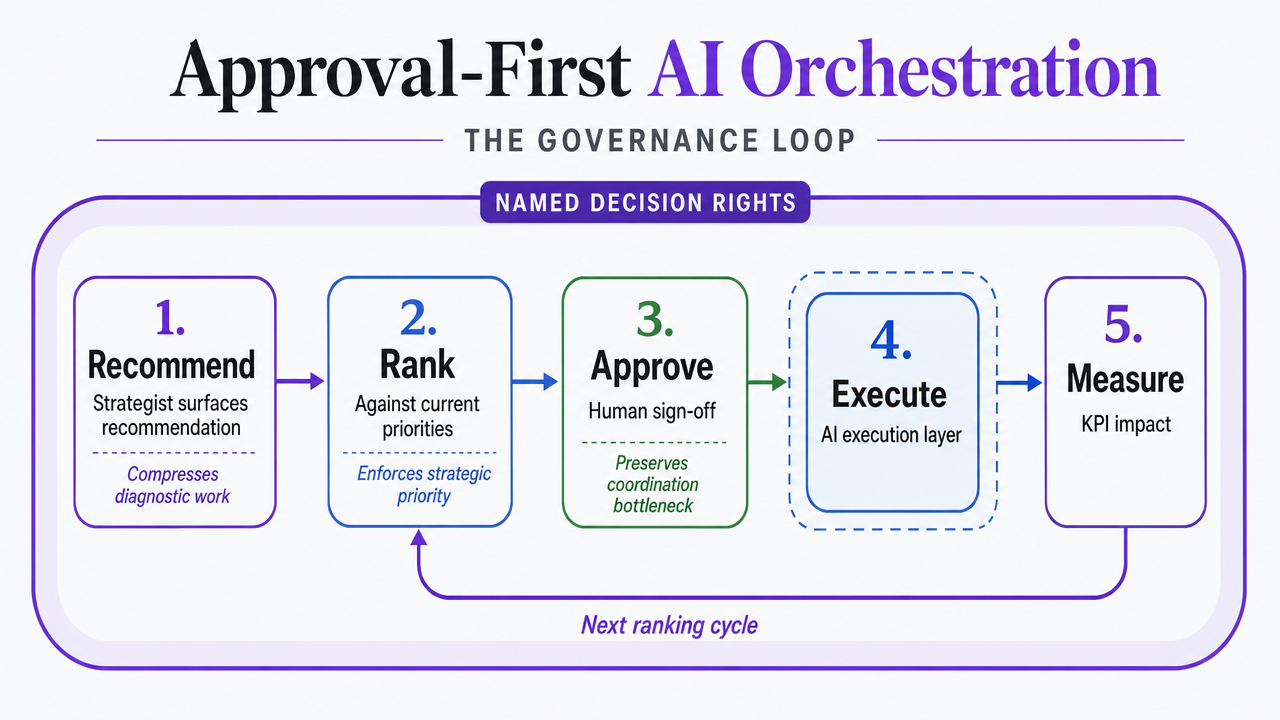 Diagram the five-stage governance loop (Recommend, Rank, Approve, Execute, Measure) introduced in the section, showing how AI execution sits inside named decision rights
See How Leading Teams Eliminate Content Workflow Bottlenecks with Centralized Approval
Discover how a unified digital content workflow streamlines approvals, accelerates production, and preserves brand standards—without increasing headcount. Request a walkthrough tailored to agency and enterprise marketing operations.
If a Manager Oversees Multiple Brands or Locations
The redesign so far assumes a single brand voice and a single approval queue. Portfolio operators face a different problem.
A content manager running 4 dental practices, 12 senior living communities, or 30 franchised home services locations is not multiplying one pipeline by N. Each unit carries its own service-area SEO, its own compliance language, and its own approver. Centralize too much and local relevance collapses into template sameness. Decentralize too much and the editorial calendar splinters into 30 calendars no one can audit.
Sloan's framework points to the right adjustment: change which steps centralize and which decentralize based on where coordination value actually lives 1. Brand voice rules, claim libraries, and SEO frameworks centralize because they aggregate quality assessment. Local proof points, geo-specific offers, and named local approvers decentralize because the coordination value sits with the operator who knows the market.
The approval-first loop scales here precisely because rejection authority routes to a named role rather than a tool. One claim library, one brand standard, many local approvers, one ranked queue the portfolio manager can actually read on a Monday.
What to Change Monday Morning
Three changes move the most assets through the pipeline in the first week, and none of them require a new tool or a new hire.
- The first is a stage audit. Print the current pipeline and label each stage preserve, parallelize, or eliminate against the test Sloan's research proposes: does the stage aggregate information, coordinate decisions, or enforce quality that prevents downstream rework 1? Stages that fail all three tests come out. Stages that pass one stay, with their cycle time defended rather than apologized for.
- The second is a decision-rights pass. Name one approver per gate. Strip secondary reviewers who have not returned a substantive edit in the last quarter. The PLoS One survey of 263 senior marketers tied strategic clarity and specialized structures to higher content effectiveness 4, and clarity starts with a name next to each gate.
- The third is a parallelization map. Move SEO research, legal claim libraries, and distribution scoping off the critical path and into work that runs alongside drafting. The recovered hours that show up in AI-enabled content teams 5 only convert into shipped assets when the stages around drafting stop waiting their turn.
Frequently Asked Questions
References
- 1.Improve Workflows by Managing Bottlenecks.
- 2.Bottleneck factors impacting nurses' workflow and the opportunity to improve hospital efficiency and quality of care: a systematic review and synthesis.
- 3.How generative AI can boost consumer marketing.
- 4.Determinants of content marketing effectiveness: Conceptual framework and empirical findings from a managerial perspective.
- 5.Deloitte Digital's latest research forecasts generative AI's transformation of content marketing.
- 6.Superagency in the workplace: Empowering people to unlock AI’s full potential.
- 7.The economic potential of generative AI: The next productivity frontier.
- 8.The State of AI in the Enterprise - 2026 AI report.
- 9.The changing role of marketing: transformed propositions ....