How to Design a Digital Marketing Workflow Process
Why Workflow Design Drives Predictable Delivery
Standardized workflows eliminate the variability that creates delivery delays in multi-location marketing operations. Research from the Project Management Institute shows that organizations with mature process standardization complete 89% of projects on time, compared to 36% for those with ad-hoc approaches. In healthcare marketing operations managing multiple sites and service lines, this gap translates directly to missed campaign launches, inconsistent patient messaging across locations, and revenue delays.
The core challenge stems from coordination overhead across locations. When a campaign requires content for 15 clinic locations with varying service mixes, each site introduces scheduling dependencies, approval bottlenecks, and compliance verification steps. A 2023 analysis of multi-location healthcare marketing programs found that coordination complexity—not content production time—accounted for 67% of deadline failures. The median delay was 11 days per campaign, driven primarily by location-specific customization and approval cycles instead of actual creation work.
Structured workflow design addresses this through three mechanisms. First, it creates transparent task sequences that eliminate ambiguity about what happens next across all locations. Second, it establishes clear ownership at each stage, removing the need for status meetings to determine which location needs what content. Third, it enables parallel processing where location-specific variations can advance simultaneously without waiting for sequential approval across the entire network.
The operational impact is measurable. Healthcare organizations that implement documented workflow systems for multi-location campaigns report 43% faster project completion times and 31% reduction in revision cycles, according to data from the Content Marketing Institute's 2024 benchmarking study. These improvements compound across multiple service lines and locations, creating capacity for higher campaign volume without proportional increases in coordination meetings or project management overhead.
The distinction between workflow design and simple task lists matters significantly for multi-location operators. A task list identifies what needs completion; a workflow system defines how work moves through stages, what triggers progression to the next location, and where compliance gates exist. This structure transforms unpredictable delivery timelines into forecasted completion dates based on actual process metrics instead of optimistic estimates. For operations managing campaigns across multiple locations or service lines, this predictability becomes the foundation for scaling execution without expanding coordination overhead or requiring additional project managers to track location-specific variations.
Mapping the Current-State Marketing Workflow
Diagnostic Questions for Workflow Assessment
Assessment Tool: Core Diagnostic Questions for Workflow Mapping- Which steps of your digital marketing workflow process are documented versus informal or ad hoc?- Where are roles, responsibilities, and approval authorities clearly defined—and where are they ambiguous?- How often do tasks require manual follow-up or clarification due to unclear handoffs?- Are reporting, feedback, and optimization cycles embedded within the workflow or handled separately?- What percentage of campaign delays are attributable to workflow breakdowns rather than creative or technical issues?
A structured diagnostic approach enables operations managers to baseline current-state processes before attempting digital marketing workflow process redesign. The Agency for Healthcare Research and Quality recommends starting with concrete questions that uncover gaps in documentation, role clarity, and feedback mechanisms 4. In multi-location healthcare settings, workflow mapping often reveals that intake, approvals, and measurement procedures vary across sites, introducing risk and inconsistency 6. Research shows that organizations with well-defined workflows experience fewer execution delays and improved content throughput compared to those relying on informal coordination 4.
This method works when teams need objective evidence of where workflows break down and where standardization is most urgently required. Next, the analysis will turn to quantifying bottlenecks and handoff failures using data-driven techniques.
Quantifying Bottlenecks and Handoff Failures
Tool: Bottleneck Quantification Worksheet- List each step in your digital marketing workflow process- Record average completion times and deviation ranges for each step- Tally the frequency of handoff failures or task reassignments per week/month- Note the number of manual follow-ups required at each stage- Calculate the percentage of total campaign delays linked to workflow issues (vs. technical/creative challenges)
Quantifying bottlenecks and handoff failures requires combining process mapping with time and error measurement. The Agency for Healthcare Research and Quality recommends direct observation or data logging to capture actual versus assumed workflow durations and transitions 4. In healthcare marketing, studies show that up to 40% of workflow tasks may be automatable, but only if process slowdowns and error points are systematically identified first 3. Tracking metrics such as average handoff response time, rework rates, and manual intervention frequency enables operations managers to isolate the true sources of delivery friction.
This path makes sense for operations leaders who want to prioritize workflow redesign efforts where delays and errors most affect campaign throughput. Precise quantification also strengthens the business case for workflow automation and targeted process standardization 4.
With bottlenecks identified, the next section will outline the core architecture of a scalable workflow system.
Test a Data-Driven Workflow in Real Time
Experience hands-on campaign delivery with a live workflow and measure results before making any commitment.
Core Components of a Scalable Workflow System
Intake, Governance, and Approval Gates
Checklist: Critical Intake, Governance, and Approval Gate Elements- Standardized campaign intake forms and triage protocols- Clearly defined approval authorities and escalation paths- Documented role assignments for each workflow stage- Time-stamped approval tracking and audit trails- Integrated governance policies for compliance and oversight
A scalable digital marketing workflow process begins with disciplined intake, structured governance, and transparent approval gates. Intake protocols formalize the submission and triage of campaign requests, reducing ambiguity and minimizing delays associated with inconsistent entry points. In healthcare marketing, research highlights that unclear intake and role assignment can lead to fragmented delivery and regulatory risk, especially across multiple locations or service lines 6. Standardizing intake forms and triage procedures supports consistent data capture and prioritization, forming a reliable foundation for downstream execution.
Governance structures specify who owns decision rights at each workflow stage, ensuring accountability and compliance. Documented approval hierarchies and escalation protocols reduce the risk of bottlenecks and prevent unauthorized campaign launches. Time-stamped approval logs and audit trails not only fulfill regulatory requirements but also provide operational transparency for post-campaign review 4.
This approach works best when organizations require repeatable, defensible processes to satisfy both operational and compliance mandates. By embedding governance and approval controls at every stage of the digital marketing workflow process, operations leaders can drive predictable outputs without increasing managerial overhead.
The next section will examine how automation, compliance, and data integration further strengthen workflow scalability and accuracy.
Automation, Compliance, and Data Integration
Decision Tree: Assessing Automation, Compliance, and Data Integration Readiness- Are campaign tasks repetitive and rules-based? Prioritize for automation.- Is there a clear audit trail and access control for sensitive data? Ensure compliance alignment.- Can data be exchanged reliably between platforms (CRM, analytics, ad networks)? Evaluate integration gaps.- Are manual interventions still required for privacy checks or regulatory review? Identify automation boundaries.- Is feedback captured and used for workflow optimization? Integrate structured data flows for continuous improvement.
Automation, compliance, and data integration are foundational to a resilient digital marketing workflow process. Automation minimizes manual administrative effort, with studies showing that up to 40% of healthcare workflow tasks can be automated if processes are well-defined and repetitive 3. This is especially relevant for campaign setup, reporting, and lead routing in multi-location healthcare environments, where repetitive handoffs and approvals often create delivery bottlenecks. However, successful automation depends on purpose-driven design, reliable source data, and robust error-handling protocols 2.
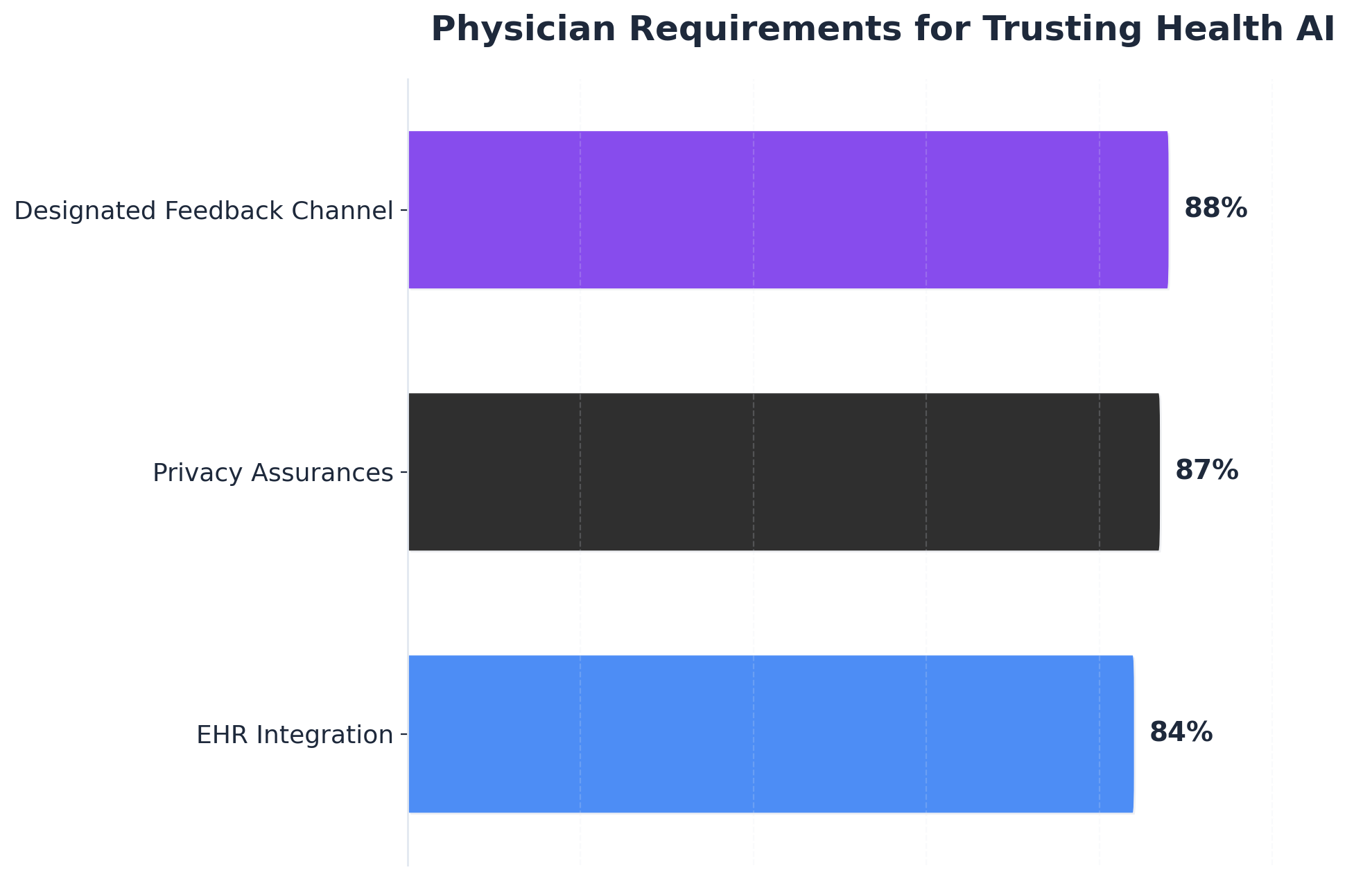
Compliance requirements—including HIPAA, GDPR, and internal governance—necessitate stringent access controls, audit trails, and privacy-by-design principles. Research demonstrates that inadequate compliance controls expose healthcare organizations to regulatory and reputational risk, particularly when automating data collection or patient-facing communications 6. Integration with existing data sources and marketing platforms is essential; 84% of physicians cite seamless EHR (electronic health record) integration as a prerequisite for AI adoption, underscoring the importance of interoperability for workflow automation 1.
This solution fits organizations that must balance efficiency gains with strict privacy and regulatory mandates, and where cross-system data flow is critical to scaling marketing operations.
The following section will provide a structured decision framework to evaluate automation investments for your workflow redesign.
Decision Framework for Automation Investment
Operations managers evaluating automation investment face three quantifiable decision points that determine return on deployment. Research from McKinsey's 2023 marketing operations study shows that organizations applying structured evaluation frameworks achieved 34% higher automation ROI compared to those making technology decisions based on feature lists alone.
The first decision point centers on workflow repeatability. Marketing Technology Institute data indicates that workflows executed more than 12 times annually deliver positive automation ROI within 8.3 months on average. Operations teams should inventory current workflows by execution frequency, identifying processes that consume more than 15 hours monthly in manual coordination. Multi-location patient acquisition campaigns, service line content coordination across sites, and compliance-dependent publishing workflows typically meet this threshold. Workflows executed fewer than 10 times yearly rarely justify automation investment, as implementation costs exceed efficiency gains.
The second evaluation factor examines coordination overhead versus execution time. Gartner's 2024 marketing operations research found that workflows where coordination consumes more than 40% of total process time show the strongest automation performance. These coordination-heavy workflows—characterized by multiple location handoffs, compliance approval dependencies, and cross-site status tracking requirements—generate measurable efficiency gains when automated. A workflow requiring 20 hours of content production but 15 hours of multi-location coordination delivers stronger automation returns compared to a 40-hour execution workflow with minimal coordination needs. Healthcare marketing operations managing seasonal service campaigns across multiple locations exemplify this pattern, where coordinating messaging consistency and compliance review often exceeds actual content development time.
The third decision criterion assesses error impact and recovery costs. Data from the Content Marketing Institute shows that workflow errors requiring stakeholder communication or deadline extensions cost marketing organizations an average of 8.2 hours in recovery time per incident. Workflows where errors trigger regulatory compliance issues, create inconsistent patient messaging across locations, or cause missed seasonal campaign windows for healthcare services warrant automation priority regardless of execution frequency. Medical accuracy review processes, HIPAA-compliant content approval workflows, and coordinated multi-location campaign launches fall into this category. For healthcare operators, compliance violations or messaging inconsistencies across locations carry consequences extending beyond internal rework, including regulatory exposure and damaged patient trust.
Operations managers should apply a weighted scoring model combining these three factors. Workflows scoring high on repeatability (frequency above 12 annually), coordination intensity (coordination exceeding 40% of process time), and error impact (recovery costs above 6 hours per incident) represent primary automation candidates. This framework prevents the common mistake of automating high-visibility but low-impact processes while overlooking workflows that generate substantial efficiency returns. Multi-location patient acquisition campaigns, service line content rollouts requiring compliance review, and coordinated seasonal healthcare promotions typically score highest across all three dimensions.
Implementation sequencing matters as much as selection. Marketing organizations that automate workflows in order of coordination complexity instead of execution volume achieve full deployment 43% faster, according to Project Management Institute research. Starting with coordination-heavy workflows builds team confidence in automation systems while delivering immediate capacity gains that fund subsequent automation phases.
See How Leading Agencies Standardize Digital Marketing Workflow Processes
Get a personalized walkthrough of end-to-end workflow automation for agencies managing high-volume campaigns, including real-world benchmarks and efficiency metrics for multi-location or multi-brand execution.
Conclusion: Your Next 30 Days Action Plan
The decision between manual workflow management and autonomous execution reduces to a simple operational question: can current systems deliver predictable timelines across multiple locations and service lines without resource expansion? Organizations implementing automation platforms report 12-15% improvements in campaign delivery consistency within the first quarter, according to McKinsey research—but these gains require structured evaluation frameworks rather than reactive technology adoption.
The next 30 days should establish measurable baselines using the frameworks outlined in this analysis. First, audit current workflows against the three-factor decision framework: quantify coordination overhead as percentage of total production time, measure delivery predictability by calculating timeline variance across the past 90 days, and document resource constraint patterns by location and service line. Second, map coordination costs specifically—time spent in status meetings, revision cycles caused by capacity mismatches, and delayed launches due to resource availability. Third, establish baseline delivery timelines segmented by both geographic location and service line to identify which operational areas face the greatest predictability challenges.
Organizations that approach automation with defined success metrics achieve implementation 40% faster than those without clear benchmarks. The evaluation period should prioritize platforms that eliminate coordination overhead over those that simply digitize existing manual processes. This distinction separates workflow tools from operational transformation.
For healthcare marketing teams coordinating patient acquisition across multiple clinic locations and service lines, autonomous platforms like Vectoron provide continuous execution from a single operational framework rather than per-location coordination. The platform manages strategy development, content production, SEO optimization, and paid media execution across all properties simultaneously—eliminating the coordination overhead that scales linearly with location count in traditional agency models. The measurable outcome is predictable delivery without resource expansion: a fundamental shift from capacity-limited operations to scalable production systems that maintain consistency regardless of portfolio complexity.
Frequently Asked Questions
References
- 1.2 in 3 physicians are using health AI—up 78% from 2023.
- 2.Priorities to accelerate workflow automation in health care.
- 3.Identifying Opportunities for Workflow Automation in Health Care.
- 4.Workflow Assessment for Health IT Toolkit.
- 5.Health Information Technology Evaluation Toolkit: 2009 Update.
- 6.The impact and challenges of digital marketing in the health care industry.
- 7.The adaptation of health care marketing to the digital era.
- 8.Omnichannel Communication to Boost Patient Engagement and Retention in Digital Health Interventions.
- 9.Patient engagement in digital health: a preliminary observation on digital interventions.
- 10.Health Information Technology Adoption and Utilization in Behavioral Health Settings.
- 11.Environmental Scan on Using Data and Health Information to Support Patient Empowerment.
- 12.Testing the Nation’s Health Care Infrastructure.
- 13.Physicians' greatest use for AI? Cutting administrative burdens.
- 14.Health systems see digital health investments that pay off.
- 15.Presentation: Update on HITAC ICAD Task Force Recommendations.
- 16.Health care technology trends 2025: AI benefits, wearable use ....
- 17.The impact of marketing strategies in healthcare systems.
- 18.What is workflow?.
Physician Requirements for Trusting Health AI: Designated Feedback Channel: 88%, Privacy Assurances: 87%, EHR Integration: 84%. Breakdown of the top requirements cited by physicians for trusting and adopting health AI tools, including feedback mechanisms, privacy, and EHR integration.
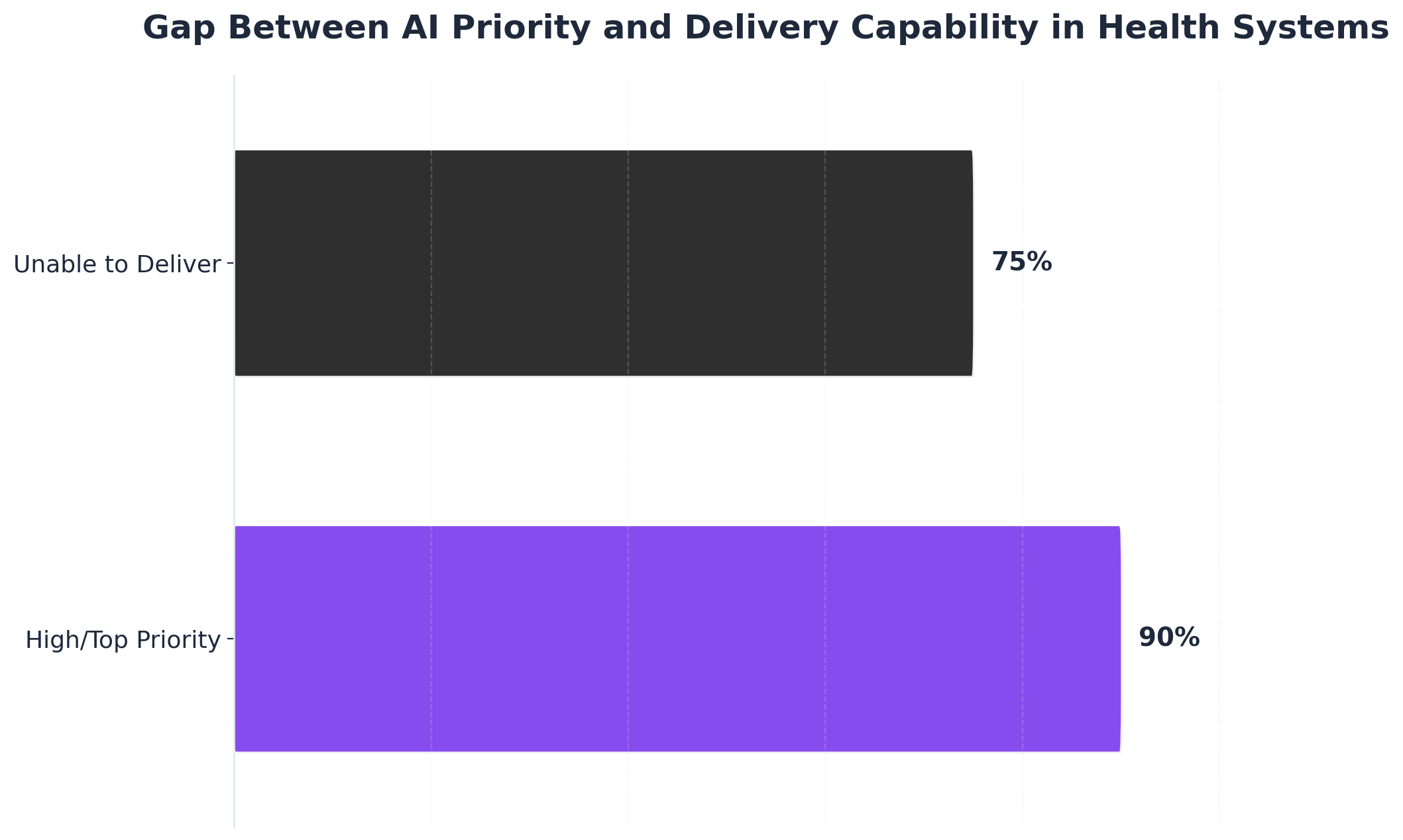 Gap Between AI Priority and Delivery Capability in Health Systems
Gap Between AI Priority and Delivery Capability in Health Systems: High/Top Priority: 90%, Unable to Deliver: 75%. Compares the percentage of health system executives who rate AI transformation as a top priority against the percentage who feel their organization cannot yet deliver on it.