
Key Takeaways
- Treat the calendar as a control layer that governs briefs, approvals, and themes rather than a schedule tracking who writes what by when.
- Redesign around the new bottleneck — coordination, brand voice, and sign-off — because AI has removed drafting as the primary constraint on output 4.
- Stack three layers with distinct clock speeds: annual thematic pillars, a weekly production pipeline, and per-asset approval gates, each answering a different question.
- Set four to six annual pillars with one-page definitions so AI drafts stay anchored to defensible territory and editors can reject thematic drift 2.
- Run the weekly pipeline as staged handoffs — brief, draft, edit, channel prep, approval — with named owners and entry criteria to prevent review-queue clogging 5.
- Space three risk-tiered approval gates across the pipeline — brief, editorial rubric, channel — to catch drift early rather than at publish.
- Split work by judgment versus execution: humans own the brief, argument, proof, and sign-off; AI handles drafts, variants, and repurposing passes 7.
- Defend against commoditization with proof density, stated contrarian angles, and voice guides that list banned phrasings and annotated examples 6.
The calendar is no longer a schedule — it's a control layer
Content calendars used to answer one question: what publishes when. That framing is now the wrong one. For in-house teams under pressure to lift output without lifting headcount, the calendar has to answer a harder question — what gets approved, in what order, against which theme, and by whom — before anything reaches a channel.
The shift is practical, not philosophical. Drafting capacity is no longer the bottleneck it was three years ago. Coordination is. When AI can produce a first pass of a blog post, a repurposed email, and five social variants inside an hour, the constraint moves upstream to briefing, brand-voice enforcement, editorial judgment, and sign-off. A schedule cannot govern that. A control layer can.
Higher-ed communications teams already model a version of this pattern. Michigan State's editorial guidance treats the calendar as a shared production record — tracking access, content detail, and a maintenance cadence that keeps multiple stakeholders aligned without adding staff 1. The mechanics translate directly to a commercial content function: the calendar is where themes, briefs, drafts, editors, approvers, and publish windows live in one place.
The rest of this piece treats the calendar that way. Three layers structure it — annual thematic pillars, a weekly production pipeline, and per-asset approval gates — with AI absorbing the drafting load underneath, and human judgment concentrated where it changes outcomes.
Why the old calendar model breaks under AI-era output demands
The traditional editorial calendar was built around a scarcity that no longer exists: writer hours. Rows corresponded to what a fixed roster of humans could realistically produce in a week. Deadlines were set backward from that ceiling. Briefs were rationed because drafting was the expensive step. The whole structure assumed the drafting queue was where content lived or died.
That assumption is broken. The American Marketing Association's 2024 survey of more than 1,000 marketers found that nearly 90% have used generative AI at work, 71% use it weekly or more, and 85% of AI-using marketers report a productivity increase — with content creation, brainstorming, and SEO optimization named as the top use cases 4. This indicates that AI-assisted drafting has moved from experimental to default within content management functions.
When the drafting bottleneck loosens, the constraints migrate. Brief quality, editorial judgment, brand-voice fidelity, and approval throughput become the new choke points. A calendar sized to writer capacity underdescribes those constraints — it has columns for status and due date, not for reviewer, risk tier, brand-voice pass, or channel-specific approver. Teams that keep the old structure end up with AI producing volume the calendar cannot govern, which shows up as inconsistent voice, duplicated angles, and assets sitting in review queues no one owns.
The redesign is not cosmetic. The calendar has to stop tracking who is writing and start tracking who is deciding. That reframe is what the next three layers make operational.
The three-layer calendar: pillars, pipeline, approval gates
A calendar that governs AI-assisted output needs three layers stacked on top of each other, each with a different clock speed. Annual thematic pillars set direction and defend against sameness. A weekly production pipeline moves briefs through drafting, editing, and channel prep. Per-asset approval gates decide what actually ships. Each layer answers a different question — what to say, how it gets made, and whether it meets the bar — and each layer fails differently when collapsed into the others.
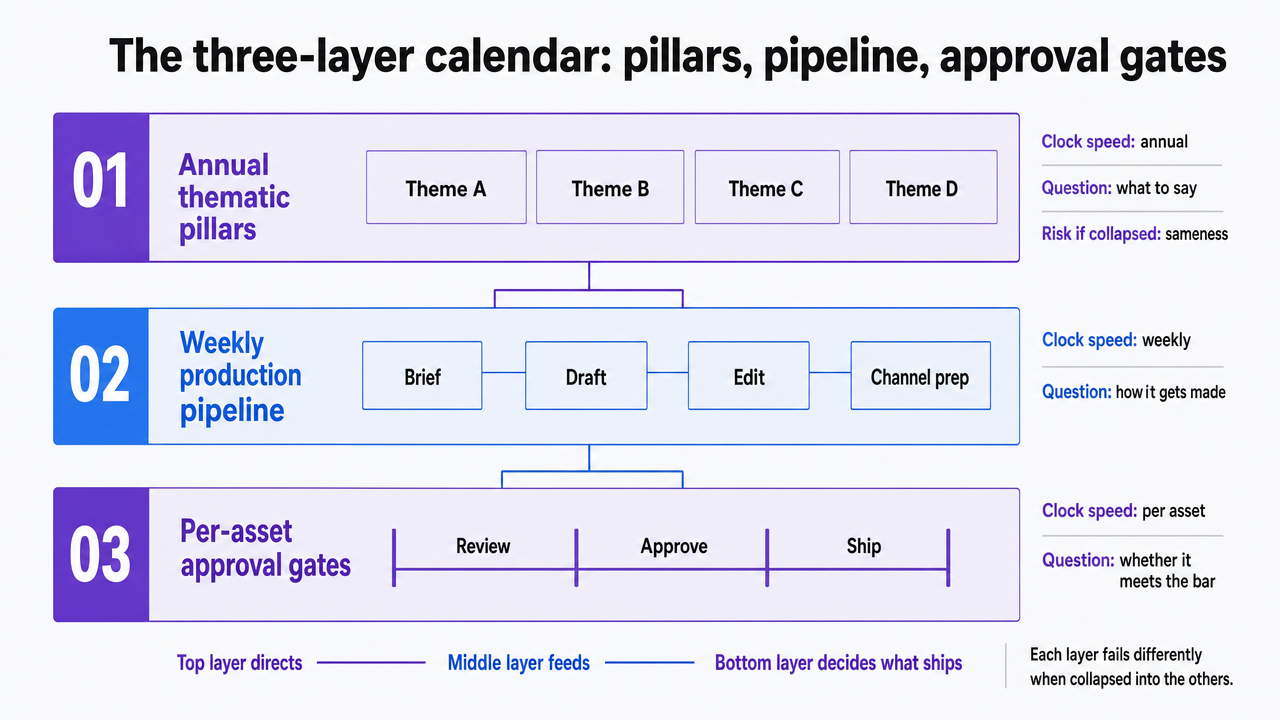 Visualize the three stacked layers of the calendar control system with their distinct clock speeds and questions answered, directly supporting the section's framework explanation
Layer one: annual thematic pillars
Thematic pillars are the annual scaffolding that keeps AI-assisted output from drifting into sameness. Four to six pillars, set at the top of the year, define what the brand has a defensible right to say — the intersection of audience problems, category authority, and business priorities. Every asset the calendar produces has to trace back to one.
The University of Wisconsin's Office of Strategic Communication runs a version of this pattern at institutional scale, using broad monthly themes tied to strategic priorities to unify storytelling across a fragmented set of communicators 2. For a growth-stage content function, pillars might be structured as three evergreen category positions plus one or two campaign-driven pillars that rotate quarterly. The evergreen pillars protect topical authority. The rotating pillars carry launches, seasonal pushes, or narrative bets.
What pillars actually do inside an AI-assisted workflow is constrain the prompt space. When a strategist briefs a draft, the pillar sets the argument frame, the reader's problem, the proof types allowed, and the angles already claimed. Without that constraint, AI drafting tends toward the median of the training data — competent, on-topic, and indistinguishable from every other article on the same query. Deloitte flags this directly, warning that generative AI is commoditizing digital content and that differentiation has to come from human refinement layered onto an AI-first process 6. Pillars are where that refinement gets its instructions.
Practically, each pillar should carry a one-page definition: the claim the brand is making, the audience segment it serves, three to five sub-topics that belong under it, the proof assets already published, and the angles competitors own. That page becomes source material for every brief written against the pillar all year. It is also what an editor uses to reject an AI draft that reads generic — the failure mode is rarely factual, it is thematic drift.
Test a Streamlined Content Calendar in One Week
Experience fast, coordinated content planning and real-time publishing with measurable results before you commit.
Layer two: the weekly production pipeline
If pillars set direction, the pipeline moves the work. Its job is to convert a week's briefs into approved assets with predictable throughput — and to do that with AI carrying the drafting load rather than sitting beside it.
McKinsey's 2024 Global Survey on AI found that 65% of organizations report regularly using generative AI, nearly double the share reported ten months earlier 5. Adoption at that rate changes what a production pipeline is for. When most organizations have gen AI running somewhere, the competitive question is no longer whether to use it — it is whether the pipeline treats AI as a production input with defined handoffs, or as a side tool a strategist opens in another tab. The second pattern is why so many calendars produce more drafts without producing more approved assets.
A weekly pipeline built around AI as an input has five stages, each with a named owner:
- Brief (strategist)
- Draft (AI, prompted against the pillar page and brand voice guide)
- Edit (human editor, working against a fixed rubric)
- Channel prep (specialist for SEO, email, or social variants)
- Queue for approval
Stages are not statuses in a spreadsheet — they are handoffs with entry and exit criteria. A draft does not enter edit until the brief is signed off. An asset does not enter channel prep until the editor's rubric passes. That discipline is what keeps AI volume from clogging review queues.
Cadence matters as much as structure. The pipeline layer should run on a weekly heartbeat: Monday brief review, midweek draft-and-edit compression, Thursday channel prep, Friday approval queue. The pillar layer updates quarterly. The approval layer runs continuously. Collapsing those clocks — treating everything as urgent, or letting the pipeline drift to whenever an editor has capacity — is the failure mode that returns the calendar to a schedule and the team to bottlenecks it already tried to solve.
Layer three: per-asset approval gates
Approval is where AI-assisted calendars either hold quality or lose it. Gates are not a single sign-off at the end — they are checkpoints spaced along the pipeline, each with a defined reviewer, a defined pass criterion, and a defined consequence for failure. The point is to catch drift early, when a rewrite costs minutes, rather than at publish, when it costs a slot.
Three gates carry most of the load:
- Brief gate: a strategist confirms the brief maps to a pillar, names the reader problem, specifies the argument, and lists proof types. Drafts that skip this gate are the ones editors end up rewriting from scratch.
- Editorial gate against a fixed rubric — brand voice, factual accuracy, citation integrity, and thematic fit. The rubric has to be written down. Editors reviewing AI drafts from memory produce inconsistent decisions, and inconsistency at volume is what erodes voice.
- Channel gate, run by whoever owns the destination, checking SEO structure, email deliverability, or platform-specific formatting before the asset enters the publish queue.
Risk-tier the gates. A thought-leadership piece under the founder's byline needs a stricter editorial gate than a supporting FAQ page. Both still pass every gate — the depth of review scales with the stakes. That tiering is what keeps the approval layer from becoming its own bottleneck once AI has removed the drafting one.
What AI drafts, what humans still own
The split is not draft-versus-edit. It is judgment-versus-execution. AI handles the work that scales with prompt quality — first drafts, headline variants, meta descriptions, outline expansions, social cutdowns, email versions, FAQ generation, internal linking suggestions, and translation passes. Those are execution tasks. The prompt sets the bar; the model hits it or misses it in ways an editor can catch.
Humans own four things the calendar cannot delegate: the brief, the argument, the proof, and the sign-off.
- The brief is where a strategist decides what claim the asset is making and why the brand has standing to make it.
- The argument is the structural logic that makes the piece defensible — what evidence sequence carries the point, which counterarguments get addressed, where the reader's objection lives.
- The proof is the specific data, quote, customer example, or original observation that separates the asset from the median result an AI produces on the same query.
- The sign-off is accountability — a named human who owns the consequence if the piece is wrong, off-voice, or thin.
Harvard's professional education group frames AI in marketing as an opportunity for more customized, relevant work across channels rather than a replacement for the strategist doing the customizing 7. This matches what content managers are seeing: AI compresses the time between brief and draft, but the brief itself becomes more valuable. A vague brief now produces vague output faster.
The practical rule for the calendar: any task that a competent strategist could specify in a written brief belongs to AI. Any task that requires deciding what the brief should say belongs to a human. That line is where quality holds under volume.
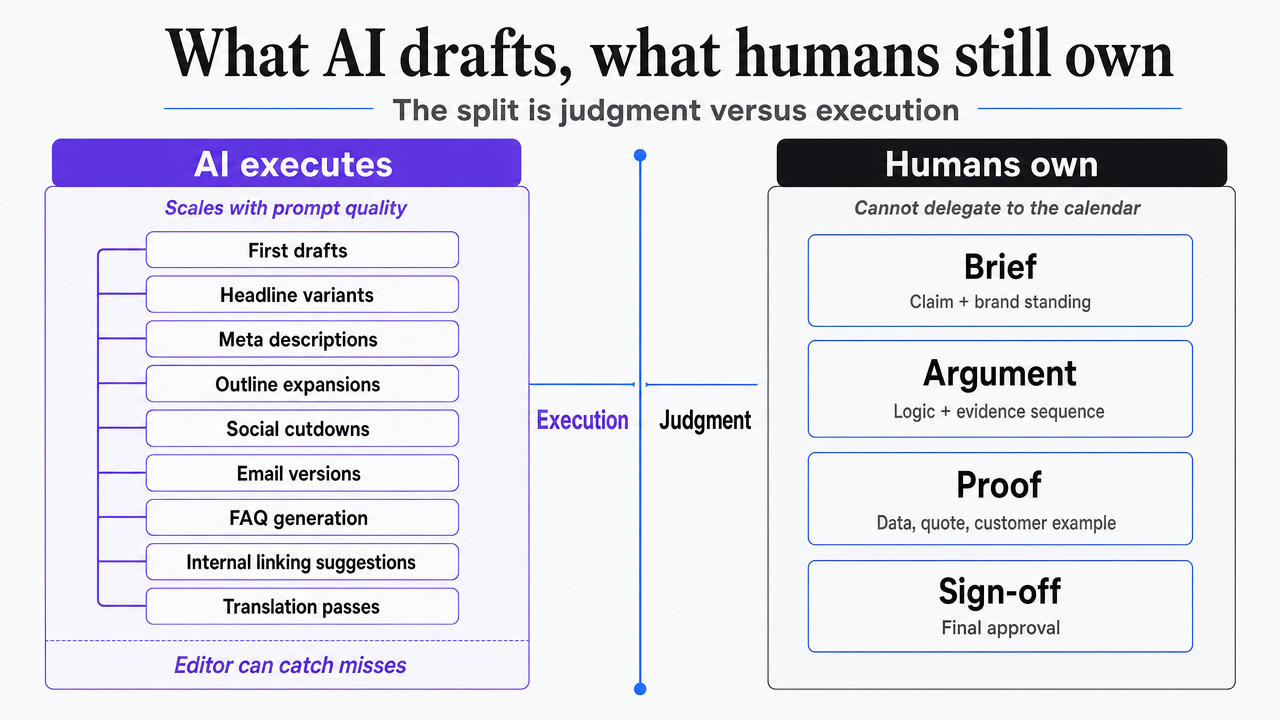 Comparison infographic showing the judgment-versus-execution split between human and AI responsibilities, directly supporting the section's core argument
Defending against content commoditization
Volume without a defense is a liability. When drafting is cheap for every competitor in the category, the pieces that read like the median result of a good prompt stop earning attention — search or otherwise. Deloitte's media production analysis names the mechanism directly: generative AI is commoditizing digital content, and the response has to be an AI-first process that ends with human refinement, not an AI-only one 6. The calendar is where that refinement gets scheduled.
Three defenses do most of the work:
- Proof density. Every asset should carry at least one piece of material a competitor cannot cheaply reproduce — a customer data point, an original benchmark, a named practitioner quote, a screenshot from live operations. AI drafts the surrounding argument; the strategist inserts the proof. Assets that leave the pipeline without a proof element get flagged at the editorial gate.
- Angle discipline. Pillar pages already list the angles competitors own. Briefs should require a stated contrarian, adjacent, or narrower angle before drafting begins. If the brief cannot name what the piece says that the top ten results do not, the piece is not ready to draft.
- Voice specificity. Generic voice guides — "confident, helpful, human" — produce generic drafts. A voice guide that lists banned phrasings, preferred sentence structures, and three annotated examples of on-voice paragraphs gives editors and models the same rubric. That is what keeps ten thousand words a month from sounding like everyone else's ten thousand.
See How Leading Teams Build High-Velocity Content Calendars—Without Expanding Headcount
Request a walkthrough of unified content orchestration workflows proven to increase output and SEO impact for agencies and enterprise brands—no additional writers required.
Governance: applying NIST AI RMF to editorial work
Governance is the layer most content managers skip when they first wire AI into the calendar, and it's the layer that decides whether the operation holds up under audit, legal review, or a bad draft that shipped. NIST's AI Risk Management Framework is voluntary and general-purpose, designed to improve trustworthiness in AI systems across use cases 8. Its four core functions — Govern, Map, Measure, Manage — translate cleanly into editorial controls a content lead already owns.
Govern : Sets the policy layer. For editorial work, that means a written brand voice policy, a documented AI use policy (what tools are approved, what data can go into a prompt, what disclosures are required), and named accountability for each asset type. If no one can point to the person who owns AI-drafted press releases versus AI-drafted FAQ pages, the Govern function is missing.
Map : Risk tiering by asset type. A regulated-industry landing page carries different risk than a supporting glossary entry. Map assigns each asset class to a risk tier and specifies which controls attach — legal review, subject-matter expert sign-off, mandatory citation checks, or a lighter editorial pass. The map lives on the pillar page, not in a strategist's head.
Measure : Quality metrics run on a cadence. Sampled audits of AI-drafted assets against the voice rubric, citation accuracy checks, and tracked rejection rates at each gate. Measurement is what tells the team whether the editorial rubric is actually catching drift or rubber-stamping it.
Manage : Remediation. When an asset fails post-publish — factual error, off-voice paragraph, missed citation — there's a defined workflow: pull or correct the asset, log the failure, adjust the prompt or the rubric, retrain the reviewer if the miss was human. Without a Manage loop, the same failures recur at scale, which is the specific risk that scaled AI drafting introduces.
Applied this way, the framework isn't a compliance exercise. It's the operating system for a calendar that produces more assets than any single editor can watch by hand.
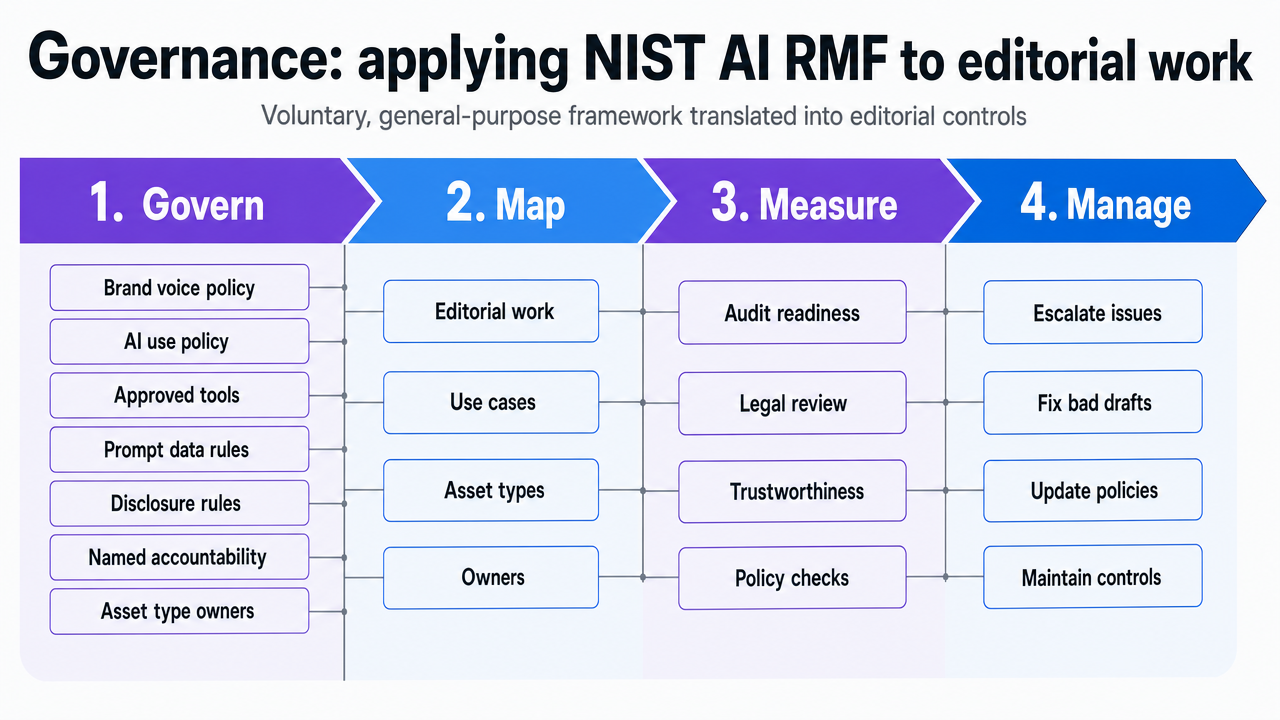 Framework infographic mapping NIST AI RMF's four functions to editorial controls, directly visualizing the section's governance translation
If you manage multiple locations: the consolidation economics
A note on audience: the rest of this piece applies to any in-house content function, but the math shifts sharply for teams serving multiple locations, practice lines, or regional markets. Read the next section as a worksheet, not a prescription.
Multi-location operators — law firms with branch offices, DSOs, home services franchises, senior living portfolios — historically solved content scale by either duplicating a generic corporate feed to every location or hiring a local writer per market. Both fail. The first produces pages that neither rank nor convert because they lack local proof. The second multiplies headcount linearly with location count, which is exactly the constraint the calendar is supposed to relieve. Towson's academic-year calendar model — anchoring content around milestone programs and enrollment cycles 3 — translates to the seasonal demand windows that drive multi-location service businesses: personal injury after holiday travel, HVAC before summer, memory care after Thanksgiving family visits.
The consolidation move is to run one pillar layer at the corporate level and let AI generate location-specific variants at the pipeline layer, gated by a local reviewer. The economics work as a plug-in worksheet:
| Variable | Baseline (writer-per-location) | AI-assisted calendar |
|---|---|---|
| Locations served | L | L |
| Assets per location per month | A | A |
| Total assets per month | L × A | L × A |
| Human hours per asset | H | H × (productivity delta) |
| Named reviewer per location | Same | Required |
| Pillar strategy owners | L | 1 centralized |
The productivity delta is directional, not multiplicative — the AMA survey found 85% of AI-using marketers report productivity gains without quantifying the size 4. Content leads should benchmark their own hours-per-asset before and after, not assume a fixed multiple. What consolidates cleanly is the pillar layer and the rubric; what stays local is proof, reviewer, and compliance sign-off.
Repurposing as a calendar input, not an afterthought
Most calendars treat repurposing as cleanup — a Friday task where a strategist chops a published post into a LinkedIn carousel and an email. That sequence wastes the highest-leverage move AI enables. Repurposing belongs at the brief stage, not the publish stage.
The reframe is simple: every pillar-aligned brief should specify the asset family it produces, not the asset. A single argument, drafted once with AI, can spawn a long-form post, a newsletter version, three social cutdowns, an FAQ block, a sales-enablement one-pager, and a search-optimized landing variant. Harvard's professional education group notes that AI's real leverage in marketing is customized, channel-relevant output at scale 7. That leverage only shows up when the calendar plans the family upfront and routes each variant through the same pillar rubric.
Two controls keep this from turning into slop. First, each variant gets its own channel gate — SEO structure for the landing page, deliverability rules for the email, platform formatting for social — reviewed by whoever owns the destination. Second, the strategist decides at brief stage which variants carry the proof element and which are pointer assets driving traffic back to the anchor. Volume without that split produces ten versions of a generic take.
Frequently Asked Questions
References
- 1.Editorial Calendars - University Communications and Marketing.
- 2.Editorial Calendar - Office of Strategic Communication.
- 3.Strategic Editorial Calendar - Towson University.
- 4.Generative AI Takes Off with Marketers.
- 5.The state of AI in early 2024.
- 6.Generative AI Media Production.
- 7.AI Will Shape the Future of Marketing.
- 8.AI Risk Management Framework.
- 9.The State of AI: Global Survey 2025.