
Key Takeaways
- Campaign plans decay between planning and launch because templates capture intent without routing decisions; treating the template as a coordination layer closes the gap where fidelity is lost.
- Every line item should carry four execution attributes—named owner, KPI with a decision threshold, approval gate, and downstream channel—plus dependency and revision paths to sequence work.
- Tiered approval gates keep governance proportional to risk: full review for messaging, targeting, and AI-generated assets; lighter review for creative variants and budget shifts inside pre-authorized bands 1.
- Prioritize three template edits this quarter: add the four routing attributes to every row, split approvals into two tiers with named reviewers, and require a reasoning field on every recommendation.
Why Most Campaign Plans Stall Between Slide 12 and Launch
Most campaign plans are impressive right up to the moment they need to ship. The audience research is thorough. The positioning statement is sharp. The channel mix has been debated for weeks. Then the deck lands in a shared drive, and three months later the actual campaign that reaches the market looks nothing like slide 12. Ad copy went out without the approved messaging. The email nurture launched two weeks after the paid media. The landing page never made it into the sprint. Nobody is technically at fault, and nobody can point to the moment the plan diverged from execution.
This is the failure mode a marketing campaign plan template is supposed to prevent, and it is the failure mode most templates do nothing about. The document captures intent. It rarely captures who owns what, which KPI each action moves, or how a decision gets from a strategist's recommendation into a live channel without a two-week detour through email threads and status meetings.
The stakes attached to closing that gap are no longer marginal. McKinsey's 2025 workplace report estimates that sales and marketing functions concentrate roughly 28 percent of the potential economic value generative AI can unlock across business functions—a figure that reflects the analyst firm's function-level modeling of gen AI's productivity ceiling, not observed revenue 7. The scope matters: that value shows up only when the planning layer and the execution layer are wired together tightly enough for AI-assisted work to actually reach a channel. Templates that stop at intent leave that value stranded on the slide.
The Planning-to-Execution Decay Problem
Planning-to-execution decay is the measurable gap between what a campaign plan specifies and what actually ships to a channel. It shows up in small variances at first: a headline gets rewritten in the ad platform because nobody could find the approved version, a launch date slips by ten days because the paid team is waiting on landing page copy, a nurture sequence goes out with generic subject lines because the strategist who wrote the messaging brief is on a different account this week. Individually, none of these variances register as failure. In aggregate, they determine whether the plan on slide 12 has any relationship to the campaign the market actually sees.
The decay compounds at three predictable points:
- The handoff between planning and production, where an approved brief loses fidelity as it moves from a slide into a task in someone's queue.
- Cross-channel sequencing, where the paid, organic, email, and site teams are executing against the same plan but on different clocks.
- Mid-flight optimization, where a strategist's recommendation to shift budget or swap creative sits in a review thread long enough that the window it was meant to capture has closed.
Standard planning references treat these as operational problems for someone else to solve. The SBA template documents what a plan should contain—target market, competitive advantage, sales plan, marketing and sales goals, and a marketing action plan—and stops there 3. University frameworks add executive summary, market research, objectives, strategies and tactics, budget, and performance measurement to the same list 6. Both are correct about the components. Neither addresses the routing layer that turns a component into a shipped asset, and that omission is where decay lives.
A template that ignores routing will produce decay regardless of how carefully its strategic sections are written. Closing the gap requires treating the template itself as the coordination layer, not the record of what the coordination layer was supposed to do.
Reframing the Template as an Operating System
From Document to Decision-Routing Layer
A campaign plan template earns its keep when every field it contains routes a decision. That is the shift that separates a planning artifact from an execution operating system: the template stops being a record of what the team agreed to and becomes the interface through which work is assigned, approved, and measured.
The recognizable planning blocks stay intact. The SBA template still specifies target market, competitive advantage, sales plan, marketing and sales goals, and a marketing action plan 2. What changes is what each block carries next to it. Target market is not just a persona paragraph; it carries the owner who maintains the audience definition, the KPI that will confirm the audience was reached, the approval gate for any change to targeting parameters, and the channels where that targeting is expressed. Competitive advantage carries the messaging owner, the differentiation claim being tested, the review gate for legal or brand sign-off, and the assets that inherit it. Every planning block gets four execution-layer counterparts: owner, KPI, approval gate, and channel.
Mapped this way, the template becomes readable by both the strategist writing it and the workflow system routing tasks against it. A change to the sales plan does not require a meeting to figure out downstream implications; the routing layer already knows which channels inherit the change and which owner has to approve it before it ships. The document stops being a snapshot of intent and starts behaving like a live coordination layer that produces the campaign it describes.
Fields That Actually Route Work
Most templates fail at the field level. A row labeled "channel: paid social" tells nobody who is writing the copy, which audience segment it targets, what metric decides whether it stays live, or who signs off before spend begins. The field captures a choice without capturing the work the choice implies.
Fields that route work carry four attributes on every line item:
- A named owner, not a team. "Paid team" is not an owner; the paid media manager who will build the campaign in the ad platform is.
- A specific KPI with a target and a decision threshold: not "increase conversions," but "cost per qualified lead below the current blended average, evaluated at day 14."
- The approval gate the item must clear before it ships: creative review, legal sign-off, budget authorization, or a strategist's final read.
- The downstream channel or system where the item lives once approved: the ad account, the CMS, the email platform, the intake team's script.
Two secondary attributes make the field operational. A dependency reference tells the routing layer what has to be complete before this item can move—the landing page before the paid launch, the offer before the email sequence, the tracking parameters before any of it. A revision path tells the owner where a mid-flight change goes: back through the same approval gate or through a lighter optimization review. Without these two, the template can describe work accurately and still fail to sequence it. With them, the fields stop being labels and start behaving like instructions a coordinated team, human or AI-assisted, can act on without a status meeting to interpret what the plan meant.
Test a full campaign workflow in days
Experience end-to-end campaign execution and measure real results before committing long term.
The Four-Phase Execution Cadence
The American Marketing Association organizes campaign execution across four phases—messaging, launch, optimization, and expansion—with each action item assigned an owner and a deadline 8. The phasing itself is not the innovation; most VPs already run campaigns in something resembling this arc. What matters is what each phase carries in the template: the owner accountable for the phase gate, the KPI that determines whether the phase closes, and the approval that has to clear before the next phase opens.
Messaging is the phase where positioning, differentiation claims, and creative direction get locked. The owner is the strategist who wrote the positioning; the KPI is qualitative and gate-based (messaging approved by brand and legal, tested against the target audience definition); the approval gate is a single review with brand, legal, and channel leads in the same document rather than a serial email chain. Nothing enters production until this gate closes.
Launch is where the messaging becomes assets in channels. The owner shifts to the channel leads—paid media, content, email, site—each carrying their own launch checklist tied back to the approved messaging. The KPI is delivery-based: assets live on the scheduled date, tracking parameters verified, dependencies cleared. The approval gate is a pre-flight review that confirms the launch sequence matches the plan.
Optimization is the phase most templates treat as an afterthought and where planning-to-execution decay does the most damage. The owner is the strategist reading performance data against the KPI thresholds set during messaging. The KPI is quantitative and time-boxed: cost per qualified lead at day 14, conversion rate at day 21, channel mix efficiency at day 30. The approval gate is a lighter revision path for creative swaps and budget shifts within pre-authorized bands, and a full gate for anything outside them. This is the phase where AI-assisted coordination earns its keep, because the volume of small decisions exceeds what a lean team can route through email.
Expansion is the phase that decides whether the campaign becomes a repeatable asset or a one-time effort. The owner is the VP or director accountable for the pipeline outcome. The KPI is business-level: qualified pipeline generated, cost per acquisition against target, contribution to the quarter's revenue plan. The approval gate authorizes scaling the winning elements—audiences, creatives, channels—into the next campaign or the next market.
Read across the four phases, the template stops being a plan and starts behaving like a cadence the team executes against. Each phase closes with a decision, not a status update. That is the difference between a campaign that ships what the plan specified and one that arrives at the market as a diluted version of slide 12.
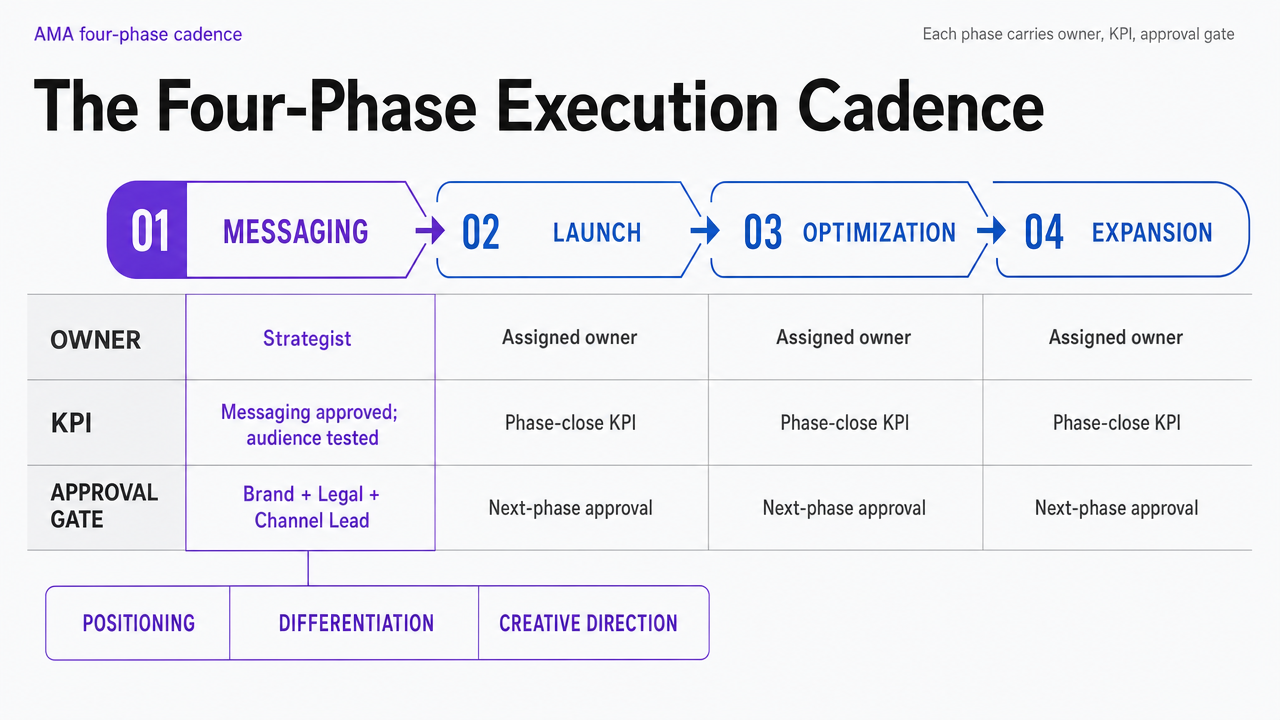 Visualize the AMA-cited four-phase cadence (messaging, launch, optimization, expansion) with owner, KPI, and approval gate attributes for each phase, directly supporting the section's operating model
AI-Assisted Coordination Inside the Template
The optimization phase exposes the coordination ceiling of a lean marketing team. A VP running three concurrent campaigns with a team of five cannot manually route every creative swap, audience refinement, and budget shift through the right approval gate on the day it matters. This is where AI-assisted coordination stops being a productivity story and becomes a template design question: which fields does the routing layer need in order to act, and which decisions stay with a human strategist?
McKinsey's work on agentic AI in marketing frames the answer as a redesign of the operating model, not a plug-in. Its research on reinventing marketing workflows argues that value comes from combining human and AI agents inside future-state workflows with clear human roles and governance, rather than layering AI tools on top of an existing process 4. Applied to a campaign plan template, that means the fields already discussed—owner, KPI, approval gate, channel, dependency, revision path—have to be legible to both a strategist and an AI agent reading the same row.
Three coordination tasks concentrate the gains:
- Priority ranking against live performance data: an AI agent reads the KPI thresholds set in the messaging phase and surfaces which line items are outperforming, underperforming, or waiting on a dependency.
- Draft production: creative variants, audience refinements, and channel-specific adaptations are generated against the approved messaging and staged for review inside the same template, not in a separate tool.
- Cross-channel sequencing: the routing layer reads dependency references and flags when a paid launch is scheduled before its landing page has cleared approval.
The strategist's role does not shrink; it moves. Reviewing every draft becomes reviewing ranked recommendations with the reasoning attached. The template has to carry that reasoning as a field—why this creative variant, why this budget shift, why this audience cut—so the approval decision is a judgment on the logic, not a search for context. Templates that omit the reasoning field force strategists back into the email threads AI-assisted coordination was meant to replace.
Governance and Approval Gates Without the Bureaucracy
Approval gates fail in two directions:
- Absence: work ships without review, and the campaign becomes a series of unvetted decisions that legal or brand only sees after the fact.
- Over-engineering: every asset routes through the same serial chain regardless of risk, and the calendar slips by weeks while low-stakes creative variants wait behind high-stakes messaging changes.
Both failure modes produce the same outcome, which is a template nobody trusts to move work through.
The NIST AI Risk Management Framework is built around a different premise. It treats trustworthiness as something incorporated into the design and use of AI systems rather than bolted on as a review step, and it structures governance around mapping, measuring, and managing risk in proportion to the decision at hand 1. Applied to a campaign plan template, that principle produces tiered gates instead of uniform ones. Messaging changes, targeting logic, and any AI-generated asset that reaches the market carry a full gate: brand, legal, and channel lead sign-off in a single review, with the reasoning field from the template attached so reviewers judge the logic rather than reconstruct it. Creative variants inside pre-approved messaging, budget shifts within authorized bands, and audience refinements against a locked definition carry a lighter gate: a single strategist approval with an audit trail.
Two design choices keep the gates from becoming bureaucracy. Each gate has a named decision-maker rather than a committee, and each gate has a service-level target measured in hours, not days. A template that names the reviewer and clocks the review turns governance into a scheduled step in the cadence. Without those two, tiered gates collapse back into the email threads they were meant to replace.
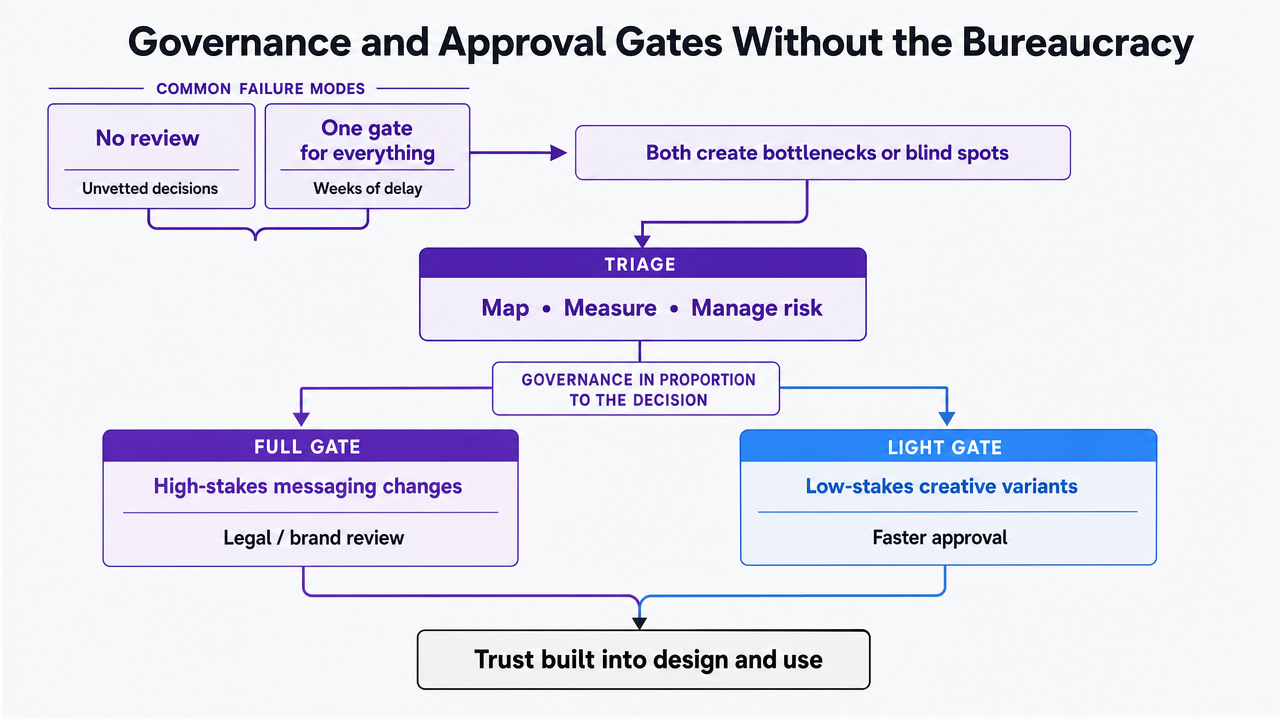 Visualize the two-tier approval gate structure described in the section, showing which decisions route through the full gate versus the lighter gate, aligned with NIST's proportional-risk governance principle
See How Top Teams Execute Multi-Channel Campaigns at Scale
Request a walkthrough of a data-driven marketing campaign plan template built for high-volume execution and unified reporting—purpose-built for agencies and enterprise brands managing multiple channels and locations.
Measurement That Survives a CFO Review
A CFO reading a campaign report is looking for two things: whether the numbers reconcile to pipeline, and whether the metrics reported reflect decisions the team could actually make. Reports that lead with impressions, engagement rates, and click volume rarely survive the second test. The peer-reviewed guidance on evaluating digital campaigns argues for exactly this discipline—treating digital data as evidence for whether a paid effort produced the outcome it was funded to produce, not as a summary of activity the platforms recorded 9.
The template carries measurement in three layers, and each layer answers a different question:
- The channel layer records what shipped and what it cost: assets live, spend deployed, delivery against the launch plan.
- The response layer records what the audience did in ways tied to the KPI thresholds set during messaging: qualified leads at day 14, booked appointments at day 21, cost per qualified lead against the blended target.
- The outcome layer records what the campaign contributed to the pipeline the CFO is watching: qualified pipeline generated, cost per acquisition against target, revenue attributable to the campaign window.
Each layer references the one above it, so a shift in the outcome number traces back to a specific response metric and a specific channel action.
Two rules keep the measurement structure defensible. Every reported metric names what was measured and over what window, matching the SBA's guidance that marketing and sales costs be compared directly to the revenue they generate 3. And every metric maps to a decision the template already authorizes—a budget shift, a creative swap, a phase gate. Metrics that do not route a decision do not belong in the report. That single filter is what turns a campaign dashboard into a document a finance leader can sign off on.
 Potential Economic Value of Gen AI in Sales and Marketing
Potential Economic Value of Gen AI in Sales and Marketing
If You Manage Multiple Locations: Consolidation Economics
This section shifts scope from single-brand marketing teams to VPs running campaigns across multiple locations—law firm offices, dental groups, senior living communities, home services territories, behavioral health facilities. The template mechanics discussed above still apply, but the economics behind them change once execution has to repeat across 10, 40, or 200 sites.
The default operating model for multi-location marketing is a stack of specialist vendors. An SEO agency handles local pages and citations. A PPC agency manages paid search and social. A content agency produces the blog and location-page copy. A social vendor runs organic posting. A call tracking provider handles intake attribution. Each vendor coordinates with the in-house team on a separate cadence, produces its own reports on its own metrics, and bills against its own retainer. The campaign plan template becomes a translation layer between five contracts.
The comparison worth running is not a fabricated savings claim; it is the operator's own invoice math against a unified platform price. The table below is a worksheet, not a benchmark.
| Cost Line | Traditional Vendor Stack | Unified AI Execution Model |
|---|---|---|
| SEO retainer | [your current monthly fee] | Included |
| PPC management | [your current monthly fee] | Included |
| Content agency | [your current monthly fee] | Included |
| Social vendor | [your current monthly fee] | Included |
| Call intelligence | [your current monthly fee] | Included |
| Coordination hours (internal) | [hours/week × loaded rate] | Approval queue time only |
| Monthly total | [sum of above] | $599/month post-trial |
The number that matters on the left side is not the sum of the retainers. It is the coordination hours—the time the in-house team spends briefing, reviewing, and reconciling work across five vendors on separate clocks. That line is where planning-to-execution decay concentrates for multi-location operators, because every location multiplies the coordination surface. A single approval queue that routes ranked recommendations across all channels replaces that surface with a scheduled review step.
What to Change in Your Template This Quarter
The template edits that produce the largest execution gains are unglamorous. Three are worth prioritizing before the next campaign cycle opens:
- Add four attributes to every line item: named owner, KPI with decision threshold, approval gate, and downstream channel. Rows without all four get flagged and returned before the plan enters production.
- Split the approval structure into two tiers—full gate for messaging, targeting logic, and any AI-generated asset reaching the market; lighter gate for creative variants and budget shifts inside pre-authorized bands. Assign a named reviewer and an hours-based service target to each tier.
- Add a reasoning field to every recommendation the template carries, so approvals judge the logic rather than reconstruct it.
A campaign plan template built this way stops being the document the team writes before the work starts and becomes the interface through which the work moves. Platforms like Vectoron are built around exactly that premise: an approval queue, ranked recommendations with reasoning attached, and execution across channels once a strategist signs off.
Frequently Asked Questions
References
- 1.AI Risk Management Framework | NIST.
- 2.Marketing plan example | U.S. Small Business Administration.
- 3.Marketing and sales | U.S. Small Business Administration.
- 4.Reinventing marketing workflows with agentic AI.
- 5.How generative AI can boost consumer marketing.
- 6.What Is a Marketing Plan and How to Make One?.
- 7.AI in the workplace: A report for 2025.
- 8.AMA Marketing Plan Template.
- 9.An approach to evaluation of digital data in public health campaigns.