
Key Takeaways
- Treat campaigns as a capacity-regulated system where booked crew-hours by trade and territory, not monthly budget, set the ceiling on productive spend each week.
- Run a Signal–Constraint–Lever loop: read demand forecasts, booked load, and answered call rate daily, then throttle PPC, LSAs, and remarketing against a utilization band that typically breaks between 85% and 90% booked.
- In shoulder seasons, shift the offer instead of cutting spend—fund maintenance-plan enrollment, off-peak replacements, and commercial work, and measure six-week forward booked-hours rather than same-week CPA.
- For multi-territory operators, split account architecture by trade then territory, wire marketing, booking, and dispatch into one loop, and keep every automated bid adjustment previewable and human-approved before it fires 8.
The Monday Morning Mismatch
It's 10:14 a.m. on a Monday in July. Paid spend across the HVAC accounts is running 22% above the prior four-week average because the bidding system saw the heat wave and pushed. The dispatch board tells a different story: every truck in two of the three territories is already committed through Wednesday, and the CSR team is quoting Thursday afternoon at the earliest. Every additional click that lands on the emergency AC landing page for the next 48 hours has a lower marginal chance of converting into a same-week booking, and a higher chance of turning into a voicemail a competitor will pick up.
That gap between what the campaigns are buying and what the crews can deliver is the operating problem this article treats as the main event. Not seasonality on its own. Not creative refreshes. The mismatch between demand generation and billable crew-hours, measured week by week, territory by territory, trade by trade.
Marketing directors at multi-territory home services operators already run the channel stack — Local Services Ads, PPC, local SEO, remarketing, email. The unresolved question is how to pace those channels against a constraint that changes daily. The rest of this piece frames campaigns as a capacity-regulated system and gives a working control loop for the paid, organic, and lifecycle levers most teams already own.
Why Static Campaigns Break Against Real Demand
Home services demand does not move in a straight line, and the size of the swing is what breaks fixed monthly budgets. HVAC search volume varies by 250–600% across the year in aggregated U.S. search data, with AC repair queries climbing 266% in July and furnace repair queries surging 137% in January 9, 10. Electrical work, by comparison, tracks closer to a flat baseline because it is less weather-driven 13. A single company-wide budget applied against curves that diverge that sharply spends the same dollars whether the pipeline is drowning or empty.
The failure mode is mechanical. Automated bidding responds to auction pressure and click intent, not to whether a dispatcher can slot the job this week. When July heat lands, machine-driven pacing pushes HVAC CPCs higher at exactly the moment when the marginal lead has the lowest chance of being served in-window. When shoulder-season quiet arrives in April or October, the same automation pulls back at the moment maintenance-plan enrollments and equipment quotes could have been generated at their lowest acquisition cost.
Static calendars fail for the mirror reason. A promotional plan built in January assumes a demand shape that climate variability, regulatory deadlines, and housing turnover routinely disrupt 11. The pattern is predictable enough to plan against, but not so rigid that a fixed calendar substitutes for a live control loop. Firms that treat demand as flat, or as a single peak instead of dual summer and winter peaks, structurally misallocate spend across half the year 14.
The corrective is not more automation. It is automation wired to a different input. Bid rules, budget caps, and channel pacing need to read booked crew-hours as an upstream signal, not just conversion rate and CPA. The rest of the argument works from that premise.
Crew-Hours Are the Real Budget Line
Ad budget is the number that shows up in the finance review. Billable crew-hours are the number that determines whether that budget produces revenue. A territory with four HVAC trucks running eight-hour days has roughly 160 sellable hours per week before considering drive time, callbacks, and warranty work. That ceiling does not move because a heat wave pushed CPCs up. It moves when a technician is hired, a van is added, or a shift structure changes — all quarter-scale decisions, not week-scale ones.
Capacity planning discipline treats demand forecasting and resource availability as a paired input, not two separate spreadsheets 1. For a home services marketing director, that pairing has a specific shape. The upper bound on productive spend in a given week is the crew-hours available minus the hours already booked, converted into a lead volume the CSR team can convert without stretching quote times past the point where close rates collapse. Above that line, incremental spend buys inquiries that either go to voicemail, get quoted for next week, or get poached by a competitor with an open slot tomorrow.
The practical shift is to move the primary planning number in the marketing dashboard from monthly budget to weekly available crew-hours by trade and territory. Budget becomes a derived figure. If plumbing in the north territory has 92 open hours next week and HVAC has six, the campaign posture is not "spend the July allocation." It is fund plumbing acquisition, cap HVAC bids, and shift creative toward maintenance-plan enrollment for the customers who will need service in six weeks. Same dollars, different destination, aligned to what the crews can actually deliver.
Test adaptive campaigns aligned to crew capacity
See how automated campaigns match live crew availability before peak or slow season impacts your results.
The Signal–Constraint–Lever Framework
Signal: Reading Live Demand and Booked Load
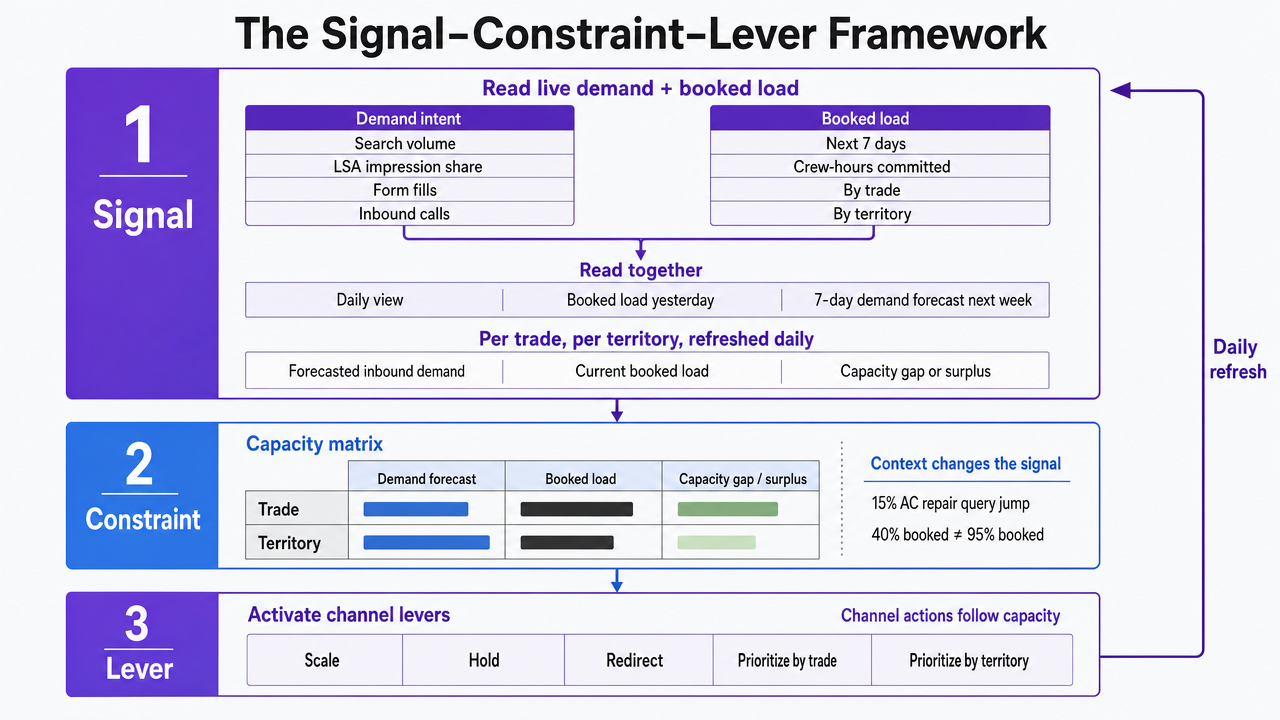
Two signals matter, and most marketing dashboards only track one. The first is demand intent — search volume, LSA impression share, form fills, inbound call volume. The second is booked load — the percentage of available crew-hours already committed for the next seven days, broken out by trade and territory. Campaigns pace correctly only when both are read together.
Applied to a marketing control loop, the daily question is not "what did CPA do yesterday" but "what did booked load do yesterday, and what does the seven-day demand forecast say next week looks like." A 15% jump in AC repair queries matters differently when the HVAC board is 40% booked versus 95% booked.
The signal layer should surface three numbers per trade, per territory, refreshed daily:
- forecasted inbound demand for the next seven days,
- current booked-hours percentage, and
- answered call rate for the past 48 hours.
Call tracking feeds the last one directly, and AI-driven automation makes the pull continuous rather than a Monday morning report 7. When any of the three crosses a threshold, the campaign posture changes. That is the input side of the loop. The next question is what the constraint actually looks like when it is modeled honestly.
Constraint: Modeling Capacity by Trade and Territory
Capacity is not one number. It is a matrix. Rows are trades — HVAC install, HVAC service, plumbing service, drain, electrical, roofing. Columns are territories. Each cell holds a weekly available crew-hours figure, adjusted for scheduled time off, warranty callbacks, and drive time between jobs. That cell is what a campaign posture is actually spending against.
The shape of the constraint changes across the year in a way that fixed staffing plans cannot absorb. National search data shows that home services demand runs on two peaks, not one — a summer HVAC surge and a winter HVAC-plus-plumbing surge, with shoulder-season troughs between them 14. This pattern is statistically predictable, driven by climate cycles, regulatory deadlines, and housing turnover, which is why the residential services association frames seasonal demand as a forecasting problem rather than a surprise 11. A capacity model that assumes flat weekly hours across twelve months will overspend in April and October and undershoot in July and January.
The practical model has three inputs per cell: baseline weekly crew-hours available, a demand multiplier keyed to the two annual peaks, and a utilization ceiling above which quote-to-close rates degrade because response times stretch. Most operators find that ceiling somewhere between 85% and 90% booked; past that, the CSR team is quoting further out than the customer is willing to wait. The constraint is not the theoretical maximum. It is the utilization band where marketing spend still converts to booked revenue. Everything above that band is waste dressed up as pipeline.
Lever: Throttling PPC, LSAs, SEO, and Remarketing
With demand signal on one side and a trade-territory capacity matrix on the other, the lever is the channel palette. A multi-channel stack — LSAs, PPC, local SEO, email, remarketing, and a residential-versus-commercial split — gives a marketing director enough surface area to move volume up or down without hard-pausing anything 5, 4. Hard pauses cost Quality Score and LSA ranking; graduated throttling does not.
The lever assignments follow the constraint. When a trade-territory cell is running above the utilization ceiling, PPC bid caps come down first, LSA weekly budget contracts second, and remarketing to prior customers holds because those are the highest-intent, easiest-to-schedule jobs. When a cell is running under the floor, PPC bids expand, LSA budget uncaps, and content and email push maintenance-plan enrollment and off-peak packages that book into the future without straining the current week. Local SEO is the constant underneath — it does not throttle in real time, but the landing page a paid click hits can swap between "same-day service" and "schedule your fall tune-up" based on the same signal.
Bid automation has to be legible for this to work. Practitioners already push for transparency into how automated systems calculate adjustments before they go live, and any capacity-regulated system should preserve that preview step 8. A rule that pulls HVAC bids 30% because dispatch is at 92% booked should be visible to the marketing director before it fires, not surfaced in a post-mortem the following Monday. Human-in-the-loop approval is what separates a control loop from an opaque automation experiment.
 Visualize the three-stage control loop (Signal, Constraint, Lever) that governs the entire framework section, showing how demand signals feed into a capacity matrix which then activates channel levers
Shoulder-Season Plays That Flatten the Curve
The instinct during April and October is to pause. Search volume drops, CPCs feel expensive relative to conversion, and the finance team asks why the ad line is still running. Pausing is the wrong move. Shoulder seasons are when the marketing function generates future capacity utilization at the lowest acquisition cost of the year, and the play is to shift the offer, not cut the spend.
Three offer types absorb crew-hours during troughs without competing with peak-season pipeline:
- Maintenance-plan enrollment converts a one-time customer into scheduled recurring visits that fill October and April dispatch boards before the next surge lands.
- Off-peak equipment replacement — furnace swaps in May, AC installs in November — moves discretionary jobs into quiet weeks with tune-up bundles and financing offers.
- Commercial and remodel work, where scheduling is set weeks out, gives crews steady billable hours between residential peaks.
The underlying tactic is straightforward: use pricing, promotions, and flexible scheduling to spread demand around the peaks rather than compete inside them 2.
Channel mix shifts to match. Email and remarketing carry more of the load because the audience is prior customers with known service history and lower acquisition friction. Content and local SEO run continuously — a fall tune-up landing page indexed in August captures search demand that PPC would pay for twice. Weather-triggered messaging queues up for the shoulder-to-peak transition, tuned to fire when the seven-day forecast breaks a temperature threshold rather than a calendar date 6. The residential-versus-commercial split matters here: commercial campaigns can run steady while residential PPC contracts, preserving crew utilization without diluting peak-season budgets 5.
The measurement change is what makes the play defensible. Shoulder-season success is not measured by same-week booking rate. It is measured by six-week forward booked-hours and maintenance-plan enrollment growth — leading indicators that show up in dispatch capacity, not in this month's CPA report.
Budgeting Against Capacity, Not Calendar
A capacity-regulated budget starts with a total, then treats the monthly split as an output rather than an input. The sizing anchor most home services operators use is 7–10% of revenue directed to marketing, with real-time data and AI-driven automation optimizing the channel mix inside that envelope 7. That percentage sets the ceiling. What breaks in most planning cycles is the assumption that the ceiling should be divided into twelve equal months on a calendar-year spreadsheet.
The alternative is to allocate against forecasted crew-hours by trade and territory, then let the Signal–Constraint–Lever loop draw down against that pool week by week. A trade with a summer peak gets a heavier draw in June through August and a lighter one in April; a trade with steadier demand draws more evenly. Shoulder-season spend does not disappear — it shifts to maintenance-plan enrollment, commercial pipeline, and content that indexes ahead of the next peak. The annual total lands inside the 7–10% band 7; the monthly line item flexes with what the crews can absorb.
Two mechanics make the model defensible in a finance review. First, the budget carries forward. Dollars unspent in a throttled week fund an accelerated week later in the quarter, so the annual commitment holds even when weekly pacing does not. Second, every throttle decision is tied to a booked-load threshold and a channel lever, both visible before they fire 8. A CFO asking why April spend dropped 18% gets a specific answer: booked load ran below floor, PPC bids contracted, LSA budget compressed, and the reclaimed dollars queued for the June acceleration window. The budget is not smaller. It is sequenced against capacity.
See How Adaptive Campaigns Align Marketing Spend with Real-Time Crew Availability
Connect with our team to learn how enterprise marketers synchronize campaign pacing to capacity data, minimizing wasted budget and missed opportunities across territories.
If You Manage Multiple Territories
Trade-Level Throttling Across Markets
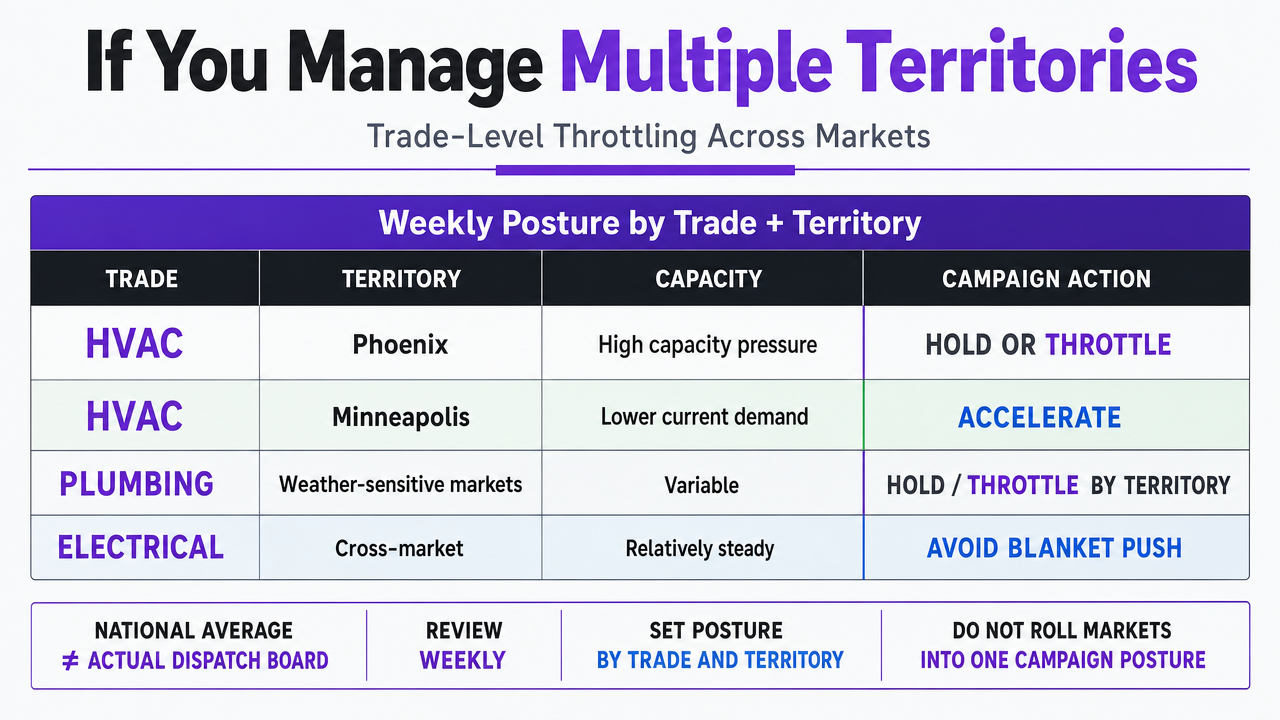
For marketing directors running multi-territory operations, the constraint model breaks in a specific way: what reads as a company-level HVAC surge is often three territories at 95% booked and two territories at 40%. Rolling those into a single national campaign posture spends against an average that does not exist on any actual dispatch board. The corrective is trade-level throttling that respects territory-level capacity, not company-level demand.
Differential seasonality makes this concrete. HVAC and plumbing swing hard against weather, while electrical work stays comparatively flat because it is less climate-driven 13. A national HVAC pause during a shoulder week misses the reality that the Phoenix market is still moving refrigerant calls while Minneapolis is quiet. A blanket electrical push ignores that the constraint on electrical growth is usually licensed technicians, not demand. The two trades need different levers on different clocks, and each clock is set by territory.
The working structure is a campaign account architecture that splits by trade first, then by territory inside each trade, with residential and commercial separated further 5. That separation lets bid caps, LSA budgets, and landing page variants move independently. When the Dallas HVAC service board hits 90% booked, only that cell throttles. Kansas City HVAC install keeps running. Both electrical accounts hold steady. The dispatch matrix drives the campaign matrix one-to-one, and no territory subsidizes another's overspend.
A Posture Table for Weekly Campaign Decisions
The Monday planning meeting needs a single artifact that maps capacity to campaign action. A posture table, refreshed weekly and reviewed before any bid adjustments fire 8, gives the marketing director, the ops lead, and the CSR manager one document to argue against. The columns stay constant; the values move.
| Territory | Trade | Weekly Billable Crew-Hours Available | Current Booked % | Recommended Posture |
|---|---|---|---|---|
| Territory A | HVAC Service | HA,HVAC | 92% | Throttle |
| Territory A | Plumbing | HA,Plumb | 58% | Accelerate |
| Territory B | HVAC Install | HB,HVAC-I | 71% | Hold |
| Territory B | Electrical | HB,Elec | 44% | Accelerate |
| Territory C | Roofing | HC,Roof | 88% | Throttle |
Accelerate : bid caps rise, LSA budgets uncap, and content and email push into the trade-territory pair.
Hold : the current pacing stands and the cell is monitored daily.
Throttle : bid caps compress, LSA budgets contract, and remarketing to prior customers carries the intent volume forward.
Every posture change ties to a booked-load threshold visible before the automation fires 8, which is what makes the table defensible in a cross-functional review rather than a marketing-only decision.
 Visualize the weekly posture table that maps trade-territory capacity to campaign action (Accelerate / Hold / Throttle), directly reinforcing the operating artifact described in the section
Wiring Marketing, Booking, and Dispatch Into One Loop
The framework fails without integration. Signal, constraint, and lever are three different systems in most home services operators — a marketing analytics stack, a field service management platform, and a dispatch board — and the handoffs between them are usually a Monday morning report and a Slack channel. That latency is where capacity-regulated campaigns break. A booked-load figure that is 72 hours stale cannot govern bid rules that adjust every 15 minutes.
The industry is moving to close that gap. Home service companies are increasingly investing in technologies that synchronize marketing, booking, and dispatch to reduce missed calls and idle technician time, and tighter integration between call centers, dispatch software, and marketing analytics platforms is a defining 2026 trend 12. The operational shape is a single control loop: call tracking feeds answered-rate and intent data to the marketing layer 7, the booking system writes committed hours back to the same layer, and dispatch confirms utilization by trade and territory. The marketing director sees one view where a bid adjustment, a booked job, and a technician's next open slot are the same conversation.
Two disciplines protect the loop from becoming an automation experiment. Every automated adjustment is previewable before it fires, so a rule that reallocates spend across trades is inspected by a human before the money moves 8. And approval sits with the marketing director, not with the model — the system ranks and recommends, but shipping decisions stay with the person accountable for the number. That is how AI-assisted execution scales without adding headcount, and it is the operating model platforms like Vectoron are built to support.
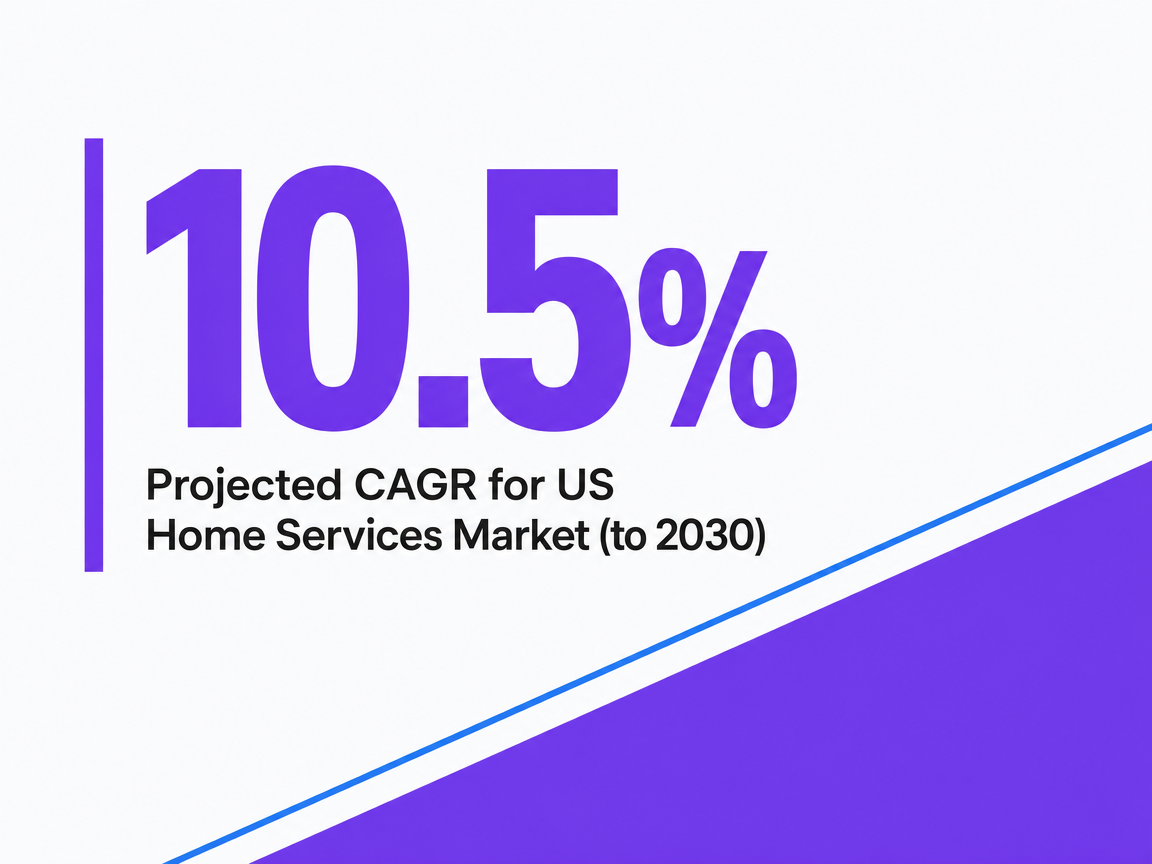 Projected CAGR for US Home Services Market (to 2030)
Projected CAGR for US Home Services Market (to 2030)
Frequently Asked Questions
References
- 1.Capacity planning: Meet demand and drive growth.
- 2.Managing seasonal demand.
- 3.US Home Services Market Driving Always-On Consumer Demand.
- 4.7 Digital Marketing Strategies For Home Service Companies.
- 5.Home Services Marketing Guide: Grow Your Business.
- 6.Seasonal Marketing Made Easy for Home Service Providers.
- 7.Home Services Marketing: Seven Strategic Insights.
- 8.Can I see the calculation behind bid automation adjustments?.
- 9.Seasonal Search Shifts in Home Services Demand (Data + Playbook).
- 10.Seasonal search shifts in home services demand: What spikes when and how to stay ready.
- 11.Seasonal Demand Patterns in Residential Services Professional Practice.
- 12.30 Home Service Industry Trends To Watch In 2026.
- 13.Seasonal search shifts in home services demand.
- 14.Seasonal search shifts in home services demand: What spikes when.