Key Takeaways
- Agency delivery problems usually sit in the process layer, not the tool layer—digitizing a manual workflow preserves every handoff and exception that broke the original 1.
- Four failure points decide whether delivery holds under load: inconsistent data definitions, undefined boundaries between disciplines, operator non-adoption, and the absence of continuous evaluation on the handoffs themselves 1.
- Capturing the upper end of the 5 to 15 percent marketing productivity range from generative AI depends on redesigning the workflow first; layering AI on a broken process scales the breakage 12.
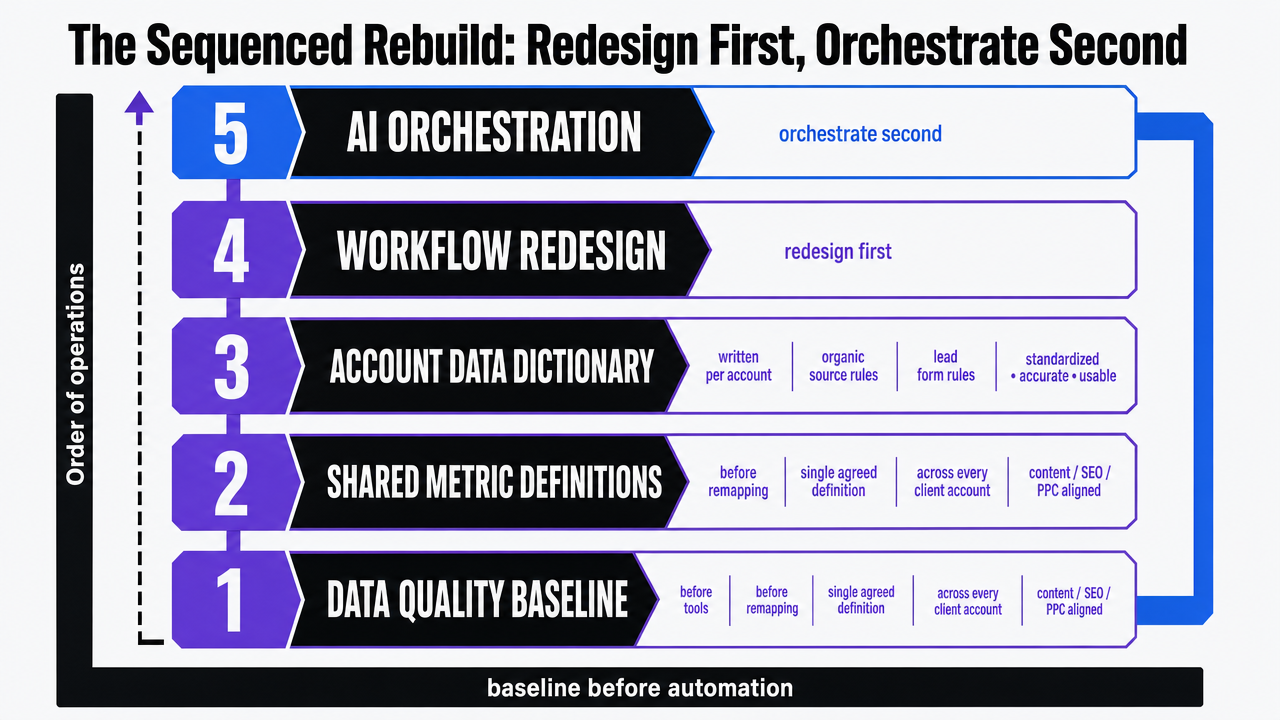
- Sequence the rebuild as data dictionary, then boundary map, then operator-led adoption, then handoff metrics—only then add AI orchestration as the connective layer, with tighter governance for multi-location healthcare accounts 8.
The Diagnostic: Agency Workflows Break at the Process Layer, Not the Tool Layer
Most agencies misdiagnose their delivery problem. When briefs slip, QA cycles stretch, and reporting falls out of sync across clients, the instinct is to swap the project management tool, hire another producer, or bolt on a generative AI assistant. The breakage almost never lives there.
Workflow automation research from the Office of the National Coordinator and NIH points to a different root cause. Inefficient workflows are described as a pervasive problem that affects everyone in the operation, and the dominant failure pattern is what the review calls the "digitized" paper workflow: a manual process copied step-for-step into software, preserving every handoff and exception that broke the original 1.
That diagnosis transfers cleanly to agency operations. A content brief routed through Slack, then a Google Doc, then a Trello card, then a CMS, then a separate reporting deck is not an automated workflow. It is a digitized version of the manual one, with the same coordination drag and the same dependency on individual memory.
The sections that follow isolate four specific failure points in that pattern, then sequence the rebuild.
Four Failure Modes Borrowed From a More Rigorous Domain
Failure Mode One: Data Quality That Cannot Survive Coordination
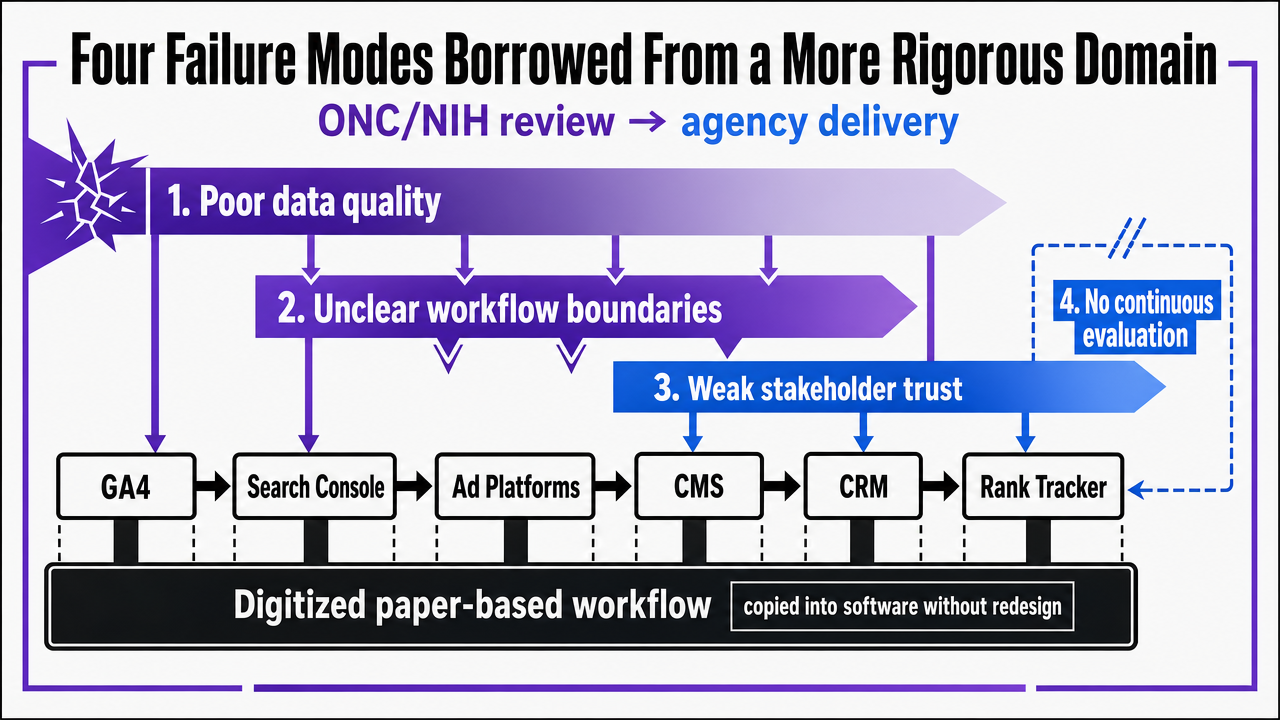
The ONC/NIH workflow automation review names four recurring failure points in operations that look productive on paper but stall under load:
- poor data quality
- unclear workflow boundaries
- weak stakeholder trust
- the absence of continuous evaluation
The review also flags the dominant anti-pattern that sits underneath all four, the "digitized" paper-based workflow that copies a manual process into software without redesigning it 1. These four failure points map cleanly onto agency delivery.
Data quality is the first one to fail because it is the input every downstream step depends on. An agency running content, SEO, PPC, and link work for a single client pulls from GA4, Search Console, ad platforms, the CMS, the CRM, and at least one rank tracker. When those sources disagree on a session count, a conversion definition, or a service-line label, the disagreement does not stay contained. It propagates into briefs, into bid decisions, into reporting decks, and into the next quarter's strategy.
An information quality framework developed for managed care argues the same point in a regulated setting: coordinating multi-step operations on inconsistent inputs produces compounding error, not just localized error 4. The agency version of that compounding error looks like a content team writing to keyword data the SEO team has already deprecated, or a PPC team optimizing toward a conversion event the analytics team renamed two weeks earlier. The tool is fine. The shared definition of the data is not.
Failure Mode Two: Undefined Process Boundaries Between Disciplines
The second failure point shows up at the seams between specialists. The ONC/NIH review describes unclear workflow boundaries as a condition where work is initiated, paused, or duplicated because no one has defined where one role's responsibility ends and another's begins 1. In agency delivery, the seams are predictable: content to SEO, SEO to PPC, PPC to analytics, analytics back to strategy.
A landing page rewrite illustrates the pattern. Content owns the copy. SEO owns the on-page structure and internal linking. Conversion owns the form and the offer. PPC owns the post-click experience for paid traffic. When none of those boundaries are written down, the page ships three times: once when content delivers a draft, again when SEO restructures the headings, and a third time when PPC swaps the hero to match an ad variant. Each rewrite is defensible inside its own discipline. None of them coordinate.
The cost is not just rework. It is the loss of any single source of truth about what the page was supposed to do. Strategy can no longer evaluate whether the original hypothesis was correct, because the artifact that tested it no longer exists in its original form. Boundary definitions are the artifact that protects the test, not bureaucracy.
Failure Mode Three: A Working Tool That No One Actually Uses
The third failure point is adoption. A digital transformation review frames it directly: technology acceptance and innovation are separate variables, and a deployed tool that operators route around is functionally identical to a tool that was never installed 5. Most agencies have a graveyard of these. The project management platform that the strategy team uses but the producers do not. The brief template that exists in Notion but lives in Slack threads. The reporting dashboard that the account team rebuilds in Google Slides every Monday because no client has ever opened the live version.
Adoption fails for two operator-level reasons. The first is that the new process adds steps without removing any, so the producer's day gets longer without getting clearer. The second is that the people running the work were not consulted on the design, so the workflow encodes assumptions that do not match how the work actually happens at 4 p.m. on a Friday with three client deadlines stacked.
The ONC/NIH review treats this as a stakeholder trust problem, not a training problem 1. More training on a workflow the operator already rejected does not change the rejection. Rebuilding the workflow with the operator at the table does.
Failure Mode Four: No Continuous Evaluation, Only Quarterly Postmortems
The fourth failure point is the easiest to miss because it looks like discipline. Agencies run quarterly business reviews. They run monthly client check-ins. They run weekly stand-ups. What they rarely run is a continuous evaluation loop on the workflow itself, separate from the evaluation of campaign performance.
The distinction matters. A campaign postmortem asks whether the work hit its targets. A workflow evaluation asks whether the process that produced the work is still capable of producing it at the next volume increment. The ONC/NIH review identifies the absence of this second loop as one of the primary reasons automation initiatives degrade after launch, because the workflow is treated as finished once it ships rather than as a system that needs ongoing measurement 1.
In agency operations, the symptom is a delivery process that worked at twelve clients and starts cracking at twenty without anyone being able to point to what changed. Nothing changed at the step level. The cumulative load on the handoffs changed, and no one was measuring the handoffs. Continuous evaluation puts the handoffs themselves on the dashboard.
 Visualize the four named failure points from the ONC/NIH review as they map onto agency delivery, supporting the section's core framework
Experience Seamless Agency Workflow Automation Risk-Free
See how automated workflows eliminate bottlenecks by publishing real campaigns during your trial—no commitment required.
The Productivity Ceiling on an Unredesigned Workflow
The ceiling on what an agency can recover by adding AI to its current process is knowable, and it is lower than most operators assume. McKinsey's modeling of generative AI's economic potential estimates that the marketing function can capture productivity gains worth 5 to 15 percent of total marketing spending 12. That range is a function-level estimate across marketing operations, not a guaranteed return on a single agency's P&L, and the report flags adoption pace, regulatory response, and organizational readiness as the variables that decide where any individual operation lands inside the band 12.
Two implications follow for agency operators. The first is that the upper bound is not the default. Capturing 15 percent assumes the workflow underneath the AI was redesigned to make the gain available. Capturing 5 percent is closer to what an agency gets when it adds a generative layer on top of the existing handoff chain and leaves the data quality, boundary, and adoption failures from the previous section untouched.
The second implication is sharper. An AI layer applied to a digitized paper workflow does not just underperform the ceiling. It amplifies the failures already in the process, because faster output on inconsistent inputs produces more inconsistent output, distributed across more clients, at higher volume 1. The productivity gain is real. The path to it runs through the rebuild, not around it.
The Sequenced Rebuild: Redesign First, Orchestrate Second
Stage One: Set a Data Quality Baseline Before Anything Else
The rebuild starts where the failures start. Before any new tool gets installed or any workflow gets remapped, the agency needs a single agreed definition of what each metric means across every client account. That sounds elementary. It is not. Most agencies discover during this stage that their content team, SEO team, and PPC team have been working from three different conversion definitions for the same client, often for months.
The information quality framework developed for managed care argues that standardized, accurate, and usable data is the precondition for any coordinated multi-step operation, not an output of one 4. The agency translation is a written data dictionary per account: which session source counts as organic, which form fill counts as a lead, which service line each landing page maps to, and which platform is the system of record when two sources disagree.
The deliverable from this stage is not a dashboard. It is a one-page reconciliation document per client that every specialist signs off on before the next stage begins. Skip this and every later stage inherits the same compounding error the original workflow had.
Stage Two: Define Process Boundaries Between Content, SEO, PPC, and Link Work
With data definitions settled, the next stage writes down where each discipline's responsibility starts and ends. The ONC/NIH review treats unclear boundaries as one of the four named failure points because work that lives between roles tends to get done twice, late, or not at all 1. The agency version requires the same explicit mapping.
For each recurring deliverable, the rebuild assigns four roles:
- Who originates the work
- Who reviews it
- Who publishes it
- Who is accountable for the outcome it was supposed to drive
A service-line landing page might originate with the SEO strategist, get drafted by the content team, get reviewed by conversion, and get published by the account lead, with SEO accountable for the organic traffic outcome and conversion accountable for the form fill rate. None of those roles overlap. None of them are implied.
Boundary definitions also specify what does not get touched after handoff. Once the page ships, PPC cannot rewrite the hero to match an ad variant without a documented test brief. The constraint protects the original hypothesis from being silently overwritten, which is the failure pattern the prior section described. Boundaries are how the workflow stops shipping the same artifact three times.
Stage Three: Earn Adoption From the Operators Who Will Run It
Stage three is where most rebuilds quietly fail. The data dictionary exists. The boundary map exists. The producers go back to running the old process anyway, because nothing about the new design accounted for how the work actually happens under deadline pressure.
Acceptance research on digital transformation makes the point directly: a deployed system that operators route around delivers no measurable gain over no system at all, and acceptance is a separate variable from technical capability 5. The practical implication is that the operators running content, SEO, PPC, and link work need to be co-authors of the new workflow, not recipients of it. That means pulling them into the boundary definitions in stage two and giving them veto power over steps that add time without removing any.
The signal that adoption is working is small and concrete. Producers stop using the old Slack channel for handoffs. The brief template gets opened directly instead of pasted into a doc. If those behaviors do not change within two cycles, the workflow is still rejected and the design needs another pass.
Stage Four: Build Continuous Evaluation Into the Workflow Itself
The fourth stage closes the loop the previous section identified as missing. Continuous evaluation means the handoffs themselves are measured, not just the campaigns that flow through them. The ONC/NIH review treats this loop as a primary reason automation initiatives degrade after launch, because workflows ship and then get treated as finished rather than as systems that need ongoing measurement 1.
Three handoff metrics are usually enough to start:
- Time from brief approval to first draft
- Time from draft to publish
- Number of reopens per deliverable after publish
Track those three at the account level and the seams where the process is failing become visible within a month.
The evaluation cadence runs separately from client reporting. Campaign performance answers whether the work hit its targets. Workflow performance answers whether the process can hold at the next volume increment. Conflating the two is how agencies discover at thirty clients that the system they built for twelve never had a measurement layer underneath it.
Only Then: AI Orchestration as the Layer on Top
With data quality, boundaries, adoption, and evaluation in place, AI orchestration becomes the layer that connects them rather than the patch that hides their absence. McKinsey's work on agentic marketing systems describes the target state as brief-to-production-to-optimization running as one continuous chain, with AI agents handling the coordination tasks that previously required manual handoffs between specialists 13. That chain only exists if the four prior stages have already built the rails it runs on.
The order matters because the failure mode of reversing it is predictable:
- AI applied to an undefined boundary produces faster ambiguity.
- AI applied to inconsistent data produces faster wrong answers.
- AI applied to a workflow operators have already rejected produces faster output that no one trusts enough to ship.
The ONC/NIH review names this directly: digitizing a broken process at higher speed does not fix the process, it scales the breakage 1.
Orchestration on a redesigned workflow looks different. A content brief generated from the reconciled data dictionary flows into production with the boundary map already encoded, gets reviewed against the adoption-tested template, and feeds the evaluation metrics automatically. The agent is not making the workflow work. The workflow was already working. The agent is removing the coordination tax.
 Visualize the five-stage sequenced rebuild described in the section, showing the order of operations from data baseline to AI orchestration
See How Top Agencies Eliminate Workflow Bottlenecks with AI Coordination
Request a workflow analysis to identify inefficiencies in your agency’s content, PPC, and backlink operations—plus, discover benchmarks for AI-driven execution at scale.
When the Account Is Multi-Location Healthcare: A Tighter Operating Standard
If You Manage Multiple Locations: Why Coordination Cost Compounds Per Site
The four failure points above apply to any agency. The math changes when the account is a healthcare operator running ten, thirty, or eighty locations under one parent brand. At that scale, coordination cost stops growing in a straight line and starts compounding per site.
Each location carries its own service line mix, its own provider roster, its own local search footprint, and its own intake process. A workflow that depends on per-location briefs, per-location approvals, and per-location reporting multiplies handoffs against every site under management. Thirty locations do not produce thirty times the work. They produce thirty times the work plus the coordination tax between every site that shares a service line, a payer mix, or a regional campaign.
Research on healthcare marketing strategy frames the requirement directly: effective patient-facing marketing depends on systematic investigation of patient needs and coordinated communication across touchpoints, not on parallel campaigns running in isolation per facility 11. An agency operating per-location workflows produces parallel campaigns by default. The redesign target is a single account-level plan that resolves to location-specific execution without rebuilding the brief, the data dictionary, or the approval chain at each site.
Governance, Privacy, and Patient-Centered Coordination as One Concern
Healthcare-adjacent marketing operations carry governance load that general B2B accounts do not. Consent capture, identity data, behavioral tracking, and conversion definitions all touch information that sits close to protected categories even when the marketing surface itself is not covered by federal health privacy law. The privacy literature argues that protections should apply to health-relevant digital data regardless of whether the specific dataset is technically regulated, because the trust cost of mishandling falls on the operator either way 8.
The governance side reinforces the same point. A narrative review of ethical and regulatory challenges in healthcare AI concludes that a governance framework is a prerequisite for AI implementation in clinical and adjacent settings, not a layer added after deployment 2. For an agency running content, paid media, and intake-facing assets across multiple healthcare locations, that means audit trails on every approved asset, version control on every claim made about a service or provider, and a documented chain of who approved what for which location.
This collapses three concerns that agencies usually treat separately. Privacy, regulatory compliance, and patient-centered communication are one workflow concern in this setting, because they share the same approval surface and the same data inputs. Splitting them across three different tools and three different owners reproduces the boundary failure from the earlier sections at the highest-consequence layer.
Economics of Per-Location Billing vs. Account-Level Execution
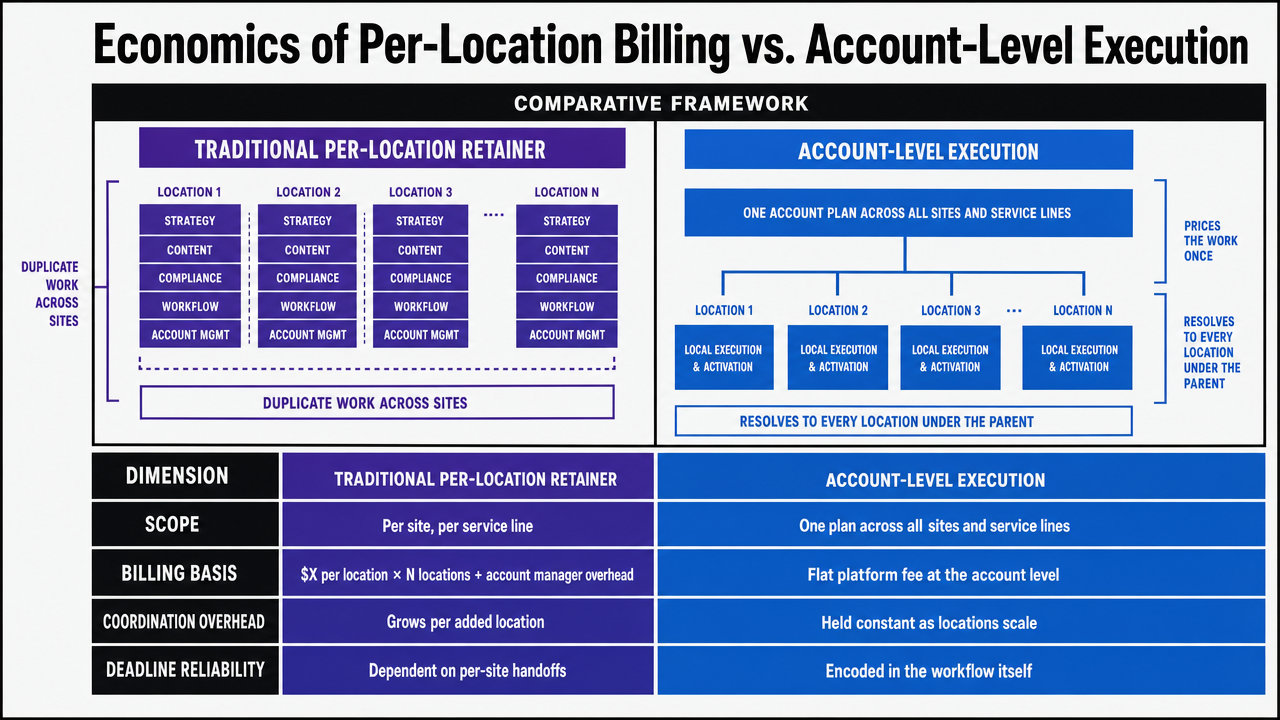
The billing model an agency uses for multi-location healthcare work shapes whether the redesigned workflow can actually scale. Per-location retainers create an incentive to duplicate work across sites because each location funds its own version. Account-level execution prices the work once and resolves to every location under the parent.
The structural comparison, expressed in variables rather than invented benchmarks:
| Dimension | Traditional Per-Location Retainer | Account-Level Execution |
|---|---|---|
| Scope | Per site, per service line | One plan across all sites and service lines |
| Billing basis | $X per location × N locations + account manager overhead | Flat platform fee at the account level |
| Coordination overhead | Grows per added location | Held constant as locations scale |
| Deadline reliability | Dependent on per-site handoffs | Encoded in the workflow itself |
| Execution model | Manual handoffs, retainer hours | Continuous, account-level production |
Research on healthcare business models notes that process change tends to fail when the underlying business model is not designed for the uncertainty the operation actually faces 9. Per-location billing is a model designed for predictable, isolated work. Multi-location growth programs are not that.
 Visualize the comparison table contrasting per-location retainer model with account-level execution for multi-location healthcare agencies
The Operator Decision Point
The decision in front of an agency operator is not whether to adopt AI. That question is already answered by the productivity math. The decision is whether to redesign the workflow first or to layer automation onto the current process and hope the breakage stays contained.
The research points in one direction. Workflow classification and redesign are now treated as prerequisites for AI adoption at the federal level, not as optional preparation 3. The agencies that capture the upper end of the productivity gain will be the ones that fixed the data dictionary, the boundaries, the adoption gap, and the evaluation loop before introducing orchestration. The ones that skipped the rebuild will scale their existing failures faster.
For agency owners running multi-location healthcare accounts, where coordination cost compounds per site, the rebuild is not a quarterly initiative. It is the operating model. Platforms like Vectoron exist because that rebuild is the work, and the work does not get done by adding headcount.
Frequently Asked Questions
References
- 1.Priorities to accelerate workflow automation in health care.
- 2.Ethical and regulatory challenges of AI technologies in healthcare: A narrative review.
- 3.America’s AI Action Plan.
- 4.An Information Quality Framework for Managed Health Care.
- 5.Digital Transformation in Healthcare: Technology Acceptance and Innovation.
- 6.A Review of the Role of Artificial Intelligence in Healthcare.
- 7.Telemedicine for healthcare: Capabilities, features, barriers, and applications.
- 8.Privacy protections to encourage use of health-relevant digital data in evidence generation.
- 9.Exploring business models for managing uncertainty in healthcare.
- 10.The digital transformation in pharmacy: embracing online platforms and telepharmacy.
- 11.The impact of marketing strategies in healthcare systems.
- 12.The economic potential of generative AI: The next productivity frontier.
- 13.Reinventing marketing workflows with agentic AI.