
Key Takeaways
- Launch-calendar product marketing breaks down when 86% of B2B purchases stall and buyers run self-directed, AI-assisted, committee-driven evaluations 5, requiring a continuous operating system instead.
- The workflow runs five connected stages — insight capture, living message architecture, lifecycle content, multi-channel orchestration, and revenue-tied measurement — each with a named owner, dated artifact, and stage-level metric.
- Coordination drag across handoffs is the real cost to optimize; AI earns a slot only where it compresses cycle time in content, orchestration, and personalization, not in hypothesis or sign-off decisions 8.
- VPs should defend the workflow with four metrics — pipeline contribution by segment, activation rate, net revenue retention with expansion ARR, and experimentation throughput — and install the loop on a 90-day sequence 10.
The launch-factory model is breaking under buyer behavior
Most SaaS product marketing functions still run like a launch factory: pick a quarter, ship a tier-one announcement, stand up a campaign microsite, drop sales enablement into the LMS, and move on. The artifact is the launch. The metric is the launch. The cadence is the launch. Meanwhile, the people on the other side of that motion have changed how they buy.
Forrester's State of Business Buying, 2024 survey of business buyers found that 86% of B2B purchases stall during the buying process, 81% of buyers report dissatisfaction with the providers they ultimately chose, and roughly 95% of buyers expect to use generative AI to support their decision and purchase process within the next 12 months 5. These are not channel-attribution problems. They are signals that the dominant buying motion is now self-directed, AI-assisted, and committee-driven across stalled, multi-stakeholder evaluations.
A launch-and-campaign workflow assumes a buyer who shows up at a moment of intent, consumes a curated narrative, and converts. Forrester's data describes the opposite: buyers who pause, regroup, query an LLM, share artifacts across a buying group, and frequently choose a vendor they later regret.
Product marketing built around discrete launches does not address any of this. The discipline needs a continuous workflow that captures buyer signal, refreshes positioning, produces lifecycle content, orchestrates channels, and measures revenue outcomes on a repeating loop. The remainder of this article specifies that workflow.
Why product marketing now runs as an operating system, not a launch calendar
The shift is structural. McKinsey's analysis of software product marketing argues that the PMM role is becoming a differentiator for the most successful software providers precisely because the function now owns customer-insight loops, pricing, sales enablement, and lifecycle messaging as connected responsibilities rather than discrete projects 1. A launch calendar cannot hold that scope. An operating model can.
Forrester's framing of lifecycle revenue marketing makes the same point from the demand side. The discipline is defined as a customer-obsessed growth strategy that spans the entire customer lifecycle and the full range of buying motions and opportunity types — acquisition, activation, retention, and expansion — not a sequence of launches 10. That definition pushes product marketing out of the announcement business and into continuous program management against revenue stages.
The structural argument matters because the alternative is already failing. Forrester's research on B2B buying shows that digital and self-service interactions now appear across every stage of the purchase, with buyers completing tasks autonomously that sales teams once mediated 6. Product marketing that ships a launch microsite and waits for sales to carry the narrative forward is not present in the rooms where decisions actually get made.
McKinsey's marketing operating model work names the structural requirement directly: integrated planning, agile squads, and tech-enabled content operations that make marketing both faster and more accountable 9. Those are operating-system properties — shared data, repeatable rituals, instrumented handoffs — not campaign properties.
The practical consequence for a Series B–D SaaS team is that the calendar artifact has to change. Quarterly launch grids give way to a continuous backlog organized by lifecycle stage, fed by buyer signal, and measured against revenue outcomes. Launches still happen inside that system, but they stop being the organizing principle. The workflow is.
The five-stage workflow: inputs, artifacts, owners, and metrics
Stage one — Insight capture: turning buyer signal into a working hypothesis
Insight capture is the input layer of the workflow. Its job is to convert raw buyer signal into a working hypothesis that the rest of the system can act on. Without it, positioning drifts, content gets written to internal preferences, and channel teams optimize against proxies instead of customers.
The input set is broader than most SaaS teams currently treat it. Win/loss interviews and CRM stage data are table stakes. The harder inputs are the ones McKinsey flags as core PMM territory: customer-insight loops that combine qualitative interviews, product telemetry, pricing sensitivity, and competitive intelligence into a continuous feed rather than a quarterly research project 1. Forrester's work on self-service buying adds another input source that most teams underweight — the digital trail buyers leave while completing evaluation tasks on their own, including content consumption patterns, third-party review behavior, and the questions buyers bring to vendor sites already partially decided 6.
The artifact this stage produces is a working hypothesis document: a short, dated brief that states what the team now believes about the segment, the job to be done, the competitive frame, and the objections that are currently stalling deals. It is owned by the product marketing lead, refreshed on a fixed cadence, and explicitly versioned so downstream teams can tell when the hypothesis has changed.
The metric is hypothesis-to-evidence ratio: how many claims in the brief are backed by primary or behavioral data versus internal assertion. A brief running below roughly two-thirds evidence-backed is not ready to drive the next stage.
Stage two — Positioning and message architecture as a living artifact
Positioning fails when it is treated as a launch deliverable. It has to be a living artifact that updates as the insight hypothesis updates. The input to this stage is the dated brief from stage one. The artifact is a message architecture document that maps category frame, primary value claims, proof points, objection responses, and persona-specific language variants.
McKinsey's framing of experience-led growth pushes positioning past feature claims into journey-level value creation, with the explicit point that growth aspirations have to be anchored to customer experience and measured with CX and revenue metrics, not campaign output 3. That standard rules out positioning documents that read as internal feature taxonomies. It also rules out the common pattern of writing one master narrative and letting channel teams improvise variants.
The owner is product marketing, but the document is co-signed by product and sales leadership on a fixed review cycle — typically every six to eight weeks for a Series B–D team. Co-signing is what keeps it a living artifact instead of a forgotten PDF. When a sales leader can point to the line in the architecture that her team is now objecting against, the document is working.
The metric here is message adoption rate across surfaces: how consistently the current architecture appears in the top-traffic web pages, the active sales decks, the highest-engagement nurture sequences, and the paid ad copy in market. Architecture that exists only in a Notion doc is not positioning. It is intent.
Stage three — Lifecycle content production across pre- and post-sale
Content production is where most SaaS teams discover that their workflow is actually a backlog. The input to this stage is the message architecture. The artifact is a lifecycle content map: assets planned, produced, and instrumented against each stage of the buyer and customer journey, from first-touch awareness through onboarding, adoption, retention, and expansion.
Forrester's B2B content guide is specific about what this requires. Tech buyers expect relevant vendor content both before and after purchase, in different formats and channels depending on where they are in the lifecycle, with explicit needs for evaluation content during selection and value-realization content during onboarding and adoption 11. A workflow that produces five tier-one launch assets per quarter and nothing for activation or expansion is misallocated against how buyers actually consume.
Forrester's lifecycle revenue marketing framing reinforces the same point structurally: the discipline spans the entire customer lifecycle and the full range of buying motions, not the pre-sale funnel alone 10. That means the content map has to include post-sale assets owned by product marketing — onboarding sequences, feature adoption guides, expansion narratives — not handed off to customer success and forgotten.
The owner is a content lead reporting into product marketing, with editorial accountability for the full lifecycle map rather than a single funnel stage. The metric is stage coverage and stage performance: every lifecycle stage has a current asset in market, and each asset carries a primary metric tied to its stage — pipeline influenced for evaluation content, activation rate for onboarding content, expansion ARR for post-sale content. Asset count without stage-level performance is vanity output.
Stage four — Multi-channel orchestration against one acquisition plan
Orchestration is the stage that exposes whether the rest of the workflow is actually integrated. The input is the lifecycle content map. The artifact is a single customer acquisition plan that coordinates SEO, paid media, backlinks, lifecycle email, partner channels, and sales-led outbound against the same positioning, the same segments, and the same revenue targets.
The bar for what counts as orchestrated is higher than most teams assume. McKinsey's B2B growth research sets the benchmark explicitly: the new bar for omnichannel excellence is ten or more channels across three engagement modes — in-person, remote, and self-service — delivered 24/7 and coordinated through shared data and technology 7. That is a coverage matrix, not a channel list. A team running paid search, organic, and outbound is operating at roughly a third of the benchmark, and usually running each channel against a different brief.
The structural failure mode is siloed channel ownership. When the SEO team optimizes for keyword clusters that no longer match the current message architecture, when the paid team buys terms that pull traffic to pages written for a prior positioning, and when the backlink program targets domains aligned to last year's category frame, the workflow is producing channel output without orchestrated effect. McKinsey's marketing operating model work names the structural fix: integrated planning and tech-enabled content operations that make execution both faster and more accountable across teams 9.
The owner is a growth or demand lead working from the same plan as product marketing, with explicit handoff rituals — weekly channel reviews, shared experiment backlogs, and a single source of truth for which message variants are live where. The metric is channel coverage against the buyer journey and contribution to pipeline by stage, not channel-level vanity volume. A channel that delivers traffic outside the segments named in the working hypothesis is misallocated capacity, regardless of its individual performance numbers.
Stage five — Measurement and learning tied to revenue lifecycle metrics
Measurement closes the loop. The input is everything the prior four stages put in market. The artifact is a measurement framework that ties each stage of the workflow to revenue lifecycle metrics and feeds learnings back into the next insight-capture cycle.
Forrester's lifecycle revenue marketing framework names the metric spine directly. Marketing performance should be measured across acquisition, activation, retention, and expansion, aligned with revenue teams around value realization rather than lead volume or initial deal close 10. That definition rules out dashboards that stop at MQLs. It also rules out the common pattern of measuring each channel against its own conversion metric and never reconciling the numbers to pipeline reality.
McKinsey's B2B Pulse research adds the experimentation discipline that makes the loop productive. High-growth B2B companies commit to continuous experimentation and a deliberate channel mix — the report's rule-of-thirds framing of traditional, digital, and ecosystem channels — as a standing practice, not a quarterly initiative 8. Embedded in the workflow, that means each measurement cycle produces a small set of named experiments queued for the next cycle, with explicit hypotheses linked back to the insight brief.
The owner is the VP of marketing, with operational accountability shared across product marketing, demand, and revenue operations. The metric is the integrity of the loop itself: every stage has a primary metric in market, every metric reconciles to a revenue lifecycle outcome, and every measurement cycle produces a versioned update to the insight brief. A workflow that produces dashboards but not hypothesis updates is reporting, not learning.
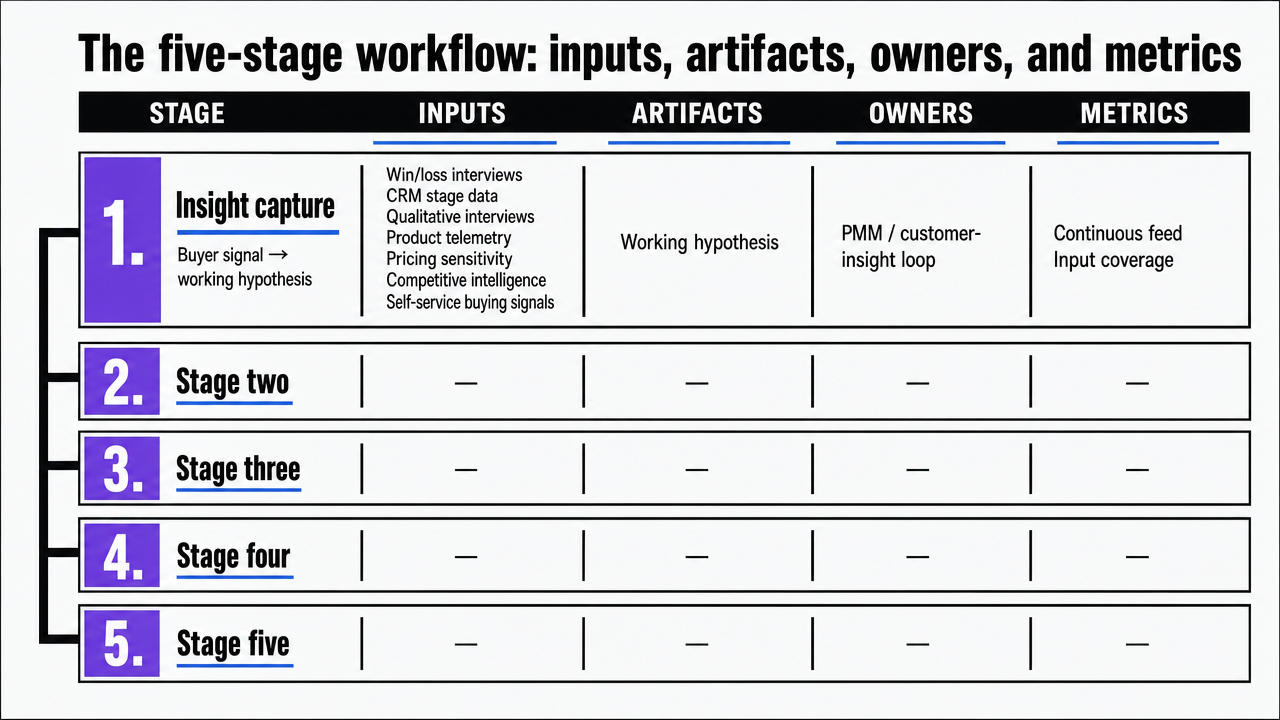 Visualize the five sequential workflow stages with their owners, artifacts, and stage-level metrics as described in the section
Test a Unified Workflow for Product Marketing
Run your full product marketing workflow and measure live outcomes before you commit.
Staffing and coordination economics: traditional model vs. integrated workflow
The hidden cost of the launch-factory model is not the line items on the agency invoice. It is the coordination tax that compounds every time a stage hands off to a different owner running a different brief on a different cycle. McKinsey's marketing operating model work names the structural fix as integrated planning, agile squads, and tech-enabled content operations that make marketing both faster and more accountable across teams 9. The implication is uncomfortable for most Series B–D SaaS teams: the cost center to optimize is the handoff, not the headcount.
The table below maps each workflow stage to its typical traditional ownership, the coordination drag that ownership creates, and what changes when a single integrated workflow runs the same stage. Cycle times reflect the handoff pattern, not the underlying production work.
| Workflow stage | Traditional ownership | Coordination drag | Integrated workflow ownership |
|---|---|---|---|
| Insight capture | In-house PMM + research vendor | 4–6 week cycles; 3+ handoffs between research, PMM, and product | PMM owns continuous signal feed; research vendor consulted for depth, not cadence |
| Positioning and message architecture | In-house PMM + brand agency | 6–8 week rewrites; agency interprets brief, PMM re-edits, leadership re-reviews | PMM owns living document co-signed by product and sales on fixed cycle |
| Lifecycle content production | Content agency + freelancers + in-house editor | Per-asset briefing; 2–3 handoffs per piece; no shared lifecycle map across vendors | Content lead inside PMM with tech-enabled production against one lifecycle map |
| Multi-channel orchestration | Separate SEO agency, paid agency, link-building vendor, in-house demand | Each vendor briefed separately; channel briefs drift from current positioning | Growth lead works from one acquisition plan; channels share message variants |
| Measurement and learning | Each vendor reports its own KPIs; in-house analyst reconciles | Channel-level dashboards never reconcile to pipeline reality | Shared measurement framework tied to acquisition, activation, retention, expansion |
The point is not that agencies are obsolete. It is that coordination drag is the real economic variable, and an integrated workflow collapses the handoff count rather than the vendor count. Teams that consolidate ownership without redesigning the rituals around it tend to recreate the same drag inside the building.
Where AI earns its place inside the workflow
AI deserves a slot inside the workflow only where it changes the unit economics of a specific stage. Three places clear that bar today: content velocity in the production stage, channel orchestration in the multi-channel stage, and personalization across the lifecycle. The rest is decoration.
McKinsey's work on generative AI in consumer marketing maps cleanly onto B2B lifecycle execution. The underlying mechanics — multimodal inputs, deeper profile understanding, AI-recommended offers and next-best actions — produce higher-quality data insights that surface new campaign ideas and better-targeted customer segments 2. Translated to the workflow: AI compresses the time between an insight-brief update in stage one and a refreshed asset variant going live in stage three, from weeks to days. That compression is the point. It is what makes the loop run at the cadence buyers now expect.
Channel orchestration is the second earned slot. Hitting the McKinsey omnichannel bar — ten or more channels across in-person, remote, and self-service — with siloed teams running separate briefs is mechanically impossible at a Series B–D headcount. AI-orchestrated execution against one acquisition plan is how that math works.
McKinsey's B2B Pulse 2024 names the third use directly: generative AI has become a critical lever in the operating models of high-growth B2B companies, alongside continuous experimentation and a deliberate channel mix 8. The discipline that earns AI its slot is experimentation throughput. AI is useful where it multiplies the number of message variants, segments, and channel combinations a team can test per cycle without multiplying headcount.
Where AI does not earn a slot: replacing the working hypothesis in stage one, signing off on the message architecture in stage two, or owning the board-facing measurement narrative in stage five. Those remain human judgment calls. The workflow uses AI to scale execution between them, not to abdicate them.
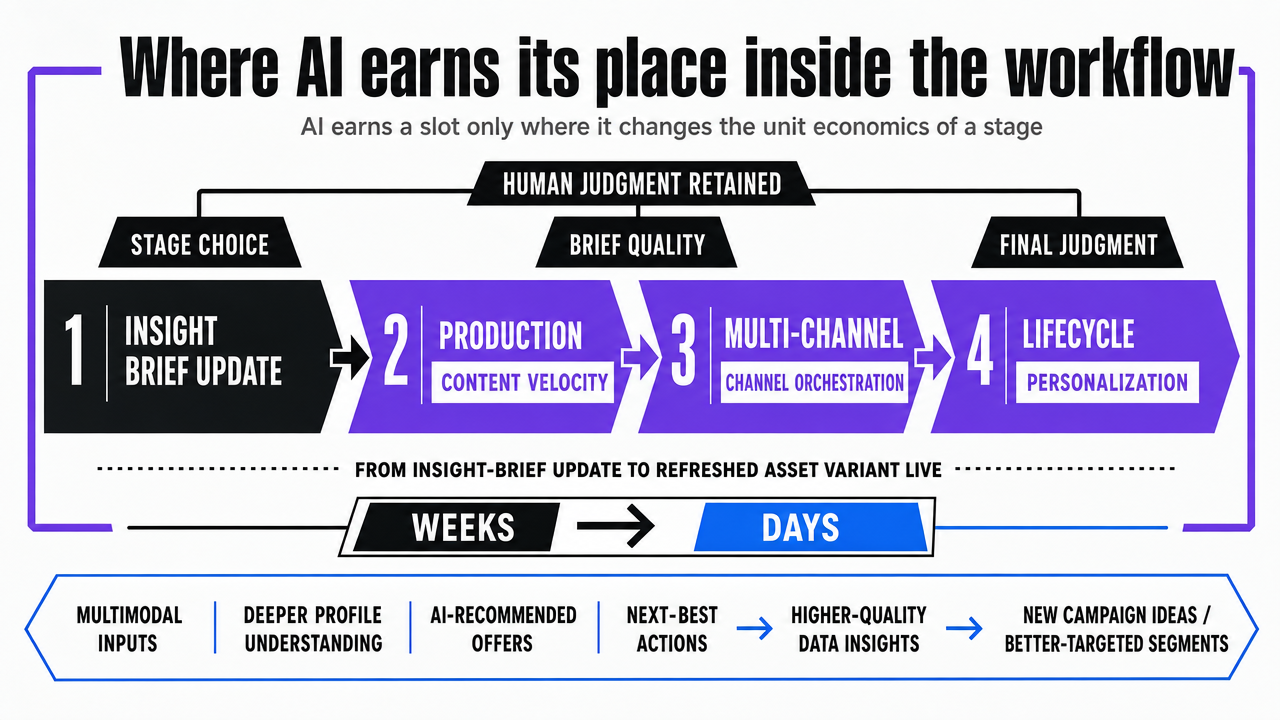 Show the three places AI earns a slot in the workflow versus the three places where human judgment is retained, as a comparison framework
Where the workflow breaks: regulated verticals, buying committees, attribution gaps
The workflow described above assumes a few conditions that do not hold everywhere. Three failure modes deserve direct treatment before a VP installs the system:
- Compliance-heavy verticals
- Buying committees that exceed what any single message architecture can address
- Attribution gaps that distort the measurement loop
The first failure mode is regulated execution. Most SaaS readers will not feel this acutely, but teams selling into healthcare, life sciences, or financial services run into review cycles that break the velocity assumption inside stage three. McKinsey's pharma work shows the workaround rather than the exception: AI-assisted medical, legal, and regulatory review can produce ultratargeted materials in-house while still clearing strict compliance constraints 4. The workflow holds, but the cadence has to be re-tuned around review SLAs, and the message architecture in stage two carries an extra column for approved claim language.
The second failure mode is the buying committee. Forrester's 2024 research on business buying is explicit that the dominant motion is now multi-stakeholder, with buyers using genAI to support decisions across a group rather than a single evaluator 5. A single persona-led message architecture will under-serve those committees. The fix is structural: stage two has to produce role-specific variants — economic buyer, technical evaluator, end user, executive sponsor — and stage four has to deliver them through channels each role actually uses, not a single nurture track.
The third failure mode is attribution. Self-service buying means much of the decision happens on surfaces the vendor cannot fully instrument 6. Channel-level conversion data will under-credit content that influenced the decision before any tracked click. The honest response is to anchor stage-five measurement in pipeline contribution and lifecycle outcomes rather than last-touch attribution, and to accept that some of the workflow's most valuable output will never show up cleanly in a dashboard.
See How Top SaaS Teams Standardize Product Marketing Workflows
Request a walkthrough of data-driven workflow automation for aligning SEO, PPC, and content production—built for agencies and enterprise marketing teams managing complex product portfolios.
The metrics a VP can defend in a board review
A workflow that cannot be defended in a board review is not a workflow. It is a slideware. The measurement stack that holds up under board scrutiny is small, mapped to lifecycle stages, and reconciles to revenue rather than channel volume.
Four metrics carry the weight:
- Pipeline contribution by segment, anchored to the working hypothesis in stage one, answers whether insight capture is pointed at the right buyers.
- Activation rate among new customers, drawn from Forrester's lifecycle revenue marketing spine, answers whether stage-three content is doing post-sale work rather than only pre-sale work 10.
- Net revenue retention and expansion ARR answer whether the workflow is producing value realization, not just initial close.
- Experimentation throughput — the count of named experiments shipped per cycle with documented hypotheses and outcomes — answers whether the loop is actually learning, a discipline McKinsey identifies as a defining practice of high-growth B2B companies 8.
What does not belong in a board deck: MQL counts, channel-level CTRs, and asset production volume. Those are operating telemetry for the team, not evidence of growth. A VP who shows up with four lifecycle metrics and a versioned experiment log has a defensible workflow. One who shows up with a dashboard of forty has reporting.
Installing the workflow: a 90-day sequence and a category note
A 90-day install is enough to get the loop running, not enough to perfect it. The point of the sequence is to stand up every stage at minimum viable depth so the workflow starts producing learnings, then iterate from there.
- Days 1–30: rebuild stage one and stage two. Run win/loss interviews against the last two quarters of closed deals, reconcile findings against product telemetry and self-service buying signal 6, and publish a dated working hypothesis. Rewrite the message architecture against that hypothesis and get product and sales leadership co-signed.
- Days 31–60: build the lifecycle content map and audit existing assets against it. Most teams will discover heavy pre-sale coverage and almost no activation or expansion content 11. Fill the largest stage gap first.
- Days 61–90: consolidate channel briefs into one acquisition plan and stand up the measurement framework against acquisition, activation, retention, and expansion 10. Ship the first three named experiments.
Running this loop at the cadence buyers now expect is where AI-orchestrated execution earns its keep. Vectoron is one category example of a platform built to run the workflow end-to-end.
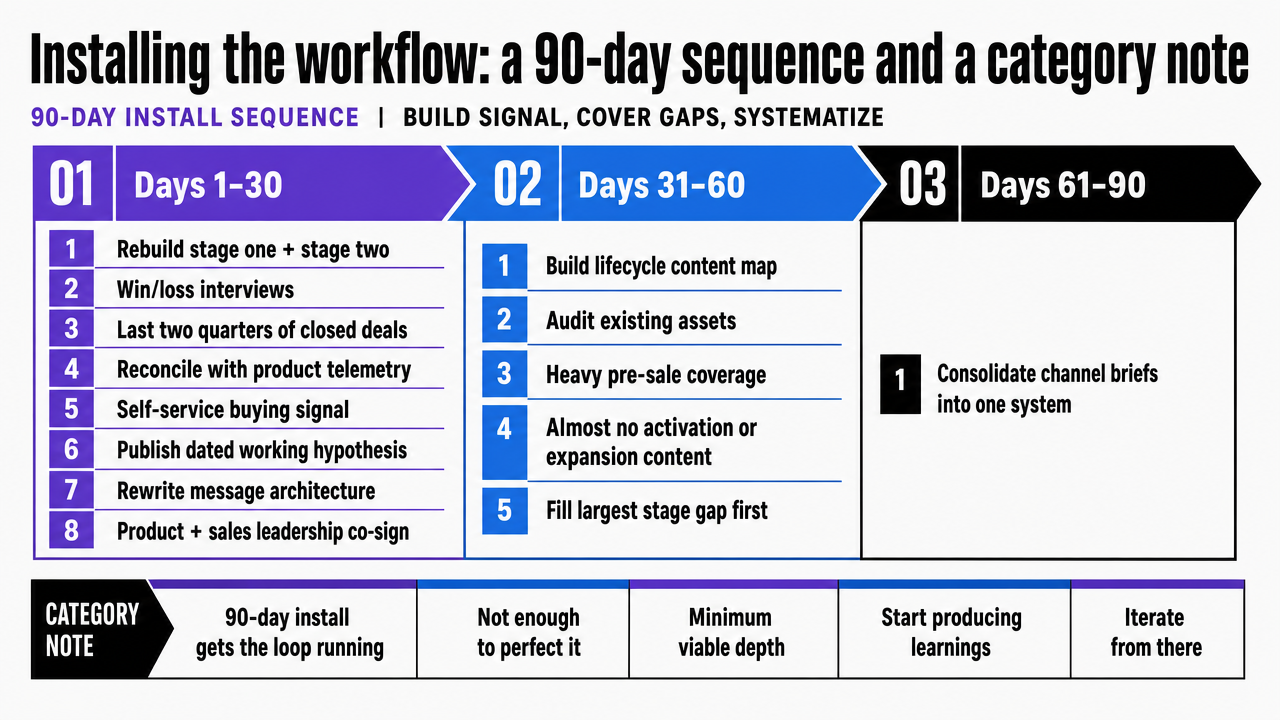 Visualize the explicit 90-day install sequence with dated milestones referenced in the section
Frequently Asked Questions
References
- 1.The importance of software product marketing managers.
- 2.How generative AI can boost consumer marketing.
- 3.Experience-led growth: A new way to create value.
- 4.Generative AI in the pharmaceutical industry: Moving from hype to reality.
- 5.The State Of Business Buying, 2024 - Forrester.
- 6.Self-Service Buying Is A Wake-Up Call For B2B Sales.
- 7.The new B2B growth equation.
- 8.McKinsey B2B Pulse 2024 (Five fundamental truths: How B2B winners keep growing).
- 9.A makeover for your marketing operating model (MOM).
- 10.Lifecycle Revenue Marketing: The Key To B2B Marketing Growth.
- 11.The B2B Content Guide: Pre- And Post-Sales Content.
- 12.B2B Event Content Best Practice To Drive Audience Engagement.