
Key Takeaways
- A production workflow is the governed facilitation of a business process through declared rules, routes, and roles, not a task list or duplicated project template 2.
- The distinction between process definition and process instance is diagnostic: without a stable definition every case follows, an agency has habits and templates, not a workflow 3.
- Task-driven workflows advance on completion dependencies, while data-driven workflows trigger on signals like ranking drops or CPL spikes, initiating work when business conditions warrant 11.
- Redesign should sequence eliminate, synchronize, streamline, then automate; automating a step that should have been cut only encodes the waste 9.
Why the definition matters for agency margins
Most agency operators can describe their production workflow. Fewer can define it in terms strict enough to audit. A production workflow, in the formal sense used by the Workflow Management Coalition, is the computerized facilitation of a business process, in whole or in part 1. It is not a Trello board, not a briefing doc, and not a shared calendar. It is a governed system of task definitions, routing rules, and roles that turns creative work into a repeatable, measurable process 2.
The margin implication is direct. Coordination overhead, revision cycles, and status meetings compound on every retainer account. McKinsey estimates generative AI could address up to 60% of marketing tasks when workflows are rewired around human-AI collaboration 8. Agencies that cannot define their workflow with precision cannot redesign it, and cannot capture that productivity without also breaking quality control.
What a production workflow actually is
The formal definition: process, template, and instance
The Workflow Management Coalition frames a workflow as the computerized facilitation or automation of a business process, in whole or in part 1. This phrasing separates the business process from its execution and treats software support as the mechanism that makes the process repeatable rather than incidental to it.
Two terms clarify the rest. A process definition is the template: the ordered set of tasks, dependencies, inputs, and outputs that describe how a piece of work should move from request to completion 3. A process instance, or case, is a single run of that template against real inputs 3. For example, one blog post moving through drafting, editing, and client approval is an instance. The documented sequence that governs every blog post is the definition.
For agency operators, the distinction is diagnostic. If the shop cannot point to a stable process definition that every case follows, what exists is a habit, not a workflow. A structured sequence of tasks with declared dependencies and objectives is the minimum bar 7. Anything looser is coordination by memory.
Anatomy: rules, routes, and roles
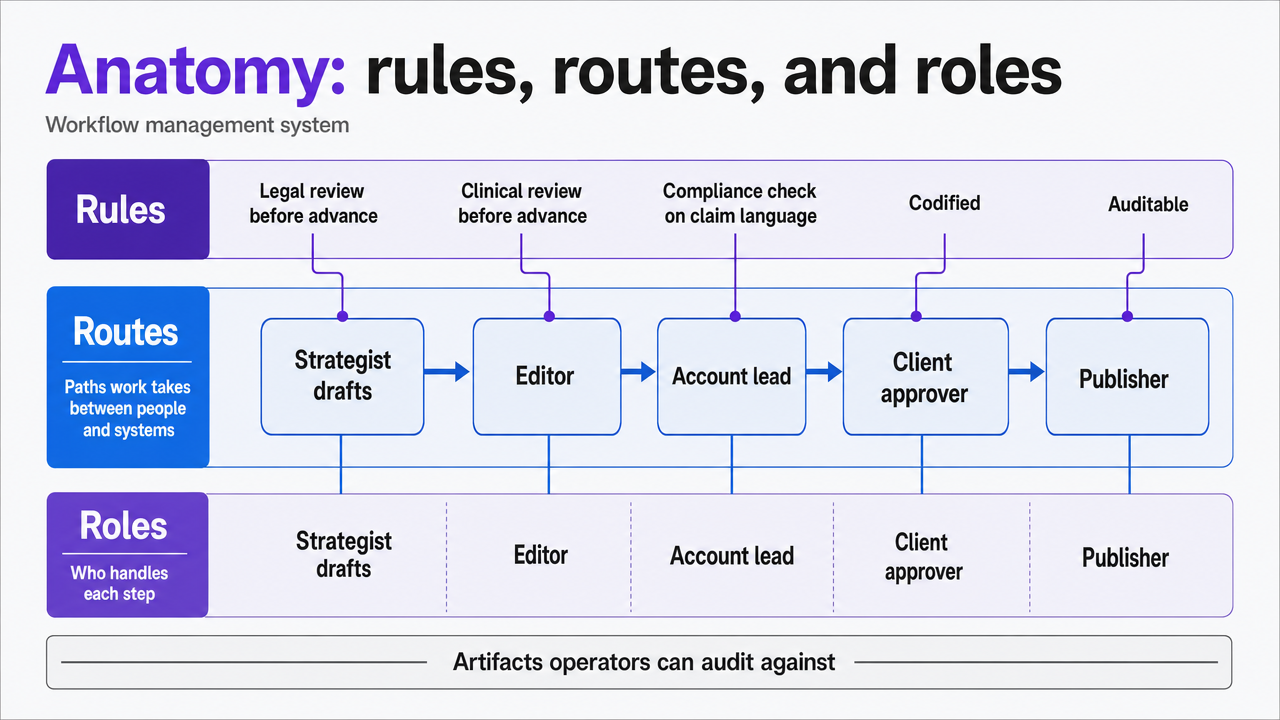
The Center for Technology in Government classifies workflow management systems along three components: rules, routes, and roles 2. Each maps to an artifact agency operators can audit against.
Rules are the conditions that govern what happens to a piece of work and when. For instance, a rule might state that healthcare copy requires legal or clinical review before it advances, or that a paid social ad cannot ship without a compliance check on claim language. Rules are the codified version of what senior operators enforce informally. Written down, they become auditable; left in someone's head, they become the reason a client escalation lands on the principal's desk.
Routes are the paths work takes between people and systems. Examples include strategist drafts to editor, editor to account lead, account lead to client approver, and approver to publisher. Routes define handoffs, and handoffs are where most agency margin leaks. A route that requires three status pings to advance is a route that has not been designed.
Roles are the responsibilities attached to each step: approver, executor, reviewer. Roles are not job titles. One person can hold multiple roles across a case, and one role can be filled by different people across cases. The point is that every task has a declared owner and a declared approver before the case begins, not after a delay surfaces the question.
An operator can audit an existing workflow in an afternoon by asking, for each recurring deliverable, whether the rules are written, the routes are drawn, and the roles are assigned. Gaps in any of the three predict where cases will stall.
Production workflow vs. project template vs. task list
These three terms are often used interchangeably in agency operations, but they are not the same thing.
A task list enumerates what needs to happen. It has no routing logic, no approval structure, and no persistent definition. A Google Doc with checkboxes is a task list. It captures work but does not govern it.
A project template adds sequence and standard assignments. Duplicating a Trello board or an Asana project for each new client engagement produces a project template. It reduces setup time and encodes a rough playbook, but it is still oriented around a single engagement rather than a repeatable production line. Changes to how the work should run tend to happen in each copy, not in the source.
A production workflow is the movement of documents and tasks through a defined business process, supported by rules, routes, and roles that persist across every case 2. The definition lives in one place. Every instance runs against it. When the process changes, it changes once and applies going forward. Reproducibility, reliability, and monitoring are properties of the definition, not of individual runs 4.
The practical test is whether last month's blog production and next month's ran through the same declared system. If not, the shop has templates, not a workflow.
Task-driven and data-driven architectures
The traditional task-driven model
Most agency workflows still run on the task-driven model. A task begins when its parent tasks have completed 11. For example, the editor edits after the writer submits. The account lead reviews after the editor signs off. The client sees the deliverable after internal QA closes. Completion cascades downward, one dependency at a time.
The model has real strengths. Sequence is legible. Ownership is explicit at each step. A production lead can look at any case and know who holds it. Foundational workflow research treats this as the default enactment pattern: business processes captured as ordered specifications, with each activity gated by the finish state of the previous one 10.
The weakness surfaces in retainer work. Task-driven graphs assume the trigger for the next step is always human sign-off inside the workflow. When the actual trigger is something happening outside it — a keyword losing position, a landing page bounce rate climbing, a client's competitor launching a new offer — the workflow does not know. Someone has to notice, then start the case manually. That noticing is where the coordination tax lives.
The data-driven shift: triggers over completion dependencies
The alternative is a data-driven workflow. In this model, tasks are triggered by data inputs and outputs rather than by task completion dependencies 11. The workflow watches signals. When a signal crosses a threshold, the relevant case starts on its own.
The distinction is architectural, not cosmetic. A task-driven blog production workflow starts because a strategist added a card to the queue. A data-driven version can start because a monitored URL dropped three positions on a target query, because a topic cluster's aggregate impressions declined week over week, or because an existing post crossed a staleness threshold in the content inventory. The next task in each case is not the next task after the previous one finished. It is the task appropriate to the data condition that fired.
The same applies across channels. A Cost Per Lead (CPL) that jumps above a client's tolerance can trigger a paid-search audit case. A call-tracking flag on missed qualified calls can trigger an intake copy review. An approval status change in the client's queue can release a batch of downstream production tasks that were waiting on it. Each of these is a trigger sourced from data flowing through the system, not a manual handoff.
The trade-off is real. Task-driven workflows are simpler to specify and easier for a small team to keep in their heads. Data-driven workflows require declared signals, thresholds, and monitoring infrastructure before they can run, and that complexity has to be paid for once, up front 11. What operators get in return is a workflow that initiates work when the business condition warrants it, rather than when someone remembers to open the board.
The human-oriented to system-oriented continuum
Task-driven versus data-driven is one axis. The other is how much of the workflow humans perform directly versus how much the system enacts. Foundational research places workflows along a continuum: at one end, human-oriented workflows in which humans collaborate on tasks and coordinate handoffs among themselves; at the other, system-oriented workflows in which software performs the tasks and humans supervise 10.
Agency production almost never sits at either extreme. A blog case might have system-oriented drafting, human-oriented editorial judgment, and a system-oriented publish step. A PPC case might have system-oriented variant generation and a human-oriented approval gate on claim language. The continuum matters because it forces operators to declare, task by task, where the work should live. A workflow that treats every task as human-oriented cannot absorb throughput gains. A workflow that treats every task as system-oriented removes the judgment layer clients pay for.
The operator decision is not whether to be human-oriented or system-oriented in the abstract. It is which specific tasks in a defined process should shift along that continuum, and what approval structure protects the ones that should not move.
Test AI-driven production workflows in real time
Experience streamlined content approval and publishing across all channels before making a commitment.
Three production workflow examples from agency delivery
Blog production: brief to published
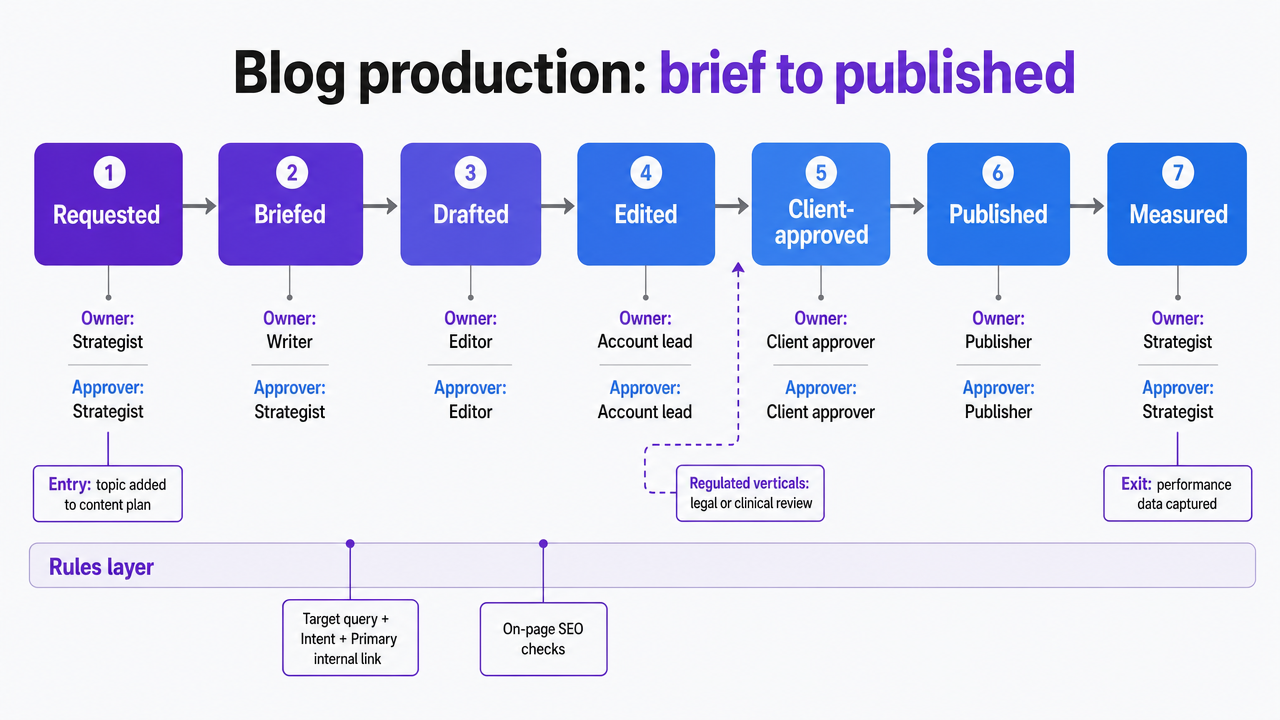
Blog production is the workflow most agencies think they have defined and most have not. The process definition should specify seven states, each with a declared owner and a declared approver: requested, briefed, drafted, edited, client-approved, published, and measured 3. A case enters at requested when a topic is added to the content plan. It leaves at measured when performance data is captured against the case, not when the URL goes live.
The rules layer governs what can advance. A brief without a target query, a search intent classification, and a primary internal link target does not move to drafted. A draft without on-page SEO checks does not move to edited. Regulated verticals add a legal or clinical review rule before client-approved 2. The route runs strategist to writer to editor to account lead to client approver to publisher, with a monitoring hand-back to the strategist for the measurement state.
The failure mode most operators recognize is a case that stalls in client-approved for weeks while everything downstream waits. That is a routing problem, not a client problem. A workflow that treats external approval as an untimed step guarantees the delay compounds across the portfolio.
SEO deliverables: audit, fix, verify
SEO deliverables illustrate why interdependent tasks need declared inputs and outputs, not just an order 6. The process definition runs three phases: audit, fix, and verify. Each phase produces artifacts that become inputs to the next.
Audit outputs a ranked list of issues with severity, affected URLs, and estimated effort. Fix consumes that list and outputs implemented changes with before-and-after snapshots. Verify consumes the snapshots and outputs a signed report showing which issues resolved, which regressed, and which still need a second pass.
Roles matter more here than in blog production. The auditor and the verifier should not be the same person on the same case. Splitting the role is the rule that keeps the workflow honest. Routes vary by fix type: on-page changes route through the content team, technical fixes route through development, and off-page work routes through outreach. The workflow definition holds all three routes; the case selects which apply based on the audit output.
PPC creative rotation: signal, generate, approve, ship
PPC creative rotation is the clearest example of a data-driven trigger in agency production. The task-driven version starts because someone on the account team remembered to refresh ads. The data-driven version starts because a monitored signal fired: CTR dropped below a threshold, frequency crossed a ceiling, or a variant's conversion rate degraded week over week 11.
The process definition has four states: signal, generate, approve, ship. Signal is the trigger condition, declared per client with thresholds documented in the account playbook. Generate produces new variants against the current best performer, with claim language checked against the client's approved messaging. Approve routes to the account lead for internal QA and to the client for sign-off on regulated claims. Ship pushes the variants live and starts the next observation window.
The rule that protects margin is that Signal is the only entry point. Ad-hoc refresh requests get logged as signals with a stated reason, or they do not enter the workflow. Otherwise the case queue fills with work that is not tied to a measured business condition.
AI execution under human approval
Where gen AI fits in the task graph
The productivity question is not whether AI belongs in agency production. It is where in the task graph it sits, and what remains a human decision. McKinsey's analysis of marketing organizations puts an upper bound on the first half of that question: generative AI could power as much as 60% of marketing tasks when workflows are rewired around human-AI collaboration 8. This figure is a task-level applicability estimate across marketing functions, not a productivity guarantee and not a headcount forecast. It describes what gen AI can plausibly touch inside a redesigned workflow, not what any given agency will capture without changing how work is defined.
Read against the task graph, the number is easier to use. In the blog production definition, drafting, on-page SEO checks, meta generation, and internal link suggestions sit on the addressable side. Editorial judgment on angle, source vetting, and client-context nuance do not. In the PPC rotation, variant generation and claim-language pre-screening are addressable. Approval on regulated claims is not. In SEO deliverables, audit output, issue classification, and verification checks are addressable. Deciding which fixes get shipped to which client, in what order, remains a human call.
The design question shifts from which tasks can AI do to which tasks in this defined process should shift along the human-oriented to system-oriented continuum 10. The task graph is the unit of analysis, not the job description.
Approval gates as the design constraint
Once execution capacity stops being the bottleneck, approval structure becomes the binding constraint on throughput and quality. A workflow that can generate ten variants in the time it took to write one still cannot ship faster than its slowest gate. That is a feature, not a defect, provided the gates are placed where judgment actually matters.
Approval-first design starts by declaring, for each task in the process definition, whether the output requires human sign-off before the case advances and who holds that authority 2. The gates that survive scrutiny share a pattern: they sit at points where a wrong output creates a client-visible or regulatory consequence that cannot be undone cheaply. This includes claim language in a regulated vertical, publish actions on a client domain, and budget shifts on paid media. Everything else can route through lighter review or run without a gate.
The rule that protects margin is that approval routing is part of the workflow definition, not a courtesy step added at runtime. Every generated output arrives at a named approver with the strategic reasoning attached, so the reviewer decides on substance rather than reconstructing context. Gates without that attachment become bottlenecks; gates with it become the mechanism that lets AI throughput scale without eroding the judgment clients pay for.
Redesigning a production workflow: eliminate, synchronize, streamline, automate
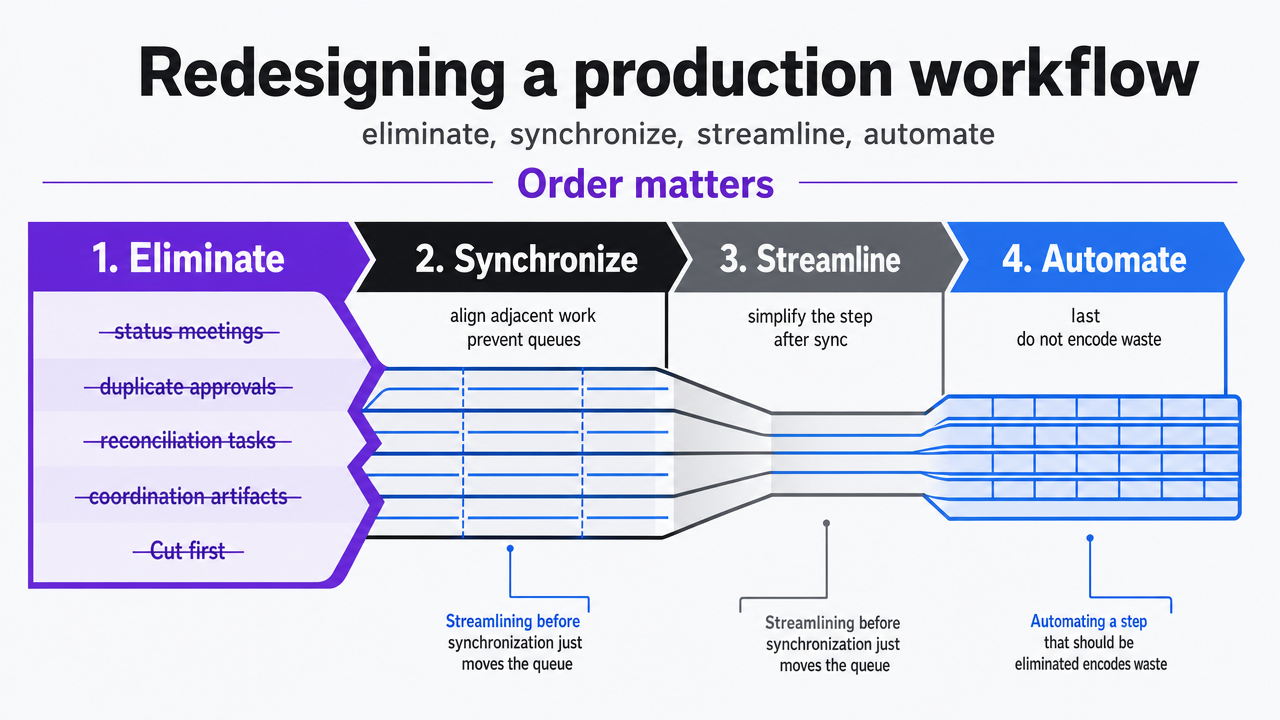
Once the process definition is written and the gates are placed, the next question is which parts of the workflow should not exist at all. McKinsey's process optimization framework sequences the redesign in four moves: eliminate, synchronize, streamline, automate 9. The order matters. Automating a step that should have been eliminated encodes the waste. Streamlining a step that has not been synchronized with adjacent work just moves the queue.
Eliminate comes first. Every recurring status meeting, duplicate approval, and reconciliation task on the production board is a candidate. A weekly internal QA that repeats what the editor already signed off on is a duplicate approval. A status update that exists to reassure the account lead that a case is moving is a coordination artifact, not a production step. Cutting these does not require software.
Synchronize aligns the remaining steps so downstream work does not wait on upstream ambiguity. Brief templates that force the target query, intent, and internal link target to be declared before drafting begins are synchronization. So is a shared client-approval calendar that keeps external gates from becoming untimed.
Streamline reduces the effort inside each step that survives. This could involve shorter briefs, fewer revision rounds by contract, or one QA checklist instead of three overlapping ones.
Automate comes last, applied only to steps that have already been eliminated where possible, synchronized with their neighbors, and streamlined at the task level 9. The top quartile of organizations already use gen AI and analytics dashboards to enhance the workflows they have redesigned, not to paper over the ones they have not 9.
See How Centralized Production Workflows Eliminate Agency Overhead
Connect with our team to evaluate how centralized approval and orchestration can reduce production bottlenecks, increase throughput, and maintain quality control across all channels for complex client accounts.
If the agency runs a portfolio of accounts
The definitional work above assumes a single production line. Agency operators do not run one line. They run a portfolio of client accounts, each with its own SOW, cadence, and approval chain. The economics of workflow redesign look different at that scope, and the shift deserves an explicit marker before the math starts.
Consider the leverage variables.
A : accounts served
D : the average deliverables per account per month
H : the coordination hours per deliverable before redesign
H' : the coordination hours after
C : the blended hourly cost of the people doing that coordination
Portfolio-level recovered capacity in hours per month is A × D × (H − H'). The dollar equivalent is that figure multiplied by C.
| Variable | Meaning |
|---|---|
| A | Accounts served |
| D | Deliverables per account per month |
| H − H' | Coordination hours saved per deliverable |
| A × D × (H − H') | Recovered capacity, hours per month |
Two properties matter. The savings multiply across the portfolio, so a small per-deliverable reduction compounds hard at scale. And the workflow definition is written once, then reused across every account 3. That is the leverage traditional project templates cannot produce.
Measuring a production workflow: reproducibility and monitoring
A workflow that cannot be measured is not a production workflow. It is a habit with software attached. The infrastructure literature is direct on this point: workflow systems exist for set-up, performance, and monitoring of defined task sequences, with reproducibility, reliability, and efficiency as first-order properties 4. If two runs of the same process definition produce different outputs for reasons the workflow cannot explain, the definition is incomplete.
Three metrics carry most of the diagnostic weight. Cycle time per state shows where cases stall, which is usually at external approval gates rather than inside production. First-pass yield — the share of cases that clear each gate without rework — surfaces rules that are declared but not enforced. Variance across cases against the same definition tests whether the process is genuinely repeatable or whether operators are quietly running different versions 7. Monitoring is not reporting. It is the mechanism that keeps the definition and the actual work from drifting apart.
Frequently Asked Questions
References
- 1.Workflow Overview.
- 2.An Introduction to Workflow Management Systems.
- 3.Workflow management for enterprise transformation.
- 4.Scientific Workflow Management Challenges and Tools - PSAAP.
- 5."An Overview of Workflow Management: From Process Modeling to Workflow Automation Infrastructure".
- 6.Scientific Workflow Management by Database Systems.
- 7.A Terminology for Scientific Workflow Systems.
- 8.The future of marketing in the age of AI.
- 9.Rethinking your process optimization strategy | McKinsey.
- 10.An Overview of Workflow Management: From Process Modeling to Workflow Automation Infrastructure.
- 11.Exploration of Workflow Management Systems Emerging Features.