
Key Takeaways
- The real constraint in agency SEO operations is decision throughput at QA and client sign-off, not execution capacity, so adding strategists rarely improves output without redesigning routing and approval logic 4.
- Match workflow shape to work type: use Kanban with explicit WIP limits for continuous operations like content refreshes and internal linking, and reserve Scrum for migrations, schema rollouts, and relaunches 5.
- Consolidating recommendations onto a single approval surface—with reasoning attached, deterministic routing, and visible decision latency—can recover 16 to 32 strategist hours per month across a 20-client book 1.
- Focus next on codifying the authority matrix, building a knowledge layer that surfaces prior decisions and rejections at the point of approval, and evaluating tools by decision velocity rather than feature parity 3.
The Coordination Tax Hiding Inside Your Agency
In many agency SEO operations, the constraint isn't visible at the execution level. Writers are writing, technical specialists are crawling, and analysts are pulling data. The perceived slowness isn't due to idleness but because decisions are stuck in queues.
For example, a strategist's recommendation to consolidate three category pages might wait four days for client approval. A schema rollout for a large dental group could stall because the SEO lead and development partner use different communication channels for approvals. An internal linking initiative might be drafted, reviewed, re-reviewed, then quietly deprioritized when a new client emergency arises. This results in leadership seeing throughput, but missing the hidden cost: the coordination tax. This tax manifests as strategist hours spent on status updates, briefing handoffs, and chasing approvals, rather than applying search expertise.
This issue becomes particularly pronounced as client counts increase. The decision layer, not the execution layer, is often the first to break. Research on workflow design suggests that bottlenecks are systemic and require holistic solutions, not piecemeal fixes 4. This article explores how to redesign operations to address this reality.
Why Operating-Model Redesign Beats Hiring Another Strategist
The common reaction to throughput pressure is to hire more staff—another strategist, writer, or technical specialist. While this seems intuitive for handling more accounts, it often extends the same operating model that created the constraint in the first place.
McKinsey's analysis of marketing operating models highlights that productivity gains in marketing stem from how work is organized, governed, and routed, rather than just increasing labor capacity. The firm estimates generative AI's annual productivity potential in marketing at approximately $463 billion globally 1. This potential, however, relies on operating-model redesign, not just tool adoption. Without changes to roles, processes, and governance, layering AI onto a fragmented approval chain only accelerates fragmentation, not output.
For a Head of SEO managing numerous client accounts, adding a strategist to a team already navigating multiple communication channels for approvals won't significantly boost throughput. The new hire's capacity will be largely absorbed by coordination overhead, learning client preferences for communication, and identifying who holds final sign-off authority. In many agencies, less than half of a new hire's capacity survives this coordination burden.
The alternative is to focus on the operating model itself as the primary deliverable. This involves clearly defining where and by whom decisions are made, what evidence supports each recommendation, and how completed work informs subsequent decisions. Once this framework is established, additional capacity—whether human or automated—can be integrated without incurring the coordination tax. The following sections will detail the inefficiencies of current models and propose solutions.
Locating the Real Bottleneck in an SEO Pipeline
Mapping the Pipeline from Intake to Measurement
A typical agency SEO pipeline involves eight stages: intake, keyword and strategy, brief, draft, SEO QA, client approval, publish, and measurement. Each stage has a distinct owner, artifact, and waiting period. While it might appear as a relay race, it often functions more like a switchboard, with most time spent waiting between stages rather than in active work.
MIT Sloan's research on workflow bottlenecks emphasizes that constraints in interdependent systems require holistic solutions 4. Mapping the pipeline reveals this. When a Head of SEO tracks actual cycle times for these eight stages—using median times from recent completed tasks, not idealized SLAs—two common choke points emerge: SEO QA and client approval.
SEO QA often backs up because senior strategists, who are also frequently pulled into pitches and QBRs, are the only ones qualified to identify critical issues like cannibalization risk or schema drift. Client approval delays occur due to inconsistent routing, with some clients using Slack, others email, and some requiring legal review for specific content. This mapping helps distinguish between structural constraints and those caused by routing inconsistencies, which require different solutions.
Why Approval Queues, Not Execution, Are the Constraint
Upon mapping the pipeline, the initial inclination might be to increase staffing at the QA stage by adding another senior reviewer. However, this addresses the symptom, not the root cause. Approval queues—both internal QA and external client sign-off—are fundamentally decision-throughput problems, and decision throughput doesn't scale linearly with the number of reviewers.
Adding a second reviewer only impacts queue depth if the routing logic also changes. If both strategists pull from the same undifferentiated inbox, work will still accumulate with the slower reviewer. Similarly, if client sign-off depends on an account director's availability, new internal capacity will be absorbed downstream, without reducing the median ticket age. Workflow research highlights this common misinterpretation: organizations often focus on visibly busy teams, missing that the true bottleneck lies in decision-making, not execution 4.
A practical test involves comparing the average time a task spends in QA and client approval to the time it spends in active drafting or technical execution. In most agencies, the combined waiting time at these two approval stages is three to five times longer than the active work time. This ratio, rather than a writer's velocity or a technical specialist's queue, dictates how many clients a team can manage. Therefore, throughput improvements must target these approval stages.
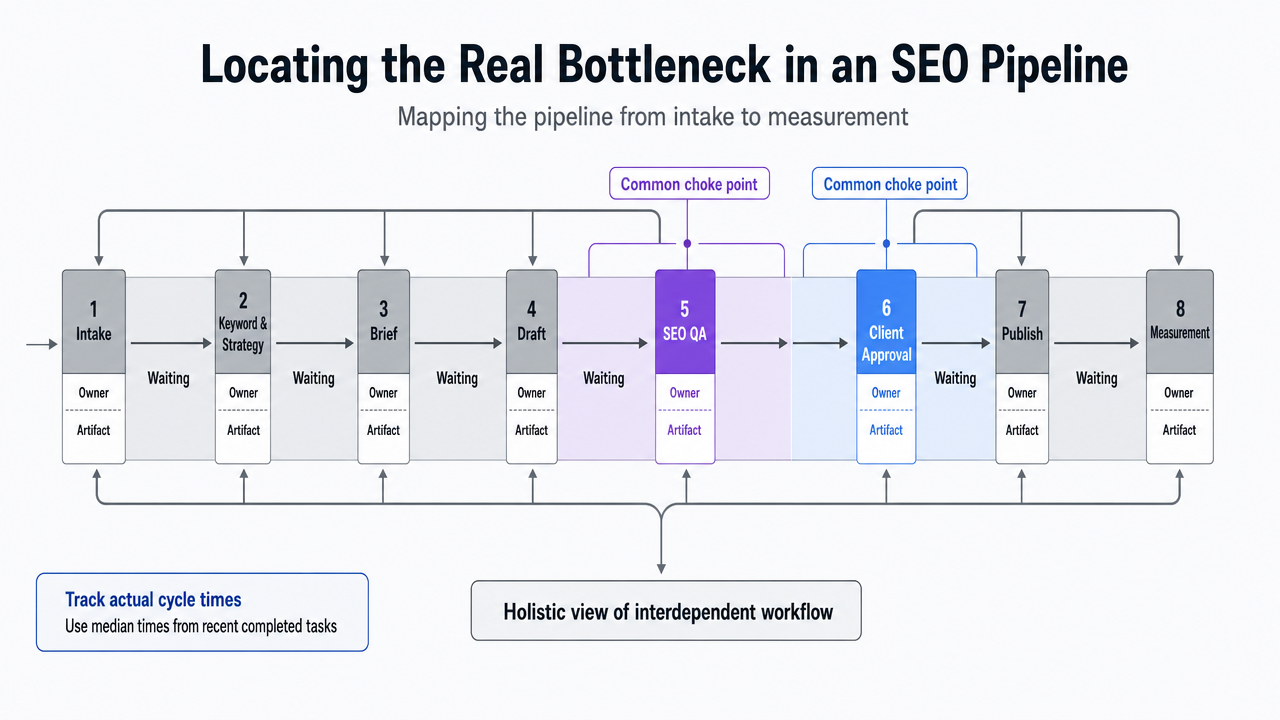 Visualize the eight-stage SEO pipeline described in the section to help readers identify where approval bottlenecks form
The Coordination Tax in Distributed SEO Pods
Many agency SEO teams are distributed, with members in different geographical locations and time zones. While this structure appears functional on paper, it introduces a measurable coordination loss that compounds across a client roster.
A Berkeley analysis of over 61,000 Microsoft employees revealed that company-wide remote work reduced cross-group collaboration time by approximately 25% and led to more siloed communication networks 7. Although this study focused on a large enterprise, the underlying mechanism applies to agencies. SEO work relies on constant interaction between content, technical, and analytics functions. When these communication threads weaken, fixes are delayed, rework increases, and strategists become translators between specialists who are no longer directly collaborating.
Internally, this often manifests as an increase in one-on-one Slack DMs replacing channel discussions. Decisions are made between two individuals, and other functions remain unaware until a problem arises. Harvard Business School's research on remote knowledge workers shows the benefits of reduced interruptions and increased asynchronous control, but these benefits only materialize with a workflow designed for such an environment 8. Without asynchronous design, distributed teams experience the drawbacks of fewer informal interactions without compensatory structural support.
The coordination tax is not a cultural issue; it's a workflow design problem, representing a second hidden cost in addition to approval queue delays.
Test a unified SEO workflow at scale
Experience centralized approval and task management using your own live content and campaigns for seven days.
Matching Workflow Shape to Work Type
Continuous Operations: Kanban-Shaped Work
Much of the work within an agency SEO team isn't project-based but rather a continuous stream. This includes:
- content refresh cycles
- internal linking sweeps
- GBP optimization for multi-location accounts
- monthly technical audits
- link prospecting
- schema maintenance
- query monitoring
Each is a recurring flow with no fixed end date and a self-replenishing queue. Attempting to sprint-plan such work adds unnecessary ceremony without improving throughput.
Kanban is well-suited for this type of work because it prioritizes flow over iteration. A University of Phoenix comparison notes that Kanban is "more open-ended," optimizing for continuous pull and explicit work-in-progress (WIP) limits rather than time-boxed segments 5. For continuous SEO operations, the WIP limit is particularly useful. Capping the number of content refreshes a strategist can have in QA, for instance, forces the queue to clear before new work enters. This makes constraints visible on the board as they arise, rather than weeks later as a missed deliverable.
The Kanban board should mirror the pipeline stages: intake, strategy, brief, draft, QA, client approval, publish, and measurement. Each column should have a WIP cap calibrated to strategist hours, not client count. A team managing 22 accounts wouldn't have 22 parallel briefs in progress; instead, it would be limited by what the senior reviewer can clear in a week, with the column enforcing this limit.
Campaigns and Migrations: Scrum-Shaped Work
Certain exceptions disrupt the continuous flow model. These include large-scale domain migrations, schema rollouts across hundreds of pages, or site relaunches with new templates and staging environments. Such initiatives have a defined scope, a hard deadline, and cross-functional dependencies involving content, technical, development, and client legal review in a fixed sequence. Trying to manage these through a continuous board risks burying them under recurring tasks.
Scrum is ideal for this profile. Sprints divide the migration into time-boxed segments—discovery, redirect mapping, template QA, staging validation, launch—with defined roles and daily syncs to identify blockers early 5. The structured cadence is key. A two-week sprint compels the technical lead, content lead, and development partner to align on decisions, which is crucial for migrations but less so for continuous operations.
For a Head of SEO managing both types of work, the practical rule is to use the continuous Kanban board as the default for all accounts. A parallel Scrum track should only be initiated for work with a fixed scope, a firm deadline, and cross-functional dependencies that cannot be resolved asynchronously. The error to avoid is flattening both into a single tool view simply because the tool allows it.
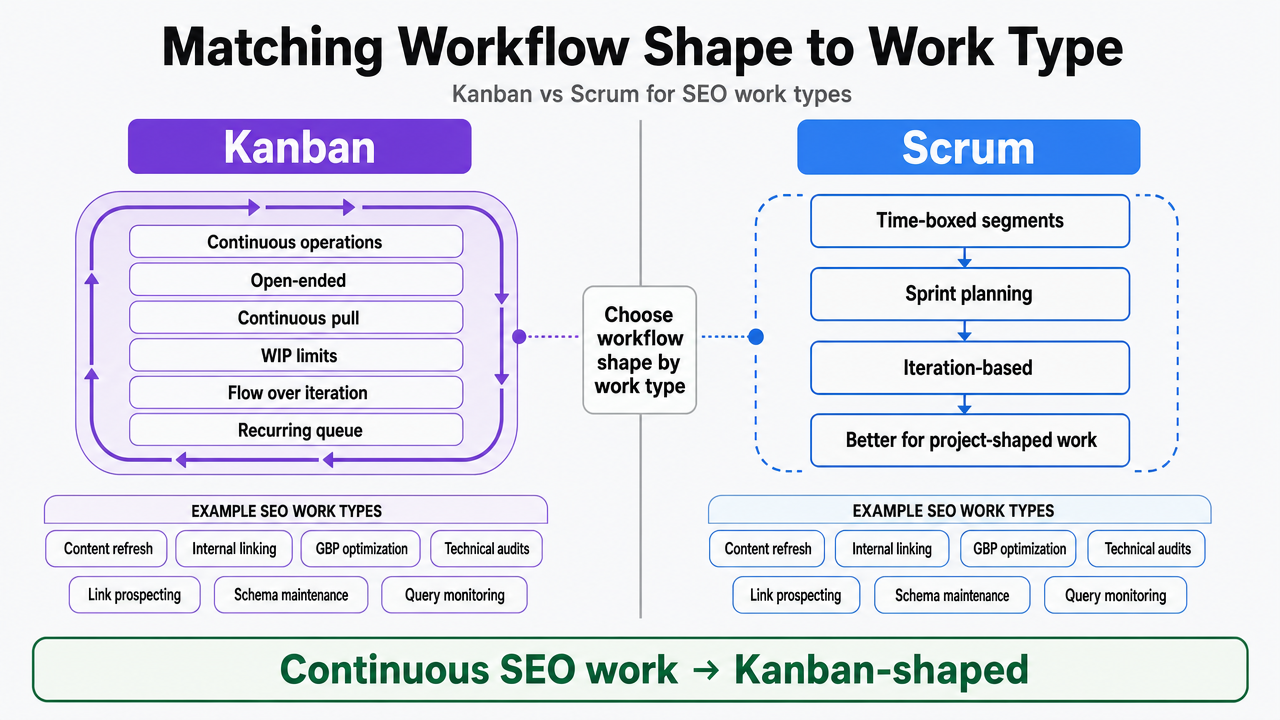 Compare Kanban and Scrum workflow models side-by-side to clarify when each applies to SEO work types, as cited from the University of Phoenix source
Designing the Single Approval Surface
Addressing decision-throughput loss requires a structural, not behavioral, solution. Simply urging strategists to clear queues faster or account directors to respond promptly offers only temporary relief. A lasting change involves consolidating all team recommendations—content refreshes, schema edits, redirect maps, internal link changes, GBP updates—into a single approval surface where the decision, supporting evidence, and routing logic coexist.
This approval surface should have three key properties:
- Each item must include its rationale: search query data, cannibalization checks, projected lift, and risk assessments. Reviewers shouldn't need to open multiple tabs to approve a category page consolidation. Knowledge-management research indicates that the application of stored knowledge, not just its capture, drives performance gains 6. An approval surface that provides recommendations without their reasoning is merely a documentation system, not a decision system.
- Routing must be deterministic. The system should automatically know which clients require legal review for health claims, which approve at the account-director level, and which have a CMO who personally signs off on homepage changes. Strategists shouldn't have to re-establish this routing logic for each cycle. A case study on project-management platforms in regulated environments demonstrates how standardized templates and visual boards increase throughput by embedding routing logic directly into the workflow 9. This principle applies equally to law firm, behavioral health, and dental DSO accounts, where the cost of missing a reviewer is higher than a slower cycle.
- The surface should track decision latency as a primary metric. Median time-in-queue at each approval stage, broken down by client and reviewer, should be visible on the same dashboard as task completion counts. Once this data is visible, it can be managed. Until then, it invisibly consumes strategist capacity, and the team perceives the loss as workload rather than a design flaw.
Approval Economics Across a 20-Client Book
The cost of fragmented approvals can be quantified by isolating key variables. Consider a team managing 20 client accounts, each generating 'Y' SEO tasks per month requiring strategist sign-off (e.g., content refreshes, schema edits, redirect maps, internal link changes, GBP updates). Each approval takes 'Z' minutes of strategist time to review, verify reasoning, and approve or send back. The strategist's fully loaded cost is 'X' per hour.
The monthly strategist hours consumed by approval review alone can be calculated as (20 × Y × Z) ÷ 60. For a team with Y=12 monthly tasks per client and Z=8 minutes per approval, this amounts to 32 strategist hours per month dedicated solely to review. This is a baseline figure, assuming clean queues, complete reasoning with each recommendation, and no rejections. In a fragmented model, the same volume takes longer because reviewers must re-establish context from various communication channels. A realistic multiplier for Z in such an environment is 1.5x to 2x, pushing the same team to 48 to 64 strategist hours per month before any actual SEO judgment is applied.
Beyond reviewer time, approval cycle latency is a critical factor. A task approved within 24 hours moves to execution while the strategic context is fresh. A task that waits 72 hours incurs re-reading costs, client follow-up, and a higher rework rate if conditions change mid-queue (e.g., algorithm volatility, competitor moves, client priority shifts). MIT Sloan's bottleneck framework states that throughput in interdependent systems is determined by the slowest decision node, not the busiest execution node 4. Tripling the cycle time at the approval stage triples the work-in-progress on the board, which in turn extends every subsequent stage.
| Variable | Fragmented Model | Consolidated Approval Surface |
|---|---|---|
| Tasks per client per month | Y | Y |
| Minutes per approval (Z) | 1.5–2x base | base |
| Approval cycle latency | 72h | 24h |
| Strategist hours/month on review (20 clients, Y=12) | 48–64 | 32 |
| WIP carried on the board | 3x baseline | baseline |
The difference represents 16 to 32 strategist hours per month redirected from queue maintenance to strategic search judgment. At a team level, this is equivalent to recovering a part-time senior strategist without a new hire—a productivity gain McKinsey attributes to operating-model redesign rather than simply adding labor 1.
Centralize and Accelerate Your SEO Workflow—Without Increasing Headcount
See how agency leaders are using AI-powered task management to streamline approvals, prioritize high-impact SEO actions, and scale multi-client operations while maintaining full oversight.
The Knowledge Layer: Turning Tasks Into Institutional Memory
Every completed SEO task contains valuable information for future tasks: a cannibalization check from a past category consolidation, a redirect map from a multi-location rebrand, or the reason a legal team rejected a specific health claim. In many agencies, this information is fragmented across a strategist's memory, unreviewed recordings, and ephemeral chat threads.
Research on knowledge-intensive organizations emphasizes that effective knowledge management—acquisition, sharing, and application—is crucial for innovation, with application often being the most neglected step 6. A documentation system that merely archives playbooks without making them accessible at the point of decision is a museum, not a functional workflow. A study on the Ethiopian public sector reinforces this, showing that knowledge sharing, documentation, and IT system use collectively predict performance 3. For an agency Head of SEO, this means templates, post-mortems, and recorded decisions only yield compounding returns when the approval surface automatically integrates them into subsequent recommendations.
The knowledge layer should store four types of artifacts:
- client-specific routing rules and reviewer maps
- recommendation templates with embedded reasoning patterns
- executed decisions tagged by outcome
- rejected recommendations with their rationales
Tagging rejections is as important as logging approvals; if a strategist proposes a tactic previously declined by a client, the system should surface that prior context before the recommendation reaches the queue. Treating SEO operations as continuous, systematic knowledge work, rather than episodic documentation, is what distinguishes teams that build on experience from those that repeatedly re-litigate the same decisions 2.
Governance That Holds When the Roster Doubles
Operating models that function effectively with 20 accounts often break down at 40. A team that previously relied on shared judgment and informal escalation begins to lose track of tasks between strategists who haven't worked on the same client. At this point, role clarity, rather than search expertise, becomes the primary constraint.
Baldrige-style management practices address this as a documentation challenge with a regular cadence: annual review of job descriptions, written ownership and authority, and performance criteria tied to the role itself 10. For a Head of SEO aiming to double their client base, this translates into three key governance actions:
- Codify which decisions strategists own outright (e.g., internal link changes, content refresh scope, on-page edits), which require senior review (e.g., schema rollouts, redirect maps, canonical changes affecting over 50 URLs), and which escalate to the Head of SEO or client legal (e.g., anything involving YMYL claims for healthcare, behavioral health, or law firm accounts).
- Review this authority matrix annually against actual decision logs, not just the organizational chart.
- Effective governance at scale is that which allows the team to function smoothly even when a team lead is on vacation, preventing queues from freezing 3.
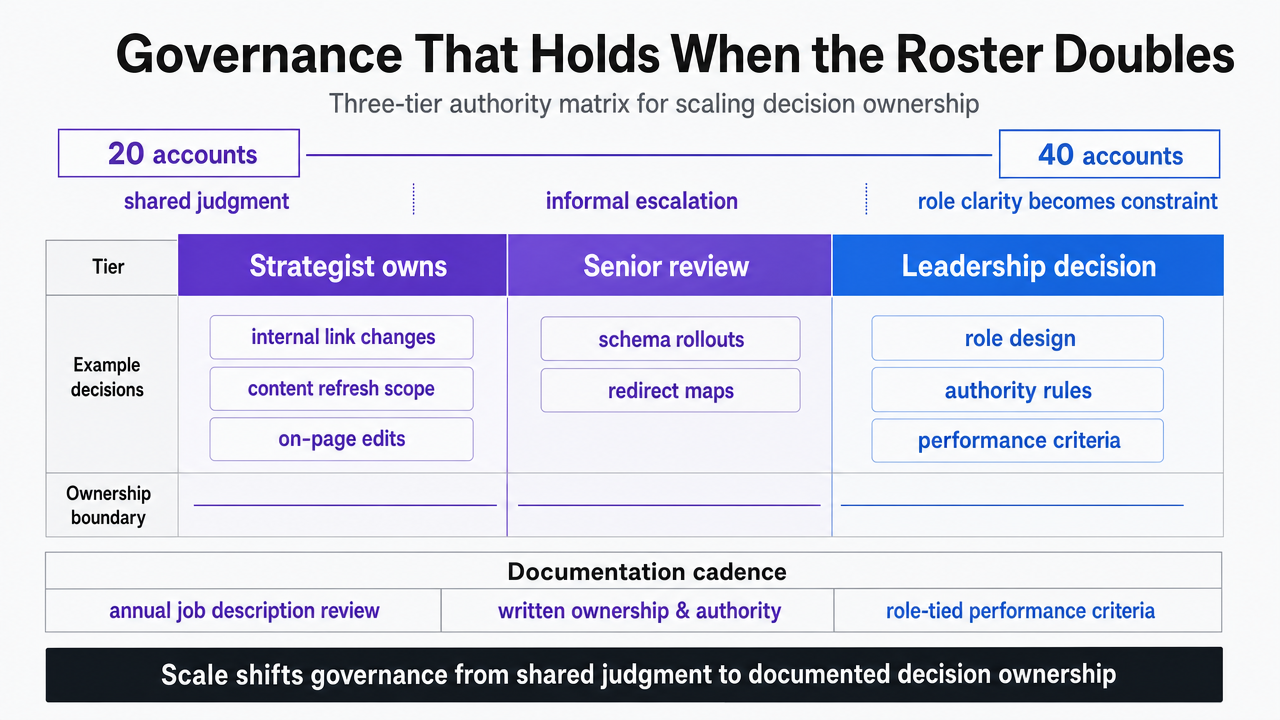 Visualize the three-tier authority matrix described in the section so Heads of SEO can see how to codify decision ownership at scale
Closing the Loop: From Throughput to Category Tooling
The preceding sections converge on a core design principle: the primary constraint on agency SEO scalability is decision throughput, not execution capacity. The sustainable solution is an operating model that centralizes approvals, codifies routing, and integrates institutional knowledge into future recommendations. Tools should support this design, not dictate it.
For a Head of SEO planning for the next 12 months, the implication is to evaluate project-management platforms not on feature parity, but on their ability to consolidate the approval surface, ensuring that reasoning accompanies each recommendation. Centralized approval orchestration is the emerging category, with Vectoron as one example. The key test is whether the system increases decision velocity at the QA and client sign-off stages without compromising the senior judgment that makes the team valuable. A team that recovers 16 to 32 strategist hours per month from queue maintenance doesn't need more headcount; it needs those recovered hours directed towards solving complex search problems that yield compounding returns.
Frequently Asked Questions
References
- 1.A makeover for your marketing operating model (MOM).
- 2.A systematic review on the roles of knowledge management in the public sector.
- 3.Knowledge Management Practices and the Performance of Public Sector Organizations.
- 4.Improve Workflows by Managing Bottlenecks.
- 5.Kanban vs Scrum in Agile Project Management.
- 6.Knowledge management process, knowledge-based innovation: A study of the Malaysian public sector.
- 7.When everyone works remotely, communication and collaboration suffer, study finds.
- 8.Research: Knowledge Workers Are More Productive from Home.
- 9.A case study in a Medical Physics lab and practice.
- 10.Malcolm Baldrige National Quality Award Application.