
Key Takeaways
- Margin compression at scaling agencies stems from workflow architecture, not pricing or hiring; modular stages with defined handoffs let one documented AI workflow process 10+ sites per day 11.
- Standardize before automating: audit current processes, codify stable inputs and outputs into SOPs, and leave brand voice and positioning as parameterized client-specific configuration 13.
- Place approval gates by reversibility rather than task volume—lock decisions at research-to-planning, pre-publish, and technical-architecture changes, while letting cheap-to-fix outputs run gateless or sample-reviewed 5.
- Heads of SEO should prioritize finishing SOP and prompt libraries for top service lines, redesigning the approval surface, and updating brief schemas to serve both classic SERPs and AI summaries 6.
The Architecture Problem Behind Agency Margin Compression
Margin compression at most mid-sized SEO agencies is not a pricing problem. It is a workflow problem dressed up as a hiring problem. Specialist salaries climb, client expectations expand, and the standard response — add another strategist, another writer, another account lead — produces linear cost growth against revenue that grows in fits and starts. The result is a P&L that thins out somewhere between the 25th and 60th client account.
One agency case study documents the alternative: an AI-powered SEO workflow that delivered a 10x efficiency gain, processing 10 or more sites per day with full workflow tracking across keyword research, on-page audits, and reporting 11. The unit of measurement matters here. The gain came from restructuring how the work flowed through the agency, not from buying a faster keyword tool or hiring a senior SEO.
That distinction reframes the scaling question. The pressure on Heads of SEO is rarely about whether their specialists are good. It is about how many interdependent tasks each specialist has to personally touch before a deliverable ships. Search Engine Journal's review of SEO project management platforms makes the same point from the tooling side: SEO work is built from many interdependent tasks, and managing several clients efficiently depends on task boards, time tracking, and automation features that move work between stages without manual handoffs 2.
Treating workflow as architecture — modular stages, defined handoffs, gated approvals, reusable assets — is what separates agencies that absorb new accounts from agencies that buckle under them. The rest of this brief breaks down the architecture choices that follow from that frame.
Modular Stages: What to Standardize Before Automating Anything
Automation applied to a messy workflow accelerates the mess. Agencies that try to layer AI onto an undocumented process end up with faster but less consistent output, and the quality variance shows up in client retention numbers six months later. Standardization comes first. The work has to be broken down into discrete, repeatable stages before any of it is handed to a model or an agent.
The reference shape is well established. A content-led SEO workflow runs through topic selection, audience definition, keyword research, brief creation, writing, optimization, editing, and publishing, with each step's completion triggering the next 1. Technical and link-building tracks follow their own modular patterns: crawl audit, issue triage, fix specification, implementation, verification. The exact stages vary by service line, but the principle holds — divide each task into manageable steps, and define what "done" means at every boundary.
Two design choices distinguish workflows that scale from workflows that merely look organized. The first is identifying which inputs and outputs are stable across the client roster and which are not. Keyword research inputs (seed terms, competitor URLs, language, location) are stable in format even when the values change per account. Brand voice, audience nuance, and competitive positioning are not. The stable elements are the candidates for codification; the variable ones stay in human hands or get parameterized as client-specific configuration.
The second choice is auditing existing processes before drafting the SOP. Agency scaling guidance is consistent on this point: assess current processes to find the bottlenecks, then write standard operating procedures for each step, supported by project management infrastructure 13. Skipping the audit produces SOPs that document the agency's wishes rather than its actual work, and those documents get ignored within a quarter.
Standardization is also what makes the output legible to downstream automation. Structured project management research on SEO-focused systems argues for explicit conceptual and mathematical models that tie SEO metrics to project planning 3. The practical version of that argument is simpler: if a stage's output cannot be described in a checklist or a schema, it cannot be reliably handed to an AI agent or to a junior specialist on another account. Standardization is the prerequisite, not the result.
Approval Gates: Where Human Judgment Must Stay in the Loop
Every workflow stage that an agent can execute is also a stage where errors compound silently. The design question is not whether to insert human review, but where to place it so that judgment lands on the decisions that actually move client outcomes — and skips the steps where review adds latency without adding quality.
McKinsey's analysis of agentic AI in marketing draws this line clearly: agents can orchestrate multi-step campaign work end-to-end, but the redesign requires explicit governance and human supervision of strategy and guardrails 5. The same paper warns that organizations adopting agentic workflows without that redesign risk over-automation. The practical translation for an SEO agency is a small number of well-chosen gates, not a review checkbox on every task.
Three gates carry most of the weight:
- The first sits between research and planning: keyword clusters, intent mapping, and target page assignments. An agent can produce the candidate set in minutes, but the call on which clusters match the client's commercial priorities is a strategist decision that compounds across every downstream brief.
- The second gate sits before publishing: brand voice, factual accuracy, and competitive positioning on any asset that will carry the client's name.
- The third sits at the recommendation layer for technical fixes that touch site architecture, redirects, or schema — changes where a wrong execution costs more to reverse than to review.
Creekmore's analysis of the AI-and-agency question lands on the same split. AI handles mechanical work — content analysis, reporting, draft production — well, but human expertise on brand positioning and competitive strategy is not substitutable 15. Academic work on AI-driven task automation reaches a parallel conclusion: throughput gains depend on appropriate human oversight at decision points, not on removing the human entirely 16.
The mistake that shows up most often in implementation is placing gates by task volume rather than by reversibility. A gate on every AI-drafted meta description creates a review queue that defeats the throughput gain; a gate on the keyword strategy that drives 200 of those meta descriptions catches the decision that actually matters. Heads of SEO designing gate placement should ask one question per stage: if this output is wrong and ships, how expensive is the correction? Cheap-to-fix outputs run gateless or sample-reviewed. Expensive-to-fix decisions get a named approver and a logged sign-off before execution continues.
Test AI-powered SEO workflows with real clients
Trial full-scale SEO delivery and measure actual workflow efficiency using your own client campaigns.
Automation Suitability by Workflow Stage
Not every SEO stage benefits equally from automation. Treating the workflow as a uniform pipeline — automate everything, review nothing, or the reverse — produces either quality drift or zero throughput gain. The useful exercise is to grade each stage on three dimensions:
- how structured the inputs are,
- how reversible the output is, and
- how much client-specific judgment the decision requires.
The reference stages from the modular content workflow give the cleanest framing: topic selection, audience definition, keyword research, brief creation, writing, optimization, editing, and publishing 1. Mapped against automation suitability, the pattern is consistent.
Automate. : Keyword research, on-page audits, internal linking suggestions, schema generation, rank tracking, and reporting belong here. Inputs are structured, outputs are easy to verify against a checklist, and errors are cheap to catch. The 10-sites-per-day case study runs almost entirely on this layer 11. Optimization passes — meta titles, header structure, alt text, entity coverage against a target SERP — fall in the same bucket.
Assist. : Brief creation, first-draft writing, and editing sit in the middle. An agent can produce a competent brief from the keyword cluster, target intent, and competitive SERP, but a strategist confirms the angle before the brief enters the writing queue. Drafts come back faster from a model than from a freelancer, but they need a human editor calibrated to the client's brand voice before publishing. McKinsey's framing on agentic workflows applies directly: agents handle the multi-step orchestration, humans supervise strategy and guardrails 5.
Human-led. : Topic selection tied to commercial priorities, audience definition for a new account, competitive positioning, and any technical recommendation that touches site architecture or redirects. These are the decisions where a wrong call propagates across dozens of downstream assets. The cost of correction outweighs any minutes saved by automating the choice.
The grading is not permanent. As prompt libraries mature and client knowledge accumulates in a structured repository, stages shift left — from human-led toward assisted, from assisted toward automated. A new account starts with more human-led work because the agent has no client-specific context to draw on; six months in, the same stages can run with lighter review. Heads of SEO designing the matrix should plan for that drift, not freeze the assignments at launch.
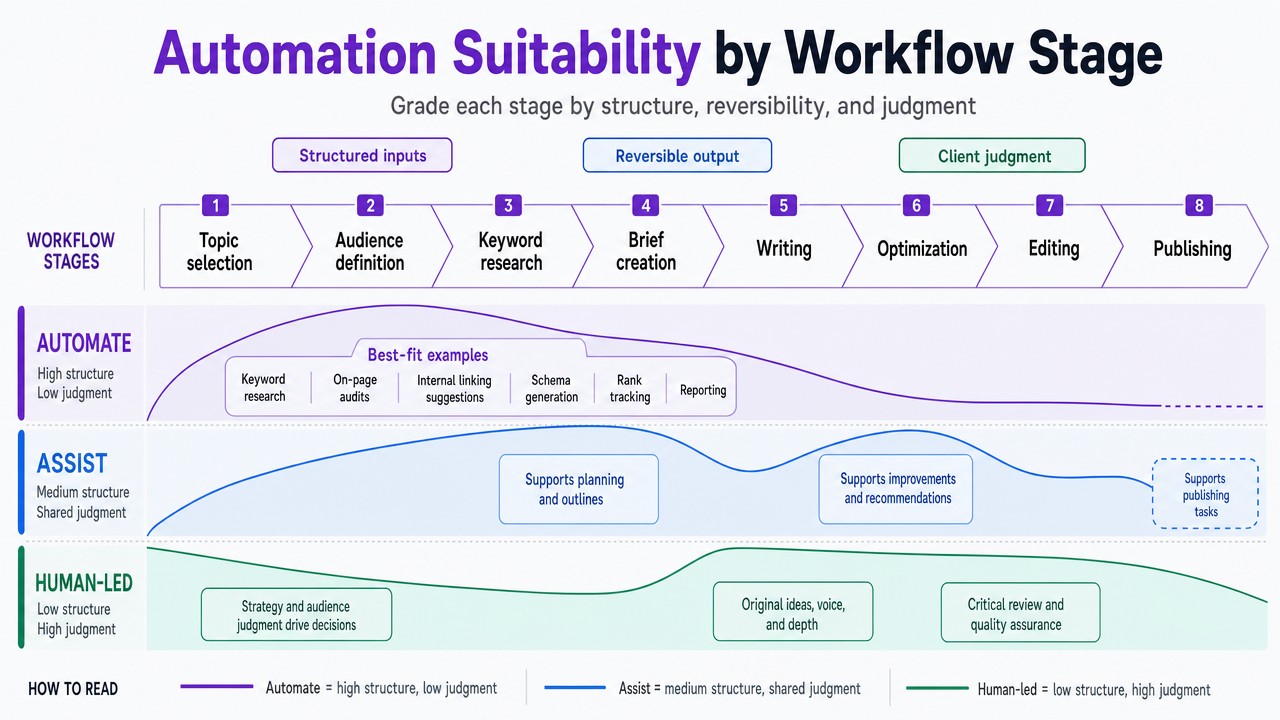 Visualize the three-tier suitability framework (Automate / Assist / Human-led) mapped against the modular SEO workflow stages cited in this section, supporting the section's framework without inventing statistics
The Knowledge Layer: Prompt Libraries, SOPs, and Reuse Across Accounts
Modular stages and approval gates set the structure. The knowledge layer is what makes the structure produce consistent output across 20, 50, or 100 accounts without the lead strategist personally re-teaching the workflow every time a new specialist joins or a new client onboards. This is where most agencies underinvest, and the gap shows up as quality variance between accounts handled by senior staff and accounts handled by everyone else.
The asset that does the heaviest lifting at scale is the prompt library. A documented case study of agencies restructuring content pipelines around multi-model AI workflows describes prompt libraries built per client brand, treated as institutional knowledge rather than as scratch files on individual laptops 10. The same study finds that the agencies achieving the deepest cost reductions built documented workflow chains alongside those libraries — prompts paired with the stage they belong to, the input schema they expect, and the output checklist that defines success.
Prompt libraries alone are not enough. They sit inside a broader knowledge management system that includes SOPs for each workflow stage, client-specific configuration files (brand voice notes, restricted topics, approved citation sources, target persona summaries), and a performance log that captures what has worked on similar accounts. Research on marketing knowledge management argues that structured capture, sharing, and application of marketing knowledge is directly linked to better strategic decisions and innovation outcomes 7. For an agency, the operational version of that claim is concrete: a junior specialist with access to a well-built knowledge base produces output closer to senior-level quality than the same specialist working from memory and Slack history.
Current best practices for knowledge management push the design further. Digital Workplace Group recommends AI-powered, personalized KM systems integrated with collaboration tools, with knowledge graphs and semantic search built into a unified ecosystem 8. The point is discoverability — knowledge that exists but cannot be found at the moment of decision is functionally absent. The foundational primer on digital KM frames the same goal as putting the right information in front of people when they need it, with intuitive grouping of assets 9.
Three design choices matter for an agency building this layer:
- Separate the universal from the client-specific. SOPs for keyword clustering or audit triage apply across accounts; brand voice files and approved phrasing do not. Mixing them produces brittle assets that have to be rewritten for every new account.
- Version control belongs on prompts and SOPs, not just on code. When a model upgrade changes how a prompt behaves, the agency needs to know which version produced which output on which client, especially during quality investigations.
- Knowledge reuse has to be measured. Academic research on AI in digital service firms finds that AI enables standardization across markets and improves efficiency and scalability while maintaining quality — but only when the standardized processes are actually applied rather than circumvented 17. Tracking which SOPs and prompts get used, by whom, on which accounts, surfaces the gap between the documented workflow and the executed one.
The payoff compounds. Each new account inherits the accumulated learnings from every prior account in the same vertical, and each new specialist inherits the senior team's working memory in a usable form.
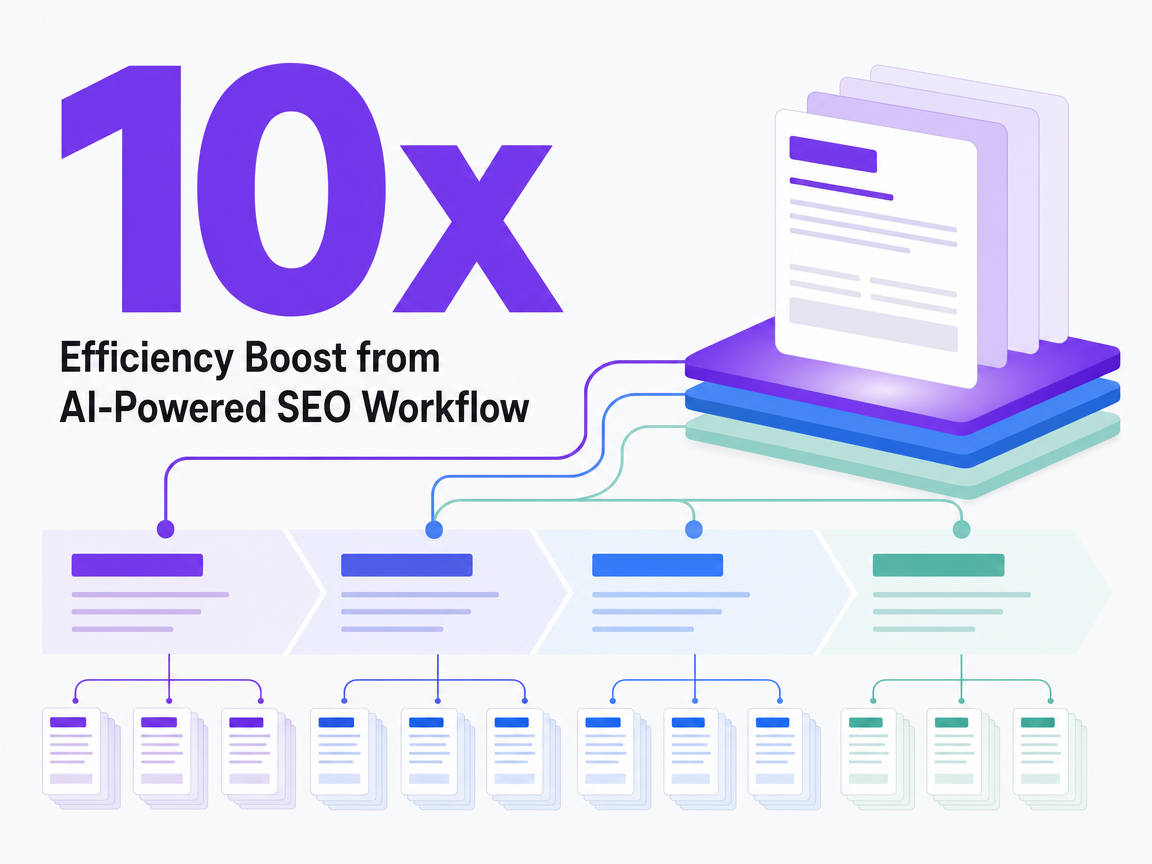 Efficiency Boost from AI-Powered SEO Workflow
Efficiency Boost from AI-Powered SEO Workflow
Adapting Workflow Outputs for AI Search Visibility
The output specification for SEO content has changed. Workflows that produce assets optimized only for classic blue-link SERPs are now shipping into an environment where the answer engine often intercepts the click. McKinsey's analysis of AI search puts the scope in concrete terms: roughly 50 percent of Google searches already surface AI summaries, and that share is projected to exceed 75 percent by 2028 6. For an agency running content production across 50 or 100 accounts, that is not a trend to monitor — it is a change in what the workflow has to produce on every brief, starting now.
The practical implication is that the brief stage and the optimization stage need to encode two output targets, not one. The classic target — rank a page for a keyword cluster, earn a click — still matters. The added target is being cited or summarized inside the AI answer when the cluster triggers one. McKinsey's guidance on AI search visibility centers on credibility signals, structured content, and topical coverage depth as the levers that determine whether a page gets surfaced in AI-mediated results 6. Those levers translate into specific changes inside existing workflow stages rather than a separate parallel workflow.
Three stages absorb most of the change:
- Keyword research has to flag which clusters currently trigger AI summaries and which do not, because the optimization approach differs.
- Brief creation has to specify entity coverage, question-and-answer structure, and source attribution in a form an AI summarizer can lift cleanly.
- Optimization has to verify schema, factual citations, and heading hierarchy that map to the way answer engines parse a page.
None of this requires inventing a new workflow. It requires updating the input schemas and output checklists at three existing stages, then propagating the change through the prompt library and SOP repository so every account picks it up at the next cycle. Agencies that treat AI search optimization as a separate service line end up running parallel workflows and re-introducing the handoff overhead that scaling was supposed to remove.
See How Leading Agencies Standardize and Scale SEO Workflow Management
Request a walkthrough of proven, AI-driven workflows that reduce manual bottlenecks, increase throughput, and maintain strategic oversight across multi-client SEO programs.
If You Manage a Multi-Client Portfolio: Throughput Models Compared
This section shifts the frame from single-account workflow design to portfolio operations — the reality for any Head of SEO running 20 to 100+ accounts under the same delivery team. The decision at this scale is no longer whether automation helps on one workflow. It is which model produces enough throughput per specialist to absorb new accounts without proportional hiring, while keeping the approval surface narrow enough for senior staff to actually use.
Three operating models are in active use across mid-sized agencies:
- Fully manual delivery: specialists run each stage by hand, supported by spreadsheets and document templates.
- Tool-assisted delivery: specialists still own each stage, but rank trackers, audit crawlers, and project management platforms reduce the time per task 2.
- AI workflow delivery with human approval gates: agents handle the mechanical stages end-to-end, specialists supervise strategy and sign off at defined gates 5, 15.
The throughput delta between models is documented. The AI-workflow case study reports a 10x efficiency gain, measured as 10 or more sites processed per day with full workflow tracking across keyword research, on-page audits, and reporting 11. The unit — sites per specialist per day — is the operative one for portfolio planning, because it sets the ceiling on how many accounts a senior strategist can govern before quality variance appears.
| Workflow model | Sourced throughput indicator | Human role | Governance gate location |
|---|---|---|---|
| Fully manual delivery | Baseline: specialist personally executes each stage 2 | Specialist owns every stage end-to-end | Implicit at every step; no formal gating |
| Tool-assisted delivery | Reduced time per task via PM and audit tooling 2 | Specialist runs stages with tool support | Ad hoc; usually at publish only |
| AI workflow with approval gates | 10x: 10+ sites/day per workflow with tracking 11 | Strategist supervises strategy and guardrails 5 | Strategy, pre-publish, technical-architecture gates |
Two portfolio implications follow. First, the binding constraint shifts from specialist capacity to gate capacity. When agents handle execution, the question is no longer how fast a specialist can audit a site — it is how many strategy and pre-publish approvals a senior reviewer can clear in a working day without rubber-stamping. Gate design from earlier in the workflow is what makes or breaks the model at portfolio scale.
Second, standardization compounds across the roster. Research on AI in digital service firms finds that AI allows firms to standardize processes across markets while maintaining quality, enabling scalable service delivery without proportional headcount growth 17. For an agency, that means the 21st account in a vertical inherits the workflow, prompt library, and SOPs already refined on the first twenty — and the marginal cost of adding it is closer to onboarding than to building.
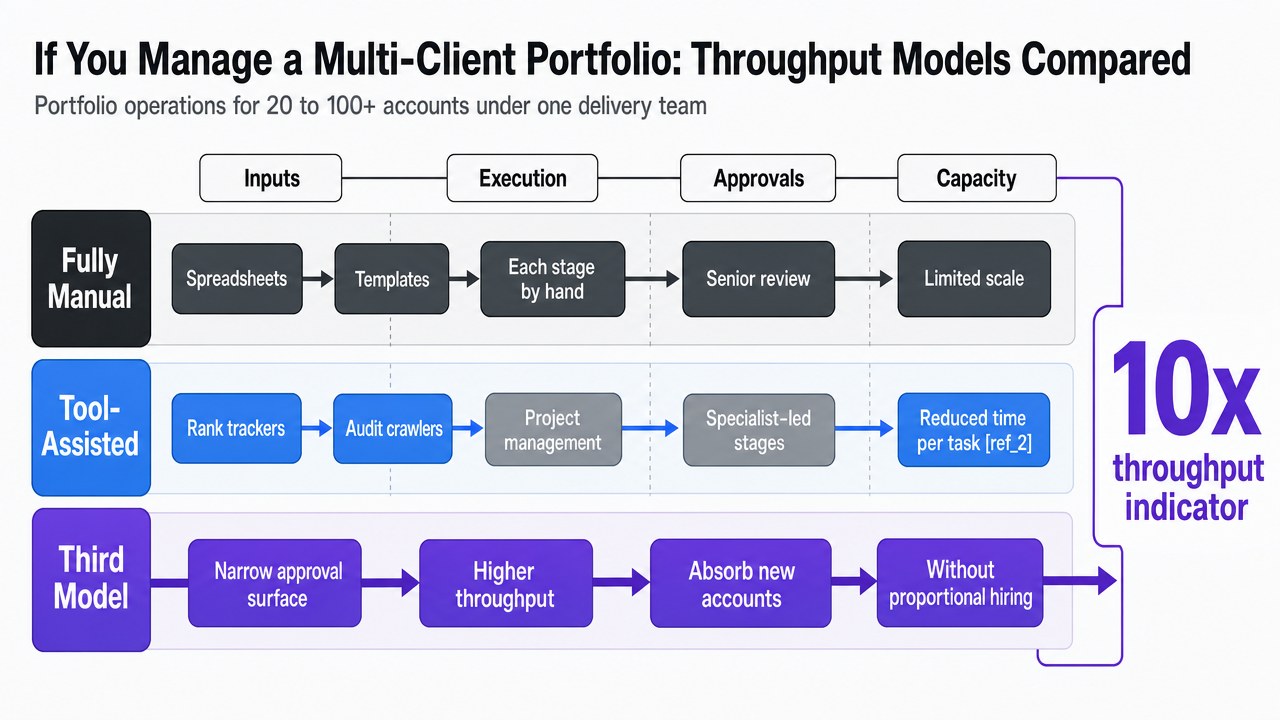 Reinforces the comparison table in this section by visualizing the three operating models and the cited 10x throughput indicator, with the exact number and citation already present in nearby prose
Governance and Reporting Without Linear Overhead
Reporting is the stage where scaled workflows quietly fall apart. Each new account adds a deck, a dashboard refresh, a status email, and a monthly review call. Multiplied across 50 accounts, the reporting layer alone can consume more senior-strategist hours than the actual SEO work it documents. The fix is not better templates. It is treating reporting as an automated output of the workflow itself, with governance attached to exceptions rather than to every routine update.
The mechanical layers of reporting — rank movements, audit deltas, traffic and conversion changes, backlink acquisition — are structured data flowing out of the same systems that produced the work. Agentic AI orchestration applies directly here: the same agents that execute audits and track keyword positions can compile the client-facing summary, flag anomalies, and draft the commentary 5. Academic work on AI-driven task automation supports the throughput case, finding that reducing manual workload on repetitive reporting frees specialists for higher-value decisions 16.
Governance at this layer means exception-based review. A senior strategist does not need to read every monthly report before it ships. They need to see the reports flagged by the system as anomalous — a sudden ranking drop, a flat-lined client, a recommendation queue stuck pending — and the strategic commentary on accounts entering quarterly review. Knowledge management research reinforces the point: discoverability and alignment with business goals matter more than volume of documentation 8. Routing every account into the same review cadence wastes the gate.
The second governance question is audit trail. When an agent ships a meta description, updates internal links, or recommends a redirect, the log of what changed, when, and under which approval has to be queryable. Enterprise SEO contexts make this non-negotiable, where coordination across stakeholders and robust reporting are baseline requirements 14. For mid-sized agencies, the same logging discipline prevents the quality investigations that consume disproportionate senior time when something goes wrong on a single account.
What This Means for Heads of SEO Planning the Next 18 Months
The agencies that absorb the next wave of accounts will not be the ones that hired faster. They will be the ones that finished documenting their workflows before automating them, then placed approval gates on the decisions that actually move outcomes.
Three priorities sit ahead of everything else on the 18-month roadmap:
- Finish the SOP and prompt library work for the top two service lines, with version control and usage tracking attached 10.
- Redesign the approval surface so senior strategists spend their gate time on strategy and pre-publish decisions rather than rubber-stamping mechanical output 5.
- Update brief and optimization schemas to produce content that performs in both classic SERPs and AI summaries — a single workflow change, not a parallel service line.
The agencies that get this right will price on outcomes and capacity, not on hours. The ones that do not will keep hiring against margin until the math stops working. For Heads of SEO ready to build that operating layer — specialist execution coordinated through a unified approval workflow — platforms like Vectoron offer a starting architecture to evaluate against the in-house build.
Frequently Asked Questions
References
- 1.SEO Workflow Management for Scalable Growth.
- 2.15 Project Management Tools For SEO Professionals.
- 3.Development of Project Management Models for Information Systems Projects Focused on SEO.
- 4.AI Will Shape the Future of Marketing.
- 5.Reinventing marketing workflows with agentic AI.
- 6.Winning in the age of AI search.
- 7.Marketing Knowledge Management Analysis to Drive Innovation and Decision-Making.
- 8.Knowledge management best practices for 2025.
- 9.Digital Knowledge Management: A Primer.
- 10.Marketing Agency Case Study: How AI Workflows Cut Content Costs While Improving Output.
- 11.SEO Automation Case Study | AI-Powered Workflow for Agencies.
- 12.25 SEO Case Studies That Moved the Needle.
- 13.7 Growth Hacks to Scale Your SEO Agency to New Heights.
- 14.What an Enterprise SEO Agency Does for Large Scale SaaS Brands.
- 15.Is AI Replacing SEO Agencies? Here's the Honest Answer.
- 16.Optimizing Project Management Workflows with AI-Driven Task Automation.
- 17.AI in International Marketing: How Digital Service Firms Standardize and Scale Offerings.