
Key Takeaways
- Coordination breakdowns, not publishing tools, cause campaign delays, so evaluate categories through approval architecture and workflow fit rather than feature checklists.
- A four-category framework of listening, reach, depth, and relationship maps to agency coordination failures, with orchestration and analytics assembly layered above.
- Social listening platforms like Brandwatch and Talkwalker close the gap between client briefs and audience conversations when their output routes into brief templates.
- Publishing suites such as Sprout Social and Hootsuite turn client sign-off from email chains into queue states, provided they support per-client approval hierarchies.
- Asset collaboration tools like Figma and Frame.io eliminate version-control confusion by anchoring reviews to a canonical file with threaded, in-context comments.
- Approval orchestration platforms become the margin-critical layer as AI-assisted production multiplies draft volume, making sign-off the new bottleneck 13.
- Community engagement tools like Sprout Smart Inbox and Sprinklr Modern Care protect retention by enforcing per-client SLAs and routing escalations automatically.
- Analytics layers such as AgencyAnalytics and Dash Hudson convert QBR assembly from a fire drill into a standing report tied to campaign objectives.
- Governance tooling from Proofpoint, Smarsh, and Hearsay makes audit questions answerable in one click, which is non-negotiable for regulated client work 1.
- Internal coordination platforms like Slack and Asana only earn their seat when wired into the publishing suite and approval layer, avoiding a second spine.
- Consolidating point tools into one approval surface recovers unbilled hours by replacing human handoffs between systems with a governed queue 7.
- Sequencing consolidation starts with approval orchestration, then publishing, analytics, and finally governance, because every category eventually passes through the sign-off queue.
The bottleneck is the operating model, not the publishing tool
Ask a client-services lead where a campaign stalls, and the answer is rarely the publishing tool. It is the third revision round on a caption, the missed approval window because the client contact was in a QBR, the asset that lived in Dropbox but was briefed in Slack and scheduled in a fourth system. The tools work. The operating model wrapped around them does not.
MIT Sloan Management Review research on enterprise social media adoption found that fewer than half of enterprise social platforms are actually used by employees on a regular basis, attributing the gap to siloed rollouts rather than integration into daily workflows 9. This mechanism carries over to agency-facing publishing suites: a platform that sits outside how pod leads, strategists, and account managers already coordinate becomes shelfware within a quarter.
The consequence for an agency Director of Client Services is measurable. Status meetings expand to fill the coordination vacuum. Approval cycles stretch because sign-off lives in email while the work lives in a dashboard. Margin leaks through hours that never appear on a timesheet.
This piece evaluates eight categories of social media collaboration tooling through that operator lens. The frame weights approval architecture, workflow fit, and coordination overhead above feature checklists. Representative products appear inside each category, but the decision is the category, not the logo.
A category framework for evaluating collaboration tools
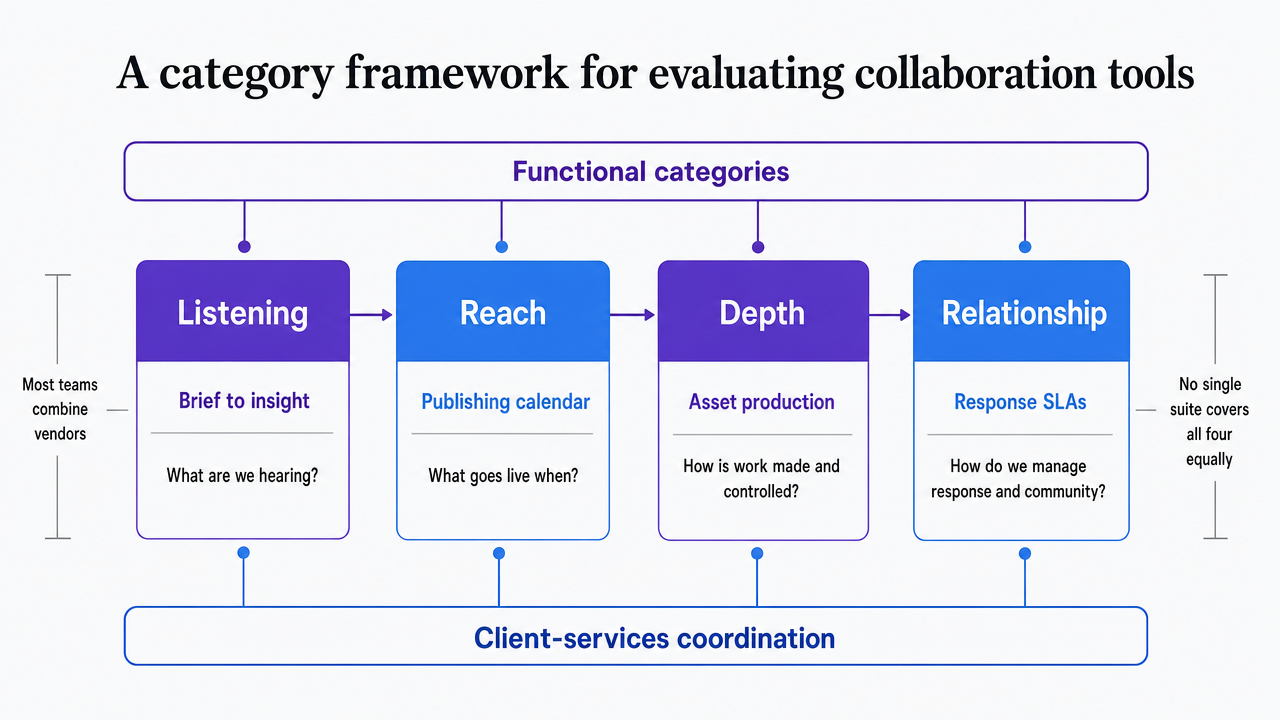
Forrester's analysts have argued for years that social marketing tools fall into four functional categories: listening, reach, depth, and relationship. Each category answers a different question, and most agencies end up combining several vendors because no single suite covers all four with equal weight 6. The report frames the vendor landscape as "indecipherable," with teams forced to choose between sprawling point-tool stacks and lopsided suites 6.
For a client-services lead, the four categories map cleanly onto the coordination failures that actually eat margin:
- Listening tools close the gap between client brief and creative insight.
- Reach platforms govern the publishing calendar and its approval spine.
- Depth tools handle asset production and the version-control tax.
- Relationship platforms manage response SLAs and community engagement.
Two more categories sit above that quadrant in modern agency work: approval orchestration and analytics assembly. Forrester's more recent framing of social suites folds planning, publishing, consumer intelligence, creator marketing, and customer response into unified offerings that increase productivity and speed 7. Governance tooling and internal coordination platforms round out the eight-category map.
The rest of this piece walks each category in order, naming the specific handoff it removes and the representative tools that occupy it. Category selection precedes vendor selection. Skip that order and the pod inherits a stack that solves nothing.
Social listening platforms: closing the brief-to-insight gap
The first coordination failure in most agency social workflows shows up before a single asset is produced. A strategist writes a brief from a client call, a copywriter interprets it three days later, and the resulting draft misses the actual conversation happening around the brand in real time. Listening tools exist to close that gap between what the client thinks is worth saying and what the audience is already discussing.
Forrester's four-category framework places social listening as the entry point to the stack, feeding insight into the other three categories rather than operating as a standalone reporting layer 6. Representative platforms in this category include Brandwatch, Sprinklr Insights, Talkwalker, and Meltwater. Each pulls conversation data, sentiment signals, and share-of-voice metrics that a pod lead can route directly into the creative brief.
The collaboration payoff is specific. When listening output lands inside the same workspace where briefs are drafted, the strategist stops emailing PDF summaries to the copywriter, and the client-services lead stops fielding "did we see the competitor launch?" escalations. NIST's framing of social media as a coordination mechanism across dispersed teams applies here: the tool earns its keep by connecting people who would otherwise chase the same insight in parallel 3.
Buy for the workflow hooks, not the dashboard. A listening platform that cannot push a trend alert into the pod's brief template is a research tool, not a collaboration tool.
Publishing and scheduling suites: the shared calendar as approval spine
The publishing calendar is where most agency pods either hold the line on delivery or watch it fall apart. Every post carries a version history, a target platform, a caption variant, an asset lock, and a client approver whose availability is a variable, not a constant. When those threads live in different tools, the pod lead becomes the human integration layer.
Publishing and scheduling suites exist to consolidate that chaos into a single queue. Forrester's category-level view of social suites describes them as platforms that unite content planning and publishing with listening, customer response, and measurement in one offering, with the stated business outcomes being team productivity, faster customer response, and clearer impact reporting 7. Representative products include Sprout Social, Hootsuite, Sprinklr, Khoros, and Emplifi. Buffer and Later occupy the lighter end of the same category for smaller pods.
The collaboration payoff sits in the approval architecture, not the scheduling engine. A shared calendar with role-based permissions turns sign-off from an email chain into a queue state. The pod lead sees what is drafted, what is with the client, what is approved, and what is scheduled across every account in a single view. Forrester's use-case mapping for social suites places social media management and customer care as core, with insights, employee advocacy, and commerce as extensions built on the same governed workflow 11.
Two selection filters matter for agency work:
- Does the suite support per-client approval workflows with distinct approver hierarchies, or does it force a one-size template across the book?
- Does the calendar surface expose bulk actions across accounts, so a pod lead managing eight brands is not clicking into each one to see the week ahead?
Suites that fail either test push the coordination work back onto humans, which is the problem the tool was bought to solve.
Experience streamlined social collaboration in real time
Test-drive unified content approvals and scheduling across all your live social channels before making a commitment.
Asset and creative collaboration tools: killing the version-control tax
Ask any pod lead where the hours actually disappear, and the version-control tax comes up fast. Draft_v3_FINAL_client-edits_v2.docx. A hero image in Dropbox that does not match the caption in the scheduler. A designer working from a brief that changed twice after the file was exported. Every misaligned version is a revision round that was not billed and a status question that lands in the client-services inbox.
Asset and creative collaboration tools solve for that specific tax. Representative platforms include Figma, Frame.io, Ziflow, Filestage, Canva Teams, and Adobe Workfront. Each provides a canonical file, threaded comments tied to timestamps or coordinates on the asset, and a version history that survives the review cycle. The copywriter, designer, strategist, and client all mark up the same object rather than parallel copies.
Academic work on enterprise collaboration technologies ties this kind of capability directly to decision-making effectiveness, noting that features like screen sharing, video sharing, and in-context commenting improve the efficiency of digital collaboration among distributed teams 2. For an agency running six or eight pods, that translates into fewer clarification calls and fewer assets shipped from the wrong source file.
Two integration questions decide whether the tool earns its seat:
- Does it hand off approved assets directly into the publishing suite without a manual export step?
- Does the comment thread on version four remain visible when a new client contact rotates in mid-quarter?
Answer no to either, and the version-control tax reappears one layer down the stack.
Approval orchestration platforms: where client sign-off stops eating margin
Every category above assumes the same thing: that a human approver eventually says yes. Approval orchestration is the layer that governs how that yes happens, who touches the work before it, and what audit record survives after. Done well, it is invisible. Done badly, it is where a pod loses eight billable hours a week to Slack pings asking whether the Thursday post cleared legal.
The category has moved fast because AI-assisted production has changed the volume math. Forrester's 2025 agency predictions report that 61% of agencies currently use generative AI in marketing efforts, compared with 17% of in-house marketing teams, and argues that AI-powered content production will decelerate the in-housing trend by making external partners more scalable per dollar 13. When a pod ships three times the drafts it used to, the approval surface becomes the constraint, not the creative one.
Representative platforms in this category include Ziflow, Filestage, GAIN, and workflow-native suites that expose approval queues as a first-class object rather than a checkbox buried in a scheduler. The functional test is whether a client-services lead can see, on one screen, every asset awaiting sign-off across every account, with the reason it is queued and the next actor named. Vectoron sits in this category, structured around a Command Center where AI-generated recommendations and drafts are routed for human approval before execution across content, social, and adjacent channels.
Two design decisions separate orchestration platforms from dressed-up publishing queues:
- Does the platform preserve the strategic reasoning behind each item so a client approver understands what they are approving, not just that something is waiting?
- Does approved work move to execution automatically, or does the pod re-key it into a scheduler?
The MIT Sloan Management Review finding on ESM adoption applies here too: orchestration that lives outside the pod's daily surface becomes another dashboard nobody opens 9. The seat is earned by removing the status meeting, not by adding a new place to check.
Community and engagement tools: keeping response SLAs off the pod lead's desk
Publishing is one direction of traffic. The return direction is where most agencies quietly lose retention. A comment on a Thursday afternoon that sits unanswered until Monday morning does more damage to a client relationship than a scheduling glitch, because the client sees it happen in public.
Community and engagement tools handle the inbound side of the same accounts the publishing suite handles outbound. Representative platforms include Sprout Social's Smart Inbox, Sprinklr Modern Care, Khoros Care, Emplifi, and Statusbrew. Each unifies mentions, DMs, comments, and tagged posts across platforms into a single queue that a community manager works from, with routing rules that escalate to the pod lead only when the response falls outside a defined SLA.
Forrester's use-case mapping for social suites places customer care alongside social media management as a core function, not an extension, because response speed is one of the three stated business outcomes suites are supposed to deliver 11. When engagement lives outside the same governed surface as publishing, the community manager works blind: they answer a comment without seeing the campaign context that produced it, and the pod lead fields a client escalation asking why the reply tone missed the brief.
The academic literature on collaboration technologies backs the mechanism. Features like threaded context, shared visibility, and role-based routing improve the efficiency of digital collaboration among distributed teams, particularly for time-sensitive decisions 2. In a community-management context, that means the difference between a two-hour response and a two-day one is usually the tool's ability to show the responder what campaign the comment is attached to and who owns the escalation path.
Two selection filters matter:
- Does the platform support per-client SLA thresholds with automatic escalation, or does the pod lead have to manually audit response times each week?
- Does approved response language flow from the brand-voice library into the reply surface without a copy-paste step?
A community tool that fails either test hands the coordination load right back to the person it was bought to protect.
Analytics and reporting layers: assembling the QBR without the fire drill
The quarterly business review is where account retention is either renewed or quietly lost. It is also where most pods spend forty hours of unbilled assembly time pulling screenshots from six dashboards, reconciling naming conventions across platforms, and building a narrative in Google Slides at 9 p.m. the night before the client call.
Analytics and reporting layers exist to convert that fire drill into a standing report. Representative platforms include Sprout Social's reporting module, Sprinklr Insights, Emplifi, Dash Hudson, Rival IQ, and dedicated reporting tools like AgencyAnalytics and Whatagraph. Each consolidates cross-platform metrics, applies consistent tagging, and produces client-ready outputs on a schedule rather than on demand.
Forrester's category framing places insights and performance among the core use cases social suites are expected to deliver, alongside management and care 11. The business outcome the analyst frames explicitly is impact measurement, not dashboard aesthetics 7. For a client-services lead, the practical translation is whether the reporting layer can produce a QBR draft the pod edits rather than assembles from scratch.
Two selection filters separate reporting tools from reporting theater:
- Does the platform tag content back to campaign objectives set in the brief, so performance ties to intent rather than raw impressions?
- Does the output land in a format the client actually reads, not a 40-page PDF nobody opens past slide six?
Centralize Social Content Approvals and Streamline Client Updates
See how leading agencies reduce meeting hours and manual coordination by orchestrating multi-channel social campaigns, content approvals, and client communications from a single AI-powered dashboard.
Governance and compliance tooling: audit trails for regulated client work
Agencies with even one client in behavioral health, legal, healthcare, or financial services already know the moment this category earns its budget. A caption gets approved, ships, and the compliance officer surfaces three weeks later asking who signed off, when, and against which claim substantiation. If the answer lives in a Slack thread that has since scrolled past the retention window, the agency owns the exposure.
Governance and compliance tooling exists to make that question answerable in one click. Forrester's work on corporate social media policy frames the requirement directly: policies must reflect corporate cultural and behavioral norms and function as digital translations of existing codes of conduct, which means the tooling has to encode role-based permissions, approval hierarchies, and audit records that map to those policies 8. Representative capabilities live inside enterprise suites like Sprinklr, Khoros, and Hootsuite Amplify, and in dedicated governance layers such as Proofpoint for social, Smarsh, and Hearsay for regulated verticals.
The DHS operational guide on social media programs makes the same point in blunter language: a mature program addresses people, process, governance, and technology together, not as separate tracks 1. For an agency running regulated accounts, that translates into three non-negotiables:
- Every draft carries a named approver and a timestamp.
- Every published asset links back to the version the client actually signed off on.
- Every policy exception is logged where an auditor can find it without a discovery request.
Consolidate this category into one strong seat rather than bolting it onto three others. When governance is scattered across the publishing suite, the DAM, and the community tool, the audit trail becomes a reconstruction project the pod bills as unrecoverable hours.
Internal coordination platforms: the pod's connective tissue
Sit in on any Monday standup and the pattern is familiar. A strategist pings the copywriter in Slack. The copywriter checks a Google Doc brief that was last edited by an account manager. The designer is in Figma, the client is in email, and the pod lead is in three windows trying to reconcile who owes what to whom by Wednesday. Internal coordination platforms are the layer that holds those threads together between the moment a brief is opened and the moment an asset enters the approval queue.
Representative platforms include Slack, Microsoft Teams, Asana, Monday.com, ClickUp, and Notion. Each provides a channel structure, task assignment, and threaded context that a pod uses to move work without scheduling a meeting for every handoff. NIST's framing of social media and collaboration tools names "connecting employees" as a core organizational use, which is exactly the role these platforms play inside a distributed pod 3.
The design decision that matters is integration depth with the surrounding stack. When a Slack channel is wired to the publishing suite and the approval orchestration layer, a status question resolves in the thread rather than a standup. When it is not, the coordination platform becomes another place to check, which is the pattern that produces the sub-50% adoption problem in the first place 9. Buy the connective tissue that plugs into the spine, not a second spine.
Consolidation economics: what happens when three point tools become one approval surface
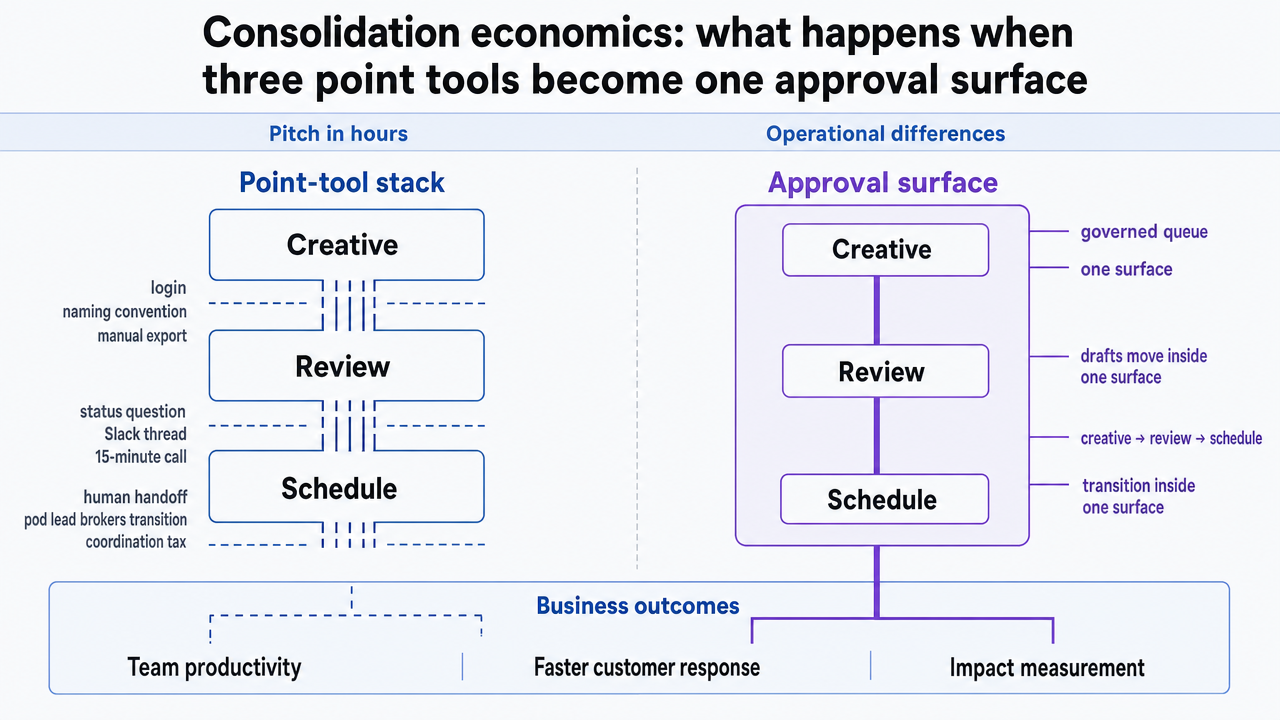
The pitch for consolidation usually gets made in feature language. The pitch that matters to a client-services lead is made in hours. Every point tool a pod runs carries a coordination tax: a login, a naming convention, a manual export, a status question that becomes a Slack thread that becomes a fifteen-minute call.
Forrester's framing of social suites names the three business outcomes consolidation is supposed to deliver: team productivity, faster customer response, and impact measurement 7. The mechanism is the same across all three, which is that a governed queue replaces the human handoff between systems. When drafts move from creative to review to schedule inside one surface, the pod lead stops brokering the transition.
The economics are easier to see as variables than as invented dollar figures. The table below compares a fragmented point-tool stack with a consolidated approval surface across the dimensions that actually show up on a P&L.
| Dimension | Point-tool stack | Consolidated approval surface |
|---|---|---|
| Tools per pod | 5–8 (brief, DAM, scheduler, approval, reporting, chat) | 1–2 (approval surface plus chat) |
| Weekly status meeting hours per client (H) | H | ~H/2 to H/3 |
| Approval cycle time per post | Email + scheduler + revision loop | Queue state, single view |
| Revision rounds per post (R) | R | R minus context-loss rounds |
| QBR assembly hours | Manual reconciliation across sources | Standing report, pod edits |
The variables matter more than round numbers. A pod running eight clients at three status hours each recovers a full day per week when H drops by a third, and that day is the one currently absorbed by unbilled coordination. Sustained productivity gains only materialize when the surface is the one the pod already works from 9. Consolidation that adds a ninth dashboard nobody opens produces the opposite result.
If you manage a multi-client portfolio: sequencing the consolidation
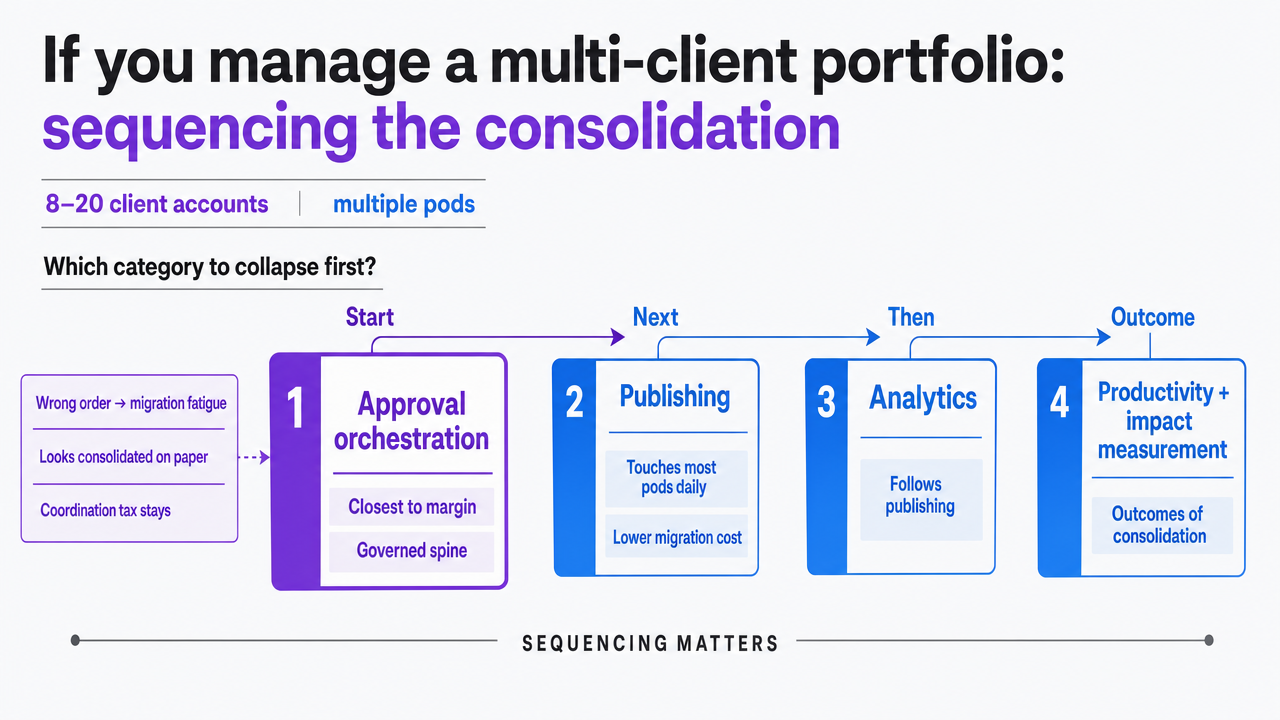
For directors running eight to twenty client accounts across multiple pods, the question is not whether to consolidate but which category to collapse first. Sequencing matters because the wrong order produces migration fatigue and a stack that looks consolidated on paper while the coordination tax sits in the same places.
- Start with approval orchestration. It sits closest to margin because every other category's output eventually passes through a sign-off queue, and Forrester's framing of social suites places productivity and impact measurement as the outcomes consolidation is supposed to deliver 7. Fix the queue and the downstream categories inherit a governed spine to plug into.
- Publishing and analytics come next, in that order. The publishing suite already touches most pods daily, so the migration cost is low and the calendar becomes the visible surface clients associate with the account. Reporting layers follow because a standing QBR draft compounds retention value once the underlying tags are consistent.
- Governance tooling gets consolidated last for pods with regulated accounts, but never optionally.
Vectoron's Command Center sits in the orchestration layer for teams starting there, routing recommendations for human approval before execution.
Frequently Asked Questions
References
- 1.From Concept to Reality: Operationalizing Social Media for ....
- 2.Revisiting the effects of social networks on enterprise collaboration ....
- 3.Embrace It or Not, Social Media Is Impacting Your Organization | NIST.
- 4.Partner Social Media Toolkit.
- 5.Using Social Media To Expand Organizational Capabilities.
- 6.The Four Social Marketing Tools You Need.
- 7.The Social Suite Landscape, Q4 2023.
- 8.Corporate Social Media Policy: Critical Components.
- 9.Maximizing the Impact of Enterprise Social Media.
- 10.Enhancing team effectiveness with social media in organizations.
- 11.Boost Your Social Media Team With A Social Suite Provider.
- 12.Four Takeaways On The State Of Social Suites.
- 13.Predictions 2025: Agencies Jettison Legacy Structures To Unleash Creativity, Media, And Commerce.