
Key Takeaways
- Treat the website content workflow as a five-stage governed system — strategy, briefing, production, review, and measurement — with named owners and gates between each handoff 4.
- Brief ambiguity and review queue collisions, not slow drafting, are where mature teams lose the most time; tighten Stage Two briefs to convert editor time from corrective to editorial work 4.
- Concentrate AI on briefing inputs and production subtasks like SERP analysis, first drafts, schema, and location variants, while humans hold strategy decisions and review gates 11, 9.
- Scaling output without adding headcount means lifting approval throughput rather than drafting throughput, especially for multi-location operators where workflow unit economics dictate the model 8.
Why Content Output Stalls Even With More Writers
Adding writers rarely fixes a content operation that has stopped scaling. The bottleneck almost never sits in the drafting stage. It sits in the connective tissue between strategy, briefing, review, and measurement — the parts of the workflow that determine whether a finished asset actually moves pipeline.
Peer-reviewed work on content marketing effectiveness identifies the real drivers of output and impact:
- clarity of strategy
- alignment with audience needs
- adherence to quality standards
- ongoing performance measurement
- structural specialization through defined processes 4
The same research notes that many firms underinvest in measurement and process design, which is why ad-hoc teams plateau even after headcount increases 4. More writers feeding an unclear brief produce more drafts that still need rework.
Harvard Business School Online frames the sequence that disciplined teams follow: define goals, identify audiences, research topics, choose formats, build a calendar, and track performance against benchmarked KPIs before scaling production 1. Skipping that sequence and hiring against output targets is what creates the familiar pattern — a backlog of half-briefed drafts, a review queue that never empties, and traffic numbers that drift without correlating to revenue.
The teams pulling ahead treat the website content workflow as a governed production system, not a writing roster. They standardize the work upstream of drafting and instrument the work downstream of publishing. The five stages that follow describe that system and where each stage actually breaks.
The Five-Stage Governed Production System
Stage One: Strategy and Demand Mapping
Strategy is the stage that pays for itself before a single word is drafted. It defines what content the site needs to exist, who it serves, and what KPI movement justifies its production cost. Teams that compress or skip this stage end up rewriting briefs mid-production and explaining traffic dips to executives who expected pipeline.
The Harvard Business School Online framework is unambiguous about the sequence: define goals tied to business objectives, identify target audiences, research topics and keywords, choose formats, and benchmark current performance against the KPIs that will measure the work 1. That benchmarking step is the one most teams omit. Without a baseline for organic sessions, assisted conversions, or qualified pipeline by topic cluster, the strategy has nothing to optimize against.
Demand mapping is the practical output of this stage. It pairs keyword and topic clusters with documented buyer questions, sales-team objections, and product or service lines, then ranks them by commercial intent and current ranking gap. The peer-reviewed evidence on content marketing effectiveness shows that clarity of strategy and alignment with audience needs are among the strongest predictors of measurable results 4. A demand map turns both into a ranked production queue.
The deliverable from Stage One is a quarterly content roadmap: cluster priorities, target KPIs per cluster, format mix, and an explicit list of topics the team will not pursue this quarter. That last item prevents scope creep from killing throughput.
Stage Two: Planning and Briefing
Briefing is where most production debt is created. A vague brief produces a draft that fails review, returns to the writer, and consumes two cycles of editor time before publication. Multiply that across a quarterly calendar and the math explains why output stalls.
A defensible brief carries six fixed components:
- the target query and search intent
- the primary audience and their stage of awareness
- the competitive SERP analysis
- the angle or thesis the asset will defend
- the required evidence and sources
- the success metric the asset will move
Each component eliminates a class of rework. Empirical research on content marketing effectiveness shows that adherence to documented quality standards correlates with stronger results, and that structural specialization through defined processes is what separates high-performing programs from ad-hoc ones 4.
Planning sits one level above the individual brief. It sequences briefs against the editorial calendar, assigns owners, and reserves review capacity downstream. The HBS framework treats the calendar as the operating document that connects strategy to execution 1. Teams that publish predictably treat it the same way — as a capacity model, not a wish list.
The briefing stage is also where AI begins to earn its slot. Generative tools can draft SERP analyses, surface adjacent questions, and assemble source lists at a speed manual research cannot match. The brief itself, and the strategic angle inside it, remains a human decision.
Stage Three: Production
Production is the stage most teams associate with the entire workflow, which is why it gets over-resourced and under-engineered. Drafting is one task inside a stage that also includes:
- research synthesis
- outline construction
- evidence gathering
- image sourcing
- internal-link mapping
- on-page SEO formatting
Each of these is a distinct unit of work with a distinct skill requirement.
Empirical analysis of marketing teams adopting generative AI shows that current applications cluster heavily in this stage: teams use AI primarily for first drafts and ideation, while human review and refinement remain critical for final output 11. That allocation is rational. First drafts and research synthesis are repeatable tasks with high token-to-judgment ratios. Angle selection, voice calibration, and source vetting are not.
McKinsey's productivity analysis identifies marketing and sales as among the most immediately impacted functions for generative AI, with copywriting, idea generation, and customer research cited as specific high-leverage applications 8. Teams that route those subtasks to AI and reserve human capacity for editorial judgment can compress draft cycle time without expanding headcount.
The production stage should produce a draft that is brief-compliant, source-cited, formatted to the CMS template, and tagged with the success metric from Stage One. Anything less and the review stage absorbs work that production should have completed. The cleanest production handoffs are the ones where the reviewer's first action is editorial, not corrective.
Stage Four: Review and Governance Gates
Review is where governance lives, and governance is what keeps a scaled workflow from producing scaled liability. The U.S. Department of Labor's content governance guidance is explicit about the components that lightweight governance requires:
- mapping the workflow so every team member knows the steps and owners
- defining planning, publication, and retirement processes
- drafting quarterly content roadmaps
- assigning clear review responsibilities including legal where applicable 7
The guidance also stresses visual workflow diagrams and criteria for updating and sunsetting content, which closes the loop on lifecycle management.
A governed review stage operates on gates, not opinions. Each gate has an owner, a checklist, and a defined output.
- Editorial review confirms the draft meets the brief and brand voice.
- SEO review confirms on-page structure, internal linking, and schema.
- Legal or compliance review, where the vertical requires it, confirms claims, disclaimers, and regulated language.
- Publishing review confirms metadata, canonical tags, and template integrity.
The brief from Stage Two specifies which gates apply, so the review queue is predictable rather than improvised.
The five-stage operating model — strategy, plan, produce, review, measure — works because each stage has documented inputs, documented outputs, a named owner, and an explicit review gate before handoff. Mapping that structure visually is the first governance practice the DOL recommends, because it makes bottlenecks and unowned steps immediately legible 7.
The discipline at this stage is restraint. Adding a gate without an owner and a checklist creates queue time without adding quality. Removing a gate to chase velocity creates downstream rework that costs more than the gate would have. The right number of gates is the smallest number that holds quality at the published threshold.
Stage Five: Measurement and the Feedback Loop
Measurement is the stage that converts published assets into strategic signal. Without it, the workflow produces content; with it, the workflow produces learning. The HBS framework places KPI tracking against benchmarked baselines as the closing step of the strategy cycle, not an afterthought attached to publishing 1.
The metrics that matter are the ones tied to the success criterion specified in the brief. For top-of-funnel clusters, that is typically organic sessions, ranking position, and assisted conversions. For mid-funnel and bottom-funnel assets, it is qualified leads, pipeline contribution, and cost per published asset measured against revenue impact. The peer-reviewed effectiveness literature identifies ongoing performance measurement as one of the determinants that separates effective content programs from ineffective ones 4.
The feedback loop is the part teams most often skip. Measurement data should flow back to Stage One on a defined cadence — monthly for tactical signal, quarterly for strategic reallocation. Topic clusters that overperform get expanded coverage in the next roadmap. Underperformers get refreshed, repositioned, or retired per the lifecycle criteria established in governance 7.
A closed loop is what makes the workflow governed rather than merely procedural. Each cycle informs the next, and the strategy that opens Stage One in the following quarter reflects what the previous quarter's data proved.
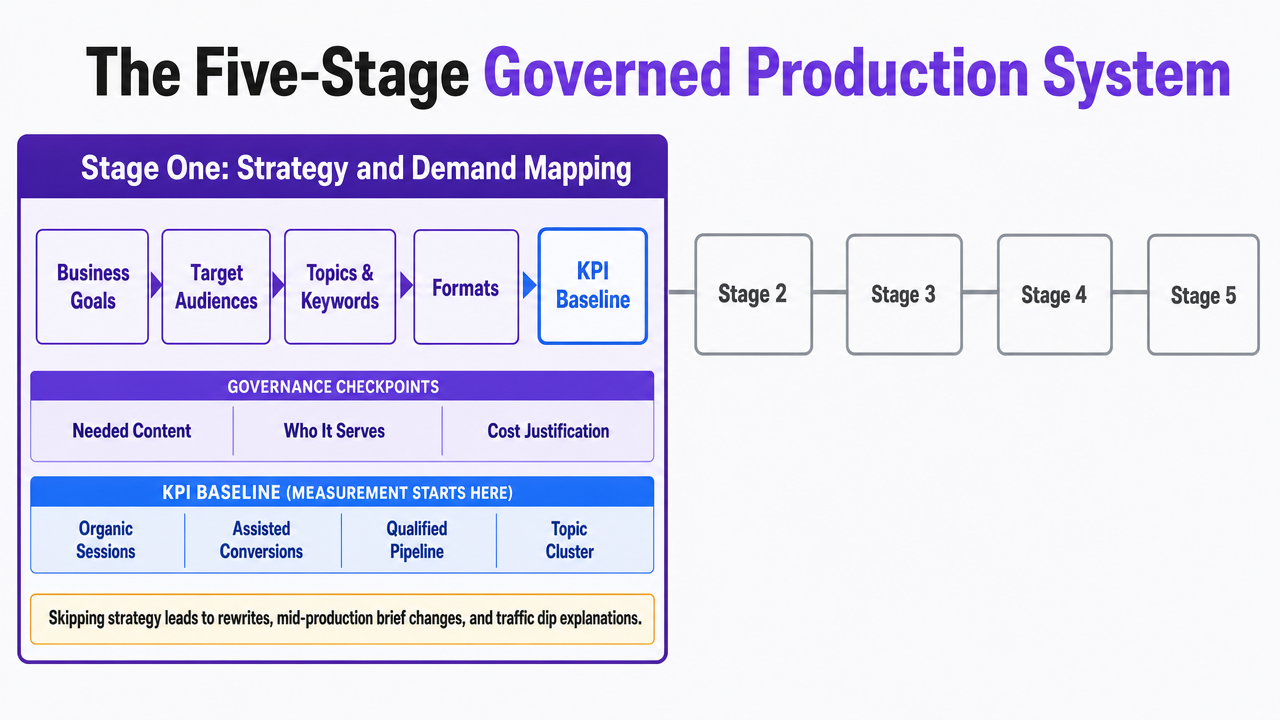 Visualize the five-stage workflow as a horizontal process diagram showing the governed production system that anchors the entire article
Where AI Earns Its Slot in the Workflow
The binary debate over whether to use AI in content production misses the actual question, which is stage-specific. The five-stage workflow does not benefit uniformly from generative AI, and treating it as a single lever is what produces both over-automated drafts and under-automated research queues.
Empirical analysis of marketing teams adopting generative AI shows a consistent pattern: teams concentrate AI use in ideation, first drafts, and research synthesis, while human review and refinement remain critical for final outputs 11. That distribution maps cleanly onto the workflow. McKinsey's productivity analysis identifies marketing and sales as among the most immediately impacted functions for generative AI, with copywriting, idea generation, and customer research called out as the highest-leverage applications 8. Those are Stage Two and Stage Three tasks — briefing inputs and production subtasks — not Stage One strategy or Stage Four governance.
The leverage curve runs roughly as follows:
- Strategy and demand mapping benefit modestly: AI can surface keyword clusters and adjacent questions, but the prioritization decision stays with the team that owns the KPI.
- Briefing benefits substantially: SERP analysis, source assembly, and outline drafts compress from hours to minutes.
- Production benefits most: first drafts, alt text, schema markup, and CMS formatting are repeatable tasks where AI converts time directly into throughput.
- Review benefits the least: editorial judgment, brand voice calibration, and compliance-sensitive editing are exactly the work McKinsey's agentic AI analysis flags as requiring human guardrails and KPI ownership 9.
- Measurement benefits in the middle: AI can cluster performance data and flag anomalies, but the reallocation decision belongs to the strategist who owns the next quarter's roadmap.
The operating principle is approval-first. AI executes the repeatable work inside each stage; humans set strategy at Stage One and hold the gates at Stage Four. Teams that invert that — letting AI ship without review, or refusing to let it draft at all — either accept quality risk or forfeit the productivity gain entirely.
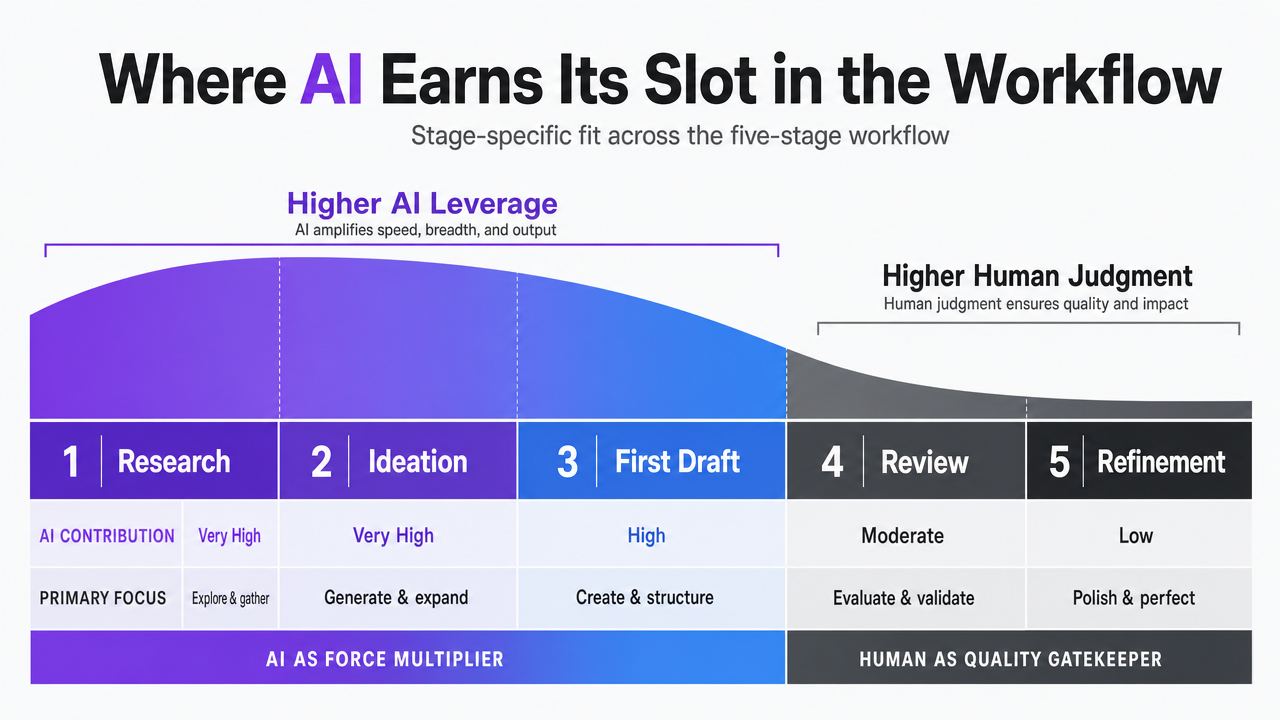 Show the AI leverage curve across the five stages, mapping which stages benefit most from generative AI versus which require human judgment
Accelerate Your Content Workflow in One Week
Test a fully automated website content process and measure impact before making a commitment.
Governance in Compliance-Heavy Verticals
Law firms, healthcare systems, dental groups, and senior living operators publish into regulated environments where a missed disclaimer or an unsubstantiated claim is not an editorial defect — it is exposure. The five-stage workflow holds up under that pressure only when the review stage carries verticalized gates with named owners.
The peer-reviewed analysis of generative AI in healthcare is direct about the trade-off: AI can personalize patient education and optimize campaigns at speed, but the same capability raises data privacy, bias, and oversight concerns that require human judgment at every patient-facing decision point 2. The clinical-side literature reinforces the same principle in a higher-stakes context — AI handles repeatable tasks well, but humans must retain control over decisions where accuracy and accountability matter 10. The marketing application is identical in structure: AI drafts, humans approve.
Harvard Law School's Center on the Legal Profession reports that firm leaders expect AI to increase lawyer productivity sharply, including in client development and marketing content, without proportional headcount additions 3. The governance implication is that legal review cannot be a bottleneck the workflow routes around. It has to be a scheduled gate with reserved capacity, the same way SEO and editorial review are scheduled.
The operational takeaway is to write the compliance gate into the Stage Two brief, not bolt it on at Stage Four. The brief should specify which claims require source documentation, which assertions trigger legal review, and which formats require disclaimer language. That single change moves compliance from a publication-blocker to a production input.
If You Manage Multiple Locations: Workflow Consolidation Economics
The reader frame shifts here. The next several paragraphs are written for multi-location operators — law firm networks, dental support organizations, senior living portfolios, home services franchises, and multi-site healthcare groups — where the content workflow runs across ten, fifty, or two hundred location pages and the cost structure of that workflow is itself a strategic variable. Single-site content managers can skip ahead.
Multi-location operations expose the unit economics of the workflow in a way single-site operations do not. A briefing process that takes four hours per asset is tolerable at twenty assets a quarter and ruinous at two hundred. A review queue that runs five business days per piece is a scheduling inconvenience for one site and a publication freeze across a portfolio. Consolidation pressure tends to surface three workflow models, each with a distinct cost shape.
The traditional agency-led model carries a monthly retainer per location or per brand, with per-article costs absorbed inside the retainer envelope. Review cycles run long because briefs travel between client and agency. Output ceilings are capped by agency staffing and concurrent client load. Governance posture is contractual rather than operational — quality lives in the statement of work, not in the workflow itself.
The in-house team plus freelancer model trades retainer cost for headcount cost. FTE assumptions typically scale with portfolio size — one content manager per cluster of locations, with freelance drafting capacity layered on. Review cycles compress because editorial sits closer to strategy, but output ceilings hit a hiring wall. Governance posture is strongest in this model when documented standards exist, which the effectiveness research identifies as a primary driver of measurable results 4.
The AI-orchestrated model with human approval gates keeps strategy, review, and governance in-house while routing repeatable production work — first drafts, SERP analysis, schema, location-page variants — to AI execution. McKinsey's productivity analysis identifies marketing and sales as among the most immediately impacted functions for generative AI, with copywriting, idea generation, and customer research as the highest-leverage applications 8. Harvard Law School's analysis of AI in legal services reaches a parallel conclusion for high-stakes professional environments: productivity gains are expected without proportional headcount additions 3. Review cycle days drop because production handoffs arrive brief-compliant. The output ceiling rises with approval throughput rather than drafting throughput. Governance posture is strongest when AI executes within named gates rather than around them 9.
| Variable | Agency-led | In-house + freelance | AI-orchestrated + approval |
|---|---|---|---|
| Cost driver | Retainer per location | FTE + per-article freelance | Platform + reviewer FTE |
| Review cycle | Longest (cross-org) | Medium (internal) | Shortest (gated handoff) |
| Output ceiling | Agency staffing | Hiring capacity | Approval throughput |
| Governance posture | Contractual | Documented standards | Gated execution |
Operators should populate the ranges from their own retainer history, freelance rates, and FTE costs. The structural insight is that the binding constraint changes by model — and the model that scales across a portfolio is the one whose constraint is approval capacity, not drafting capacity.
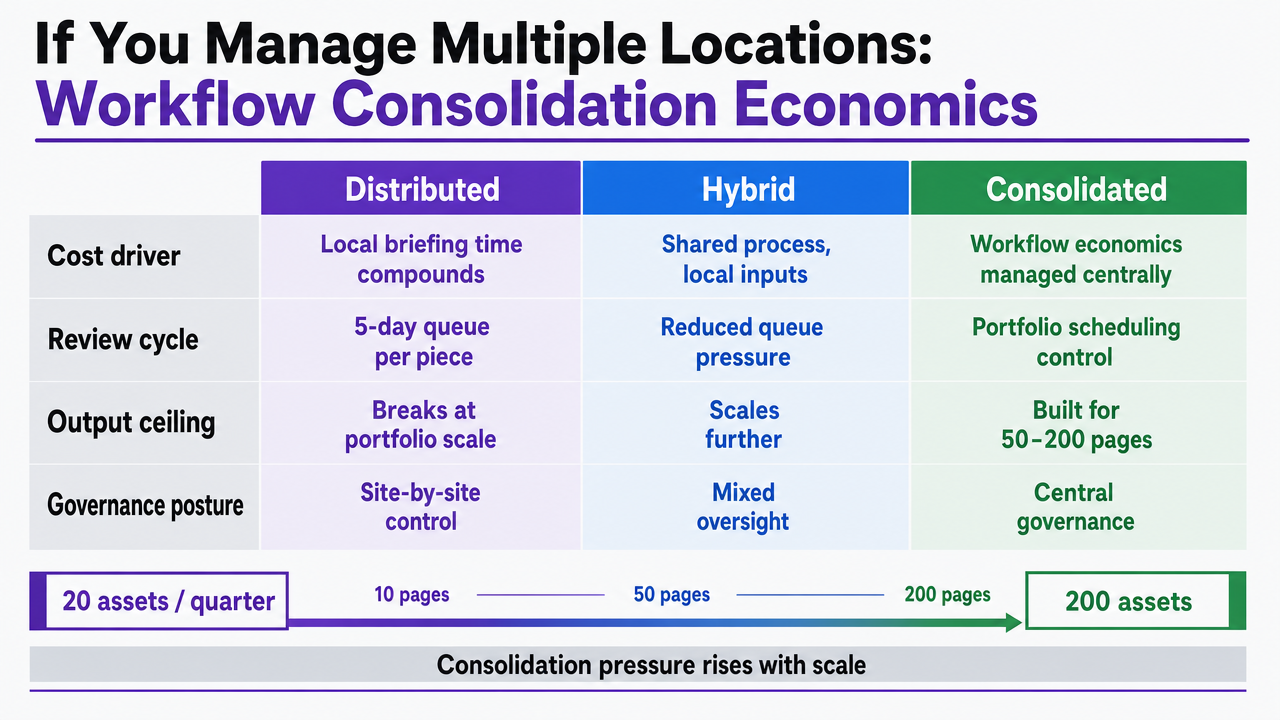 Compare the three workflow operating models for multi-location operators across cost driver, review cycle, output ceiling, and governance posture
See How Leading Teams Streamline Content Workflows for Reliable SEO Gains
Request a walkthrough of unified, approval-based workflows proven to increase publishing velocity and maintain brand standards—ideal for agencies and enterprise marketers managing multi-channel content at scale.
Bottleneck Diagnostics: Where Most Teams Actually Lose Time
The instinct when output stalls is to blame drafting speed. The data on team workflows points elsewhere. Empirical analysis of marketing teams using generative AI shows that drafting and ideation are the stages teams have already accelerated; the slowdowns now sit in the surrounding work 11.
Four bottlenecks account for most lost time in a mature workflow.
- Brief ambiguity. A draft that arrives without a defended thesis, a documented audience, or a named success metric routes back to the writer for clarification rather than forward to review. The peer-reviewed effectiveness research identifies clarity of strategy and adherence to documented quality standards as primary determinants of measurable results, which is the same evidence base that explains why ambiguous briefs cost more than they appear to 4.
- Review queue collisions. When editorial, SEO, and compliance reviewers share unstructured calendar time, drafts wait in parallel for sequential gates. The Department of Labor governance guidance recommends mapping workflows visually and assigning explicit review responsibilities precisely to surface this kind of queueing cost 7.
- Unowned handoffs between stages. A draft that is technically complete but missing schema, alt text, or internal-link targets stalls at publishing without a clear owner to resolve it.
- Missing measurement infrastructure. Assets ship without a tagged success metric, so the feedback loop to Stage One produces opinion instead of signal 1.
Diagnosing which of the four owns the lost time is a fifteen-minute exercise: pull the last twenty published assets, log the calendar days each spent in each stage, and find the stage with the highest variance. Variance, not average, is the bottleneck signature.
Building the Workflow Without Adding Headcount
Doubling output without doubling spend is a workflow design exercise, not a hiring exercise. The constraint to lift is approval throughput, and the way to lift it is to remove non-judgment work from the people who hold the gates.
Three moves do most of the lifting:
- Routing repeatable production tasks — first drafts, SERP analysis, schema, alt text, internal-link mapping, location-page variants — to generative AI execution, which is the allocation pattern that current empirical work on marketing teams already shows in practice 11.
- Tightening the Stage Two brief so drafts arrive review-ready, which converts editor time from corrective work to editorial work.
- Reserving fixed weekly capacity at each review gate so queue time stops being the binding constraint.
McKinsey's agentic AI analysis frames the operating model that ties these moves together: AI agents orchestrate multi-step production work across the stack while humans set guardrails and KPIs that define what optimization actually means 9. The structure is approval-first. AI executes inside named gates; strategists, editors, and compliance reviewers approve at them. Output rises with approval throughput rather than drafting throughput, which is the metric a content operation can scale without adding writers.
The team composition that results is small and senior. Strategy, editorial judgment, and governance stay in-house. Drafting capacity becomes elastic. That is how a content function doubles its publication rate while holding headcount flat — and it is the operating model Vectoron is built to run.
Frequently Asked Questions
References
- 1.How to Create a Content Strategy That Drives Results.
- 2.Generative Artificial Intelligence Use in Healthcare.
- 3.The Impact of Artificial Intelligence on Law Firms' Business Models.
- 4.Determinants of content marketing effectiveness: Conceptual framework and empirical findings.
- 5.The What, When, Why, and How of Content Marketing.
- 6.Examining Marketing Effectiveness of a Higher Education Internal Service Provider.
- 7.Content governance: lightweight practices your team can adopt now.
- 8.The economic potential of generative AI: The next productivity frontier.
- 9.Reinventing marketing workflows with agentic AI.
- 10.The Role of AI in Hospitals and Clinics: Transforming Healthcare in the Era of Big Data.
- 11.Integrating Generative AI into Team-Based Marketing Workflows.