
Key Takeaways
- A content calendar is a structured system for planning, organizing, and scheduling content across channels, with strategy linkage, ownership, and performance tracking built into every entry 1.
- Treating the calendar as an operating layer rather than a spreadsheet connects quarterly goals to weekly production, governs approvals, and ties each asset to a specific KPI 4.
- Mature calendars operate through four integrated layers: strategy inputs, production workflow, approval routing, and performance feedback, which together turn publishing slots into deliberate allocation decisions.
- Calendar maturity shows up in three measurable outcomes—cadence consistency, approval cycle time, and throughput against planned slots—which also diagnose which layer is weakest when performance drifts 2.
The Content Calendar as an Operating Layer
Most content calendars fail because they lack authority. They exist as spreadsheets, disconnected from strategy, approval processes, and analytics. This results in a schedule that outlines intentions but doesn't govern execution.
A more effective approach views the calendar as an operating layer connecting strategy to publishing. It transforms quarterly goals into weekly production commitments, aligns format decisions with capacity, and links every published asset to a specific KPI 4. Practitioners define a calendar as a structured system for planning, organizing, and scheduling content across channels, with performance tracking integrated from the start 1.
For in-house managers scaling content operations, this distinction is crucial. A spreadsheet answers "what publishes Thursday?" An operating layer addresses broader strategic questions: which themes are underweighted, which approvals are stalled, which formats are underperforming, and where reactive capacity exists to capitalize on trends 2.
This reframing directly impacts velocity. Teams needing to scale output without increasing headcount require a planning tool that is the system itself, not merely a reflection of it. The following sections detail the components of this operating layer, how mature teams structure it, and which decisions belong at the calendar level.
Defining the Modern Content Calendar
A content calendar is a structured system for planning, organizing, and scheduling content across channels, with performance tracking built-in 1. While this definition seems straightforward, the term has evolved significantly. It can refer to anything from a shared Google Sheet to a comprehensive planning surface managing briefs, approvals, publishing, and analytics.
Older definitions often described the calendar as a timeline of publishing dates, similar to a magazine editorial schedule 3, 11. While not incorrect, this view is incomplete. A modern calendar goes further by aligning content with goals, audience segments, and keyword priorities, connecting publishing decisions to business outcomes rather than just a posting cadence 2, 9.
Three key characteristics differentiate the modern content calendar:
- Strategic means each entry links to a documented goal or theme 4.
- Operational implies that ownership, review states, assets, keywords, and calls to action are integrated within the calendar entry itself 2.
- Measurable means KPIs are attached at the entry level and regularly audited 5, 9.
The practical test is simple: if a manager can open the calendar and determine the goal, owner, status, and success metric for any entry, it functions as an operating system. If this information is scattered across multiple tools, the calendar is merely a schedule.
The Four Layers of a Content Calendar
Strategy Inputs: Goals, Themes, and Audience Signals
The strategy layer establishes the calendar's authority. Every production entry should directly connect to a quarterly goal, a defined theme, or an audience signal. Without this traceability, the calendar becomes a list of topics, and production capacity is wasted on assets that don't contribute to business objectives.
The Content Marketing Institute's framework emphasizes this input layer, prioritizing stakeholders and quarterly goals over content mix and cadence decisions 4. Reversing this order leads to calendars reflecting what the team wants to create rather than what the business needs to publish, resulting in productive-feeling cadences but underperforming pipelines.
This layer includes three essential inputs:
- Business goals define the north-star metrics for each theme, such as qualified pipeline, organic sessions, or customer retention 5.
- Themes translate these goals into recurring editorial areas, moving beyond one-off topic ideas.
- Audience signals, derived from keyword research, sales insights, and platform analytics, determine which themes receive greater emphasis in a given cycle 2.
Properly implemented, the strategy layer transforms a blank calendar into a slot allocation problem. Each publishing slot is pre-assigned a theme, goal, and audience target before any topic brainstorming, ensuring coherence in subsequent layers.
Production Workflow: Ownership, Formats, and Capacity
Once strategy is set, the production layer dictates who creates what, in which format, and within capacity limits. This layer is critical for velocity. Ownership, format assignments, review states, and asset links are all embedded within the calendar entry, distinguishing an operating layer from a mere schedule 2.
Format allocation is particularly important due to its economic impact. For instance, video posts on social media can generate approximately 38% higher engagement than static images 6. This highlights that format mix is a slot-level decision with predictable performance outcomes, not a post-by-post preference. Teams that defer format decisions until drafting lose the ability to strategically shape quarterly performance.
Capacity is another crucial constraint for this layer. Practitioner guides for 30-day planning cycles stress that calendars must reflect realistic production capacity, encompassing creation, review, publishing, promotion, and analysis within the workflow 7. A calendar entry without an owner, format, and review checkpoint indicates a lack of true production planning.
Mature production layers also account for dependencies. A long-form article requiring three social cutdowns and an email placement should show these child assets linked to the parent entry on the calendar. This ensures promotional capacity is committed when the primary asset is scheduled 1, preventing the common issue of shipping an anchor asset without planned distribution.
Approval Routing: The Governance Layer
Approval routing is a common point of failure for many calendars. Teams often design detailed strategy and production fields but leave the review process to informal channels like Slack or email. This leads to extended cycle times, inconsistent brand voice, and an inability for the calendar to accurately predict publishing dates.
A functional approval layer defines, for each entry: who reviews, in what sequence, and against what criteria. Practitioner guides advocate for integrating ownership and review checkpoints directly into the workflow 1, 2. Higher-education marketing teams, facing complex stakeholder reviews, prioritize this routing as a core calendar field because informal processes don't scale 5.
Routing rules should vary by content type. A recurring blog post in an established cluster doesn't require the same extensive review as a campaign anchor for a product launch. When the calendar reflects this distinction, senior reviewers can focus on high-impact work, avoiding bottlenecks on low-risk content.
The measurable outcome of an effective approval layer is cycle time. If a manager cannot reasonably estimate the time from draft-ready to published for each format, the governance layer is not properly instrumented. Attaching approval states to calendar entries transforms cycle time from an anecdotal observation into a measurable and optimizable metric 4.
Performance Feedback: KPI Attachment per Entry
The final layer closes the loop: every entry on a mature calendar includes the KPI it's designed to influence, and this KPI is reviewed regularly, not just in quarterly reports. Without this, the calendar generates output but provides no evidence of which themes, formats, or channels are truly effective.
Attaching KPIs at the entry level transforms the calendar into a decision-making tool rather than just a historical record. Higher-education marketing guidance links calendar entries directly to engagement and conversion tracking, using per-entry KPIs to assess content effectiveness instead of relying solely on channel-level reports 5. Similarly, SMB-focused calendar advice emphasizes connecting publishing decisions to business goals at the entry level, followed by regular audits and optimization 9.
The feedback interval is as important as the metrics themselves. Monthly or quarterly calendar reviews, where underperforming themes lose slots and successful ones gain them, make the calendar a dynamic allocation tool 2. Teams that skip this review accumulate outdated commitments, leading to a crowded but ineffective calendar.
When instrumented this way, the four layers function as a unified system: strategy inputs determine slot allocation, production defines creation, approval manages shipping, and performance feedback informs future cycles.
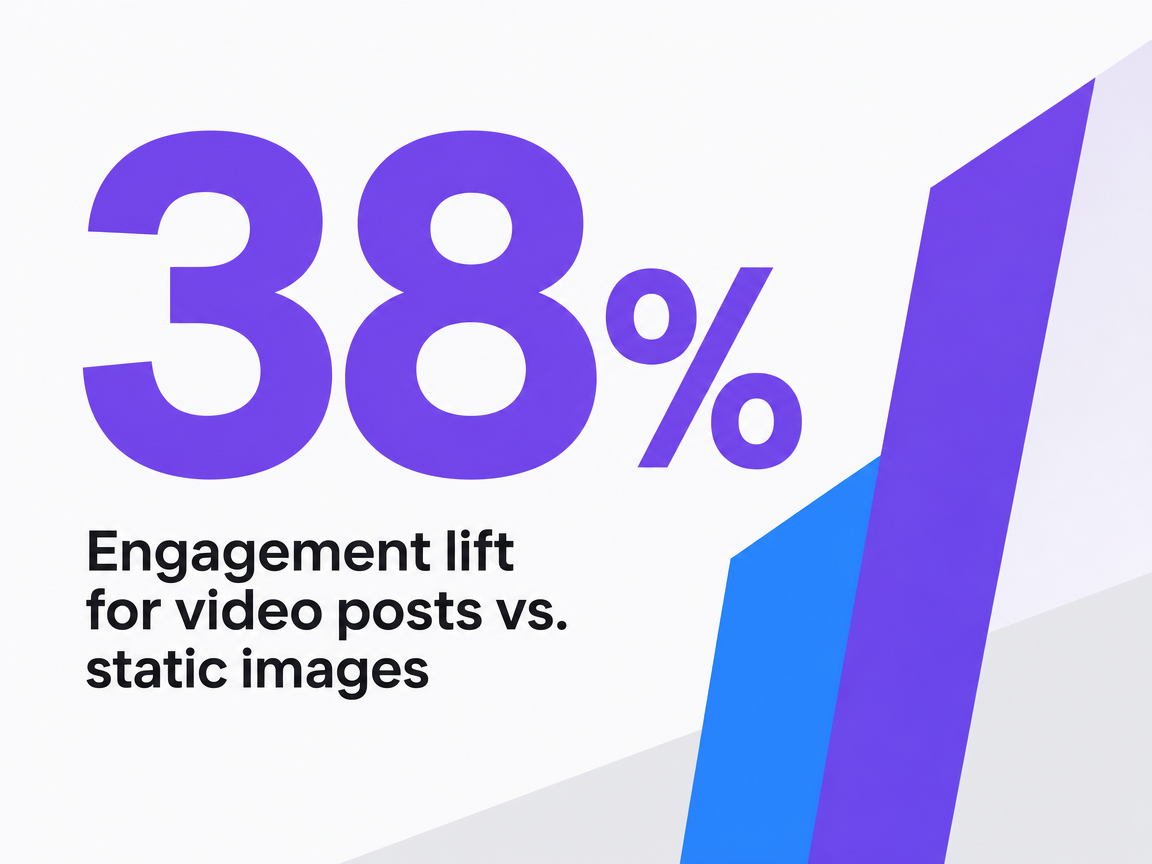 Engagement lift for video posts vs. static images
Engagement lift for video posts vs. static images
Test a live content calendar workflow risk-free
Experience hands-on content scheduling and approvals with real outputs before making a commitment.
Planning Horizons: 30, 90, and Rolling Cycles
The choice of planning horizon significantly impacts how a calendar operates. A 30-day cycle offers different tradeoffs than a 90-day build or a rolling quarterly view. Managers should make this choice deliberately, rather than inheriting a default.
Short cycles prioritize agility. Practitioner guides for 30-day content plans integrate creation, review, publishing, promotion, and analysis into a single monthly loop 7. This provides rapid feedback, allowing underperforming themes to be cut quickly and enabling timely responses to audience behavior signals. However, this agility comes at the cost of coordination; complex campaigns, SEO cluster builds, or stakeholder-heavy approvals often struggle within a four-week timeframe.
Longer horizons foster compounding effects. Social and content practitioners for brand campaigns suggest building calendars at least 90 days in advance to coordinate channel launches, secure creative assets, and track performance against a stable baseline 8. SEO work particularly benefits from this horizon, as cluster coverage and internal linking yield results over months. The drawback is reduced reactive capacity; a calendar fully committed 90 days out has little room for unexpected trend opportunities.
Rolling quarterly cycles aim to combine the benefits of both. The team maintains a 90-day forward view but re-plans in 30-day increments, adjusting for reactive slots and demoting underperforming themes at each interval. The Content Marketing Institute's framework recommends planning for flexibility within a quarterly goal structure, which aligns with the operational shape of rolling cycles 4. For growth-stage teams under pressure to scale, this model often outperforms pure short or long horizons by balancing compounding benefits with reactive capabilities.
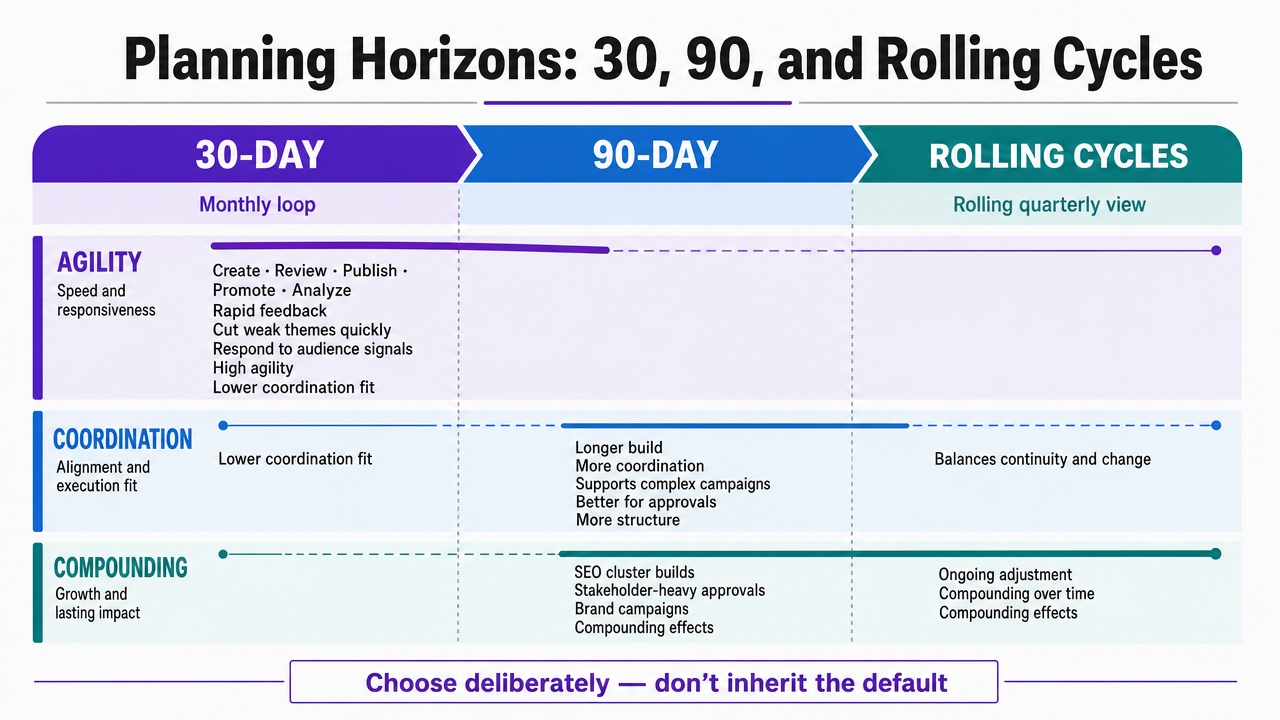 Compare the three planning horizons discussed in the section against tradeoffs of agility, coordination, and compounding
Encoding Cadence and Reactive Slots in Mature Teams
Cadence is not merely frequency; it's a slot structure that assigns purpose to each publishing window before topics are even considered. Mature teams pre-determine how many slots per cycle are allocated to evergreen cluster work, campaign anchors, and reactive content responding to trends, news, or platform-specific opportunities. Social calendar guidance explicitly states that posting rhythm should be based on audited past performance and platform benchmarks, not intuition 6.
The reactive slot ratio is a common misstep for many teams. Calendars fully committed to planned entries lose the ability to capitalize on timely opportunities, a concern highlighted by practitioners regarding overly rigid schedules 2. Conversely, calendars with too much open space sacrifice the compounding benefits of themed cluster work and campaign sequencing. A practical approach for growth-stage teams is to reserve a defined percentage of each cycle's slots for reactive content, with pre-agreed criteria for what qualifies and who approves its fulfillment.
The Content Marketing Institute's framework integrates flexibility directly into the planning process, treating it as a scheduled feature 4. On the calendar, this means reactive slots exist as visible placeholders with assigned owners, formats, and target KPIs, even if the specific topic is undefined. When a trend emerges, the slot is filled against a pre-approved specification, rather than being created under pressure.
Calendar Maturity and Measurable Outcomes
Calendar maturity is evidenced by three measurable metrics:
- Cadence consistency
- Approval cycle time
- Publishing throughput against planned slots
Teams treating the calendar as an operating layer see these metrics improve concurrently, as the integrated layers reinforce each other.
Cadence consistency measures the deviation between planned and actual publishing dates. Mature calendars maintain a tight gap because production, approval, and promotion capacities are committed during planning 1. Chronic slippage often indicates issues upstream: vague strategy inputs, inaccurate production estimates, or informal approval routing.
Approval cycle time is highly responsive to structural changes. Integrating review states, reviewer sequences, and decision criteria into calendar entries transforms approval from a social process into an instrumented one. The seven-step strategic framework considers measurement of this kind a final planning discipline 4. Growth-stage teams typically compress cycle time by narrowing reviewer sets for low-risk entries, rather than pressuring reviewers.
Throughput against planned slots is the outcome metric that connects the others. A calendar with clear strategy, instrumented production, structured approval, and per-entry KPI attachment yields a predictable ratio of shipped-to-planned entries 2, 9. Teams reporting high throughput but low performance often lack the performance feedback layer; those with strong per-asset performance but inconsistent output usually miss the approval layer.
Together, these four layers form a diagnostic surface. Drifting cadence points to issues in the strategy or production layer. Expanding cycle time indicates unstructured approval routing. High throughput with flat outcomes suggests a broken performance feedback loop. Managers can identify the weakest layer by observing which metric shifts first, then address the problem at that specific layer.
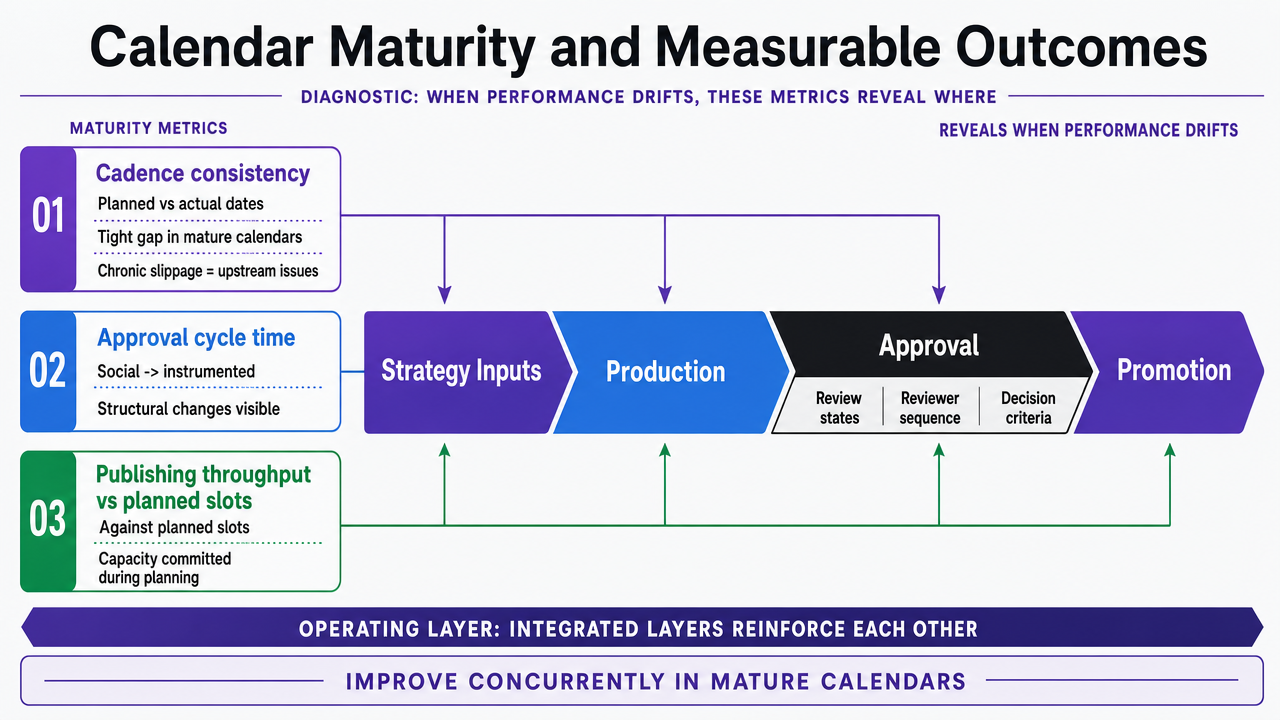 Show the diagnostic relationship between the three maturity metrics and which calendar layer they reveal when performance drifts
Accelerate Content Calendar Execution With Centralized Approval Workflows
See how leading brands use unified dashboards to streamline content planning, reduce bottlenecks, and boost production velocity—without losing oversight or brand consistency. Request a walkthrough tailored to your multi-channel needs.
Small Teams, Higher Leverage: Scaling Without Headcount
The velocity bottleneck for most in-house teams isn't writing; it's coordination. For teams with limited contributors, time spent on briefing rewrites, chasing reviewers, and reconciling statuses is time lost from shipping content. A calendar designed as an operating layer reduces this overhead by moving decisions upstream, enabling small teams to produce at a higher volume without additional hires.
Practitioner guidance for resource-constrained teams emphasizes that a content marketing calendar functions as a planning and decision-making tool, linking publishing choices to business goals. Regular audits ensure the calendar remains aligned with what's effective, not just what was planned 9. This audit discipline creates leverage: underperforming themes lose slots, formats with faster approval cycles gain priority, and reactive capacity is fine-tuned based on observed success rates.
The structural benefit is clear: when strategy inputs, ownership, approval routing, and per-entry KPIs are all integrated into the calendar, the marginal cost of shipping each subsequent asset decreases. Coordination no longer consumes production capacity 2. For teams needing to scale output without increasing headcount, this shift, more than any tool, transforms the calendar into a velocity multiplier.
When a Notebook Outperforms a Platform
Not every operation requires a complex governance layer. Solo operators and small, single-channel teams often find a weekly notebook entry more effective than a full planning platform. The National Federation of Professional Trainers, for example, advocates for a simple model: one page per week to record promotions, events, costs, and results, maintained for a year as a running log of what worked 10. For a practitioner managing their own marketing alongside a service business, this level of detail is sufficient.
The tipping point is coordination load. When a calendar has a single owner, one channel, and no approval routing, a notebook can capture the four essential layers—what was planned, what shipped, its cost, and its return—in a concise format. In such cases, the overhead of a dedicated platform offers no significant advantage.
Platforms become essential when the calendar needs to coordinate multiple owners, channels, and reviewers against a shared cadence. Below this coordination threshold, the operating layer can effectively reside on a single page.
Frequently Asked Questions
References
- 1.What Is a Content Calendar? Free Template, Examples & Planning Strategies.
- 2.How to create a marketing content calendar.
- 3.Setting up a content calendar.
- 4.7 Steps to a More Strategic Editorial Calendar.
- 5.How to Create a Strategic Content Calendar For Higher Ed Marketers.
- 6.How to Build a Successful Social Media Content Calendar.
- 7.Content Marketing Strategy: How to Create a 30-Day Plan.
- 8.Your Step-by-Step Guide to Social Media Strategy and Content Calendars.
- 9.Best Content Marketing Calendar for SMBs + Template.
- 10.Keeping a Marketing Calendar Journal.
- 11.Creating an Editorial Calendar? Here Are 8 Tips to Get Started.