
Key Takeaways for Marketing Leaders
- Accelerated Buying Cycles: With 75% of buyers completing their journey in 12 weeks, online B2B marketing must pivot to transparent, self-serve content that supports digital-first research.
- Precision Over Volume: Tightly defined ICPs and segmentation can drive 4x conversion improvements, making data foundation and tech stack integration critical for success.
- Experimentation as a Growth Engine: Organizations running 5+ experiments monthly see 3x higher growth, necessitating a shift from assumption-based planning to hypothesis-driven execution.
Creating an Online B2B Marketing Framework
For VP Marketing SaaS leaders, the challenge is no longer just generating leads but orchestrating a comprehensive online B2B marketing system that aligns with rapid shifts in buyer behavior. As decision-makers increasingly rely on digital channels for research and evaluation, the traditional linear funnel has been replaced by a complex, self-directed journey. This guide outlines the structural components required to build a high-performance marketing engine, from data foundations to experimentation cultures.
Why Online B2B Marketing Cycles Are Accelerating
Digital-First Research Reshapes Decisions
Checklist: Is Your Digital Research Journey Buyer-Ready?
- Does your website provide detailed product information without requiring a demo?
- Are peer reviews, case studies, and pricing easily accessible?
- Can prospects benchmark your solution with alternatives using digital tools?
- Is content optimized for AI-driven search and buyer self-education?
Digital-first research has become the dominant force reshaping B2B decision-making. According to a recent Google survey, nearly 75% of B2B buyers now complete their entire purchasing journey within 12 weeks—significantly faster than previous cycles1. Decision-makers rely on search engines, AI-powered comparison platforms, and social validation rather than engaging sales early in the process. This shift demands that online B2B marketing strategies prioritize transparency, unbiased content, and seamless access to critical decision data.
A striking 58% of buyers reported switching vendors at the point of purchase, signaling eroding supplier loyalty and increased willingness to explore alternatives8.
This approach is ideal for organizations aiming to stay competitive in an environment where buyers assemble shortlists based on digital reputation and content quality before any direct sales outreach. The implication is clear: brands must invest in content and web experiences that not only attract but also educate and retain digital-first buyers.
As digital research accelerates, the next section will examine how engagement timing and the so-called "80% rule" are transforming the handoff between marketing and sales.
The 80% Rule and Sales Engagement Timing
Decision Tree: Is Your Sales Team Engaging at the Optimal Point?
- Step 1: Does marketing track buyer intent signals (web activity, content downloads) in real time?
- Step 2: Are prospects provided with self-serve resources until they demonstrate clear purchase intent?
- Step 3: Is the sales handoff protocol based on behavioral thresholds, not arbitrary timelines?
- Step 4: Are marketing and sales using shared data to define sales-ready criteria?
The "80% rule" refers to the finding that B2B buyers now complete roughly 80% of their purchasing process before initiating direct contact with a sales representative2. This shift has compressed the traditional sales window and redefined the purpose of sales engagement. The majority of research, evaluation, and shortlist creation now takes place through digital channels—placing heightened pressure on online B2B marketing to deliver tailored, high-quality content and buyer enablement tools.
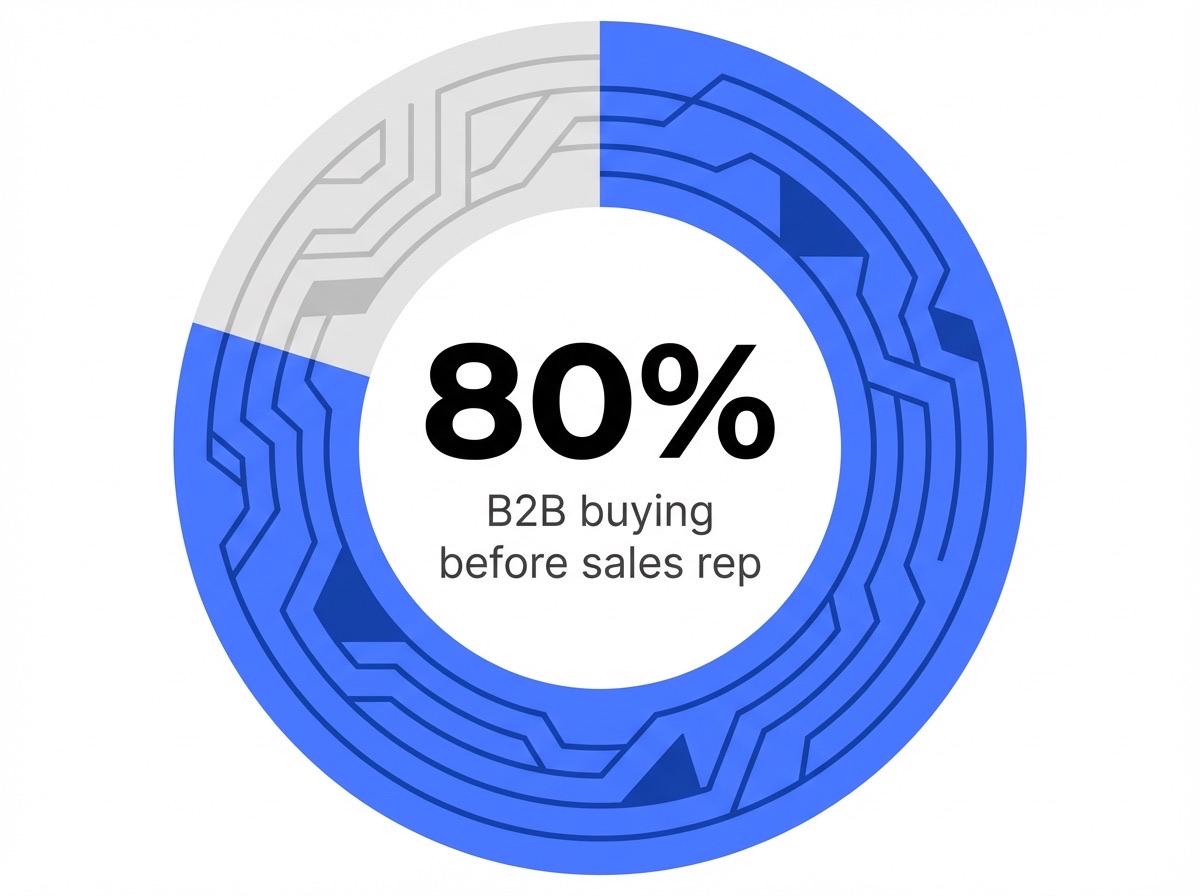 Portion of B2B buying process completed before engaging a sales rep: 80%
This strategy suits organizations that prioritize intent-driven engagement and outcome-focused marketing. When marketing teams use behavioral data to determine sales-readiness, the handoff is less likely to disrupt buyer momentum. Notably, Forrester predicts that by 2025, over half of large B2B transactions will be executed entirely through digital channels, reflecting the reduced need for early-stage sales involvement2.
For VP Marketing SaaS, aligning marketing and sales on engagement timing can tighten revenue cycles, improve conversion efficiency, and support product-led growth. Prioritizing this approach ensures that sales conversations begin at the moment of highest buyer intent, not before.
The next section examines how core framework components—such as ICP definition and segmentation—set the foundation for high-performance, data-driven marketing.
Core Components of Performance-Driven Online B2B Marketing Frameworks
ICP Definition and Market Segmentation
Assessment Tool: ICP and Market Segmentation Readiness Checklist
- Has your team documented firmographic, technographic, and behavioral traits for your ideal customer profile (ICP)?
- Are market segments prioritized based on revenue potential, ease of acquisition, and strategic fit?
- Does your segmentation model reflect recent shifts in buyer behavior—such as digital-first research and shorter decision cycles?
- Are your content and campaigns tailored to distinct segment needs and buying committee roles?
Defining an accurate ICP (Ideal Customer Profile) and deploying structured market segmentation underpin all high-performing online B2B marketing frameworks. An ICP is a data-driven description of accounts most likely to generate long-term value, characterized by attributes like industry vertical, company size, tech stack, and decision-maker roles. Segmentation divides the addressable market into discrete groups for targeted outreach, allowing for focused resource allocation and personalized messaging.
This approach works best when marketing budgets are constrained and teams need to maximize ROI from limited outreach. Recent research underscores the importance of precision: companies that focused their marketing on tightly defined segments saw up to a 4x improvement in conversion rates compared to broad-based campaigns3. Yet, only 46% of organizations have a documented content or segmentation strategy in place3.
Prioritizing ICP and segmentation enables marketing leaders to align resources with the highest-value opportunities and adapt to rapid changes—such as the 75% of buyers who now complete their purchasing journey in under 12 weeks1. The next section will explore how a unified data foundation and integrated tech stack support this segmentation-driven approach.
Data Foundation and Tech Stack Integration
Integration Checklist: Is Your Data Foundation and Tech Stack Future-Ready?
- Do all core platforms (CRM, CMS, analytics, automation) share a unified data model?
- Can marketing, sales, and customer success access real-time account and engagement data?
- Are workflows automated across channels, or do manual processes persist?
- Is your martech stack reviewed quarterly for capability utilization and redundancy?
A unified data foundation is central to performance-driven online B2B marketing. This means synchronizing customer and account data across systems—such as CRM, content management, and analytics platforms—to enable consistent targeting, personalization, and attribution. According to BCG, organizations that treat tech stack implementation as a business transformation (not a technical project) are six times more likely to rate their stack as state-of-the-art, with top performers reporting productivity gains of 30–50% versus 10–15% for tool-centric deployments4.
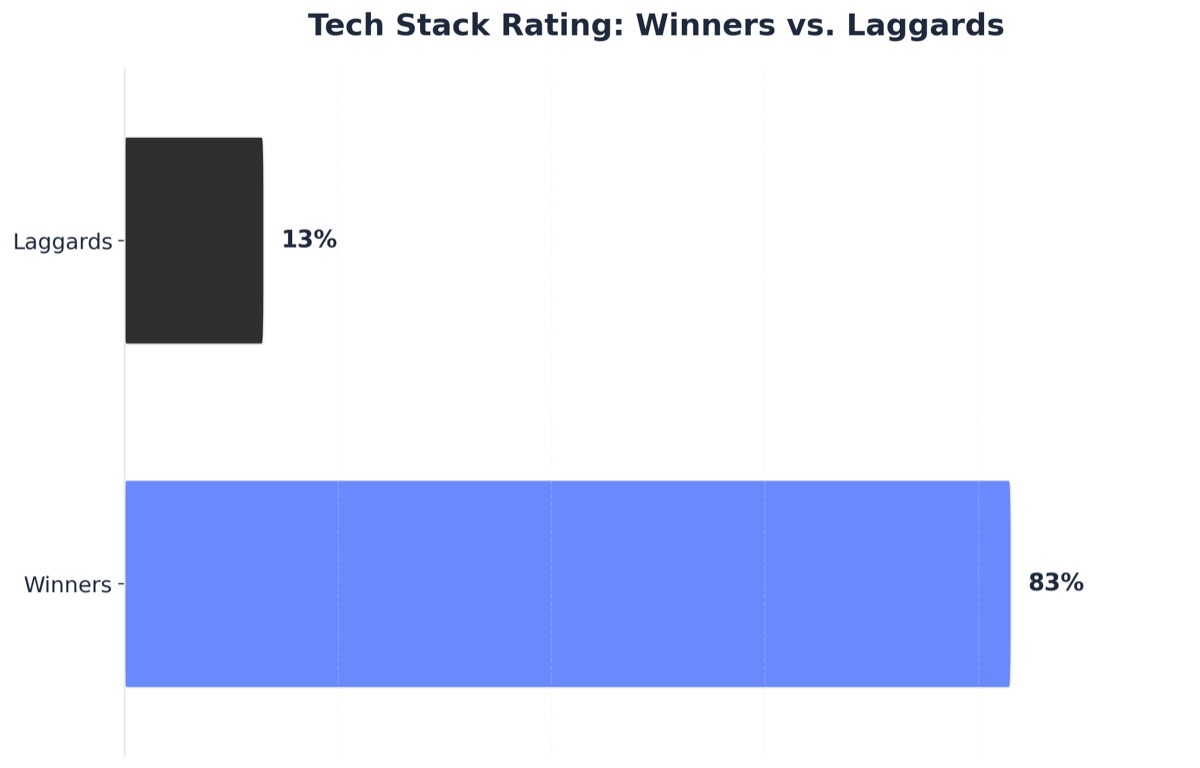 Tech Stack Rating: Winners vs. Laggards
Tech Stack Rating: Winners vs. Laggards (BCG research shows a stark contrast in how companies with high ROI from their tech stack perceive its quality ('state-of-the-art') compared to low-performing companies.)
This solution fits organizations aiming to maximize ROI from limited budgets and accelerate marketing workflows. However, research highlights that 67% of companies use only a third of their available martech capabilities, underscoring the need for ongoing process redesign and user training4.
Opt for a connected data and technology strategy when the goal is to reduce wasted spend, enable real-time insights, and lay the groundwork for scalable, experimentation-led content programs. The next section investigates how experimentation-led content engines validate strategies and drive continuous improvement.
Building an Experimentation-Led Content Engine
Hypothesis Testing for Audience Validation
Experimentation Roadmap: Audience Validation Hypothesis Checklist
- Has your team defined clear, testable hypotheses about audience pain points and motivators?
- Are landing pages, headlines, and CTAs prioritized for rapid testing?
- Is statistical significance calculated for each experiment (e.g., minimum 95% confidence)?
- Are failed tests analyzed for actionable insights, not just discarded?
- Is audience feedback integrated into iteration cycles?
High-growth online B2B marketing frameworks depend on systematic hypothesis testing to validate both audience assumptions and content effectiveness. Rather than relying on stakeholder intuition, organizations that test multiple variables—such as offer types, messaging, and channel mix—achieve three times faster growth compared to those running fewer than two experiments per month3. Hypothesis-driven experimentation is particularly effective for SaaS and agency teams operating in competitive, rapidly shifting markets where buyer needs and digital behaviors evolve quickly.
This path makes sense for marketing leaders seeking objective evidence to guide resource allocation and creative direction. For example, an experiment reducing form fields from seven to three delivered a 47% increase in conversion rate, highlighting how even incremental changes can drive measurable results3. Time investment typically ranges from one to three weeks per test cycle, depending on audience size and decision complexity; resource requirements include dedicated analytics support and access to agile content production workflows.
Opt for this framework when the objective is continuous optimization and de-risking major campaign investments. By embedding experimentation at the core of content engines, organizations can validate what resonates and adapt quickly to market feedback.
The following section explores how real-time personalization builds on validated audience insights to increase relevance throughout the buyer journey.
Real-Time Personalization at Scale
Personalization Readiness Checklist: Scaling Real-Time Buyer Engagement
- Are website and email experiences dynamically tailored based on user behavior, firmographics, or account data?
- Does your tech stack enable real-time content adaptation as prospects interact with key touchpoints?
- Are behavioral segments refreshed continuously to inform targeting and nurture logic?
- Can marketing teams orchestrate personalized journeys across channels (web, email, social) without manual intervention?
- Is compliance with GDPR/CPRA built into personalization workflows?
Real-time personalization is now a fundamental requirement for online B2B marketing. Research shows that 77% of B2B buyers will not purchase from brands that fail to personalize offers or experiences5. This shift is driven by rising buyer expectations for relevance and the proliferation of AI-powered tools capable of adapting content, CTAs, and banners in milliseconds as users engage across channels. Real-time approaches use live data—such as on-site behavior, engagement scores, and firmographic signals—to trigger dynamic content and messaging, shortening sales cycles and improving conversion rates.
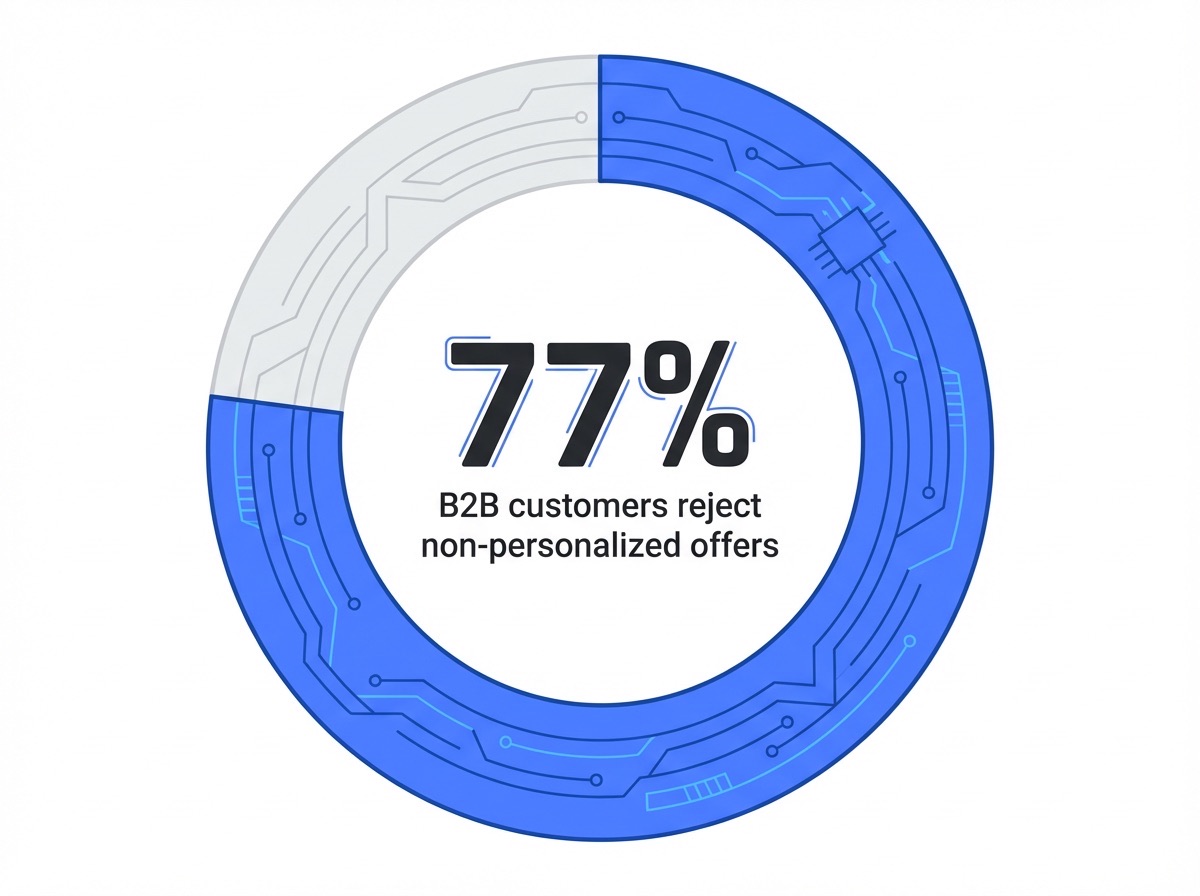 B2B customers who will not buy from businesses that don't personalize offers: 77%
Consider this method if your organization aims to increase pipeline velocity and minimize wasted spend on generic campaigns. For enterprise teams, integrating real-time personalization requires robust data infrastructure and automation capabilities, but enables each visitor or account to receive contextually relevant experiences without manual customization. Time investment will depend on martech maturity, but most organizations can pilot rule-based personalization within four to eight weeks, scaling to advanced AI-driven models as data sophistication grows5.
The next section will examine how aligning sales and marketing teams around shared data and processes is critical for realizing revenue gains from personalized engagement at scale.
Unlock a Data-Driven B2B Marketing Framework for Scalable Growth
Access Vectoron’s automated content engine to generate SEO-centric articles, deploy multi-channel campaigns, and drive measurable pipeline impact—backed by industry-leading benchmarks and real-time analytics.
Accelerate Your B2B Marketing Framework—Test Vectoron's Full Platform Free for 7 Days
Experience Vectoron's AI-powered content engine for B2B marketing. Get full access to automated article creation, seamless social scheduling, and direct publishing across WordPress, Webflow, and more—risk-free for 7 days.
Sales-Marketing Alignment for Revenue Growth
Alignment Maturity Scorecard: Identifying Operational Gaps
- Shared Metrics: Do both teams track revenue, not just MQLs/SQLs?
- Content Velocity: Can marketing produce assets fast enough to support active deals?
- Feedback Loops: Is there a formal process for sales to request specific content assets?
- Tech Integration: Do CRM and MAP systems sync data in real-time?
You've already invested in alignment frameworks—weekly pipeline reviews, shared Salesforce dashboards, unified lead definitions. Yet the content bottleneck persists. In product-led SaaS environments where 67% of the buyer journey occurs before sales engagement, according to Gartner research, the alignment challenge has shifted from process design to operational execution. The constraint isn't misaligned incentives; it's the content infrastructure required to support self-service evaluation at scale while maintaining message consistency across 8-12 touchpoint sequences.
The revenue impact becomes measurable when content operations can match production velocity to pipeline demands. Companies using unified lead scoring models report 67% higher close rates on marketing-qualified leads, based on data from Forrester Research. However, these frameworks break down when sales requests 15 industry-specific case studies but marketing can only deliver three per quarter. Aberdeen Group data shows that 79% of leads get dismissed as unqualified—not because scoring models fail, but because the content required to nurture mid-funnel prospects through product evaluation simply doesn't exist at the necessary volume.
Your sales team already provides the intelligence—objection patterns from lost deals, competitive differentiators that close enterprise accounts, technical questions that stall POC conversions. The constraint is transforming these insights into assets fast enough to impact active pipeline. Research from Demand Gen Report shows that organizations with collaborative content development processes experience 36% shorter sales cycles and 38% higher win rates, but traditional production models require 6-8 weeks per asset. In SaaS velocity models where deal cycles compress to 30-45 days, that timeline eliminates content's ability to influence outcomes.
Table 1: Impact of Sales-Marketing Alignment on Key Performance Indicators
| Metric | Siloed Operations | Aligned Operations |
|---|---|---|
| Marketing Revenue | Baseline | +208% |
| Win Rates | Baseline | +38% |
| Customer Retention | Baseline | +36% |
Integrated technology stacks provide data visibility but don't solve throughput limitations. Your CRM shows exactly which content gaps correlate with stalled opportunities—missing technical comparison guides, absent ROI calculators for specific verticals, incomplete integration documentation. Companies that implement closed-loop reporting systems demonstrate 15% higher annual revenue growth rates, according to HubSpot's State of Marketing Report, yet 73% of marketing teams report content production capacity as their primary constraint in acting on sales intelligence.
The operational challenge extends beyond quarterly planning cycles. High-performing SaaS organizations require continuous content deployment aligned to real-time pipeline signals—when enterprise deals cluster around compliance questions, when product launches create new positioning requirements, when competitive threats demand immediate response assets. Weekly alignment meetings identify these needs, but traditional content workflows—agency briefings, freelancer coordination, review cycles—can't match the execution speed that product-led growth models demand. Organizations that solve this production constraint report 24% faster revenue growth and 27% higher customer retention rates compared to companies where content operations remain the limiting factor in sales-marketing collaboration.
Frequently Asked Questions
Conclusion
Sales-marketing alignment represents a measurable opportunity for revenue acceleration across B2B organizations. Research consistently demonstrates that aligned teams generate 208% more marketing revenue and achieve 38% higher win rates compared to siloed operations. The implementation framework—shared revenue targets, unified customer data platforms, collaborative content development, and joint pipeline reviews—provides a structured approach to breaking down organizational barriers that limit growth potential.
Marketing leaders face pressure to demonstrate direct contribution to pipeline and revenue metrics. Alignment initiatives deliver quantifiable outcomes: reduced customer acquisition costs through improved lead quality, shortened sales cycles via coordinated nurture programs, and increased deal velocity when both functions operate from unified intelligence. Organizations that establish formal alignment processes report 36% higher customer retention rates and 27% faster profit growth over three-year periods.
The strategic imperative extends beyond operational efficiency. As buyer journeys become increasingly complex across multiple touchpoints, integrated sales-marketing execution becomes essential for maintaining competitive positioning and achieving sustainable revenue growth targets.
References
- 1.Google survey: Faster, AI-driven research is reshaping B2B buying.
- 2.What's Next for B2B Marketing in 2025: The Top Trends to Watch.
- 3.The data-driven approach to B2B marketing and growth.
- 4.Creating Value with Your Integrated Sales Tech Stack.
- 5.Practical real-time personalization strategies for B2B buyer engagement.
- 6.The Definitive Guide to B2B Content Marketing.
- 7.B2B Website Strategies for Performance in 2025.
- 8.The Ultimate B2B Marketing Strategy Guide for Growth in 2026.
- 9.B2B marketing strategies: Data-driven growth for enterprise teams.
- 10.B2B Sales & Marketing Alignment: 7 Strategies for Growth in 2026.