
Key Takeaways
- Strategies that last past 90 days run on a four-stage pipeline—plan, produce, review, publish—with channel objectives and content risk tiers set before anyone opens a model.
- AI can lift volume while quietly eroding authenticity; a study of 680 U.S. participants found engagement rose as perceived quality fell, so keep humans on founder stories, testimonials, and crisis posts 9.
- Disclosure and labeling are not optional: FTC endorsement rules cover virtual influencers and avatars 5, 7, TikTok requires labels on realistic AI scenes 8, and label wording measurably shifts belief 10.
- Measure social against pipeline, not post counts, and keep a provenance record for every asset—prompt, source doc, model, reviewer, label—because no watermark or metadata survives every platform intact 2.
Why most AI social strategies fail in the first 90 days
You buy a few seats, write a prompt library, and ship ten posts a day across LinkedIn, Instagram, and TikTok. By week six, engagement is flat, legal is nervous about a testimonial video, and one of your channels flagged an unlabeled clip. The problem is rarely the model. It is that the strategy was built around output volume instead of a governed pipeline.
A recent experimental study with a representative sample of 680 U.S. participants found a dual effect: some AI tools increased engagement and the volume of generated content, while reducing perceived quality and authenticity and producing negative spillover in conversations 9. That is the trap. The same lever that helps you publish more can quietly erode trust with the audience you are trying to convert.
The strategies that survive past 90 days share four traits. They set channel-specific objectives before prompts. They assign human review at the points where claims, likeness, or regulated topics appear, consistent with the risk categories in NIST's generative AI profile 1. They record how each asset was made. And they measure social against leads and pipeline, not post counts. The rest of this guide shows you how to build that pipeline step by step.
The governed pipeline: a four-stage operating model
Plan: channel objectives and content risk tiers
Start by writing down what each channel is for. LinkedIn might carry thought leadership that pulls demo requests. Instagram might run service-area awareness for a dental group. TikTok might test short explainers for a home-services brand. If you cannot name the business outcome per channel in one sentence, the AI will fill the vacuum with generic posts.
Then tier your content by risk. Four tiers cover most lead-gen brands:
- Routine promo: event reminders, job posts, holiday graphics. Low claim density, low likeness risk.
- Claims-bearing: anything that states a benefit, outcome, price, or comparison. Must be substantiated before publish.
- Synthetic likeness: AI voices, avatars, or realistic people and scenes in images or video.
- Regulated topics: health, legal, financial, or anything your industry treats as sensitive.
NIST's generative AI profile recommends mapping risks to specific controls rather than applying one blanket policy 1. Tiering gives you that map. A routine promo can move fast. A claims-bearing post needs a reviewer who can verify the claim. A synthetic likeness post needs a rights check and a label decision. Write these tiers into your content calendar so every scheduled post carries a tier before anyone opens a model.
Produce: prompts, source material, and model selection
Production is where most teams over-rotate on prompt tricks and under-rotate on source material. The model is only as good as what you feed it.
Build a small source library per brand: approved service descriptions, patient-safe phrasing, pricing rules, do-not-say lists, and five to ten reference posts that sound like you. Point every prompt at that library. For claims-bearing posts, require the prompt to pull from a specific document, not open web memory.
Match the model to the job. Use a stronger reasoning model for long-form carousels, scripts, or regulated topics where accuracy matters. Use a faster model for variant generation, hooks, and A/B tests where you are iterating on tone. Record which model produced each asset; you will need that record during review and for the provenance log in stage four.
Prompts themselves should be short and specific: channel, tier, audience, source doc, output format, constraints. NIST's profile treats prompts and source material as part of the risk surface for generative systems, which is why the library and model selection matter as much as the words 1. If a prompt cannot name its source doc, it is not ready to ship.
Review: where human judgment is non-negotiable
Review is a design choice, not a bottleneck. Tie the depth of review to the content tier you set in planning, and most of your reviewers' time will land on the posts that can actually hurt you.
Three approval modes cover the work:
- Autonomous: routine promo posts ship without human sign-off. Spot-check a sample weekly.
- Moderated: a reviewer scans before publish. Use for anything with a specific claim, comparison, or offer.
- Full approval: a named reviewer signs off in writing. Use for synthetic likeness, regulated topics, and any post naming a customer or employee.
NIST's generative AI profile frames human review, factual verification, and post-publication monitoring as distinct controls, each worth selecting on purpose 1. In practice that means a claims-bearing post gets a verification step against the source doc, a synthetic-likeness post gets a rights and disclosure step, and a regulated-topic post gets a subject-matter reviewer, not a generalist.
Write these rules into the tool. If your workflow lets you set approval by tier, do it there so the model cannot publish a full-approval post on an autonomous track. The reviewer's job is to catch the three things a model will not: a claim without a source, a face or voice without a release, and a topic that needs a lawyer or clinician.
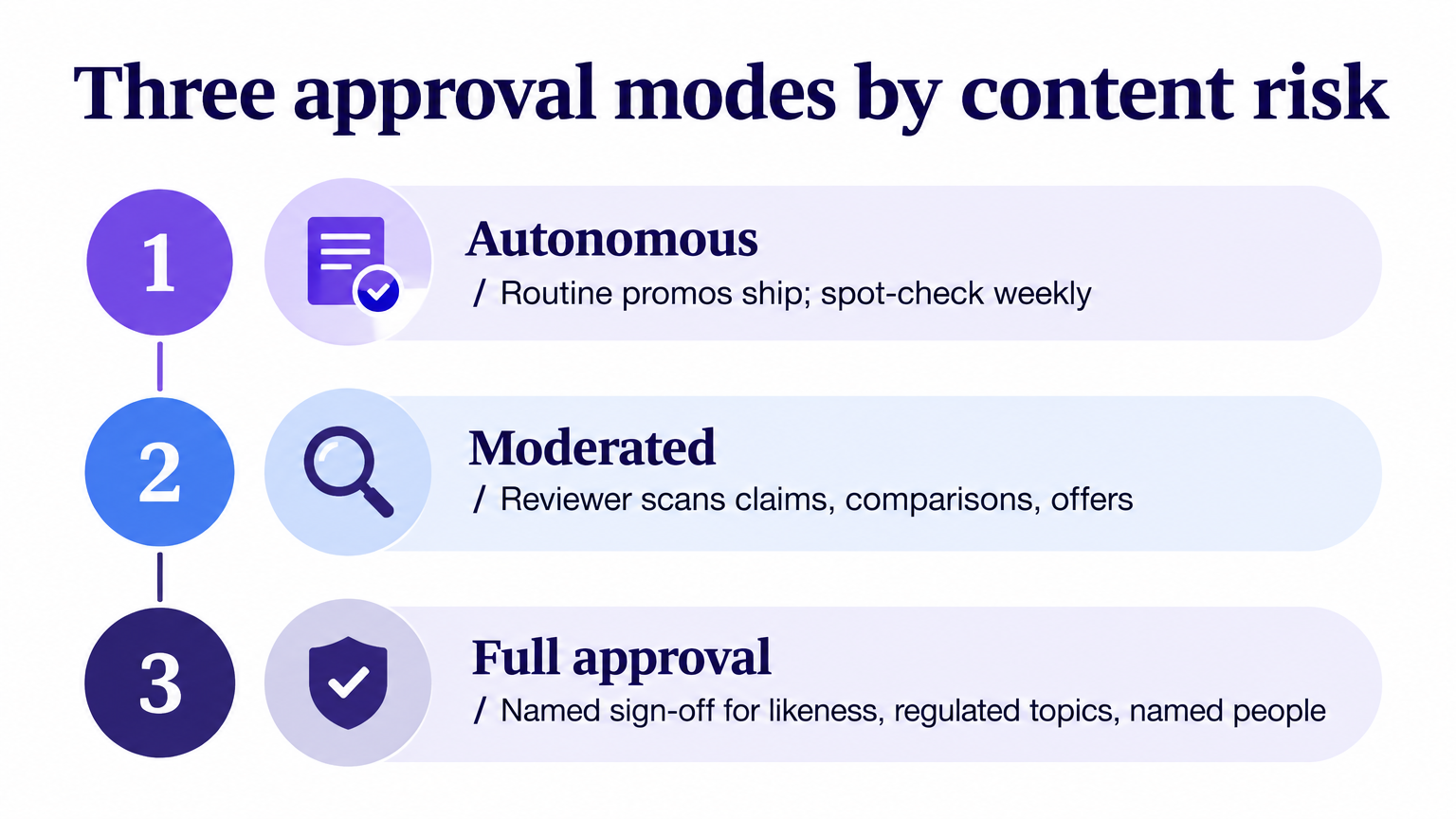 three approval modes for AI social media content: autonomous, moderated, full.
Publish: scheduling, provenance records, and post-publication monitoring
Publishing is more than hitting schedule. Record how each asset was made at the moment it ships: which prompt, which source doc, which model, which human reviewed it, and any edits applied. NIST's synthetic content report treats provenance tracking as a core control for AI-generated media, with the caveat that no single technical measure, including watermarks or metadata, survives every platform intact 2. Keep your own record so you are not relying on a platform to preserve one for you.
After publish, monitor. Watch for takedowns, label additions by the platform, comments flagging authenticity, and any drift in engagement quality on AI-heavy posts. NIST's profile calls out post-publication monitoring as a named control because generative outputs can age badly or be reinterpreted in context 1. Set a weekly review where someone pulls flagged posts, platform notices, and a sample of autonomous-tier content. That is your early warning for the trust problems covered in the next section.
The dual effect: when AI helps volume but hurts trust
Here is the tradeoff you have to design around. In a controlled experiment with a representative sample of 680 U.S. participants, researchers found that some AI tools in social interactions increased engagement and the volume of generated content while decreasing perceived quality and authenticity, with negative spillover into the surrounding conversation 9. The study ran in group settings, so the exact numbers will not transfer to a dental group's Instagram feed or a law firm's LinkedIn page. The pattern will.
Two failure modes follow from that finding. The first is overuse: AI writes every caption, replies to every comment, and generates every image, until the voice flattens and regular followers feel it before you do. The second is mismatch: AI handles the wrong post. A founder story written by a model reads hollow. A patient testimonial produced by an avatar reads worse.
You counter both by splitting your calendar. Let AI own volume work where a human voice adds little: service-area reminders, variant hooks, alt text, repost scheduling, hashtag research. Keep humans on the posts where authenticity is the product: founder POV, customer stories, employee features, crisis responses, anything that names a real person. Audit weekly. If engagement climbs while comment sentiment or reply quality drops, you are publishing too much AI in the wrong places. Rebalance before the trust erodes further.
Test Your Social Content Workflow Live
Build and publish real social posts while testing an AI content workflow shaped around your brand.
Disclosure and labeling rules that actually apply to your posts
Material connections, virtual influencers, and AI avatars
Disclosure obligations do not disappear because a model wrote the caption or an avatar read the script. The FTC's revised Endorsement Guides apply to virtual influencers, incentivized reviews, and social-media tags, and they warn that a platform's built-in disclosure tool may not always do the job on its own 5. If a creator, employee, or affiliate has a material connection to your brand, the disclosure has to be clear and conspicuous, and the duty sits with both the brand and the endorser, not the platform 6.
AI avatars get the same treatment. The FTC's guidance on the Consumer Reviews and Testimonials Rule does not ban AI-generated avatars outright, but deceptive claims, fake testimonials, and undisclosed relationships can still create liability when a synthetic presenter is involved 7.
Translate that into three operating rules:
- If a person or persona endorses your product and has any paid, employment, or free-product relationship, disclose it in the post itself, not only in a bio.
- If the presenter is an AI avatar or virtual influencer, make that clear in a way a scrolling viewer would notice.
- Never generate a testimonial attributed to a real or realistic-looking customer unless that person actually said it and approved the depiction.
Channel-specific labeling: TikTok's realistic-scene rule and what it implies elsewhere
Platform rules add a second layer on top of FTC guidance. TikTok requires creators to label AI-generated or significantly edited content that shows realistic-looking people or scenes; unlabeled content can be removed, restricted, or labeled by the platform depending on potential harm 8. The policy references C2PA signals where they can be detected, but the responsibility to label still lands on you 8.
Apply the same test to every channel you post on, even where the written rule is softer. Before publish, ask two questions. Does the asset show a realistic person, place, or event? Was any part of it generated or significantly altered by a model? If both answers are yes, label it.
Where to put the label matters. A watermark burned into the video survives reposts. An on-screen caption at the first second is read before the viewer scrolls. A bio note is not enough. Build the label step into your publish checklist for synthetic-likeness tier posts so no one has to remember it in the moment. The reviewer who approves the post is the person who confirms the label shipped with it.
How label wording changes reader response
The words on the label do real work. Across two preregistered survey experiments with 7,579 Americans, all tested labels reduced belief in the claims presented in the content, but simple AI labels had little effect on viewers' stated likelihood of engaging with the post 10. Process-based labels that explain how the content was made and harm-based labels that flag misleading potential moved belief differently, so the choice is not cosmetic 10.
Use that evidence to design a small decision flow for each post:
- Routine AI-assisted copy with no realistic likeness: a short process label such as "Made with AI assistance" meets transparency without reshaping the post.
- Synthetic voice, avatar, or AI-generated person: a direct process label naming the synthetic element, placed on-screen, so viewers do not infer a real person spoke.
- Realistic AI-generated scenes depicting events that did not occur: a harm-aware label that makes the fabricated nature clear, not just "AI-generated."
- Endorsements with material connections: the connection disclosure runs alongside the AI label; one does not substitute for the other.
Test the wording the way you test subject lines. Rotate two variants on a post type, watch belief-sensitive signals like comment questions about authenticity, and keep the version that reduces confusion without tanking reach.
Provenance, rights, and ownership of what the model produces
Recording how each asset was made
Treat every AI-assisted post like a shipment with a bill of lading. At publish, record the prompt, the source document, the model and version, the human who reviewed it, any edits applied, and the approval tier it ran under. Store that record next to the asset, not in someone's inbox.
NIST's synthetic content report treats authentication and provenance tracking as a core control, while noting that no single technical measure, including watermarks, metadata, and C2PA signals, survives every platform re-encode intact 2. That is why the internal record matters. Platforms may strip or overwrite credentials. Your log is the one that will answer a legal, platform, or reporter question six months later.
Make the record cheap to produce. A single row per post works: asset ID, channel, tier, model, prompt reference, source doc, reviewer, label applied, publish timestamp. If a post later draws a takedown or a complaint, you can reconstruct how it was made in minutes instead of days.
Digital replicas, voice clones, and synthetic testimonials
A digital replica is a digitally created or manipulated audio, image, or video that realistically but falsely depicts an individual, per the U.S. Copyright Office's Part 1 report, which also flagged gaps in current protections and recommended a new federal law covering unauthorized distribution 3. That definition pulls in more than deepfake stunts. It covers voice clones of your CEO, AI-generated "patient" faces in a dental ad, and composite influencers built from real people's features.
Set three hard rules for your team.
- Never clone a real person's voice or face without a signed release that names the uses, the channels, and the expiration date. Keep the release with the provenance record.
- Never generate a testimonial that reads as if a real or realistic-looking customer said it unless that customer actually said it and approved the depiction. The FTC treats fabricated or misleading testimonials as deceptive even when the presenter is synthetic 7.
- For synthetic spokespeople who do not depict a real individual, still label the asset so viewers do not infer a human source, and run the script through the same claims review as any other endorsement.
When in doubt, assume the replica rules apply. The legal ground is still moving 3, and the reputational cost of a cloned voice landing wrong is worse than the production cost of filming the real person.
Who owns AI-generated captions, images, and video
Ownership of AI output is not automatic. The U.S. Copyright Office's Part 2 report concluded that copyrightability depends on meaningful human authorship, which means a caption, image, or video produced by prompting alone may not qualify for protection the way a human-authored work does 4. Adaptations with substantial human creative contribution can be treated differently 4.
Three implications for your social program:
- A purely model-generated image a competitor reposts may be harder to defend than a photo your team shot. Treat raw AI assets as lower-value IP and plan accordingly.
- Document the human contribution. Note the editor who rewrote the caption, the designer who composited the image, the producer who directed the video. Your provenance log already captures this.
- Push the highest-value creative, brand films, founder content, flagship campaigns, through enough human authorship to clear the bar, not just a prompt and a one-click approval.
Measuring social against pipeline, not post counts
Post counts tell you the model worked. They do not tell you the program worked. If your dashboard leads with impressions and follower growth, swap it. The right top-line for a lead-gen brand is the number of qualified conversations social produced this month and what it cost to produce them.
Build the measurement stack in three layers. The first layer is business outcomes: form fills, booked calls, chat starts, and closed revenue attributed to social sources in your CRM. The second layer is content quality signals that predict those outcomes: saves, shares, meaningful comments, DM replies, and profile visits to service pages. The third layer is operating health: review-minutes per post by tier, takedown and label-addition rate, and the share of autonomous-tier posts flagged in your weekly audit.
Segment by content tier, not just by channel. Routine promo and claims-bearing posts should carry different conversion expectations. A synthetic-likeness post that drives leads but triggers authenticity complaints is a losing trade, even when the CPL looks fine.
Tie the operating layer back to the risk controls you set in planning. NIST's profile treats post-publication monitoring as a named control for generative systems because output can age or drift in context 1. Report flagged posts and reviewer load to leadership alongside pipeline numbers. That is how you catch the volume-versus-trust tradeoff before it shows up in a quarterly review as a sentiment problem no one can trace.
Put Your Social Content Strategy Into Practice
See how Vectoron brings social strategy, content creation, and publishing into one platform, with approval settings you control across your brands and workflows.
If you manage multiple brands or locations: a portfolio economics view
Switch audiences for a moment. If you run social for an agency book, a DSO with twenty practices, a law firm with branch offices, or a home-services franchise, the math changes. You are not deciding whether AI helps one brand post more. You are deciding whether the pipeline from section two can run across a portfolio without the review layer collapsing.
Use variables, not invented dollars. The weekly cost of your current model is roughly: posts per brand per week × number of brands × review minutes per post by tier × loaded cost per reviewer minute. Add a fixed line for strategy and reporting hours. Compare that to the same output under a traditional agency retainer or an added full-time hire covering the same brand count.
Three portfolio-specific rules keep the economics honest:
- Store brand context per account: service lines, do-not-say lists, approved claims, and release records. A shared prompt library across brands is where voice collapses and claims drift.
- Set approval tiers per brand, not per portfolio. A dental group's regulated-topic post cannot inherit a home-services brand's autonomous settings.
- Report review-minutes and flagged-post rate by brand monthly. That is where you spot the account that is quietly consuming your margin.
A 30-day rollout plan you can defend to legal and leadership
Ship this in four weeks, not four quarters. The goal is a working pipeline you can show to legal, leadership, and the platform policy teams if a post ever gets flagged.
- Week one: write channel objectives, define your four content tiers, and draft the approval matrix that maps each tier to autonomous, moderated, or full approval. Pull the NIST generative AI profile into the memo as the framework reviewers will recognize 1. Inventory which brands, locations, or clients the pipeline will cover.
- Week two: build the source library per brand. Approved claims, do-not-say lists, release records, and five reference posts that sound like you. Pick your models by job. Draft the disclosure and labeling rules against FTC endorsement guidance and the platform policies you actually publish on, including TikTok's realistic-scene labeling requirement 5, 8.
- Week three: run ten posts per tier through the pipeline as a pilot. Log the provenance record for each, including prompt, source doc, model, reviewer, and label applied 2. Have legal sign off on the claims-bearing and synthetic-likeness samples before anything ships publicly.
- Week four: turn on scheduled publishing for routine and claims-bearing tiers, hold synthetic likeness in full-approval mode, and start the weekly post-publication audit. Report review-minutes per tier, flagged-post rate, and pipeline attribution to leadership at day thirty. If you want a platform that runs this pipeline with your approval rules intact, Vectoron is built for it—start a conversation at /contact.
Frequently Asked Questions
References
- 1.Artificial Intelligence Risk Management Framework: Generative Artificial Intelligence Profile.
- 2.Reducing Risks Posed by Synthetic Content.
- 3.Copyright and Artificial Intelligence, Part 1 Digital Replicas.
- 4.Copyright Office Releases Part 2 of Artificial Intelligence Report.
- 5.Revised FTC Endorsement Guides strengthen and clarify guidance for advertisers, address emerging market trends.
- 6.FTC’s Endorsement Guides: What People Are Asking.
- 7.The Consumer Reviews and Testimonials Rule: Questions and Answers.
- 8.New York S895B/A6789B Social Media Companies.
- 9.The impact of generative AI on social media: an experimental study.
- 10.Labeling AI-generated media online.
 Vectoron logo
Turn your social media strategy into a repeatable content workflow
See how Vectoron brings strategic analysis, AI social content creation, and publishing together, with approval settings you control.