
Key Takeaways
- Content pillars work best as structured metadata tagging every post across four dimensions: theme, journey stage, POEM channel, and voice rule, not as a static planning poster.
- Lean teams should run three to five pillars, with three as the starting point and seven or more risking diluted focus, muddled signals, and tagging breakdowns 2.
- Service verticals with high-value conversions often shift the 80/20 mix, raising the convert tier to 25-35% during active periods and auditing actual output against tagged performance 12.
- Sustained performance comes from weekly pillar reviews, encoded voice rules per pillar, and treating untagged posts as production defects rather than acceptable exceptions 10, 1.
Pillars as a Tagging Layer, Not a Planning Poster
Most content pillar guides focus on planning: selecting themes and pinning them to a slide. This approach is incomplete. Pillars are most effective when they function as structured metadata, tagging every piece of content a team produces.
Industry consensus suggests three to five recurring themes, with each post tagged by pillar. This allows for analysis of engagement, reach, and conversion by theme, rather than just by publication date 1. This tagging transforms a planning artifact into an analytical dimension. Without it, teams lack data to identify top-performing content or areas of high cost-per-lead waste.
This distinction is crucial as production velocity increases. A content team publishing 20 to 40 posts weekly across multiple platforms needs structured feedback at the pillar level to decide what to scale, what to retire, and what to refine. Bazaarvoice emphasizes that pillars should be continuously refined through social performance analysis, not fixed at the start of the year 10.
The key takeaway is simple: pillars are primarily tags, and secondarily planning categories. This article proceeds with that understanding.
The Four Dimensions Every Pillar Needs
Theme: The Subject Matter Anchor
Theme is the most basic layer of a pillar, often where many teams stop. It defines the subject matter a brand covers, such as claims handling, post-operative recovery, HVAC maintenance, or estate planning. Bazaarvoice defines pillars as themes unique to a brand that guide content creation 10.
An effective theme meets three criteria:
- it addresses a genuine audience question the team can answer authoritatively,
- it supports enough sub-topics for consistent weekly publishing for at least a year,
- and it is distinct from other pillars, allowing for unambiguous classification by content producers or AI tools.
However, theme alone is insufficient for governing content production. Two posts under the same theme can target different audiences, require different distribution strategies, and demand different tones. A single-dimension pillar collapses these distinctions, making performance data less actionable. The following three dimensions add the necessary structure to make a pillar operational.
Journey Stage: Educate, Inspire, Entertain, or Convert
The second dimension categorizes content by its intended impact on the reader. The American Marketing Association's framework assigns each piece of content within a pillar to one of four functions: educate, inspire, entertain, or convert, applied across a brand's recurring themes 11.
Layering journey stage onto theme creates a content matrix. For example, a law firm with an estate planning pillar might publish educational explainers on probate, inspirational client success stories, entertaining myth-busting videos, and conversion-focused consultation prompts. Each piece shares the same theme but serves a different purpose.
Many pillar systems falter here, often prioritizing educational content due to its ease of production. The other functions become afterthoughts. Tagging by journey stage reveals this imbalance in reporting, which is essential for correction.
For service businesses with consultation or intake conversion goals, the "convert" tier requires dedicated production. Convert posts, while sharing a theme with educational content, follow a distinct structure: a clear offer, a single call-to-action verb, and a measurable response. Without journey-stage tagging, these posts get grouped with engagement content, obscuring critical performance signals.
POEM Channel: Where Each Pillar Earns Its Distribution
A pillar without a distribution plan remains a theoretical concept. The third dimension assigns each pillar a primary channel within the paid, owned, and earned media (POEM) framework. Harvard Business School Online defines paid media as promotional content displayed through paid means, owned media as digital content created by the company, and earned media as public exposure from word-of-mouth, reviews, social mentions, or media coverage 3. Penn State Extension similarly defines owned channels as those directly controlled by the business 8.
Mapping pillars to POEM channels prevents two common pitfalls. First, it avoids treating every pillar as an organic-only effort, which limits reach to algorithmic ceilings. Second, it prevents paying to amplify content not designed for conversion, which inflates cost per acquired lead.
A practical application involves assigning channels strategically. Educational posts under an authority pillar might run on owned channels with targeted paid amplification for high-intent keywords. Inspirational client stories could seed earned coverage and review syndication. Conversion-focused posts under a service pillar would receive the majority of the paid budget due to their direct offer.
The optimal POEM mix varies by category. Research on POEM combinations indicates that the most effective media blend for shaping brand attitude is context-dependent, with no universal ratio across consumer segments 6. High-stakes service verticals, where a single conversion can represent significant pipeline value, typically allocate more paid weighting to convert-tier pillars compared to retail or DTC categories.
Voice Rule: The Sentence-Level Constraint
The fourth dimension is voice, which prevents a pillar from adopting an inconsistent register based on the last writer or model. Mural advises clear brand voice guides that detail tone, language, and personality with examples of appropriate and inappropriate usage 13. Canva's framework emphasizes consistent brand presentation across all platforms and touchpoints 14.
For pillar implementation, voice rules must be integrated into the pillar definition itself, acting as a sentence-level constraint. A thought-leadership pillar might allow for longer analytical sentences and specific industry references. A community pillar might require a warm, second-person tone and shorter sentences. A compliance-sensitive pillar in legal or healthcare might restrict superlatives, comparative claims, and unverified outcome language.
Encoding voice at the pillar level enables scalability. When the voice rule is part of the pillar tag, every brief, approval process, and AI-assisted draft automatically inherits these constraints. This ensures brand consistency even as production volume increases beyond what individual editors can review line by line.
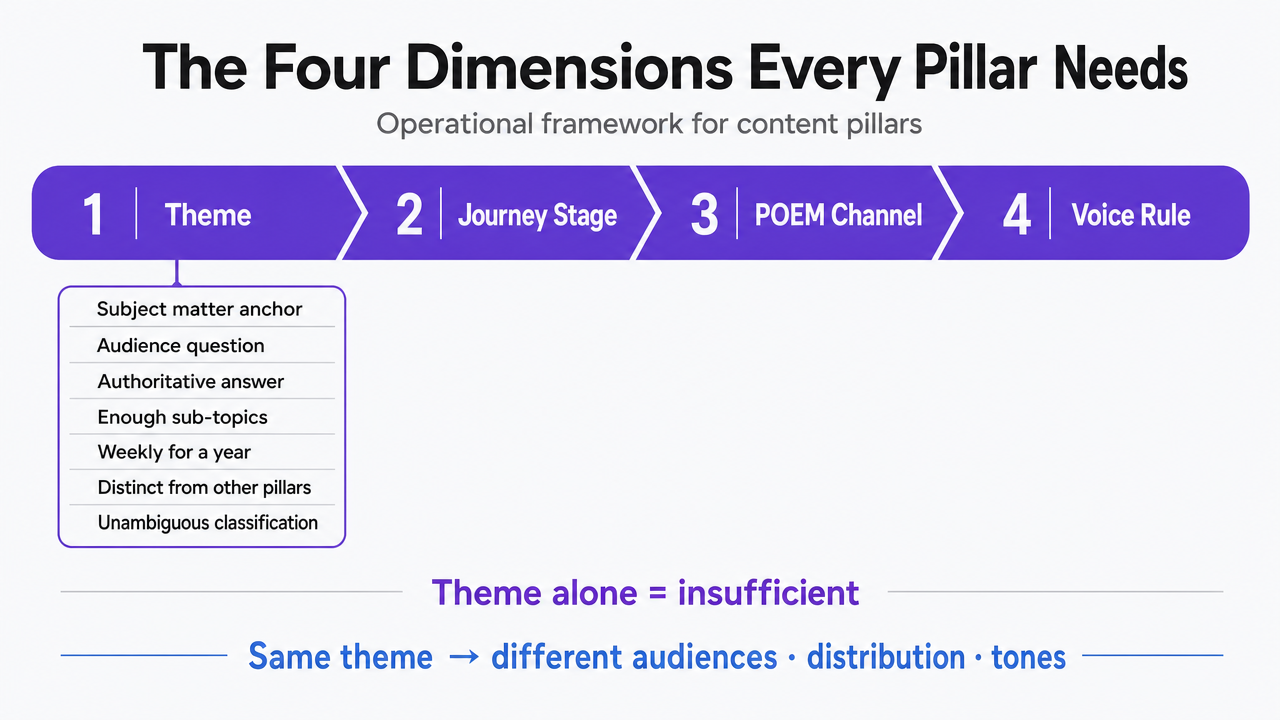 Visualize the four-dimensional pillar structure (Theme, Journey Stage, POEM Channel, Voice Rule) that the section explicitly defines as the operational framework
How Many Pillars a Lean Team Can Actually Run
The consensus among practitioners is a narrow range: three to five pillars, with each post tagged to allow for analysis of engagement and conversion by theme 1. This range is not arbitrary; it reflects what a single producer or small team can effectively manage while drafting, batching, and reviewing dozens of posts weekly.
Three pillars streamline the content calendar. Fewer themes mean faster shipping because briefs follow familiar structures, and tagging remains clear as classifiers (human or AI) rarely hesitate between categories. The trade-off is reach, as a narrow set of themes limits the audience segments a brand can serve weekly.
Five pillars expand coverage without overcomplicating the taxonomy. Each theme still receives significant publishing volume, and reporting can distinguish which pillars drive engagement versus qualified leads. This should be considered the upper limit for most teams, not a starting point.
Operating with seven or more pillars typically leads to system collapse. Focus becomes diluted, audience signals are muddled, and batching efficiency decreases because producers lose sight of patterns across themes 2. Tagging accuracy also suffers; overlapping categories lead to inconsistent assignments, degrading the precision of analytics.
The rule is straightforward: start with three. Only add a fourth or fifth pillar if a clearly underserved audience segment or conversion path lacks a home in the existing taxonomy.
Test Content Pillars in Live Social Campaigns
Evaluate real-time performance of your content pillar framework on active social channels before making a long-term commitment.
The 80/20 Mix, Recalibrated for Service Verticals
A common guideline suggests that 80% of social content should delight or educate, while 20% should promote with a clear call to action 12. This is a heuristic, not a rigid benchmark, and practitioners debate the ideal ratio based on business model, campaign period, and conversion intent 12.
For service verticals where a single intake call can generate substantial revenue, the default 80/20 ratio often needs adjustment. A law firm seeking personal injury clients, a behavioral health network managing admissions, or a dental group driving new patient bookings rarely meets its goals with an 80/20 mix alone. The "convert" tier often needs to increase to 25% to 35% during active enrollment or seasonal periods, with the "educate" and "inspire" tiers making up the remainder.
The pillar taxonomy makes this recalibration auditable. With every post tagged by journey stage, a team can compare the actual content mix shipped against the intended ratio. Without tags, the mix tends to drift towards the easiest content to produce, which is typically educational.
Rule-of-thumb 80/20 social content mix: 80% delight or educate, 20% promote with a clear CTA. The ratio is debated and varies by business model, and service verticals with high-value conversions often shift the promote tier upward 12.
Two operational rules maintain the integrity of this mix. First, the convert quota is set per pillar, not for the entire calendar, ensuring that underperforming authority pillars don't drain resources from effective service pillars. Second, the ratio is reviewed monthly against tagged performance data to verify if convert-tier posts are actually generating leads or merely consuming space.
Encoding Voice Rules So Pillars Survive Volume
High volume exposes weaknesses in a voice system. A team publishing ten posts weekly can manually edit each one. A team publishing forty cannot, and the disparity between intent and output grows with each additional producer or AI model.
Brand voice influences how audiences perceive, engage with, and remember a brand on social channels, making it a crucial production input 7. The practical step is to document voice guidelines that are integrated with the pillar. The Small Business Development Center framework recommends defining the target audience, identifying personality traits and core values, and maintaining consistency across all published content 9. Mural expands on this with a structured voice chart, including tone descriptors, language rules, and examples of appropriate and inappropriate usage 13.
For pillar implementation, these guidelines should be segmented by pillar rather than stored as a single global document. A thought-leadership pillar will have different sentence length norms, vocabulary, and referencing behavior than a community pillar. Embedding these within the pillar definition ensures that every producer, freelancer, and AI tool inherits the correct constraints during drafting.
Three rules help maintain voice consistency as volume increases:
- Each pillar should have an approved vocabulary list and a banned-phrase list.
- Each pillar should include two annotated examples (one passing, one failing) to provide a shared reference for classifiers and reviewers.
- Finally, voice rules should be reviewed against published output at the same frequency as performance data, as tonal drift can accumulate unnoticed between formal audits 13.
Canva's perspective reinforces this: the brand must present consistently across all platforms and touchpoints, which is only achievable if voice is encoded where production occurs 14.
Feeding Pillars Into AI-Assisted Production
A four-dimensional pillar definition functions as a machine-readable brief. The theme identifies the subject, journey stage defines the purpose, POEM channel specifies the distribution, and the voice rule sets the constraints. Each of these fields can be provided to a drafting model as structured input, making high-volume social production manageable without a proportional increase in headcount.
The mechanics are important. A drafting prompt that incorporates the pillar's approved vocabulary, banned phrases, and annotated examples produces output that aligns with the brand's voice on the first attempt 13. A prompt that only receives a topic will result in tonal drift, forcing editors to spend time rewriting tone instead of evaluating substance.
Pillars also govern the review process. When a draft arrives tagged with its pillar, journey stage, and POEM destination, reviewers immediately know which checklist applies. A convert-tier post under a service pillar is checked against the offer, CTA verb, and any required compliance language. An educate-tier post under an authority pillar is checked for accuracy and source quality. The pillar tag streamlines the workflow.
Performance feedback completes the loop. Engagement, reach, and conversion data, tagged by pillar, inform the model about patterns that gained attention. This allows subsequent drafts to adopt successful structures rather than reverting to a generic average 1, 10.
See How Top Brands Structure Content Pillars for Scalable Social Impact
Request a walkthrough of advanced brand intelligence tools that automate content pillar extraction, streamline social media workflows, and maintain messaging consistency across all platforms.
What Breaks at Scale: Drift, Fragmentation, and Untagged Data
Pillar systems rarely fail immediately; they gradually erode as production volume increases and the initial taxonomy no longer reflects actual publishing.
Drift is the primary failure mode. A pillar initially defined as "post-operative recovery" might slowly incorporate related topics like surgical preparation, insurance questions, or staff introductions. While each individual decision may seem reasonable at the time, the cumulative effect is a pillar whose meaning deviates from its original scope. This leads to reporting that compares dissimilar posts under the same label. Bazaarvoice's framework suggests ongoing performance analysis as a corrective, allowing pillars to be refined based on data rather than remaining static 10.
Voice fragmentation is the second issue. If voice rules are separate from the pillar definition, each new producer, freelancer, or AI model introduces minor deviations. Within months, a community pillar might exhibit two distinct registers depending on who drafted the content. Canva's consistency framework emphasizes that a brand should present uniformly across all platforms and touchpoints, which is compromised when voice rules are not integrated with the production unit 14.
Untagged data is the third and most costly problem. Posts published without a pillar tag, journey stage, or POEM destination cannot be analyzed in reports. They create noise that obscures which themes are truly effective. The tagging discipline that transforms pillars into an analytical dimension is only valuable when coverage is nearly complete; partial tagging yields partial answers 1.
The solution for each of these issues is consistent: audit pillar coverage monthly, retire or split themes that have drifted, and treat any untagged post as a production defect rather than an acceptable exception.
If a Team Manages Multiple Locations: Centralized Pillar Governance
This discussion now shifts from single-brand teams to multi-location operators, such as DSOs, law firm networks, behavioral health groups, and home services franchises managing social accounts for numerous locations. At this scale, the pillar question evolves. The taxonomy becomes a governance tool that determines whether the network operates as a unified brand or a collection of fragmented local accounts.
The default for many multi-location operators is local autonomy, where each location manages its own calendar, themes, and captions. This often results in inconsistent voice, untagged posts, and an inability for the network to compare which themes are effective across markets. Bazaarvoice's approach, which refines pillars based on live performance data, requires a shared taxonomy for effective comparison 10.
Centralized pillar governance reverses this model. Headquarters defines the three to five pillars, the journey-stage matrix, POEM assignments, and voice rules for each pillar. Locations then inherit this taxonomy and contribute local evidence, such as provider photos, before-and-after work, named team members, and market-specific offers. The pillar framework is shared, while the supporting content is localized.
| Variable | Per-location independent production | Centralized pillar-governed production |
|---|---|---|
| Posts per location per week | Set locally; variable across network | Set against shared pillar quota |
| Voice-consistency review hours | Scales linearly with locations | Scales with pillar count, not location count |
| Tagging coverage | Inconsistent or absent | Inherited from pillar definition at draft time |
| Cross-market performance comparison | Not possible without shared taxonomy | Sliceable by pillar across all locations |
The efficiency gains are compounded with batched production. A single brief developed against a centrally defined pillar can be adapted for dozens of locations in the time a local team would spend drafting one post. This aligns with the principle that too many pillars dilute focus and hinder batching efficiency 2. Governance does not eliminate local input; instead, it shifts local contributions from theme selection, which can fragment the brand, to local proof, which strengthens it.
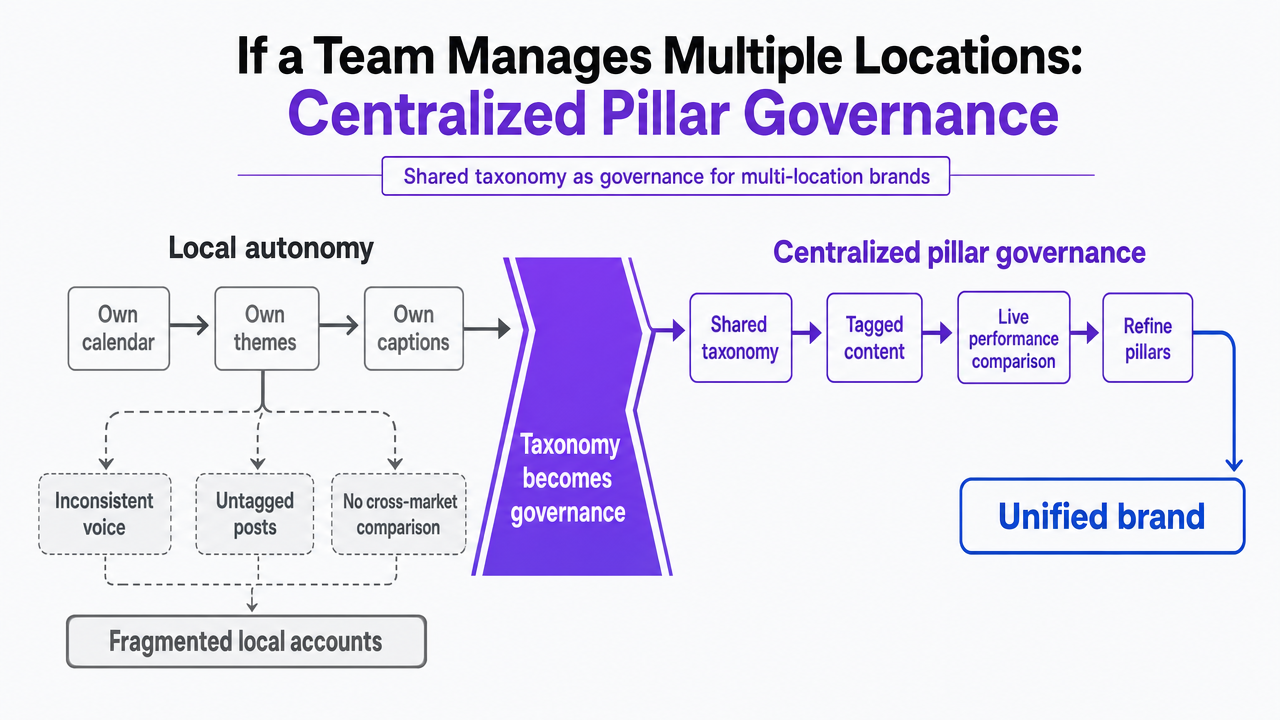 Visualize the centralized vs. decentralized governance comparison that the section's table outlines, reinforcing the operating model for multi-location brands
Refining Pillars on a Weekly Cadence
Quarterly pillar reviews are too infrequent for teams publishing social content at modern speeds. By the time a quarterly retrospective identifies a weak theme, the team has already produced twelve weeks of content under it.
A weekly cadence ensures the taxonomy remains current. This involves a focused discipline:
- analyzing engagement, reach, and conversion data segmented by pillar, journey stage, and POEM channel;
- flagging any pillar with below-median performance for two consecutive weeks;
- and reviewing one annotated example per pillar against the documented voice rule.
The American Marketing Association's framework considers monthly review the minimum, with adjustments based on engagement and content fatigue 11. High-volume teams should shorten this interval.
The weekly review addresses three key questions: Which pillar is gaining attention, which is becoming generic, and which convert-tier posts are generating measurable leads? Each answer informs the following week's content brief. Bazaarvoice's iterative approach is the standard: pillars are refined based on live performance data rather than being static 10.
Pillars developed in this manner transcend being mere planning documents. They become the operational framework that enables lean teams to scale production while maintaining brand integrity.
Frequently Asked Questions
References
- 1.Social Media Success: How Content Pillars Shape Your Strategy.
- 2.How to Use Content Pillars to Elevate Your Social Media Strategy.
- 3.Paid vs. Owned vs. Earned Media: What's the Difference?.
- 4.POEM Framework (Paid, Owned, Earned Media).
- 5.Paid, Owned, Earned Media Framework: Are You in the Right Place?.
- 6.A Qualitative Comparative Analysis of Paid, Owned and Earned Media: Key Attributes Shaping Consumer Attitude.
- 7.The Importance of Brand Voice on Social Media.
- 8.Owned, Paid, and Earned Media for Effective Marketing.
- 9.Maintaining a Consistent Brand Voice & Why it is Important.
- 10.A guide to content pillars for social media and beyond.
- 11.How to Build a Winning Social Media Strategy in 8 Simple Steps.
- 12.Optimal Content Mix for Social Media Marketing.
- 13.Ensure consistent brand voice across touchpoints.
- 14.Brand consistency guide : Align design, voice, and teams.