
Key Takeaways
- Publishing velocity stalls at review handoffs, not at drafting; removing ambiguity about who decides what closes gates faster than adding writers or asking reviewers to work harder.
- Every asset clears four decision gates—scope, voice, factual accuracy, and legal—each assigned to a single named owner with a timestamped artifact rather than a Slack thumbs-up 1.
- Match review depth to content type: evergreen SEO clears lighter gates, while regulated claims clear all four with a documented legal SLA and substantiation file attached before drafting 8.
- AI-assisted drafts require provenance records covering prompt, model, editor, sources, and approvals, with tighter factual review for hallucinations and substantiation per the NIST Generative AI Profile 3, 4.
Why review chains, not writers, cap publishing velocity
Most in-house content teams running 2-6 writers do not have a drafting problem. A competent writer or AI-assisted draft can produce a 1,400-word service page in a day. The page then sits for nine more, moving between a Slack thread, a Google Doc with eleven open comments, a legal email, and a CMS staging environment that nobody is sure has the latest copy. The bottleneck is not throughput at the keyboard. It is ambiguity at every handoff.
The U.S. Department of Labor's content governance guidance frames this directly: governance is positioned as a way to improve consistency, reduce workflow confusion, and increase team efficiency, not as added process overhead 1. Confusion is the operative word. When a reviewer opens a draft and cannot tell whether they are checking for brand voice, factual accuracy, or legal exposure, they default to checking all three, badly, and the asset stalls.
Regulated public-sector publishers reached this conclusion years ago. The VA requires that every new or substantially changed web property arrive with a maintenance and sustainment plan before launch 2, and the IRS documents formal procedures for developing, publishing, and maintaining web content 10. Neither agency is famous for speed, yet both ship continuously because the decision points are named in advance.
The argument that follows is straightforward. Adding writers to a team with an unstructured review chain produces more drafts stuck in the same queue. Removing ambiguity from review produces published assets.
The four decision rights that govern every published asset
Scope, voice, factual accuracy, and legal: assigning each decision to a single owner
Every published asset clears four distinct decision gates, whether the team has named them or not.
- Scope answers whether the asset should exist at all and what it must cover.
- Voice answers whether the language fits the brand and the audience.
- Factual accuracy answers whether the claims, names, statistics, and procedural details are correct.
- Legal and regulatory accuracy answers whether the asset can be published as drafted under the rules that apply to the vertical.
Governed publishing assigns each of these to a single named owner with a recorded artifact behind the decision. The DOL guidance frames this plainly: governance improves consistency and reduces workflow confusion when responsibilities are documented inside existing processes rather than added on top of them 1. The VA goes further for higher-stakes properties, requiring that new or substantially changed sites and applications carry an approved maintenance and sustainment plan before launch, which forces scope and ownership to be settled in writing up front 2.
A workable assignment for a 2-6 person in-house team looks like this. The content manager owns scope and signs the brief. A senior editor owns voice against a published style guide. A subject-matter reviewer, often the practice lead or the product owner, signs off on factual accuracy. Legal or compliance owns the regulatory check and signs a dated approval on a defined SLA. Each owner has one job on the asset, one place to record the decision, and no authority to redo someone else's gate.
The artifact matters as much as the role. A Slack thumbs-up does not survive a six-month audit; a timestamped entry in the approval surface does.
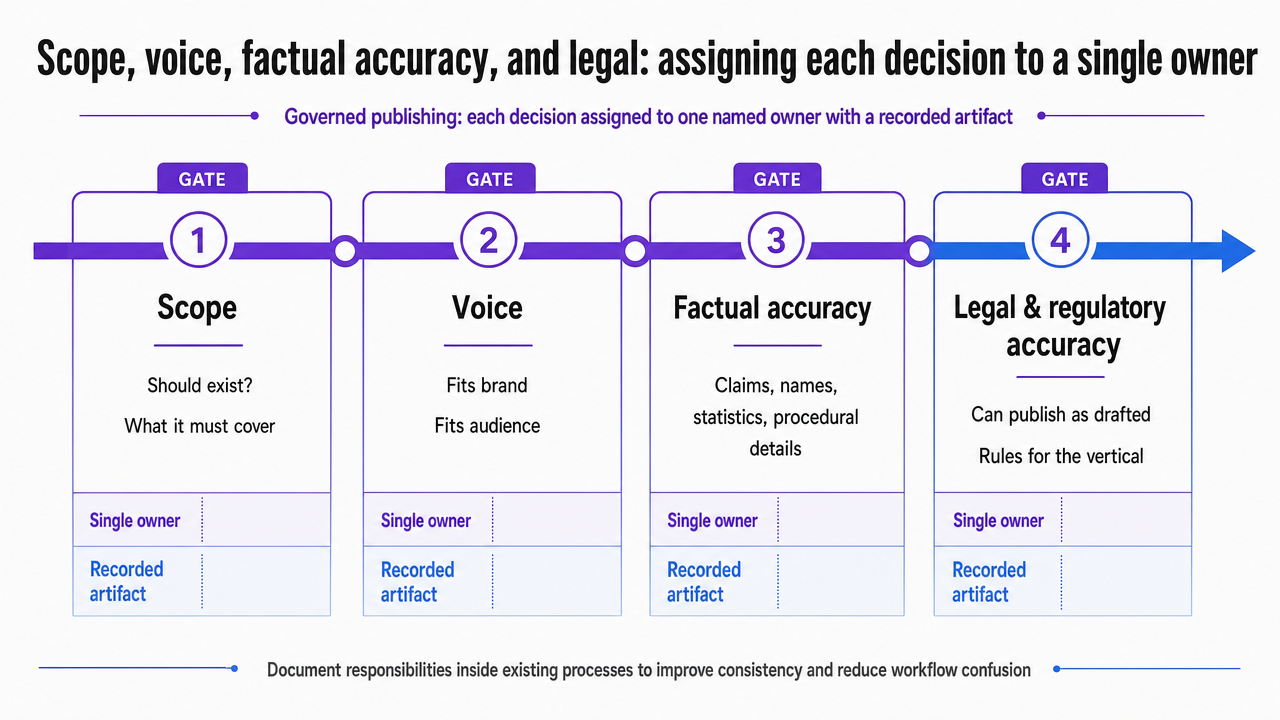 Visualize the four decision gates and their single-owner assignments described in this section, making the governance framework scannable
Why ambiguity, not workload, drives review cycle time
Reviewer hours and review cycle time are not the same metric. A legal reviewer might spend 18 minutes on a 1,400-word service page, yet the page sits in their queue for four days because the reviewer cannot tell which claims are theirs to evaluate and which were already cleared by the subject-matter editor. Workload is small; cycle time is large. The gap is ambiguity.
This is the pattern the DOL guidance addresses when it positions governance as a way to minimize workflow-related confusion rather than to add steps 1. Confusion compounds at handoffs. When a reviewer opens a draft without a defined gate, they instinctively check everything they can see, which means they check things outside their authority, raise issues other reviewers should resolve, and push the asset back into the queue for a round of clarification that no one owns.
The agile-in-regulated-environments research makes the same point in a different domain, recommending that compliance obligations be mapped to specific process stages so teams know exactly which checks belong where 8. Applied to publishing, the rule is simple. A reviewer with a named gate, a written criterion, and a deadline closes the gate. A reviewer with an open invitation to comment opens a conversation.
Cutting cycle time, then, is not a matter of asking reviewers to work faster. It is a matter of telling each reviewer exactly what they are deciding and what they are not.
From serial chain to single approval surface
What public-sector publishing already documents about controlled-but-fast workflows
A serial review chain has a predictable shape. A draft lands in a Google Doc, gets pinged in Slack to the editor, gets emailed to the subject-matter reviewer, gets forwarded to legal, gets pasted into the CMS for a final read, then waits for someone to remember to publish. Each handoff is a fresh context switch, and each reviewer reads from the top because nothing tells them what has already been cleared. A 1,400-word page passes through six tools and four mailboxes before it goes live.
Public-sector publishers run controlled workflows on a different geometry. The DOL governance guidance describes lightweight processes that improve consistency and reduce workflow confusion by naming roles inside existing tools rather than chaining new ones together 1. The IRS documents formal procedures for developing, publishing, and maintaining web content, where each stage has a named owner and a defined output before the asset moves 10. Iowa's digital experience team runs a revision-based moderation workflow: drafts are prepared as forward revisions against the live asset, reviewed in place, and promoted to current when ready, so the page never goes dark while review is underway 11.
The shared shape is a single surface where every reviewer sees the same artifact, the same criteria, and the same status. Reviewers work in parallel against their own gate rather than in sequence against the whole document. Cycle time falls because handoffs collapse into views, not transfers.
Structured intake: what a publishing request must carry before it enters the pipeline
The single approval surface only works if every request enters it the same way. An intake form that accepts a one-line Slack message produces the same downstream confusion as no intake at all. A structured request carries the fields reviewers need before the first reviewer opens the draft.
At minimum, a publishing request should declare:
- the asset type and target URL,
- the primary audience and channel,
- the claim categories involved (factual, comparative, regulated),
- the named owner for each of the four decision gates,
- the requested publish date with a defined legal SLA,
- and the maintenance plan after launch.
The VA codifies the last item directly, requiring that requests for new or substantially changed properties carry a maintenance and sustainment plan before approval 2. That field alone prevents a category of orphaned pages that no one is responsible for reviewing in six months.
The EDUCAUSE third-party integrations guide treats intake the same way for tool requests, recommending formal approval teams, a catalog of approved items, and annual reviews of what is already in production 9. The pattern transfers. A content catalog with structured intake records becomes the audit trail, the editorial calendar, and the maintenance queue at the same time.
Requests that arrive without the required fields do not enter the pipeline. They go back to the requester with the missing fields named. That single rule eliminates the most common source of mid-review delay: a reviewer discovering halfway through that they cannot finish the gate because the brief never specified what was being claimed.
Accelerate governed content publishing this week
Experience streamlined approvals and publish live content within your real organizational workflow before you commit.
Templates and structured fields as a velocity layer
Structured templates do for content production what structured data does for regulatory filings: they convert open-ended judgment calls into populated fields. A peer-reviewed analysis of structured content and data management in regulated filing ecosystems found that standardization directly addresses underlying inefficiencies in production workflows 6. The same logic applies to a service page or a clinical comparison article. When the draft arrives in a template with named slots for the offer, the audience qualifier, the proof points, the regulated claims, and the calls to action, reviewers stop hunting for what to check.
A working template for a service page might require seven fields:
- page purpose,
- primary keyword cluster,
- audience qualifier,
- three substantiated claims with sources,
- one regulated or comparative claim flagged for legal,
- internal links to two pillar pages,
- and a meta description under 155 characters.
A drafter cannot submit the template with empty fields. A reviewer cannot approve a field that is not flagged as their gate.
The downstream effect is measurable in reviewer minutes per asset. A legal reviewer scanning an unstructured draft has to read the whole document to find the two sentences that carry regulatory exposure. A legal reviewer opening a template jumps to the flagged claim field, evaluates it against the cited source, and closes the gate. The DOL guidance frames this as governance that reduces workflow confusion rather than adding process 1. Structured fields are the artifact that delivers that reduction.
Templates also produce a second-order benefit: they make AI-assisted drafting useful instead of risky. A model prompted to fill a structured template with named field constraints returns a draft that reviewers can evaluate against the same criteria as a human-written one. A model prompted with "write a service page about dental implants" returns a draft that nobody knows how to review.
Matching review depth to content type
Mapping autonomy to content category: evergreen SEO, product pages, regulated claims, executive POV
Treating every asset to the same review depth is the single most expensive choice a content team can make. A 900-word evergreen SEO post comparing two productivity habits and a 1,400-word service page making a clinical claim do not carry the same risk, yet the typical review chain routes both through the same reviewers in the same order. The result is that low-risk content moves at the speed of high-risk content, and reviewer hours are spent on assets that did not need them.
The agile-in-regulated-environments research proposes the cleaner pattern: define levels of autonomy by mapping compliance obligations to specific process stages, so teams can ship faster on the work that carries lighter obligations without abandoning control on the work that carries heavier ones 8. Translated to publishing, the question is not how much review an asset gets, but which gates it has to clear and which it can skip.
A workable matrix for an in-house team running a mixed editorial calendar sorts content into four lanes.
- Evergreen SEO content — top-of-funnel explainers, comparison posts, definitional pages — clears scope and voice gates, with factual review only on cited statistics.
- Product and service pages clear all four gates, because every claim about a service offering carries comparative or substantiation exposure.
- Regulated claims — anything touching health outcomes, financial returns, legal results, or protected categories — clear all four gates with a documented legal SLA and a substantiation file attached to the asset.
- Executive POV pieces and bylined thought leadership clear scope, voice, and factual gates with an additional named approval from the bylined executive, since reputational exposure sits with the author.
The matrix is published. Reviewers know which lane an asset is in before they open it, and the intake form forces the lane assignment at request time. A piece misassigned at intake is the only piece that needs re-routing later, and that exception becomes the audit signal worth tracking.
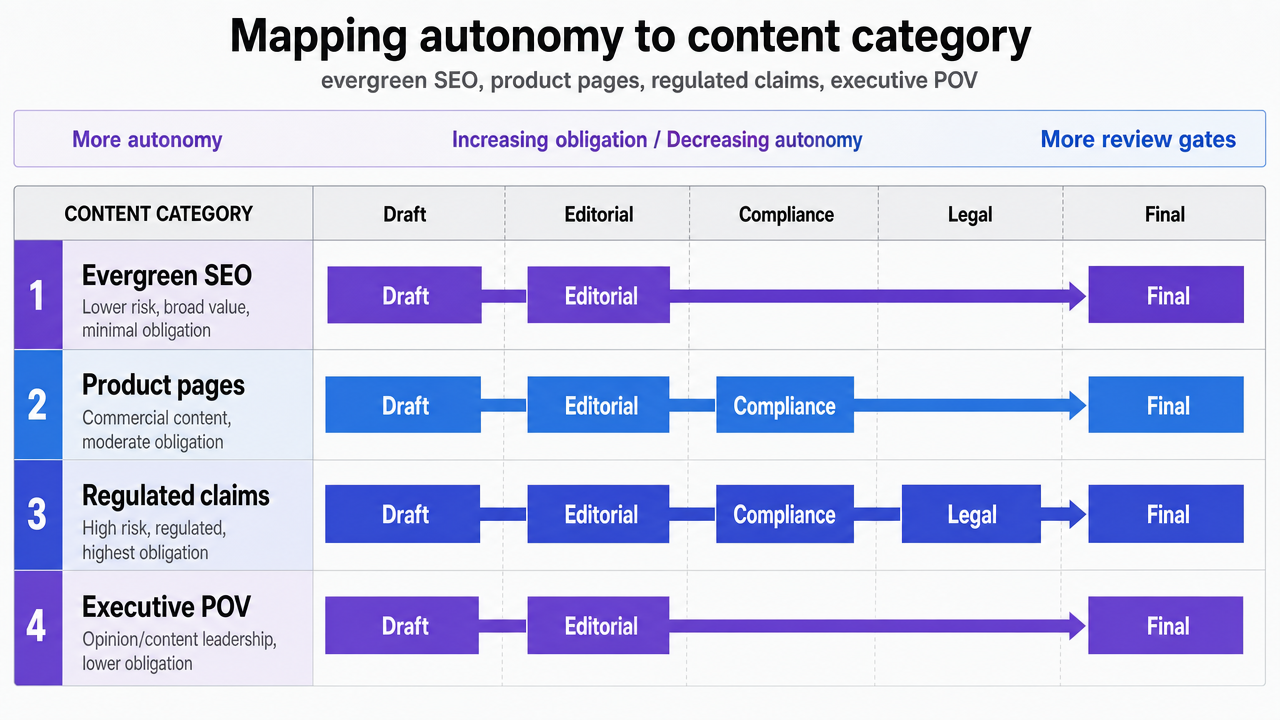 Make the four-lane content matrix concrete by showing which gates each content category must clear, directly visualizing the section's framework
AI-assisted drafting under a governed model
Provenance, metadata, and the human approval gate
AI-assisted drafting collapses the time to first draft, which means the review chain becomes a larger share of total cycle time, not a smaller one. A model can fill a structured service-page template in under a minute. The legal reviewer still needs an hour. The only way that hour stays useful is if the reviewer can tell, on opening the draft, what the model produced, what a human edited, and what evidence sits behind the claims.
NIST's report on reducing risks posed by synthetic content recommends stronger provenance practices, structured metadata management, and verification of mitigation mechanisms before deployment 4. Translated to a content team's daily work, that means every AI-assisted draft carries a provenance record attached to the asset: the prompt source, the model and version used, the human editor who revised the draft, the fact-check pass against named sources, and the timestamped approval from each of the four decision-gate owners. The record lives next to the draft, not in a separate file that nobody opens.
The same NIST report notes a tradeoff worth naming for in-house teams. More complete provenance increases metadata weight and complicates privacy handling 4. A 1,400-word page does not need every keystroke logged. It needs the five fields a reviewer would want to verify under audit: model, prompt category, editor, sources, approval chain.
The human approval gate stays where governance has always put it. A reviewer signs the regulated claim, not the prompt. The model produces a draft; the named owner produces the decision. The DOL governance guidance frames this without naming AI specifically: documented responsibilities reduce workflow confusion regardless of who or what wrote the first version 1. A provenance record makes that documentation operational. A draft without one re-opens every question the gate was supposed to close.
Where the NIST Generative AI Profile changes review criteria
NIST released a Generative AI Profile to its AI Risk Management Framework in 2024, addressing risks specific to generative systems rather than AI broadly 3. For content teams, the Profile shifts review criteria in two practical ways.
First, hallucinated claims become a named review category, not an afterthought folded into factual accuracy. The factual-accuracy gate on an AI-assisted draft checks every cited statistic, named source, and proper noun against the original document, not against the model's summary of it. A reviewer who treats AI-drafted text the same as human-drafted text catches typos and misses fabrications.
Second, regulated-claim review tightens around substantiation. The FDA's guidance on firm communications to health care providers expects truthfulness, balance, and substantiation in scientific information shared about unapproved uses 5. Applied to an AI-drafted comparison page or clinical explainer, the substantiation file attached to the asset has to predate the draft, not be assembled after the model produces a claim that sounds plausible.
The Profile is voluntary 3. The review discipline it implies is not optional for teams publishing in regulated verticals. A governed model treats AI as a drafting accelerator inside the same approval surface, with tighter gates on the categories where generative systems fail in characteristic ways.
Accelerate Content Publishing Without Losing Oversight
See how centralized approval workflows help agencies and enterprise teams scale publishing output, cut cycle times, and maintain quality standards across all channels—backed by real operational benchmarks.
If you manage multiple locations: scaling governance across a portfolio
This section shifts from single-brand in-house managers to operators running content across a portfolio: a DSO with 40 practices, a senior living group with 22 communities, a multi-office law firm with regional pages for each market. The governance question changes shape. The four decision gates do not multiply by location count; the artifacts do.
A naive multi-location model routes every location page through the same central reviewer chain, which means a 22-community senior living portfolio publishing two pages per location per month sends 528 assets a year through a legal queue sized for a single brand. Cycle time stretches, reviewers triage by gut, and location marketing leads start publishing around the queue. The agile-in-regulated-environments research points to the cleaner pattern: map levels of autonomy to process stages so lower-risk work clears with lighter oversight while higher-risk work keeps full review 8.
Applied to a portfolio, that means central governance owns the criteria, templates, and substantiation files; location teams own scope and voice gates against those templates; central legal owns regulated-claim review only on assets flagged by the intake form. A location service page describing existing offerings against an approved template clears in days. A new clinical claim or comparative statement routes to central legal with a documented SLA.
The math operators should run uses three variables they already know: assets per location per month, reviewer minutes per asset under ad-hoc review versus criteria-based review, and number of locations. The output is reviewer hours reclaimed per quarter, not a dollar figure. The EDUCAUSE governance pattern reinforces the maintenance side: a published catalog of approved templates and integrations, reviewed annually, prevents portfolio drift without adding a standing committee 9. One catalog, many locations, same gates.
Lifecycle ownership: treating every published asset as a maintained object
A published asset is not a finished asset. It is a maintained object with a refresh cadence, a named owner, and a sunset condition. The VA codifies this directly by requiring that every new or substantially changed property carry a maintenance and sustainment plan before launch 2. The plan answers four questions the publishing team will otherwise face under pressure later: who reviews this page on what interval, what triggers an unscheduled review, when does the page retire, and where does the substantiation file live.
The IRS web content management procedures treat maintenance as a peer process to development and publishing rather than a tail-end task 10. Inside an in-house team, that means the approval surface carries a scheduled review date for every asset, not just a publish date. Evergreen SEO pages might cycle every 12 months. Service pages with regulated claims cycle every 6 months or when a referenced statistic, guideline, or product detail changes. AI-assisted drafts carry the same provenance record forward into each refresh, so a reviewer in month nine sees what was cleared and what was changed.
The EDUCAUSE governance pattern adds the annual catalog review: a published list of approved assets, templates, and integrations reviewed once a year against current need 9. Pages that no longer earn traffic, support a live offer, or carry current claims retire on schedule. Lifecycle ownership turns the content library from a growing liability into an audited inventory.
Frequently Asked Questions
References
- 1.Content governance: lightweight practices your team can adopt now.
- 2.Enterprise content management systems - VA Web Governance.
- 3.AI Risk Management Framework.
- 4.Reducing Risks Posed by Synthetic Content.
- 5.Communications From Firms to Health Care Providers Regarding Unapproved Uses of Approved or Cleared Medical Products.
- 6.Structured content and data management—enhancing acceleration ....
- 7.A framework for health information governance: a scoping review.
- 8.A Systematic Approach to Agile Development in Highly Regulated ....
- 9.Third-Party Integrations: Governance and Process Guide.
- 10.2.25.101 IRS.gov Web Content Management Procedures.
- 11.Content Moderation Workflow - Digital Experience - Iowa.gov.
- 12.Complying with COPPA: Frequently Asked Questions.
- 13.Promoting the Rule of Law Through Improved Agency Guidance Documents.
- 14.CFTC Reports | CFTC.
- 15.Marketing.
- 16.Advancing Compliance with HIPAA and GDPR in Healthcare.
- 17.digital health: understanding the fda regulatory landscape.