
Key Takeaways
- Cost-per-signed-case, not cost-per-lead, is the metric that reflects real ad economics, because cheap form fills from unqualified callers can starve a firm of signable matters.
- Targeting, creative, landing pages, and phone intake function as one governed loop, and compliance with Rule 7.1 belongs in the creative brief rather than a late legal review 9.
- Structured pre-screen forms and a telephony baseline covering busy signals, wait times, and after-hours routing convert high-intent clicks into consultations that actually reach an attorney 6, 10.
- Multi-jurisdiction firms should version copy libraries by state and diagnose cost-per-signed-case variance at the landing page and phone layers before reallocating budget across markets 3, 12.
Why cost-per-signed-case is the only ad metric that matters
Cost-per-lead flatters the wrong part of the funnel. A campaign that produces cheap form fills from tire-kickers, statute-of-limitations misses, and out-of-jurisdiction callers can post enviable CPLs while starving the firm of signed matters. The metric that actually reflects economics is cost-per-signed-case, and the operating variable that moves it is the share of paid clicks that reach a qualified consultation with an attorney authorized to take the matter.
That framing changes what a paid campaign is optimizing. Bidding, creative, targeting, landing pages, and phone intake stop being separate disciplines and start functioning as one loop. Research on how laypeople search for legal help found that the internet is currently failing them, with online resources rarely guiding a person from a life problem to an appropriate service 3. Every drop-off between click and consultation is a place where ad dollars convert into no revenue, and most of those drop-offs live outside the ad platform.
Compliance sits inside the same loop. State bar rules governing advertising, notably Rule 7.1's prohibition on false or misleading communications, are treated by regulators as commercial speech constraints that apply from the headline through the intake script 9. Copy that inflates outcomes may lower CPL and raise disciplinary exposure at once.
The sections that follow treat targeting, messaging, landing pages, and intake as a single governed pipeline, measured against one number: what a signed case costs to acquire.
Intent-matched targeting: buying attention from people already searching for representation
Reading intent signals across search, local, and social
Paid channels differ less in reach than in the intent temperature they deliver. A query like "truck accident lawyer near me" carries transactional intent that a display impression on a news site cannot match, and the difference shows up in downstream consultation rates rather than click volume. Search and local formats capture people who have already self-identified as looking for representation; social formats reach people who may have the underlying problem but have not yet decided to hire.
That distinction should govern how budget is split. Search and Google Business Profile placements sit closest to the decision, so they warrant tighter keyword-level bidding, negative keyword lists that exclude informational and DIY queries, and geographic radii that match the jurisdictions where the firm can actually take the matter. Social placements work as demand-shaping rather than demand-capture: they can move a prospect from awareness to a scheduled consultation, but only when the creative gives a clear next action. A peer-reviewed analysis of social advertising found that action-oriented appeals with explicit calls to action produce measurably higher rates of clicks and sign-ups than baseline display formats, though the study covered consumer behavior generally rather than legal services specifically 11.
Firms that fund social the way they fund search, on cost-per-click parity, tend to overpay for the wrong stage of the funnel.
Behavioral targeting's ceiling in a regulated vertical
Behavioral targeting, defined in the legal literature as collecting data on consumer behavior and using it for advertising, promises efficiency by narrowing spend to profiles that resemble past converters 1. In practice, the ceiling on that efficiency in legal advertising is set by three pressures that do not apply to consumer goods.
- Platform policy. Major ad networks restrict interest-based targeting on sensitive categories that overlap heavily with legal need, including personal hardship, family status, and health.
- Ethical constraint on targeted solicitation. California's Rule 7.3, for instance, sits alongside Rule 7.1 to limit how directly a lawyer may reach out to a specific prospective client believed to need particular services 12.
- The privacy debate the law review literature itself flags: whether current frameworks adequately protect consumers from profiling in ways that could later be challenged as unfair 1.
The operational move is to lean on declared intent, primarily search queries and self-selected form inputs, and treat behavioral lookalikes as a secondary layer used to expand qualified audiences rather than to solicit specific individuals. That posture preserves conversion economics without accumulating regulatory risk.
Compliant messaging as a campaign design input, not a legal review afterthought
Rule 7.1 substantiation and the copy patterns it kills
Rule 7.1's operative language prohibits a lawyer from making a false or misleading communication about the lawyer or the lawyer's services, including statements likely to create unjustified expectations about results 9. That single clause invalidates a large share of the copy patterns that ad platforms otherwise reward with high click-through rates.
Four patterns fail routinely under Rule 7.1 analysis:
- Headlines that promise a specific outcome ("Get the settlement you deserve") create unjustified expectations, because past results do not predict future ones and the statement invites the reader to conclude they will receive comparable treatment.
- Superlative comparisons ("the top-rated firm in the state," "the best trial lawyers") fail when the underlying claim cannot be factually substantiated against a defined peer set.
- Case-result callouts ("$4.2M verdict") displayed without the disclaimers, matter facts, and no-guarantee context required by state comments are read as implying replicable results.
- Aggregate-money headlines ("Over $100 million recovered") face the same substantiation demand, especially when the firm cannot document the underlying matter list on request.
The operational fix is upstream, not downstream. Copy standards belong in the creative brief, not in a legal review at the end of the sprint. Ad copy, headline variants, and dynamic keyword insertion rules should be reviewed against a firm-specific substantiation file that records the evidence, dates, and matter identifiers backing every claim in rotation. When a keyword bid triggers a headline the firm cannot substantiate, that headline is pulled, not disclaimed. Cornell's Wex entry is blunt about the downside of skipping this discipline: lawyers who violate advertising rules face state bar discipline up to disbarment and separate judicial proceedings for false or misleading advertising 8.
Treated as a design input, Rule 7.1 narrows the creative surface but sharpens the message that survives: specific practice area, jurisdiction, verifiable qualifications, and a clear next step.
Testimonials, case results, and the FTC endorsement overlay
Client testimonials sit under two rule sets at once. Bar rules police whether the testimonial creates an unjustified expectation about results; the FTC's endorsement guidance governs whether the endorsement itself is honest and adequately disclosed. The FTC requires that endorsements
"reflect the honest opinions, findings, beliefs, or experience"
of the endorser and not be misleading 4. That standard applies whether the testimonial appears in a paid social ad, a YouTube pre-roll, or a landing page video below the fold.
Three operational rules follow:
- Compensated endorsers, including staff-adjacent influencers and any incentivized reviewer, require clear and conspicuous disclosure of the material connection; a hashtag buried in the eighth line of a caption does not qualify.
- Scripted testimonials that a client did not actually say, or that describe an outcome the client did not experience, fail the honest-experience standard even if the underlying legal claim is true.
- Composite testimonials that blend multiple clients into a single narrative are not endorsements of anyone's honest experience and should be labeled as illustrative, not attributed.
Case-result videos need the same treatment as case-result headlines: matter facts, jurisdiction, date, and the plain statement that results depend on the specific facts of each case. When the ad platform strips disclosure text at certain aspect ratios, the ad is not compliant at that placement and should be excluded from that inventory.
State consumer protection statutes stacked on bar rules
Bar discipline is not the only exposure. State consumer protection statutes give attorneys general independent authority over deceptive legal advertising, and they apply to any actor who represents an ability to provide legal services, not only licensed attorneys. Georgia is a useful reference point: its Consumer Protection Division states that Georgia law
"prohibits the intentional false advertisement of legal services by attorneys and others who represent they can provide legal services"
7.
Two implications matter for campaign design. First, lead-generation partners and referral marketers named in an ad, or whose branded creative drives the click, can trigger consumer-protection review on the same copy that already passed bar review; the AG's office is not bound by state bar rulings. Second, disclosure obligations follow the ad across state lines. A campaign that runs identical creative in Georgia and a neighboring state cannot rely on the more permissive jurisdiction's standard when the ad is served to a Georgia resident. Ad-serving geography, not the firm's principal office, sets the applicable floor.
Trial real ad campaigns with measurable results
Launch and track actual ads to evaluate qualified case intake before committing long-term.
The click-to-consultation loop: where qualified cases are actually won or lost
Landing pages that guide laypeople rather than impress peers
A high-intent click delivered to a firm-brand homepage is a wasted click. The person clicking a "truck accident lawyer" ad is not evaluating the firm's history or reading partner bios; they are asking whether this office can take their matter and what happens next. Stanford Law Review research on how laypeople search for legal help concluded that the internet is currently failing them, with online resources rarely moving a user from a stated life problem to an appropriate service 3. That failure is a landing-page problem before it is an intake problem.
The pages that survive that gap share a small set of properties. The above-the-fold answer confirms the matter type in the visitor's own language, not the firm's practice-area taxonomy, and states the jurisdictions where the firm can act. A single primary action, either a call button that routes to a live human during business hours or a short pre-screen form after hours, sits in the visitor's first screen without competing calls to action. Attorney credentials, verifiable case-type experience, and any required advertising disclosures live below the fold, not because they are unimportant but because they answer questions the visitor has not yet asked.
Firms measuring page performance on time-on-page and scroll depth are measuring the wrong thing. The relevant metric is the share of clicks that reach a qualified consultation, and the drop-off points inside that funnel, targeting mismatch, page UX failure per 3, intake delay, and screening disqualification, tell the operator which subsystem to fix next.
Structured online intake and pre-screen form logic
A pre-screen form is a filter, not a lead capture. Its job is to route matters the firm can take toward an attorney consultation and matters it cannot toward a referral, a self-help resource, or a polite decline, before intake staff time is spent. Legal Services Corporation guidance on online intake and triage systems documents the operational payoff directly: structured screening
"can reduce the number of inappropriate applicants that intake staff must screen, allowing staff to spend more time assisting eligible clients"
6. Applied to a paid-media pipeline, the same logic converts raw form fills into a smaller, higher-density queue.
Effective form logic asks the disqualifying questions first, not last. Jurisdiction, incident date against the applicable statute of limitations, opposing party (for conflicts screening), and matter type are gating fields. Contact details come after those gates, so the operator captures a usable disqualification signal rather than a phantom lead that consumes a callback. Conditional branching, where a personal-injury path skips family-law questions and vice versa, keeps completion rates from collapsing under the weight of a universal form.
A comparison of intake outcomes with and without structured triage makes the staffing case concrete. Without triage, intake staff work every inbound inquiry to disposition, and eligible clients wait behind ineligible ones. With triage, ineligible matters exit the queue at the form layer, and intake time reallocates to matters that can actually be signed 6. The visible cost is a lower raw lead count in the ad platform report. The invisible gain is a higher share of remaining leads that convert to signed cases, which is the number the P&L actually reflects.
Forms should also write structured data back to the ad platform for conversion optimization. When "signed case" is the conversion event fed to the bidding algorithm rather than "form submitted," the algorithm learns to buy the audiences that produce matters, not the audiences that produce clicks.
Phone intake: the LSC telephony baseline applied to paid campaigns
Phone remains the dominant channel for legal intake because a person with a legal problem wants to talk to a person. That makes the phone system the single highest-leverage variable in the loop for most firms, and the operational floor is lower than partners usually assume.
Legal Services Corporation's telephony baseline for intake systems recommends monitoring
"busy signals, wait times, dropped calls"
as first-order metrics and treats hosted phone systems, call routing, and integration with online intake as baseline requirements, not upgrades 10. The same baseline applies to any firm buying paid clicks. A campaign that generates 40 calls a day into a two-line system with no overflow routing is not a marketing problem; it is a telephony problem being paid for out of the marketing budget.
Four operational rules follow:
- Every paid campaign gets a tracked number that routes to a live human during business hours, with a defined ring-to-answer target and a hard cap on abandonment rate.
- Overflow calls route to a licensed after-hours service that can complete the pre-screen and book the consultation, not a voicemail box; the LSC guidance flags voicemail-only handling as a known intake failure mode 10.
- Call recordings and pre-screen dispositions flow back to the same signed-case conversion event the forms feed, so bidding sees phone outcomes alongside form outcomes.
- Weekly review pulls the calls that qualified but did not book and the calls that booked but did not sign, and traces each back to the ad, keyword, and time-of-day that produced it.
A firm can hold Rule 7.1-clean creative, run intent-matched targeting, and still lose the case at 5:47 p.m. on a Friday because the phone rang eleven times. The telephony layer is where paid-media economics either close or leak, and it is measured the same way LSC recommends measuring any intake operation: by the calls that do not connect and the ones that do but should not have needed to wait 10.
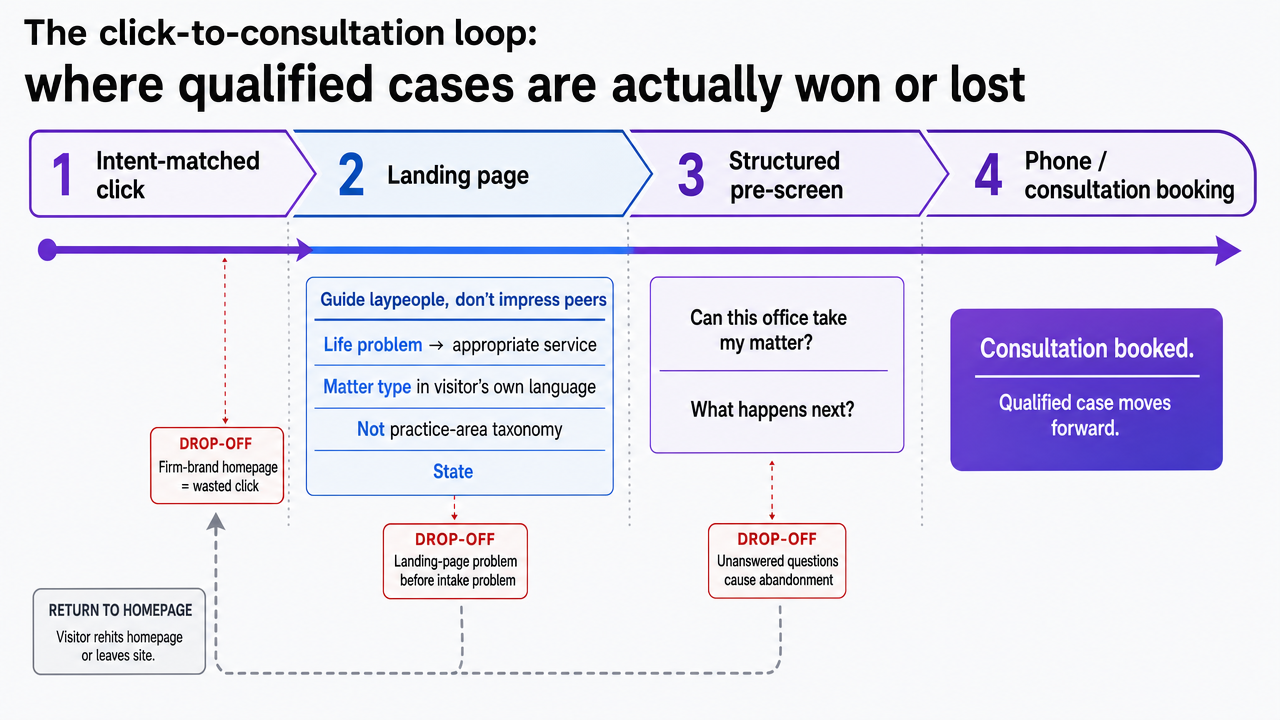 Visualize the four-stage governed pipeline described in the section: intent-matched click, landing page, structured pre-screen, and phone/consultation booking, with the drop-off diagnostics the article names
Governance loop: closing the gap between spend, ethics review, and signed matters
The firms converting the highest share of clicks into signed matters treat ads, ethics review, and intake as one workflow with one weekly meeting, not three departments with three calendars. When copy sits in a designer's queue for a week, then legal review for another week, and campaign changes wait behind both, the ad account cannot respond to what the intake data is showing. The Legal Services Corporation's technology summit framed the same principle for civil legal aid: an integrated service-delivery system outperforms siloed tools, because the handoffs between information, triage, and service are where users drop out 5. The private-firm analogue is that handoffs between media, compliance, and intake are where paid budget drops out.
A functional governance loop has four moving parts operating on a single cadence. Campaign signals, keyword-level cost per qualified consultation, disqualification reasons from the pre-screen, and after-hours call outcomes, arrive weekly in a shared view. Copy changes, new headlines, testimonials, or case-result variants route through a substantiation check before they enter rotation, using the firm's existing evidence file rather than a fresh legal opinion each cycle. Approved changes ship the same week, and the resulting signed-case data feeds back into the next review. Nothing waits for a quarterly meeting.
Two guardrails keep the loop honest. Every claim in rotation is traceable to a substantiation record consistent with Rule 7.1's substantiation demand 9, and every intake disposition is traceable to the ad, keyword, and time of day that produced the call. When those two audit trails exist, the P&L conversation stops being about CPL and starts being about which campaigns produced matters the firm could take.
See How Data-Driven Ad Campaigns Can Consistently Deliver Qualified Case Leads
Request a demonstration of AI-powered ad workflows that optimize for case quality and cost efficiency—backed by live analytics, approval-first automation, and measurable intake performance.
If you operate multiple offices or jurisdictions
Cross-jurisdiction compliance when California and Georgia campaigns share creative
For managing partners overseeing offices in more than one state, the risk vector shifts from creative approval to ad-serving geography. A single headline approved for a Georgia campaign can trigger a California Rule 7.3 solicitation review the moment the ad platform serves it to a California IP, and vice versa. California's Chapter 7 confirms that a lawyer may advertise services subject to Rule 7.1's truthfulness demand and Rule 7.3's solicitation limits 12, while Georgia's Consumer Protection Division applies an independent state statute prohibiting the intentional false advertisement of legal services by attorneys and others representing they can provide legal services 7.
Two rules keep multi-state creative from becoming a discipline exposure. Copy libraries are versioned by jurisdiction, not by office, and the ad platform's geographic targeting is the enforcement layer: California-cleared creative runs only in California-eligible placements, and Georgia-cleared creative runs only where Georgia's stricter statutory floor applies. Nothing runs nationally by default. Cornell's Wex overview is direct on the stakes, noting that lawyers who violate advertising rules face state bar discipline up to disbarment alongside separate judicial proceedings 8.
A qualified-consultation economics framework by market
The economics conversation across offices should be structured in variables, not in borrowed benchmarks. Firms that compare markets on cost-per-lead miss the operational point, because a market with a $180 CPL and a 12% signed-case rate is more expensive than a market with a $340 CPL and a 34% signed-case rate. The framework below holds the metric that matters, cost per signed case, constant across markets while exposing which subsystem is driving the variance.
| Variable | Definition | Where it is set |
|---|---|---|
| Ad spend per market (S) | Monthly paid media budget for the jurisdiction | Media plan |
| Qualified consultations (Q) | Screened calls or forms that reached an attorney consult | Intake triage 6 |
| Cost per qualified consultation | S ÷ Q | Loop between targeting and intake |
| Consult-to-signed rate (R) | Share of consultations that convert to signed matters | Attorney consult, matter fit |
| Cost per signed case | S ÷ (Q × R) | Full pipeline |
| Average matter value (V) | Fee revenue per signed matter | Practice mix |
Two markets with identical S and V but divergent cost per signed case usually differ on one subsystem: landing page UX for laypeople 3or telephony response on the intake side 10. Diagnose before reallocating budget.
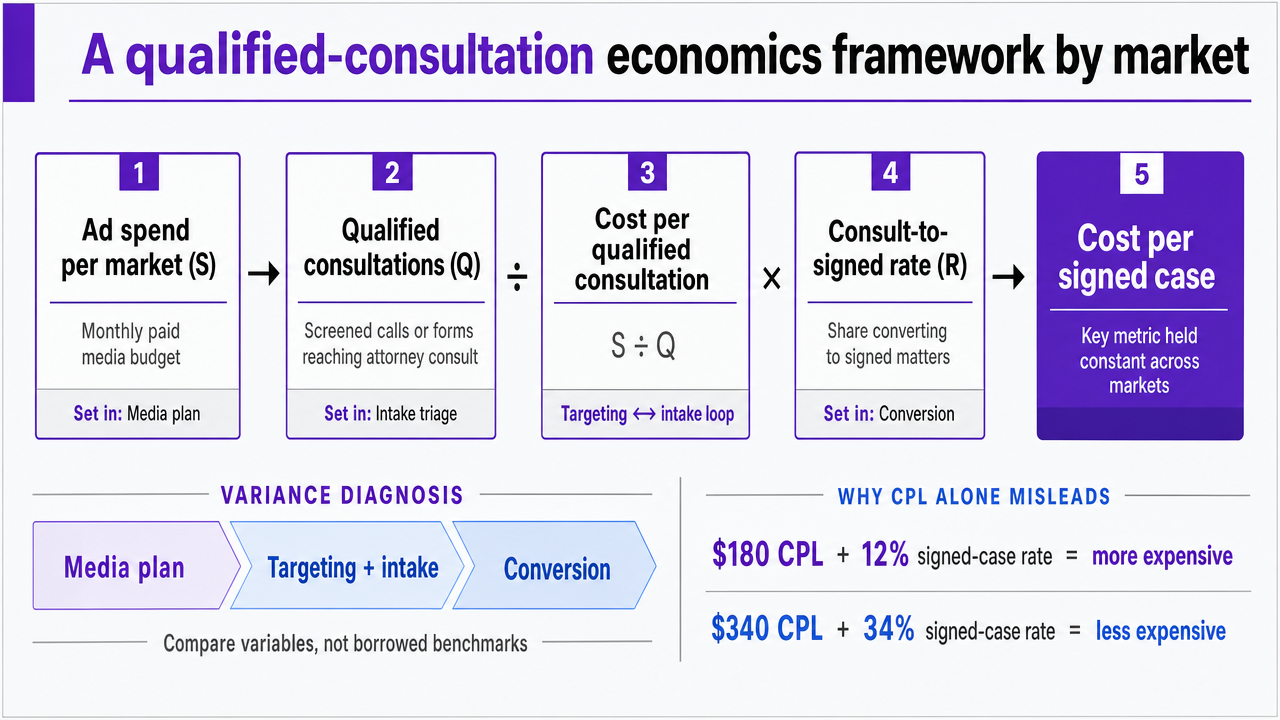 Reinforce the cost-per-signed-case framework table by visualizing the formula chain from ad spend to signed case across markets, making the variance diagnosis explicit
What a governed ad-to-intake operation looks like in practice
A firm running the loop this article describes does not look busier than one running channels in isolation. It looks quieter. The Monday review pulls three numbers, cost per qualified consultation by campaign, disqualification reasons from the pre-screen, and the calls that qualified but did not book, and the operator can name which subsystem produced each variance before the meeting ends. Media, intake, and compliance sit at the same table, so a copy change triggered by a rising disqualification rate ships that week rather than waiting for a quarterly refresh.
The signal that the operation is working is inversion. Raw lead count in the ad platform report falls or stays flat while signed matters rise, because the pre-screen is doing the filtering the intake staff used to do manually 6. Phone metrics, ring-to-answer, abandonment, after-hours conversion, sit next to media metrics in the same view rather than in a separate telephony report 10. Every headline in rotation traces to a substantiation record consistent with Rule 7.1 9, and every intake disposition traces to the ad and keyword that produced the call.
Firms that want that loop coordinated in one workflow rather than three vendors are the audience Vectoron is built for.
Frequently Asked Questions
References
- 1.Balancing Consumer Privacy with Behavioral Targeting.
- 2.Social Advertising Effectiveness in Driving Action: A Study of Consumer Behavior.
- 3.The User Experience of the Internet as a Legal Help Service.
- 4.FTC’s Endorsement Guides: What People Are Asking.
- 5.Report of The Summit on the Use of Technology to Expand Access to Justice.
- 6.Online Intake & Triage (Replicable TIG Projects).
- 7.Legal Advertisements.
- 8.Legal advertising | Wex Legal Dictionary.
- 9.Walking the Ethical Line with Lawyer Advertising.
- 10.9.1 Baseline for Intake and Telephonic Advice – Telephone Systems.
- 11.Social Advertising Effectiveness in Driving Action: A Study of Consumer Behavior.
- 12.Chapter 7. Information About Legal Services (Rules 7.1–7.6).