
Key Takeaways
- Account expansion plays triggered by product usage signals reorient marketing toward renewals and expansion, where 61% of B2B revenue actually originates 2.
- Incrementality-tested paid media programs use geo holdouts and audience splits to isolate true lift, exposing channels where conversions would have happened anyway 1.
- Personalization-at-scale campaigns require segment-level control groups to credibly claim the 10–15% revenue lift McKinsey associates with strong execution 6.
- ABM motions built on account-level pipeline attribution outperform broad demand gen when target lists stay under 200 accounts per sales rep cohort 10.
- Omnichannel orchestration tied to buyer journey signals matches how B2B buyers now move across ten interaction channels in a single journey 4.
- Hybrid sales-marketing campaigns with shared account targets can drive up to 50% more revenue by combining digital, remote, and in-person coverage 5.
- Post-sale lifecycle motions for renewal and expansion close the personalization gap that typically collapses after closed-won, where most B2B revenue lives 2.
- Real-time decision-engine campaigns suit high-stakes offers by selecting the next-best message from a tagged content library, measured against a fixed-rule control 9.
- An AI-orchestrated decision layer ranks next-best actions across the other eight archetypes, routing significant calls for human approval before execution 11.
Why most campaign examples fail the revenue test
Search results for "marketing campaigns examples" often highlight creative spectacles like viral spots or clever hashtags, which, while impressive, frequently lack a clear connection to closed-won revenue. For demand generation managers with pipeline quotas, a campaign that generates 200 million impressions but cannot be tied to revenue is more suited for an awards reel than a budget defense.
The issue of marketing measurement credibility is significant. Forrester data reveals that 64% of B2B marketing leaders do not fully trust their own organization's marketing measurement, often relying on volume metrics with a weak link to revenue 8. Furthermore, operations leaders note that fundamental practices such as campaign data tagging, goal setting, and sales–marketing alignment are often inconsistent, undermining claims of revenue impact 7.
This disconnect explains why many published "examples" fall short under CFO scrutiny. They typically describe the campaign's appearance but fail to detail how its contribution was isolated from baseline demand, paid reach, or sales activities. They might cite vendor-supplied lift figures without an incrementality control or count MQLs that sales teams have already dismissed.
The campaign archetypes discussed here prioritize revenue measurement first, then describe the mechanics. While creative execution is important, it is secondary to a robust measurement model.
The three traits shared by revenue-defensible campaigns
Revenue-defensible campaigns, those that consistently pass CFO review, share three core structural traits, regardless of their creative elements.
First, they are signal-triggered, not calendar-triggered. These campaigns activate when specific behaviors or account conditions occur, such as a product usage threshold being crossed, a buying committee engaging with a vendor site, or a renewal window opening. McKinsey's 2024 B2B Pulse indicates that buyers now navigate approximately ten interaction channels in a single journey, a significant increase from five in 2016 4. Campaigns tied to a corporate content calendar often miss much of this dynamic buyer activity.
Second, they are measured against a credible counterfactual. Simply reporting that a campaign "influenced" $4M in pipeline is insufficient without a control group, a holdout, or an incrementality test. A randomized field experiment by Carnegie Mellon on programmatic advertising demonstrated that without experimental design, advertisers frequently overstate the attributable lift from their spending 1.
Third, they operate through a single decision layer rather than fragmented channel silos. Forrester operations leaders highlight inconsistent tagging and poor sales-marketing alignment as critical bottlenecks that invalidate otherwise sound campaigns 7. When email, paid media, and sales outreach function with separate data sets, account-level revenue attribution becomes unreliable during an audit.
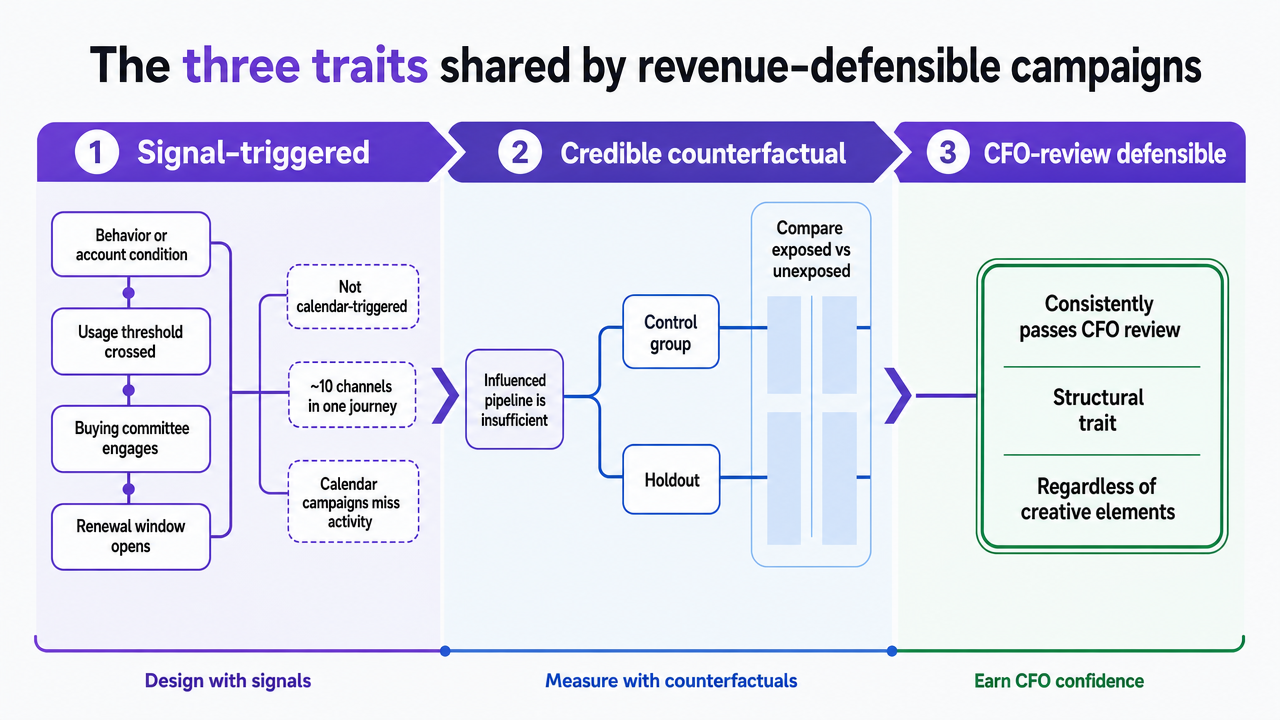 Visualize the three structural traits as a clear framework that supports the section's argument about what makes campaigns revenue-defensible
Test campaign tactics that deliver pipeline impact
Launch and measure your own campaigns to validate real pipeline results before committing long-term.
Nine campaign archetypes that hold up under CFO scrutiny
Account expansion play triggered by product usage signals
This archetype begins with an internal usage signal from an existing customer, such as a new admin seat provisioned, a feature adoption milestone, or a support ticket pattern indicating a workflow gap. This signal initiates a coordinated sequence—an in-product nudge, a customer marketing email, and an alert to the account team—all focused on a specific expansion offer.
The defensibility of this archetype lies in its measurement model. Expansion revenue is tracked for the triggered cohort and compared against a holdout group of similar accounts that did not receive the sequence. Win rate, deal size, and time-to-close are reported at the account level, not just the campaign level.
The focus on existing customers is strategic, as Forrester reports that 61% of B2B revenue originates from renewals and expansion, yet most personalization efforts target net-new acquisition 2. A signal-triggered expansion play reorients marketing efforts towards the primary source of revenue.
Expected outcomes typically include increased expansion ACV per account and improved renewal rates within the treated cohort, rather than just lead volume. Potential pitfalls include triggers firing on noisy signals, customer success teams engaging accounts prematurely, or sequences training buyers to ignore in-product messages. A clear signal hierarchy and a disciplined holdout approach are crucial for program integrity.
Incrementality-tested paid media program
An incrementality-tested paid program treats each channel as a hypothesis. Instead of relying on last-click conversions or platform-reported ROAS, the team employs geo holdouts, ghost bids, or audience-level treatment-and-control splits to isolate the actual lift generated by the channel. Reporting focuses on comparing treated and untreated cohorts based on revenue, not just clicks.
This rigorous approach is supported by research; a Carnegie Mellon randomized field experiment published in Management Science revealed that programmatic bidding and incentive structures can lead to reported outcomes that significantly diverge from true incremental value, with advertisers often paying for impressions and clicks that would have converted organically 1. This risk is prevalent in branded search, retargeting, and other channels where the audience already exhibits intent.
Demand-gen managers can implement this within a quarter by selecting the two highest-spend channels, designing a clear holdout (geo or audience-based), running it for a duration that covers the sales cycle, and then comparing incremental revenue per dollar spent. Channels that demonstrate positive incremental revenue receive more budget, while underperforming channels are reallocated.
The expected outcome is a more efficient distribution of paid spend, often increasing revenue without increasing the total budget. A common failure is impatience, ending the test before the sales cycle concludes or running it for too short a period to detect a clear lift signal above noise.
Personalization-at-scale campaign with revenue lift modeling
Personalization-at-scale campaigns customize offers, creative content, and timing for segments that are small enough to feel individual yet large enough for measurable impact. The measurement model involves pairing each personalized variant with a non-personalized control group within the same audience segment, then attributing revenue lift at the segment level.
McKinsey's cross-industry research quantifies the benefits: personalization typically drives a 10 to 15 percent revenue lift, with company-specific results ranging from 5 to 25 percent. Companies excelling at personalization generate 40 percent more revenue from these activities than average performers 6. This wide range underscores the importance of execution quality.
The counterweight to personalization is crucial. Forrester survey data indicates that not all personalization is valued equally by customers; poorly timed or irrelevant tailoring can be perceived as intrusive and reduce conversion rates 3. Campaigns that achieve higher lift combine behavioral signals with clear opt-out options and a relevance threshold. If insufficient signals exist for meaningful personalization, a strong generic variant is delivered instead.
A common failure mode is treating personalization as a creative exercise rather than a measurement one. Without segment-level controls, any reported lift is anecdotal, not a verifiable result. Demand gen managers need the control group as much as the personalized variant to defend budget allocations.
ABM motion built on account-level pipeline attribution
An Account-Based Marketing (ABM) motion that withstands audit reports at the account level, not the lead level. The target account list is established at the program's outset. Engagement, opportunity creation, win rate, and Average Contract Value (ACV) are tracked against this defined universe, with a matched comparison set of similar accounts not included in the program.
The triggers for these campaigns are account fit and buying-committee activity, rather than calendar timing. Sequences integrate paid media, email, direct mail, and sales outreach, all targeting the same account list, with data unified by account ID instead of contact email. This unification enables reporting on pipeline coverage and velocity within the target universe.
Academic case studies on B2B manufacturers demonstrate that firms adopting data-driven, account-focused marketing approaches achieved measurable improvements in sales conversion and overall revenue performance compared to generic outreach 10. The mechanism is straightforward: concentrating spend on accounts with verified fit increases win rates and ACV sufficiently to offset the higher cost per account.
Failure occurs when the target list is too extensive. ABM diluted across 2,000 accounts essentially becomes broad-based demand generation under a different name. Programs that report defensible lift typically maintain an active tier of under 200 accounts per sales representative cohort and provide weekly pipeline coverage reports against this fixed denominator.
Omnichannel orchestration tied to buyer journey signals
Omnichannel orchestration synchronizes email, paid media, web, sales outreach, and partner channels based on buyer journey signals, with a single decision layer determining the next-best action for each account or contact. The trigger is the buyer's journey stage, not a channel-specific calendar.
The rationale for this investment is rooted in contemporary buyer behavior. McKinsey's 2024 B2B Pulse found that B2B customers now use an average of ten interaction channels in a single buying journey, up from five in 2016, and online sales contribute 34 percent of revenue for organizations with e-commerce capabilities 4. Campaigns confined to a single channel reach a diminishing portion of the actual buyer journey.
Measurement is conducted at the account or contact level across all channels, rather than within each channel's individual dashboard. The decision layer records which action was taken, when, and in response to which signal, allowing the team to report revenue lift compared to a control cohort that received only standard channel cadences.
The primary operational challenge is data discipline. Orchestration cannot function effectively with inconsistent tagging schemes across systems. Programs that achieve credible revenue impact typically begin by standardizing campaign taxonomy and account IDs across their marketing stack before implementing cross-channel sequencing. Without this foundation, the failure mode is double-counted pipeline and confused attribution.
Hybrid sales-marketing campaign with shared account targets
Hybrid campaigns intentionally blur the lines between marketing-sourced and sales-sourced pipeline by providing both teams with the same account list, shared engagement data, and a unified revenue target. Marketing manages digital and content initiatives, while sales handles remote and in-person outreach. The campaign measures the combined pipeline contribution against the joint target list.
The revenue logic for this approach is well-established. McKinsey reports that hybrid sales models, which integrate in-person, remote, and digital interactions, can drive up to 50 percent more revenue than traditional field-only approaches. Remote representatives can also reach approximately four times as many accounts within the same timeframe 5. This expansion in account coverage creates opportunities for marketing-supported sequences to enhance, rather than cannibalize, sales efforts.
An effective campaign mechanic involves marketing running ungated content, paid air cover, and triggered emails against the account list, while sales conducts scheduled outbound activities and warm follow-ups with engaged prospects. Both teams report into a shared dashboard that tracks key metrics such as meetings booked, opportunities created, and ACV per account.
The classic alignment problem is a common failure mode: marketing claims influence on every deal, sales claims sole sourcing, and the CFO trusts neither. The solution is a clear, written sourcing rule agreed upon before the campaign begins, rather than negotiated after the quarter ends.
Post-sale lifecycle motion for renewal and expansion
The post-sale lifecycle motion operates continuously from contract signature through renewal, treating each customer as an ongoing campaign audience rather than a closed-won record. Triggers include onboarding milestones, usage drop-offs, changes in executive sponsors, and the opening of renewal windows.
Forrester highlights that B2B personalization often declines significantly after the sale, despite the majority of revenue residing in renewals and expansion 2. This disconnect is operational: acquisition teams manage the customer data model up to closed-won, then hand off to customer success teams using a separate tech stack. The lifecycle campaign aims to bridge this gap with shared data and content production.
Measurement is straightforward when properly configured: net revenue retention, gross retention, and expansion ACV by cohort, with treated cohorts compared against untreated baselines from the prior year or a matched holdout. Time-to-first-expansion serves as a valuable leading indicator to track weekly.
A common failure is treating lifecycle campaigns as mere newsletter cadences. A monthly customer email that arrives irrespective of account changes may show good engagement metrics but fail to impact revenue. Effective motions are triggered by account-level events and measured against the retention curve of accounts that did not receive the treatment.
Real-time decision-engine campaign for high-stakes offers
Real-time decision-engine campaigns utilize a centralized model to select the optimal message, offer, or channel for each contact based on current behavior, rather than a predefined sequence. These are particularly effective in high-stakes sectors like financial services, healthcare, and legal, where relevance and timing significantly influence conversion and the cost of an incorrect message is high.
McKinsey describes how leading personalization programs now execute "millions of micro-campaigns" annually, with decision engines selecting from a content library in real time across digital and human-assisted channels 9. The economic rationale is that incremental relevance at scale yields measurable conversion lift that fixed sequences cannot match.
This campaign archetype thrives when three conditions are met:
- a unified customer data record,
- a content library tagged for context, and
- a measurement framework that compares the decision-engine cohort against a fixed-rule control.
Without the control, the team is reporting engine outputs, not actual lift.
Failure modes often revolve around content supply. Decision engines become ineffective if the content library is too sparse to support meaningful variation, and they can overfit if optimized for short-term clicks rather than long-term revenue. Successful programs ensure the content investment aligns with the engine's variation requirements before deployment.
AI-orchestrated campaign layer as a decision tier across the other eight
The ninth archetype is not a campaign itself, but a decision layer that operates above the other eight. An AI-orchestrated layer processes signals across various channels, ranks the next-best action for each account or segment, and executes approved tasks using the appropriate archetype—whether it's an expansion sequence, an incrementality test, or a lifecycle trigger.
The Deloitte CMO Survey highlights increasing investment in marketing technology, analytics, and experimentation as CMOs seek to more directly link campaigns to business outcomes under heightened ROI scrutiny 11. This orchestration tier provides an operational solution to this pressure, centralizing decision logic that would otherwise be dispersed among channel managers.
The functional definition is more important than the vendor category. An orchestration layer proves its value when it can ingest live signals, rank potential actions by expected revenue impact, route all significant decisions for human approval, and log the result against the originating signal for future measurement. Anything less is merely workflow automation with an attached model.
A critical failure mode is bypassing the human approval step. Campaigns launched without human review accumulate small errors—incorrect offers, wrong segments, poor timing—which compound into measurement noise. The decision tier adds value precisely by ranking and explaining options; the human still provides the final sign-off.
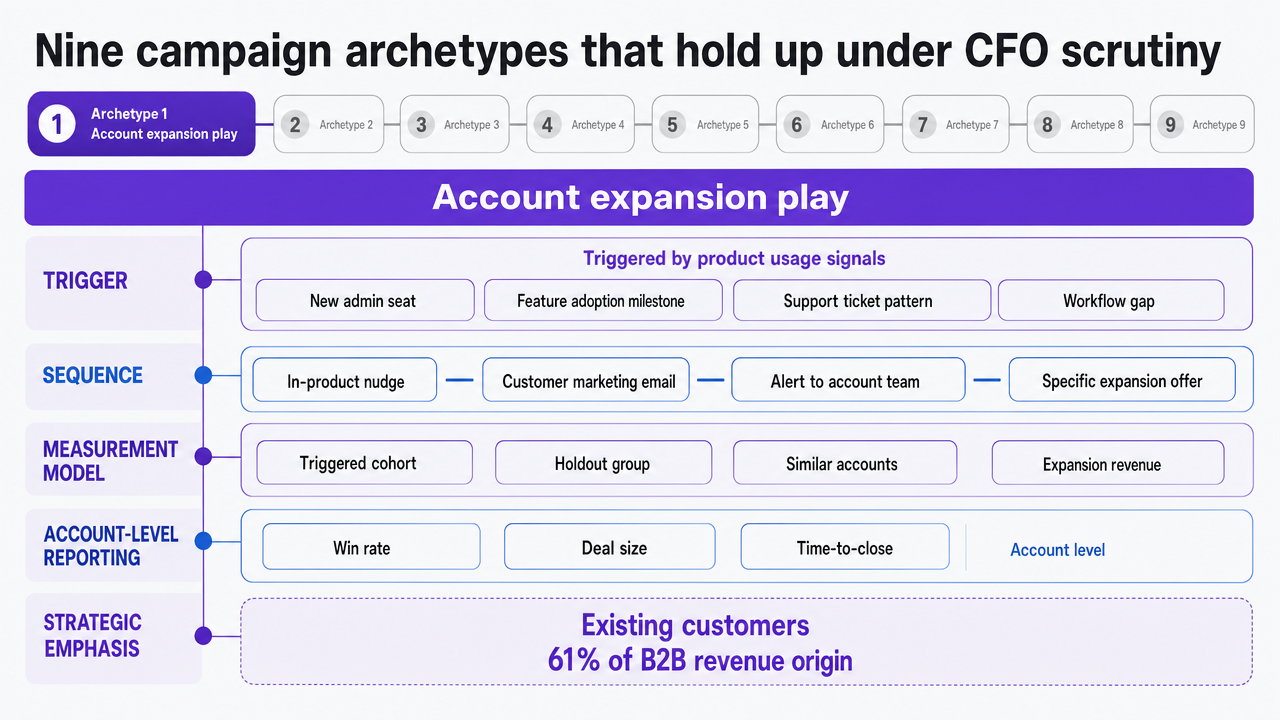 Provide a navigable visual index of the nine archetypes covered in this section, reinforcing the list structure with their triggers and measurement basis
Closing the measurement-credibility gap before the next QBR
The utility of these nine archetypes depends entirely on the underlying measurement framework. Forrester's finding that 64% of B2B marketing leaders distrust their own measurement is not a cultural issue, but an operational one that becomes apparent each quarter when revenue leaders question campaign effectiveness 8. Operations research suggests three key repairs to enhance credibility without requiring new tools.
Begin with taxonomy. Forrester's interviews with marketing operations leaders consistently identify campaign tagging, goal setting, and sales-marketing alignment as persistent failures undermining reliable revenue attribution 7. A demand gen team that dedicates two weeks to standardizing campaign IDs, source codes, and account identifiers across its tech stack will achieve greater reporting accuracy than any new dashboard could provide.
Next, define the counterfactual method for each archetype before the campaign launches—whether it's a holdout cohort, geo split, matched control, or pre/post analysis with a comparison segment. Document this in the campaign brief. A QBR discussion that starts with "here is the control group and here is the treated group" shifts the conversation from defending influence claims to discussing the magnitude of lift.
Finally, discontinue metrics that do not withstand scrutiny. Volume metrics with a weak link to revenue should not be central to reporting.
See How Leading Brands Execute Campaigns That Drive Measurable Pipeline
Request a private walkthrough of high-performing, multi-channel campaign workflows—complete with KPIs, attribution data, and cross-channel coordination insights tailored for agency and enterprise teams.
Reallocating budget toward the archetypes that pay back
Budget reallocation is the natural next step after measurement repair. Once holdout cohorts and account-level reporting are established, the subsequent quarter's planning conversation transforms. Spending shifts towards archetypes that demonstrate incremental revenue per dollar and away from those that only appeared successful due to the absence of a control group.
The Deloitte CMO Survey, which gathered insights from over 300 marketing leaders, describes this precise shift: a move towards disciplined experimentation, stricter ROI scrutiny, and reallocation of resources to digital, data, and AI-enabled programs as CMOs strive for growth with constrained budgets 11. Demand gen managers operating without additional headcount can implement two or three of these archetypes concurrently by centralizing decisions through a single orchestration layer, rather than staffing each channel independently. Platforms like Vectoron streamline this decision-making process into an approval-first workflow, enabling teams to scale execution without expanding the organizational chart.
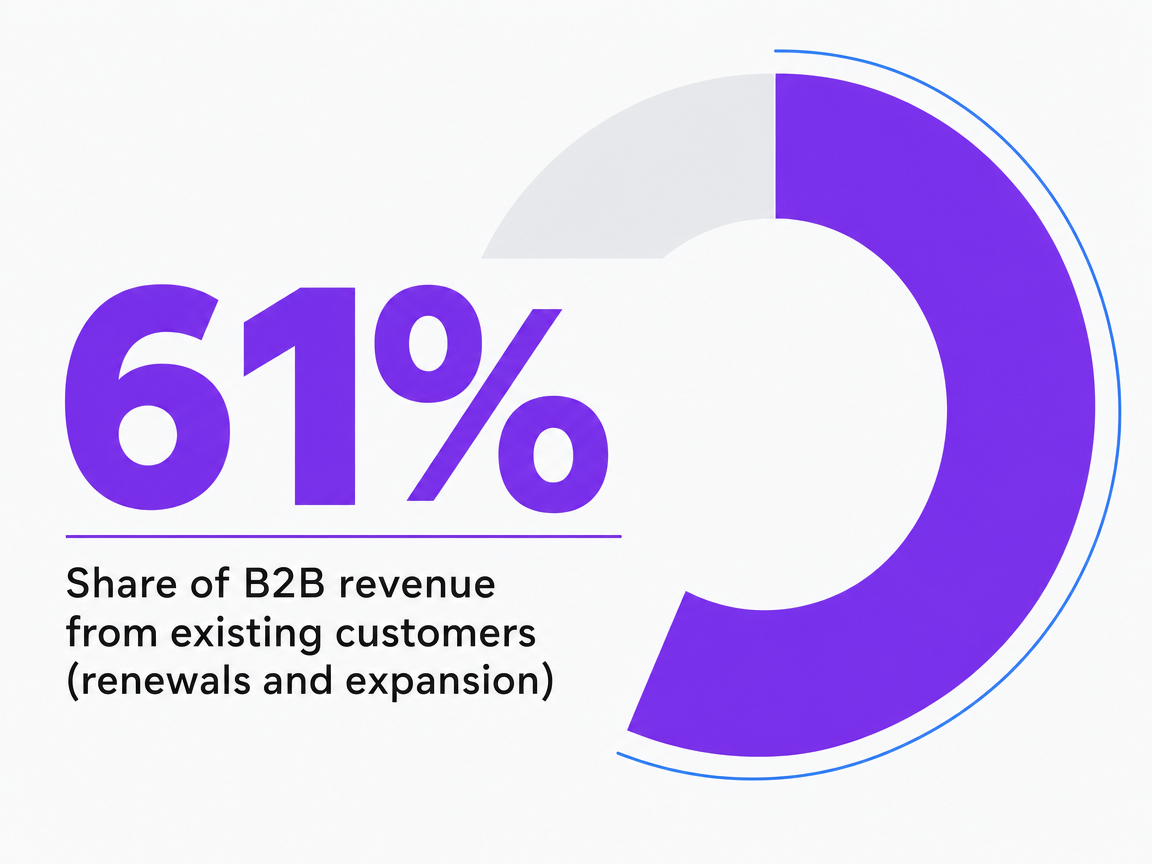 Share of B2B revenue from existing customers (renewals and expansion)
Share of B2B revenue from existing customers (renewals and expansion)
Frequently Asked Questions
References
- 1.Incentive Misalignments in Programmatic Advertising: Randomized Field Experiment.
- 2.New Contract, Who Dis? Why B2B Personalization Drops Off After The Sale And How To Fix It.
- 3.Consumers Don't Always Want The Personalization That You're Delivering.
- 4.Five fundamental truths: How B2B winners keep growing.
- 5.The future of B2B sales is hybrid.
- 6.The value of getting personalization right—or wrong—is multiplying.
- 7.Measuring Campaigns: Perspectives From Around the Table.
- 8.B2B Marketing Leaders Don't Trust Their Measurement.
- 9.Unlocking the next frontier of personalized marketing.
- 10.Strategy & Tactics to Improve Sales for B2B Manufacturing Firms.
- 11.2026 CMO Survey.