
Key Takeaways
- Channel sprawl breaks lean teams at the approval layer, not the channel layer — review capacity, not drafting or tool count, sets the real publishing ceiling.
- Measure the production-to-approval ratio first: most lean teams clear six to ten finished assets per reviewer weekly before consistency and voice begin to slip.
- Treat repurposing as a front-loaded production step where one brief produces the anchor and every derivative, so a single approval covers the full channel package.
- Defend the program with one weekly dashboard tracking conversions, email engagement, and website traffic 4— publishing cadence alone is not evidence of impact.
Why channel sprawl breaks small content teams
The expectation gap is the first thing that snaps. B2B buyers now move across an average of ten or more channels during a single purchase, and companies running hybrid omnichannel motions outperform single-channel peers on growth metrics 1. That buyer reality lands on a 2–6 person content team as a publishing mandate: search, email, social, web, video, and sales enablement, all kept current, all on brand, all measurable.
The mandate is not the problem. The math is. Lean teams treat each channel as its own production line — a blog cadence here, a LinkedIn calendar there, a monthly email, a quarterly video — and each line carries its own briefing, drafting, review, and publishing steps. Headcount stays flat. Channels multiply. Review queues stack up behind one or two approvers who also own strategy.
What breaks is rarely the channel itself. It is the seams between channels: the repurposing pass that never happens, the brand-voice drift that compounds across formats, the analytics that live in five dashboards no one consolidates. Content marketing produces three times the leads of outbound at 62% lower cost 2, but that efficiency only shows up when the production system can carry the volume without quality collapse.
The rest of this guide treats channel mix as a downstream output of an orchestration system, not a strategic choice made in isolation. The teams holding the line on quality at scale have stopped asking which channels to add and started asking how many finished pieces their approval surface can absorb in a week.
The production volume problem behind channel failure
Lean teams do not fail at multi-channel publishing because they pick the wrong networks. They fail because the unit volume required to keep every channel current outruns the people available to brief, edit, approve, and measure the work. The numbers from B2B content benchmarking make the squeeze concrete: 58% of B2B marketers name lack of resources as their top non-creation challenge, while 54% report struggling with content consistency and 54% with differentiating their content from competitors 4, 3.
Those three figures describe one operational condition, not three separate problems. Resource scarcity is the input constraint. Consistency erosion and differentiation drift are what the constraint produces once a 2–6 person team tries to feed search, email, social, web, and video on the same calendar. The first month, voice holds. By the third month, the LinkedIn posts read like the email subject lines, the blog drafts repeat the webinar deck, and the team cannot point to a single piece that a competitor could not have published.
Generative AI has not fixed this. It has shifted where the bottleneck sits. With 72% of B2B marketers already using generative AI 3and content teams reporting that rising volume across channels is now their top production challenge 5, the constraint has moved from drafting capacity to review capacity. More drafts arrive at the same two approvers who also own strategy, brand voice, and reporting.
The diagnosis matters because it determines the fix. If the problem were channel selection, the answer would be to cut channels. If the problem were tool stack, the answer would be consolidation. The actual problem is throughput at the approval layer — how many finished pieces can move past a single reviewer before consistency and differentiation collapse. That reframes the next decision: not which channel to add, but what production system can hold the line on voice and judgment while volume climbs.
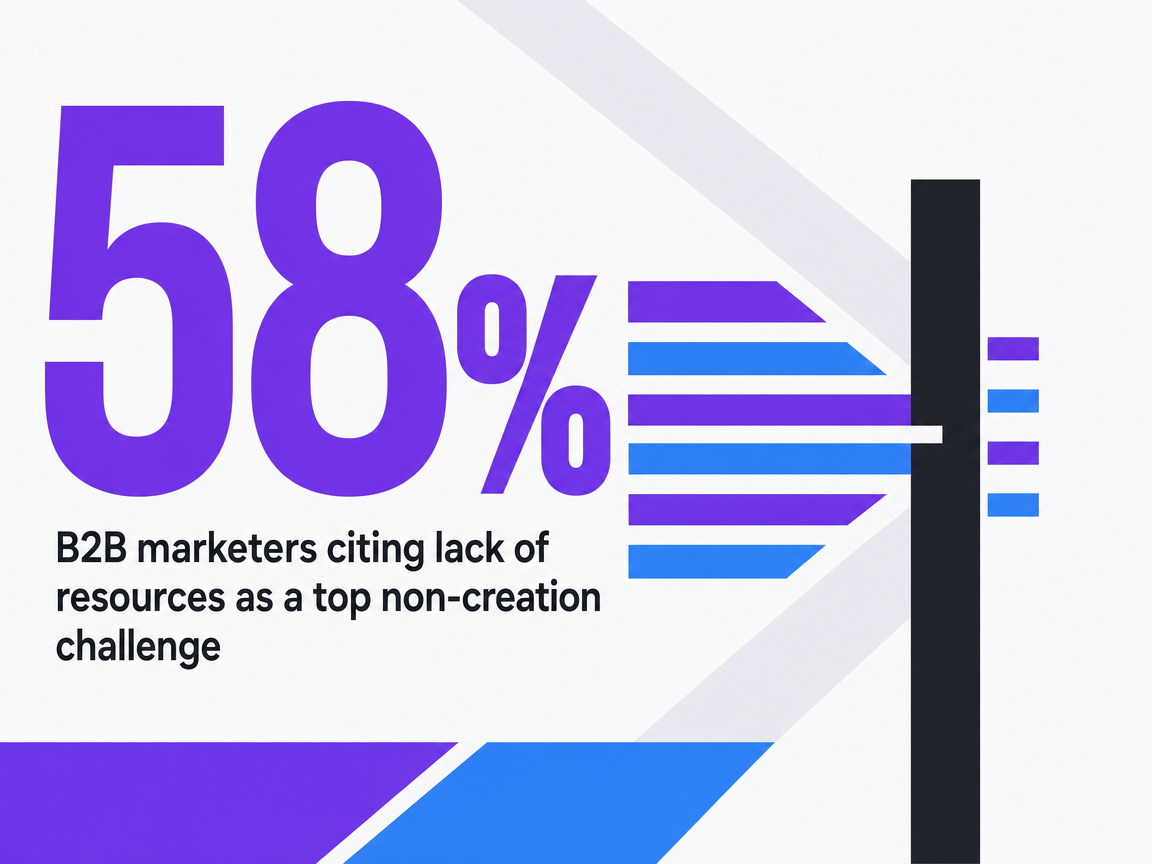 B2B marketers citing lack of resources as a top non-creation challenge
B2B marketers citing lack of resources as a top non-creation challenge
Orchestration over channel selection
The conventional advice tells lean teams to pick fewer channels. The data points the other direction. B2B buyers now move across roughly ten channels in a single purchase cycle, and the companies running hybrid omnichannel motions consistently outperform single-channel peers on growth 1. Cutting channels does not shrink the buyer's expectations. It only shrinks the surface area where a small team gets to show up.
The more useful move is to stop treating channels as parallel production lines and start treating them as outputs of a single orchestration layer. In an orchestrated model, one prioritized backlog feeds every channel. One brief produces a long-form anchor and the derivative cuts. One reviewer approves the package, not five drafts in five tools. Repurposing is a step inside production, not a Friday-afternoon scramble. Measurement runs back through the same surface, so the team can see which channel actually moved conversions instead of which channel hit its posting cadence.
This is the shift the marketing automation market is already pricing in. Average ROI on automation programs sits at $5.44 per $1 invested, and top-quartile programs reach $8.71, with the spread driven by integration depth rather than feature count 7. Agentic AI adoption inside marketing teams climbed from 15% in 2024 to 45% in 2026 — a trajectory that tracks orchestration, not point tools 7.
Channel mix becomes a downstream decision. The upstream decision is what the team's approval surface can carry, in what order, with judgment intact. Get that right and the channel question answers itself.
Building a single approval surface
The production-to-approval ratio
Every lean team has a number it has never measured: how many finished pieces of work can move through a single reviewer in a week before quality collapses. Call it the production-to-approval ratio. It is the ceiling that determines whether adding a channel produces results or just produces drafts.
The ratio matters because the constraint has moved. With 72% of B2B marketers using generative AI 3and first-draft time down 50–80% when AI is in the loop 6, drafting is no longer the chokepoint. Review is. A content director who could once edit four pieces a week now receives twelve, plus the social cuts, the email versions, and the video script. The drafts arrive faster than judgment can be applied to them.
Calculating the ratio is mechanical. Count the finished assets a single approver cleared last quarter — blog posts, emails, landing pages, social packages, video scripts — and divide by the working weeks. Most lean teams land between six and ten approved units per reviewer per week before consistency scores start to slip in audits. That number, not the editorial calendar, sets the publishing cadence.
Once the ratio is visible, the team can do something useful with it. Rank the backlog so the highest-leverage piece clears first. Bundle derivative formats with their anchor asset so one approval covers the package. Push lower-stakes work into a lighter review track. The decision in front of a lean team is not how many channels to chase — it is how to get more value past a fixed approval gate without overloading the person standing at it.
Governance for AI-drafted work
The governance gap is bigger than the adoption gap. While 72% of B2B marketers already use generative AI in their workflows, 61% report their organization has no guidelines for how it should be used 3. That is the operational risk hiding behind the productivity numbers: drafts moving through the system faster than the rules that decide what is allowed to ship.
For lean teams, governance is not a policy document. It is a set of approval rules wired into the production flow. Three rules carry most of the weight:
- Every AI-assisted draft is labeled at intake so the reviewer knows what they are reading and applies the right level of scrutiny.
- The briefing doc — not the prompt — carries the brand voice, the source material, and the claims the piece is allowed to make.
- Factual claims and statistics are checked against a named source before the asset enters the approval queue, not after publication.
This matters most in regulated work. Legal, healthcare, dental, and behavioral health teams cannot route an AI-drafted patient-facing page through the same gate as a top-of-funnel blog post. The governance model separates tracks: a fast lane for low-risk educational content, a controlled lane for anything making a clinical, financial, or legal claim, with the compliance reviewer added as a required approver on the second track.
The point of the framework is throughput, not paperwork. A reviewer who trusts what arrives in the queue clears more work. A reviewer who has to re-verify every line clears less. Written rules at the intake stage protect the production-to-approval ratio at the gate.
Test Multi-Channel Publishing With Real Campaigns
Experience streamlined content approvals and live multi-channel launches in a real-world environment, risk-free for seven days.
Repurposing as a production step, not a cleanup task
Most lean teams treat repurposing as something that happens after publication, if it happens at all. A blog post ships on Tuesday, and on Friday someone tries to carve a LinkedIn post out of it. The video version, if it exists, lags a quarter behind. That sequence is where the production-to-approval ratio breaks down: every derivative is a fresh ticket, a fresh brief, a fresh approval — for content that already cleared the gate once.
The fix is structural. The repurposing pass moves to the front of the production step, inside the same brief that produces the anchor asset. One brief specifies the long-form piece, the email cut, the social package, the short video script, and the sales-enablement one-pager. AI handles the format conversion drafts — and this is where the time math actually works. Teams using AI for content creation cut first-draft production time by 50–80% 6. That compression matters most when it is applied to derivative formats, where the source material is already approved and the AI is rewriting for length and channel, not generating claims from scratch.
Video is the format that forces the issue. With 69% of B2B marketers now investing in video content 11, the channel cannot be treated as a separate production line staffed by a separate vendor on a separate calendar. In manufacturing content programs, 74% of marketers rate video as their most effective format 12— a sector-specific signal, but one that points to where lean teams are losing reach when their video pipeline runs three months behind their blog pipeline.
Built-in repurposing also enforces consistency without adding review cycles. When the LinkedIn post, the email, and the video script all derive from one approved brief, voice drift shrinks at the source rather than getting policed at the gate. The reviewer is not reading five unrelated drafts — they are approving one package. That is what lets a 2–6 person team show up across search, email, social, and video on the same week, with the same argument, in the same voice.
Measuring what the added channel surface is worth
A multi-channel program is worth what the dashboard can prove. The B2B benchmark data makes the answer concrete: marketers rank conversions (73%), email engagement (71%), and website traffic (71%) as the top three metrics they use to assess content performance 4. Those three numbers should sit on a single page that a lean team reviews every week.
Conversions are the anchor. A blog post, a LinkedIn carousel, and a short video are not separate programs to be measured separately — they are entry points to the same funnel. The useful question is which channel carried the visitor who became a lead, and which channel touched that visitor before the conversion. Last-touch attribution is the floor. First-touch and assisted-touch views are the lift, and they are what tell a small team which channel to keep funding and which to cut.
Email engagement is the channel-quality signal that surfaces voice drift before conversions do. Open and click rates decline weeks ahead of pipeline metrics when the brand voice has fragmented across formats. A lean team that watches email engagement as a leading indicator catches consistency problems while there is still time to tighten the brief.
Website traffic is the demand-capture read. Segmented by channel source, it shows whether the repurposing pass actually expanded reach or just moved the same audience between properties. Traffic that grows on social while organic search flatlines is not a multi-channel win — it is the same readers, counted twice.
The dashboard discipline is what separates publishing cadence from publishing impact. A lean team that publishes to six channels and reports on six different metrics has six anecdotes. A team that publishes to six channels and reports conversions, email engagement, and traffic on one page has a system it can defend to the CFO.
The business case for centralized orchestration
The cost of running multi-channel publishing through fragmented tools is not the license fees. It is the throughput that never materializes. Marketing automation programs return an average of $5.44 for every $1 invested, while top-quartile programs reach $8.71 — and the spread is driven by integration depth, not feature count 7. The teams pulling top-quartile returns are not the ones with the most tools. They are the ones whose tools share a backlog, an approval queue, and a measurement layer.
That gap matters for a lean team because the alternative — a CMS in one tab, a social scheduler in another, an email platform in a third, and a reporting dashboard rebuilt by hand on Mondays — taxes the same two approvers who already cap the production-to-approval ratio. Every context switch is a small deduction from review capacity. The orchestration argument is not about elegance. It is about preserving reviewer attention for the work only humans can do: voice, judgment, prioritization.
The market is moving in that direction quickly. Marketing teams running at least one agentic AI system for automation tasks climbed from 15% in 2024 to 45% in 2026 7. That trajectory is not about replacing strategists. It is about consolidating the routing, drafting, repurposing, and measurement work that used to live across five vendors into one governed surface where a small team can actually see the queue.
The business case writes itself in two lines on a finance memo. A lean team can either add headcount to absorb channel growth, or it can compress the steps between brief and publish so the existing team clears more approved work per week. The second path is what the ROI data is measuring. Vectoron is one example of the orchestration category built around that math — ranked recommendations, a single approval gate, execution across channels — and the broader category is where the next round of marketing budget is going.
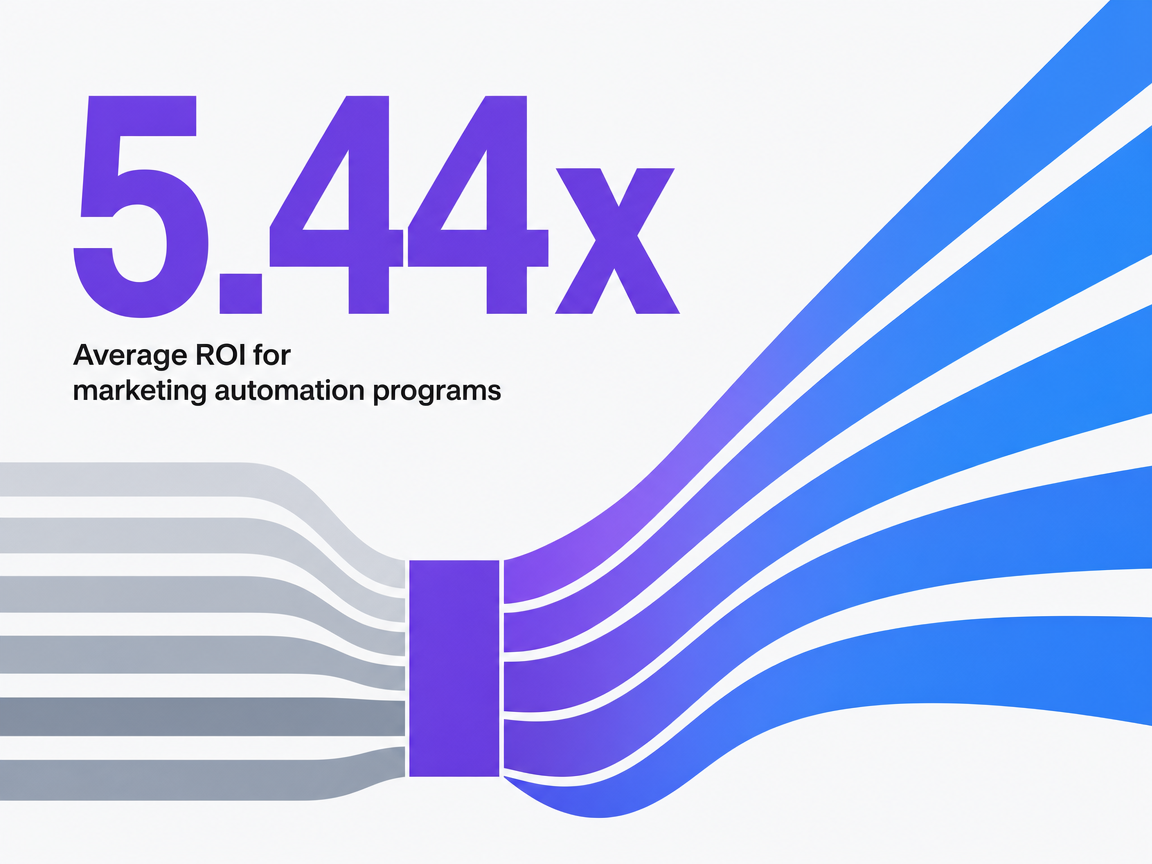 Average ROI for marketing automation programs
Average ROI for marketing automation programs
Centralize Multi-Channel Publishing Without Expanding Your Team
See how enterprise marketing teams and agencies are accelerating content output and maintaining oversight with a single approval workflow for all channels—no extra headcount required.
If you manage multiple locations: a portfolio economics view
Audience shift: the next few paragraphs are written for operators running a portfolio — DSO leadership, multi-site behavioral health, home services franchises, multi-location law firms, senior living groups. Single-location managers can skip to the next section.
Portfolio operators carry a math problem that single-location teams do not. Every channel a lean corporate team adds gets multiplied by the location count: a blog cadence becomes a blog cadence times forty sites, an email program becomes localized sends across every market, a social calendar becomes a network of location pages that each need their own posts. The B2B benchmark on resource scarcity (58% citing it as the top non-creation challenge) 4understates the squeeze at portfolio scale, where the same two corporate approvers sit behind every location's queue.
The orchestration economics are directional, not exact. Finance owns the inputs — retainer spend, in-house salaries, per-location agency fees — and operations owns the leverage variables. The table below frames the comparison using only sourced numbers and explicit variables, so a CFO and a marketing lead can fill in the rest.
| Variable | Source or input | Portfolio effect |
|---|---|---|
| Average marketing automation ROI | $5.44 per $1 invested 7 | Baseline return on a connected stack across sites |
| Top-quartile automation ROI | $8.71 per $1 invested 7 | Achievable when integration depth replaces tool sprawl |
| First-draft time reduction with AI | 50–80% 6 | Applied per location, compounds across the portfolio |
| Pieces published per location per month | Operator input | Multiplier on every step above |
| Current per-location agency or content spend | Finance input | The number orchestration is being compared against |
The point of the table is not to produce a single ROI figure. It is to show where the leverage sits. A portfolio that runs forty locations through forty parallel briefing cycles loses the ROI spread between average and top-quartile programs at every site. Consolidating the backlog, the approval surface, and the measurement layer is what closes that gap — and it is the only path that does not require scaling corporate headcount in step with location count.
A sector lens: compliance review as a publishing bottleneck
In legal, healthcare, dental, behavioral health, and senior living, the slowest step in multi-channel publishing is rarely the writing. It is the compliance pass. A blog post about a clinical service, an email promoting a new intake workflow, or a social ad for a legal practice area each carries claim-substantiation rules that a marketing reviewer is not licensed to clear. The asset sits in a queue waiting for a second approver who is also seeing patients, taking depositions, or running operations.
That queue is where the production-to-approval ratio collapses fastest. With 58% of B2B marketers already citing lack of resources as the top non-creation challenge 4, adding a compliance reviewer to every asset turns a six-piece-per-week ceiling into three. The volume pressure does not ease — 72% of B2B marketers are now using generative AI 3, and content teams report rising channel demands as their top production challenge 5— but the gate narrows.
The operational fix is to split the queue by claim risk, not by channel. Educational content that names no treatment, outcome, or legal result moves through a single marketing approval. Anything making a clinical, financial, or legal claim routes to a dedicated compliance lane with the licensed reviewer named at intake and the source documentation attached to the brief. Repurposed derivatives inherit the parent asset's clearance when the claims do not change — a rule that prevents the compliance reviewer from approving the same statement four times across blog, email, social, and video.
The result is not faster review. It is fewer reviews per published unit, which is what actually moves a regulated lean team's output.
Where to start this quarter
- Measure the production-to-approval ratio for the past quarter. Count finished assets cleared by each approver, divide by working weeks, and write the number down. That figure is the cadence the team can actually support — every channel decision that follows has to fit underneath it.
- Consolidate the brief. One brief should produce the anchor asset, the email cut, the social package, and the short video script, with derivatives inheriting the parent's approval when claims do not change. This is where the 50–80% first-draft compression from AI converts into throughput instead of more drafts in the queue 6.
- Build the dashboard. One page, three metrics — conversions, email engagement, website traffic — reviewed weekly 4. Anything else is reporting theater.
Teams ready to compress the steps between brief and publish can evaluate orchestration platforms like Vectoron, where ranked recommendations route through a single approval gate before execution across channels.
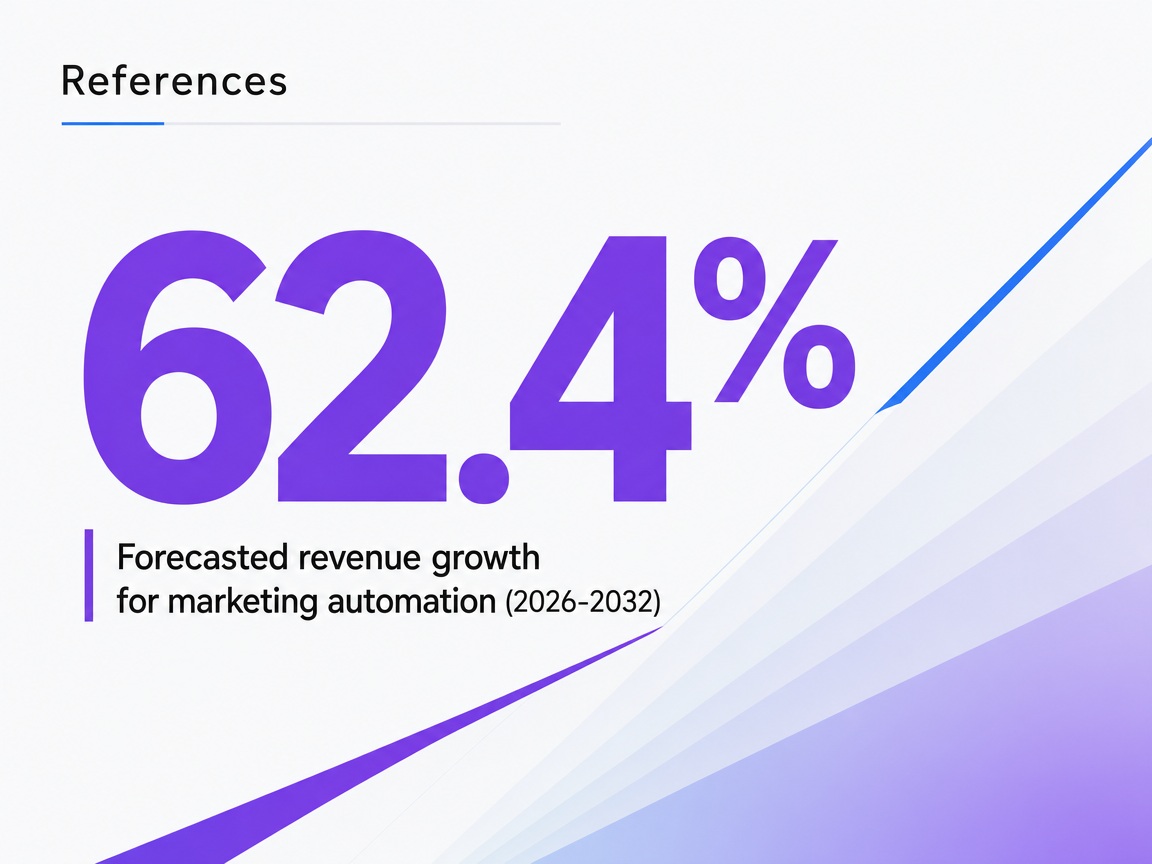 Forecasted revenue growth for marketing automation (2026-2032)
Forecasted revenue growth for marketing automation (2026-2032)
Frequently Asked Questions
References
- 1.B2B sales: Omnichannel everywhere, every time.
- 2.2026 Content Marketing Statistics: Key Data to Shape Your Strategy.
- 3.B2B Content Marketing Benchmarks, Budgets, and Trends: Outlook for 2024.
- 4.B2B Content Marketing Benchmarks, Budgets, and Trends: Outlook 2024.
- 5.The Top Production Challenges Facing Content Teams.
- 6.True Marketing Efficiency For Small (But Mighty) Marketing Teams.
- 7.Marketing Automation Statistics 2026: 130+ Key Metrics.
- 8.Marketing Automation Statistics and Facts (2026).
- 9.15 Key Marketing Automation Statistics for 2026.
- 10.10 content marketing challenges and how to overcome them.
- 11.B2B Marketing Statistics & Emerging Trends.
- 12.Manufacturing Content Marketing Benchmarks, Budgets, and Trends.