
Key Takeaways
- Platform updates now reweight three distinct layers—recommendation, ranking, and ad targeting—each moving a different part of the funnel, so a single reach number hides where audience composition actually shifted 6.
- Concentration on YouTube and Facebook, used by 84% and 71% of U.S. adults respectively, means a ranking change on either dominant platform can move quarterly pipeline before any creative decision is made 4.
- Engagement-optimized reach and intent-aligned reach behave as separate assets; when impressions climb while qualified calls, bookings, or branded search stay flat, the update has redirected exposure into a lower-intent segment 7.
- Marketing leaders should track qualified calls, booked appointments, cost per lead by platform, and branded search lift, and hold new formats behind pilot approval gates tied to downstream signals rather than platform dashboards 1.
Ranking Changes Now Move Pipeline, Not Just Reach
Social platforms have quietly become pipeline infrastructure for service businesses, and every ranking update now touches downstream metrics that show up on a marketing VP's dashboard. The FTC's 2024 staff report on the largest platforms found that recommendation, search, and ad-targeting systems all sit on top of the same engagement-driven business model, and that platforms' own monitoring of those systems has been inconsistent 1. When the ranking logic shifts, the audience composition shifts with it, and the qualified-call and booking curves that lean marketing teams depend on start to drift within days.
The old framing treated algorithm updates as a distribution question: reach went up, reach went down, adjust the posting cadence. That framing no longer holds. Recommendation systems are engineered to maximize engagement and time on platform 6, which means the users a brand reaches after an update may not be the users a brand reached before one, even when raw impressions look flat. For regulated verticals with narrow buyer intent — a personal-injury inquiry, a same-week dental booking, a memory-care tour request — a change in audience mix is a change in pipeline quality.
Treating ranking changes as a governance problem, rather than a creative-tactics problem, is what separates predictable organic pipeline from reactive posting. The rest of this analysis lays out what platforms actually change, where the concentration risk sits, and which pipeline signals register a shift first.
What Platforms Actually Change When They Update an Algorithm
Platform announcements tend to lump every ranking tweak under a single label, which obscures what actually moves. Three distinct systems sit inside every major feed, and an update usually touches one or two of them at a time:
- the recommendation layer that surfaces content from accounts a user does not follow,
- the ranking layer that orders content from accounts a user already follows, and
- the ad-targeting layer that decides which paid impressions get matched to which inferred audience segments 6.
Each layer feeds a different part of the pipeline. Recommendation drives cold discovery. Ranking drives repeat exposure and retention among a warm audience. Ad targeting sets the cost floor for paid amplification of organic content.
The common thread across all three layers is optimization for engagement and time on platform 6. When a platform announces a change to "video recommendations" or "feed quality," the underlying adjustment is almost always a reweighting of the engagement signals the system already uses — dwell time, completion rate, reshare velocity, comment depth — not a wholesale replacement of the model. The FTC's 2024 review of the largest platforms confirmed that recommendation, search, and advertising share the same data substrate and the same commercial incentive, and that internal monitoring of downstream effects has been inconsistent across companies 1. That inconsistency is why the same update can produce different reach outcomes for two brands in the same vertical during the same week.
For a marketing team, the practical implication is that an update to any one layer changes which audience segment sees which content, at what cost, and with what quality of attention — even when the total impression count on a dashboard looks stable. A recommendation-layer change can flood the top of the funnel with unqualified discovery traffic while ranking-layer changes quietly suppress repeat exposure to existing followers. Reading a single reach number without decomposing it across these three layers is the fastest way to misdiagnose a pipeline shift as a creative problem.
Concentration Risk: Why a Handful of Platforms Dictate Pipeline Volatility
Reach in the United States is not spread evenly across a dozen apps. It sits on two. Pew's 2025 platform report finds that 84% of U.S. adults have ever used YouTube and 71% have ever used Facebook, well ahead of every other major service in the survey 4. For a lean in-house team pushing organic content into service-buyer audiences, that concentration is the single most important input to pipeline risk modeling. Two ranking systems, controlled by two companies, sit upstream of the majority of addressable adult attention.
Concentration cuts both ways. It makes distribution planning simpler, because a two- or three-platform focus captures most of the reachable market without diluting production capacity across marginal channels 17. It also means a ranking change on either dominant platform can move a disproportionate share of organic pipeline within a single quarter. When YouTube reweights watch-time signals or Facebook adjusts what counts as a meaningful interaction in the ranking layer, the exposure surface for a home-services franchise or a multi-office dental group narrows or expands before any creative decision has been made.
The concentration risk is compounded by the fact that recommendation, ranking, and ad targeting on both platforms share the same engagement-driven substrate that the FTC flagged as inconsistently monitored across the largest services 1. A brand that has built its qualified-call flow around one dominant platform carries single-point-of-failure risk on both the reach side and the audience-composition side. If the ranking logic drifts toward content types the brand does not produce — long-form video over static posts, native short video over link-outs — the reach loss is not recoverable by posting harder.
The governance action is straightforward and unglamorous. Marketing leaders should hold a documented view of what share of organic pipeline each dominant platform contributes, refreshed against qualified-call and booking data rather than impressions. When that share crosses a threshold the team has set in advance — commonly a majority of sourced inquiries from one platform — the next quarter's content plan should fund a secondary platform to the point where a ranking shock on the primary one does not collapse lead flow below plan.
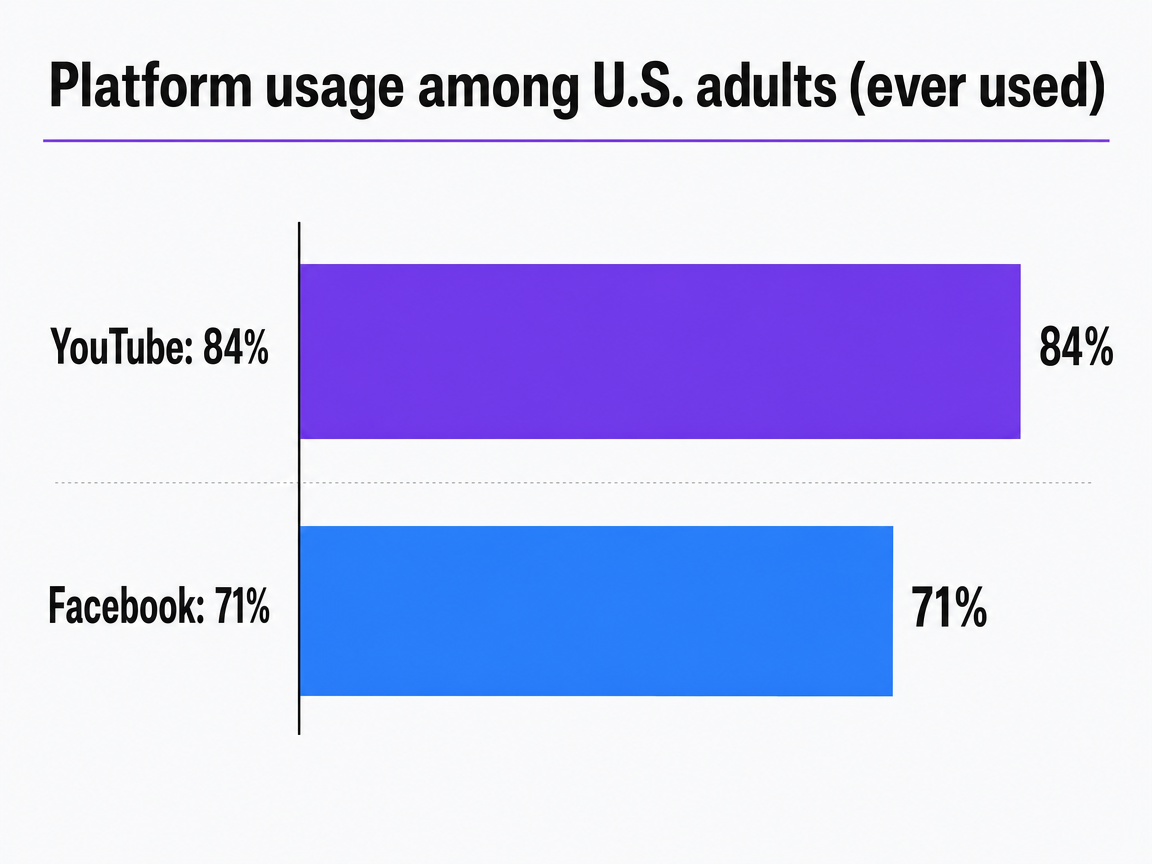 Platform usage among U.S. adults (ever used)
Comparison of the percentage of U.S. adults who have ever used YouTube versus Facebook, according to a 2025 Pew report.
Engagement-Optimized Reach Is Not Intent-Aligned Reach
Impression counts flatter the wrong side of the funnel. A peer-reviewed 2025 audit of Twitter's and TikTok's ranking systems found that engagement-optimized ranking on Twitter amplified divisive content well beyond what users, when asked directly, said they preferred to see 7. The gap between what a ranking model rewards and what an audience says it wants is not a rounding error. It is the mechanism by which raw reach and qualified pipeline drift apart.
For a marketing team feeding organic content into service-buyer audiences, that gap has a specific operational cost. Recommendation systems are built to maximize engagement and time on platform 6, and the FTC's 2024 review documented that platforms have not consistently monitored the downstream effects of that optimization 1. Impressions can rise on a piece of content because it triggered scroll-halting reactions in an audience segment that will never book a memory-care tour, sign an intake form, or schedule a same-week dental visit. The dashboard says the update helped. The intake queue says otherwise.
Business-outcomes research on social media marketing reinforces the point from the conversion side: algorithm-boosted engagement translates into measurable performance only when it is mediated by platform trust, perceived value, and credible support around the brand 13. Reach without those mediators is a vanity input. Reach through content that a ranking model amplified for divisiveness is worse than a vanity input, because it also imports brand-adjacency risk into audiences that a regulated service business would not knowingly buy against.
The practical read for a VP running organic pipeline is to treat two reach numbers as different assets:
Engagement-optimized reach : The number a platform surfaces by default: impressions, watch time, interaction rate.
Intent-aligned reach : The subset of that reach that lands on audience segments the ranking system has correctly matched to the buyer profile, measurable only through downstream signals — qualified calls sourced from social, booked appointments, and cost per lead by platform.
When those two numbers move together after a ranking update, the change is neutral or positive. When engagement metrics climb while qualified inquiries flatten or decline, the update has redirected reach into a segment that does not convert, and the correct response is to pull production away from the format the update rewarded rather than double down on it.
This is where governance replaces reflex. A content team optimizing to the surfaced engagement number will follow the ranking model into whichever audience it prefers this quarter. A team measuring intent-aligned reach will hold creative decisions to the downstream signal, approve or pause formats based on qualified-call attribution, and accept a lower impression ceiling when the alternative is importing a lower-quality audience into the top of the funnel.
Test real social content against new algorithms
See how your pipeline responds to the latest social algorithm changes with live content during your trial.
The Pipeline Signals That Actually Register an Algorithm Shift
Impressions are the last place a ranking change registers cleanly, and the first place a marketing dashboard misreads it. Downstream pipeline signals move earlier and more honestly. Four of them, tracked together, give a lean team a reliable read on whether a platform update is helping or hurting:
- qualified calls sourced from social,
- booked appointments attributed to the same source,
- cost per lead by platform, and
- branded search lift in the seven to fourteen days after an organic exposure window.
Qualified calls move first because they compress every upstream shift into a single yes/no signal. A recommendation-layer reweighting that pushes a home-services brand's short video into a broader discovery audience will show up as a higher raw call volume with a lower qualified rate before it shows up anywhere in the platform's own analytics. The FTC's 2024 review documented that platforms have not consistently monitored those downstream effects 1, which means the marketing team's own call-scoring log is often the earliest reliable read on an audience-composition change.
Booked appointments lag calls by the intake team's response window, usually two to five business days. That lag is useful. It filters out the noise from a one-day spike in engagement-optimized reach and confirms whether the new audience segment actually converts. When booked appointments diverge from qualified calls after a ranking update — calls hold, bookings fall — the audience the update surfaced is willing to inquire but not to commit, which is a signal to pause the format the update rewarded rather than scale it.
Cost per lead by platform is the accountant's version of the same read. Recommendation systems are engineered to maximize engagement and time on platform 6, and when a ranking change matches organic content to a lower-intent segment, paid amplification of that same content runs into a higher CPL almost immediately because the ad-targeting layer inherits the shifted audience signals. A rising CPL on a platform where organic impressions are also rising is the clearest early indicator that engagement-optimized reach has decoupled from intent-aligned reach.
Branded search lift is the outside check. A ranking change that surfaces a brand to the right audience produces a measurable bump in branded queries within two weeks; a change that surfaces the brand to a lower-intent audience produces impressions without search follow-through. Business-outcomes research on social media marketing confirms the mechanism: engagement translates into performance when it is mediated by trust and perceived value 13, and branded search is the cheapest available proxy for both.
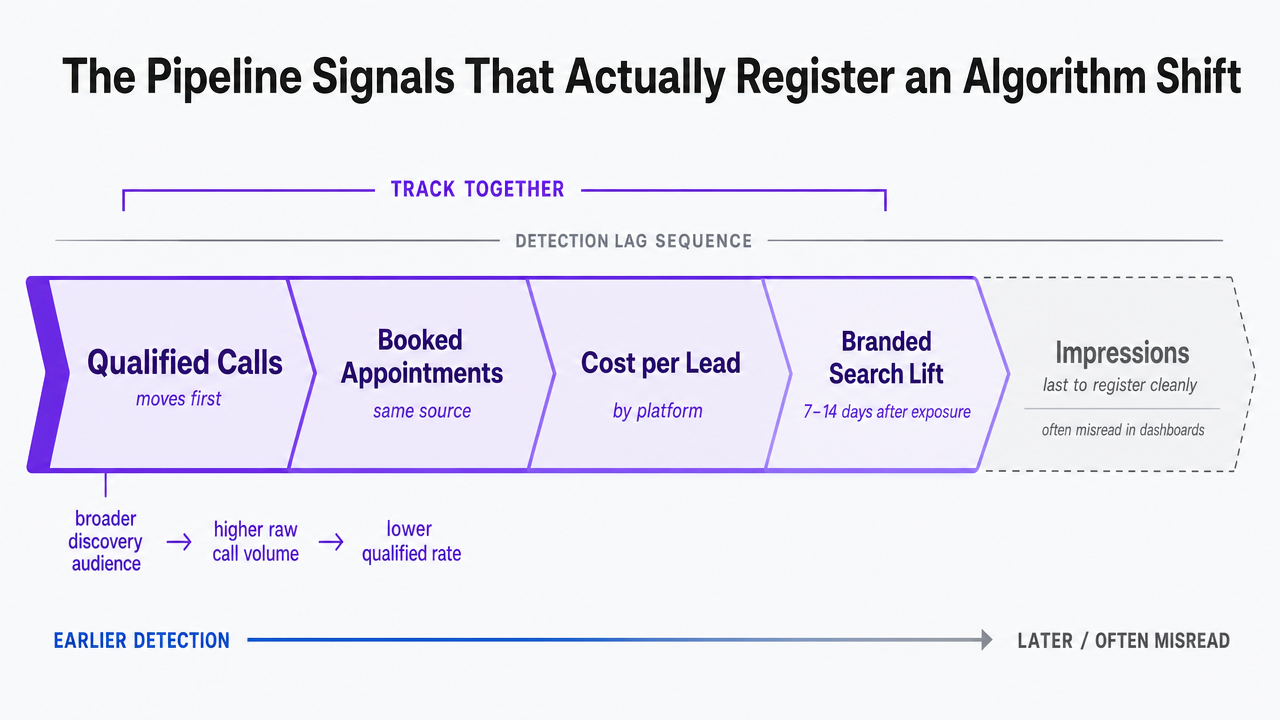 Visualize the four downstream pipeline signals and their detection lag sequence described in the section, since the section explains a governance workflow rather than chartable statistics
Thought Leadership and Branded News Distribution Under Ranking Drift
Ranking changes do not stop at consumer content. About half of U.S. adults get news from social platforms at least sometimes, with Facebook and YouTube leading regular news use 5. That means the executive bylines, case-study announcements, and category-defining posts a marketing team publishes to build authority are competing for the same ranking slots as general news, and they move with the same signals.
When a platform reweights toward native short video or downgrades outbound links, a well-argued long-form post from a general counsel or a clinical director can lose reach in a week without a single word of the content changing. The gatekeeping effect is not neutral distribution; algorithmic curation actively shapes which brand narratives prospective clients encounter 15. A ranking drift that suppresses link-outs during a category launch quietly caps the audience for the pieces meant to drive branded search and consultation requests.
The governance action is to separate thought leadership from campaign content in the measurement stack. Track its reach and engagement against branded search lift and direct-source consultation forms rather than platform-native engagement metrics, and hold the publishing format loose enough to shift between native video, static, and off-platform links as ranking signals move.
If You Manage Multiple Locations: How Volatility Compounds Across a Portfolio
Signal-to-Governance Table for Multi-Location Operators
The scope shifts here from single-brand marketing teams to operators running content and pipeline across a portfolio: DSOs with dozens of practices, home-services franchises with regional territories, senior-living groups with community-level intake teams, and multi-office law firms with location-specific practice areas. For these organizations, a single algorithm update does not produce a single reach outcome. It produces a distribution of outcomes across branches, and the variance itself is the problem.
A ranking-layer change on a dominant platform can lift qualified-call volume at one location while suppressing it at another in the same week, because each branch's follower composition, content mix, and local audience density interact differently with the reweighted signals. The FTC's 2024 review documented that internal monitoring of these downstream effects has been inconsistent across the largest platforms 1, which means portfolio operators cannot rely on platform-side attribution to explain branch-level divergence. The governance layer has to sit inside the operator.
The table below maps the pipeline signals that matter most for portfolio operators to what algorithm changes typically move them, how quickly the signal registers, and the governance action a marketing leader should take when it does.
| Pipeline Signal | What Algorithm Changes Typically Move It | Detection Lag | Governance Action |
|---|---|---|---|
| Qualified calls sourced from social, per location | Recommendation-layer reweighting toward broader discovery audiences 6 | 3–7 days | Compare qualified rate across branches; flag locations where raw calls rise but qualified rate falls |
| Booked appointments attributed to social, per location | Ranking-layer shifts that change audience composition among warm followers | 5–10 business days | Pause the format the update rewarded at branches where bookings diverge from calls |
| Cost per lead by platform, per location | Ad-targeting layer inheriting shifted engagement signals 1 | 7–14 days | Cap paid amplification at branches where CPL rises alongside organic impressions |
| Branded search lift in the 7–14 day window after exposure | Whether reach landed on intent-aligned segments mediated by trust and perceived value 13 | 10–14 days | Treat as the outside check; reallocate production to formats that move branded search across the portfolio, not just a top-performing branch |
Detection Lag and Approval Gates Across Branches
The lag between an algorithm update and its appearance in branch-level pipeline data is where portfolio operators lose the most ground. Qualified calls register a shift in three to seven days at the fastest-moving locations, but the same shift can take two weeks to show up at a branch with lower baseline call volume, and by then the format the update rewarded has already been scaled across the network.
Approval gates are the countermeasure. Portfolio operators should hold new content formats behind a two-branch pilot for a full detection cycle — roughly ten business days — before rolling the format to the rest of the network. The pilot branches should be selected for high baseline signal density, not for representativeness, because the goal is early detection, not statistical inference. Approval to scale should require the pilot's qualified-call rate and branded search lift to move together, not just impressions.
This is also where transparency limits matter. Peer-reviewed work on recommendation systems notes that auditability of ranking logic remains technically possible but not standardized at scale 8. Portfolio operators cannot wait for platform disclosure. The approval gate has to run on the operator's own signal log, refreshed weekly, with a documented threshold for pausing a format the algorithm has begun to reward at the expense of intent-aligned reach.
See How Algorithm Shifts Impact Your Lead Pipeline—With Full Visibility and Control
Connect with a strategist to review your current pipeline exposure to social algorithm changes and discover data-backed solutions for maintaining conversion consistency across all channels.
Regulated Verticals: Legal, Behavioral Health, Dental, Home Services, Senior Living, Healthcare
Engagement-optimized ranking creates a specific compliance exposure for regulated service categories that a general consumer brand does not carry. The peer-reviewed audit of Twitter's and TikTok's ranking systems found that engagement-based optimization amplified divisive content well beyond what users said they wanted to see 7. For a personal-injury firm, a behavioral-health provider, or a senior-living operator, the risk is not that a divisive post goes viral. The risk is that the ranking model surfaces the brand's compliant content next to divisive adjacent content in a feed the platform assembled for engagement, importing brand-adjacency exposure the marketing team never approved.
Healthcare and behavioral-health marketing carry an additional constraint. A systematic review of social media use for health purposes found that institutions rely on these platforms for information dissemination and intervention, but that accuracy and compliance requirements limit the formats that can be published without review 18. When a ranking update rewards short native video with informal captions, the format the algorithm prefers is often the format a HIPAA-aware compliance team cannot approve without added workflow. Reach loss during a ranking shift is not always a creative failure; it can be the correct outcome of holding the line on substantiation and privacy.
Legal, dental, and senior-living marketing sit in a similar bind. State bar rules, ADA advertising guidance, and senior-living disclosure requirements all constrain claims, testimonials, and comparative language in ways the ranking layer does not recognize. The FTC's 2024 review documented that platforms have not consistently monitored the downstream effects of their own recommendation and ad-targeting systems 1, which means a regulated advertiser cannot outsource brand-safety judgment to the platform's default settings.
The governance action for these verticals is to run a pre-publication review that treats algorithmic amplification as a foreseeable outcome, not an edge case. Content that would be compliant at baseline reach should also be compliant if the ranking layer multiplies its exposure tenfold into an audience segment the team did not target. Home-services operators face a lighter compliance load but the same audience-composition risk: a lead-gen video that converts at one intent segment can produce complaint-driving inquiries when the recommendation layer routes it into another.
The Regulatory Trajectory VPs Should Plan Around
The regulatory ground under recommendation systems is moving from advisory to enforceable, and marketing leaders who plan a two-year horizon should assume ranking logic will be audited by parties other than the platforms themselves. The Harvard STRIPED roadmap synthesizes public-health, neuroscience, and legal evidence to argue that engagement-based algorithms warrant independent risk audits, and it provides model state legislation to require them, with the Social Media Algorithm Accountability Act as a reference framework 12. The FTC's 2024 staff report reached a compatible conclusion from the federal side: platform self-monitoring of recommendation, search, and ad-targeting effects has been inconsistent, and the commercial incentive to optimize for engagement has outpaced internal oversight 1.
Two implications follow for a marketing VP. First, disclosure and audit requirements will likely reach the ad-targeting layer before the recommendation layer, which means paid amplification of organic content is the near-term compliance surface. Second, ranking transparency remains technically feasible but not standardized 8, so operators should document their own signal-to-pipeline logic now — what was published, to which audience, with which downstream outcome — because that record is what defends creative decisions when the audit trajectory arrives.
A Decision Framework for Reallocating Effort After a Ranking Change
Reallocation decisions after a ranking update usually happen too fast and on the wrong evidence. A four-question sequence, run in order, keeps the response tied to pipeline signals rather than the platform's own dashboard.
- Which layer changed. Recommendation, ranking, or ad targeting each move a different part of the funnel 6. A cold-discovery shift shows up in raw call volume and qualified rate; a ranking-layer shift shows up in repeat-exposure engagement among existing followers; an ad-targeting shift shows up in CPL before it shows up anywhere else. Naming the layer first prevents a team from rewriting creative when the actual change was upstream of the format.
- Did intent-aligned reach move with engagement-optimized reach. If impressions and qualified inquiries move together, the update is neutral or positive and the content plan holds. If impressions rise while qualified calls, bookings, or branded search lift stay flat or fall, the update has redirected exposure into a lower-intent segment — the same divergence documented in the peer-reviewed audit of engagement-optimized ranking 7. The correct move is to pull production away from the format the update rewarded, not to scale it.
- How concentrated is the exposure. When a single dominant platform contributes a majority of sourced inquiries, a ranking shock on that platform will move quarterly numbers regardless of creative quality. The reallocation question shifts from format to platform mix, funding a secondary channel to the point where the primary one is no longer a single point of failure.
- What does the approval log say. Business-outcomes research shows that algorithmic engagement converts only when mediated by trust and perceived value 13. Every format that gets scaled after an update should carry a documented reason tied to a downstream signal, not to impression lift. The approval log is also the record that defends creative decisions when independent audit requirements arrive 12.
Run in sequence, these four questions replace the reflex to post more with a governed response: identify the layer, test whether reach quality moved with reach quantity, check concentration exposure, and require an approval reason grounded in pipeline data. That governance loop is where lean in-house teams recover predictable organic pipeline from ranking volatility, and it is the operating model that platforms like Vectoron were built to support at the approval layer.
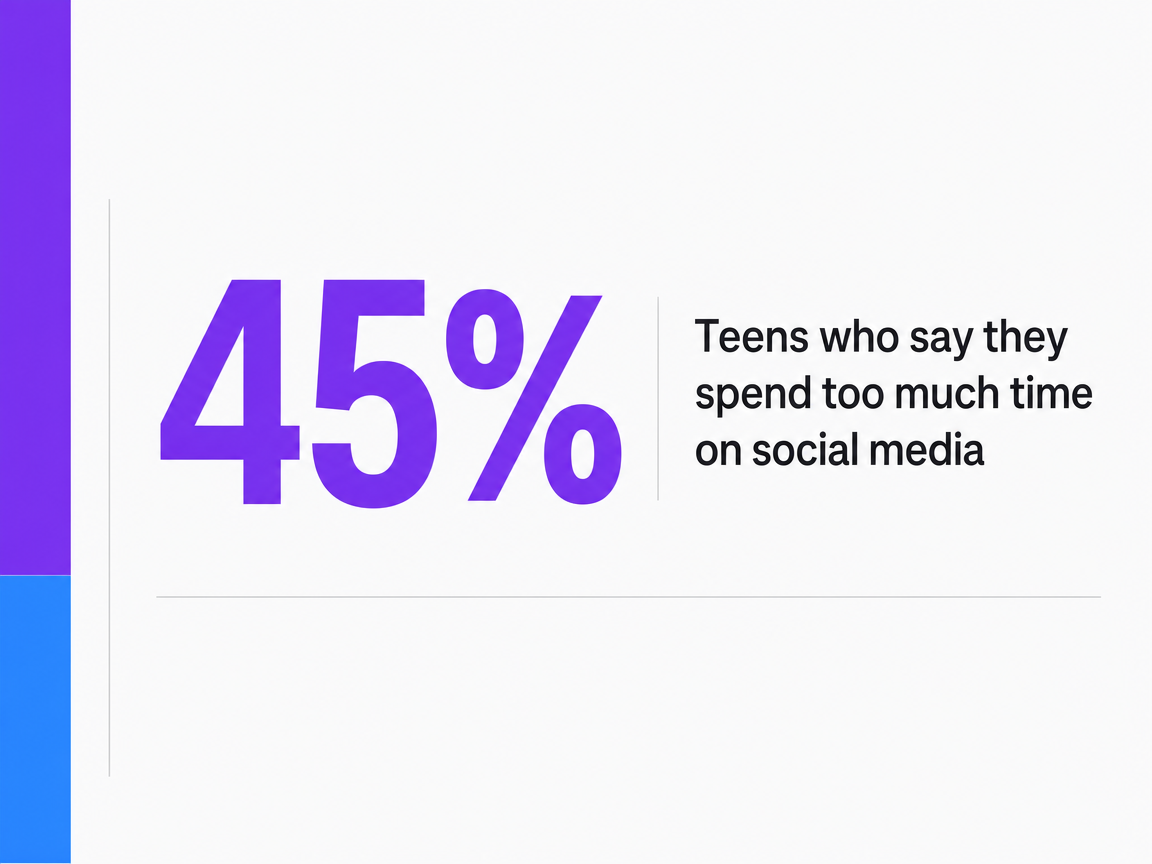 Teens who say they spend too much time on social media
Teens who say they spend too much time on social media
Frequently Asked Questions
References
- 1.Examining the Data Practices of Social Media and Video Streaming Services.
- 2.Social Media and Youth Mental Health.
- 3.Teens, Social Media and Mental Health.
- 4.Americans' Social Media Use 2025.
- 5.Social Media and News Fact Sheet.
- 6.How Social Media Work.
- 7.Engagement, user satisfaction, and the amplification of divisive content by ranking algorithms on TikTok and Twitter.
- 8.An approach to sociotechnical transparency of social media recommendation algorithms.
- 9.Social Drivers and Algorithmic Mechanisms on Digital Media.
- 10.The Relationship Between Social Media Information Sharing and Recommendation Algorithms.
- 11.Social Media Algorithms and Teen Addiction.
- 12.How to Hold Social Media Platforms Accountable: A Roadmap for State Policymakers & Advocates for Legislation to Require Independent Algorithm Risk Audits.
- 13.Beyond the basics: Exploring the impact of social media marketing on business outcomes.
- 14.Q&A: How TikTok's 'black box' algorithm and design shape user behavior and recommendation.
- 15.The Impact of Social Media Algorithms on Information Consumption.
- 16.Demystifying the "Social Media Algorithm".
- 17.Social Media Marketing Strategies for Small Businesses.
- 18.Social Media Use for Health Purposes: Systematic Review.