
Key Takeaways
- Discovery now runs as one loop: social exposure creates the demand event, and search confirms it, so crediting each channel in isolation understates what actually drives booked pipeline.
- Fragmented vendor stacks flatten pipeline through coordination tax, not tactical weakness, because each handoff between social, SEO, content, and compliance extends time-to-publish and duplicates substantiation work.
- Substantiation is now a shared ranking signal across FTC guidance, Operation AI Comply, and Google's medical update, so one evidence standard should clear social and search assets in a single pass 1, 16.
- Channel mix should follow verified adoption by vertical, with YouTube and Facebook carrying senior living and home services while Instagram anchors DSO and behavioral health work targeting younger audiences 4, 6.
Discovery Has Collapsed Into One Behavior Loop
The clean split between social media and search engine optimization no longer describes how audiences actually find service providers in high-stakes categories. Pew's 2026 tracking of information behavior shows that 36% of U.S. adults now get health information from social media at least sometimes, and 22% report the same about AI chatbots 3. The study measures self-reported information-seeking among U.S. adults, not clinical decisions or booked appointments, but the direction is unambiguous: discovery starts in feeds and conversational interfaces before it lands in a search box.
For a VP of marketing running a lean team in behavioral health, dental, senior living, home services, or legal services, that shift changes what an organic pipeline actually looks like. A prospective patient scrolls a short-form video about anxiety treatment, sees a comment thread about a specific medication protocol, and only then searches the provider's brand name plus a city. The search query is the visible artifact. The social exposure is the demand event that produced it.
Treating those two moments as separate marketing programs, staffed by separate vendors, running against separate KPIs, produces the flat pipeline most CFOs are now questioning. Engagement on the social side does not translate into booked revenue when the search-side content it seeded fails the substantiation tests that both algorithms and regulators apply to health-adjacent claims 1, 16. The rest of this analysis works through what a unified discovery system looks like in practice, why governance now sits on the critical path rather than the sidelines, and how in-house teams can measure whether their current stack is quietly taxing growth.
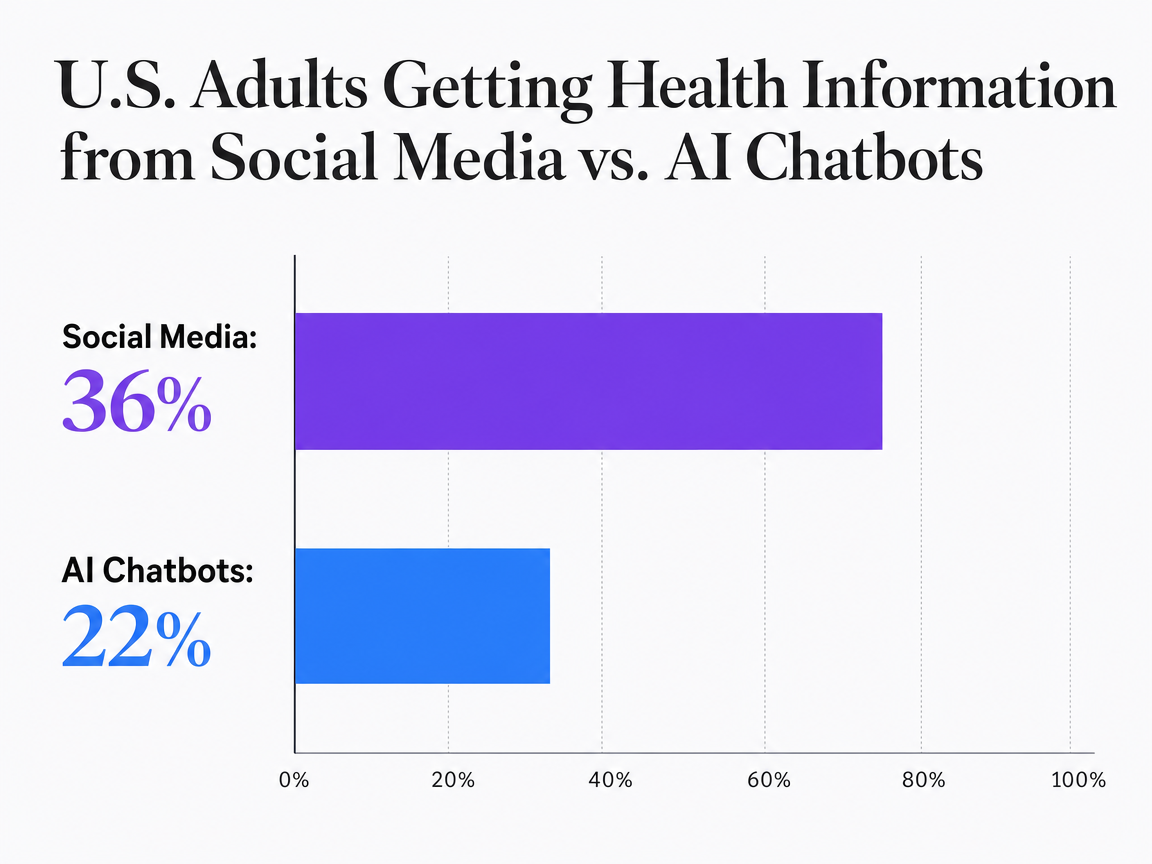 U.S. Adults Getting Health Information from Social Media vs. AI Chatbots
Comparison of the percentage of U.S. adults who report getting health information from social media (36%) versus AI chatbots (22%) at least sometimes.
The Discovery-System Model Replacing Channel Silos
Social Exposure Seeds the Query, Search Captures the Intent
The mechanics of organic acquisition in high-stakes categories have inverted over the past three years. Social platforms now handle the demand-creation half of the funnel that SEO once shared with paid media, and search engines increasingly serve as the confirmation layer where audiences validate what they already saw on a feed. The systematic review of social media use for health purposes documents this pattern across information dissemination, peer support, and health promotion, concluding that social behaviors shape trust and engagement before any transactional query occurs 15.
A concrete sequence illustrates the mechanic. A prospect in a dental service organization's catchment area sees a short-form video explaining sleep apnea appliances, follows a comment thread that references a specific clinical protocol, and later searches the practice's brand name alongside "night guard" and a ZIP code. The video did not close the appointment. It changed the query.
Growth teams that instrument only the terminal search event see a branded traffic spike with no attributable origin, and they under-invest in the social exposure that produced it. The healthcare provider literature review reinforces that social platforms function as recruitment and brand-building channels rather than downstream awareness plays 17. When marketing leaders map their organic pipeline as one discovery system, social spend earns credit for the search demand it seeds, and SEO teams stop optimizing in the dark for queries whose intent was formed elsewhere.
Why Siloed Vendor Stacks Flatten Pipeline
Fragmented execution is what makes the discovery-system model hard to run in practice. A typical in-house marketing group in behavioral health, home services, or a dental service organization contracts a social agency for feed content, a separate SEO vendor for editorial and technical work, a content shop for long-form assets, and a compliance reviewer bolted onto the end of each cycle. Each vendor optimizes for the KPI in its own scope of work.
The result is predictable. Social produces engagement metrics with no line of sight into the branded search queries it should generate downstream. SEO produces ranking wins on non-branded terms whose commercial value the social team never amplifies. Content sits in a Google Doc for three weeks waiting for legal review, then publishes without the social distribution that would have compounded its authority signals.
The resource-allocation study of lean editorial teams describes this pattern under different labels, noting that visibility strategies are constrained less by tactical knowledge than by staffing, editorial capacity, and coordination bandwidth 11. For a VP running a 3-to-8-person marketing team against a pipeline target, the coordination cost is not overhead. It is the primary reason integrated organic growth stalls even when each individual vendor is competent inside its own lane.
Substantiation as the Shared Ranking Signal
Both algorithms and regulators have converged on the same failure mode: unsupported claims presented at scale. Google's medical update analysis identifies the primary driver of visibility loss for health-adjacent sites as the failure to meet ranking criteria tied to expertise, authoritativeness, and trust, not thin content or technical defects alone 16. Social platforms have moved in parallel, with the infodemics review documenting how credibility signals and source vetting now shape distribution across major networks 9.
What this means operationally is that the same claim, poorly substantiated, degrades performance on both channels simultaneously. A behavioral health provider that publishes an unsourced statistic about treatment efficacy risks demotion in organic search and reduced amplification on social feeds where credibility heuristics apply. The National Academy of Medicine framework defines credible sources as those that manage conflict of interest, maintain transparency, and ground claims in evidence 14. Those attributes now function as ranking inputs, not brand-safety niceties.
For marketing leaders, this collapses two governance workflows into one. The evidence standard that satisfies FTC substantiation review is close enough to the standard that satisfies platform credibility scoring that maintaining separate quality tracks for social copy and SEO copy is duplicative work producing weaker outputs on both sides.
Channel Mix by Vertical, Not by Trend Cycle
Broad-Reach Verticals: Senior Living and Home Services
Senior living operators and home services franchises share an audience characteristic that should dictate channel investment: the decision-maker or the influencer sits well outside the demographic bands where newer platforms concentrate attention. Pew's 2025 adoption data puts YouTube at 84% of U.S. adults and Facebook at 71%, the two highest reach figures for any mainstream platform 6. Those two channels remain the load-bearing surfaces for verticals whose buyers and adult-child referrers skew 45 and up.
The operational implication for a lean in-house team is that platform diversification often reduces yield rather than expanding it. A senior living operator producing weekly TikTok content is spending production capacity against a channel where the adult children coordinating a parent's move are underrepresented, while the Facebook community group where local move decisions actually get discussed goes uncovered. Home services operators face the same math on YouTube, where long-form explainer content about roof replacement or HVAC diagnostics maps directly to the research queries a homeowner runs before requesting a quote.
Channel selection here is not a creative choice. It is a reach calculation against verified adoption data, and the discipline is refusing to spread production across platforms where the audience is thin.
Age-Concentrated Verticals: DSO and Behavioral Health
Dental service organizations targeting cosmetic and orthodontic revenue, along with behavioral health providers serving young adults, operate against an inverted demographic curve. Pew's platform survey reports Instagram use at 78% of adults ages 18 to 29, compared with only 15% of adults 65 and older 4. That 63-point gap is the sharpest age gradient in mainstream social adoption, and it forces a different channel logic than the broad-reach playbook.
For a DSO marketing clear aligners, Invisalign consultations, or cosmetic bonding, Instagram and short-form video are where the consideration set forms. Prospects see before-and-after content, follow a specific provider's account, and later run a branded search that appears in the analytics as if it originated from direct traffic. A behavioral health group treating anxiety, ADHD, or eating disorders in the 18-to-34 range faces the same funnel: the platform where symptom recognition happens is not the platform where the appointment gets booked, but the appointment does not get booked without the platform.
The mistake in-house teams make is copying the senior living playbook into these verticals or the reverse. A behavioral health provider that publishes exclusively on Facebook because it is the highest-reach platform overall is optimizing against the wrong denominator. The right denominator is reach among the age band that actually buys the service.
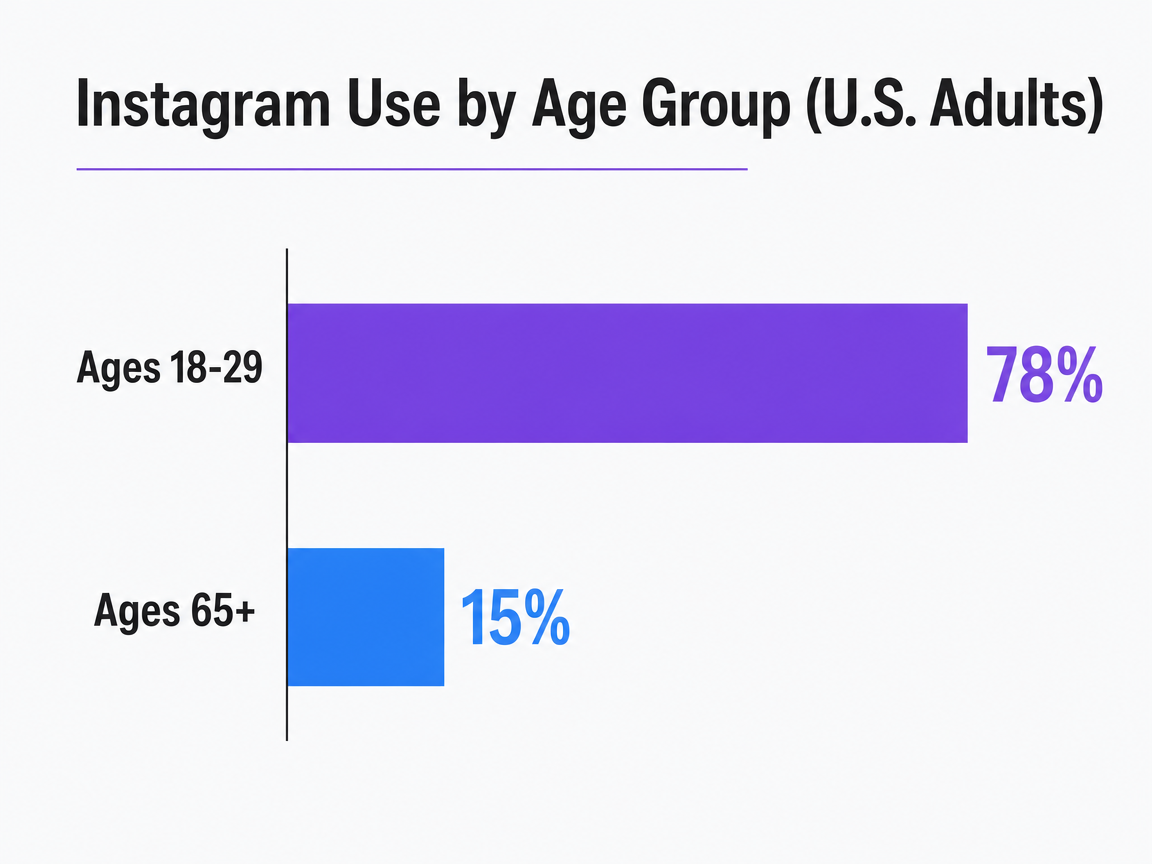 Instagram Use by Age Group (U.S. Adults)
Comparison of Instagram usage between adults aged 18-29 (78%) and adults aged 65 and older (15%).
When the Audience Is Vulnerable, the Substantiation Bar Rises
Behavioral health warrants its own treatment because the audience composition shifts what content teams are allowed to publish. Pew's 2025 teen tracking found that 40% of girls and 28% of boys at least sometimes get mental health information from social media 5. The study measures adolescent self-report of information-seeking, not diagnostic accuracy or clinical outcomes, and it does not extrapolate to adult treatment decisions. Its relevance to a behavioral health marketing program is narrower and more specific: content that circulates in the same feeds where teens are researching symptoms is being read by an audience the platforms, regulators, and clinical bodies all treat as protected.
Practical consequences follow. Claims about treatment efficacy, medication comparisons, or diagnostic self-assessment tools require documented substantiation before publication, not after a compliance review flags them. The National Academy of Medicine credibility framework, which weights transparency, conflict-of-interest disclosure, and evidence grounding, applies with more force here than in verticals where the audience is uniformly adult and self-selecting 14. Behavioral health marketing leaders should treat that framework as a pre-publication checklist, not a post-hoc audit.
Test Integrated SEO and Social Workflows Risk-Free
Experience unified campaign execution and measure organic pipeline impact with live, publishable results in your market.
Governance Is the Growth Ceiling, Not the Guardrail
The Approval Loop as an Acquisition Variable
Most in-house marketing leaders treat approval workflow as risk management. In high-stakes categories, it functions as an acquisition variable. The gap between a claim being drafted and a claim being live on a feed or a landing page determines how quickly a marketing team can respond to a competitor's campaign, a seasonal demand spike, or a topical query surge.
The healthcare social media literature review documents that provider organizations increasingly treat social platforms as recruitment and brand-building infrastructure rather than optional outreach 17. That reclassification raises the stakes of every handoff. When a behavioral health group's clinical reviewer sits three business days downstream of the content team, and the content team sits two days downstream of the social calendar, the practical result is a two-week lag between market signal and market response.
Approval velocity is measurable. Growth teams that instrument time-to-publish, average number of reviewer handoffs per asset, and percentage of assets that require post-publication correction can see governance as a throughput metric rather than an audit function. The teams that consolidate legal, clinical, and editorial review into a single approval surface publish faster against the same substantiation standard, which is the operational advantage the fragmented model gives away.
FTC Substantiation and the Operation AI Comply Sweep
The FTC's Health Products Compliance Guidance sets the substantiation standard that governs claims about benefits, safety, and efficacy in health-related marketing, requiring competent and reliable evidence before a claim reaches an audience 1. The guidance does not distinguish between a paid ad, a social caption, an SEO landing page, or an AI-generated draft. The claim itself carries the burden, wherever it appears.
Operation AI Comply, the enforcement sweep the FTC announced in 2024, made the AI dimension explicit. The action targeted companies using AI to supercharge deceptive or unfair conduct, including fake review generation and exaggerated claims about AI-produced outputs 2. For a marketing VP scaling content production with generative tools, the sweep converts an abstract governance concern into a specific operational requirement: any AI-assisted output that touches a health-adjacent claim needs a documented substantiation trail before it publishes, not after.
Practically, this means the review layer that clears a social post about a treatment outcome is the same review layer that clears the pillar page targeting the same query. Marketing teams that run separate compliance tracks for social and SEO end up substantiating the same claim twice with different evidence standards, and the weaker of the two determines the enforcement exposure. Consolidating substantiation into one governed loop is the only version of this process that scales without creating audit gaps.
E-E-A-T Failures and the Google Medical Update
The regulatory standard has a search-side counterpart that operates on the same failure mode. The Google Medical Update analysis concluded that health and medical sites lost visibility primarily because they failed to meet ranking criteria tied to expertise, authoritativeness, and trust, not because of technical shortcomings alone 16. Sites with credentialed authorship, transparent editorial processes, and evidence-linked claims retained visibility. Sites that produced volume without those signals did not.
What connects this to social governance is the shared underlying variable. A claim that fails FTC substantiation review is almost always a claim that would also fail E-E-A-T scoring, because both frameworks look for the same evidentiary traits: a qualified source, a transparent basis, and a verifiable link between the assertion and the record supporting it. The infodemics review reinforces that credibility heuristics have moved into distribution decisions on social platforms as well, using similar signals 9.
For marketing leaders, this means the E-E-A-T upgrade a technical SEO audit prescribes and the substantiation upgrade a compliance review prescribes are the same project. Treating them as separate initiatives, staffed by separate vendors, produces duplicative documentation and weaker outputs. One authoring standard, applied across social and search, is the version that clears both filters.
The Coordination Tax: A Diagnostic for Fragmented Stacks
The cost of a fragmented organic stack does not appear as a single line item. It shows up as slower publication, duplicated review cycles, and pipeline that flattens between quarterly board decks. Marketing leaders can measure it directly by counting operational variables against their current workflow, then comparing the count to what a consolidated approval loop would produce.
The variables below are operator-facing. No dollar figures are asserted because the research does not support benchmarked cost claims, and the point of the diagnostic is to make internal comparison possible without importing invented numbers.
| Operational Variable | Fragmented Stack (Separate Social, SEO, Content, Compliance Vendors) | Unified Approval Loop |
|---|---|---|
| Vendor touchpoints per campaign | 4+ (social agency, SEO vendor, content shop, compliance reviewer) | 1 governed surface |
| Briefing cycles per month | One per vendor, often unsynchronized | Single brief distributed across channels |
| Approval handoffs before publication | 3 to 5 (draft, edit, legal or clinical, channel owner, publish) | Consolidated into one review pass |
| Time-to-publish in business days | Variable, typically extended by handoff queues | Reduced by removing sequential waits |
| Channels covered per approval | One per approval cycle | Multiple channels cleared per cycle |
| Substantiation evidence trail | Duplicated across vendors, weakest version determines exposure | Single documented trail applied uniformly |
The diagnostic works best as a two-week audit. Marketing leaders can log every asset published in that window, count the handoffs each one required, and record the elapsed days between draft creation and live publication. The resource-allocation study of lean editorial teams observed the same dynamic in a different setting, finding that visibility outcomes were shaped more by staffing capacity and coordination bandwidth than by tactical knowledge 11. For a 3-to-8-person in-house team, the audit almost always reveals that the constraint is not creative output or technical skill. It is the number of surfaces a single claim must cross before it earns distribution.
See How Leading Brands Integrate Social and SEO for Predictable Pipeline Growth
Connect with our team to review case data on multi-channel execution—learn how digital leaders coordinate social and search to increase organic conversions without expanding internal resources.
Multi-Location Operators: One Approval Loop, Many Markets
The analysis shifts here from single-location practices to multi-location operators: DSO groups running 40 clinics across three states, behavioral health networks with 12 outpatient sites, senior living portfolios spanning multiple regions, and home services franchises with independent operators in every metro. The governance problem changes shape at that scale.
A single-location practice can absorb a fragmented vendor stack because one clinical reviewer sees every claim before it publishes. A 40-location DSO cannot. Local marketing coordinators produce site-specific social content, regional SEO vendors optimize location pages against different query sets, and corporate compliance sees only the assets that get escalated. The health tourism synthesis observes the same pattern in providers coordinating digital marketing across destinations, noting that integrated social, email, and SEO strategies drive facility selection when they are executed as one program rather than parallel campaigns 20.
The failure mode is claim drift. A behavioral health network's Denver clinic publishes an Instagram post about a treatment protocol using language its Phoenix clinic would not clear. Both posts run under the same brand, but the substantiation trail behind each one differs. When a regulator or a Google core update surfaces the weaker claim, the enforcement or ranking consequence attaches to the entire network, not just the location that published it.
One approval loop with location-level inputs is the operational fix. Local coordinators feed market-specific context into a central review surface that applies one substantiation standard, one E-E-A-T authoring guideline, and one credibility framework across every site's output 14, 16. The result is faster local publication with lower enterprise risk, which is the tradeoff most multi-location marketing leaders have been told they cannot have.
Technical SEO and Comprehension as the Same Problem
Technical SEO and reader comprehension get treated as separate disciplines in most in-house workflows, staffed by different people and reviewed against different rubrics. The evidence suggests they are the same problem viewed from two angles. A peer-reviewed analysis of diabetic retinopathy websites found that sites well-designed for search discovery were not reliably readable for the patients those sites were meant to serve, exposing a gap between rankings and comprehension that ranking data alone cannot detect 7. A parallel study of digital health center websites reported that content quality scored higher on average than ranking-related variables, indicating that visibility and informational value move on separate axes 8.
For a marketing VP, the practical read is that a page can rank and still fail the audience it captured. A behavioral health landing page written at a graduate reading level, or a senior living services page structured for crawlers but dense with clinical jargon, produces the ranking outcome and forfeits the conversion. The SEO methods literature frames discoverability as necessary but not sufficient, since content must be found before it can be read, but being found does not guarantee it will be understood 12, 13.
The operational fix is a single authoring standard that treats schema, heading hierarchy, and internal linking as comprehension aids rather than ranking hacks. One editor reviewing for both crawlability and reading level closes the gap the fragmented model leaves open.
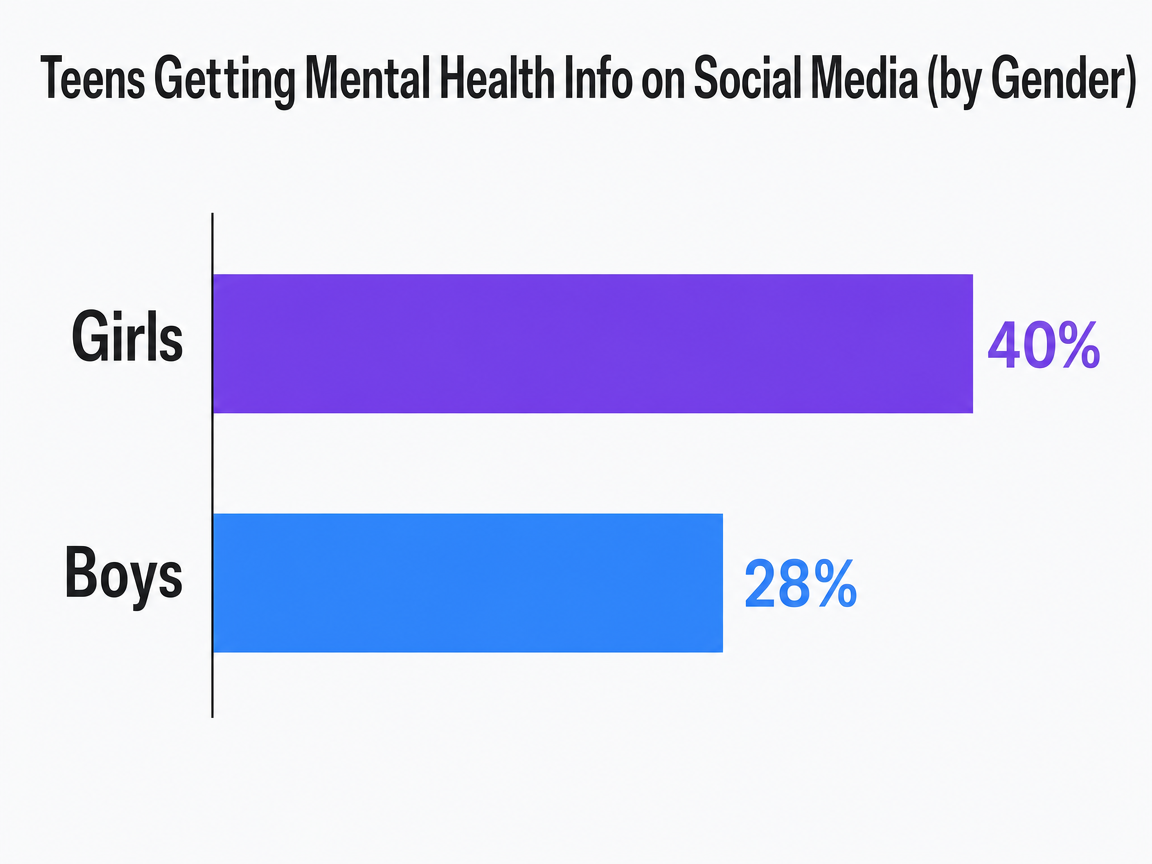 Teens Getting Mental Health Info on Social Media (by Gender)
Comparison of the percentage of teen girls (40%) and boys (28%) who get mental health information from social media at least sometimes.
Frequently Asked Questions
References
- 1.Health Products Compliance Guidance.
- 2.FTC Announces Crackdown on Deceptive AI Claims and Schemes.
- 3.Health information from social media and AI rated more convenient ....
- 4.How Americans Use Social Media | Pew Research Center.
- 5.Teens, Social Media and Mental Health - Pew Research Center.
- 6.Americans' Social Media Use 2025.
- 7.Search engine optimization and its association with readability and ....
- 8.Applying Website Rankings to Digital Health Centers in the United ....
- 9.Infodemics and Health Misinformation: A Systematic Review of Reviews.
- 10.Social media and the spread of misinformation - PMC - NIH.
- 11.Becoming visible with limited resources: Non-profit journalists ....
- 12.Search engine Performance optimization: methods and techniques.
- 13.Search engine optimization for scientific publications: How one can ....
- 14.Identifying Credible Sources of Health Information in Social Media: Principles and Attributes.
- 15.Social Media Use for Health Purposes: Systematic Review.
- 16.Google Medical Update: Why Is the Search Engine Decreasing the Visibility of Health and Medical Information Websites?.
- 17.Social Media and Health Care, Part I: Literature Review of Social Media Use by Health Care Providers.
- 18.The Public Health Perils of Search Engine Marketing.
- 19.The Impact of Social Media in Healthcare: Five Key Strategies.
- 20.Health Tourism Facility Use of Digital Marketing and AI.