
Key Takeaways
- The Poll-to-DM Sequence converts a LinkedIn poll into a segmentation event, routing each answer bucket into a tailored follow-up that produces tagged, traceable pipeline activity.
- The Buying-Group Sequence runs parallel content tracks for each committee role, addressing the consensus failure that stalls half of B2B deals 3.
- The Instrumented Social Selling Program logs rep activity against CRM records, justifying investment through opportunity creation rather than direct revenue claims 7.
- The Employee Amplification Engine uses peer signals from a small core of repeat participants, with attribution tracking which shared assets produced sourced meetings 4.
- The Platform-Concentration Bet directs 70 to 80 percent of social effort to LinkedIn, since Forrester data shows it leads B2B initiatives by a wide margin 1.
- The Omnichannel Buyer Journey treats social as the front door to digital-first deals, requiring an agreed multi-touch attribution model rather than first or last-touch shortcuts 5.
- The Community and Influencer Network Play targets the external voices buyers consult, using proxy metrics like inbound mentions and creator-named demo requests 9.
- The Value-Oriented Prospecting Campaign publishes narrow industry insights that self-qualify engagers, turning content engagement data into a prospecting and research function 4.
- The CRM-Tagged Social Touch Model designs measurement as its own campaign, producing a quarterly view of how often social appears in winning deals 8.
- The Coordinated Specialist Workflow runs content, social, paid, and analytics through a single approval queue, avoiding the briefing overhead of a multi-vendor stack 10.
Why most B2B social campaign roundups fail demand gen managers
Search for social media campaign examples and the results read like a museum tour of consumer marketing: a fast food brand's tweet war, a razor company's launch video, a duolingo owl. None of it helps a demand gen manager explain to a CMO what social sourced last quarter.
The gap is mechanical, not creative. Consumer roundups celebrate reach and sentiment. B2B pipeline is built on a different chain: a social touch creates a known prospect, that prospect enters a sequence, the sequence produces a meeting, and the meeting becomes an opportunity in the CRM. Peer-reviewed work on B2B sales finds that social media activity influences opportunity creation and relationship management, which then move relational sales performance 6. The mechanism matters more than the post.
This piece treats ten campaigns as archetypes, each anchored to a named pipeline mechanism and the instrumentation required to prove it. The audience is a lean demand gen team that already runs paid LinkedIn, owns MQL-to-pipeline reporting, and needs models that survive a Monday QBR rather than screenshots that win design awards.
How to read these ten archetypes
Each archetype below follows the same skeleton: the mechanism that produces a known prospect, the platform choice that makes the mechanism efficient, and the instrumentation that ties the activity to a CRM opportunity. Skimming for the creative idea misses the point. The pipeline value sits in the mechanism and its measurement, not the post.
Three lenses run through every example. The first is platform allocation, where Forrester's 2024 survey of B2B marketing leaders places LinkedIn well ahead of YouTube, Facebook, and Instagram for B2B initiatives 1. The second is the buying group, because half of B2B deals stall when the committee cannot reach consensus 3. The third is attribution discipline, treating social touches as fields in the CRM rather than impressions in a dashboard 8.
The archetypes are not ranked. A lean team should pick two or three that match its current pipeline gap and ignore the rest until the first cohort proves out.
Test Data-Driven Social Campaigns With Live Results
Launch real campaigns and see pipeline impact before you commit—no risk, full access, real audience reach.
Ten campaign archetypes built around a pipeline mechanism
The Poll-to-DM Sequence: turning a LinkedIn poll into a segmentation event
The poll-to-DM sequence treats a LinkedIn poll less as engagement bait and more as a self-selected segmentation event. A demand gen team posts a tightly scoped question to its target persona, harvests the response groups, and routes each cluster into a different follow-up sequence based on what they picked. The vote is the qualifying signal. The DM is the pipeline action.
LinkedIn's own practitioner guidance describes this exact mechanic: grouping engaged respondents by answer and messaging them with content tailored to their stated preference 2. A poll asking how a finance team currently handles a specific reconciliation problem returns four answer buckets, and each bucket becomes a micro-campaign with a different opening line, different case study, and different meeting offer.
The instrumentation is light but mandatory. Each poll response is logged with the prospect's name, company, and answer; that data flows to the CRM as a custom field tagged with the poll campaign ID; outbound DMs reference the answer explicitly and carry a tracked link to a calendar or asset. Without the tagging step, the activity reads as conversation noise. With it, the team can show how many sourced opportunities trace back to a single poll, which answer bucket converted best, and which persona to target with the next round.
The Buying-Group Sequence: multi-stakeholder content for the committee
Most social campaigns aim at a single champion. The buying-group sequence assumes that champion cannot close the deal alone. Gartner's research, summarized in recent buying-committee analysis, finds that half of B2B deals collapse because the group cannot reach consensus 3. A campaign that wins the champion's attention but never reaches the CFO, the security lead, or the operations director still produces a stalled forecast.
The mechanism is straightforward in concept and disciplined in execution. The team maps the typical committee for its top opportunity type, names three to five roles, and produces a separate content track for each:
- The champion gets the strategic narrative.
- The technical evaluator gets the integration teardown.
- The economic buyer gets the cost-of-inaction analysis.
- The end user gets the workflow comparison.
Each track runs on the same platform within the same window so multiple stakeholders inside the same account see complementary material instead of identical posts.
Instrumentation requires account-level visibility, not just lead-level. The CRM needs a buying-group object that links multiple contacts to one opportunity and records which social touches reached which role. When the deal advances, the team can show the committee saw the right material in the right order. When the deal stalls, the gap is visible: the security lead never engaged, or the CFO content never reached the right title. Forrester's broader strategy guidance frames this as mapping the buying network, not the buyer 9.
The Instrumented Social Selling Program: tying rep activity to sourced opportunities
Social selling earns its line item only when the activity ties to a CRM record. Peer-reviewed research on B2B social selling reports that 78.6% of salespeople using social media outperform peers who do not, that programs see a 10 to 20 percent lift in win rates, and that cycle time compresses 20 to 30 percent when social is integrated into the funnel rather than bolted on 7. Those deltas describe a program, not a posting habit.
The instrumented version treats every rep's social activity as logged work. Connection requests reference a defined ICP filter and are tagged with a campaign code. Direct messages flow through a shared template library so the team can compare reply rates across openings. Engagement on a prospect's post is recorded as a touch on the account record, with a date and a context note. When an opportunity closes, the team can pull the touch history and see which social actions preceded the first meeting.
The supporting research from structural equation modeling on B2B sales finds the causal path runs through opportunity creation and relationship management, both of which then move relational performance 6. The implication for a demand gen owner is that social selling does not need to claim direct revenue attribution to justify investment. It needs to show it created opportunities that the existing sales process then converted at a measurable rate.
The Employee Amplification Engine: peer effects as a prospecting lever
An employee amplification program turns the company's headcount into a distributed publishing network. The mechanism is not vanity reach. It is the peer signal that buyers trust more than brand-owned posts. Baylor research on social media in sales performance finds that peer usage magnifies the positive effects of individual social activity, with value-oriented prospecting and proactive servicing emerging as the selling tasks most strengthened by an active social presence 4.
The engine has three moving parts:
- A content library gives employees ready-to-share assets organized by persona and stage.
- A light approval workflow keeps brand voice consistent without forcing every post through a queue.
- An attribution layer captures which employee shared which asset, who clicked, and which clicks became known prospects in the CRM.
The common failure is volunteer fatigue. Programs that lean on goodwill last a quarter and then quietly die. Programs that survive build a small core of repeat participants, usually six to twelve people across sales, customer success, and product, and treat their social activity as part of the role. The demand gen team supplies the assets and tracks the downstream effect on sourced meetings. The participants get credit for the opportunities their posts influence, which keeps the engine running without a separate budget line.
The Platform-Concentration Bet: where B2B social investment actually pays
Platform allocation decides whether the rest of the campaign portfolio has a chance. Forrester's 2024 survey of B2B marketing leaders places LinkedIn as the clear leader for B2B social media marketing initiatives, with YouTube, Facebook, and Instagram competing for a distant second 1. A lean team that splits effort evenly across four networks is funding three weaker channels at the expense of the one with the highest ICP density.
The concentration bet looks like this: roughly 70 to 80 percent of social budget and headcount goes to the primary network, the remaining share funds a single secondary channel chosen for a specific job, and the rest of the platforms are deprioritized until the primary channel has hit its current ceiling. YouTube earns a slot when the buying group needs product demonstration or executive thought leadership in long form. A community network earns a slot when the ICP gathers in a specific forum the brand can credibly join.
The discipline part is harder than the allocation part. Teams keep secondary channels alive out of habit, posting to Instagram or X because the calendar has slots, even when the analytics show no sourced pipeline. The concentration bet kills those slots and reinvests the time in the primary channel: more poll sequences, more buying-group tracks, more rep enablement. The Forrester data does not say the other platforms have no role. It says the marginal dollar in B2B should default to LinkedIn until the team has a specific reason to move it 1.
The Omnichannel Buyer Journey: social as the entry to a digital-first deal
B2B buyers now route most of their evaluation through digital and remote channels, even for high-value purchases. McKinsey's analysis of the digital inflection point in B2B sales documents the durable shift: a majority of decision makers prefer remote human interactions or digital self-service over traditional in-person sales, and suppliers with strong omnichannel engagement outperform peers on revenue growth 5.
The omnichannel archetype treats social as the front door, not the whole house. A LinkedIn post drives to a gated asset, the asset triggers a sequence, the sequence routes to a self-serve product tour or a booked demo depending on the buyer's behavior, and the sales conversation begins already aware of which content the buyer consumed. The same prospect may also receive a retargeting impression on YouTube, an email digest, and an outbound DM, with each touch logged against the account.
The instrumentation question is which channel gets credit. First-touch attribution flatters social. Last-touch flatters sales outreach. The pipeline-honest answer is multi-touch with a documented model the team agrees to, then a quarterly review of how often social appears in the touch path of closed-won deals. Teams that skip the model end up arguing about credit instead of optimizing the journey. The McKinsey framing matters because it removes the question of whether buyers will tolerate digital-first deals. They already do 5.
The Community and Influencer Network Play: reaching the buying network, not the buyer
Buyers no longer evaluate vendors in isolation. Forrester's B2B strategy guidance reports that 30 percent of Millennial and Gen Z buyers include ten or more external influencers in their buying process, drawn from peer communities, analysts, and subject-matter creators they encounter on social and community channels 9. A campaign that ignores those voices is competing for a smaller share of the decision than it thinks.
The network play works on two axes:
- The first is community presence: the brand contributes substantively to the forums, Slack groups, and LinkedIn communities where the ICP actually gathers, with named employees building reputation over months rather than a logo posting promotional content.
- The second is influencer collaboration: the brand sponsors or co-produces content with the specific creators its buyers cite, prioritizing depth over follower count.
Measurement here is messier than a direct-response campaign and the demand gen team should accept that upfront. The proxy metrics are inbound mentions of the brand in community discussions, demo requests that name a specific creator or community as the source in the form field, and lift in branded search and direct traffic in markets where a community campaign is active. The play does not replace direct demand generation. It increases the share of the buying network that has already heard the brand named favorably before the first sales conversation.
The Value-Oriented Prospecting Campaign: insight content as a conversation opener
Value-oriented prospecting replaces the cold pitch with a published insight the prospect would have wanted to read anyway. The Baylor research on salesperson performance identifies value-oriented prospecting as one of the selling tasks most strengthened by active social media use, with measurable downstream effects on results 4. The mechanism is simple: the rep or the brand publishes a specific, useful observation about the prospect's industry, and the outbound message references the insight rather than a product.
The content has to be narrow enough to feel personal. A general market trend post drives likes. A teardown of three pricing pages in a specific vertical, or a breakdown of how a regulatory change affects a specific operations workflow, drives replies. The post itself does the qualification: people who engage are people who have the problem.
The outbound layer then carries the conversation forward. The DM or email references the engagement, offers a deeper version of the analysis, and asks one question. The CRM logs the source post, the engagement type, and the response. Over a quarter, the team can show which insight topics produced the highest reply rates and which converted to meetings. The campaign becomes a content research function as much as a prospecting function, because the engagement data tells the team which problems the market is willing to talk about.
The CRM-Tagged Social Touch Model: measurement as a campaign, not an afterthought
Most social media campaigns die in the QBR because no one can answer the sourced pipeline question. The CRM-tagged social touch model treats measurement as its own campaign, designed before the first post goes live. A University of Florida curriculum on measuring LinkedIn social selling to pipeline frames this directly: tying social touches to opportunities and pipeline requires a defined instrumentation layer, not a dashboard add-on 8.
The model has four required fields:
- Every campaign carries a unique ID that appears in UTMs, manual touch logs, and form-fill source data.
- Every contact record has a social touch object that records platform, date, campaign ID, and touch type.
- Every opportunity inherits the touch history of its associated contacts, so reporting can answer how many opportunities had at least one social touch in the 90 days before creation.
- Every closed-won record gets a brief source review that names the channels in the touch path.
The output is not a single attribution number. It is a quarterly view of how often social appears in winning deals, which campaigns repeatedly show up, and which produce touches that never advance. That view is what survives a CMO challenge. It also reframes the team's internal conversation: instead of debating whether social works, the team debates which archetypes are earning their slot in the touch path and which should be cut.
The Coordinated Specialist Workflow: running ten archetypes without ten contractors
A lean demand gen team cannot execute ten archetypes by hiring ten contractors. The traditional model fragments work across separate vendors for content, social, paid, and analytics, each with its own briefing cycle, status meeting, and reporting cadence. The coordination overhead consumes the headcount the archetypes were supposed to save. Peer-reviewed work on B2B social media use finds that the competitive advantage comes from coordinated information gathering, networking, and relationship management, not from any single channel run in isolation 10.
The coordinated specialist workflow is an execution model that runs content production, social distribution, paid amplification, and measurement through a unified approval queue with one operator in the seat. Specialist functions analyze the live pipeline data, surface ranked recommendations tied to specific archetypes, and execute approved work without a separate briefing round. The demand gen manager keeps creative control through the approval gate. The execution layer handles the production, scheduling, tagging, and reporting that would otherwise eat a full-time role.
Vectoron's platform applies this pattern to the archetypes in this piece, with specialist strategists for content, social, paid, and analytics coordinated through a single Command Center and an approval-first automation model. The economic case is straightforward for a team that has already costed out the alternative: a coordinated workflow runs at a fraction of the multi-vendor stack and removes the briefing tax that makes lean teams choose between speed and oversight.
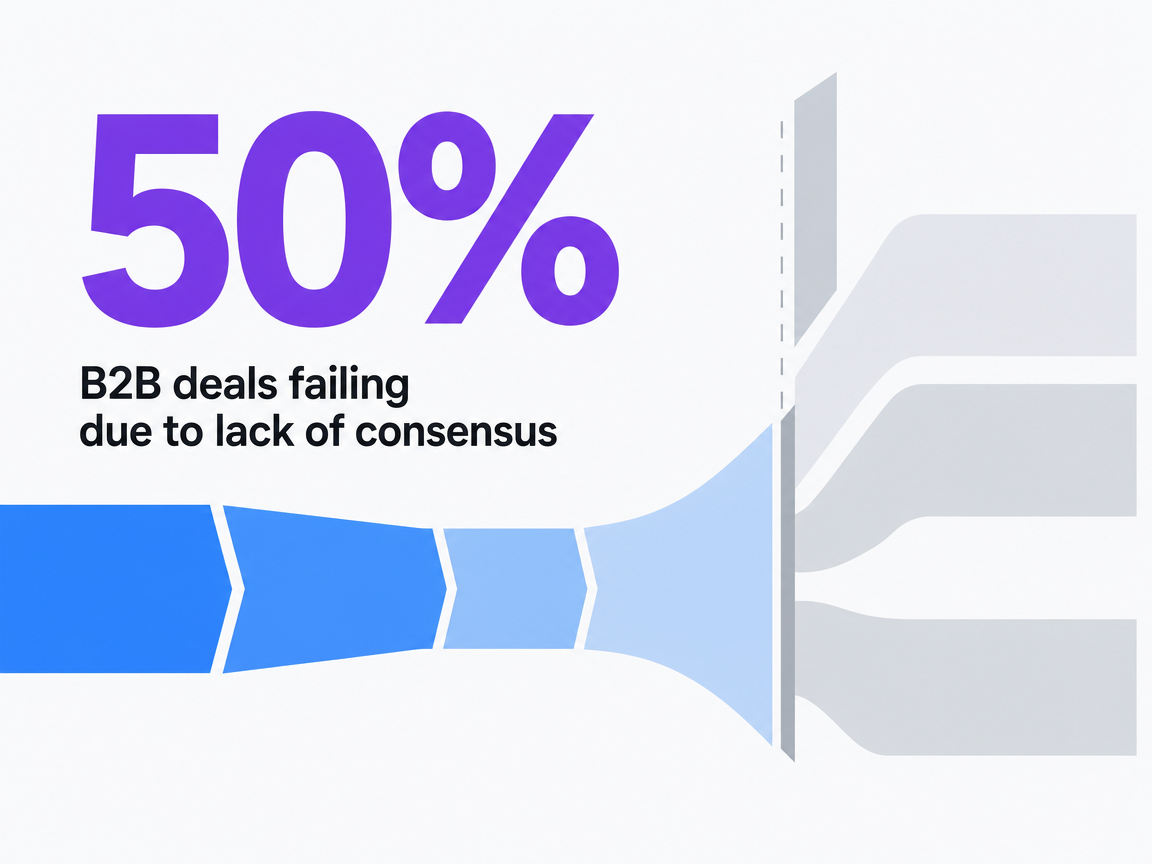 B2B deals failing due to lack of consensus
B2B deals failing due to lack of consensus
See How AI-Driven Social Campaigns Consistently Fuel Sales Pipelines
Get a walkthrough of operational frameworks and approval workflows behind high-performing, multi-channel social campaigns—built for teams managing complex buyer journeys and accountable for pipeline results.
Picking which archetypes to run this quarter
Ten archetypes is a menu, not a roadmap. A lean team that tries to run all of them in a quarter produces ten half-instrumented campaigns and a CRM full of untagged touches. The better move is to pick two or three based on the current pipeline gap, then add a third only after the first cohort has produced a clean touch history.
The selection logic is mechanical:
- Teams missing top-of-funnel volume run the Poll-to-DM sequence and a Value-Oriented Prospecting campaign on the primary network, because both produce named prospects from a single post.
- Teams with strong volume but stalled mid-funnel deals run the Buying-Group sequence and tighten the CRM-Tagged Social Touch model, since the failure pattern is usually a committee that never saw the right material 3.
- Teams whose sales org already posts but cannot prove contribution run the Instrumented Social Selling program first, because the measurement layer is the bottleneck, not the activity 8.
One rule covers all three paths: no archetype ships until the CRM fields exist to track it. Untagged campaigns produce stories, not pipeline reports.
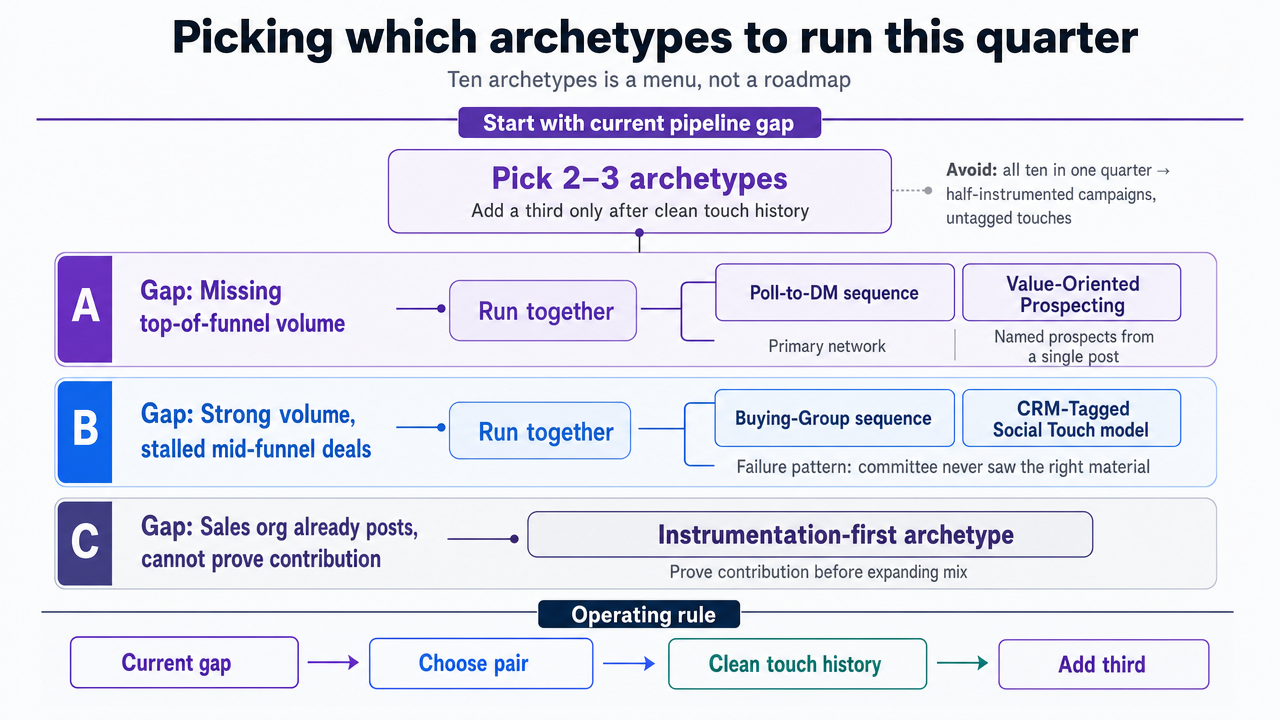 Visualize the selection logic described in this section, mapping a team's current pipeline gap to the recommended archetype pairing — directly supports the section's decision framework
Frequently Asked Questions
References
- 1.The State Of B2B Social Media Marketing Strategy And Preferences 2024.
- 2.Building a Sales Pipeline Through Social Media - LinkedIn.
- 3.Gartner survey reveals B2B buyers' complex journey - LinkedIn.
- 4.The Secrets of Social Media in Salesperson Performance.
- 5.The B2B digital inflection point: How sales have changed during COVID-19.
- 6.Social Media's Influence on Business-To-Business Sales Performance.
- 7.The Importance of Social Selling & the Development of a Social Selling Class.
- 8.How to Measure LinkedIn Social Selling to Pipeline.
- 9.B2B Marketing Strategy.
- 10.Social media use in B2B sales and its impact on competitive advantage: An exploratory study.