
Key Takeaways
- Coordination cost, not creative quality, is what breaks multi-location social programs past 25 sites — approval chains and routing work scale linearly with every added location.
- A governance-first model centralizes voice, compliance, templates, and measurement while pushing offers, staff spotlights, community references, and review response to the location.
- A single unified approval workflow replaces the field marketer role, cuts approval latency from days to hours, and holds compliance review coverage at 100% 9.
- VPs should measure publish reliability, response latency, content-to-outcome attribution per site, and hours per approved post — if coordination cost climbs with site count, the operating model is failing.
Coordination Cost Is the Hidden Tax on Multi-Location Social
A 50-location dental support organization does not fail at social media because its copy is weak. It fails because a single approved holiday post takes eleven days to move from corporate creative to the last practice's Facebook page, and by then the promotion window has closed.
That gap between strategy and publish is the operator problem worth naming. Creative quality plateaus quickly. Coordination cost — the labor and time required to move one piece of content through brand, legal, and 50 to 500 local hands — scales linearly with location count and eats every efficiency gain a franchise system tries to build.
The evidence pointing to this is quieter than the trend reports. A qualitative case study of small business social adoption identified strategic planning gaps, content inconsistency, and resource constraints as the dominant barriers to performance, with owners specifically citing the need for "clearly defined social media marketing strategies" before they saw returns 18. Franchise locations behave, operationally, like the small businesses in that study. Each one inherits the same expertise gap. Multiply that gap by 80 practices or 300 restaurants and the coordination surface becomes the real cost center, not the creative work itself.
Franchise Development VPs already understand this intuitively — most have watched a national campaign land in 40 markets and skip the other 10 because a regional manager was on PTO. What follows is a strategist-level answer to how the winning systems restructure that problem: what to centralize, what to push to the location, and how to keep regulated verticals defensible while publishing at a cadence that matches the ad market's growth.
Why Per-Location Execution Fails at 25+ Sites
The math turns against per-location execution somewhere between the 20th and 30th site. Below that threshold, a regional marketing manager can still hold every calendar in her head. Above it, the model breaks in predictable ways: content velocity drops, brand drift accelerates, and the cost of coordinating one campaign across the network exceeds the cost of producing it.
The market pressure making this worse is measurable. Global social media advertising is forecast to grow at roughly 18.1% per year through 2026 14. That figure reflects paid spend across the segment, not organic content workload, but the two move together. Rising ad investment pulls production expectations up with it — more creative variants, more localized offers, more platform coverage per market. A per-location model absorbs that pressure by adding headcount or accepting slower cycles. Neither scales.
The Walden multiple case study of small business social adoption traced the failure mode directly. Owners cited lack of expertise, insufficient time, and undefined strategy as the dominant barriers to performance 18. Franchise locations inherit the same constraints — a practice manager running a dental office does not become a content strategist because a brand guide arrives in her inbox. When a system asks 50 locations to each solve that problem independently, it is asking 50 undertrained operators to produce work that requires either expertise or a shared production line.
Three specific failures repeat across networks that try per-location execution at scale.
- Content cadence collapses in the bottom quartile of locations, dragging the network average below what corporate reports to franchisees.
- Brand voice fragments as each site develops its own visual and copy habits, undermining the consistency that made the franchise valuable to begin with.
- Coordination overhead — the emails, the approval chains, the reshoots — grows faster than location count, because every added site introduces new dependencies on the ones already in the system.
None of this is a creative problem. It is a production architecture problem, and it is why the systems that publish reliably at 100 or 300 sites stopped asking each location to run its own program years ago.
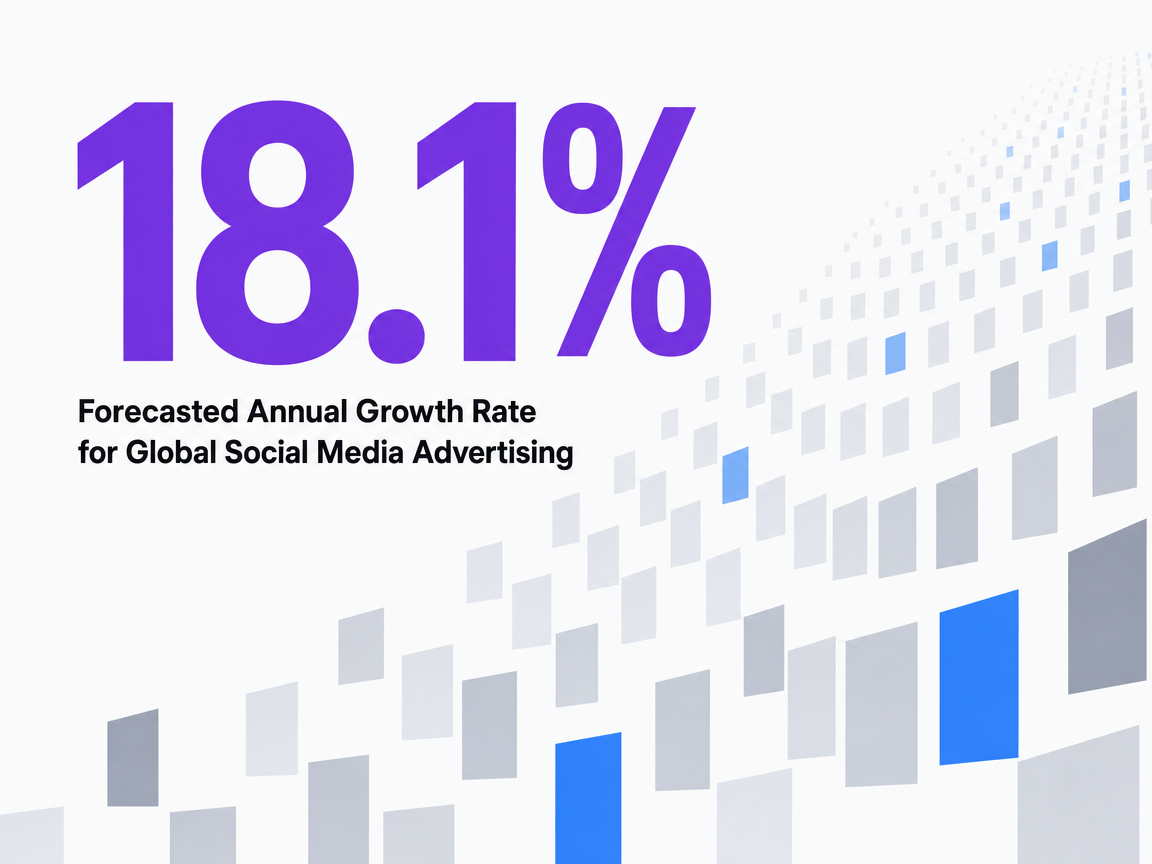 Forecasted Annual Growth Rate for Global Social Media Advertising
Forecasted Annual Growth Rate for Global Social Media Advertising
The Governance-First Operating Model
What Belongs at the Center: Brand Voice, Compliance, Templates, Measurement
The center of a multi-location social program should own the four things that cannot survive being reinvented 50 times: voice, compliance, templates, and measurement.
Voice is the easiest to justify and the hardest to enforce. A DSO with 80 practices that lets each office write its own captions ends up with 80 slightly different brands — some clinical, some jokey, some off-key. Centralizing the voice guide, the visual system, and the master content templates removes that drift without asking each practice manager to become a copywriter. The Illinois DCEO playbook makes the operational case at the location level: separate business accounts, consistent posting, and content that meets the audience where they are 19. Consistency is a corporate output when it works, not a local one.
Compliance belongs at the center for a different reason — the cost of a single mistake at one location can be borne by the entire system. Peer-reviewed work on social marketing enablers found that platform trust and secure data sharing are among the strongest predictors of business outcomes 10. That trust is built by rules written once and applied everywhere, not by 300 practice managers making judgment calls about what to post.
Templates and measurement round out the center. Standardized creative frames give every location a floor. A unified analytics view — impressions, engagement, click-throughs, and downstream calls or bookings mapped back to each site — gives the VP a network view no field marketer can assemble from screenshots.
What Belongs at the Location: Offers, Staff, Community, Review Response
Everything the center cannot see from a spreadsheet belongs to the location. That list is shorter than most franchise systems assume, and it is where local authenticity actually lives.
- Local offers are first. A Traverse City practice running a back-to-school cleaning special knows its calendar in a way corporate does not. The center provides the template and the pricing guardrails; the location fills in the dates, the offer language, and the market-specific hook.
- Staff spotlights are second. A new hygienist, a milestone anniversary, a team photo from a community 5K — this content converts because it is specific, and specificity cannot be centralized without becoming fiction.
- Community references are third. Trade.gov's franchise localization guidance underscores that social strategy has to adapt to local audience behavior on platforms like Facebook, Instagram, and TikTok 15. A location knows which parade, which high school, which neighborhood association matters. Corporate cannot fabricate that map from headquarters.
- Review response is the fourth and most operationally consequential. SBA guidance is direct: whether a customer reaches out by private message or public review, timeliness and tone are non-negotiable 3. Response latency is a location-level variable — a corporate approval queue that adds 48 hours between a one-star review and a reply defeats the purpose of responding at all. The workable pattern is centralized response templates and escalation rules, with location staff empowered to publish within those rails. Regulated verticals add authorization requirements on top, covered later in the compliance section.
The rule of thumb: if a customer would recognize the difference between a corporate post and a local one, the local variable belongs at the site.
The Single Approval Workflow That Replaces Field Marketers
The unlock in a governance-first model is not the templates or the voice guide. It is the approval workflow that connects them.
Field marketers exist in most 50-plus location systems for one reason: someone has to route creative through legal, brand, and the local site before it publishes. That routing is the job. Strip it away and the field marketer role thins to community management and event support, which do not require regional headcount to cover 50 markets.
Municipal communications teams offer a useful governance analog. The City of Newport Beach and the City of Louisville, Colorado both publish moderation rules and posting standards that govern distributed public-facing channels through a single policy layer rather than per-department discretion 16, 17. Commercial multi-location systems need the same architecture: one policy, one workflow, one queue where every post — corporate-authored, location-authored, or template-plus-local-variable — passes through the same approval gates before it goes live.
The operational effect is measurable. Approval latency drops from days to hours because the queue is unified rather than routed through email chains. Compliance review coverage rises to 100% because nothing publishes outside the workflow. And the per-location coordination cost — the number that grows fastest with location count under any other model — flattens, because adding the 51st site does not add a 51st approval chain. It adds one more input to a queue the same reviewer is already working.
Test AI-driven social media execution at scale
Experience multi-location content publishing and performance tracking with real posts live across your franchise network.
Signal-to-Post: Local Data That Should Trigger Content
The default multi-location content calendar is a static grid: two posts a week, one product, one lifestyle, repeated across every market. That model produces volume without relevance. A better architecture treats the calendar as a response system — local business signals feed into it, and specific content types get triggered when those signals cross a threshold.
Four signals do most of the work.
- Review velocity is the first. A location receiving three positive reviews in a week has a testimonial-ready moment corporate cannot see from a headquarters dashboard; a location taking two one-star reviews in a week has a service-recovery moment that needs a response template, not a promotional post.
- Call volume is the second. Spikes above a rolling baseline usually indicate a working ad or a local news mention worth amplifying.
- Booking gaps are the third — an unusually soft week on a location's schedule is the signal to publish a limited-time offer with corporate-approved pricing guardrails.
- Local events and seasonality make up the fourth, and they are the most under-used: a Traverse City practice going into cherry festival week has an obvious content hook that a national calendar will miss every time.
The evidence for weighting promotional content in this mix comes from a Kennesaw study of young adults, which found that frequency of social media use to gather information on local sales and promotions significantly predicted perceived relationships with local businesses and higher purchase intentions 21. The sample was young adults only, so the finding does not extend cleanly to senior living or Medicare-age patient populations. But for DSOs, home services, and behavioral health networks with adult-onset service demand, the read is directional: localized promotional content earns response, and the signals above tell the system when to deploy it.
The operational point is that these signals already exist inside most franchise systems — they sit in review platforms, call tracking, scheduling software, and local event feeds. The failure mode is that no one is watching them at the network level. A signal-to-post architecture connects those inputs to the content queue, so a booking gap in one market or a review surge in another automatically routes a pre-approved template to the location for local variables and sign-off. The calendar stops being a plan and starts being a response.
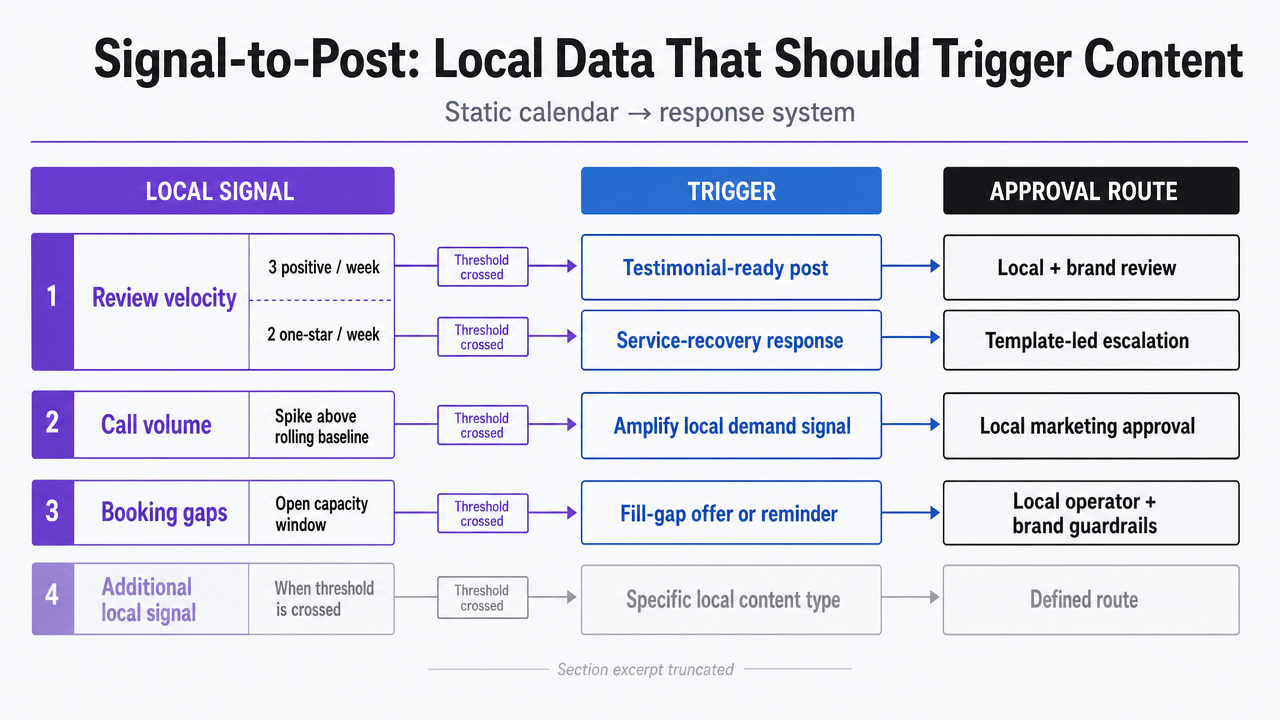 Visualize the four local business signals and how each maps to a content trigger and approval route, directly supporting the section's signal-to-post framework
Compliance Architecture for Regulated Verticals
For DSOs, behavioral health networks, senior living operators, and multi-specialty medical groups, the compliance layer is not a subsection of the social program — it is the constraint that determines what the program can look like at all. A single practice manager posting a before-and-after photo without written authorization can trigger a breach obligation that reaches the entire covered entity.
The rules are settled and the scope is wider than most location teams assume. HIPAA marketing standards require a covered entity to obtain authorization for any use or disclosure of Protected Health Information for marketing, with narrow exceptions such as face-to-face communications 8. The definition of PHI in a social context is broader still — names, photos, videos, tattoos, room numbers, and other unique identifiers all count, and none of it can appear in a post without valid authorization 20. Ohio medical board guidance reinforces the same standard for individual clinicians: no individually identifiable patient health information, no images or videos, without express written consent 6.
The under-discussed risk is the comment thread. HIPAA social media guidance is explicit that responding to a patient post or review can itself be considered a disclosure of PHI, which puts every location-level reply into scope 9. A well-meaning practice manager thanking a patient by name for a five-star review has just confirmed a treatment relationship in public. Tracking technologies compound the exposure — HHS guidance describes how pixels and analytics tools on regulated entity websites can transmit information about user interactions that qualifies as PHI when tied to a covered entity's services 5. Social ads that drive to location landing pages inherit that risk directly.
The architecture that contains all of this has three parts.
- A single written policy — not 50 versions — that defines what location staff can post, what requires authorization, what response templates are pre-approved for reviews and comments, and what escalates to legal.
- Workforce training tied to the policy, refreshed on the cadence enforcement actions demand rather than treated as a one-time onboarding item 9.
- A unified approval workflow so every post and every reply — including the ones authored at the location — passes through the same compliance gate before publishing.
Peer-reviewed work on social marketing enablers found that platform trust and secure data sharing are among the strongest predictors of outcomes 10; in regulated verticals, that trust is manufactured by the workflow, not by the copy.
Behavioral health carries an additional layer. Updated Notice of Privacy Practices requirements now incorporate substance use disorder record rules, which affects how patient-facing communications reference services across a network 7. Systems running behavioral health locations should treat SUD-related content as a distinct approval track with its own template library, not a variant of general health content. The operational rule for VPs: if a location cannot publish or reply without the workflow, the workflow is doing its job.
Consolidation Economics: Three Staffing Models Compared
The cost question for a 50-location system is not which model has the lowest sticker price. It is which model absorbs the coordination load without collapsing the other three variables VPs actually care about: approval speed, compliance coverage, and content volume per site.
Before any of these models earns its budget, the hygiene floor applies equally to all three. AMA franchise guidance sets the baseline at 100% of location pages claimed, verified, and built out with accurate content and images 1. A system that has not cleared that bar is not choosing between operating models — it is losing to competitors who did the basics.
| Variable | Per-Location Agency Retainer | In-House Regional Pods | Centralized Platform + Approval Workflow |
|---|---|---|---|
| Annual cost per location | Retainer × 50 (highest unit cost, scales linearly) | Pod salary + overhead ÷ locations covered (mid-range, steps up per pod) | Platform license + central team ÷ locations (lowest marginal cost, flattens with scale) |
| Approval cycle time | Days to weeks (email chains across brand, legal, location) | 1–3 days (regional bottleneck at pod lead) | Hours (single unified queue) |
| Compliance review coverage | Variable by agency; inconsistent across markets | Partial; depends on pod training and workload | 100% (nothing publishes outside the workflow) 9 |
| Content volume per location per month | Fixed by retainer scope; renegotiated per site | Capped by pod capacity | Elastic; templates plus local variables scale without headcount |
| Scalability ceiling | Breaks past ~30 sites (coordination overhead) 18 | Adds a pod every 15–25 locations | Marginal cost of the 51st site approaches zero |
Two patterns show up in the columns. The first is that per-location agency retainers optimize for creative quality at a single site and fail everywhere coordination matters — the same failure mode the Walden case study documented when small operators tried to run social without a defined strategy or shared production line 18. The second is that in-house regional pods are a hybrid that inherits the worst of both models above roughly 100 locations: pod leads become the bottleneck the field marketer role was supposed to solve, and adding another pod resets the coordination cost clock.
The centralized platform column is not cheaper because it removes people. It is cheaper because it removes the routing work — the emails, the approval chains, the version reconciliation — that grows faster than location count under the other two models. For a VP scoping the next fiscal year, the question worth costing is not "what does each model spend?" but "which model's cost curve flattens when the network doubles?"
 Franchise Local Page Claim/Verification Rate
Franchise Local Page Claim/Verification Rate
Scale Multi-Location Social Content Without Adding Headcount
See how centralized AI workflows enable brand-governed, locally relevant social media content production for every location—while maintaining efficiency, quality, and compliance at enterprise scale.
Measurement That Matters to a VP, Not a Community Manager
Impressions and follower counts do not survive a board meeting. They tell a community manager the account is alive; they tell a VP nothing about whether the network is producing patients, bookings, or qualified calls.
A defensible measurement stack for a 50-plus location system runs on four layers.
- Publish reliability comes first — the percentage of scheduled posts that actually ship on time, per location, per week. If the bottom quartile of sites is publishing at 40% of cadence, no downstream metric matters yet.
- Response latency is second: median time from a review or inbound message to a compliant reply, tracked at the location level. SBA guidance on timely response to public reviews and private messages 3 is the operational bar; anything above 24 hours degrades the customer experience the post was meant to create.
- Content-to-outcome attribution. Impressions tie to calls, calls tie to bookings, bookings tie to revenue — mapped per location, not rolled up to the network. For regulated verticals, HHS tracking technology guidance constrains how that attribution can be built 5, which means the measurement architecture has to be designed with compliance in mind, not retrofitted.
- Coordination cost: hours spent per approved post. When that number drops as location count rises, the operating model is working. When it climbs, the model is quietly failing.
Build Sequence for the First 90 Days
Systems that try to switch operating models in one quarter usually fail because they attempt everything at once. The workable sequence loads the first 30 days with foundation, the next 30 with production, and the final 30 with signal integration.
- Days 1–30 clear the hygiene floor and lock the center. Audit every location page and drive claim/verification to the 100% benchmark AMA franchise guidance sets as the baseline before advanced tactics 1. In parallel, ratify the single written social policy, the compliance rules for regulated locations, and the master template library. Consolidate accounts where the SBA channel-discipline point applies — a network cannot resource platforms it will not monitor 2.
- Days 31–60 stand up the approval workflow and pilot it on a controlled subset. Ten to twelve locations across two or three markets is enough to expose routing failures without risking the whole network. Municipal governance models from Newport Beach and Louisville are instructive here — one policy, one queue, one moderation standard across distributed channels 16, 17. Measure publish reliability and approval latency weekly; both should move before expansion.
- Days 61–90 connect the signals. Wire review platforms, call tracking, and booking data into the content queue so that local business signals trigger pre-approved templates. Roll the workflow to the remaining locations only after the pilot cohort holds cadence for three consecutive weeks. The system is ready when adding a location adds an input, not an approval chain.
Frequently Asked Questions
References
- 1.Localize Your Social Marketing.
- 2.Simple Social Media Guide for Small Businesses.
- 3.5 Tips to Make Your Small Business Social Media Savvy.
- 4.Small Business Social Media Marketing.
- 5.Use of Online Tracking Technologies by HIPAA Covered Entities and Business Associates.
- 6.Social Media & Digital Communications Guidelines.
- 7.Model Notices of Privacy Practices.
- 8.What are the HIPAA Marketing Rules?.
- 9.HIPAA Social Media Guidelines - Updated for 2026.
- 10.Beyond the basics: Exploring the impact of social media marketing enablers on business success.
- 11.Multifaceted Role of Social Media in Healthcare - PMC.
- 12.Social Media and Health Care Professionals: Benefits, Risks ....
- 13.Social franchising in healthcare: a systematic review and narrative ....
- 14.eCommerce Frontline Social Media Forecast.
- 15.Philippines Franchise Concepts.
- 16.Digital Communication | City of Newport Beach.
- 17.Communications | City of Louisville, CO.
- 18.Social Media Marketing Adoption Strategies: An Exploratory Multiple Case Study of Small Businesses.
- 19.Social Media Marketing Basics.
- 20.Lessons Learned: Avoiding Risks When Using Social Media.
- 21.The Effectiveness of Social Media Use for Local Businesses.
- 22.Social Media Impact on Small Brick and Mortar Businesses.