
Key Takeaways
- Social retainer margin leaks come from repetitive planning overhead and revision cycles, not creative work; compressing revision cycles from three to one recovers the majority of rework hours across a portfolio.
- Select channels before building calendars, using audience-presence data such as YouTube reaching 84% of U.S. adults and Facebook 71% 1, and treat platform reformatting as production rather than parallel strategy.
- Engineer post templates around empirically identified engagement drivers—brand features, platform characteristics, and technical post features 7, 8—so reviewers score against a checklist instead of relitigating subjective preferences each week.
- Centralize approval by having clients sign off on the quarterly template, pillar mix, and checklist once, then measure response quality, saves and shares, and format-level engagement 5, 8to defend renewals.
Where Agency Margin Actually Leaks on Social Retainers
Most agency owners can identify the retainer that consistently loses money each month, and it is almost always social media. While the line item appears healthy on proposals, the client seems content, and the strategist produces work on schedule, timesheet audits reveal gross margins far below the agency's target, sometimes questioning the client's viability.
The margin leak rarely stems from the creative work itself. Instead, it originates from a series of small, repetitive decisions surrounding each post: the internal kickoff, the strategist's draft, the account manager's edit, the client's initial review, revisions, a second review, platform-specific reformatting, and scheduling. Each step consumes labor at a loaded rate, and this process multiplies by the post volume across every account.
Social media's distinct challenge lies in its cadence. A monthly SEO deliverable incurs planning overhead once. In contrast, a twelve-post monthly social calendar incurs this overhead twelve times, or more, if the client expects stories, reels, and platform variations. Research on social marketing effectiveness highlights platform trust, perceived value, and support quality as key drivers of measurable outcomes 5. These drivers are not enhanced when a strategist spends hours reformatting captions for multiple channels, which is precisely the margin problem this social media content planner aims to solve.
The Planning-Cost Problem Hiding Inside Every Retainer
Hours Per Post, Multiplied by Every Client
A single social post rarely consumes only its production time. It incurs additional planning hours for pillar assignment, copy drafting, visual briefing, internal review, client review, and at least one revision before publication. Each of these steps is priced at a loaded labor rate, encompassing salary, benefits, software, and overhead.
The financial implications become significant at portfolio scale. An agency managing a modest twelve-post monthly cadence for ten social retainers plans one hundred and twenty posts every month. If each post requires just two cumulative hours of labor from the strategist, account manager, and reviewer, that totals two hundred and forty hours before accounting for media spend or reporting. Two revision cycles per post can push this figure closer to three hundred and sixty hours.
Engagement research identifies brand features, platform characteristics, and technical post features as antecedents to engagement 7. This framing is crucial because planning labor is only productive when it targets these specific inputs. Hours spent on rework, reformatting, or resolving internal disagreements do not contribute to outcomes recognized by engagement literature.
A Per-Client Cost-of-Planning Worksheet
To clearly identify the margin leak, an agency can analyze a retainer using four variables derived from timesheet data. This worksheet avoids fabricated figures, relying instead on actual operational inputs.
| Variable | Symbol | Notes ||---|---|---|| Posts per client per month | P | Includes platform variants counted separately || Cumulative planning hours per post | H | Kickoff + draft + review + revision + scheduling || Revision cycles per post | R | Each cycle multiplies H by a rework factor || Loaded labor rate | L | Salary + benefits + overhead per billable hour || Clients in book | C | Social retainers only |
The monthly planning cost per client is calculated as P × H × R × L. The total cost across all clients is this figure multiplied by C. The most impactful lever, often underestimated by agencies, is R (revision cycles). Reducing revision cycles from three to one does not simply cut costs by a third; it reduces the rework portion by approximately two-thirds, as the initial pass is largely fixed, while subsequent cycles are highly elastic.
A ten-client portfolio with three revision cycles per post can spend the equivalent of a full-time strategist's salary on rework alone. By reducing this to a single reviewed cycle, guided by a template and an approval standard set quarterly, agencies can reallocate that headcount to higher-value strategy work. This lever is effective because engagement outcomes correlate with platform trust, perceived value, and support quality 5, none of which improve with additional internal wordsmithing. Once a post meets engagement criteria, further revision becomes a margin drain.
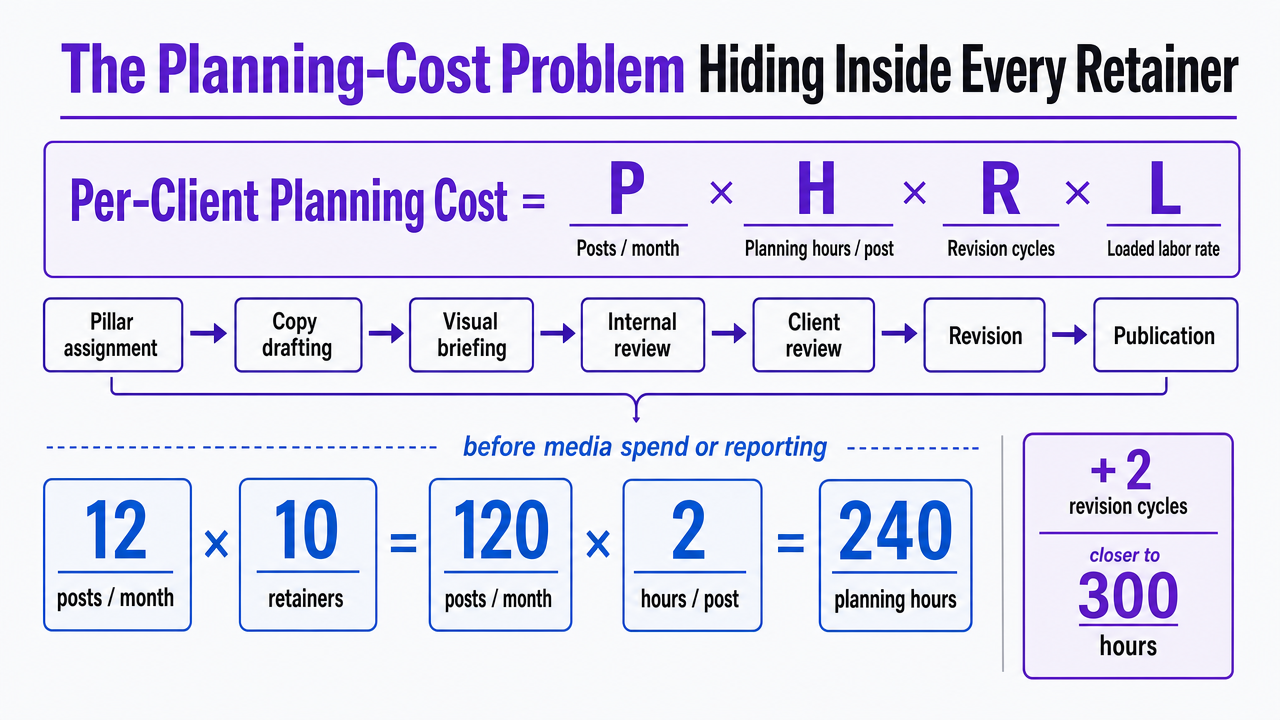 Illustrate the per-client cost-of-planning worksheet formula (P × H × R × L) and the multiplier effect of revision cycles, which is the core operational framework of the section
Channel Selection Before Calendar Construction
Where U.S. Adults Actually Spend Attention
Building calendars before making channel decisions is one of the most costly habits in agency social work. A strategist might open a template with rows for six platforms, inadvertently creating a labor commitment for each, even if the client isn't paying for it or the target audience isn't present on those channels.
The uneven distribution of attention among U.S. adults underscores this point. YouTube reaches 84% of U.S. adults, Facebook reaches 71%, and Instagram reaches 50%. Approximately half of adults visit Facebook and YouTube daily 1. While these figures represent general adult usage, not engagement rates for branded content, they clearly indicate where attention is concentrated and where it is scarce.
Operationally, this means a client whose buyer aligns with the general U.S. adult population is not well-served by treating LinkedIn, X, and TikTok as coequal channels with Facebook and YouTube on the content calendar. Each additional platform variant increases planning hours, as demonstrated in the earlier worksheet. When a channel is added due to client request rather than audience data, the retainer absorbs costs that yield no measurable outcome. A more efficient approach begins with a channel shortlist justified by audience data, followed by a calendar built around that shortlist, and then platform-specific formatting handled as production, not parallel strategy.
Audience-Segment Volatility for Youth-Adjacent Brands
Agencies serving family brands, education clients, youth apparel, or any category targeting teenagers face a planning challenge not captured by general adult data. This demographic exhibits both enormous reach and a significant retreat from social media simultaneously.
Up to 95% of youth aged 13–17 report using a social media platform, with over a third stating they use it almost constantly 2. This data, from the U.S. Surgeon General's advisory, indicates platform presence rather than receptivity to branded content. Conversely, 44% of teens report reducing their social media use, a slight increase from 2023 3. A Pew report also notes that 48% of teens believe social media has a mostly negative effect on their age group 3.
For planning, this dynamic alters the calendar's structure. Volume-heavy schedules targeting teen audiences risk betting against a segment actively reducing exposure and expressing negative sentiment about the medium. Agencies working with youth-adjacent brands should maintain lower post frequency than for adult-audience clients, prioritize formats on platforms their specific segment still favors, and revise their channel shortlist biannually instead of annually. Assuming a stable teen audience across a twelve-month calendar leads to underperforming retainers.
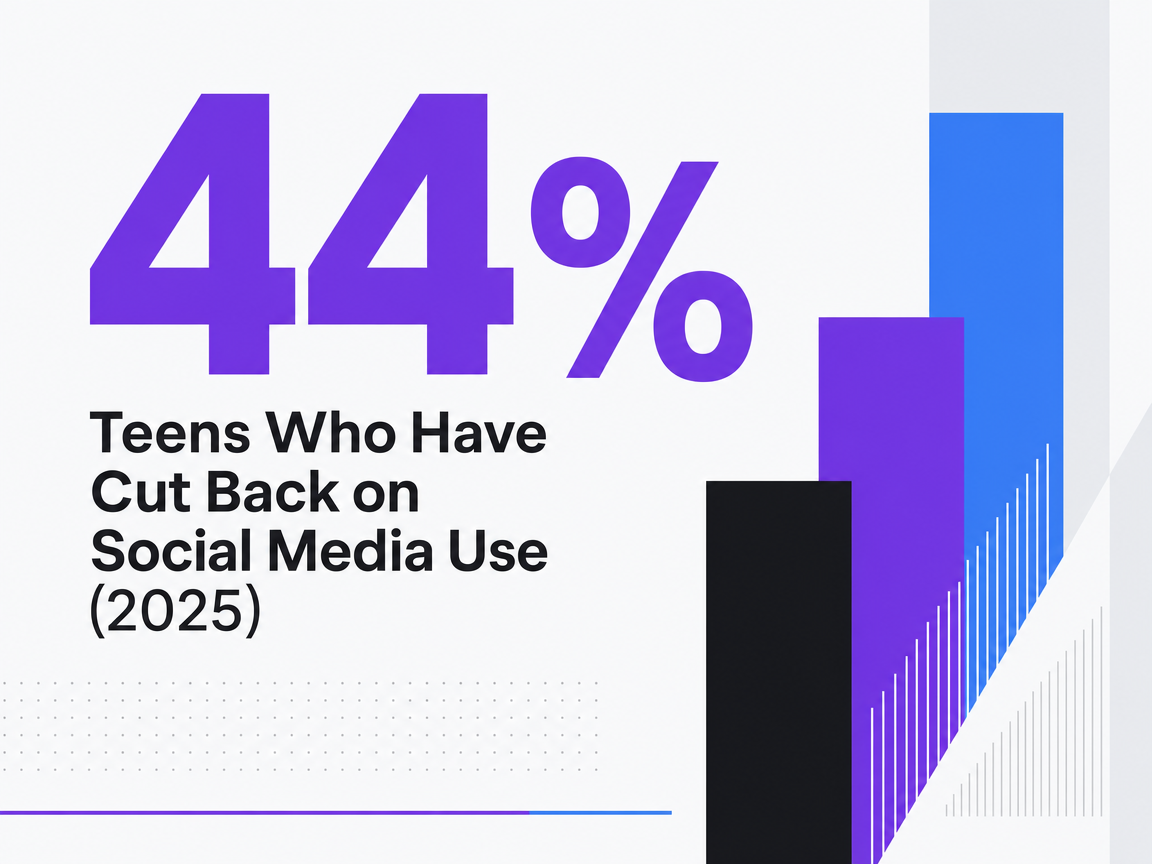 Teens Who Have Cut Back on Social Media Use (2025)
Teens Who Have Cut Back on Social Media Use (2025)
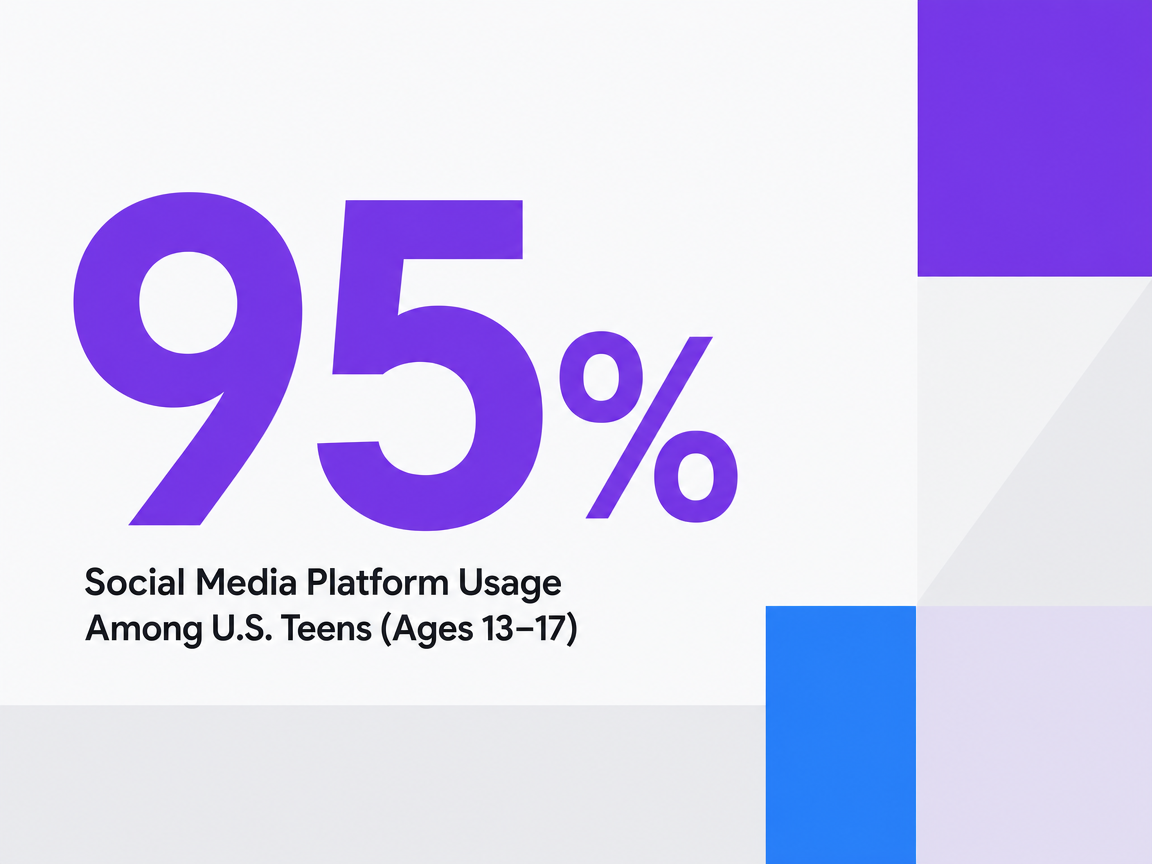 Social Media Platform Usage Among U.S. Teens (Ages 13-17)
Social Media Platform Usage Among U.S. Teens (Ages 13-17)
Test a unified social planning workflow today
See how streamlined approvals and orchestration impact your agency’s content delivery, risk-free for 7 days.
Engineering Posts Instead of Guessing at Them
What the Engagement Literature Actually Says
The phrase "we'll know it when we see it" becomes costly when applied across multiple client calendars. It encourages subjective revision, which inflates planning hours beyond budget. Academic research on social engagement offers a more valuable perspective than many agencies realize, treating engagement as the result of identifiable inputs rather than subjective taste.
A foundational paper on social media engagement identifies brand features, platform characteristics, and technical features of posts as antecedents to engagement, meaning the mechanics of the post itself are measurable drivers alongside audience and channel 7. A 2024 systematic review corroborates this by cataloging specific elements that influence engagement metrics on social media posts 8. Earlier field work on content-driven engagement in large-scale real-world settings further supports this argument 6.
Another 2024 peer-reviewed study on social marketing success highlights customer support, platform trust, secure data sharing, and perceived value as significant factors 5. This finding is particularly important for agency operators, as it reframes the objective. The planning goal is not to create posts a strategist personally likes, but to produce posts whose observable features align with empirically isolated drivers, and to cease expending labor on features that do not contribute to these drivers.
Turning Findings Into Template Rules
The operational solution is to translate these research findings into template rules that can be enforced by a template and quickly scored by a reviewer. Each post pillar should have a fixed structure: an opening hook, a claim linked to a customer-support or perceived-value angle derived from marketing-effectiveness literature 5, a supporting visual specification, and a call-to-response tailored to the platform's specific interaction pattern. Technical features identified as consequential by engagement reviews, such as caption length, visual composition, and format choice, become fields on the template rather than subjective judgments 8.
Such rules streamline the reviewer's task into a checklist:
- Does the hook exist?
- Does the claim connect to a research-identified driver?
- Does the format match the platform?
- Is there a response prompt?
A post that clears this checklist ships. A post that doesn't receives one revision based on the same checklist, not a subjective rewrite.
The benefit is the revision-cycle compression discussed earlier. When standards are documented and evidence-based rather than preference-driven, subsequent rounds of edits become unnecessary, as there is no basis for further debate. The strategist's expertise is applied to the template itself, once per quarter, instead of to every post, every week.
Approval as the Real Bottleneck
The Briefing-Cycle Model and Why It Compounds Cost
The traditional approval sequence resembles a relay race with excessive handoffs. A strategist drafts, an account manager reviews, the client marketing lead comments, their director weighs in, legal or compliance reviews for regulated accounts, and the post returns to the strategist for reconciliation. Each handoff introduces queue time, context reloading, and minor edits that arrive after substantive changes have already been addressed.
The cost is not in individual reviews but in their compounding effect. A post moving through five sequential reviewers, each with a one-business-day queue, can take a full working week to ship. Any reformatting request arriving late in the sequence resets stages that earlier reviewers had already cleared. The planning-hours worksheet accounts for revision cycles as a multiplier on labor cost for this precise reason.
The deeper issue is that the briefing-cycle model treats every post as a new negotiation. Standards are re-litigated weekly because no reviewer is anchored to a written criterion accepted by others. Research on marketing effectiveness points to trust and perceived value as significant drivers of outcomes 5, neither of which is enhanced by a fifth round of caption edits arriving on a Friday afternoon.
Centralized Approval Orchestration
The alternative is to centralize decision-making earlier in the process. Centralized approval orchestration means a single reviewer, using the template rules established previously, clears a batch of posts against a written checklist, rather than multiple stakeholders clearing individual posts based on private preferences. The strategist's recommendation, its rationale, and the evidence linking it to engagement drivers 7, 8are all visible alongside the approval action.
In practice, this means the client approves the quarterly template and pillar mix once, not the twelve individual posts generated monthly. Revisions that meet the checklist criteria are batched into a single reviewed pass, not distributed throughout the week via email threads. The account manager shifts from being a courier between strategist and client to focusing on the strategic work for which the retainer is priced.
The margin impact directly relates to the revision-cycle variable in the earlier worksheet. When 'R' drops from three to one across a ten-client portfolio, the reclaimed hours are substantial, representing the difference between a social service line that funds strategy work and one that quietly subsidizes it. This planning discipline can pay for itself within the first billing cycle after implementation.
KPIs That Connect Planning to Client Retention
Retention on social retainers correlates less with reach metrics and more with whether clients perceive the work as producing outcomes they can justify to their own leadership. Reach and impressions, often prioritized on agency dashboards, are the metrics least connected to the significant drivers identified in peer-reviewed research. Customer support quality, platform trust, secure data sharing, and perceived value are the factors that drive social marketing success empirically 5. None of these are reflected in an impressions total.
A planning framework that fosters client retention measures what the strategist can influence and what the client can act upon. Three categories are particularly impactful:
- Response quality, tracked by inbound message resolution time and the proportion of comments receiving substantive replies, directly relates to the customer-support driver.
- Save and share rates, rather than likes, better indicate perceived value because they capture instances where a user deems a post worth keeping or forwarding.
- Format-level engagement, broken down by the technical features highlighted as consequential in systematic reviews 8, informs the strategist which template rules to retain or revise during quarterly reviews.
Reporting structured around these three categories links planning decisions to renewal discussions. The client sees which pillars generated saves, which formats elicited replies, and which channels underperformed enough to be dropped. The strategist enters renewal conversations with a defensible record of the retainer's value, not merely a screenshot of follower counts. This reporting approach helps maintain a book of business over a twelve-month cycle.
Streamline Social Content Approval and Execution for Maximum Margin
See how centralized planning and governed workflows can eliminate approval bottlenecks, cut production overhead, and deliver consistent multi-channel results—without sacrificing client oversight or strategic control.
Planning Inputs for Regulated Verticals
Agencies serving regulated industries such as law firms, behavioral health practices, dental groups, senior living operators, and healthcare clients face unique planning requirements. Content must comply with advertising regulations, patient-privacy standards, and platform data practices. The calendar must integrate these constraints upfront, rather than discovering them mid-cycle.
The FTC has enforced Section 5 of the FTC Act against unfair or deceptive data-security and privacy practices 9, and its guidance on consumer data emphasizes notice, choice, and limits on downstream use as baseline protections 10. The 2024 FTC study of major social and video platforms details the data environment these channels operate in, influencing what regulated clients can safely target and measure 11. For planning, this means audience-segment definitions, tracking configurations, and any use of client-supplied data must be resolved before the pillar mix is drafted, not after a post is queued.
The practical adjustment is to incorporate a compliance layer into the template once, rather than adding a legal review to every post. Approved claim language, prohibited terms, disclosure formats, and data-use boundaries are embedded within the pillar structure. The reviewer scores against these fields using the same checklist that governs engagement criteria, ensuring revision cycles remain compressed because the standard was established before the calendar began.
If an Agency Runs a Portfolio of Location-Based Clients
This section focuses on agencies serving multi-location clients, such as dental groups with multiple offices, senior living operators with a regional footprint, home services franchisees, or law firms with satellite offices. The planning challenge shifts significantly when a single client requests location-specific social output across ten or forty addresses.
The costly error is treating each location as a separate content plan. A forty-location client managed this way multiplies pillar work by forty and review work even more, as each location manager may want input on their feed. A more effective structure involves one approved template set at the brand level, one pillar mix, and location-level fields populated as production rather than strategy. The engagement drivers identified in literature, including platform trust and perceived value, operate at the brand level and do not necessitate forty parallel calendars 5.
| Planning input | Brand level | Location level ||---|---|---|| Pillar mix | Set once per quarter | Not adjusted || Template rules | Set once per quarter | Not adjusted || Approval standard | Set once per quarter | Not adjusted || Local proof points | Sourced quarterly | Populated per post || Response handling | Escalation path only | Owned locally |
Margin is generated by avoiding duplication of strategy work that only needs to occur once.
A Grounded Recommendation for Agency Operators
The three levers discussed in this planner work synergistically:
- Channel selection based on actual audience presence 1,
- templates engineered using post-level features identified by engagement research 7, 8, and
- a single approval standard applied consistently rather than re-litigated weekly.
Each lever compresses the revision-cycle variable, which is critical for determining whether a social retainer is profitable.
Agency operators seeking to consolidate strategy, ranked recommendations, and a single point of approval across social and adjacent channels can explore how Vectoron's Command Center manages this workflow. While the planning discipline described here is effective without specific tooling, it operates more efficiently with orchestration that centralizes the approval standard.
Frequently Asked Questions
References
- 1.Americans' Social Media Use 2025 | Pew Research Center.
- 2.Social Media and Youth Mental Health: The U.S. Surgeon General’s Advisory.
- 3.10 facts about teens and social media - Pew Research Center.
- 4.Associations Between Screen Time Use and Health Outcomes ....
- 5.Beyond the basics: Exploring the impact of social media marketing ....
- 6.The Effect of Social Media Marketing Content on Consumer ....
- 7.Social Media Engagement: Content Strategy and Metrics Research ....
- 8.Elements Influencing User Engagement in Social Media Posts on ....
- 9.Global Regulation of Data Flows in a Post-Snowden World.
- 10.Big Data and Consumer Privacy - Federal Trade Commission.
- 11.Examining the Data Practices of Social Media and Video Streaming ....