
Key Takeaways
- Treat social as a closed-loop system across four stages—audience intelligence, channel-fit production, blended spend, and measurement—wired into two-week feedback cycles rather than quarterly waterfalls.
- Coordination capacity, not creative talent or budget, is the binding constraint; the video gap where 67% value it but only 7% fully use it reflects process bottlenecks 4.
- Defend budget as three sub-lines with distinct jobs: organic for intelligence, paid for distribution, and creators near Deloitte's 24% category benchmark 5, reporting brand lift, assisted pipeline, and sentiment risk separately.
- Focus the next quarter on reducing coordination latency—parallel channel briefs, time-budgeted approvals, and AI-assisted drafting under human checkpoints—rather than expanding headcount or output volume.
The Coordination Problem Hiding Inside Your Social Strategy
Most content marketing managers face a coordination problem, not a social media strategy problem. While calendars are built and channels mapped, the pipeline from blog post to LinkedIn carousel to short-form video often stalls due to approval bottlenecks.
Data supports this: 90% of B2B marketers use social channels for content distribution, making it a universal layer rather than a competitive advantage 12. Half of B2B teams running paid channels report good results from social ads, and audience knowledge is the strongest predictor of content success 3. The strategic value is clear; the execution remains challenging.
Traditional frameworks suggest six stages: strategy, planning, implementation, engagement, measurement, and optimization 2. While sound in structure, this linear approach fails in a system requiring continuous feedback. Audience insights from social media should inform briefs immediately, not wait for quarterly planning.
This article views social media as a closed-loop distribution and intelligence system, identifying coordination, not creativity, as the primary constraint on velocity.
Why Most Social-for-Content Frameworks Fail Operators
The Strategy-Execution Gap in Plain Numbers
The Content Marketing Institute's video research highlights the execution gap: 67% of marketers say video is more important, and 54% report social media videos deliver strong results, yet only 7% feel they fully utilize video 4. This self-reported data suggests that even marketers who believe in video struggle with its implementation, indicating a systemic issue beyond willingness.
This gap reveals a critical structural signal: strategic conviction and channel performance are established, but execution capacity remains stagnant. Frameworks that merely advocate for "prioritizing video" overlook the operational challenges that prevent teams from achieving their goals, assuming willpower alone can bridge the divide.
For content marketing managers, any framework that doesn't detail how a brief translates into a published asset within the channel's native cadence is incomplete. The significant disparity between video's perceived importance and its actual utilization represents a budget line item that social frameworks should aim to reduce.
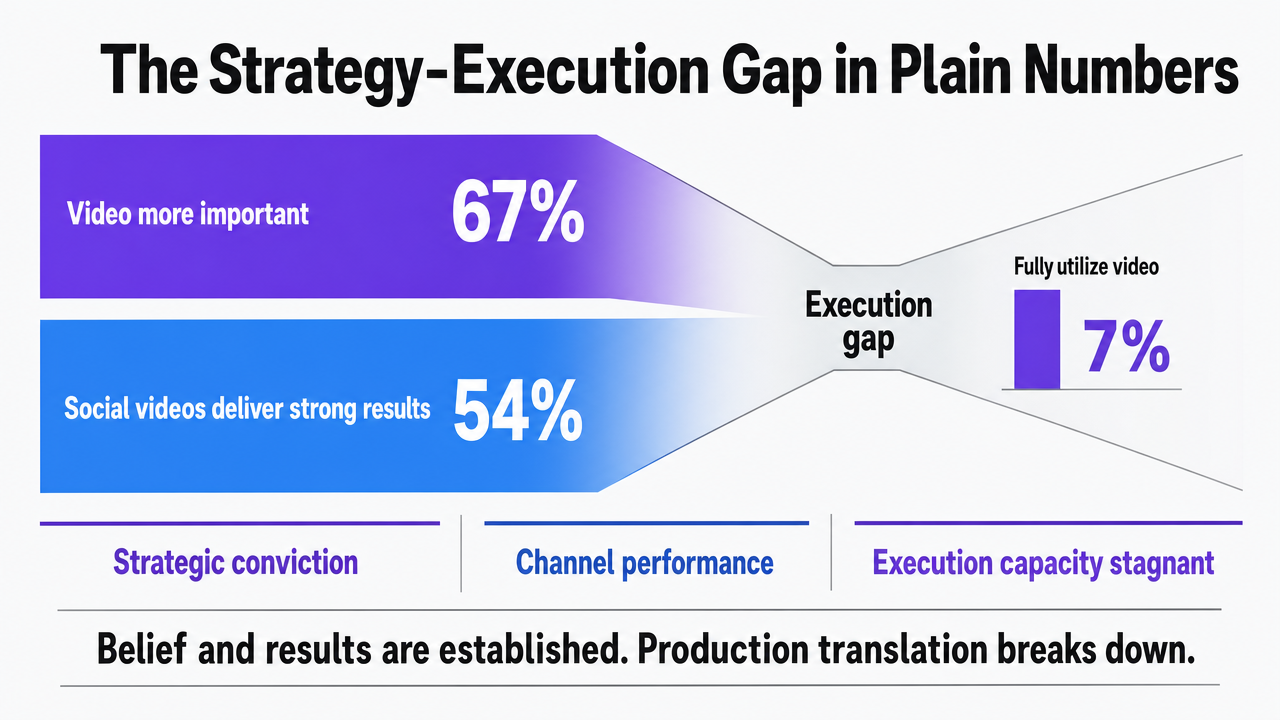 Visualize the stark gap between video's perceived importance and actual utilization, which is the central evidence of the section
From Six-Stage Process to Closed-Loop System
The prevailing industry model for social media, encompassing strategy, planning, implementation, engagement, measurement, and optimization 2, is often presented as a linear progression. While visually clear, this model assumes quarterly feedback cycles, which are too slow for dynamic social media environments. For instance, if a post performs exceptionally well, the linear model delays incorporating that insight into future briefs until the next planning cycle.
Academic research increasingly frames social media, particularly in B2B, as a co-creation channel where audiences actively shape messaging 7. This perspective transforms measurement into an input for content creation, rather than a final stage. Insights from comment sentiment, save rates, share patterns, and reply language should inform new briefs immediately, not be confined to monthly reports.
Content marketing managers can adapt this by retaining the six stages as functions but wiring them into a two-week feedback loop instead of a quarterly waterfall. This allows implementation to feed measurement, measurement to inform planning, and planning to revise strategy mid-quarter based on strong signals.
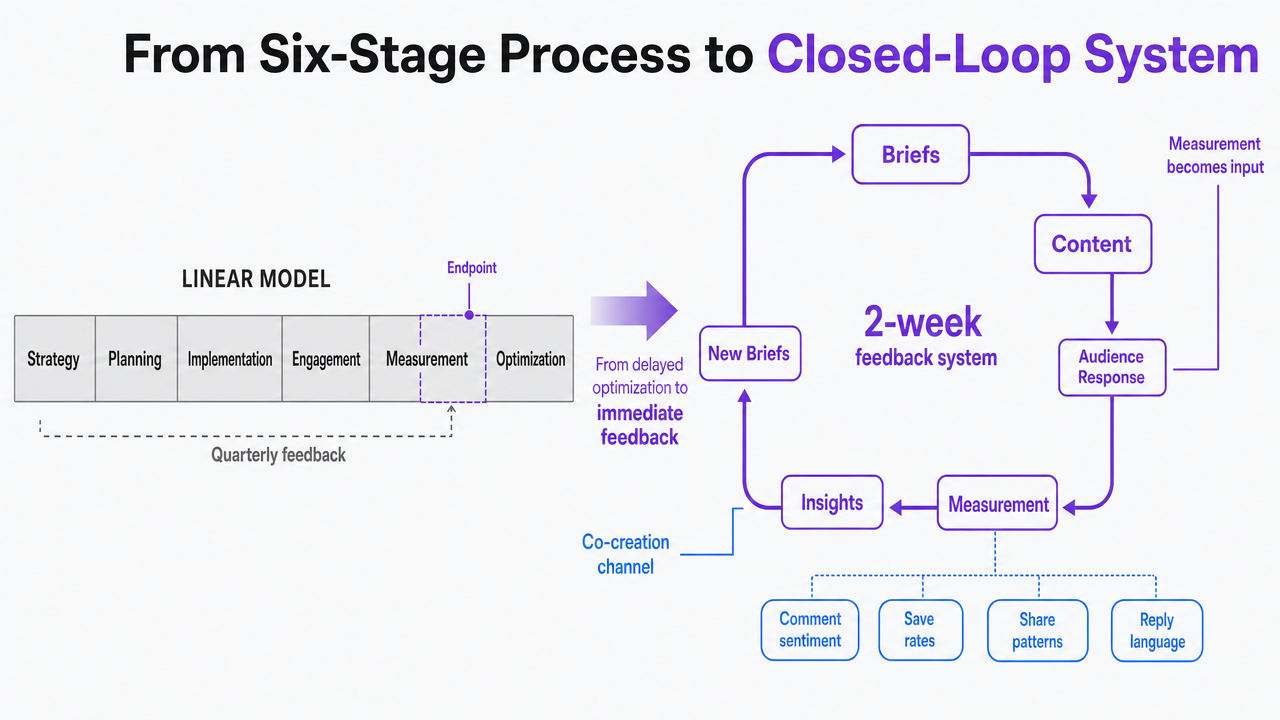 Visualize the article's reframing of the traditional linear six-stage social media model into a closed-loop two-week feedback system, which is a core framework contribution of the article
Stage One: Audience Intelligence as a Two-Way Channel
What 'Knowing the Audience' Actually Means in 2024
Audience knowledge is a crucial factor in content marketing success. The 2024 CMI/MarketingProfs B2B survey found that 79% of top-performing B2B content marketers identified audience understanding as a key success factor 3. Given that 90% of B2B marketers use social channels for content distribution 12, the most successful teams are those who leverage insights from these platforms to inform their content briefs.
The definition of "knowing the audience" has evolved beyond annual persona documents and quarterly surveys. In 2024, it involves actively monitoring comment threads, reply chains, save patterns, and direct message volumes, treating these as primary research. While persona decks provide initial orientation, they cannot replace the continuous, real-time signals generated by social media engagement.
Wiring Social Signals Back Into the Brief
Typically, social performance data is compiled into monthly reports, informing subsequent planning cycles, while content briefs are often locked weeks in advance based on older keyword research and stakeholder requests. This disconnect prevents real-time insights from influencing content creation.
A closed-loop system integrates three key social inputs directly into the brief template:
- Audience language from replies and quote-posts
- Specific objections from comment threads
- Format-level patterns indicating engagement
These become mandatory fields, ensuring that content is shaped by current audience interactions. For example, if a SaaS content team observes finance leaders reframing a procurement angle on LinkedIn, this directly informs the next brief, as the audience has already provided positioning guidance.
This dynamic reflects the co-creation model where buyers influence messaging in real-time 7. Operationally, it requires a designated individual who interprets social data as research, tags signals against active briefs, and has the authority to adjust scope mid-cycle. Without this role, the feedback loop remains open, and briefs risk becoming outdated.
Accelerate Social Content Publishing This Week
Experience rapid, data-driven content delivery across all social channels with measurable results—before you commit.
Stage Two: Channel-Fit Production Without Headcount Growth
Repurposing as a Production Model, Not a Salvage Operation
Many content teams view repurposing as an afterthought, slicing a pillar article into social posts only when bandwidth allows. This approach is inefficient because it consumes significant pipeline time (briefing and drafting) but often yields suboptimal, channel-unfit content, as the original asset was designed for a different context.
Drawing from higher-education content research, a more effective model treats creation and repurposing as parallel design decisions 1. In this approach, a pillar brief simultaneously outlines the main article, a LinkedIn carousel, a short-form video script, and a comment-thread prompt. Each channel-specific asset is designed with its own hook, length, and success metrics from the outset, eliminating the need for post-hoc adaptation.
Consider a SaaS content team running a webinar. Instead of merely producing a recap blog and a clip, a channel-fit model would generate a numbered LinkedIn post from the Q&A, a 45-second vertical video clip highlighting a key objection-handling moment, and a carousel summarizing the framework—all briefed before the webinar. This doesn't double labor but increases approval cycles, highlighting coordination capacity, not creative capacity, as the limiting factor for channel-fit output 7.
The Video Pillar and the Capability Gap
Video production often exposes the limitations of channel-fit models due to the significant gap between strategic intent and actual output. While half of paid B2B marketers report good results from social media advertising, with video driving much of this performance 3, CMI's research indicates a capability gap: strong conviction in video's importance but low utilization 4. This isn't a lack of creative talent; teams understand effective social video.
The primary constraint is process. Producing a 45-second vertical video requires:
- A script
- Shooting or screen capture
- Captions
- A thumbnail
- Legal review (if applicable)
- Platform-specific uploading
Each step involves different owners. Scaling this for multiple platforms and a weekly cadence quickly leads to workflow collapse due to coordination overhead, long before ideas run out.
An effective operational strategy is to treat video as a production line with defined handoffs and time budgets. For example, a healthcare brand planning a creator-led explainer should pre-determine which 15-second cut goes to TikTok and which 45-second version goes to LinkedIn, along with who approves each, with medical review running in parallel. This approach doesn't alter the framework stages but significantly reduces latency between them, addressing the execution gap marketers frequently report 4.
Stage Three: Blending Organic, Paid, and Creator Spend
What Each Mode Actually Buys You
Organic, paid, and creator content are distinct investments, each offering unique benefits. Understanding these differences is crucial for content marketing managers before budget discussions.
Organic posting provides audience intelligence and builds compounding brand presence. It's the most cost-effective way to gather insights on reply language, save patterns, and objection framing, which are vital for Stage One. However, its reach is limited, and while earned distribution can be as effective as paid per impression, its volume ceiling and variance are significant 11.
Paid amplification offers predictable distribution and measurable lift. The 2024 CMI/MarketingProfs survey indicates that half of B2B marketers using paid channels report good results from social ads 3. Paid channels allow a successful organic post to be scaled into a controlled experiment with known costs per outcome.
Creator partnerships provide credibility that a brand account often cannot achieve independently. Nielsen's research on Facebook impressions showed that socially endorsed paid placements (ads featuring a friend or trusted voice) generated greater brand lift than standard paid units with similar reach 11. This structural advantage has moved creator content from an experimental tactic to a standard budget line item.
A Defensible Allocation Lens for Finance Conversations
Content marketing managers must justify their budget mix to finance with quantifiable data. The 2024 benchmark data provides a starting point. Deloitte's 2025 State of Social report found that creators were the top social marketing budget priority in 2024, accounting for approximately 24% of average yearly social spend 5. Concurrently, 50% of B2B marketers using paid channels reported good results from social advertising in the CMI/MarketingProfs 2024 survey 3.
These figures suggest a defensible default: roughly a quarter of the social budget for creators, a significant portion for paid amplification of validated organic posts, and the remainder for organic production and audience intelligence (Stage One). The precise allocation should vary based on industry and buying cycle. For instance, a regulated healthcare brand might prioritize organic and paid due to higher creator vetting costs, while a SaaS team with a clear Ideal Customer Profile (ICP) and mature paid program might exceed the 24% creator benchmark.
A successful financial defense isn't about a fixed ratio but the ability to articulate what each dollar achieves—intelligence, distribution, or credibility—and to demonstrate the metrics it influences. A single "social budget" line is difficult to defend, but three sub-lines with clearly defined outcomes are more robust.
Stage Four: Measurement That Survives a CMO Review
Brand Lift, Pipeline Contribution, and Sentiment Risk as Three Separate Reads
Measuring social performance effectively requires more than a single metric. A CMO review benefits from presenting three distinct measures.
The first is brand lift, which assesses whether audience exposure increases brand recognition, recall, or preference. Nielsen's research showed that socially endorsed paid placements generated greater brand lift than standard paid units at similar reach, and earned media could match or exceed paid effectiveness per impression, albeit with volume ceilings 11. This distinction helps managers attribute contributions from organic, paid, and creator content separately.
The second measure is pipeline contribution. Half of B2B marketers using paid channels reported positive results from social ads in the 2024 CMI/MarketingProfs survey 3. Pipeline contribution is best reported as assisted conversions and influenced opportunities, rather than last-click revenue, as social media rarely closes high-consideration B2B deals independently 9.
The third, often overlooked, measure is sentiment risk. Addressing this gap is crucial for Stage Four.
Governing the Downside: When Social Content Costs Revenue
Sentiment risk is frequently categorized as a PR concern, but its impact on revenue can be significant. McKinsey's research, highlighted in Marketing Dive, includes a telecom case where negative online buzz led to an 8% decline in sign-ups, directly linking social sentiment to revenue loss 10. While this is a specific case, it demonstrates the potential for direct financial impact that should be included in CMO reviews.
Operationally, a content calendar that publishes creator briefs, paid amplifications, and organic posts weekly without a clear approval process creates the same risk quantified in the telecom case. Implementing approval-first workflows—where every creator script, paid boost, and reactive post is human-reviewed before publication—transforms latent risk into managed risk.
Content marketing managers should integrate sentiment risk into their dashboards alongside brand lift and pipeline contribution, establishing a threshold for pausing amplification if negative signals emerge. Platforms like Vectoron streamline these approvals through a single workflow, ensuring governance scales with output rather than becoming a bottleneck.
Streamline Social Content Production with Data-Driven Approval Workflows
See how leading teams coordinate multi-channel content and social publishing—at scale—using unified oversight, automated execution, and measurable performance tracking.
Coordination Capacity: The Real Constraint on Output Velocity
The core argument across these stages is that the primary limitation on social-for-content output isn't creative talent, channel expertise, or budget. Instead, it's the sheer volume of approvals, handoffs, and context switches a team can manage weekly before quality declines or work stalls.
McKinsey's research on social technologies estimates that between $900 billion and $1.3 trillion in value could be unlocked in the U.S. economy, with roughly two-thirds stemming from improved internal communication and collaboration 13. While this figure encompasses cross-industry collaboration, the principle applies to content teams: significant leverage lies in optimizing how work flows between people, not just in the work itself.
For a content marketing manager, a practical exercise is to count the touchpoints for a single LinkedIn carousel from brief to publication:
- Brief writer
- Designer
- Copy reviewer
- Legal/compliance
- Social manager
- Scheduler
This involves six distinct touchpoints, each with its own queue. The B2B literature describes social as a co-creation channel that should operate on a daily cadence 7. Most teams cannot achieve this without re-engineering their approval processes.
AI-assisted execution, under human oversight, provides a solution by compressing the queue without removing critical checkpoints. Briefs, drafts, and channel-specific variants can be generated in parallel, while human approval remains governed. This operating model is essential for the four-stage framework to function as a continuous loop rather than a linear waterfall.
What an Operator-Grade Quarter Looks Like
A content marketing manager effectively implementing the four stages in a continuous loop should be able to outline the next 90 days with six concrete commitments. The approach is specific.
In week one, audience intelligence becomes a dedicated function, with a tagging system routing reply language, objection patterns, and high-performing content signals into the active brief queue within 48 hours. From week two through twelve, every pillar asset enters production with its channel-specific variants—article, carousel, 45-second video, comment prompt—briefed simultaneously, transforming repurposing from a salvage operation into an integrated part of the process 1. The budget is divided into three defensible sub-lines: organic production linked to intelligence, paid amplification triggered by organic performance thresholds, and creator partnerships aligned with Deloitte's 24% category benchmark 5.
Monthly measurement reports three distinct metrics: brand lift by content mode, assisted pipeline contribution, and a sentiment risk score with a defined pause threshold 10. Approval routing is time-budgeted per asset class, with AI-assisted drafting accelerating initial content creation while human checkpoints maintain governance. This quarter's focus is on increasing output velocity by reducing coordination latency, not by expanding the team.
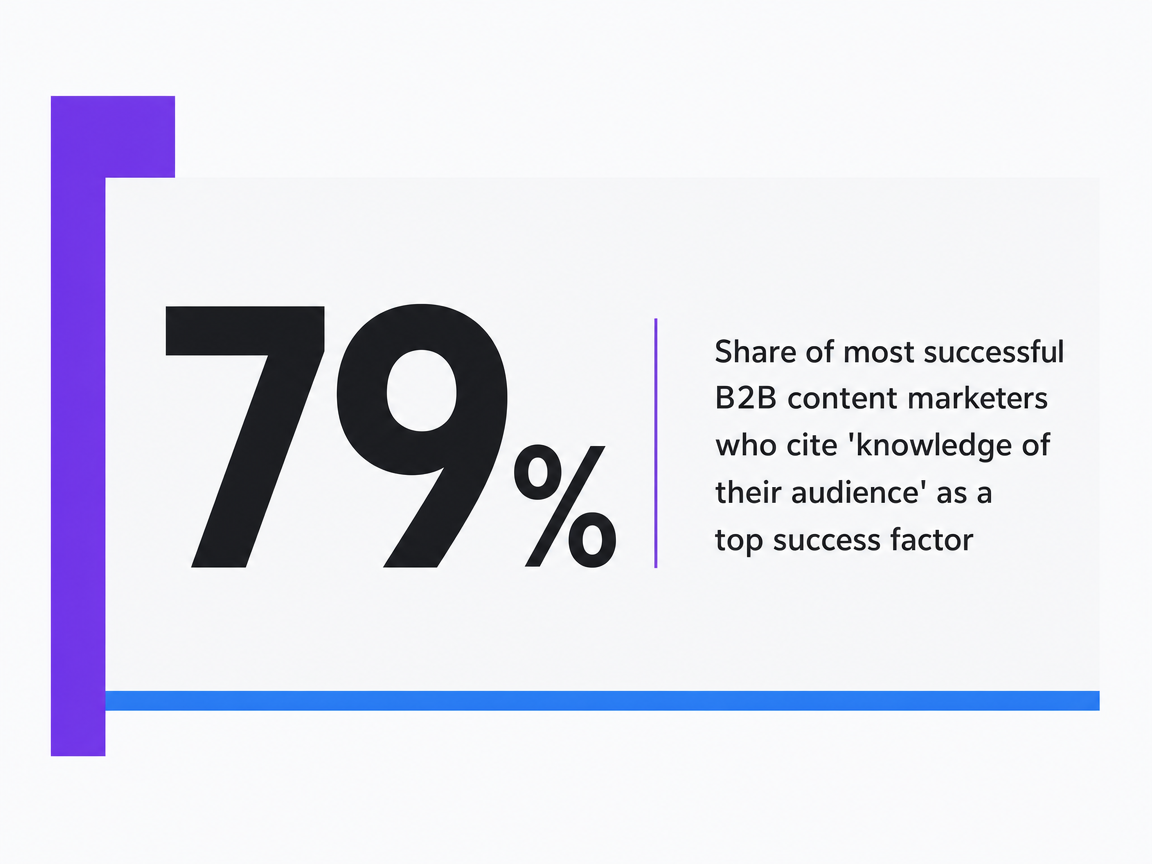 Share of most successful B2B content marketers who cite 'knowledge of their audience' as a top success factor
Share of most successful B2B content marketers who cite 'knowledge of their audience' as a top success factor
Frequently Asked Questions
References
- 1.A Framework for Integrating Content Marketing and Social Media for Higher Education Institutions.
- 2.Social Media Marketing Framework.
- 3.B2B Content Marketing Benchmarks, Budgets, and Trends: Outlook 2024.
- 4.Why Most Video Content Fails To Reach Its Full Potential [New Research].
- 5.2025 State of Social Research.
- 6.Teens, Social Media and Technology 2024.
- 7.The new times of social media marketing in the B2B framework.
- 8.The Influence of Digital Content Marketing and Online Channels on Brand Performance.
- 9.Social media marketing in B2B: Capabilities, usage and performance.
- 10.McKinsey: Data reveals social media impact on sales.
- 11.Nielsen research: Social media impressions in Facebook ads.
- 12.25 Content Marketing Statistics for 2024.
- 13.The Real Return on Marketing Investment in Social Media.
- 14.Social Strategy at Harvard Business Review.