
Key Takeaways
- Social earns budget only when anchored to a named ICP target list and mapped to all six buying-committee roles, not generic personas or single deciders.
- Sequence social as one instrumented layer inside an omnichannel motion, with social selling activating once accounts cross a defined engagement threshold tied to CRM handoff.
- Defensible reporting splits sourced pipeline, influenced pipeline, and revenue—conservative on first-touch sourcing, transparent on influence criteria—rather than headlining impressions or reach.
- Bake FTC disclosure standards, substantiation files, and a fixed approval cadence into the creative brief upstream so compliance and throughput never stall the calendar.
Why social earns budget only when it produces opportunities
Demand gen managers defending social media line items are no longer rewarded for reach. They are asked one question: did this channel create or accelerate opportunities that closed? A social media marketing campaign that cannot trace its work to sourced pipeline, influenced pipeline, or revenue is functionally a brand expense, and brand expenses get cut first when targets slip.
The shift is operational, not philosophical. B2B buyers move through coordinated paid, organic, search, email, and sales touches before a conversation ever starts, and market leaders keep investing in that coordinated motion rather than treating each channel as its own scoreboard 9. Social only earns its budget when it functions as one instrumented layer inside that motion, feeding opportunity creation the same way paid search or outbound does.
This piece treats social as a pipeline system with five working parts:
- ICP-anchored targeting
- Committee-aware creative
- Social selling integrated with sales
- Compliant endorsement workflows
- Measurement tied to opportunities and revenue
Each section is built so a demand gen manager can defend the program in a budget review with specific numbers, not adjectives.
Anchor the campaign to ICP and the buying committee
Define the ICP as a target list, not a persona
Personas describe people. Target lists describe revenue. A social media marketing campaign built for pipeline starts with a finite, named set of accounts that match firmographic, technographic, and operational criteria the sales team already uses to qualify deals. Everything else—creative, paid distribution, social selling activity, measurement—gets evaluated against whether it moves that list.
The practical shift looks like this. Instead of "VP of Operations at a mid-market SaaS company," a demand gen manager defines the ICP as a list of 600 to 2,000 accounts with named decision-makers, their LinkedIn URLs, current vendor signals, recent funding or expansion activity, and the rep who owns each account. Paid social audiences are built from that list. Organic content is engineered to be useful to the people on it. Sales activity is timed against engagement signals from the same accounts.
This matters for measurement. When the ICP is a list, opportunity creation can be attributed back to specific accounts that touched specific social assets, which is the precondition for reporting sourced and influenced pipeline downstream. Without a list, social attribution collapses into channel-level impressions and clicks—numbers that do not survive a budget review.
Map content to buying-center roles
B2B purchases are not made by a single lead. They are made by a buying center—initiators, users, influencers, deciders, buyers, and gatekeepers—each with different questions, risk tolerances, and authority. B2B marketing is highly strategic precisely because firms gather extensive information about customers and the roles inside the buying center 8. A social campaign that speaks only to the decider ignores five other people who can stall or kill the deal.
Mapping content to roles forces creative discipline.
Initiator : Often a user or middle manager who first notices the problem—responds to diagnostic content: short-form posts, problem-framing carousels, and tactical breakdowns that name the pain in their language.
User : Will live with the product—wants workflow detail, integration notes, and honest comparisons.
Influencer : Commonly a peer or technical advisor outside the immediate team—engages with research, benchmarks, and analyst-style commentary that they can forward internally.
Decider : Needs business-case material: outcome data, risk framing, and executive-grade case studies.
Buyer : Runs procurement—looks for contract structure, security posture, and vendor stability signals.
Gatekeeper : Usually an executive assistant or operations lead—screens outreach and responds to credibility cues: mutual connections, public reputation, and clear relevance.
The operational artifact is a role-to-format matrix that pairs each role with the asset types and channels most likely to reach it. Initiators are reached through high-frequency organic posts and short video. Users are reached through technical threads, demos, and community content. Influencers are reached through long-form thought leadership and research distribution. Deciders are reached through executive posts, customer story video, and targeted paid placements against the ICP list. Buyers are reached through trust assets—security pages amplified socially, compliance content, and third-party validations. Gatekeepers are reached indirectly through brand familiarity built across the other five roles.
This matrix becomes the creative brief for the quarter. Every asset gets tagged with the role it serves before it ships, and the social calendar is audited against role coverage rather than post volume. Teams that skip this step tend to overproduce decider content—because that is who sales asks for—and underproduce the user and influencer assets that actually move accounts through the committee.
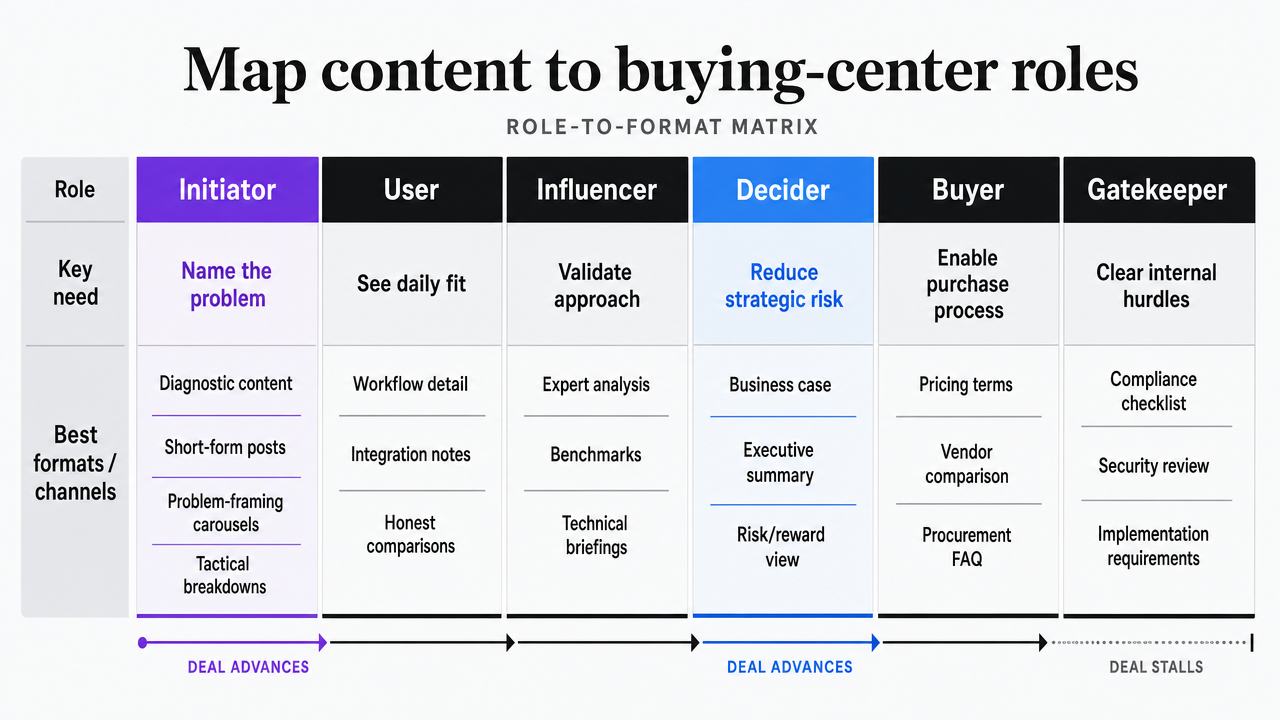 Visualize the role-to-format matrix described in the section, pairing each of the six buying-committee roles with their recommended content formats and channels
Treat social as a layer inside an omnichannel motion
A social media marketing campaign that runs in isolation will lose to one that is sequenced against email, search, and sales outreach. B2B buyers do not move linearly through a single channel; they research on LinkedIn, read a vendor comparison via search, open a nurture email, watch a customer story on YouTube, and accept a meeting from a rep who referenced a post they engaged with three weeks earlier. McKinsey's omnichannel research found that companies adding the human touch to digital sales consistently outperform peers, and 2024 pulse data shows market leaders continue to experiment, invest, and commit to omnichannel sales rather than retreat to single-channel tactics 3, 9.
The operational implication is sequencing. Inside a 90-day buying window, paid social handles list-based reach against the ICP and retargets engaged accounts. Organic social carries the educational load: posts from executives, product leaders, and customer-facing employees that surface the same arguments a rep will eventually make on a call. Social selling activates when an account hits a defined engagement threshold—multiple touches across roles in the buying committee, a content download, or a website visit from a named ICP account. Email reinforces the same thesis to known contacts. Search captures the down-funnel query when the buyer is ready to compare options. Sales outreach references specific signals from the prior touches rather than opening cold.
The orchestration artifact is a touch sequence map. Each ICP account has a visible trail across channels, and creative for each channel is briefed to advance the same argument rather than introduce a new one. Demand gen managers who run social this way stop reporting social metrics in a silo and start reporting social's contribution to multi-touch journeys—which is the only frame that survives a CFO review of channel spend.
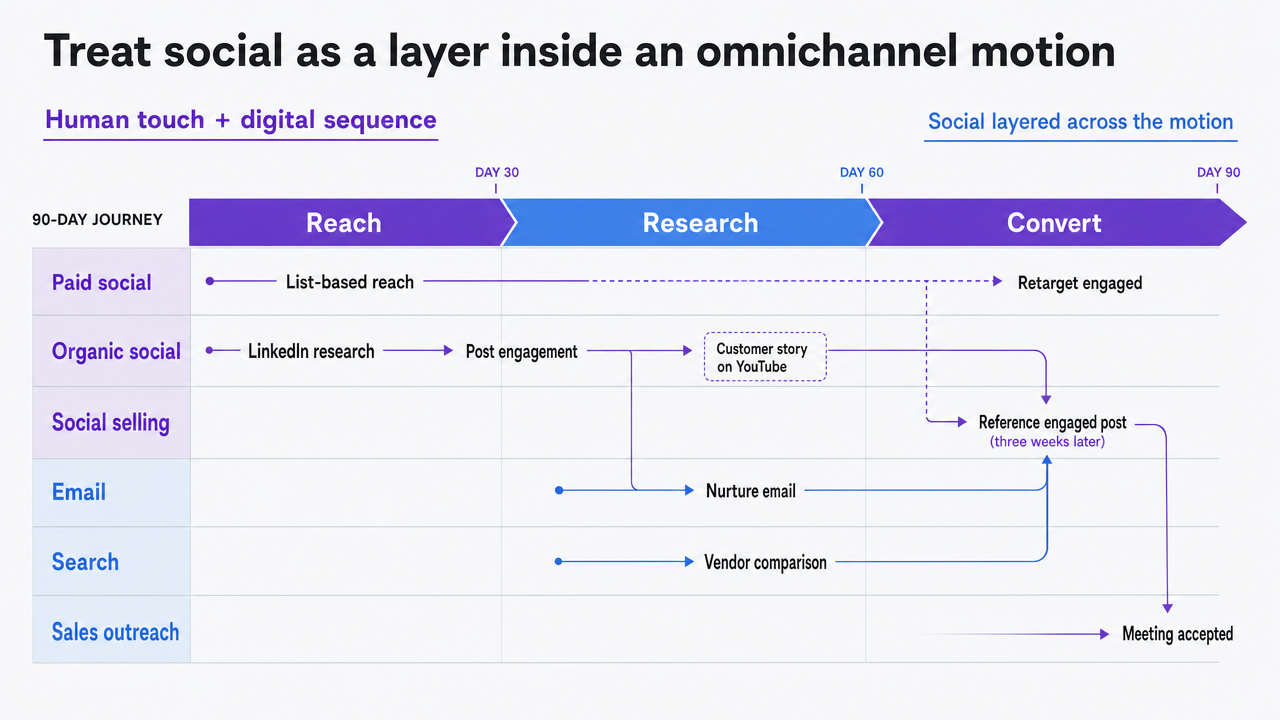 Illustrate the 90-day touch sequence across paid social, organic social, social selling, email, search, and sales outreach described in this section
Test a Real Social Campaign in One Week
Launch and measure a live social media campaign with full control, risk-free, for seven days.
Social selling: where peer trust converts to opportunity
Social selling is the activity that turns committee coverage into named opportunities. It is what a rep does on LinkedIn when a target account engages with an executive post, a customer story, or a paid placement against the ICP list—comment, share, send a tailored message that references the prior touch, and route warmer accounts into the CRM as opportunities rather than cold leads.
The trust mechanics are well documented. A LinkedIn survey cited in academic work on B2B social selling found that 84% of B2B buyers start the buying process with a referral and 90% of B2B buying decisions are influenced by a peer 7. Scope matters: this is a LinkedIn-sourced survey of buyer self-reports, not a universal market measurement, and the magnitudes vary by industry and deal size. The directional point still holds—peer signal and warm context outperform cold outbound for the same audience.
For demand gen managers, social selling fails when it is treated as a rep responsibility with no marketing infrastructure. It works when marketing supplies four things:
- A shared engagement-threshold definition that triggers rep outreach (for example, three role-distinct touches from a named ICP account inside 21 days).
- A content library reps can post and reference without writing from scratch.
- Weekly account signal reports that surface which accounts are warming.
- A feedback loop where reps tag which social touches preceded a created opportunity.
The artifact to build is a social-to-sales handoff playbook. It names the trigger, the message template families, the assets reps can reference, and the CRM fields that capture which social activity influenced the opportunity. Without that handoff, peer trust shows up in engagement reports and dies before it reaches pipeline.
Creative throughput and approval workflow
Most social programs fail at the production line, not the strategy deck. A demand gen manager can map the buying committee, define an ICP list, and brief a touch sequence, then watch the calendar stall because three executives have not approved the carousel sitting in their inbox. Throughput is the silent variable that decides whether the campaign hits the volume needed for committee coverage.
The baseline math is unforgiving. A role-to-format matrix covering six committee members across three channels at two posts per role per week produces 36 assets weekly, or roughly 150 per month. Few in-house teams ship that volume against a 2,000-account ICP list without either dropping quality, dropping roles, or collapsing the calendar to whichever asset the loudest executive prefers.
Three levers move throughput without expanding headcount:
- Separate creative production from creative approval. Production should run continuously against a briefed backlog; approval should run on a fixed weekly cadence with named approvers and a default-publish rule after a defined window.
- Build a reusable asset library—pull quotes, customer outcome cards, product screenshots, executive talking points—that lets reps and employee advocates post without rewriting source material.
- Instrument the approval queue itself. Track average time-from-brief-to-publish, approval cycles per asset, and rejection reasons. Teams that do not measure their own workflow cannot diagnose why throughput is half of what the plan requires.
AI-assisted execution patterns now sit inside this workflow rather than replacing it. A specialist drafts against the brief, a human approves against brand and compliance criteria, and approved work ships automatically. The point is not speed for its own sake—it is sustaining the asset volume that committee-aware targeting actually requires.
Endorsement compliance as a campaign design input
Compliance is usually treated as a legal review at the end of a campaign. For social, that is the wrong sequence. Endorsements, employee posts, customer quotes, and creator content all carry FTC disclosure obligations that shape what a campaign can ship—and treating them as a creative input rather than a final-stage check is what keeps the pipeline from being paused by a takedown or a fine.
The operative rules are narrow and concrete. When someone endorses a product and has a material connection to the brand—financial, employment, family, or otherwise—that relationship must be disclosed clearly and conspicuously, in the same language as the endorsement, and inside the content itself rather than on a profile page or behind a "more" link 1. Vague tags or ambiguous hashtags do not qualify, and platform-supplied disclosure tools are not assumed to be sufficient on their own 2. Advertisers also need substantiation for the claims made on their behalf, not just the wording of the disclosure 5. The FTC's 2023 revision to the Endorsement Guides extended this scope explicitly to fake reviews, creator content, and modern social formats, which means employee advocacy and customer story programs sit squarely inside the rules 6.
For a demand gen manager, this translates into four campaign design inputs:
- Build a disclosure standard into the creative brief—"#ad," "Paid partnership," or "I work at [Company]" placed at the top of the caption or visibly inside video, not buried in a hashtag block.
- Maintain a substantiation file for every outcome claim a customer or influencer is asked to make, with the source the rep or creator can point to.
- Train employees who post about the company on what counts as a material connection; employment is one.
- Route any influencer or paid creator contract through a single template that requires the disclosure language in the post itself.
Consolidating compliance into the brief, the contract, and the approval queue prevents the alternative pattern—scattering disclosures across formats, missing them on short video, and discovering the gap when an enforcement letter or a customer complaint surfaces. Compliance handled upstream costs throughput a few minutes per asset. Handled downstream, it costs the campaign.
Streamline Social Campaigns That Directly Impact Pipeline Results
Connect with our experts to see how coordinated, multi-channel social execution can drive measurable pipeline contribution—without increasing your headcount or budget.
Measurement: sourced pipeline, influenced pipeline, revenue
Most social media reporting fails the budget review because it stops at the wrong altitude. Impressions, reach, and engagement rate describe activity, not contribution. A defensible measurement model separates four tiers and reports the bottom two as the headline numbers, with the top two available as diagnostics.
The tiers stack as follows:
- Vanity metrics—follower count, impressions, reach—indicate distribution health and nothing else.
- Engagement metrics—reactions, comments, saves, dwell time, click-through rate—indicate whether creative is landing with the intended roles.
- Pipeline metrics split into sourced opportunities (the first touch on the account was social) and influenced opportunities (a social touch occurred inside the buying window for an opportunity created by another channel).
- Revenue metrics close the loop: closed-won amount attributed to sourced and influenced deals, deal velocity for accounts with social touches versus those without, and win rate by touch composition.
The peer-reviewed work on digital marketing capabilities makes the underlying point: firms with stronger digital marketing systems achieve more precise targeting and more accurate attribution of marketing causes and effects 4. Reporting at the bottom two tiers requires that capability to be built, not assumed.
The operational definitions need to be written down before the dashboard is built. Sourced pipeline counts an opportunity when the first known touch on any contact at the account was a social asset—paid impression with click, organic engagement, or social selling outreach. Influenced pipeline counts an opportunity when at least one social touch occurred against any contact at the account within the 90 days preceding opportunity creation. Both definitions require CRM fields that capture social touch timestamps and asset IDs, populated either by UTM parameters, LinkedIn lead-gen form syncs, or rep-tagged activity in the social-to-sales handoff playbook.
Three reports run on a weekly cadence:
- Lists sourced and influenced opportunities created that week, by account, with the specific social assets and roles touched.
- Compares deal velocity and win rate for accounts with three or more social touches against accounts with zero or one, holding ICP segment constant.
- Surfaces creative performance by buying-committee role, so the next week's brief can rebalance toward whichever role is underrepresented in the influenced-pipeline cohort.
Two measurement traps appear in nearly every program. The first is overclaiming sourced pipeline by attributing any account with a social touch as socially sourced, which inflates the channel's contribution and erodes credibility with finance. The second is underclaiming influenced pipeline by requiring last-touch attribution, which assigns credit to whichever channel happened to convert the meeting and ignores the committee coverage that made the meeting possible. The defensible posture is conservative on sourced—first-touch only, on the account, with a documented social asset—and generous on influenced, with the criterion published so the CFO can see what counts.
A demand gen manager reporting at this altitude walks into the budget review with three numbers: sourced pipeline value, influenced pipeline value, and the velocity or win-rate delta for socially touched accounts. Those numbers either justify the line item or signal exactly where the program needs to change.
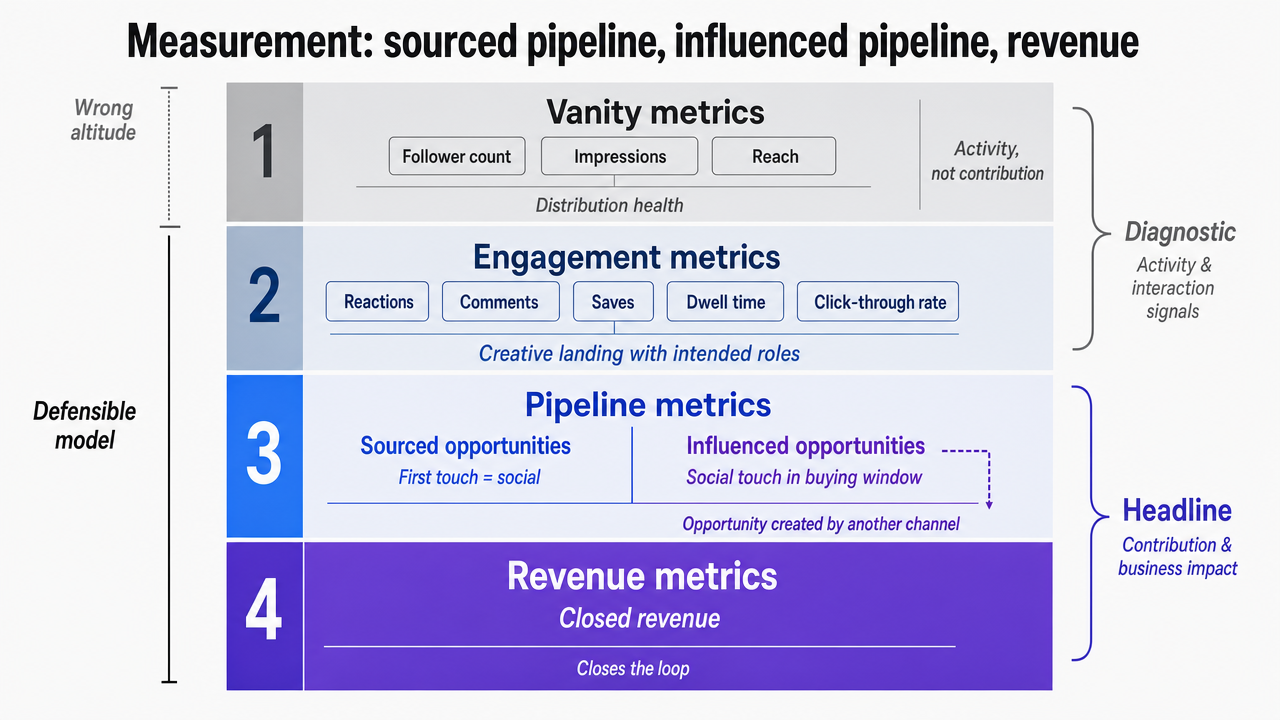 Visualize the four-tier measurement model described in the section, showing how vanity, engagement, pipeline, and revenue metrics stack and which serve as headline vs diagnostic
If you manage multiple locations: consolidation economics
The reader frame shifts here. Demand gen managers running social for a single brand can stop at the prior section. The next discussion is for operators with multiple locations under one parent—dental DSOs, home services portfolios, senior living groups, behavioral health networks—where social execution costs scale with location count and the question is how to staff the work without breaking unit economics.
Three execution models compete for that budget: a traditional agency retainer, a fully-loaded in-house hire or small team, and an AI execution platform with human approval. The choice is rarely about quality in the abstract; it is about monthly cost, creative throughput per location, approval cycle time, and whether the model produces the measurement artifacts—sourced and influenced pipeline by location—that the parent organization needs to allocate budget across the portfolio.
The compact comparison below uses the Vectoron platform price ($599/mo after a two-week trial) as the AI-execution anchor and operator-supplied benchmarks for the other two columns, because agency retainers and fully-loaded salaries vary too widely by market to be quoted as facts.
| Dimension | Agency retainer | In-house hire | AI execution platform ||---|---|---|---|| Monthly cost | Operator-supplied retainer benchmark | Fully-loaded salary ÷ 12 (operator-supplied) | $599/mo post-trial || Channels covered | Varies by scope | Limited by one person's range | Content, SEO, PPC, backlinks, social, call intelligence || Approval cycle | Briefing rounds, email threads | Direct but bottlenecked at one person | Fixed approval queue with default-publish window || Creative throughput per location | Capped by retainer hours | Capped by headcount | Capped by approval bandwidth, not production || Pipeline attribution | Reported by agency, not owned | Owned but manual | Instrumented per location, per asset |
For a portfolio of ten locations, the decision usually turns on two numbers operators already have: the current cost-per-qualified-call by location, and the asset volume each location actually receives per month. If asset volume is below what the committee-coverage math in section 5 requires, the model that lifts throughput without multiplying monthly cost wins the comparison.
A 90-day implementation sequence
Days 1 to 30 are about inputs, not output. Build the ICP target list with named accounts, decision-makers, and rep ownership. Draft the role-to-format matrix against the six buying-center positions. Define sourced and influenced pipeline in writing, agree on the criteria with sales and finance, and add the CRM fields that capture social touch timestamps and asset IDs. Set the approval cadence, name the approvers, and write the default-publish rule. Audit existing content against the matrix to flag the role gaps that will drive the first production sprint.
Days 31 to 60 turn the system on. Paid social runs against the ICP list at low budget to validate audience match before scaling. Organic posting hits the role-to-format calendar at the volume the committee math requires. The social-to-sales handoff playbook goes live with a defined engagement threshold, and reps begin tagging which social touches preceded a created opportunity. Compliance disclosures sit in the brief from day one, not the legal review at the end.
Days 61 to 90 shift from execution to evidence. The first weekly pipeline report runs—sourced opportunities, influenced opportunities, velocity delta for socially touched accounts. Creative gets rebalanced toward the buying-committee roles underrepresented in the influenced cohort. The budget review at day 90 opens with three numbers, not a deck of impressions.
Frequently Asked Questions
References
- 1.Disclosures 101 for Social Media Influencers.
- 2.Endorsements, Influencers, and Reviews.
- 3.Embracing the B2B omnichannel opportunity.
- 4.The value relevance of digital marketing capabilities to firm ....
- 5.FTC's Endorsement Guides: What People Are Asking.
- 6.Guides Concerning the Use of Endorsements and Testimonials in Advertising.
- 7.The Importance of Social Selling & the Development of a Social ....
- 8.4.3 Buying Centers.
- 9.McKinsey B2B Pulse 2024.
- 10.Disclosure Standards for Social Media and Generative Artificial Intelligence in Health Research.