
Key Takeaways
- Cap X at 15–20% of the B2B social envelope and treat it as a supporting channel, since its share of social leads has fallen to roughly 12.73% 3.
- Run a three-lane workflow — executive amplification, content repurposing, and real-time engagement — through a single approval gate, absorbing 4–6 hours of one senior marketer's week.
- Assign each channel a distinct job: LinkedIn carries pipeline, X carries awareness and discourse, and the owned site compounds attention that both social surfaces borrow.
- Measure X on reach into target accounts, share of voice, referral sessions, and executive-post engagement quality rather than MQLs, and sunset the program if those assists stop landing.
Why the Twitter Question Keeps Coming Back to Marketing Leaders
Every planning cycle, the same debate resurfaces on lean B2B marketing teams: keep X, kill it, or grow it. The channel refuses to settle into a clear role. LinkedIn has hardened into the primary lead surface, content and SEO carry compounding demand, and paid media has its own owners. X sits in the middle, absorbing attention it may or may not deserve.
The reach argument still holds. X reported more than 250 million daily users heading into 2024, with roughly 550 million monthly, and nearly 80% under age 50 2. That is not a dead platform. It is, however, a different platform than the one that once fed B2B pipelines directly, and treating it like a lead engine is what breaks lean teams.
The question marketing leaders actually need to answer is narrower: what is the smallest, most defensible X operation that produces measurable contribution without pulling a headcount slot away from higher-leverage work? The rest of this piece answers that question with allocation math, a three-lane workflow, and an economics comparison a VP can defend in a budget review.
The Allocation Math Behind a Supporting Channel
What X Is Worth Inside a B2B Social Budget
The cleanest way to settle the X debate is to write down the split before writing down the tactics. Current guidance for 2026 puts LinkedIn at roughly 65–70% of B2B social media resources, X at 15–20%, and other platforms sharing the remaining 10–20% 3. That range is not aspirational. It reflects where measurable pipeline is actually forming, and it gives lean teams a defensible ceiling for how much X work belongs on the roadmap.
The underlying trend is more revealing than the split itself. X's share of B2B social media leads has fallen from about 32% in 2020 to roughly 12.73% today 3. That is a two-thirds decline in direct lead contribution over a single planning horizon. A VP allocating fixed headcount against that trajectory cannot justify staffing X the way it was staffed in 2019, and any plan that assumes X will recover its former lead share is planning against the data.
What the math produces, in practice, is a hard budget for X work: no more than one-fifth of the social envelope, and closer to 15% when LinkedIn output is still maturing. For a team with 3–8 marketers, that translates to a fractional allocation — a slice of one person's week, not a role. It also sets a ceiling on tooling spend. If X is worth 15–20% of the social budget, it is worth 15–20% of the social tools budget, not a dedicated stack.
The rest of the workflow argument in this article assumes that ceiling. Every hour beyond it needs to come from documented lift on LinkedIn, content, or paid — not from optimism about the channel.
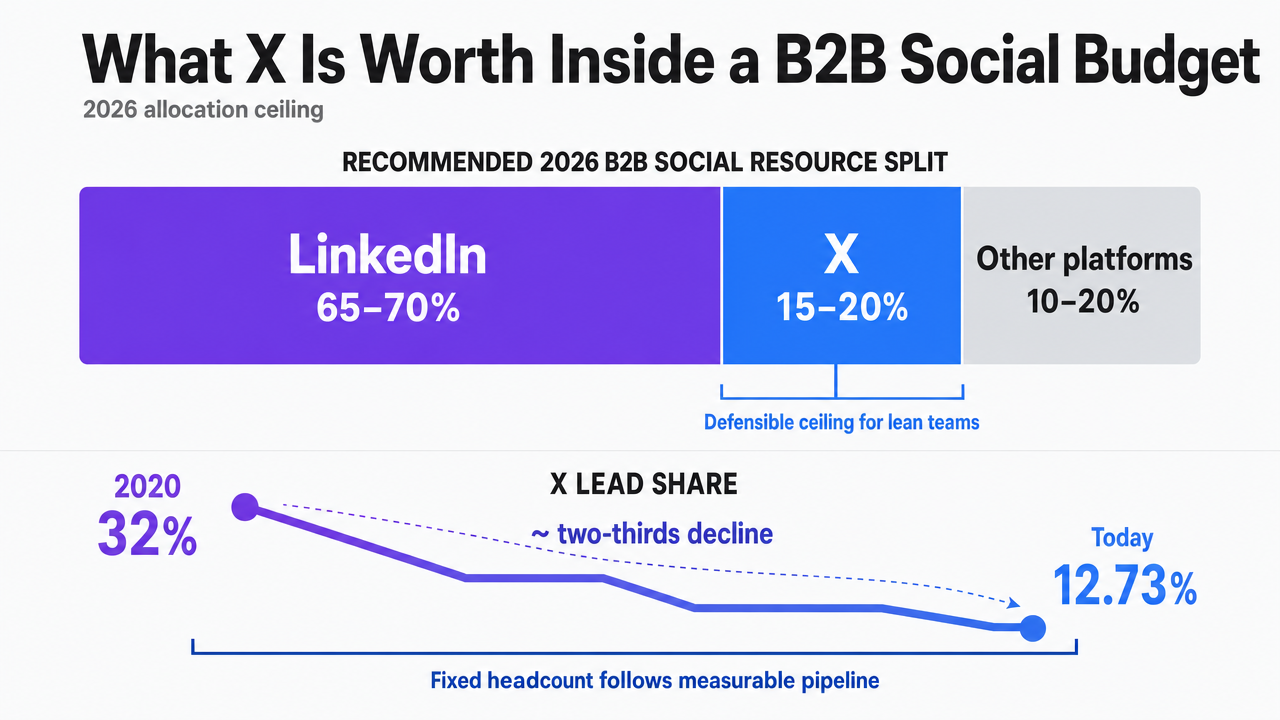 Visualize the 2026 B2B social budget allocation ceiling that anchors the entire article's argument
The Channel-Role Framework: LinkedIn, X, and the Content Site
Once the budget ceiling is set, the next question is what each channel is actually for. Lean teams get into trouble when every surface is expected to do every job — awareness, nurture, lead capture, retention — and no single channel is measured against a specific outcome. A clearer division of labor reduces the amount of work each channel has to carry.
LinkedIn is the pipeline surface. Benchmark analysis of B2B social platforms puts LinkedIn at roughly 277% more effective at lead generation than Facebook and Twitter 4. That figure describes lead-gen effectiveness across those three platforms; it does not claim LinkedIn wins every objective. It does, however, settle the question of which channel should carry conversion-oriented content, gated assets, and sales-team activity. If a piece of content is designed to produce a form fill or a booked meeting, LinkedIn is the primary distribution surface.
X is the awareness and discourse surface. Practitioner analysis of the two platforms frames the most effective B2B approach as complementary — LinkedIn for deeper engagement and leads, X for broader awareness and community building 9. That framing matches how X actually behaves in 2026: live commentary, industry reactions, executive voice, and customer-service touches, none of which fit LinkedIn's slower rhythm.
The content site is the compounding surface. It hosts the long-form work that both social channels distribute, and it is the only surface a company owns. X and LinkedIn borrow attention; the site accrues it.
The practical consequence is that a post on X should almost never be measured by MQLs. It should be measured by reach into target accounts, share of voice on named topics, and click-through to the site or LinkedIn asset it is amplifying. Measuring X against LinkedIn's job is the fastest way to conclude, incorrectly, that the channel is dead — and the fastest way to justify overinvesting in it, if a spike in vanity engagement is mistaken for pipeline. The three-lane workflow in the next section is built on this division of labor.
The Minimum Viable Twitter Operation
Three Lanes, One Approval Gate
A minimum viable X operation for a lean B2B team runs on three lanes and one approval gate. The lanes are executive amplification, content repurposing, and real-time engagement. The gate is a single queue where a marketer reviews drafts, replies, and reposts before anything ships. Everything else — scheduling, formatting, listening, analytics — gets automated or dropped.
The design assumption is that no one on the team owns X full time. A senior marketer spends 4–6 hours a week on the channel, split roughly across the three lanes, and each lane has a fixed weekly output rather than an open-ended calendar. Fixed output caps the work. Open calendars invite drift.
The approval gate matters because it is where judgment lives. Drafts can be generated, scheduled, and queued by tooling, but the marketer decides what actually posts, what gets repurposed from a blog into a thread, and which live conversation is worth entering. That decision layer is what keeps the channel from producing the overly promotional, low-interaction feed that signals a failing B2B social program 5.
The next three sections define each lane: what it produces, how much time it takes, and what evidence supports treating it as a leverage point rather than a chore. The lanes are independent — a team can start with executive amplification alone and add the other two as the workflow matures.
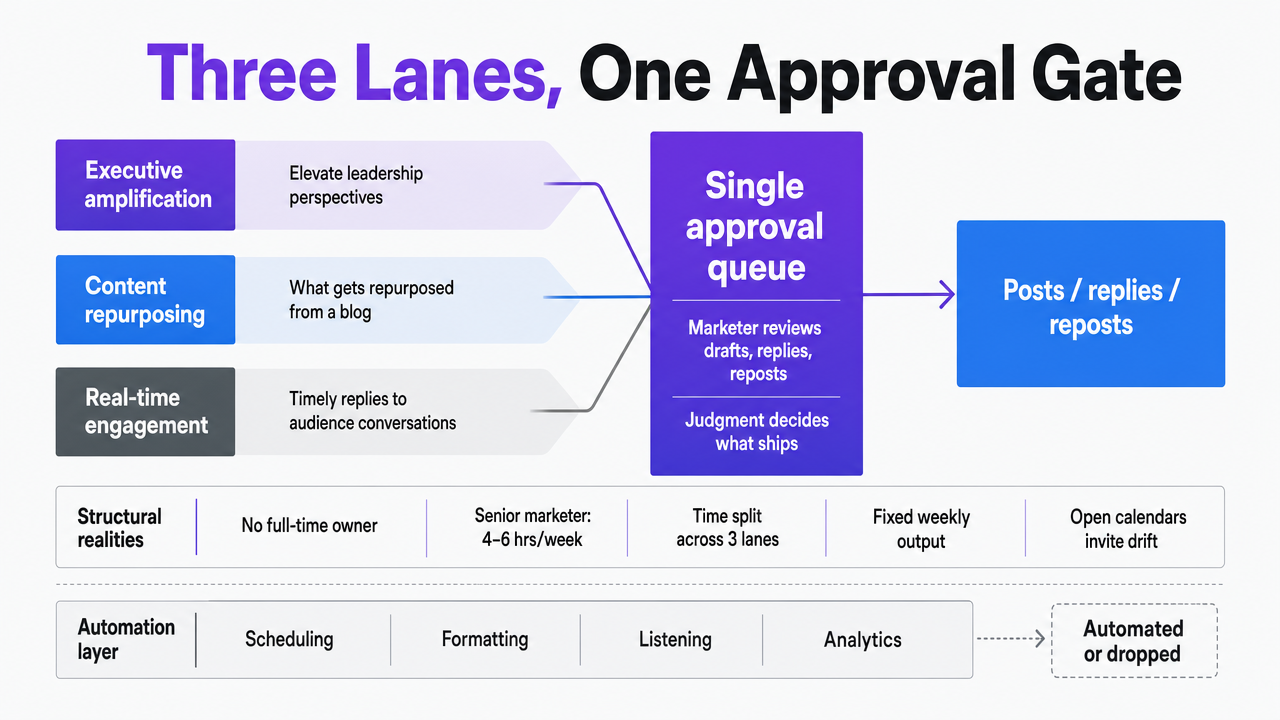 Visualize the three-lane workflow with a single approval gate that structures the operating model
Lane One: Executive Amplification
Executive amplification is the highest-leverage lane because it borrows credibility the marketing team cannot manufacture. Research on B2B CEO social media use frames executive presence as a way for leaders to demonstrate leadership, communicate ideas, and motivate others — a strategic use of the channel rather than a volume play 10. The 2026 stakeholder environment reinforces the point: investors, employees, customers, and partners increasingly evaluate CEOs by how they show up publicly, communicate vision, and respond to change 7.
Network structure research on X supports the leverage argument at the mechanical level. Highly connected influencer nodes accelerate information diffusion across the network, meaning a single well-placed executive post can reach further than a week of brand-handle posts 8. A founder or CEO with an existing following functions as one of those nodes for the company's topic area.
The operational shape of this lane is narrow. Two to four executive posts a week, drafted collaboratively — the marketer supplies the angle, data point, or customer observation; the executive supplies the voice and the final word. Guidance for CEOs in 2026 warns explicitly against letting AI or ghostwriters invisibly replace the leader's voice, so the drafting pattern should assist research and framing, not replace judgment 7. Weekly time cost for the marketing team: about 90 minutes, most of it spent surfacing angles from customer calls, product updates, and industry news the executive would not otherwise see.
Lane Two: Content Repurposing From the Site and Newsletter
The second lane converts work the team is already doing into X-native formats. Every long-form article, research report, customer story, and newsletter issue produces three to five posts: a headline claim, a supporting data point, a contrarian pull-quote, a chart, and a link back to the source. The lane exists because producing net-new X content for a supporting channel is a poor use of a lean team's hours; distributing existing content across it is not.
The output cadence is one thread or post series per major piece of content, plus daily single-post distribution from the archive. A blog post published on Tuesday generates a thread on Wednesday, a data-point post the following week, and a quote card two weeks later. The compounding surface is the site; X borrows the traffic and the attention.
Format discipline matters more than volume here. Threads that lead with a claim and pay it off with evidence outperform threads that recap the article. Charts pulled directly from research reports outperform stock imagery. Quote cards attributed to named customers outperform anonymous testimonials. The marketer's weekly time in this lane — about 90 minutes — is spent on selection and sequencing, not writing from scratch. Drafting tools handle the format conversion; the approval gate catches the ones that lost the original argument in translation.
Lane Three: Real-Time Engagement on Existing Conversations
The third lane is where X earns its keep as a live channel. Instead of broadcasting into the feed, the marketer spends a fixed window each day — 20 to 30 minutes — engaging with conversations already happening in the company's topic area. Replies to industry analysts, considered responses to competitor announcements, useful additions to threads started by customers, and quick answers to product questions surfaced through search or mentions.
The strategic case for curated engagement over broadcast posting comes from the same network research that supports executive amplification: information moves through highly connected nodes, and replying to those nodes puts the brand handle inside conversations it could not reach with standalone posts 8. Practitioner analysis of X for B2B reaches a similar conclusion — the platform's value now sits in community building and real-time discourse rather than direct lead capture 9.
Operationally, the lane needs a listening list, not a listening tool budget. Twenty to thirty accounts — analysts, customers, partners, competitors, and topic-relevant journalists — cover most of the useful surface for a mid-market B2B company. The marketer scans the list once in the morning, drafts replies during the day, and routes anything sensitive through the approval gate before it ships. Weekly time: about two hours, front-loaded early in the week when industry news breaks.
Test AI-Driven Twitter Execution With Full Access
Experience measurable Twitter workflow efficiency with live posts, analytics, and approval controls during your trial.
Content Mix for a Lean Team
A supporting channel does not get a full editorial calendar. It gets a ratio. Current B2B social guidance sets that ratio at 70/30 or 80/20 — no more than 20–30% of posts should directly promote the brand, with the remaining 70–80% built around subjects that interest and engage the audience 5. Overly promotional feeds with low interaction are the clearest failure signal, and lean teams drift toward them because promotional posts are the easiest to draft from an existing marketing plan.
The mix that holds up in practice, mapped to the three lanes already defined: industry commentary and analysis of news stories carry the largest share, followed by data snippets pulled from owned research and customer calls, then customer-quote cards and case-study excerpts, then product news and launch posts. The last category is the promotional 20–30%. Everything else earns the right to appear by being useful on its own — a chart worth screenshotting, a take worth quoting, a number worth arguing with.
Format discipline enforces the ratio without extra process. A weekly slate of, say, ten posts allocates seven to commentary, data, and customer voice, and reserves three for product, hiring, or company news. When the slate skews promotional, the approval gate sends posts back rather than shipping a feed that reads like a press release.
Operating Models: What a 4–6 Hour Week Actually Costs
The lane design in the previous section assumes 4–6 hours of senior marketer time each week. The question a VP has to answer in a budget review is which staffing path produces those hours at defensible cost. Three models cover the realistic options: an in-house social manager, a traditional agency retainer, and an AI-assisted approval workflow run by someone already on the team.
The comparison below uses variable notation for salary and retainer figures because those numbers move by market, seniority, and scope. The only fixed number is the trial pricing for the AI-assisted model, which is published.
| Model | Monthly cost | Weekly team hours | Output cadence | Approval control |
|---|---|---|---|---|
| In-house social manager | Salary range S (loaded), typically the largest of the three | 35–40 hours dedicated; team oversight ~1 hour | Full calendar across multiple channels; X gets more attention than a 15–20% allocation justifies 3 | Direct, but concentrated in one person |
| Agency retainer | Retainer R, plus scope-change fees | 3–5 hours per week on briefs, reviews, and status calls | Fixed post volume; slower turnaround on live discourse | Approval by email thread; live engagement lags |
| AI-assisted approval workflow | $599/month after a two-week trial | 4–6 hours per week on the three lanes | Two to four executive posts, one repurposing series, daily engagement window | Every draft, reply, and repost routed to a single approval queue |
The in-house model overproduces on a channel the allocation math caps at 15–20% of social effort 3. The retainer model matches the hours but loses the real-time engagement lane, which is where X's remaining leverage sits. The AI-assisted path matches the lanes and the hours because it was designed against them — drafting, scheduling, and listening happen upstream of the approval gate, and the marketer's time is spent on judgment rather than production.
The defensible answer in a budget review is the one where cost, hours, and output cadence all sit inside the 15–20% envelope. Two of the three models struggle to hit that constraint without either underdelivering or overspending.
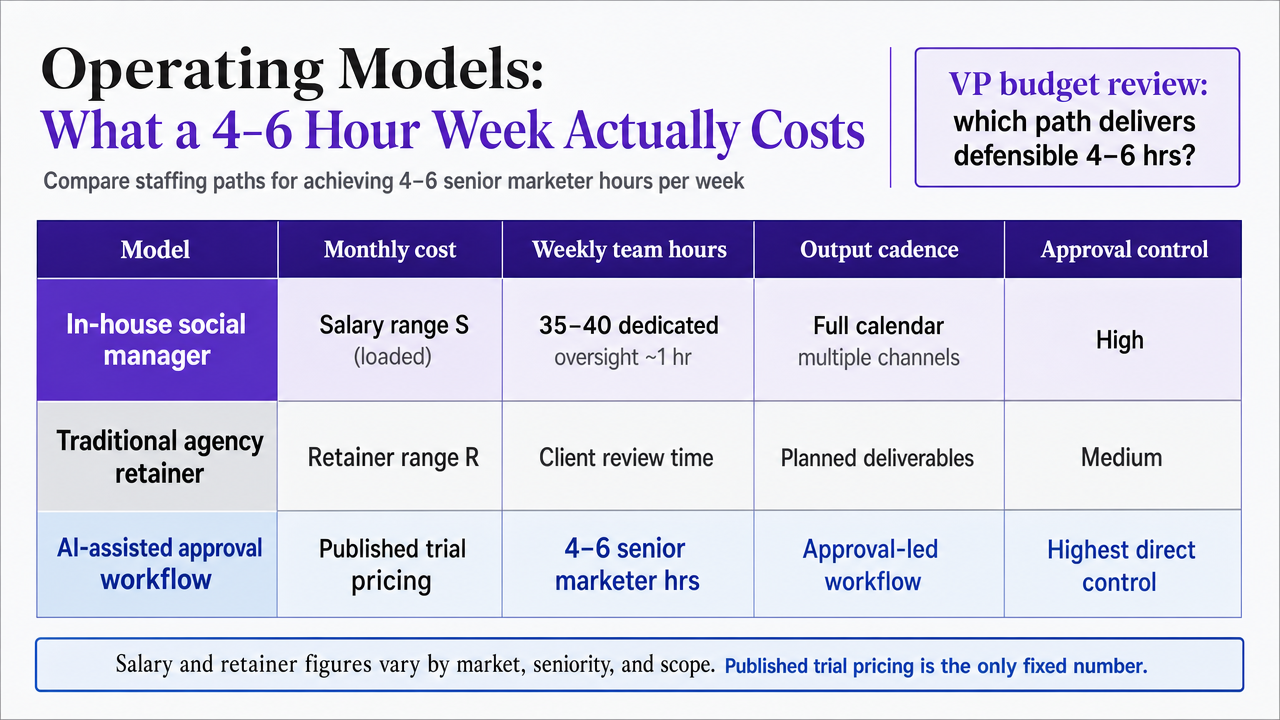 Visualize the comparison table of three staffing models against cost, hours, and control
Disclosure and Employee Advocacy When Amplification Scales
The compliance risk on a small X program is not the executive account. It is the moment amplification scales — paid boosts on organic posts, employee advocacy programs that reward reposts, and creator partnerships that route brand messages through third-party handles. Each of those triggers FTC disclosure obligations that in-house teams routinely underestimate.
The FTC's guidance is specific about what compliance looks like on X: disclosures must be hard to miss and placed with the endorsement message itself, and simple labels like "ad" or a clear brand-specific term are acceptable in space-limited formats 1. That standard applies whether the endorser is a paid influencer, an employee posting under an advocacy program with incentives, or a customer receiving anything of value in exchange for a post.
Two operational rules keep a lean team out of trouble. First, any post the company pays to amplify or that comes from someone receiving compensation, product, or advocacy rewards carries the disclosure in-post, not in a bio or pinned tweet. Second, the approval gate in the three-lane workflow reviews advocacy and partner posts against that same standard before they ship. Treating disclosure as a checklist item inside the existing approval queue costs no additional headcount and closes the most common gap.
See How AI Coordination Drives B2B Twitter Pipeline—Without Additional Hires
Get a tailored walkthrough of unified, approval-driven Twitter workflows that deliver measurable increases in qualified B2B engagement and conversions—eliminating briefing cycles and manual oversight.
Measuring Contribution Without Faking Attribution
X will not show up cleanly in a last-touch report, and building a measurement model that pretends otherwise wastes the analyst's time. The channel's job, as defined by the allocation math and the channel-role framework earlier in this piece, is awareness and discourse — not form fills 9. The measurement plan has to match that job.
Four metrics carry most of the signal. Reach into named target accounts tracks whether posts and replies are landing inside the ICP rather than in a general audience. Share of voice on a short list of owned topics — five to eight terms the company wants to be associated with — tracks whether the executive and brand handles are showing up when those conversations happen. Referral sessions from X to the content site, measured against the mix of repurposed posts, tracks whether the repurposing lane is doing its job. And engagement quality on executive posts — replies from analysts, customers, and prospects, not just likes — tracks whether the amplification lane is compounding.
None of these roll up to MQLs, and forcing them to invites the overly promotional feed the content-mix guidance warns against 5. The honest report to the executive team frames X as an assist channel: it moves people toward LinkedIn conversations, site visits, and sales-team touches that show up in pipeline under other channel names. Reviewed monthly against the 15–20% resource envelope, that report is enough to defend the program — or to sunset it if the assists are not landing.
If the Program Runs Across Multiple Business Units or Brand Handles
The three-lane model assumes one company, one brand handle, and one executive voice. Marketing leaders running multi-brand portfolios, acquired business units, or regional handles inherit a different problem: the same 15–20% social envelope 3now has to cover two or three or seven X presences, and the temptation is to either replicate the workflow per handle or consolidate everything into a single feed that pleases no audience.
Neither works. Replicating the lanes multiplies weekly hours past what a lean team can absorb, and consolidating handles dilutes the executive-voice leverage that gives X its remaining value 10. The workable pattern is a shared operating backbone with per-handle judgment: one approval queue, one listening list segmented by brand, one repurposing pipeline drawing from each unit's owned content, and separate executive accounts feeding into the same review cadence. Weekly hours scale sublinearly — a second handle adds roughly 2 hours, not another 4–6 — because drafting, scheduling, and disclosure review 1happen once against shared standards. The judgment layer stays with the marketer who owns each brand's positioning.
Frequently Asked Questions
References
- 1.Disclosures 101 for Social Media Influencers.
- 2.B2B marketing on X: What you need to know.
- 3.Effective Twitter Marketing Strategies for Growth.
- 4.How Effective is LinkedIn for B2B Marketing? These 20 Stats Say it All.
- 5.How to Build a Successful B2B Social Media Strategy.
- 6.Is Twitter a Suitable B2B Platform?.
- 7.Social Media Trends Every CEO and Thought Leader Must Know.
- 8.Network Structures and Influencer Roles on Twitter.
- 9.LinkedIn vs Twitter for B2B Marketing Strategy.
- 10.Role of Social Media in B2B CEO Thought Leadership.