
Key Takeaways
- Treat every video as a qualification step rather than a branding asset, screening callers on issue type, jurisdiction, and fit before they reach the intake line.
- Anchor discovery on YouTube long-form explainers, use social clips as top-of-funnel feeders, and reserve on-site practice-area and pre-call qualifying videos to confirm fit and shorten handle time.
- Default first consultations to phone unless visual document review, affect reading, or multi-stakeholder presence justifies video, and respect FTC 2024 Testimonials Rule limits on fake, incentivized, or suppressed reviews 4.
- Close the loop by tagging intake calls to specific videos and tracking qualified call volume, consult-to-signed rate, case value, production cost, and intake minutes saved per asset.
Video as a Qualification Filter, Not a Branding Asset
Most law firm video budgets get spent the wrong way. The brief reads "build the brand," the production company delivers a polished firm sizzle reel, and six months later the managing partner is staring at a YouTube channel with rising view counts and an intake log that looks identical to the one from last year. Volume of calls may even climb. The ratio of consultations that turn into signed cases does not move.
The frame that fixes this is simple: treat every video as a qualification step, not an advertisement. A short explainer on a settlement timeline is doing real work only if it screens out callers whose matters fall outside the firm's practice scope and pre-educates the ones who fit. A platform-native social clip earns its budget by surfacing jurisdiction, issue type, and urgency before a prospect ever reaches the intake line.
The supporting evidence is mechanical, not aspirational. Short-form video has been shown to shape consumer trust and purchase intent through perceived usefulness, ease of use, and entertainment value in commerce settings, a mechanism that transfers to professional-service decisions even though the studied behavior was retail 2. Pair that mechanism with disciplined call analysis and FTC-compliant testimonial use, and video stops being a branding line item. It becomes the front edge of an intake system that decides which conversations the firm's attorneys spend their billable hours on.
The Mechanism: Why Video Shifts Intent Before the Call
Trust and Intent Signals Transfer From Commerce to Professional Services
The reason a well-built video moves a prospect from passive browsing to a specific inquiry is not charisma. It is a measurable shift in three perceptions: how useful the content feels, how easy it is to act on, and how engaging it is to watch. A 2025 study modeling short-video influence on retail consumers found that these three variables significantly affect both trust and purchase intent 2. The study examined commerce behavior, not legal services, so the numbers do not translate into case-conversion benchmarks. The mechanism does.
A prospect researching a wage dispute, a custody question, or a wrongful termination claim is running the same cognitive checks a retail buyer runs. Is this source credible enough to act on? Does the next step feel obvious? Is the information clear enough that calling will not be a waste of time? Video that answers those three questions before the call arrives shifts the caller's intent from "I have a question" to "I have a matter that fits this firm."
That is the qualification function. The video is not selling the firm. It is narrowing the population of callers to those whose intent is already aligned with what the firm actually handles.
High Engagement Is Not High Credibility
View counts mislead. A peer-reviewed analysis of health-related YouTube content found that many videos with strong engagement metrics carried quality limitations that "might lead viewers to make poor judgments" about consequential decisions 1. The study covered medical content, but the structural problem is the same one a managing partner faces in a regulated, high-stakes vertical: the platform rewards watch time, not accuracy, and the audience cannot easily tell the difference.
For a law firm, that creates two operating constraints. First, firm-produced video has to clear a higher credibility bar than the viral legal content already circulating on the same feeds. An attorney walking through statute-of-limitations math with citations on screen performs a different job than a creator dramatizing a courtroom moment, even when the creator has ten times the views. Second, credibility signals have to be visible inside the first fifteen seconds. Named attorney, jurisdiction, practice scope, and the specific question the video answers. A prospect deciding whether to call should not have to infer any of those.
Engagement metrics still matter for distribution. They do not measure whether the video is producing the right kind of caller. Qualified-call rate does. Firms that optimize for watch time without tracking what happens at the intake line end up with a content library that performs well on YouTube analytics and poorly on the intake report.
Matching Video Format to Platform Intent
Where Prospects Actually Watch: YouTube and Social Distribution
Platform selection should follow audience evidence, not agency preference. Pew Research reports that about 53% of U.S. adults at least sometimes get news from social media, and 35% say they regularly get news on YouTube 8. That is news consumption, not legal research, but the implication for distribution is direct: a sizable share of adult prospects already treat YouTube as a default source for serious information, which makes it the natural anchor for a firm's discovery layer.
YouTube's role is the long-form explainer. A seven-minute walkthrough of how a personal injury claim moves through a state's comparative-fault rules indexes well, sits on the firm's domain through embeds, and gives a prospect enough information to self-qualify before any call. The intent on YouTube skews investigative. Viewers are searching for an answer to a specific question, not scrolling for entertainment.
Social feeds work the opposite way. Short-form clips on Instagram, Facebook, and LinkedIn rarely close a prospect on their own. They surface the firm, the practice scope, and the jurisdiction in fifteen to sixty seconds, then route interested viewers to a longer YouTube asset or a site-hosted explainer. Treating social as a top-of-funnel feeder for YouTube, rather than a standalone conversion channel, matches how prospects actually move between platforms when researching a legal matter.
Practice Areas With Younger Client Bases
Audience scope matters here. The recommendations in this subsection apply to firms whose case mix skews toward clients under 30: employment disputes, consumer protection, family law, certain immigration matters, and tenant-side housing work.
Pew's analysis of younger news consumers reports that 93% of adults under 30 at least sometimes get news from digital devices, and that this cohort is more likely than older adults to trust news they see on social media 9. For a family law practice in a metro market, that changes the math on TikTok and Instagram Reels. Short, attorney-narrated clips explaining filing thresholds or custody factors can produce a steady stream of qualified inquiries from a population that is unlikely to discover the firm through Google text ads.
The constraint is credibility. Younger prospects trust social video more readily, which raises the cost of a misleading or imprecise clip. A named attorney on camera, an on-screen jurisdiction tag, and a clear statement of what the firm does and does not handle keep the qualification function intact. Without those signals, the clip recruits the wrong callers and burns intake staff time on matters the firm will decline.
The On-Site Explainer and Pre-Call Qualifying Video
The video that does the most intake work is the one a prospect watches after clicking through to the firm's site. By that point the viewer has committed enough attention to evaluate a specific practice area page. The job of the on-site explainer is to confirm fit and prepare the caller.
Two assets carry the load. The first is a practice-area explainer: ninety seconds to three minutes, walking through the matter types the firm accepts, the typical timeline, and what the consultation will cover. The second is a pre-call qualifying video placed on the contact or scheduling page. It tells the prospect what information to have ready, what the firm needs to run a conflict check, and which fact patterns fall outside the firm's scope. A prospect who watches both arrives at intake already screened on issue type and jurisdiction, with documents in hand.
This is where video earns its budget. The pre-call qualifying asset shortens intake handle time and raises the share of consultations that convert to signed cases, because the unqualified callers self-select out before dialing. It also reduces the volume of repeat questions intake specialists field on every call, freeing capacity for the conversations that matter. Tracked correctly, the on-site explainer and the qualifying video produce measurable changes in two specific KPIs: average intake call duration and consult-to-signed rate.
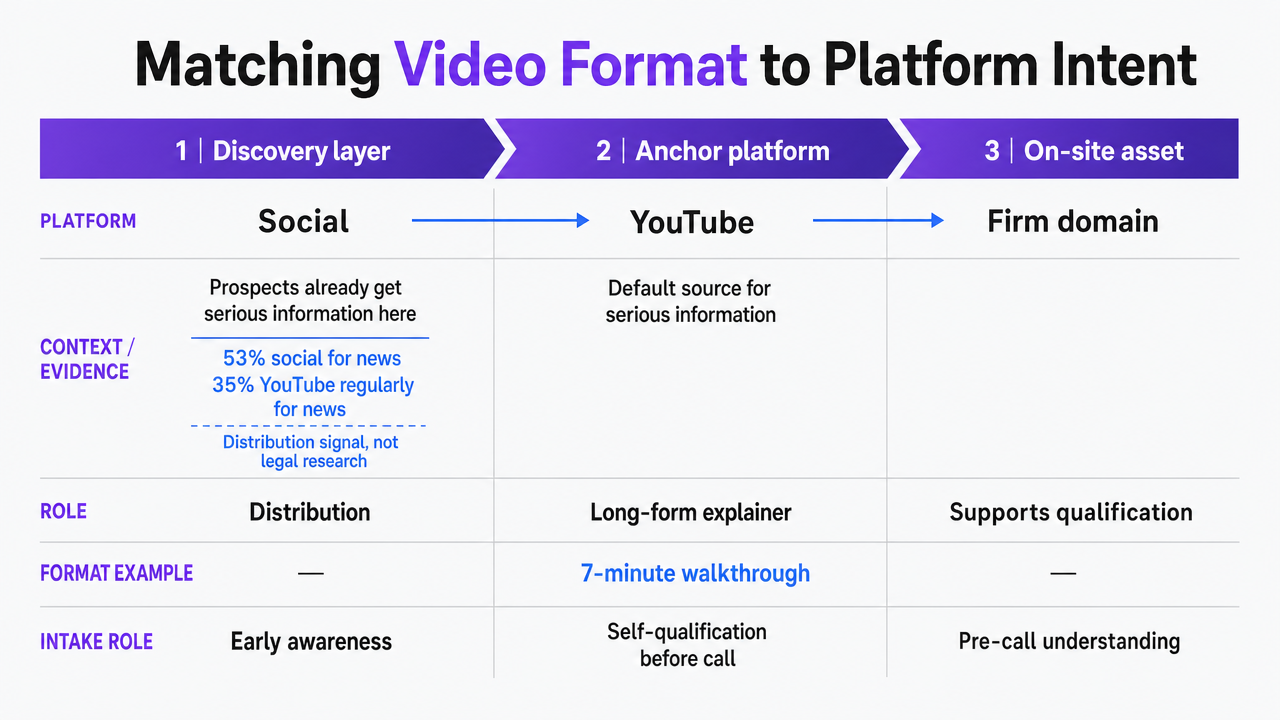 Visualize the section's comparison of platforms, video formats, and intake roles so readers can see at a glance how YouTube, social feeds, and on-site assets map to qualification stages
Test AI video intake strategies on real cases
Experience data-driven video intake analysis using your own firm’s consultation calls, risk-free for seven days.
Phone, Video, or Hybrid Consultations: A Contrarian Read
The default assumption in most agency decks is that video consultations beat phone consultations. They feel more personal, the prospect can see the attorney, and the firm looks modern. The controlled evidence does not back that assumption as cleanly as the pitch suggests.
The ASSIST randomized clinical trial tested whether phone-only telehealth visits were non-inferior to video visits on patient satisfaction and adherence to post-visit recommendations 6. The trial sits in a health-services context, not legal, so the results do not transfer as a direct benchmark. The design point is what matters here: a controlled comparison treated the modality question as open, not settled. Phone was tested as a credible alternative, not a fallback.
Translate that posture to legal intake. A first-touch consultation that screens conflicts, confirms jurisdiction, and walks through a fact pattern often does not require video. The information density is verbal. Documents move by email or upload. Forcing a prospect to install software, find a quiet room with decent lighting, and sit on camera adds friction that suppresses booking rates on matters where the firm needed a thirty-minute conversation, not a face.
Video consultation adds value in a narrower set of cases:
- estate planning sessions where the attorney is reviewing physical documents on camera,
- family law matters where reading affect matters, and
- complex business engagements where multiple stakeholders join from different locations.
Telehealth research more broadly notes that remote modalities improve access but introduce equity, privacy, and digital-divide concerns that firms inherit the moment they require video 7. Older prospects, rural broadband gaps, and households without a private space to take a video call all reduce the pool.
The operational read is straightforward. Offer both. Default to phone for first consultations unless the matter type benefits from visual review, and route the choice to the prospect at scheduling. Track booking rates and consult-to-signed rates by modality. The firm should be measuring whether video is producing better-converting consultations or just better-looking ones.
FTC 2024 Testimonials Rule: What It Rules In and Out
The Federal Trade Commission's 2024 Rule on Consumer Reviews and Testimonials reshapes what a law firm can legally do with video reviews, attorney endorsements, and client clips. The FTC describes the Rule as one that "addresses deceptive and unfair conduct" related to reviews, testimonials, and endorsements, with provisions covering authenticity, incentives, and the suppression of negative feedback 4. For firms building video into intake, the Rule is not a footnote. It determines which assets are usable at all.
Four constraints carry the most operational weight.
Fake or AI-generated testimonials are out. A video that features an actor reading a script written as a client experience, or a synthetic voice describing a case outcome, falls within the Rule's prohibition on deceptive testimonials. The same applies to consolidated quotes presented as if they came from a single client.
Incentivized reviews require disclosure. If a firm offers a gift card, a fee reduction, or any other consideration in exchange for a video review, the incentive must be disclosed clearly within the video itself, not buried in a description field. Conditioning the incentive on a positive review is independently prohibited.
Suppression of negative reviews is out. A firm cannot use legal threats, contractual clauses, or platform takedown tactics to remove unfavorable reviews it knows are genuine. That changes how engagement letters and intake forms can be drafted, and it constrains the standard reputation-management playbook some firms inherited from prior vendors.
Attorney-as-spokesperson content needs care. When an attorney appears in a video describing case outcomes, the Rule's expectations around material connections and accurate representation apply. Disclaimers about results not being guaranteed remain necessary, and any compensated third-party endorsement, including influencer content, requires clear disclosure of the relationship.
The practical effect is that the video testimonial library most firms imagined building, polished client stories produced at scale, narrows considerably. What remains viable: unscripted client interviews recorded with documented consent, attorney-led explainer content with proper disclaimers, and case-result videos that disclose the underlying facts and avoid implying typicality. Firms that build these constraints into the production brief, rather than discovering them in a cease-and-desist letter, keep their video assets in circulation and their intake funnel intact.
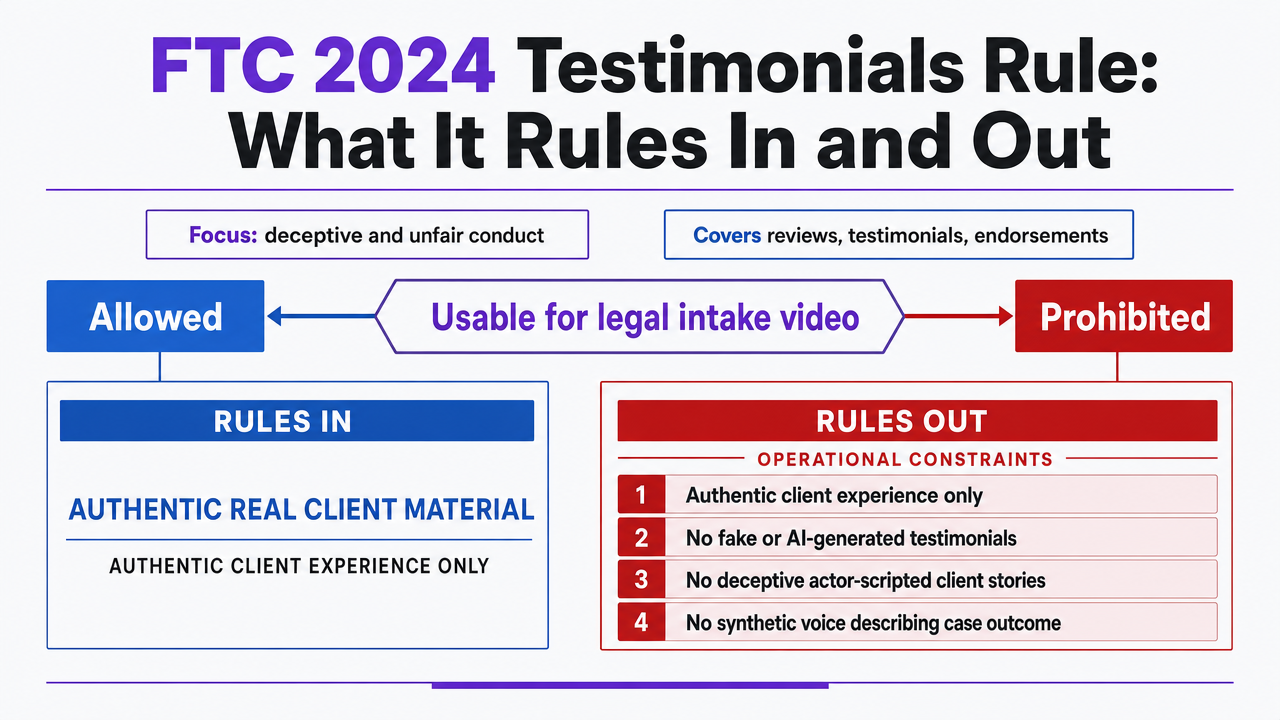 Summarize the four operational constraints from the FTC 2024 Rule so readers can quickly see what is allowed versus prohibited for video testimonials in legal intake
Integrating Video Into the Intake Stack
Recorded Information, Routing, and Online Intake
Video is one layer in a stack that already includes hosted telephony, call routing, after-hours coverage, and online intake forms. Legal Services Corporation guidance on baseline intake technology recommends that programs deliver "recorded information to callers while waiting on hold or after hours" and pair telephony with online intake options to meet a wider range of client needs 5. That framing fits a private firm's intake stack as cleanly as it fits a legal aid program. The point is that recorded content, video included, sits inside the same routing logic as the phone tree.
The practical arrangement looks like this. A prospect lands on a practice-area page, watches the explainer, and clicks to call or schedule. If the call hits after hours, the hold message routes to a short recorded segment that names the firm's practice scope, sets next-business-day expectations, and points back to the on-site qualifying video by URL. The intake form on the scheduling page collects matter type, jurisdiction, and opposing party for conflict screening before the consultation is confirmed.
LSC's guidance also flags accessibility constraints: language proficiency, sensory impairments, and older adults' difficulty with automated systems 5. Captioned video, a transcript link, and a clearly marked path to a live human keep the stack usable for the prospects most likely to drop off when forced through layered automation.
Call Intelligence: Closing the Loop on Video Topics
Video production without call analysis is open-loop work. The firm publishes content, watches view counts, and guesses at which assets are producing signed cases. Closing the loop requires reading what callers actually say once they reach the intake line, then feeding those patterns back into the video roadmap.
The mechanics are straightforward. Recorded intake calls get tagged on a small number of dimensions: practice area, jurisdiction, fact pattern, referral source, and whether the caller referenced a specific video or topic. Across a month of calls, those tags surface patterns no view-count dashboard can produce. Three of the last twenty wrongful-termination callers asked about retaliation timelines, a topic the firm has no video on. Half of the family-law callers who watched the custody explainer arrived already understanding filing thresholds, cutting handle time. A steady share of callers ask about a matter the firm does not handle, suggesting a discovery video is recruiting the wrong audience.
That feedback loop turns the editorial calendar into a response to real intake friction rather than a content-marketing guess. The Legal Services Corporation's technology summit framed the broader principle as "integrated service-delivery systems" that combine content, intake, and technology in one workflow 10. For a private firm, integration means the marketing team is reading the same call data the intake supervisor reads, and the video roadmap is adjusted monthly based on what callers reveal. Video produces qualified inquiries. Call intelligence tells the firm which videos are doing the work.
See How Video Content Can Improve Your Case Qualification Metrics
Request a walkthrough of data-driven approaches for integrating video into legal marketing workflows—learn how leading firms are using video analytics to optimize intake efficiency and reduce wasted consultations.
A Variable Framework for Qualified-Call Economics
The research base for legal video does not include cost-per-lead benchmarks, production cost surveys, or case-conversion lift studies specific to law firms. Any dollar table presented as if it did would be fiction. What managing partners can build instead is a variable framework that uses the firm's own inputs to answer one question: at what point does a video asset pay for itself in signed cases?
The math takes five inputs the firm already tracks or can capture in a quarter.
P : fully loaded production cost per video asset (script, shoot, edit, captioning, hosting).
Q : qualified calls per month attributed to that asset, tagged at intake.
C : consult-to-signed conversion rate for those calls.
V : average case value or expected fee from a signed matter in that practice area.
T : intake-staff minutes saved per pre-qualified call versus an unfiltered call.
Monthly contribution from the asset = (Q × C × V) + (Q × T × loaded intake hourly rate). Payback period in months = P divided by that monthly contribution. A firm that cannot fill in Q and C is not measuring video; it is publishing it.
The comparison that matters is video-led intake against unfiltered intake on the same practice area. Three variables move in the firm's favor when video is doing qualification work. Q rises modestly. C rises more sharply, because the callers who self-select through an explainer arrive with matched issue type and jurisdiction. T compounds across every call, because intake specialists stop re-explaining the same five things.
Two cautions keep the framework honest. Attribution requires intake to ask, in plain language, whether the caller watched a specific video, and to log the answer. Without that tag, Q is a guess. And C should be measured against a baseline period before the asset existed, not against a firm-wide average that mixes channels. A practice area where C climbs from 28% to 38% after a pre-call qualifying video is producing measurable economic lift even if total call volume held flat. A practice area where Q doubles and C falls is recruiting the wrong audience, and the asset needs revision or retirement.
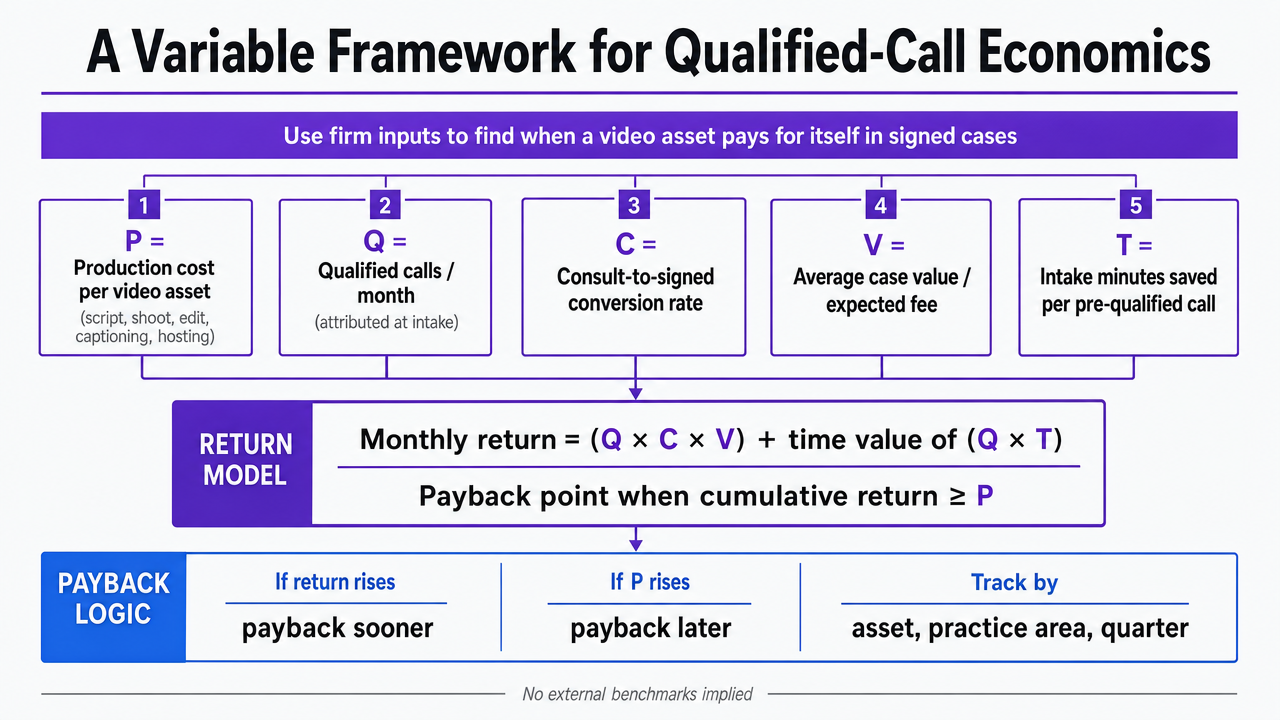 Render the five-variable payback formula introduced in this section so readers can see the inputs, the equation, and the comparison logic in one structured visual
If a Firm Manages Multiple Offices or Practice Groups
The recommendations above assume a single intake line and a unified case mix. Firms running multiple offices, separate practice groups under one brand, or a parent firm with regional subsidiaries inherit a different problem: a single video library tends to over-recruit for the wrong jurisdiction or the wrong practice.
A wage-and-hour explainer that performs well for the Chicago office routes Atlanta callers into an intake queue where the firm has no licensed attorney for that matter. The discovery video did its qualification job on issue type and failed it on geography. Three operating adjustments keep multi-office video assets honest.
- Jurisdiction tagging belongs on screen, not in the description. The opening frame names the state, the office, and the practice scope.
- The call routing layer reads the landing URL the prospect clicked through, so an Atlanta-page caller hits the Atlanta intake queue regardless of which video drove the click 5.
- Call intelligence reports get segmented by office and practice group, not rolled up. A video producing qualified calls firm-wide can still be recruiting unqualified callers for one location while subsidizing another's signed-case rate.
Frequently Asked Questions
References
- 1.Users' experience with health-related content on YouTube.
- 2.Influence of short video content on consumers’ purchase intentions.
- 3.Teens’ Experiences on TikTok, Instagram and Snapchat.
- 4.The Consumer Reviews and Testimonials Rule: Questions and Answers.
- 5.9.1 Baseline for Intake and Telephonic Advice – Telephone Systems.
- 6.Comparing Modes of Telehealth Delivery: Phone vs. Video Visits (ASSIST).
- 7.Telehealth Benefits and Barriers.
- 8.Social Media and News Fact Sheet.
- 9.Young Adults and the Future of News.
- 10.Report of The Summit on the Use of Technology to Expand Access to Justice.