
Key Takeaways
- Profound delivers cross-LLM share of answer at enterprise scale, exporting cleanly into Looker Studio so AI visibility sits alongside organic traffic in the same client report.
- AthenaHQ ties prompt-level mentions back to GA4 referral data, exposing which AI answers drive real sessions versus vanity mentions that look strong but produce no traffic.
- Otterly.AI centers reporting on competitor co-mentions, giving strategists consideration-set data that sharpens positioning narrative in a QBR beyond simple presence percentages.
- Peec AI surfaces sentiment and exact citation sources, turning visibility findings into concrete content briefs when models pull from outdated pages or competitor comparisons.
- Bing Webmaster Tools AI citations offers free first-party data showing pages cited by Bing's grounding layer, reinforcing that strong SEO underpins AI visibility 12.
- SE Ranking AI Visibility folds share of answer and citation data into the same platform agencies already use for keyword tracking, collapsing two workflows into one.
- Vectoron routes AI visibility into a closed loop with call intelligence and approval workflow, connecting prompt mentions to qualified inquiries clients actually renew on.
The reporting gap agencies can monetize right now
McKinsey's research on AI search adoption flags a number that should reshape how agencies price their next renewal: only 16% of brands systematically track their performance inside AI search engines 1. The remaining 84% are flying blind on a surface where roughly half of consumers now intentionally start their research, according to the same McKinsey survey of post-2024 buyer behavior 1. That gap is not a measurement problem for the brand. It is a reporting product an agency can build, sell, and defend in a QBR by the end of the quarter.
The same McKinsey analysis quantifies the consequence of waiting: even sophisticated companies are running 20% to 50% behind their traditional SEO visibility when measured inside AI answers 1. A client whose Google rankings look healthy can still be losing share of voice inside ChatGPT, Perplexity, and Gemini answers, and they have no instrumentation to see it. Agencies that close that visibility gap with prompt-level tracking, then connect it to organic traffic and qualified inquiries already in the client report, convert a reporting deficit into a billable line item.
The seven tools that follow are evaluated on one criterion: does the data they produce ladder into a client ROI story, or does it sit in a separate dashboard nobody opens between meetings.
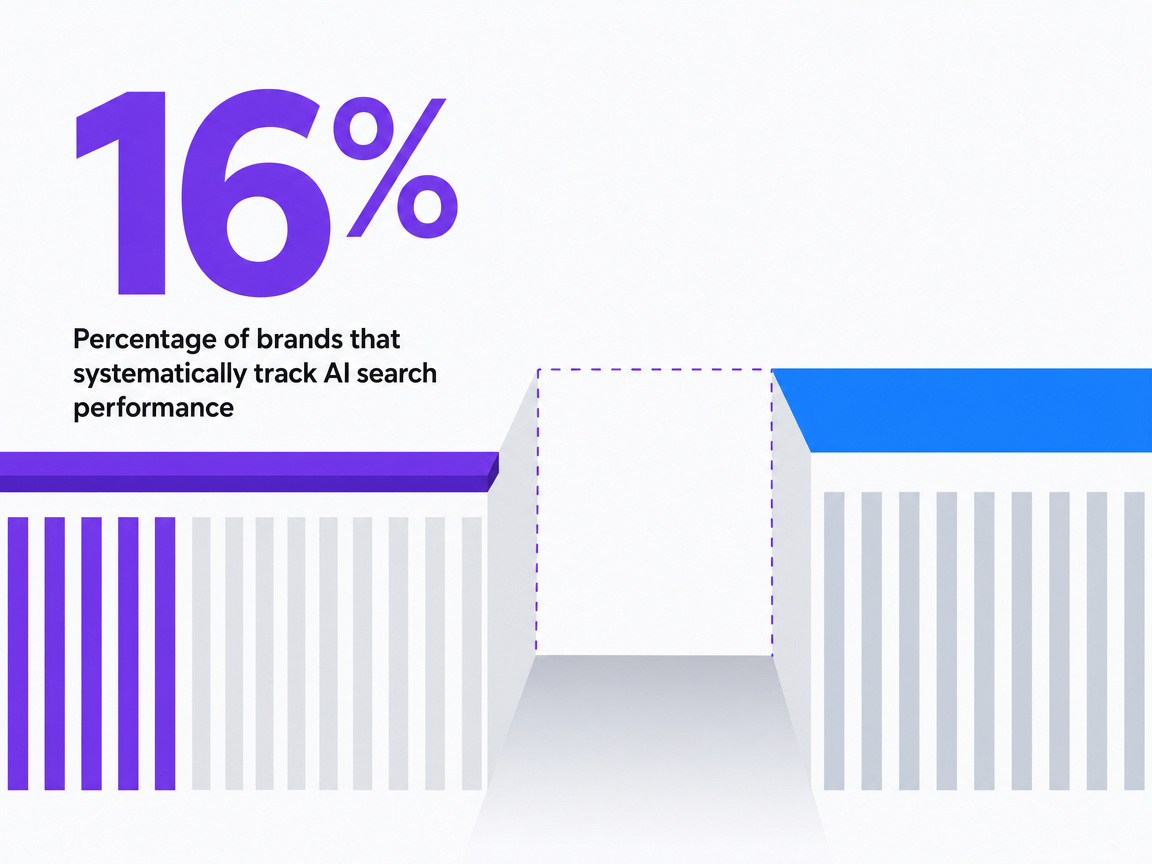 Percentage of brands that systematically track AI search performance
Percentage of brands that systematically track AI search performance
What a ChatGPT rank tracker actually records
The category name is misleading. There is no single ranked list inside an AI answer the way there is on a Google SERP. A ChatGPT rank tracking tool runs a defined library of prompts that mirror real user questions, then parses each generated answer for five distinct signals 11:
- Brand mentions
- Source links cited inside the response
- Relative placement within the answer
- Competing brands that appear alongside the client
- Sentiment or context wrapped around each mention
Those five signals matter because they map to different client questions. Mention frequency answers "are we showing up at all." Source links answer "which of our pages is the model pulling from." Relative placement, meaning whether the brand appears in the first recommendation versus a closing aside, approximates the click-equivalent of a SERP position. Competitor co-occurrence reveals the consideration set the model is constructing on the client's behalf. Sentiment captures whether the model is recommending the brand or qualifying it.
Beyond ChatGPT, most tools in this category run the same prompt set against Gemini, Claude, and Perplexity, then aggregate share of answer across engines so a single dashboard reflects multi-LLM visibility rather than a single-surface snapshot 3.
The evaluation lens: tools that ladder into client ROI
A ChatGPT rank tracker that produces a standalone dashboard nobody opens between QBRs is operationally worthless, regardless of how elegantly it parses prompts. The seven tools below were filtered against four criteria that map to how an agency lead actually reports on retention-grade accounts.
- Does the tool export prompt-level visibility data into the formats already feeding the client report, whether that means GA4 custom dimensions, Looker Studio connectors, or CSVs that survive a non-technical strategist's hands. Forbes' AEO coverage is direct on this point: traffic and engagement from AI platforms remain the most reliable signal of answer engine impact, which means the tracker has to talk to the analytics layer where conversions live 4.
- Does it cover the LLMs the client's buyers actually use, not just ChatGPT, so share of answer reflects the full consideration surface 3.
- Does it record the five signal dimensions (mentions, citations, placement, competitors, sentiment) rather than a single presence flag 11.
- Does the per-client cost and analyst time absorb into existing reporting cadence, or does it force a parallel workflow that erodes margin on every account it touches.
Test AI Rank Tracking on Live Campaigns Now
Validate real-time keyword movements and report ROI using actual client data during your trial period.
Seven ChatGPT rank tracking tools worth a shortlist slot
Profound — for agencies that need cross-LLM share of answer at scale
Profound sits at the enterprise end of the AI visibility category, built for agencies that need defensible share-of-answer math across ChatGPT, Gemini, Claude, and Perplexity in the same report. The tool runs prompt libraries that can scale into the thousands per client, then aggregates results into a single share-of-answer index that benchmarks the client against the competitive set the model is actually surfacing 7.
The reporting payoff for an agency lead is that the dashboard exports clean enough to drop into a Looker Studio panel next to organic traffic and conversion trends, which keeps AI visibility from becoming a separate meeting. Where Profound gets expensive is per-prompt cost at the volume needed for multi-segment B2B accounts. Agencies running 15-plus enterprise clients with broad keyword footprints absorb the price; boutiques running ten SMB accounts on flat retainers will feel it. The job-to-be-done is share of answer, not citation forensics, so pair it with a tool that records source-link data if QBRs need both.
AthenaHQ — for closing the loop between prompt visibility and organic traffic
AthenaHQ leans into the integration problem Forbes flagged as the most reliable AEO signal: traffic and engagement from AI platforms tied back to specific prompts the model is answering 4. The tool maps prompt-level mentions to GA4 referral data from ChatGPT, Perplexity, and Gemini sessions, so an agency can show a client which AI answers are producing actual sessions and which mentions are vanity.
That join is the part most standalone trackers skip. A brand might show up in 40% of relevant ChatGPT answers and still drive zero qualified traffic if the citations point to outdated pages or the model is recommending a competitor by name in the same response. AthenaHQ surfaces that disconnect by anchoring every prompt to the downstream session data already living in the client's analytics stack. Limitation: referral data from LLMs is still patchy, particularly for ChatGPT free-tier sessions, so the join rate will be lower than what GA4 reports for Google organic.
Otterly.AI — for competitor co-mention tracking inside specific prompts
The most undersold dimension in AI visibility reporting is competitor co-occurrence: which brands the model lists alongside the client when a buyer asks a comparison or recommendation question. Otterly.AI builds the report around that signal, recording every competing brand mentioned in each AI response and trending co-mention rates over time 11.
For an agency running a positioning conversation in a QBR, this changes what gets reported. Instead of saying "the client appears in 38% of relevant prompts," the strategist can say "the client appears in 38% of relevant prompts and is co-mentioned with Competitor A in 71% of those responses, with Competitor B closing the gap from 22% to 34% over the last 60 days." That is consideration-set data the client cannot get from Search Console. Otterly's coverage of niche LLM surfaces is thinner than Profound's, and the prompt builder requires more manual curation upfront. The payoff is sharper competitive narrative inside the existing report.
Peec AI — for sentiment and citation-source reporting in client QBRs
Peec AI focuses on the two signals most trackers report poorly: the sentiment wrapped around each brand mention and the exact source URL the model cited to construct the answer. Both matter for client conversations that go beyond presence. A model can mention a brand in a qualifying or cautionary frame, and a tool that only counts mentions will read that as a win 11.
The citation-source view is the operationally useful half. When Peec AI shows that ChatGPT is pulling answers about a client's service area from a three-year-old blog post or, worse, from a competitor's comparison page, the agency has a content brief written for them. That converts visibility data into the next sprint of work, which is the part clients reliably renew on. Sentiment classification is still imperfect on long, mixed responses, so treat the sentiment trend as directional rather than literal until the underlying models stabilize.
Bing Webmaster Tools AI citations — for first-party data agencies already trust
The most underused tool in this category is free. Bing Webmaster Tools now exposes an AI citations report that records when Bing's grounding layer, which feeds Copilot and parts of ChatGPT's web-connected responses, cites a client's pages 12. For agencies already pulling Bing data into client reports, this is a first-party signal that does not require a new vendor contract.
The strategic value sits in what the data reveals about the SEO-and-AEO relationship. CXL's analysis of the AI citations report is direct: the pages Bing cites most already rank well organically, which undercuts the framing that generative engine optimization replaces SEO and supports treating AI visibility as continuous with search fundamentals 12. That finding reframes how agencies should sell the work. The pitch is not "buy a new AI strategy." The pitch is "the SEO program we are already running is the foundation for AI visibility, and here is the first-party data proving it." Limitation: the report covers Bing's grounding queries, not ChatGPT prompts directly, so pair it with a dedicated prompt tracker for full coverage.
SE Ranking AI Visibility — for agencies already running multi-client rank tracking
SE Ranking added AI visibility tracking inside the same platform many agencies already use for keyword position monitoring across 20-plus client accounts. That matters because the operational drag of AI visibility reporting is rarely the data itself; it is the second login, the second invoice, and the second analyst-trained interface 3.
For agencies running SE Ranking as the spine of their reporting stack, the AI visibility module pulls share of answer, brand mentions, and citation data into the same client view as Google rankings and Search Console queries. That collapses the reporting workflow from two tools into one, which is the practical lever for protecting margin across a large book. The tradeoff is depth. SE Ranking's prompt coverage and sentiment classification are not as granular as Profound or Peec AI. For agencies that need defensible enterprise-grade share-of-answer math, it is a complement, not a replacement. For agencies running mid-market accounts where the QBR needs directional AI data alongside traditional SEO, the consolidation wins.
Vectoron — for routing AI visibility signal into call intelligence and approval workflow
The seventh slot belongs to a tool that addresses the part of the ROI story prompt trackers cannot close: what happens after a buyer reads the AI answer and picks up the phone. Vectoron routes AI visibility signal into a unified workflow that also reads recorded calls, tags qualified inquiries, and flags missed opportunities, then surfaces both data streams inside a Command Center where every recommendation routes for human approval before execution.
For an agency lead, the operational shift is that AI visibility stops being a standalone report and becomes one input into a closed loop: prompt-level mentions, the organic and referral traffic they drive, the calls those sessions produce, and the qualified-inquiry rate those calls hit. That is the ROI line item clients renew on, particularly in service verticals where a single qualified call covers the monthly retainer. The platform handles content, SEO, backlinks, social, and call intelligence in the same approval workflow, so AI visibility does not require a separate analyst or a separate dashboard to sit inside the QBR narrative.
Cost-to-serve: what AI visibility tracking does to analyst hours
The honest question inside an agency leadership meeting is not whether AI visibility tracking matters. It is whether absorbing it across a 20-client book adds an analyst seat or quietly eats margin on every account. The McKinsey data showing only 16% of brands systematically track AI search performance is the opening; the staffing math is what determines whether the opening converts 1.
The variable is analyst hours per client per month, not software cost. The three approaches below assume the same baseline scope: 150 tracked prompts, four LLM surfaces (ChatGPT, Gemini, Claude, Perplexity), and monthly reporting cadence tied to the existing client report.
| Reporting approach | Setup hours (per client, one-time) | Recurring hours (per client, monthly) | Hours across a 20-client book (monthly) |
|---|---|---|---|
| Manual prompt testing in ChatGPT, logged to a sheet | 4-6 | 8-12 | 160-240 |
| Standalone AI visibility tool with separate dashboard, re-keyed into the client report | 2-3 | 3-5 | 60-100 |
| Unified workflow that routes AI visibility into the existing client report | 2-3 | 1-2 | 20-40 |
The gap between the second and third row is the operational story. Standalone tools cut the data-collection cost, but re-keying prompt visibility, citation sources, and competitor co-mention rates into the QBR deck still consumes the strategist's time. Routing the same signals into the report the client already reads collapses that step. For an agency lead defending headcount, the practical takeaway is that the line item only absorbs cleanly when the AI visibility data lands inside the existing reporting surface rather than next to it.
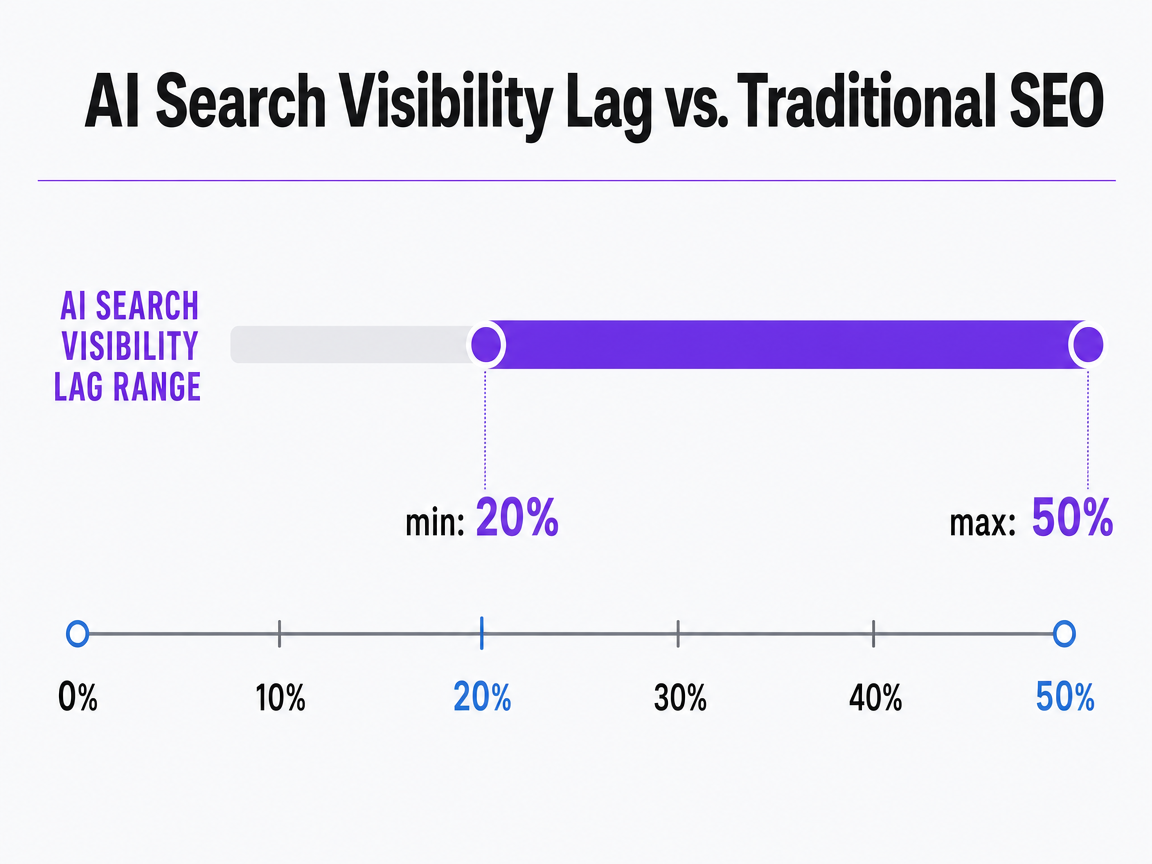 AI Search Visibility Lag vs. Traditional SEO
McKinsey notes that for even sophisticated companies, visibility in AI search can lag behind traditional SEO performance by 20% to 50%.
If you manage multiple client books or franchise rollups
Scope shift: the math above assumes single-brand clients. Agency leads supporting franchise systems, DSO rollups, or multi-location service brands face a different reporting surface, because each location runs its own consideration set inside AI answers and the parent brand needs share of answer rolled up across markets.
The operational lever is prompt segmentation. A 40-location home services brand cannot share a single prompt library; the model's answer to "best HVAC company near me" varies by geo, and a rollup report that flattens that variance hides the markets where the brand is losing share. Agencies running these accounts segment prompts by location, track share of answer per market, then aggregate to a brand-level index for the franchisor while preserving the per-unit view that franchisees actually read. The reporting math also bends toward consolidation faster at this scale: at 40-plus locations, even a one-hour-per-location monthly delta between tools compounds into a full analyst seat, which is the line item that decides whether AI visibility tracking is sustainable across the rollup 3.
See How Leading Agencies Validate SEO ROI With AI-Powered Rank Tracking
Request a walkthrough of unified rank tracking and call intelligence workflows proven to quantify keyword impact, automate reporting, and surface missed opportunities across multi-location and enterprise campaigns.
What not to put in a client report
The fastest way to undermine an AI visibility line item is to fill the QBR deck with metrics that move for reasons the client cannot act on. Three patterns recur across the vendor-led roundups and should stay out of the report.
Raw prompt counts are the first. Reporting that the tool tracked 487 prompts last month tells the client nothing about whether their buyers are seeing the brand inside answers. The number reflects how much the agency spent on the tracker, not how the brand performed. Replace it with share of answer on the prompt segments tied to the client's actual buying questions.
Single-snapshot mentions are the second. AI answers vary across sessions, models, and time of day. A one-time pull showing the brand appears in 62% of relevant ChatGPT responses is a screenshot, not a trend. The reportable signal is the rolling 30- or 60-day average against the same prompt set, with the competitive set held constant 11.
Sentiment scores presented as literal percentages are the third. Classification on long mixed responses is still directional. Report sentiment as a movement, not a verdict.
What these tools still can't do
Every tool in the shortlist runs on the same architectural compromise: prompts go in, parsed answers come out, and the layer in between is a model the agency does not control. That compromise produces four gaps an honest QBR should name rather than paper over.
- Answer variance. Two identical prompts run an hour apart can return different brand sets, different citations, and different sentiment. Trackers smooth this with repeated sampling, but the underlying noise floor is real and caps how granular week-over-week reporting can be.
- Attribution. Even when ChatGPT or Perplexity drive a session, referral data is inconsistent across free and paid tiers, so the join between prompt-level visibility and downstream conversions remains partial 4.
- Coverage. No tool tracks every AI surface a buyer might use, and prompt libraries are agency-curated approximations of how buyers actually phrase questions 3.
- Causation. A mention rate that climbs after a content sprint is correlated, not proven, and clients who pressure-test the report will ask.
A QBR-ready ROI framework for AI visibility
The framework that holds up under a CFO's questioning treats AI visibility as one layer in a four-step causal chain, not as a standalone metric. Each step has a defined owner, a defined data source, and a defined cadence, which is the structure that lets a strategist defend the line item against "what did this actually produce."
- Share of answer on the prompt segments tied to the client's buying questions, reported as a rolling 60-day average against a fixed competitive set 11.
- Referral and organic traffic from LLM sources, joined to the prompts driving them through GA4 custom dimensions, which Forbes' AEO coverage identifies as the most reliable measurable signal of answer engine impact 4.
- Qualified inquiries, whether that means form fills, booked demos, or calls scored for intent.
- Pipeline or closed revenue attributed to those inquiries, reported on the same cadence the client already uses for sales reporting.
Two anchors keep the framework honest in front of the client. The first is timing: First Page Sage's benchmark of a 6 to 12 month window for positive SEO ROI applies to AI visibility work as well, and setting that expectation in the first QBR prevents the third-quarter renewal conversation from being a defense against impatience 8. The second is a directional benchmark: roughly 70% of businesses report higher ROI from integrating AI into SEO workflows, which gives the strategist a peer-comparison anchor without overpromising client-specific outcomes 9. Frame the four-step chain in the deck, populate it with the client's actual numbers, and AI visibility stops being a curiosity line and starts behaving like the revenue input the renewal conversation needs it to be.
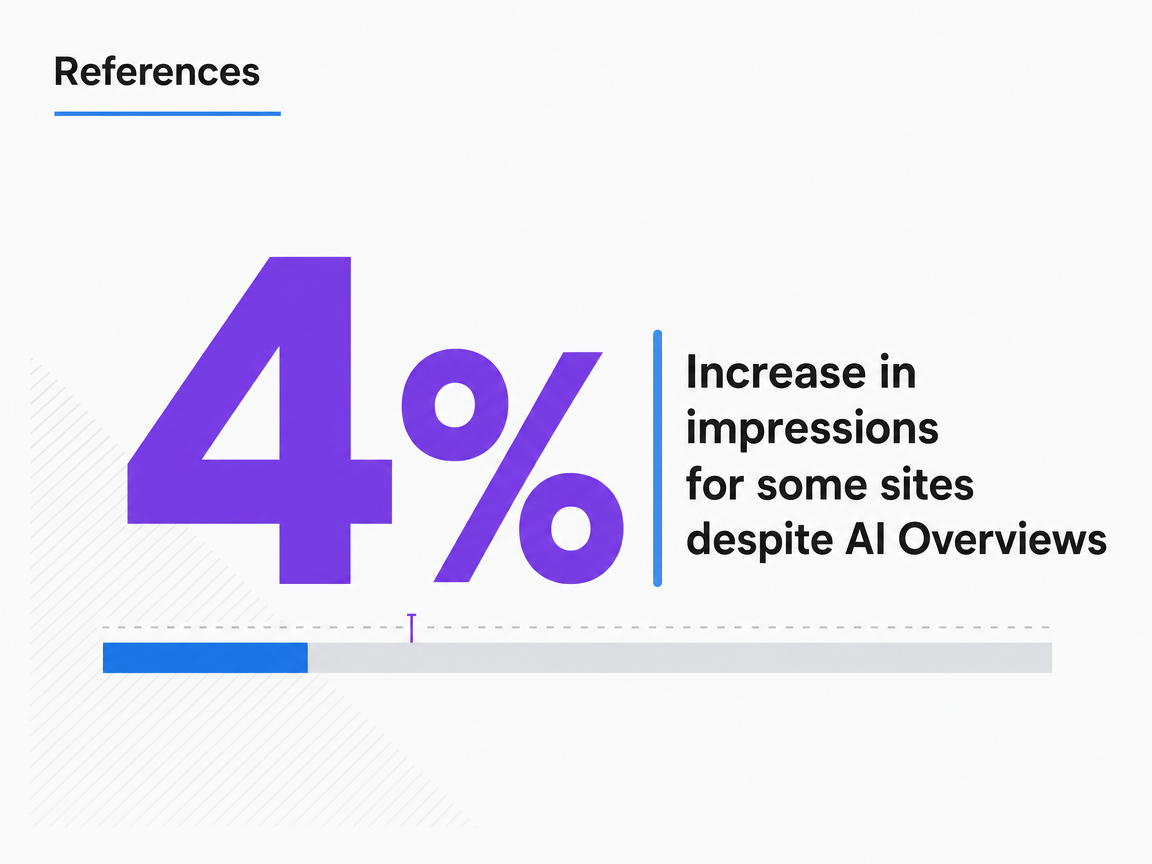 Increase in impressions for some sites despite AI Overviews
Increase in impressions for some sites despite AI Overviews
Frequently Asked Questions
References
- 1.Winning in the age of AI search.
- 2.AI Overviews SEO Impact Report [New Data].
- 3.Top Tools for Tracking AI Visibility.
- 4.Answer Engine Optimization — What Brands Need To Know.
- 5.Answer Engine Optimization (AEO): Your Complete Guide to AI Search.
- 6.11 Best AI SEO Agencies in 2026 (& How to Evaluate Them).
- 7.The 8 best AI visibility tools in 2026.
- 8.SEO ROI Statistics 2026.
- 9.26 AI SEO Statistics for 2026 & Insights They Reveal.
- 10.Core Benefits of AI for SEO Strategy in 2026.
- 11.Top ChatGPT Rank Tracking Tools for AI Visibility (2026).
- 12.How to track your AI visibility with Bing.