
Key Takeaways
- Adding more collaboration tools rarely increases output; once Slack, task boards, wikis, and docs are standard, extra platforms fragment attention and raise coordination cost per deliverable.
- Measure coordination cost by counting every touchpoint required to move one recurring deliverable from brief to approval, then multiply by hourly cost to expose the hidden margin tax.
- Assign one authoritative platform per work pattern—strategy, production, review, publishing, reporting—because a consistently used tool beats a superior tool applied inconsistently across accounts 1.
- Audit touchpoints, tool-to-pattern mapping, knowledge retrieval speed, and where human judgment truly matters before adding anything; the execution layer belongs where coordination adds no client value.
Why More Tools Stopped Producing More Output
Collaboration tools saw a significant increase in adoption between 2019 and 2021. Gartner data, compiled by HP Workforce Experience, indicates that worker adoption of digital collaboration tools rose from approximately 55% globally in 2019 to nearly 79% in 2021, largely due to the pandemic-driven shift to hybrid and remote work 5. This trend, while covering the general workforce, clearly shows that chat, video, shared documents, and task boards became standard infrastructure rather than a competitive advantage.
For agency owners, the practical outcome is more subtle than the adoption curve suggests. Once every agency uses tools like Slack, a project management system, a wiki, and a document suite, adding another tool no longer guarantees a proportional increase in throughput. In many production environments, it can have the opposite effect. Each new platform introduces another place to check, another notification stream to manage, and another set of conventions to enforce across account teams.
McKinsey's research on knowledge work highlights this issue from a productivity standpoint. Gains in efficiency come from applying technology precisely to distinct work patterns, not from broadly deploying collaboration tools across an entire team 1. Widespread deployment can actually decrease output by fragmenting attention across redundant platforms.
This article explores the tension between scaling communication about work and scaling the work itself. Understanding this distinction is crucial for agencies looking to expand margins rather than simply adding headcount to keep pace.
Coordination Cost per Deliverable: A Diagnostic Frame
While most agency owners monitor utilization, gross margin per account, and delivery velocity, few track coordination cost per deliverable. This metric is more valuable when assessing whether the current technology stack can support more clients without requiring additional hires.
Coordination cost per deliverable represents the total number of touchpoints needed to move a single billable output from initial brief to publication. A touchpoint is any human interaction aimed at aligning, clarifying, or handing off work, such as a Slack thread, a status meeting, a briefing document, a review comment, a re-brief after client feedback, or a resource reallocation due to a missed deadline. Each touchpoint incurs a time cost, which reduces the margin on the deliverable.
The diagnostic process is straightforward. Select a recurring deliverable—like a monthly SEO article, a paid social creative set, or a client report—and count all touchpoints from kickoff to client approval across every platform the team uses. Multiply this by the average hourly cost of the personnel involved. This figure, divided by the fee for the deliverable, reveals the coordination tax on that specific type of work.
Agencies conducting this exercise typically observe two patterns. First, the number of touchpoints increases with the number of platforms in use, not necessarily with the complexity of the work. Second, a significant portion of touchpoints exist to reconcile information that already exists within the stack but isn't readily accessible to the next person who needs it. Hyland's analysis confirms this: digital platforms enhance efficiency when they automate task handoffs and display progress, but they create friction when notifications and workflows aren't designed around a clear path 7.
This framework reorients the discussion about tools. The focus shifts from "which platform is best" to "which touchpoints can be eliminated without compromising quality or client trust." This is the key to actual margin expansion.
The Targeted-Deployment Argument Against Stacking
Mapping Work Patterns to Tool Categories
McKinsey's research on knowledge work suggests that productivity gains stem from precisely applying technology to distinct work patterns, rather than broadly deploying collaboration tools across a team 1. This distinction is operational: broad deployment gives everyone access to every platform, while targeted deployment assigns each work pattern to the specific tool designed for it.
For an agency, most billable output falls into four main patterns:
- Strategy work—including positioning, planning, and campaign design—is low-volume and high-context, benefiting from long-form documents, threaded discussions, and version history.
- Production work—such as writing, design, ad creation, and video editing—is high-volume and asset-heavy, requiring task queues, file management, and status tracking.
- Review work falls in between, needing inline commenting, clear approval states, and an audit trail.
- Publishing work is transactional, demanding scheduling, credential management, and a log of what was shipped and when.
The mapping exercise often reveals the weaknesses in most agency stacks. Strategy documents might be scattered across Notion, Google Docs, and Slack canvases for the same account. Production tasks could reside in ClickUp for one client and Trello for another, often due to client preference. Review comments might be split between a design tool, a shared drive, and a Slack thread. While individual tools may be competent, the lack of a single authoritative platform for each work pattern forces teams to spend time reconciling information instead of producing.
The solution of targeted deployment is straightforward: select one platform per work pattern, enforce its use across all accounts, and accept that a slightly less perfect tool used consistently will outperform a superior tool used inconsistently. This approach reduces coordination costs because teams no longer have to search for where the work resides.
Where Slack, ClickUp, Notion, and Google Workspace Actually Fit
A peer-reviewed study of hybrid digital marketing agencies consistently identified a cluster of four tools: Slack, Google Workspace, ClickUp, Trello, and Notion 4. This consistency is valuable, as it suggests the category has matured enough to focus on assigning roles rather than just selecting tools.
Slack functions primarily as a routing layer. Its most valuable uses are for push notifications from other systems and for quick clarifications that would otherwise require meetings. The study highlights Slack's role in agencies with advanced hybrid models as the main channel for agile communication 4. However, it is not an effective system of record; threads get buried, search capabilities degrade with volume, and decisions logged in Slack rarely remain accessible long-term.
ClickUp and Trello are best suited for the production pattern, managing task queues, dependencies, and delivery statuses. When an agency uses both, one client's work may be invisible to the producer handling another client, creating compartmentalization that the same study identifies as a drag on distributed teams 4. Standardizing on one of these platforms is worth the migration effort.
Notion serves as a strategy and documentation platform, excelling at briefs, positioning documents, SOPs, and account wikis more effectively than a task management tool. It is less effective as a production tracker and even worse as a messaging platform; using it for these purposes leads to the sprawl described earlier.
Google Workspace is ideal for review and asset management. Its Docs, Sheets, and Slides offer inline comments and version history that withstand client scrutiny. Noupe's overview of practitioner insights echoes this pattern: shared documents, task tools, and messaging channels are effective when updates from one system feed into another, not when each becomes a separate check-in point 8.
Trial Full-Scale Collaboration for Agency Output
Test streamlined team workflows and publish real campaigns using actual agency processes before making a commitment.
The Hybrid Agency Problem: Knowledge Compartmentalization
The peer-reviewed study of hybrid digital marketing agencies pinpointed knowledge compartmentalization as a specific impediment to distributed delivery. Researchers noted that
"the greatest difficulty in integrating 100% remote employees into team dynamics is the loss of connections between different teams and the compartmentalisation of knowledge"
4. This finding is directly relevant to digital marketing agencies, not just a general observation about remote work.
Compartmentalization often manifests as duplicated work in production. For instance, a paid media team might develop an audience framework for a client. Three months later, the content team on the same account might rebuild a similar framework from scratch because the original was stored in a private channel, a personal Notion page, or an unindexed shared drive folder. The tools themselves didn't fail; rather, the stack lacked a designated place for cross-team knowledge to be stored and easily retrieved.
Operationally, this often leads to headcount growth becoming the default solution. When a new account is acquired, the immediate response is to add producers instead of leveraging existing agency knowledge. This erodes margin per account because the agency effectively pays twice for the same intellectual work, and account teams operate as isolated silos connected only by weekly status meetings.
The solution involves establishing a knowledge surface with two strict rules: every account must have a single wiki location, and every deliverable must link back to the framework that informed it. Tools like Notion, Google Workspace, or similar platforms can handle the mechanics. The crucial element is discipline: shared knowledge retrieval must be faster than rebuilding, otherwise producers will opt to rebuild.
Tool Sprawl Is Accelerating, Not Slowing
The problem of tool sprawl is intensifying. The global collaboration software market is projected to grow from $6.56 billion in 2023 to $19.86 billion by 2032, at a compound annual growth rate of 13.1% 6. While this figure encompasses the entire vendor ecosystem, it signals what agency owners can expect: more categories, more new entrants, and more integrations marketed as productivity enhancers.
For agencies operating lean, this market growth translates into constant pressure to add new tools. A new AI note-taker integrates with Zoom, a new brief generator plugs into Notion, or a new client portal promises to replace three tools but becomes a fourth. Each addition comes with a plausible business case and a free trial, and each one increases the coordination cost per deliverable.
Agency owners need to adopt a subtractive discipline. Quarterly, at least one tool should be evaluated for removal, not addition. If a platform hasn't become the authoritative surface for a specific work pattern within ninety days of adoption, it's contributing to sprawl rather than resolving it. The market will continue to expand, but agencies that treat their tech stack as fixed infrastructure—deliberately chosen and regularly pruned—will protect margins that competitors lose to excessive tool budgets and context switching.
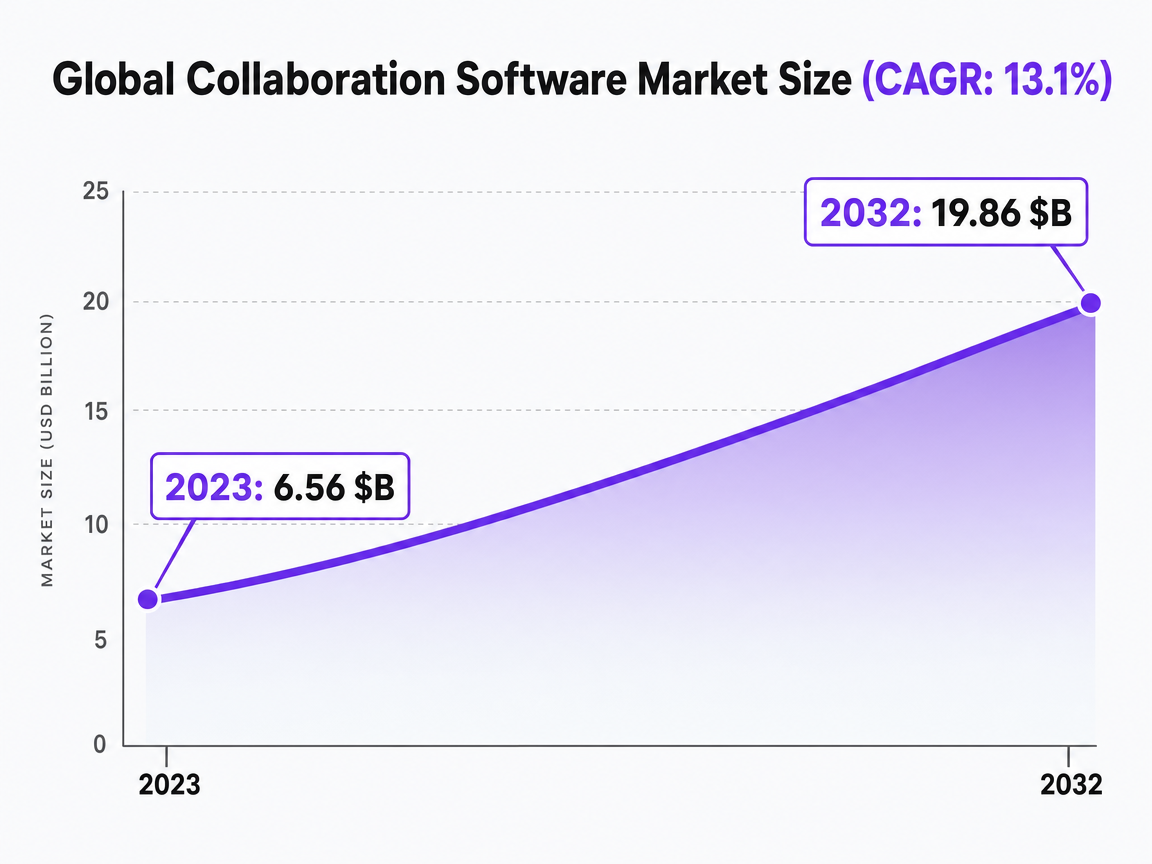 Global Collaboration Software Market Size (CAGR: 13.1%)
Source: Collaboration Software Statistics and Facts (2026) - Market.us Scoop
A Consolidation Economics View for Multi-Account Production
This section shifts focus from single-account coordination to the economics of managing production across multiple accounts. This is where tool sprawl escalates most rapidly, as each additional client multiplies touchpoints across a fragmented stack instead of leveraging consolidated infrastructure.
The table below frames consolidation as an exercise in optimizing work patterns, not merely comparing vendors. Coordination touchpoints per deliverable are represented by a variable (T), as the exact count varies by agency. However, the direction of the change (delta) is consistent across the studies cited. The "Approval-Layer Alternative" column describes the improvements when execution is governed by a single sign-off surface rather than being distributed across chat threads and task tools.
| Work Pattern | Typical Tools per Pattern | Touchpoints per Deliverable | Approval-Layer Alternative |
|---|---|---|---|
| Strategy | Notion, Google Docs, Slack canvases | T + rework from split sources | One brief surface with signed positioning |
| Production | ClickUp, Trello, per-client boards | T × number of client-specific boards | One queue with per-account tagging |
| Review | Google Workspace, design tools, Slack | T + reconciliation across surfaces | Inline comments feeding one approval state |
| Publishing | CMS, ad platforms, scheduler tools | T + credential and log fragmentation | Approved artifact ships from one execution log |
| Reporting | Sheets, dashboards, deck templates | T + weekly manual aggregation | Outcomes attached to the artifact that produced them |
The underlying math is simple. If T averages six touchpoints per deliverable at a five-account agency, the portfolio incurs thirty coordination cycles for every unit of output across all work patterns. Hyland's practitioner framework highlights how this number can be reduced: automating handoffs and designing clear notifications eliminate touchpoints that merely move information between platforms 7. The remaining touchpoints are those requiring human judgment, which is where billable expertise truly lies.
Consolidation economics doesn't imply fewer people. Instead, it means the same team can produce more billable output because the tech stack no longer taxes their hours with coordination that adds no client value.
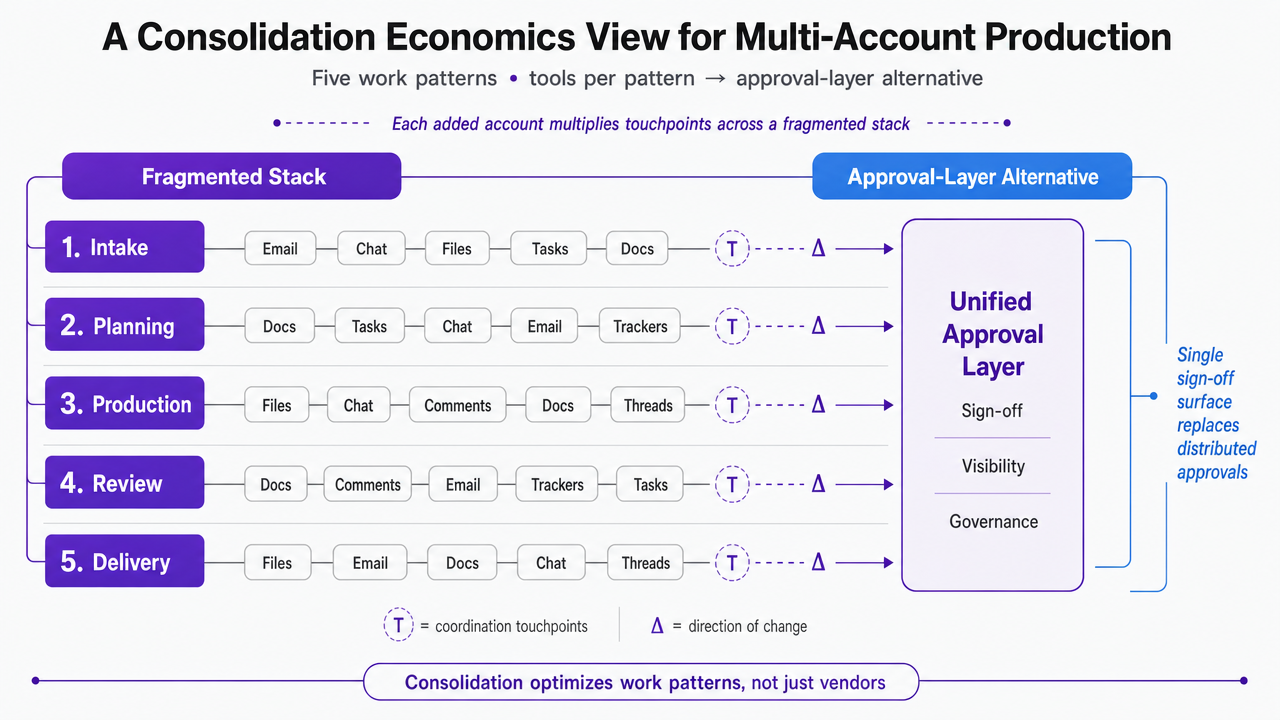 Visualize the five-work-pattern consolidation framework described in the section, mapping typical tools per pattern to their approval-layer alternative
Streamline Agency Collaboration and Deliver at Scale—With Full Oversight
Connect with our team to see how AI-driven collaboration platforms can centralize workflows, reduce manual overhead, and maintain quality control across multi-channel campaigns for agencies managing complex client portfolios.
Distributed Teams and the Psychology of Digital Workspaces
Collaboration platforms are not neutral conduits. A study of multicultural remote teams found a positive correlation between tool usage frequency and empathy, team cohesion, and cross-cultural communication, with an indirect effect of 0.109 on perceptions of inclusive leadership 3. While this result is specific to multicultural remote workforces, the broader implication is that the digital environments a distributed team inhabits influence how members perceive each other.
For agencies managing producers across time zones or contractors across countries, channel design has implications beyond mere information transfer. A dense, transactional Slack culture can be interpreted differently by a producer in another region compared to the account lead who established the tone. Asynchronous norms, response-time expectations, and how credit is assigned are not minor considerations. They shape whether producers feel comfortable raising issues early or quietly absorbing them, and quiet absorption is often where deliverables fall behind.
A cautionary note is warranted here. A separate peer-reviewed comparison of virtual workplaces revealed that immersive VR environments increased cognitive load and reduced concentration compared to standard videoconferencing 2. Agencies considering more elaborate virtual environments to bridge distance should heed this warning against over-engineering their stack. The remedy for compartmentalization lies in clearer norms and a more streamlined set of platforms, not more complex ones.
From Collaboration Layer to Execution Layer
Signal, Recommendation, Approval, Execution, Measurement
Collaboration platforms facilitate conversations about work. An execution layer, however, manages the work itself under governed sign-off. This distinction involves a five-step loop: signal, recommendation, approval, execution, and measurement. Each step produces a defined artifact, and each artifact resides in a single, authoritative location, eliminating the need to reassemble information from chat threads and status meetings.
A signal is a data event that should prompt action—for example, a qualified call dropping off, a rising cost per lead, an article slipping in rankings, or a campaign underspending. In an agency relying solely on a collaboration layer, these signals appear in dashboards that someone must notice, interpret, and then route into a task tool. In an execution-layer setup, the signal itself generates a ranked recommendation with supporting rationale, allowing the account team to debate the recommendation directly rather than spending time formulating it.
Approval acts as the gate, ensuring human judgment remains central. The producer, strategist, or account lead signs off on the recommendation before any action is taken. This preserves the creative control agency owners value and transforms approval from a meeting into a single decision on a defined artifact.
Execution is the automated phase. Approved work is automatically sent to the CMS, ad platform, outreach queue, or scheduler without a producer manually moving files between platforms. Measurement then links outcomes back to the artifact that generated them, addressing the reporting reconciliation discussed in the consolidation table. McKinsey's targeted-deployment argument underpins this loop: technology applied precisely to a defined work pattern consistently outperforms broad tool deployment 1. The execution layer applies this principle across the entire production cycle, not just to a single tool choice.
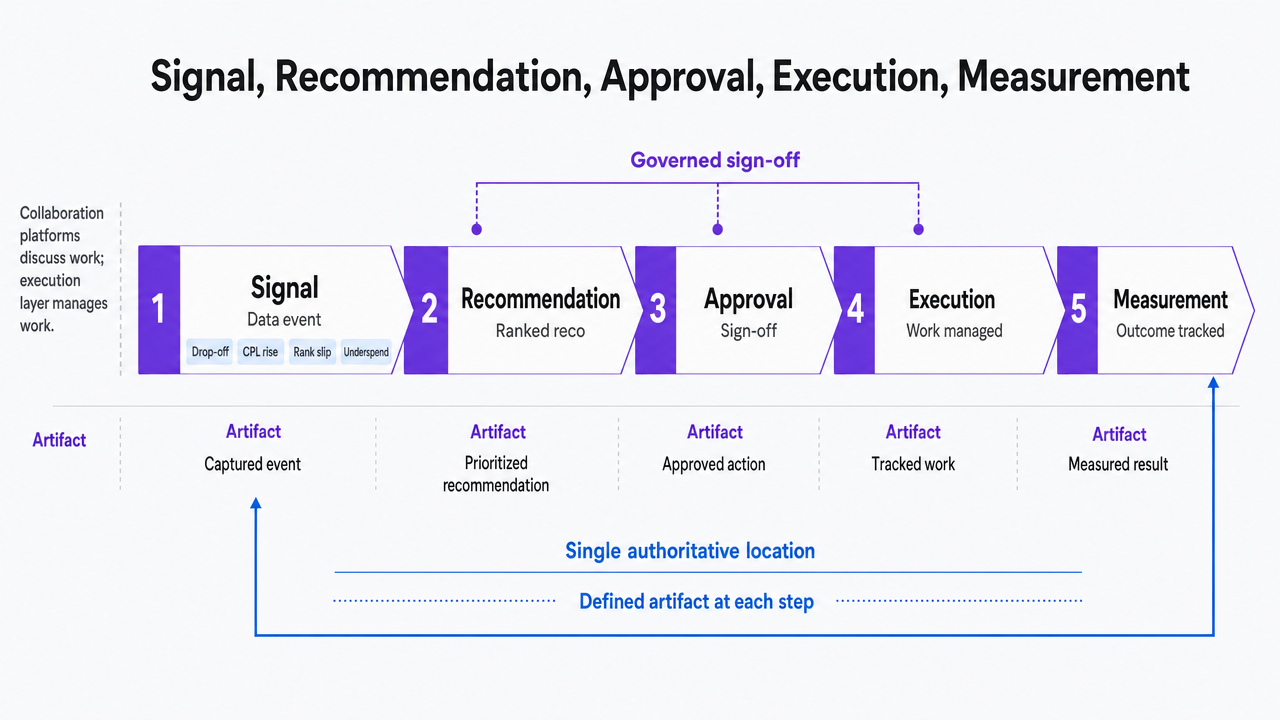 Visualize the five-step execution-layer loop described in this section, showing how each stage produces a defined artifact under governed sign-off
What Agencies Should Audit Before Adding Anything Else
Before an agency considers any new platform, four audits can clearly reveal whether the current tech stack or the operational discipline around it is the bottleneck.
- Count the coordination touchpoints for one recurring deliverable per service line, using the diagnostic method described earlier. If the count exceeds five touchpoints per deliverable and most exist to transfer information between platforms, the issue is structural, not staffing.
- List every active tool and assign each to a single work pattern: strategy, production, review, publishing, or reporting. Any tool that cannot be clearly assigned to one pattern is a candidate for removal. Any pattern served by more than one authoritative tool is a candidate for consolidation.
- Test knowledge retrieval. Select a framework the agency developed for a client six months ago and time how long it takes a producer on a different account to locate and reuse it. If rebuilding is faster than retrieving, knowledge compartmentalization is costing the agency margin that isn't visible on its P&L 4.
- Identify what truly requires human judgment in the production loop. Notification design and task automation eliminate touchpoints that add no client value, as highlighted by Hyland's practitioner analysis 7. What remains is the billable expertise. This is the core function an execution-layer platform like Vectoron is designed to preserve, while simultaneously removing the surrounding coordination tax.
Frequently Asked Questions
References
- 1.Rethinking knowledge work: A strategic approach.
- 2.Assessing the impact of virtual workplaces on collaboration and learning.
- 3.The impact of digital collaboration tools on inclusive leadership in multicultural remote teams.
- 4.Hybrid Workers in Digital Marketing Agencies.
- 5.What Is Digital Collaboration? Definition, Benefits, & Best Practices.
- 6.Collaboration Software Statistics and Facts (2026).
- 7.Digital Collaboration Strategies and Tips.
- 8.Types of Marketing Collaboration Tools Your Team Needs.
- 9.Top Remote Collaboration Tools for 2025 | Boost Team Productivity.
- 10.5 Best Marketing Collaboration Tools (2026).