
Key Takeaways
- Treat competitor keyword research as a five-stage production pipeline: seed extraction, SERP feature capture, page-level gap scoring, intent clustering, and priority ranking with content-brief handoff.
- Score gaps at the URL level using a two-axis rubric of intent match and business value, because pages rank for keywords, not entire domains 10.
- Written thresholds in a versioned standards document let junior analysts ship consistent work, while senior strategists retain approval on priority slates and benchmark competitor selection 1.
- Regulated verticals need a fourth threshold that flags medical, legal, or safety intent for subject-matter review before briefs are written, not after 15.
Why artisan competitor audits break at fifteen clients
A senior strategist can produce a beautiful competitor keyword audit for one law firm in a Tuesday afternoon: seed terms pulled by hand, top three competitor domains reviewed page by page, gaps annotated in a shared doc, priorities argued out in a call. Multiply that by fifteen accounts across dental groups, home services franchises, and behavioral health networks, and the model collapses. Not because the work is wrong, but because it is bespoke. Every analyst applies a slightly different definition of a gap, a different tolerance for keyword difficulty, a different read on intent. The output looks like fifteen craft projects, not one production line.
The economics get worse as the roster grows. Peer-reviewed evidence links targeted keywords, quality content, and scalable link building to stronger online brand positioning, though the underlying study uses correlation rather than causation and cannot claim direct effect 1. That caveat matters here: agencies cannot justify unlimited manual hours on the theory that more artisan audits automatically produce more ranking lift. What they can justify is a standardized pipeline that captures the same competitor signals every time.
Recent work on resource-constrained publishers shows SEO output remains achievable when staffing is thin, provided the process itself is disciplined rather than heroic 6. That is the reframe this article uses. The rest of the piece treats competitor keyword research as a production system with written thresholds, page-level scoring, and a governance layer that routes only judgment calls upward.
The five-stage production pipeline
Seed extraction from client and competitor pages
Seed extraction sets the ceiling for everything that follows. If the seed set is thin or biased toward the client's existing vocabulary, the entire competitor map inherits that blind spot. The University of Georgia keyword research guidance frames seeds as language the audience actually uses, drawn from their questions and phrasing rather than from internal jargon 10. For a dental group, that means the seed list starts with what patients type when a crown cracks on a Sunday, not with the marketing team's preferred service taxonomy.
At agency scale, the extraction step needs two inputs running in parallel. First, a pull from the client's own indexed pages, since search bots need on-page text to index anything at all 2. Second, a matched pull from the top three ranking competitors for each service line, one URL at a time. The output is a raw seed table with three columns: term, source URL, and whether the term appears on client, competitor, or both. That structure alone eliminates a class of downstream confusion where analysts argue about whether a keyword is a gap or a shared opportunity.
Michigan State's Digital Experience Studio positions this stage as brainstorming and researching before refining and organizing, and stresses that keywords have to sound natural and fit brand voice 9. The threshold to codify here is simple: no seed enters the pipeline unless an analyst can point to the exact page and paragraph where a competitor uses it in context.
SERP feature capture as intent signal
The SERP itself is the cheapest competitor research tool an agency owns, and most analysts underuse it. Google Autocomplete, People Also Ask, and Related Searches expose the question shapes and adjacent queries that Google has already clustered around a seed term, and Keyword Planner adds volume, competition, and geographic filters on top 10. Read together, these features function as a live map of what competing pages are trying to satisfy, not just what they contain.
Each feature answers a different question about intent. Autocomplete surfaces the modifiers users pair with a seed in real time, which reveals whether a term skews transactional, informational, or local. People Also Ask exposes the follow-up questions Google expects a satisfying page to address, which is the closest thing to a public content brief a competitor could ask for. Related Searches shows lateral topics that share a user session, which is how analysts spot cluster opportunities their client has not yet touched. Keyword Planner then quantifies those signals with volume and competition data, and its geographic filters matter for multi-location service businesses where a term that reads generic nationally is a hand-raise locally 10.
The production standard at this stage is capture, not interpretation. Every seed gets a screenshot or structured export of its four SERP features, timestamped, before any analyst attaches a judgment. That separation is what lets a junior analyst hand a completed capture set to a senior strategist without having colored the evidence. It also creates a defensible record when a client asks why a particular page was prioritized over another six weeks later.
Page-level gap scoring, not domain overlap
Domain overlap reports are the comfortable lie of competitor keyword research. They produce a large number, they look thorough, and they mislead analysts into treating a competitor's site as a single ranking entity. The University of Georgia guidance is explicit on why this is wrong: entire websites do not rank for keywords, pages do 10. A competitor that ranks for two hundred terms across its domain ranks for those terms on twelve to twenty specific URLs, each with its own intent match, internal linking, and content depth. Any gap analysis that skips the URL-level view is scoring against the wrong unit.
The operational fix is a two-axis scoring rubric applied per URL. One axis is intent match: how tightly the competitor's page addresses the query the seed term implies, judged from H1, intro paragraph, and the People Also Ask questions it visibly satisfies 10. The other axis is business value: how close the query sits to a revenue event for the client's specific service model, weighted higher for terms with local modifiers in multi-location verticals. A term ranks as a priority gap only when the competitor page scores high on intent match and the client has no page addressing the same query at comparable depth.
Michigan State's guidance on balancing high-volume and lower-competition terms feeds directly into this rubric 9. High volume without intent match produces traffic that never converts. Tight intent match on a low-volume term inside a high-value service line often outperforms a broader term the competitor already dominates. Codifying the two-axis score with written cutoffs, for example, a minimum intent score of three out of four combined with a business value score of three or higher, is what lets three different analysts score the same competitor URL and arrive at the same priority tier.
Intent clustering and priority ranking
Once gaps are scored per URL, the remaining question is what a client actually builds first. Clustering is where the pipeline converts a list of scored keywords into a content roadmap. The University of Georgia guidance recommends grouping keywords into page-level clusters aligned to a single dominant intent, so one target URL can satisfy a family of related queries rather than diluting authority across near-duplicate pages 10. In practice that means analysts group scored gaps by the shared question underneath them, not by surface-level term similarity.
Priority ranking then applies two filters on top of the cluster set. The first is business value, already scored at the URL stage. The second is production feasibility, which is where the balance-of-volume-and-competition principle from Michigan State does its actual work 9. A cluster with high intent match, moderate volume, and lower competition earns a higher rank than a cluster with higher volume but a competitive field the client cannot realistically outrank in the current quarter.
The deliverable at the end of stage five is not a keyword list. It is a ranked slate of content briefs, each tied to a specific target URL, a dominant intent, a supporting cluster of secondary queries, and a competitor benchmark page the new content is expected to displace or match. That artifact is what the rest of the agency's production system consumes. Everything upstream, from seed extraction through gap scoring, exists to make this slate reproducible across fifteen or fifty clients without a senior strategist rebuilding the logic each time.
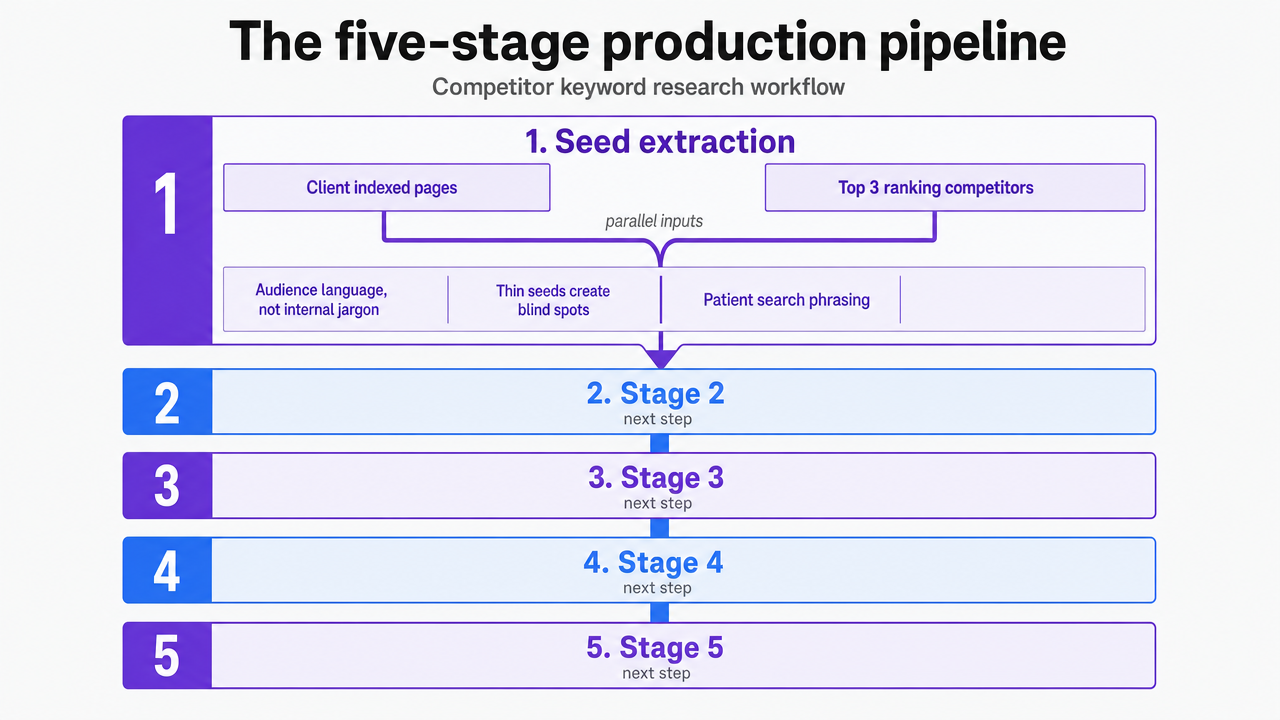 Visualize the five sequential stages of the competitor keyword research pipeline described in this section, so readers see the workflow before reading each substage
Written thresholds that let junior analysts ship senior-quality work
The gap between a senior strategist's competitor audit and a junior analyst's version usually is not talent. It is the absence of written cutoffs. When thresholds live in a strategist's head, every analyst has to reverse-engineer them from red-line comments, and the audit line stays bottlenecked at whoever holds the tacit rules. Codifying the thresholds in a shared standards document is what converts competitor keyword research from apprenticeship work into production work.
The scientific publications SEO literature offers a transferable model for how granular a threshold can be. It recommends one to two keywords in a page title, two to three (up to six) in the abstract or intro, and at least five to seven keywords attached to the article as metadata, with each field indexed differently by search engines 14. VA.gov's writing standard sits alongside that, calling for the primary keyword in the H1, in H2s, and in the intro text, while explicitly warning against keyword stuffing 7. Together, these give an agency defensible numeric ranges an analyst can apply without asking a strategist to weigh in on every draft.
The same principle scales upstream into competitor research itself. Written thresholds should specify:
- the minimum intent-match score for a gap to enter the priority tier,
- the maximum keyword-difficulty ceiling by client tier,
- the minimum SERP feature capture count before a seed is considered qualified, and
- the exact evidence a competitor URL needs before it becomes a benchmark page.
The U.S. Department of Commerce guidance reinforces the boundary condition: keyword stuffing is detectable, so density thresholds have to sit below the point where search engines discount the page 2. Standards work best when they are conservative enough to survive an algorithm update.
One artifact governs the whole system. A living standards document, versioned and dated, that any analyst can open before starting a client audit. When a senior strategist changes a threshold, the change lands in the document, not in a Slack thread. That is how three analysts in three cities produce the same priority slate from the same competitor set, and how the agency stops paying strategist rates for work a written rule can settle.
Run Live Competitor Keyword Tests This Week
Validate competitor-driven SEO strategies on real campaigns and measure impact before committing long term.
If you manage a portfolio: where specialist hours actually go
The audience shifts here. Everything above works for a single client. The question that keeps agency heads up is different: across a roster of fifteen to fifty accounts, where do the specialist hours actually get spent, and which of those hours survive scrutiny as strategist work versus which are analyst work wearing a strategist's badge?
Evidence from resource-constrained publishers is instructive. A 2025 study of non-profit online magazines found that meaningful SEO output persists under staffing limits, provided the process itself is disciplined rather than heroic 6. Translated to agency operations, that means the marginal client past account ten does not require a marginal senior strategist. It requires a pipeline where the repeatable stages are handled by analysts against written thresholds, and only the judgment stages route upward. Michigan State's four-stage keyword scaffold, brainstorm, research, refine, and organize, is the useful frame for allocating those hours, because each stage has a different labor profile 9.
The table below expresses hours as variables rather than fabricated benchmarks. H represents the manual specialist hours a senior would spend per client per quarter on each stage. Agencies should populate their own H values from time-tracking data before making capacity decisions.
| Stage | Manual specialist hours (per client, per quarter) | AI-assisted with human approval | Hours reclaimed for judgment work |
|---|---|---|---|
| Seed extraction from client and competitor pages | H₁ | ~0.15 × H₁ | ~0.85 × H₁ |
| SERP feature capture (Autocomplete, PAA, Related, Planner) | H₂ | ~0.10 × H₂ | ~0.90 × H₂ |
| Page-level gap scoring against written thresholds | H₃ | ~0.40 × H₃ | ~0.60 × H₃ |
| Intent clustering and secondary-query grouping | H₄ | ~0.35 × H₄ | ~0.65 × H₄ |
| Priority ranking and content-brief handoff | H₅ | ~0.70 × H₅ (senior sign-off retained) | ~0.30 × H₅ |
The pattern the ratios expose is the useful part. Extraction and capture, stages one and two, are near-total automation candidates because they are evidence-gathering, not evidence-weighing. Gap scoring and clustering compress once written thresholds exist, since the analyst is applying a rubric rather than inventing one. Priority ranking compresses least, because a senior strategist still has to reconcile the ranked slate against client-specific commercial context that no rubric fully captures.
What the reclaimed hours pay for is the argument. They fund the strategist work that actually differentiates the agency: interpretation of ambiguous intent, defensible tradeoffs against client business goals, and the client conversations where competitor findings become roadmap decisions 1. The correlational nature of the underlying SEO-to-positioning evidence is worth keeping in mind here 1; hours reclaimed do not automatically become ranking lift. They become the capacity to run the judgment loop more times per quarter, which is where the lift is earned.
Governance: what strategists approve, what automation can ship
Governance is where the pipeline stops being a productivity exercise and starts being a defensible operating model. The question is not whether automation can execute stages of competitor keyword research. It clearly can. The question is which decisions leave the agency exposed if a rubric makes them without a human in the loop, and which are safe to ship the moment the evidence is captured.
Three stages of the pipeline are automation-safe by their nature. Seed extraction, SERP feature capture, and initial gap scoring against written thresholds are evidence-gathering activities. They produce artifacts, not judgments, and the U.S. Department of Commerce framing of keywords and backlinks as signals search engines read from on-page text supports treating extraction as a mechanical step 2. The output is either present on the page or it is not. Automation ships these stages as soon as the artifacts are complete and the threshold document is the current version.
Two decisions require senior strategist approval before anything leaves the agency. The first is the priority slate itself, because ranking a cluster ahead of another cluster commits the client's next quarter of content spend, and that tradeoff sits against commercial context no rubric fully encodes 1. The second is the benchmark competitor selection, since designating a URL as the target to displace shapes every downstream brief. Michigan State's guidance that keywords must sound natural and fit brand voice belongs in this approval layer too, because voice fit is a human read 9.
The governance artifact is a two-column ledger. Left column lists the automation-safe stages with the threshold version they ran against. Right column lists the approval-required decisions with the strategist name, date, and reasoning attached. When a client asks why a page was prioritized, the ledger answers before the strategist has to reconstruct the call from memory. That record is what lets an agency scale competitor keyword research across fifty accounts and still defend every roadmap decision one by one.
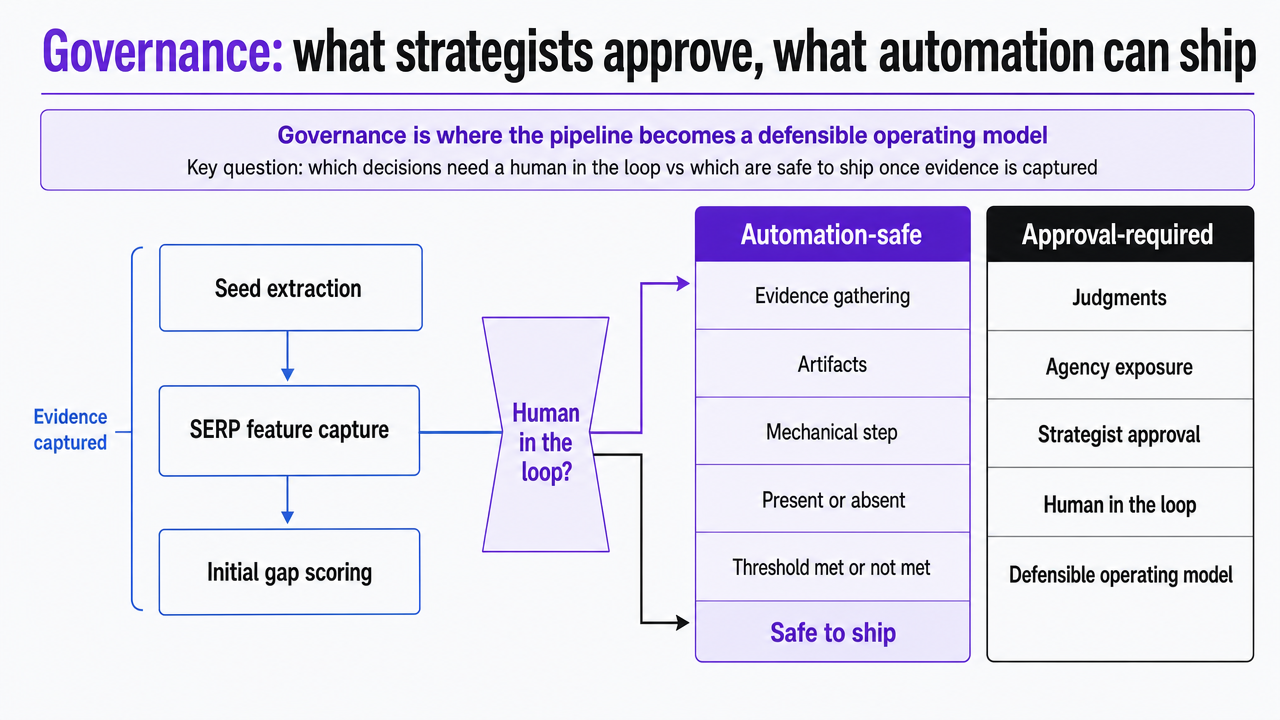 Illustrate the two-column governance ledger described in the section, separating automation-safe stages from approval-required decisions
See How Competitor Keyword Intelligence Drives Scalable SEO Results
Request a walkthrough of unified competitor keyword insights and approval-based workflows designed for agencies managing high-volume SEO delivery—no added headcount required.
High-stakes verticals: legal, healthcare, senior living
Regulated verticals bend the pipeline in ways generic e-commerce SEO does not. A competitor keyword that would be an obvious priority for a retail client, say a high-volume symptom query for a behavioral health group, sits inside a different set of constraints once it enters a healthcare content roadmap. The scoring rubric still applies. What changes is what a passing score entitles the agency to publish, and what still has to route through clinical or legal review before it moves.
Authority is the first constraint. U.S. government SEO guidance for regulated content stresses that ranking follows from clear, concise, unique, and authoritative writing, produced by a credible source, and paired with disciplined on-page and off-page work 15. In practice, that means a competitor benchmark page for a law firm cannot be evaluated purely on intent match. If the ranking competitor is a citation mill with thin author credentials, displacing it requires content the client's attorneys will actually sign, which changes the production math on every prioritized gap.
Content governance is the second. Department of Energy standards for federal communication tie SEO directly to accessibility obligations, requiring alt text on graphics for both search and Section 508 compliance, and calling for routine maintenance to remove outdated pages 11. Senior living and healthcare clients inherit similar duties under their own regulatory regimes. A competitor gap analysis that ignores accessibility and content-freshness rules produces a roadmap the client's compliance team will reject after the hours are already spent.
The third constraint is ethical. The peer-reviewed mapping of SEO's effect on visibility, though drawn from scientific publishing, shows that keyword optimization materially shapes which information surfaces to users 12. In verticals where the query is "is this side effect dangerous" or "can I sue my nursing home," that visibility carries stakes generic SEO does not. The operational adjustment is a fourth threshold in the standards document: a regulated-content flag that routes any priority gap touching medical, legal, or safety intent to subject-matter review before the brief is written, not after.
From competitor keywords to pipeline signal
The final test of a competitor keyword pipeline is whether it moves pipeline metrics the agency's clients actually pay attention to. Rankings and traffic are inputs. Qualified calls, booked appointments, and cost per lead are the outputs a dental group or law firm cares about, and those outputs sit downstream of whether the priority slate targeted queries a paying customer would type.
The connection runs through intent match, which is why stage three of the pipeline weighs it so heavily. Peer-reviewed work on SEO and e-commerce performance ties search positioning to economic outcomes rather than raw visibility, though the field still debates how cleanly SEO effects separate from other channels 3. That caveat matters when reporting to a client: a ranked slate cannot be sold as a guaranteed pipeline lift. It can be sold as the mechanism that puts the client's content in front of the queries most likely to convert, given what the top competitors have already proven ranks for that intent 4.
The reporting artifact that closes the loop is a quarterly review that pairs each shipped brief with three data points: the competitor benchmark URL it targeted, the cluster of queries it was built to satisfy, and the pipeline metric the client tracks against that service line. USAGov's writing guidance underlines the frame here, asking what users want to know, do, or go to before a page is written, and judging the page on whether it satisfies that intent 8. When those three data points are attached to every brief the pipeline produces, the agency stops defending competitor keyword research as an audit deliverable and starts reporting it as a pipeline input. That is the reframe the whole production system exists to make possible.
Frequently Asked Questions
References
- 1.Search engine optimisation (SEO) strategy as determinants to enhance the online brand positioning.
- 2.Boost Your SEO Ranking With Keywords and Backlinks.
- 3.Digital inbound marketing: Measuring the economic performance of ....
- 4.Digital Marketing for Private Practice: How to Attract New Patients.
- 5.Data set of a representative online survey on search engines ....
- 6.Becoming visible with limited resources: Non-profit journalists ....
- 7.Writing for SEO - VA.gov Design System - Veterans Affairs.
- 8.SEO Tips for Content Writing - USAGov.
- 9.SEO Strategy and Keyword Research.
- 10.How to research keywords for SEO.
- 11.Search Engine Optimization Best Practices - Department of Energy.
- 12.The SEO effect. Mapping the optimized landscape around ....
- 13.Online marketing and brand awareness for HEI: A review and ....
- 14.Search engine optimization for scientific publications: How one can maximize visibility and impact of scientific publications.
- 15.Tapping Into SEO: How Government Websites Can Improve Content.
- 16.3.3 Search Engine Optimization (SEO) | Digital Services & Solutions.