Key Takeaways
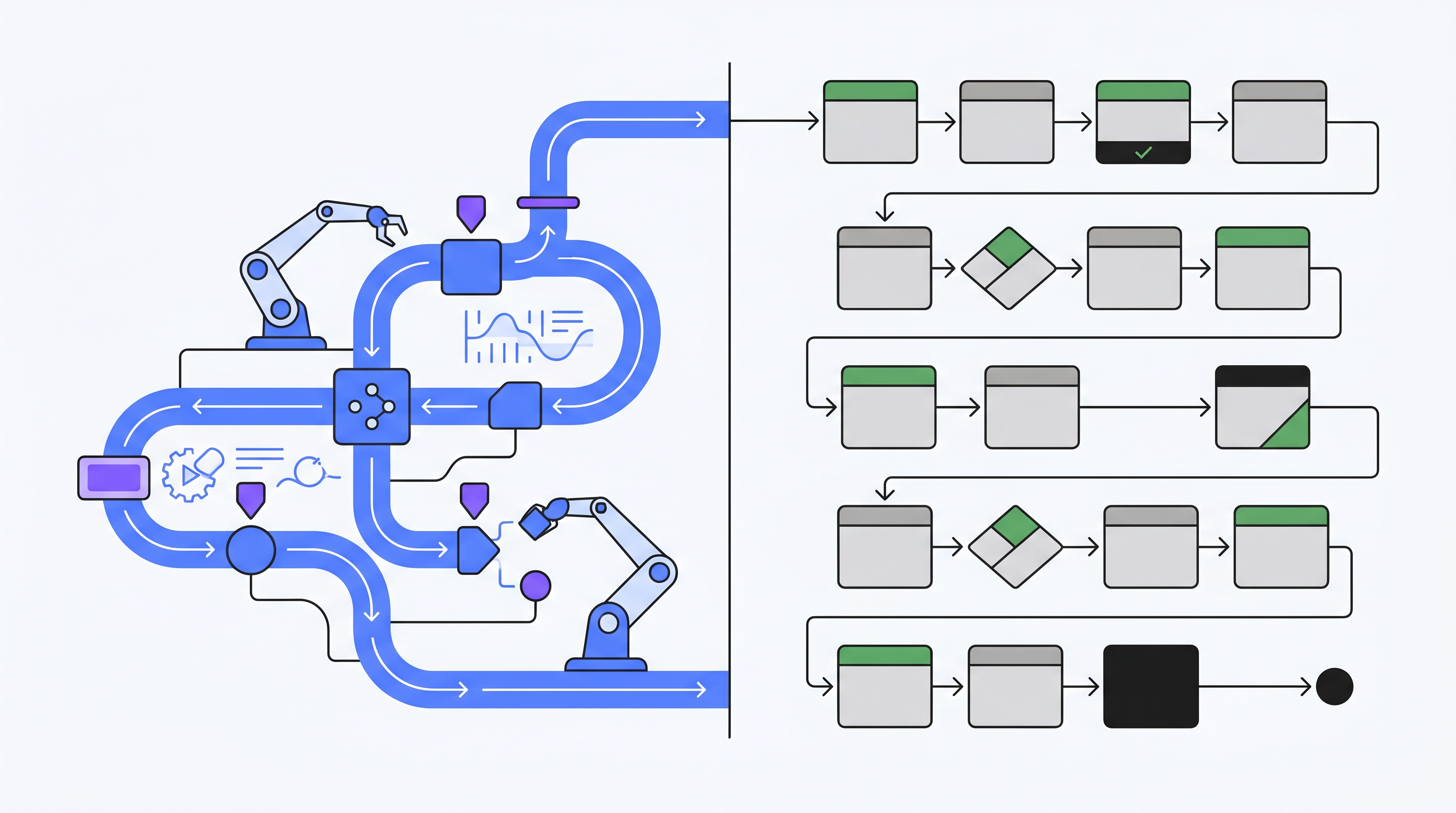
- The real bottleneck in content production is coordination overhead, not writing speed — marketing teams spend 72% of their time on handoffs, status updates, and asset hunting 9.
- Four operator metrics decide the architecture choice: cost per published asset, brief-to-live time, strategic coherence across ICPs, and scaling elasticity when volume doubles.
- Agency retainers renegotiate to scale and in-house teams hit hiring lags, while human-directed AI flattens the cost curve once brief, voice, and approval thresholds are codified.
- AI execution holds up on comparison posts, glossaries, feature explainers, and programmatic SEO, but founder essays, customer stories, and contrarian positioning should stay with senior humans 4.
- The decisive trade-off is where to draw the seam between strategy and execution — retain strategy in-house, delegate structured execution to AI, and reserve narrative work for senior writers.
The bottleneck isn't writing speed — it's coordination overhead
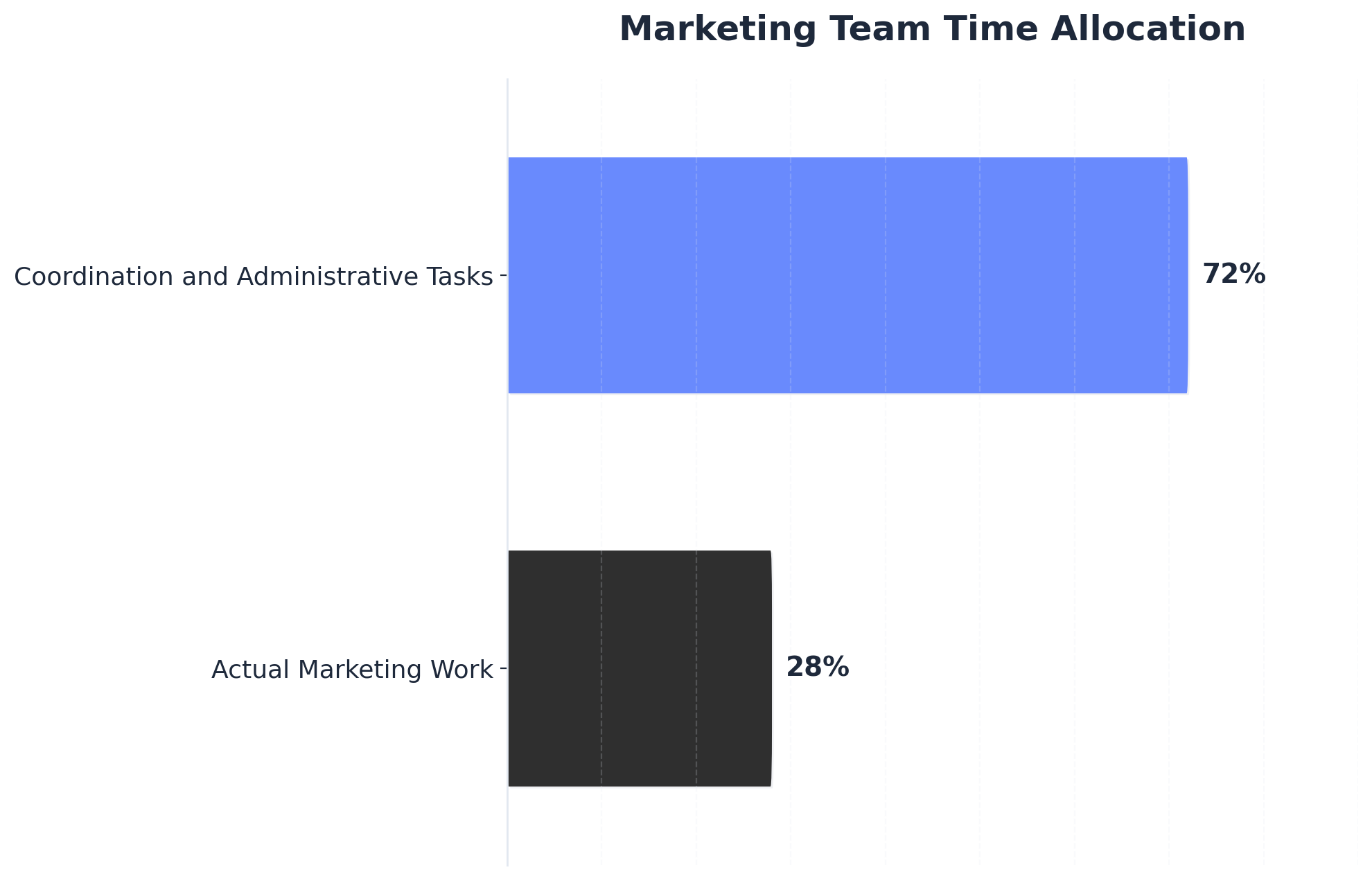
Most comparisons of content marketing platforms start from a flawed premise: that the constraint on a growth team's output is how fast someone can produce a draft. The data points elsewhere. Marketing professionals spend roughly 28% of their time on actual marketing work, with the remaining 72% absorbed by coordination, status updates, asset hunting, and information searches across disconnected tools 9. Writing speed is a small slice of that 72%.
This reframes the AI-versus-manual question entirely. A platform that drafts a blog post in 90 seconds instead of six hours has compressed a portion of work that was never the binding constraint. The binding constraint sits in the briefing loops, the review cycles, the freelancer onboarding, the brand-voice corrections on draft three, and the project-management thrash between strategist, writer, editor, and SEO reviewer.
Growth leaders running multi-product or multi-ICP roadmaps feel this directly. A SaaS team shipping 50 assets per quarter across three product lines isn't bottlenecked by keystrokes. It's bottlenecked by the human handoffs required to keep each asset coherent with positioning, on-brief, and on-schedule. Agency models add another coordination layer on top — an account manager translating between operator and producer.
The right comparison framework, then, isn't AI tools versus human writers. It's three distinct production architectures evaluated on whether they reduce coordination drag while holding the line on strategic quality. Speed-of-draft is a vanity metric. Time-from-brief-to-published, measured against strategic coherence across the account, is the metric that decides budget, headcount, and pipeline contribution.
 Marketing Team Time Allocation
Marketing Team Time Allocation: Actual Marketing Work: 28%, Coordination and Administrative Tasks: 72%. Shows the breakdown of how marketing professionals spend their time, highlighting that a majority is spent on non-marketing tasks like coordination and information searching.
The decision a Head of Growth has to make this quarter
The choice in front of most growth leaders this quarter is not which platform to license. It is where to draw the seam between strategy and execution, and which architecture honors that seam without taxing the team for crossing it.
Three honest questions resolve most of the indecision. Does the roadmap require throughput that fixed headcount cannot absorb without burnout or a hire? Does the asset mix lean toward structured, high-volume formats where AI execution holds up, with a defined carve-out for narrative pieces that should stay human 4? And does the senior team have the bandwidth to codify brief, voice, and approval thresholds once, rather than re-briefing per asset?
If the answer to all three is yes, the architecture follows. Strategy stays in-house. Execution moves to AI specialists running under approval workflows. The handoff layer that consumed 72% of marketing time compresses, and the cost curve flattens after the first wave of assets 9. Vectoron is built around that seam — strategy retained by the operator, execution delegated to specialist AI under a single account-level plan — for growth teams that have already decided the agency retainer is not the answer to the next 50 assets.
Three production architectures, not two
Pure agency retainer: strategy and execution outsourced
Under the agency retainer model, both the thinking and the doing live outside the company. The growth team writes a quarterly brief, hands it to an account manager, and waits. Strategy decisions — positioning angles, ICP prioritization, content pillars — get filtered through a third party who does not sit in the standup, does not see the product roadmap, and does not feel the pipeline pressure.
The structural cost shows up in two places. First, the agency must price for its own coordination layer: project managers, QA reviewers, client-services overhead, and the margin stacked on top. Second, the operator pays a translation tax on every brief, every revision, and every strategic pivot. The shift toward AI is already compressing this model — the value agencies once captured through execution capacity is collapsing as that capacity becomes commoditized 5.
What agencies still do well is high-craft creative and senior strategic counsel for teams without that depth in-house. What they do poorly is throughput against a moving roadmap. A retainer priced for 10 deliverables a month does not scale gracefully to 25 without a renegotiation, and the renegotiation itself becomes a coordination event.
In-house manual team: strategy and execution co-located
The in-house manual team solves the translation tax by collapsing strategy and execution into the same payroll. A content lead, two writers, an SEO specialist, a designer, and a fractional editor sit inside the org, see the roadmap, and ship against it.
This architecture wins on strategic coherence and loses on elasticity. Headcount is fixed; output ceilings are fixed with it. A team built to ship 30 assets per quarter cannot absorb a board mandate to ship 60 without either burning out or hiring — and hiring carries a 60-to-90-day lag before the new writer produces on-brief work. The 72% coordination overhead documented across marketing teams hits this model hardest, because every additional person multiplies the handoff surface area 9.
The cost structure is also stickier than it appears. Salary, benefits, tooling, and management overhead don't flex down in a slow quarter. Growth leaders running this architecture often discover that the marginal cost of the 31st asset is not the salary line — it's the senior strategist's calendar getting consumed by editing instead of positioning work. The team scales linearly with headcount, and headcount is the constraint the CFO is asking to remove.
Human-directed AI: strategy retained, execution delegated
The third architecture splits the seam differently. Strategy stays in-house — positioning, ICP definition, message hierarchy, channel priority, asset roadmap — held by a small senior team that knows the product and the pipeline. Execution moves to AI specialist systems coordinated through approval workflows, with human review concentrated at the brief and final-edit stages rather than spread across every keystroke.
This is the architecture the trajectory of the agency model is bending toward. As execution capacity becomes abundant, the human role consolidates around strategy, brand integrity, and the judgment calls that AI cannot make defensibly 5. The role-evolution data tracks the same direction: execution-heavy roles compress while strategy and oversight roles expand 2.
The operational claim is specific. A growth lead and a content strategist, working with AI execution, can hold the strategic center of an account that previously required a five-person team or a $25K/month retainer. They write the brief once, define the brand voice once, set the approval thresholds once, and the system produces against those constraints across every product line. Coordination overhead drops because the handoff count drops. Throughput rises because execution is no longer rate-limited by human keystrokes. The trade-off is real and addressed in the next sections — AI execution has known failure modes that determine which assets belong in this lane and which do not 4.
The four operator metrics that actually decide this
Feature checklists between platforms collapse under operator scrutiny because they ignore what actually shows up in a quarterly business review. Four metrics survive that scrutiny, and they apply uniformly across agency, in-house, and AI-directed architectures.
Cost per published asset. Not cost per draft. Not cost per hour billed. The fully-loaded cost from brief to live URL, including coordination time, revision cycles, and the senior strategist hours consumed in review. Organizations that fold AI into content production report a 68% lift in content marketing ROI, with average returns of $7.65 for every dollar spent — a signal that the cost denominator moves more than the revenue numerator 1.
Time-to-publish. Measured brief-to-live, not draft-to-draft. This is where the 72% coordination tax shows up most visibly 9. An architecture that compresses handoffs compresses this metric. An architecture that adds an account-management layer extends it.
Strategic coherence across the account. Whether the 47th asset still sounds like the brand, still maps to the positioning, and still serves the right ICP without re-briefing from scratch. This metric is the one most comparison frameworks omit, and the one that separates a content engine from a content factory.
Scaling elasticity. What happens to cost-per-asset and time-to-publish when quarterly volume doubles. Fixed-headcount models break here. Retainer models renegotiate. Architectures that sit between the two are graded on how cleanly they absorb the next 50 assets without a corresponding rise in coordination drag.
Plot any production model against these four and the AI-versus-manual debate dissolves into something more useful: a scorecard a Head of Growth can defend in a budget review.
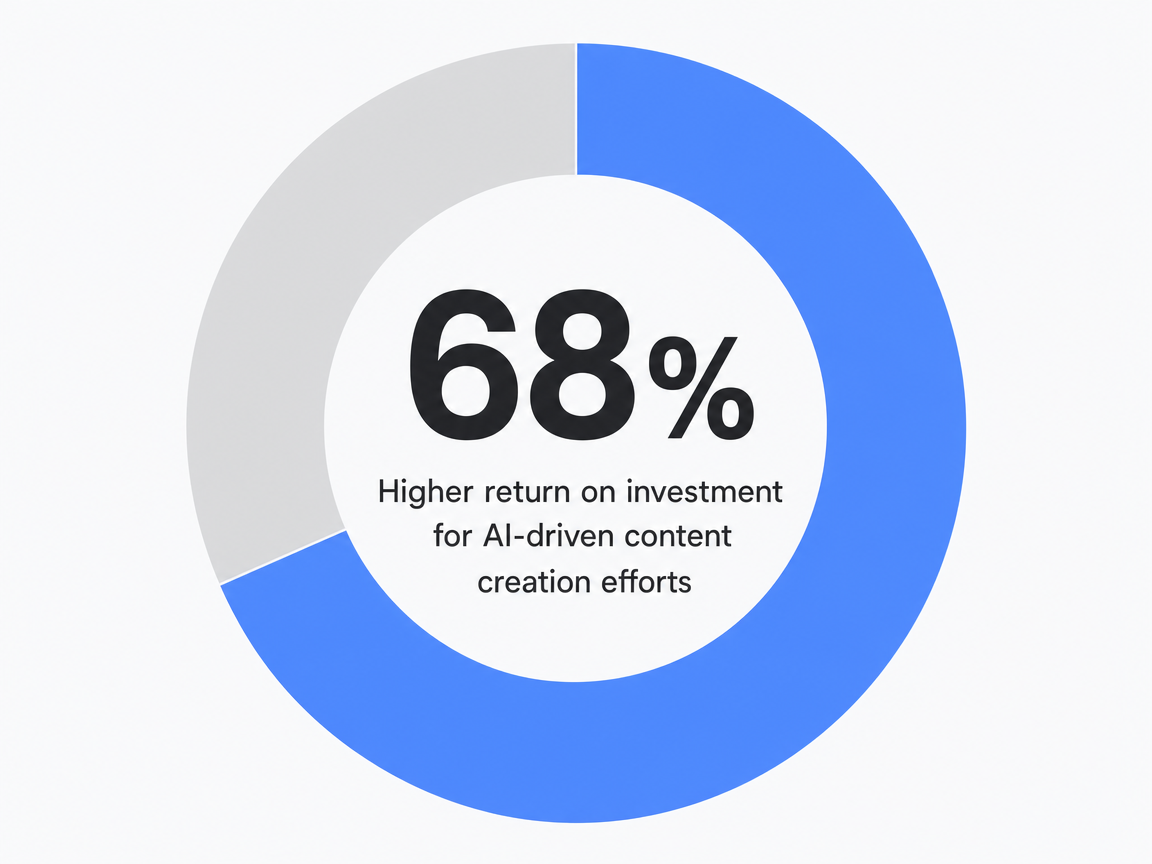 Higher return on investment for AI-driven content creation efforts: 68%
Test AI-Powered Content Workflows Risk-Free Today
Experience real-time content production and publishing using your own campaigns during your risk-free seven day trial.
Production architecture economics for a 50-asset quarterly plan
The economics shift depending on which architecture absorbs the work. The table below holds volume constant — 50 assets per quarter, mixed long-form and supporting pieces, across two product lines — and varies only the production model. Dollar figures the reference map does not support are left as variables the operator can plug from internal benchmarks. The relative comparisons hold regardless of the specific inputs.
| Dimension | Pure agency retainer | In-house manual team | Human-directed AI |
|---|---|---|---|
| Quarterly cost band | 3X (retainer + revision cycles) | 2X–2.5X (loaded salary + tooling) | X (platform + senior strategist hours) |
| Throughput ceiling at 50 assets | At or near contract limit | Near capacity; burnout risk | Well below ceiling |
| Time-to-publish (brief → live) | Longest; AM translation layer adds cycles | Mid; constrained by review queues | Shortest; human review concentrated at brief and final edit |
| Strategic coherence across ICPs | Variable; depends on AM continuity | High; team holds context | High when brief and brand voice are codified once 5 |
| Coordination overhead | Highest; external handoffs stack on internal ones 9 | High; scales with headcount 9 | Lower; handoff count compresses |
| Scaling elasticity to 100 assets | Renegotiation event | Hiring lag, 60–90 days | Marginal cost approaches platform fee |
| ROI signal | Baseline | Baseline | 68% higher content marketing ROI; $7.65 return per dollar 1 |
Two patterns deserve attention. The retainer column carries a coordination penalty that does not appear on any invoice — it shows up as the senior strategist’s calendar absorbed by briefing calls and revision rounds, the same 72% drag documented across marketing teams 9. The in-house column flexes only through hiring, which prices the 51st asset at the marginal cost of a new salary line rather than an incremental unit of execution.
The third column behaves differently because the cost curve flattens after the senior strategist defines brief, voice, and approval thresholds once. From there, the next 30 assets do not require 30 proportional increases in human time. That curve shape — not a single quarter’s headline number — is what a Head of Growth defends to a CFO who is asking whether the next phase of the roadmap requires another hire or another vendor.
Where AI fails honestly — and what that means for asset mix
Any production architecture argument that skips AI's failure modes loses credibility with operators who have actually shipped against one. The honest critique: AI execution underperforms human writers on authentic storytelling, original point-of-view work, and the kind of narrative that requires lived context to sound true 4. A platform can produce a competent comparison post on its 47th attempt with the same fluency as the first. It cannot produce a founder essay that earns a place on the homepage of a category-defining company.
This is not a defect to engineer around. It's a guide to asset mix.
The assets where AI execution holds up are the ones with structural patterns and verifiable inputs: comparison posts, glossary entries, feature explainers, integration documentation, programmatic SEO pages, supporting middle-of-funnel content, and the long tail of question-shaped queries that map cleanly to research and synthesis. These are also, not coincidentally, the assets that consume the majority of a content roadmap by volume and the majority of a senior strategist's review time when produced manually.
The assets that should stay in human hands are narrower and more important. Founder narrative, customer story interviews, original research write-ups, contrarian positioning pieces, and any asset where the differentiator is a specific human judgment the brand wants on record. These pieces carry disproportionate brand weight and represent a small share of quarterly volume.
A growth team that sorts its roadmap along this seam — high-volume structured assets to AI execution, low-volume narrative assets to senior humans — captures the throughput gain without paying the authenticity tax. The mistake is treating the choice as binary across the whole content program rather than asset by asset.
Strategic coherence across multiple ICPs and product lines
A SaaS company selling one product to one buyer can survive almost any production model. The shop sees the work, edits the work, and the brand voice stays intact through proximity. That model breaks the moment the company adds a second product line, a second buyer persona, or a second motion — say, self-serve plus enterprise — because the surface area of strategic decisions multiplies faster than the team can hold them in working memory.
Coherence is the metric most production architectures fail silently. Failure does not look like a typo. It looks like the SecOps buyer page borrowing tone from the developer-relations blog, the integrations hub describing the product in language the pricing page contradicts, and three different definitions of the ideal customer landing in three different campaigns over a single quarter. Each individual asset reviews fine. The portfolio drifts.
Agency retainers handle this poorly because account continuity is a staffing question, not an architecture one. A junior writer rotates onto the SaaS account, reads the last 20 deliverables to absorb the voice, and produces something close enough to pass. In-house teams hold coherence well at small scale and lose it as headcount grows, because each new hire imports a slightly different read of the brand.
Human-directed AI execution inverts the dynamic. The brief, the brand voice rules, the ICP definitions, and the positioning hierarchy get codified once and applied uniformly across every asset the system produces. The senior strategist's calendar shifts from re-briefing freelancers to maintaining the source documents that govern the output. That role consolidation — strategy and oversight expanding while execution roles compress — tracks the broader workforce direction documented across marketing functions 2. The 47th comparison post and the 12th feature explainer reference the same positioning, the same proof points, and the same persona definitions, because they are reading from the same canonical brief rather than from a junior writer's interpretation of it.
See Measurable Gains: Compare AI vs. Manual Content Marketing Platforms
Request a data-driven platform comparison tailored to your agency or enterprise brand. Uncover efficiency, cost, and performance metrics to inform your content marketing strategy at scale.
The marginal cost of the 51st asset
Most production decisions get framed around the cost of the first asset, not the fiftieth. That framing flatters the agency model, which prices a single deliverable transparently and hides the cost curve that follows.
The relevant question for a Head of Growth defending a budget is different: what does the 51st asset cost, given that the first 50 are already committed? Under a retainer, the answer is a renegotiation. Under in-house manual production, the answer is a hiring requisition or a missed deadline. Under human-directed AI execution, the answer approaches the marginal cost of the platform itself, because the senior strategist hours that defined the brief, the brand voice, and the approval thresholds have already been spent against the first 50.
This is the curve shape that matters. Performance marketing is moving the same direction at the campaign layer, where autonomous agents are compressing cost-per-lead by removing the human keystrokes between hypothesis and execution 3. The content-production analog is identical. Once the strategic scaffolding is built, additional volume does not require proportional additional senior time.
A growth leader presenting to a CFO should plot the cost-per-asset curve, not the unit price. The architecture that flattens fastest after the first 20 to 30 assets is the one that survives a doubled roadmap without a doubled budget.
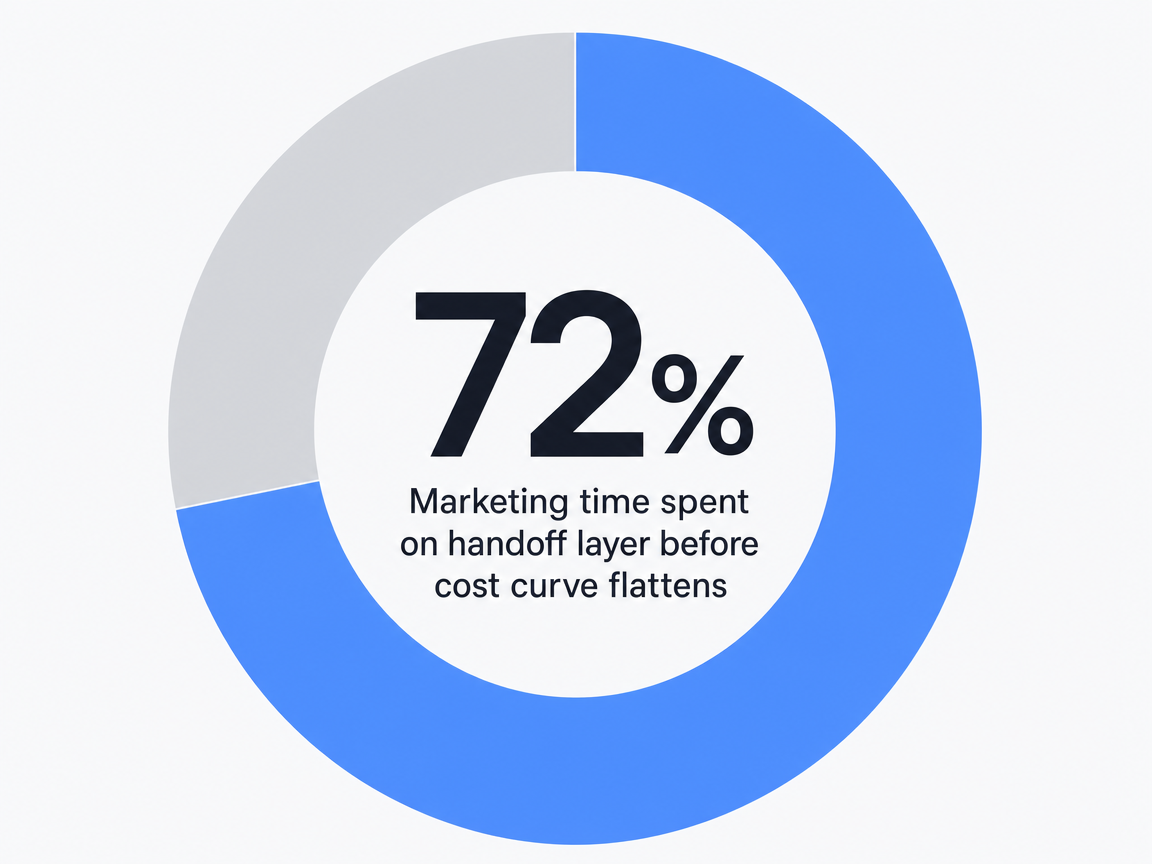 Marketing time spent on handoff layer before cost curve flattens: 72%
Team structure under a hybrid architecture
The headcount question changes shape once execution moves to AI. The team a growth leader needs is not a smaller version of the manual team — it's a different shape entirely.
At the center sits a content strategist who owns the brief, the brand voice document, the ICP definitions, and the approval thresholds. This is the role that previously got consumed editing freelancer drafts and translating positioning to an account manager. Around that role: a senior growth lead setting the asset roadmap against pipeline targets, an SEO operator maintaining the keyword and intent maps the AI execution layer reads from, and a part-time editor handling the narrow band of high-stakes assets that should never see automated production 4.
What disappears from the org chart is the layer of mid-level execution roles — staff writers, junior SEO analysts, content coordinators — whose job was to bridge strategy and output. The role-evolution data points the same direction: execution-heavy positions consolidate while strategy and oversight roles expand 2. A three-person hybrid team holds the strategic surface area a seven-person manual team used to cover, because the headcount that compressed was the handoff layer, not the thinking layer.
Sidebar: regulated-industry constraints for SaaS selling into healthcare
SaaS operators selling into hospital systems, multi-location practices, or payer organizations inherit their buyers' compliance surface the moment a case study, co-branded asset, or integration page references a covered entity. The HIPAA Privacy Rule governs how protected health information moves through any marketing artifact, including testimonials, screenshots, and outcome data 6. The broader compliance perimeter extends past HIPAA to state privacy laws and sector-specific marketing rules that apply whenever a SaaS brand publishes alongside a healthcare partner 7.
Co-branded content carries the sharpest edge. Joint case studies, integration announcements, and partner-page references require explicit alignment on what data appears, how the partner's mark is used, and which review path each asset clears before publication 8. A production architecture that ships 50 assets a quarter without a compliance gate will eventually publish something a covered-entity partner cannot defend.
Human-directed AI execution accommodates this if approval thresholds are codified into the workflow — flagged asset types route to a compliance reviewer before publication, and the brief explicitly excludes PHI from training inputs. The digitization wave reshaping healthcare operations is the same wave pulling SaaS vendors into its regulatory orbit 10. Operators ignoring it ship faster for two quarters and rebuild their content library in the third.
Frequently Asked Questions
References
- 1.AI Marketing vs Manual vs Agencies - Which is Right for You?.
- 2.A New Workforce Is Emerging to Work Alongside AI as Automation Grows.
- 3.The Future of Performance Marketing is AI Agents.
- 4.AI vs. Manual: A Deep Dive into Marketing Content Creation Efficiency.
- 5.Marketing in the AI Agency Era.
- 6.The HIPAA Privacy Rule.
- 7.What is Healthcare Regulatory Compliance?.
- 8.Co-Branding in Healthcare: Compliance Guidelines and Best Practices.
- 9.The Hidden Cost of Marketing Coordination Overhead.
- 10.Digital Transformation in Healthcare.