
Key Takeaways
- The real evaluation question is whether organic search has grown complex enough that uncoordinated workflows now constrain growth, not which vendor has the strongest feature matrix.
- Three conditions justify a platform: page volume that breaks manual crawl and link decisions, business-unit fragmentation across shared sitemaps, and integration debt between content, technical, and measurement systems.
- Platforms surface work but do not execute it, so platform spend and operator capacity must be funded as separate decisions to avoid paying renewal fees on a more sophisticated backlog.
- Evaluate by operator hours returned, tools actually retired from the renewal list, weekly decisions improved, and what ships in the first 90 days against organic pipeline contribution 1.
The Question Behind the Buying Question
Most enterprise SEO platform evaluations start in the wrong place. A vendor shortlist appears, demos get scheduled, feature matrices fill a spreadsheet, and the team argues over rank tracking accuracy and content brief quality. The actual question is upstream: has organic search become complex enough that uncoordinated workflows are now the constraint on growth?
That distinction matters because platform economics only work when the operating model already breaks at current scale. A team running 200 pages with one SEO lead and a clean handoff to content does not have a platform problem. A team running 5,000 indexable pages across three business units, two CMS instances, and four agency relationships does — and no feature comparison will surface that fact.
Forrester frames SEO platforms as infrastructure that unifies data, workflows, and reporting for organizations of meaningful size 8. The implication is sharper than it sounds. Platforms solve coordination problems, not knowledge problems. Marketing VPs asking which tool is best are usually a step behind the diagnostic question that determines whether any tool will pay back.
What Counts as an Enterprise SEO Platform Now
The category label has gotten loose. A decade ago, an enterprise SEO platform meant rank tracking at scale plus crawl diagnostics and a backlink index. Today the working definition has expanded to include content brief generation, internal link orchestration, log file analysis, SERP feature tracking, market share modeling, and increasingly, visibility measurement inside AI answer engines. Forrester groups these capabilities under three pillars: visibility, competitive insight, and content optimization, all unified by shared data and workflows 8.
That unification is the actual product. Mid-market tools sell features. Enterprise platforms sell the connective tissue between them — the ability for a technical SEO, a content strategist, and a regional marketing manager to operate on the same site model without exporting CSVs between four systems.
The category also has soft edges. Content workflow systems now ship optimization scoring. AI-search visibility tools track citations inside generative answers. Web analytics suites have absorbed parts of the reporting layer. McKinsey frames the broader pull as integrated systems that connect content, channels, and analytics — a coordination problem isolated tooling cannot solve 2.
A working definition for VPs evaluating the space: an enterprise SEO platform is software that consolidates discovery, prioritization, execution support, and reporting across a site portfolio large enough that no single operator holds the full picture in their head.
The Three-Condition Threshold Test
Page Volume: When Crawl, Index, and Internal Link Decisions Stop Being Manual
Page volume is the easiest condition to measure and the most often misread. The threshold is not a page count. It is the point at which crawl prioritization, index management, and internal link decisions stop being defensible as manual work.
A 400-page site with stable templates and a quarterly content cadence does not need automated log file analysis. A 5,000-page site with programmatic location pages, dynamic faceted navigation, and weekly content publishing does. The difference is whether a single operator can hold the site model in their head and explain why any given URL is or is not earning crawl budget.
Practical signals that volume has crossed the threshold:
- crawl reports take longer to interpret than to generate;
- internal link audits run on a 90-day lag because no one has time to refresh them;
- new content publishes before anyone confirms the orphan page list is current;
- technical SEO findings get logged in spreadsheets that no one revisits.
Ohio State's operational model for SEO work assumes a rhythm of auditing, prioritizing by impact versus time, and revisiting performance regularly 3. That rhythm breaks at volume. When the rhythm breaks, platforms earn their keep.
Business-Unit Fragmentation: Multiple Stakeholders Touching the Same Sitemap
The second condition is organizational, not technical. Fragmentation happens when more than one team owns content, technical, or measurement decisions on the same domain — and when those decisions affect each other.
A multi-location services brand with regional marketing managers publishing location pages. A B2B platform with separate product marketing teams owning competing solution pages. A media property with editorial, commerce, and partnerships teams operating on overlapping URL paths. In each case, the sitemap is shared but the decision rights are not.
Fragmentation creates a coordination tax that no individual operator can absorb. Two teams target the same query without knowing it. Technical SEO ships a canonical change that breaks a regional team's tracking. Content briefs are written against different keyword research tools, producing redundant articles that cannibalize each other within six months.
Forrester's argument for SEO platforms rests on this exact problem: organizations of meaningful size need shared data, workflows, and reporting because no single operator owns the full picture 8. The platform value is governance — a single source of truth that lets a regional marketing manager and a central technical SEO operate on the same site model without negotiating it in a meeting.
Integration Debt: Content, Technical, and Measurement Drifting Apart
Integration debt is the third condition and the one that decides whether a platform pays back. It is the accumulated cost of content, technical SEO, and measurement systems that no longer talk to each other.
The symptoms are familiar to any VP running a mature program. Content briefs are written in one tool, optimized in a second, published through a third, and reported on in a fourth. Technical findings live in a crawler that the content team never opens. Rank tracking sits in a dashboard the analytics team does not trust. Attribution stops at session source, so organic-influenced pipeline gets credited to direct or paid.
Each disconnection is survivable. The debt is the compounding interest: every new initiative requires manual reconciliation across systems, and the reconciliation work crowds out the strategic work the team was hired to do.
Forrester frames enterprise SEO platforms as infrastructure that unifies data, workflows, and reporting — the connective tissue between visibility, competitive insight, and content optimization 8. McKinsey makes the broader version of the argument: isolated tooling cannot deliver coordinated content, channels, and analytics at scale 2. When integration debt is the binding constraint, a platform is the answer. When it is not, a platform is shelfware with a renewal date.
The three-condition test works as a gate, not a scorecard. Volume alone does not justify a platform. Fragmentation alone is solvable with better operating rhythm. Integration debt alone can sometimes be paid down with middleware. Two of three usually means the operating model is the bottleneck. All three means it already broke.
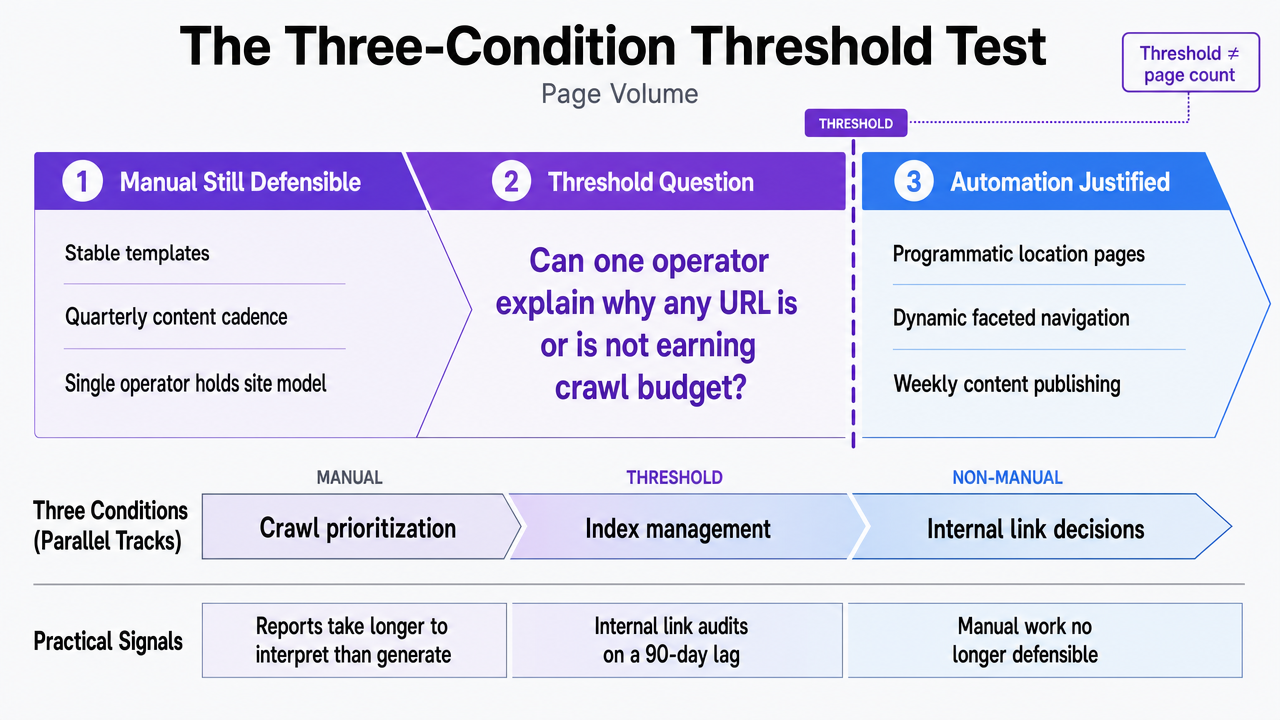 Visualize the three-condition gate test for justifying an enterprise SEO platform, directly supporting the section's framework
Test Enterprise-Scale SEO Execution in Real Time
Experience full-scale SEO workflows and publish live content during your free trial, measuring real business impact immediately.
Platform Decision vs. Execution Decision
A platform purchase and an execution capacity decision are routinely conflated, and the conflation is expensive. Platforms surface work. They do not perform it. A team that adopts enterprise tooling without the operator headcount to act on what it surfaces ends up paying renewal fees on a more sophisticated backlog.
The pattern repeats across mid-market and enterprise programs. A platform stands up rank tracking across 12,000 keywords, identifies 400 pages with declining click-through rates, generates content briefs for 80 priority refreshes, and flags 200 technical issues triaged by impact. None of that ships without operators — writers, editors, technical SEOs, developers with calendar availability — to convert findings into changes the index can see.
Forrester's argument for SEO platforms rests on data, workflow, and reporting unification, not on execution substitution 8. The distinction matters because the budget conversation usually treats them as one line item. A VP signing a six-figure platform contract on the assumption that the tool will close the throughput gap is signing for diagnostics, not delivery.
Two pressures make this worse. Forrester's CMO research finds that marketing leaders are prioritizing practical growth and measurable efficiency, with rising expectations that platform spend translates directly into outcomes 9. Deloitte's 2026 CMO Survey describes the same posture: disciplined experimentation, justified investment, every line item defended against measurable results 1. Platforms that surface work without changing how much work ships will not survive that scrutiny.
The cleaner framing separates the two decisions on purpose. Platform spend funds visibility, prioritization, and governance. Execution spend funds the operators or production capacity that act on what the platform reveals. A program that buys one without funding the other usually discovers the imbalance at the second renewal, when the year-over-year organic numbers do not justify the stack.
The Convergence Reshaping the Category
The enterprise SEO platform is not a stable category. It is being compressed from two directions, and the pressure changes what a VP is actually buying.
From one side, content workflow systems have absorbed optimization scoring, brief generation, and editorial governance. What used to be a distinct SEO platform capability — telling a writer which entities, headings, and questions to cover — now ships inside the system the content team already uses to plan and publish. From the other side, AI-search visibility tools have emerged as a separate category tracking citations and brand mentions inside generative answers, a measurement surface traditional SEO platforms were not built to monitor.
The middle is where the convergence argument lands. Forrester's case for enterprise SEO platforms rests on unifying data, workflows, and reporting across visibility, competitive insight, and content optimization 8. That thesis holds, but the unification problem has gotten larger than the original category. McKinsey makes the broader version of the point: enterprises increasingly need integrated systems that connect content, channels, and analytics, because isolated tooling cannot coordinate at scale 2.
Three implications follow for VPs evaluating the space.
- The shortlist is wider than the SEO platform Wave suggests. Content operations platforms, AI-visibility trackers, and integrated marketing execution systems are all valid answers to the underlying coordination problem, depending on which side of the convergence the team's gravity sits on.
- Single-purpose platforms are getting harder to justify as standalone line items. A tool that only does rank tracking and crawl diagnostics, no matter how well, leaves the integration debt unresolved.
- The category label matters less than the operating model the purchase enables. The question worth asking in a demo is not which SEO capabilities the platform leads on, but which adjacent systems it replaces, displaces, or routes around — and whether the team will actually retire the displaced tools after signing.
Reading AI Features Without Buying the Pitch
Every enterprise SEO platform demo now leads with AI. Automated content briefs, predictive ranking models, generative title testing, semantic clustering, AI-assisted technical triage. The feature list reads identically across vendors, which is the first signal that feature-list buying will not separate them.
McKinsey's State of AI 2025 survey makes the gap legible. Across the global respondent base, 64 percent of organizations say AI is enabling their innovation, while 39 percent report EBIT impact at the enterprise level 6. The study measures self-reported adoption and financial outcomes across industries, not SEO platforms specifically — but the pattern is the one VPs should expect when evaluating AI-branded capabilities. Enthusiasm runs ahead of measurable financial impact by roughly 25 percentage points.
That gap reframes the demo. A vendor showing an AI feature is showing innovation potential. A vendor showing year-over-year organic pipeline lift across reference customers using that feature is showing EBIT impact. The two are not the same purchase.
Three questions sharpen the evaluation.
- Which AI capability replaces a workflow the team currently performs, and how many operator hours does it return? Generative brief creation that saves an SEO strategist four hours per brief is a measurable line. AI-assisted SERP analysis that produces a deck no one acts on is a feature in search of a workflow.
- Which capability changes a decision the team already makes badly? Predictive ranking models matter when prioritization is the bottleneck. Semantic clustering matters when keyword research is duplicative across business units. If the team's current decisions are sound and the constraint is throughput, AI features that improve decision quality will not move the number.
- What is the vendor's evidence for outcome impact, not capability existence? Forrester's CMO research shows marketing leaders prioritizing practical growth and measurable efficiency, with platform spend defended against outcomes rather than capability checklists 9. Deloitte's 2026 CMO Survey describes the same posture of disciplined experimentation 1. Both pressures push the AI conversation away from feature parity and toward operator-hours-returned and pipeline-influenced metrics.
The cleaner read: AI features are worth paying for when they shorten a specific workflow the team runs today or improve a specific decision the team makes weekly. Everything else is innovation theater priced into the renewal.
Evaluate Enterprise SEO Platforms Using Real Performance Data
Connect with our team for a data-driven comparison of leading enterprise SEO solutions, tailored to the needs of high-volume marketing operations and enterprise digital teams.
Consolidation Economics for Portfolio Operators
This section narrows to a specific audience: VPs running multi-location brands, multi-business-unit portfolios, or multi-brand structures. Single-site operators can skip the math. The consolidation case only pays back when the fragmentation already exists in the stack.
Portfolio operators usually carry five or six tool categories that an enterprise SEO platform claims to absorb:
- rank tracking
- technical auditing and crawl
- content brief and optimization tooling
- backlink monitoring
- reporting or BI for organic
- operator hours spent reconciling outputs across all of them
Each line is defensible on its own. The aggregate is where the budget pressure shows up, especially under the disciplined-experimentation posture Deloitte's 2026 CMO Survey describes 1.
The honest framing is variables, not invented dollars. The table below shows what a fragmented portfolio stack typically includes versus what a consolidated platform proposes to replace.
| Line item | Fragmented stack | Consolidated platform |
|---|---|---|
| Rank tracking | Per-keyword or per-domain SaaS, often scaled by location | Included, scaled by site or portfolio |
| Technical auditing and crawl | Separate crawler license, sometimes per-seat | Included, shared site model |
| Content brief and optimization | Standalone optimization tool plus editorial seats | Included or integrated with workflow |
| Backlink monitoring | Separate index subscription | Included, shared with competitive layer |
| Reporting and BI for organic | BI license plus analyst hours to reconcile sources | Native dashboards on unified data |
| Operator reconciliation hours | Weekly across content, technical, regional teams | Reduced when shared site model holds |
The arithmetic is straightforward when the team actually retires the displaced tools. The arithmetic breaks when they do not. Most platform regret traces to the same pattern: the contract gets signed, the legacy rank tracker stays renewed because one regional team prefers it, the standalone crawler stays because the technical SEO trusts its output, and the consolidated platform becomes a seventh line item instead of a replacement for six.
Forrester's argument for unifying data, workflows, and reporting assumes the unification actually happens at the contract level, not just the dashboard level 8. Portfolio VPs evaluating consolidation should pre-commit to which tools come off the renewal list before signing, and which teams will accept the new shared model. Without that pre-commitment, the consolidation math is a thesis the renewal cycle will not honor.
Signals You Need Better Operators, Not a Platform
The inverse case deserves equal weight. Some programs stall at scale not because the tooling is inadequate but because the operating rhythm is. Buying a platform in that situation moves the bottleneck without resolving it.
Three signals point to an operator problem rather than a platform problem.
- The team already owns capable mid-market tools and uses less than half of what they pay for. Crawl reports run monthly, but the findings sit in a backlog no one grooms. Rank tracking dashboards exist, but weekly reviews lapsed two quarters ago. The ceiling is attention, not capability.
- The prioritization rhythm has broken down. Ohio State's operational model treats SEO as a cycle of auditing, ranking impact against time-to-ship, and revisiting performance on a defined cadence 3. When that cadence collapses, a new platform produces more findings against the same broken cadence. The output is a larger backlog, not a faster program.
- The strategic posture is ad-hoc. Peer-reviewed work on SEO and brand positioning finds that systematic, integrated SEO strategy drives outcomes that sporadic optimization does not 7. A team running SEO as a reactive checklist will not be converted into a strategic function by software. Fix the operating rhythm first. The platform decision gets easier afterward, and sometimes disappears.
An Evaluation Frame Built on Execution Capacity
The evaluation that holds up across a renewal cycle is built backward from execution capacity, not forward from feature lists. A VP can score every platform in the Forrester Wave against the same rubric and still buy the wrong one if the rubric measures capability instead of throughput.
Four questions structure the frame.
- How many operator hours per week does each platform return to the team, and against which specific workflows? Generative brief creation, automated technical triage, and shared site models all promise hours back. Vendors should produce reference customer evidence, not capability demos, for the hours claim. Without that evidence, the saving is hypothetical.
- Which existing tools come off the renewal list on day one, and which teams have already agreed to retire them? Consolidation math only works when the displaced contracts actually end. Forrester's argument for unifying data, workflows, and reporting assumes the unification happens at the contract level 8. Pre-commit before signing.
- What decision does the platform improve that the team currently makes weekly? Prioritization, content gap identification, technical issue triage, and cross-business-unit coordination are decisions with measurable downstream impact. Reports the team will not open are not decisions.
- What does the team ship in the first 90 days that it could not ship before? That number, defined in advance and measured against organic pipeline contribution, is the only metric that survives the disciplined-experimentation posture Deloitte's 2026 CMO Survey describes 1. Everything else is a feature the renewal will not defend.
Frequently Asked Questions
References
- 1.2026 CMO Survey.
- 2.The next frontier of personalized marketing.
- 3.SEO Process.
- 4.SEO Basic Principles.
- 5.What is SEO Marketing? [A Comprehensive Overview].
- 6.The State of AI: Global Survey 2025.
- 7.Search engine optimisation (SEO) strategy as determinants to online business brand positioning (OBBP) in Malaysia.
- 8.Every Company Needs An SEO Platform.
- 9.Predictions 2024: CMOs Prioritize Practicality Over Purpose.
- 10.In 2024, B2C CMOs Want The Most Help With These Five Areas.