
Key Takeaways
- Surfer SEO matches Frase as a SERP-scored editor with deeper term coverage, fitting teams with multiple writers and refresh-heavy calendars but leaving writer dependency intact.
- Clearscope standardizes brief quality across distributed contributors, making it the defensible choice for mid-size programs running freelance writer rosters at eight to fifteen articles monthly.
- NeuronWriter consolidates research, briefing, and drafting into one login for small SaaS teams, replacing four subscriptions rather than delivering a single best-in-class feature 4.
- MarketMuse scores topical authority across a site instead of single pages, earning its place when planning gaps—not optimization gaps—are blocking category-building traffic.
- Writesonic with Chatsonic attacks first-draft cost directly with GEO-aware generation, fitting teams who need higher cadence while keeping editors on argument and brand voice.
- Vectoron treats research, draft, and publish as one pipeline, replacing writer dependency itself for teams scaling output without adding headcount or freelance rosters.
Why the Frase Category Outgrew the Brief
Frase.io built its reputation on a narrow, useful job: scrape the SERP, score a draft against it, and hand the writer a brief that reads like a checklist. That job is now the easy part of the workflow. The hard part is everything around it—research that survives an editor, drafts that do not need a full rewrite, and visibility inside AI assistants that increasingly intercept top-of-funnel queries before Google does.
The adoption curve explains why the question shifted. Siege Media's content marketer survey tracked planned AI use climbing from 64.7% in 2023 to 83.2% in 2024 to 90% in 2025 2. Those figures cover marketers reporting intent to use AI in their content workflows, not seat counts or revenue. What matters for tool selection is the inflection: when nearly every team is already using AI somewhere, the differentiator stops being access to a model and becomes which layer of production the platform actually owns.
Frase sits at the brief-and-optimize layer. Originality.ai's review describes it as a tool for amending existing content, generating new drafts, and providing SEO support like search volume estimates 8. That description, written approvingly, is also the ceiling. A SaaS content manager publishing eight to fifteen articles a month still needs writers, editors, internal linkers, and someone to push the draft into the CMS. Frase's 2026 update added a GEO score alongside its SEO score 1, which acknowledges the new surface but does not change the labor model behind it.
The six alternatives below are sorted by how much of that labor model they absorb.
 Planned Use of AI in Content Marketing by Marketers
Shows the year-over-year growth in the percentage of content marketers planning to use AI, based on a study by Siege Media.
The Spectrum: Optimization Assistant to Production System
Comparing Frase alternatives as a flat feature grid hides the only question that matters: how much of the workflow does the tool actually own? A useful frame puts the six alternatives on a single horizontal axis. On the left sits Brief + Optimize—tools that score a draft against the SERP and stop there. On the right sits Research → Draft → Publish—systems that absorb research, briefing, drafting, internal linking, and CMS handoff into one pipeline.
Frase itself anchors the left side. Its 2026 update added a GEO score next to its SEO score 1, which expanded the surface it optimizes for but not the labor it eliminates. A writer still opens the editor, still drafts, still publishes. The same is true of Surfer SEO and Clearscope, which sit beside Frase on the optimization end—both are SERP-scored editors that grade what a human produces.
NeuronWriter shifts slightly rightward by bundling planning, drafting, and optimization for smaller SaaS teams 4. MarketMuse moves further right by modeling topical authority across a site, not just a page. Writesonic with Chatsonic pushes into the drafting layer with GEO-aware generation, reducing—but not removing—the writer's role.
The right endpoint is held by integrated production systems that treat research, draft, and publish as a single account-level workflow. Ethical SEO's stack guidance recommends pairing all-in-one platforms with specialized optimization tools and AI automation layers 3, which is the manual version of what a production system delivers as one surface.
The infographic above is the article's spine. Each entry below explains what the tool replaces, where it sits on the spectrum, and which SaaS team it fits.
Where Optimization-Only Tools Hit a Ceiling
The adoption data shows exactly where Frase-class tools win and where they stop. Siege Media's marketer survey breaks AI-assisted work into three dominant tasks:
- 71.7% of respondents use AI for outlining
- 68% for ideation
- 57.4% for drafting 2
The shape of that curve is the ceiling.
Outlining and ideation are the brief stage—structured, repeatable, easy to score against a SERP. That is the work Frase, Surfer, and Clearscope already do well. The 14-point gap between outlining and drafting reveals where the workflow breaks. Fewer marketers trust AI inside the draft itself, which means a writer still owns the longest, most expensive step in the production line.
Optimization tools cannot close that gap because they were not built to. A SERP-scored editor grades what arrives in the text box; it does not produce the text. A SaaS team publishing twelve articles a month with a Frase-class tool still pays for twelve drafts, twelve editorial passes, and twelve CMS uploads. The optimization layer compresses brief time from hours to minutes and leaves drafting time roughly untouched.
That is why the spectrum's right side matters. The tools below either push deeper into drafting—reducing the writer's role to review—or absorb the full research-to-publish loop into one system. Either move attacks the 57.4% number directly, which is where throughput is actually constrained.
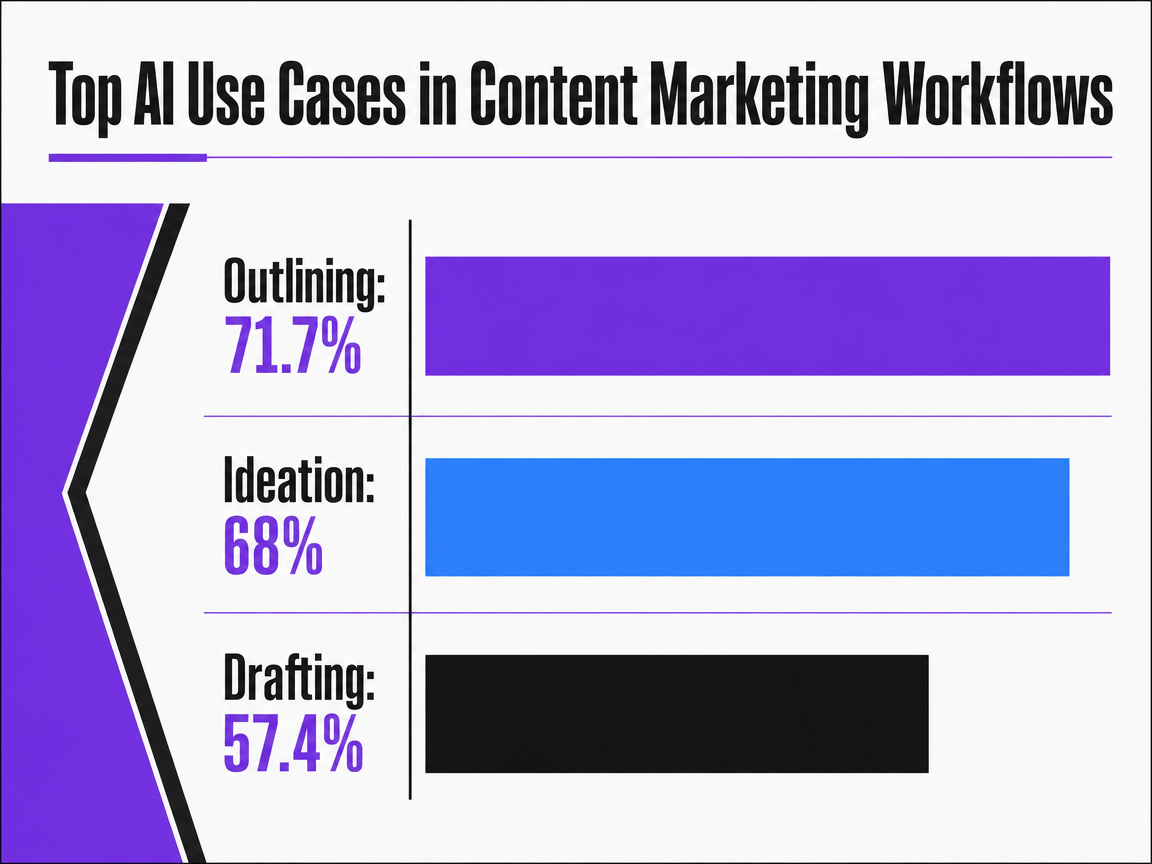 Top AI Use Cases in Content Marketing Workflows
Percentage of marketers using AI for specific tasks in the content creation process, indicating that research and planning are the most common applications.
Surfer SEO: The SERP-Scored Editor
Surfer SEO is the closest functional twin to Frase on the spectrum's left side. Both tools scrape the top-ranking pages for a target query, surface a content score against that competitive set, and grade a draft in real time as a writer types. The distinction is workflow texture, not category. Surfer leans harder into the editor surface itself, with NLP-derived term suggestions, structure recommendations, and a density panel that updates per paragraph.
Ethical SEO's stack guidance for SaaS teams names Surfer specifically as the content optimization layer to pair with an all-in-one platform like Semrush or Ahrefs, alongside Screaming Frog for technical audits and dedicated trackers for AI search visibility 3. That recommendation is informative on its own. Surfer is positioned as one component of a four-tool stack, not a replacement for any of the others. A SaaS team adopting Surfer is committing to the same labor model Frase requires: human writers producing drafts inside a scored editor, with researchers, editors, and publishers handling everything before and after.
Where Surfer wins over Frase is editor depth for teams that already have writers and want tighter SERP fidelity per article. The term-coverage scoring is more granular, and the audit feature for existing URLs is widely used for refresh cycles. Where it loses is the same place every optimization-only tool loses: the 57.4% drafting figure from Siege Media's survey 2 does not move because the writer is still the throughput constraint.
Verdict: Surfer fits SaaS teams with two or more writers, a refresh-heavy editorial calendar, and existing comfort with a stacked toolchain. Teams hoping a swap from Frase will reduce writer dependency should look further right on the spectrum.
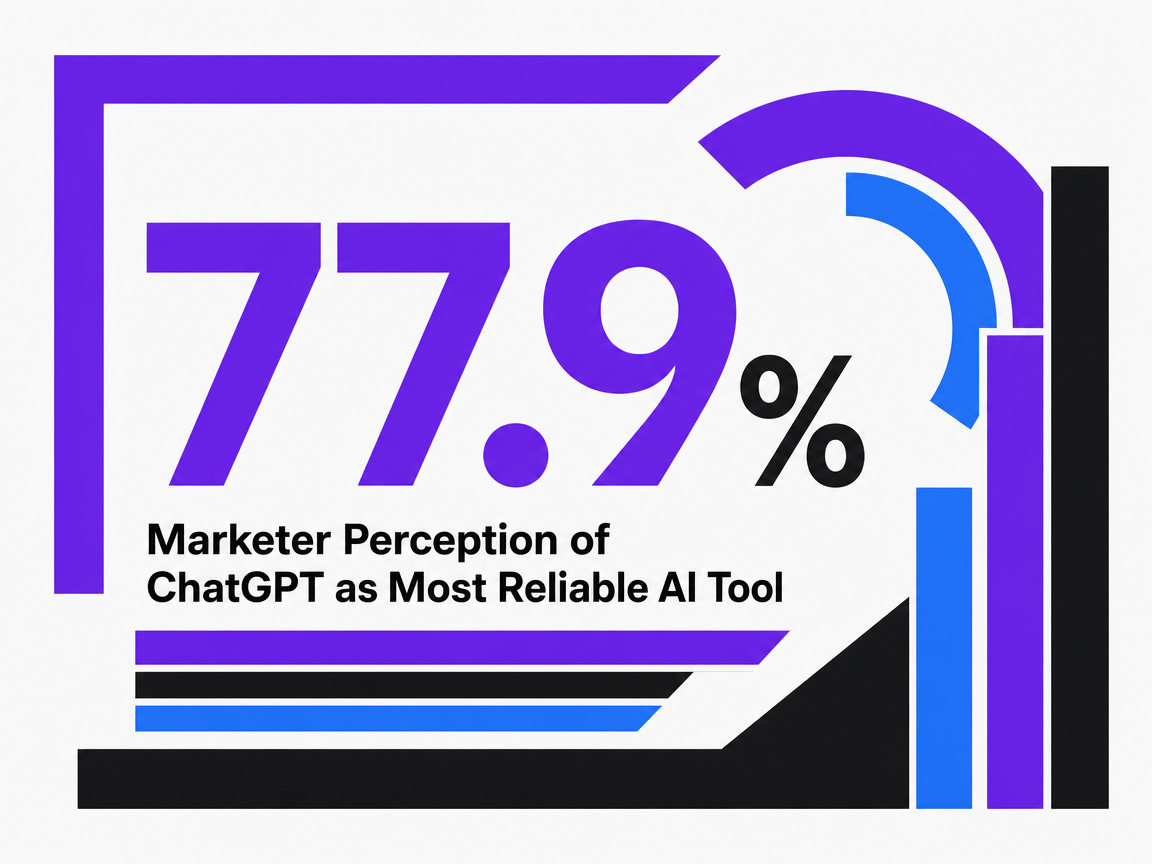 Marketer Perception of ChatGPT as Most Reliable AI Tool
Marketer Perception of ChatGPT as Most Reliable AI Tool
Test AI-powered content workflows with real publishing
See how autonomous content production accelerates your SaaS team's publishing velocity—risk-free for seven days.
Clearscope: The Enterprise Brief Standard
Clearscope occupies the same optimization slice of the spectrum as Surfer and Frase, but with a different buyer profile. It is the tool most often standardized across larger SaaS content programs and the agencies that serve them—the brief format editors recognize on sight, with a content grade letter, a target term list, and a recommended word count derived from the top-ranking pages. Ethical SEO's stack recommendation for SaaS pairs Clearscope explicitly with all-in-one research platforms and technical audit tools, naming it alongside Surfer as the content optimization layer in a multi-tool stack 3.
What Clearscope actually replaces in the workflow is the manual brief itself. A content manager who once spent ninety minutes building a brief from three competitor pages, a keyword tool export, and a People Also Ask scrape gets a usable brief in under ten. That compression is real, and for teams paying senior editors to scope briefs it pays back quickly. What Clearscope does not replace is the draft. The grader runs against a writer's output the same way Frase's does, which means the throughput math from the previous section still applies—the writer remains the constraint.
Clearscope's distinguishing feature among optimization tools is editorial trust at scale. Freelance marketplaces, content agencies, and enterprise editorial teams use the same Clearscope grade as a quality gate, which removes ambiguity from a distributed writing supply chain. For a SaaS team running content through outside writers, that shared standard has operational value Frase has historically not matched.
Verdict: Clearscope fits SaaS content teams with established writer rosters—internal or freelance—that need a defensible quality gate across many contributors. Teams trying to shrink the writer roster itself will find Clearscope, like Frase, leaves the labor model intact.
NeuronWriter: The Small-Team SaaS Option
NeuronWriter sits a notch right of Surfer and Clearscope because it bundles more of the pre-draft work into one surface. Profound's roundup of AI SEO tools for B2B SaaS describes it as a content planning, creation, and optimization tool built for smaller SaaS teams competing in both traditional and AI search 4. That framing matters. The buyer here is not an enterprise editorial program standardizing on Clearscope grades across fifty freelancers—it is a two- or three-person SaaS content team that needs research, brief, draft assistance, and SERP scoring under one login.
What NeuronWriter replaces in the workflow is the toolchain itself. A small SaaS team that would otherwise stitch together a keyword tool, a SERP analyzer, a brief template, and a separate AI drafting assistant gets those steps consolidated. The platform handles topical research, competitor term extraction, NLP-based content scoring, and an internal drafting layer that pushes past the brief stage further than Frase or Surfer typically do. That consolidation is the actual value proposition—not a single best-in-class feature, but the absence of five separate subscriptions.
Where NeuronWriter still falls short of the spectrum's right side is publishing. A writer or content manager remains the one moving the draft from the editor to the CMS, applying internal links, and managing the editorial calendar. The tool compresses brief and draft time meaningfully; it does not eliminate the human in the loop.
Verdict: NeuronWriter fits SaaS content teams of one to three people publishing four to ten articles a month who want to shrink their tool stack before they shrink their writer dependency. Larger programs with distributed contributor networks will outgrow it; teams already running a full research-to-publish system will find it redundant.
MarketMuse: Topical Authority Over Single-Page Scoring
MarketMuse pushes further right on the spectrum than Surfer or Clearscope because it scores at the wrong unit of analysis on purpose. Where Frase-class tools grade a single page against a single SERP, MarketMuse models topical authority across an entire site—mapping which subtopics a domain has covered, which it has covered thinly, and which competitors own outright. A SaaS content manager planning a quarter of work uses it less as an editor and more as a planning surface.
That distinction changes what gets replaced. Surfer and Clearscope compress brief time per article; MarketMuse compresses the editorial planning cycle itself—the work of deciding which twelve articles to commission, in what order, to build authority around a product category rather than chase isolated keywords. For a SaaS team whose category page and feature pages already rank but whose blog still bleeds traffic to competitors with deeper topical coverage, the planning layer is where the actual leverage sits.
The Bruce Clay analysis of AI use cases reports 68% of surveyed marketers saw blog traffic increases after using AI for content idea generation 6. The figure is self-reported and scope-limited to ideation, not full production, but it points at the same insight MarketMuse is built on: the upstream decision about what to write moves the traffic line more than incremental SERP tuning of what's already drafted.
Verdict: MarketMuse fits SaaS content programs publishing toward a defined product category who need to see coverage gaps across a site, not just term gaps inside a page. Teams without a planning problem—those already clear on what to publish next—will overpay for capability they will not use.
Writesonic with Chatsonic: Drafting Speed Plus GEO Awareness
Writesonic, paired with its Chatsonic assistant, lands further right on the spectrum than NeuronWriter because it pushes harder into the drafting layer itself. Where Surfer and Clearscope grade what a writer produces, Writesonic generates the long-form output and then offers optimization on top. Chatsonic adds a conversational interface with live web access, which the platform positions as a way to produce content informed by current SERPs and AI-assistant phrasing patterns rather than static training data alone.
What Writesonic replaces in the workflow is the first-draft labor, not the editorial layer. A SaaS content manager who would have briefed a freelancer and waited four days for a 1,500-word draft can produce a structured first pass in under an hour, then route it to a human editor for argument tightening, source verification, and brand voice. That compression attacks the 57.4% drafting bottleneck identified earlier rather than the brief stage Frase already handles.
The GEO angle matters more here than in the optimization-only tools. Onely's SaaS-focused guidance describes structured AI search strategies driving as much as 6x higher conversions from ChatGPT and Perplexity placements 9. That figure is Onely's framing for SaaS appearing inside AI assistants, not a controlled cross-tool benchmark, and it depends on the underlying content actually being citable—clear claims, source attribution, structured answers. A drafting tool that produces text shaped for AI-assistant retrieval gives a SaaS team a head start on that surface without retrofitting old articles.
Verdict: Writesonic fits SaaS teams trying to shrink first-draft cost and increase publishing cadence while keeping editors in the loop. Teams that need brand-voice consistency across dozens of articles, or that publish into regulated categories, will still spend heavily on the editorial layer the tool does not own.
See How Advanced AI Content Operations Compare to Frase.io Alternatives
Request a data-driven walkthrough of multi-channel content automation workflows built for SaaS and agency teams managing complex, high-volume publishing at scale.
Vectoron: Research-to-Publish as a Single System
At the right end of the spectrum sits a different category of tool entirely. Vectoron is an AI content production platform rather than an editor, which means the comparison to Frase is structural rather than feature-for-feature. Where the previous five tools sit somewhere on the line between brief and draft, Vectoron treats research, briefing, drafting, internal linking, and CMS handoff as one continuous workflow handled by AI specialist roles rather than human writers passing files between stages.
What Vectoron replaces in the workflow is the writer dependency itself. A SaaS content manager running a Frase-plus-freelancer setup pays for tool seats, freelance drafts, editorial review, and the calendar overhead of coordinating those handoffs across eight to fifteen articles a month. A production system collapses that pipeline. The content manager moves from briefing and chasing drafts to approving strategy and publishing finished output through a single interface, with the AI handling competitor gap analysis, brief construction, draft production, and optimization passes against both SEO and GEO signals.
That structural difference is the same one Ethical SEO's stack guidance points at indirectly when it recommends pairing all-in-one research platforms with optimization tools and AI automation layers 3. The recommendation describes the manual assembly of what a production system delivers as one surface. For a SaaS team publishing at meaningful cadence, the question becomes whether to manage four subscriptions and a writer roster or one platform that owns the full sequence.
Verdict: Vectoron fits SaaS content teams trying to scale published output without adding headcount or extending the freelancer roster. Teams whose constraint is editor capacity rather than writer cost, or who publish into highly opinionated voice categories where founder-led drafting is the actual asset, will get more from staying on an optimization tool plus humans.
GEO as the New Evaluation Axis
Picking a frase io alternative without weighing GEO is an evaluation done against last year's surface. Frase itself made the move explicit by adding a GEO score alongside its SEO score in its 2026 update 1, which signals where the category baseline now sits. Any tool that grades content only against the Google SERP is optimizing for half the destination.
The reason GEO earns its own axis rather than a feature checkbox is leverage. Onely's SaaS-specific guidance frames structured AI search strategies as a path to 6x higher conversions from ChatGPT and Perplexity placements 9. That multiplier reflects Onely's framing for SaaS brands appearing inside AI assistants, not a controlled benchmark across tools, and it depends entirely on the underlying content being citable—clear claims, attributed sources, structured answers an assistant can lift verbatim. A tool that produces drafts shaped for that retrieval pattern gives a SaaS team compounding visibility on a surface where Google rankings do not transfer automatically.
The practical test for any alternative is straightforward: does the tool grade and shape output for AI-assistant citation, or only for blue-link rankings? Surfer, Clearscope, and NeuronWriter weight SERP signals primarily. Writesonic and production systems push further into GEO-aware structure. Teams treating GEO as a 2026 nice-to-have will reevaluate inside twelve months.
A Decision Framework by Team Size and Cadence
The right alternative is a function of two variables: how many people touch a draft before it ships, and how many drafts ship per month. Mapping those two against the spectrum produces clear answers, not a shrug.
Solo content lead, four to eight articles a month. : NeuronWriter is the practical pick 4. The consolidation of research, brief, and draft assistance into one login saves more time than swapping editors. Surfer or Clearscope are overkill at this cadence unless a refresh backlog already exists.
Two- to four-person team, eight to fifteen articles a month, freelance writers in rotation. : Clearscope holds up here. Its grade functions as a shared quality bar across distributed contributors, which removes editorial ambiguity that compounds at this volume. Pair it with a research platform, as Ethical SEO's stack guidance recommends 3, and accept that the writer roster is the cost center.
Mid-size SaaS program, fifteen-plus articles a month, category-building intent. : MarketMuse earns its keep when planning gaps outrank optimization gaps. Writesonic fits alongside it for teams trying to compress first-draft cost while keeping editorial review.
Any team where writer dependency is the actual ceiling. : A production system like Vectoron is the structural answer. Unified Infotech's framing of hybrid AI-plus-human workflows still applies 10—editors stay in the loop—but the writer-as-bottleneck math changes when research, draft, and publish run as one pipeline.
Frequently Asked Questions
References
- 1.Frase.io Review: AI Content Optimization Tool Testing (2026).
- 2.51 AI Writing Statistics To Know in 2026.
- 3.22 Best AI-Powered SEO Tools for SaaS Companies in 2026.
- 4.11 Best AI SEO Tools for B2B SaaS Growth Teams.
- 5.9 Best AI Marketing Optimization Tools to Boost ROI.
- 6.6 Practical Use Cases for AI in Content Marketing.
- 7.Content Marketing and AI – Best Practices.
- 8.Frase.io Review - SEO-Optimized Content in Minutes.
- 9.Best AI Search Strategies for SaaS Companies in 2026.
- 10.What Marketers Must Know About AI vs Manual Content Writing.