
Key Takeaways
- The real constraint on marketing output is not headcount but the coordination tax of moving assets through fragmented briefs, reviews, and reporting cycles across channels.
- GTM is the highest-leverage function for AI-driven redesign because marketing and sales account for roughly 75% of generative AI's estimated value potential 2.
- A consolidated operating model—signal, rank, execute, measure—collapses six handoffs into five stages with one approval gate, turning governance into an accelerator rather than a brake 4.
- VPs should focus the next 90 days on instrumenting a single ranked signal queue, installing one approval gate aligned to NIST AI RMF, and closing the measurement loop so revenue outcomes re-score priorities 1.
The coordination tax capping marketing output
Most marketing teams are not undersized; they are overcoordinated. The primary scaling constraint for a modern go-to-market (GTM) function is rarely a shortage of individual contributors like writers or strategists. Instead, it's the accumulated overhead of moving a single asset from its initial brief to publication across multiple channels, each with its own owner, review cycle, and reporting requirements.
This overhead is the "coordination tax." Every asset incurs it. For example, a blog post typically moves from a strategy meeting to a brief, then to an agency or freelancer, through multiple review and revision loops, into a publishing queue, and finally into a separate reporting workflow. Paid campaigns, landing pages, and outbound sequences follow similar, parallel tracks. This process multiplies the work involved without proportionally increasing throughput.
The data on AI adoption highlights this issue. McKinsey's 2025 global survey of AI use found that nearly two-thirds of organizations have not yet scaled AI across their enterprise, and only 39% reported a positive EBIT impact at the enterprise level from AI initiatives 3. While tool adoption is high, value capture is not, indicating a significant coordination gap.
For a VP managing an in-house team, this often manifests as frozen or shrinking headcounts while channel expectations continue to rise, and finance demands quarterly proof of return. The common response—adding another agency, point tool, or dashboard—often exacerbates the problem, making the coordination tax heavier. Each new vendor introduces another briefing surface, and each new tool adds another handoff.
This article views GTM strategy as a production system with four core functions: signal, rank, execute, and measure. The key to achieving significant scale with flat teams lies in collapsing handoffs across these functions, rather than simply increasing capacity within them.
Why GTM is the highest-leverage function for productivity redesign
Not all company functions benefit equally from AI-driven productivity improvements; marketing stands out as a prime candidate. McKinsey's analysis of generative AI's economic potential shows that marketing and sales are among the four functions that collectively account for approximately 75% of the total estimated annual value potential from generative AI, out of an opportunity McKinsey estimates at up to $4.4 trillion per year globally 2. This suggests that GTM is where productivity gains are most favorable.
This favorable position is structural to marketing work. Marketing output is high-volume, rich in text and images, frequently templated across various channels, and directly linked to measurable revenue signals. A single strategic decision—such as a positioning shift or a campaign angle—can generate dozens of downstream assets, including landing pages, email sequences, ad variants, sales enablement materials, organic content, and retargeting creative. Each of these assets is an ideal candidate for AI-assisted drafting, ranking, and iteration. Few other functions combine such high volume, variability, and direct revenue linkage within a single workflow.
Consequently, redesigning the GTM production loop yields a higher return on leadership attention than redesigning most other functions. While automating a finance close cycle or augmenting a support workflow offers benefits, their revenue impact is often lower or more indirect. GTM uniquely combines high volume with high value.
For a flat marketing team, the practical implication is clear: to expand output without increasing headcount, the most effective strategy is not to hire another channel specialist or retain another agency. Instead, it is to redesign the process that transforms one strategic decision into numerous coordinated assets across multiple channels, focusing on the function where the estimated productivity payoff is largest.
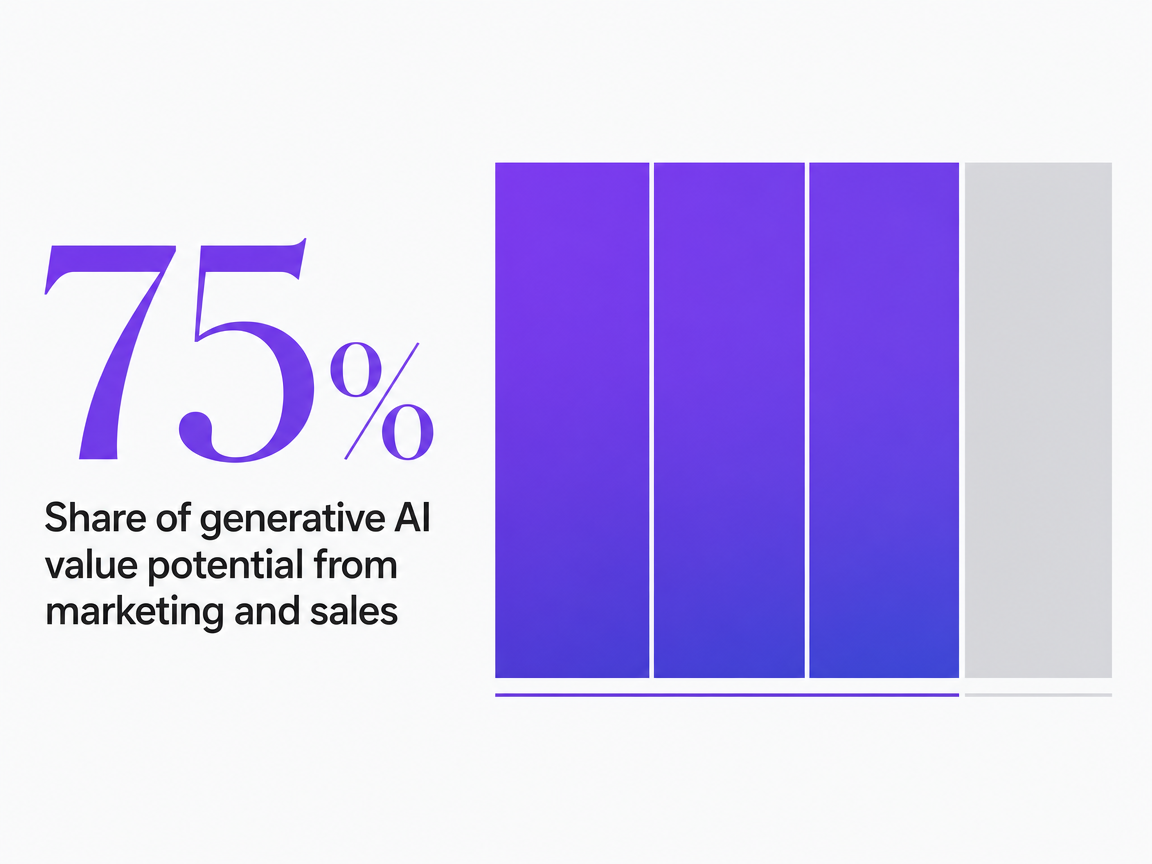 Share of generative AI value potential from marketing and sales
Share of generative AI value potential from marketing and sales
The adoption gap: tools acquired, value not captured
The challenge isn't tool adoption, but rather the capture of value. McKinsey's 2025 global survey on AI use revealed that approximately two-thirds of organizations (about 66.7%) have not yet scaled AI across their enterprise, and only 39% reported a positive EBIT impact from AI initiatives 3. This significant gap, even with self-reported data, indicates a structural issue.
This situation—where two-thirds of organizations possess untapped value—is not a technology problem. Licenses were purchased, pilots were run, and tools were installed. The missing piece is the underlying workflow redesign.
Within marketing organizations, this pattern is evident:
- A content team might adopt a generative writing tool but maintain the same brief-review-revise cycle. While the tool reduces drafting time, overall throughput doesn't increase because the upstream queue still moves at the pace of briefing.
- A paid media team might use an AI creative generator but route every variant through the same approval chain, which limits weekly launches.
- An SEO team might integrate an AI research assistant but ship the same number of pages because publishing capacity, not research, remains the bottleneck.
Each of these examples represents tool adoption, but none constitutes true scaling. The new tool operates within a workflow designed for a slower, less agile era, and this legacy workflow imposes a ceiling on the tool's potential output.
This illustrates how the coordination tax impacts AI adoption. Enhancing one part of a workflow doesn't boost overall output if other parts can't absorb the increased production. A drafter working ten times faster, but feeding a reviewer who works at the same pace, will result in the same number of published assets and a growing backlog. For a VP of Marketing aiming to convert a tool budget into pipeline, the critical question isn't which model to license, but which handoff is currently limiting throughput, and whether the operating model around the tool is being redesigned or merely preserved.
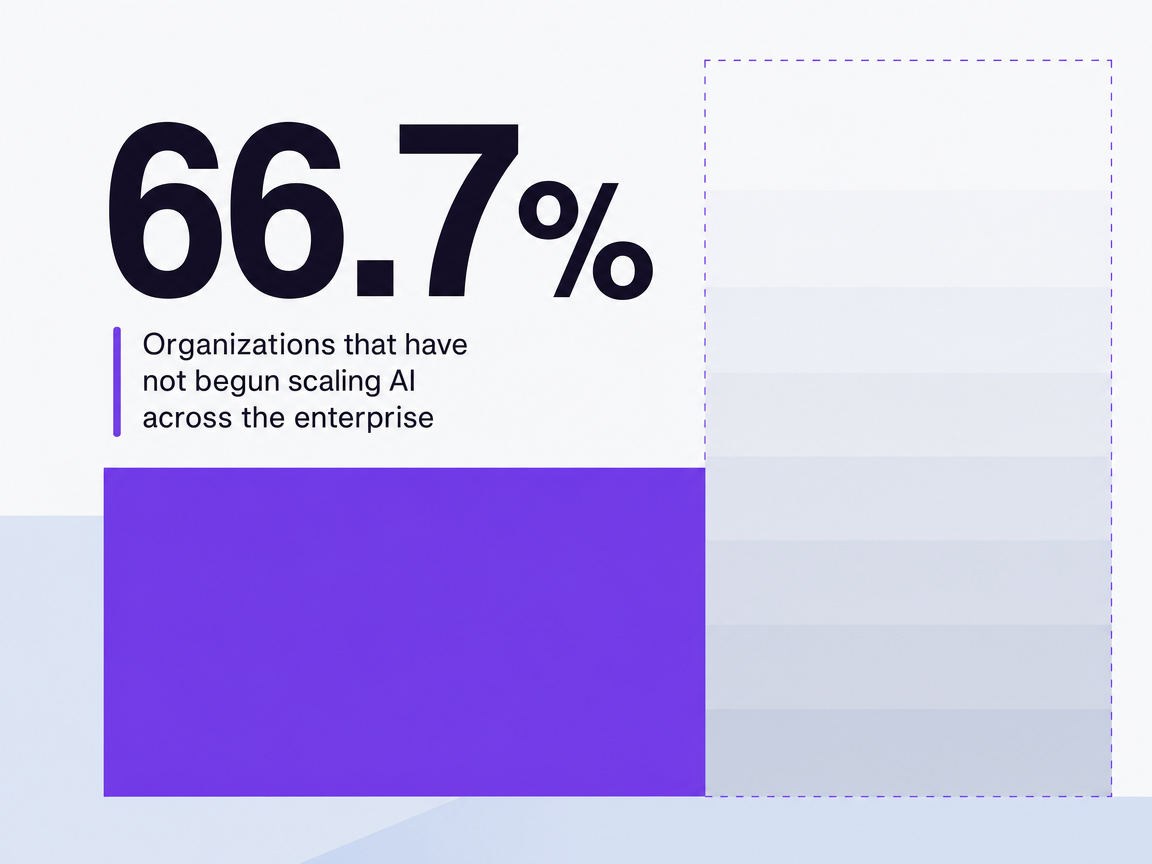 Organizations that have not begun scaling AI across the enterprise
Organizations that have not begun scaling AI across the enterprise
Test AI-Driven GTM Execution in One Week
Experience measurable impact on pipeline with real campaigns published and tracked during your trial.
The four-function operating model: signal, rank, execute, measure
A GTM production system designed to scale without increasing headcount operates on four integrated functions, rather than distinct teams:
Signal : Gathers and normalizes inputs to determine priorities.
Rank : Orders tasks by expected revenue impact.
Execute : Produces the assets.
Measure : Closes the loop by feeding performance data back into Signal.
While these functions are not new, their integration into a single, governed workflow—instead of being fragmented across agencies, freelancers, and point tools—is the transformative element. This consolidated approach eliminates separate briefs, review cadences, and reporting surfaces.
The following subsections detail how each function operates when handoffs are collapsed into a single, approval-driven loop.
Signal: consolidating inputs into one ranked queue
The Signal layer is often underdeveloped in many marketing teams. Inputs typically arrive in disparate forms: call transcripts in one platform, keyword movements in another, form conversion data in a third, paid performance metrics in a fourth, and sales feedback in a chat channel. Each fragment is interpreted by a different owner on a different schedule, leading to misaligned priorities.
Consolidating signal means routing all these inputs—such as qualified calls, booked meetings, cost per lead, ranking changes, pipeline stage conversions, and competitor activity—into a single queue that the entire team can access and understand. The goal is not merely dashboards, but a unified, ranked list of actionable tasks derived from live business data, rather than relying on the most recent meeting's discussions.
Rank and execute: where AI carries load and where humans decide
Ranking is where AI demonstrates its value within the workflow. Given a normalized signal queue, an AI model can score potential tasks by expected impact, effort, and channel fit far more rapidly than any traditional planning meeting. The execution phase—encompassing drafting, variant generation, on-page optimization, ad copy iteration, and publishing—is where significant throughput gains are realized.
Human judgment is concentrated at a single point: the approval gate between a ranked recommendation and the actual shipment of an asset. Strategy remains with the human team, while production capacity is augmented by AI.
This redesign offers a stark contrast to legacy workflows. A traditional loop typically involves six distinct handoffs—Brief, Agency, Review, Revision, Publish, Report—with approval touchpoints at nearly every stage. A consolidated loop, however, moves through five stages—Signal, Rank, Approve, Execute, Measure—with only one approval gate positioned between the ranking and execution phases. McKinsey's 2025 workplace analysis emphasizes that this type of workflow redesign, rather than mere tool adoption, is the prerequisite for unlocking AI's full productivity potential 4.
Measure: closing the loop with revenue-linked feedback
In most marketing organizations, measurement is a downstream reporting activity, often culminating in monthly decks or quarterly reviews. In a consolidated loop, however, measurement functions as an input, directly feeding the signal layer.
The mechanism is straightforward: every shipped asset is tagged with an identifier linking it back to its ranked recommendation and forward to a revenue signal, such as a qualified call, booking, opportunity, or closed deal. When performance data becomes available, it re-scores the queue rather than merely populating a slide. For instance, a landing page that exceeds conversion expectations will elevate the priority of related pages. A blog cluster driving qualified calls will push similar topics higher in the ranking. Conversely, an underperforming paid variant will be removed from rotation without requiring a meeting.
This revenue-linked feedback transforms the four functions into a continuous loop rather than a linear pipeline. Without it, ranking decisions can become subjective and inconsistent over time.
Governance as an accelerator, not a brake
Governance is often perceived as a hindrance to AI deployment. However, within a consolidated GTM loop, it acts as an accelerator. A clearly defined approval gate enables a flat team to ship assets faster without the risks associated with an ungoverned system making customer-facing decisions.
The NIST AI Risk Management Framework structures AI oversight around four functions: Govern, Map, Measure, and Manage 1. This framework aligns closely with the operating model described previously. Signal and Rank correspond to Map and Measure, focusing on understanding system decisions and performance. Execute aligns with Manage, representing controlled action. Govern acts as the overarching layer, defining who can approve what, under what conditions, and with what fallback. The NIST Generative AI Profile extends these functions to content generation, summarization, and recommendation workflows, which are central to most GTM AI activities 9.
Two critical data-handling constraints must be established upfront and treated as workflow inputs, rather than debated case-by-case. The FTC has repeatedly indicated that expanding data use for AI training through retroactive amendments to privacy policies can be deemed unfair or deceptive 8. Furthermore, the FTC's extensive enforcement history—including 97 privacy cases, 169 Telemarketing Sales Rule and CAN-SPAM cases, and 89 data security cases since 1999—serves as a reminder that customer and prospect data used in automated GTM flows carries the same obligations as it did before AI integration 7. For teams in regulated sectors like legal, healthcare, or financial services, these constraints are not mere overhead; they are the fundamental reason the approval gate exists.
Practically, this translates into a narrow and repeatable process within the loop. Every ranked recommendation includes its data sources, the proposed model action, and the human owner responsible for sign-off. Nothing is shipped without this signature. This gate becomes an accelerator because, with approval defined, scoped, and logged, the team can process more work through it, not less. Governance transforms from a committee function into a workflow field.
Workflow economics for portfolio operators
For VPs managing marketing across multiple locations, practices, or business units, the coordination challenges intensify. A single-brand team pays the coordination tax once per asset. However, a portfolio operator pays this tax once per asset, per location, and per approval chain, significantly multiplying the overhead. This multiplier highlights the advantages of the consolidated operating model described below.
When the coordination math changes: multi-location, multi-practice, multi-brand
A VP overseeing marketing for multiple entities—such as twelve dental offices, eight law firm locations, or twenty behavioral health clinics—is not managing a single GTM function. Instead, they are applying one core strategy across 'N' distinct production surfaces. Each campaign angle must be adapted to local voice, geography, compliance regulations, and intake capacity. Every asset must navigate through a regional owner, a compliance reviewer, and a local publishing queue.
The coordination tax that a single-brand team pays once, a portfolio operator pays 'N' times. At this point, adding more agencies or regional coordinators becomes counterproductive, as it merely lengthens the chain without increasing output.
Three operating models compared across coordination variables
The following comparison evaluates three common operating models—a traditional agency plus in-house hybrid, an in-house-only expansion, and a consolidated AI execution loop with human approval—based on coordination variables that directly impact output. McKinsey's 2025 workplace analysis underscores the core principle: workflow redesign, not just tool acquisition or team size, is what converts AI capabilities into increased throughput 4.
| Coordination variable | Agency + in-house hybrid | In-house-only expansion | Consolidated AI execution with approval gate |
|---|---|---|---|
| Monthly briefing cycles required per location | One per channel, per location | One per channel, per location | One per location, shared across channels |
| Average path from brief to publish | Brief → agency → review → revision → publish | Brief → internal draft → review → revision → publish | Signal → rank → approve → execute → measure |
| Vendor relationships to manage per channel | One to three per channel | Zero, replaced by internal hires | One platform across channels |
| Approval touchpoints per asset | Three to five (brief, draft, revision, legal, publish) | Three to four (draft, revision, legal, publish) | One (ranked recommendation to execute) |
| Channels covered by a single workflow | Fragmented by vendor | Fragmented by specialist | Unified across content, SEO, paid, social, backlinks, call intelligence |
| Scaling response to a new location | Add retainer, add coordinator | Add headcount | Add location to existing loop |
This comparison reveals two key patterns. First, both the hybrid and in-house models scale linearly with the number of locations because coordination surfaces multiply per site. Second, the consolidated model breaks this linearity by treating a new location as an additional input to the existing ranked queue, rather than requiring a new instance of the entire workflow. For a portfolio operator, this distinction represents a significant operational leverage advantage.
See How Leading Teams Execute GTM at Scale—Without Adding Staff
Connect with a strategist to review real-world benchmarks for multi-channel, approval-first execution and learn how top brands streamline GTM workflow to increase pipeline predictability—no new hires or extra vendors.
The macro backdrop: efficiency-led growth is now the default
The imperative to increase output without expanding headcount is not unique to marketing; it reflects the current economic landscape. U.S. nonfarm business sector labor productivity saw a modest 0.3% rise in the first quarter of 2026 5, illustrating how narrow the margin for efficiency-led growth has become across industries. Companies that are growing revenue faster than this are, by definition, extracting more value from each hour worked, employing mechanisms similar to those a VP of Marketing is now tasked with implementing within their own function.
The labor market for marketing leadership reinforces this trend. The Bureau of Labor Statistics projects a 6% growth in employment for advertising, promotions, and marketing managers between 2024 and 2034 6. This rate maintains the leadership tier but offers no such guarantee for roles beneath it. VPs are not the primary pressure point; rather, finance departments are seeking leverage from the layer of specialists, coordinators, and channel owners below them.
Taken together, these data points directly frame the operational challenge: macro productivity is inching up incrementally, while headcount below the VP level faces budget constraints that leadership does not. Therefore, a GTM strategy that scales without adding more people is not merely a temporary solution for a tight quarter; it represents an alignment with how growth is being generated across the economy today.
A 90-day sequence for VPs redesigning the loop
Redesigning a GTM production loop is not a complete replatforming project; it involves a series of focused, reversible steps to integrate the four functions—signal, rank, execute, and measure—into the team's existing operations. Ninety days is sufficient to complete this sequence and assess its impact on throughput.
- Days 1–30: Instrument signal. Consolidate all existing inputs that drive priority decisions—such as call intelligence, form conversions, ranking deltas, paid performance, sales feedback, and pipeline stage data—into a single queue. Avoid creating new dashboards; instead, integrate existing data sources into one ranked list, updated weekly, for team planning. By day 30, the output should be one unified queue, not five. McKinsey's workplace analysis highlights this as a prerequisite: workflow redesign, not merely tool adoption, is essential for converting AI capabilities into increased throughput 4.
- Days 31–60: Install the approval gate. Clearly define who approves what, under which conditions, and with specified fallback procedures. Each ranked recommendation must include its data sources, the proposed model action, and the human owner responsible for approval. Align this gate with the NIST AI RMF functions—Govern, Map, Measure, Manage—to ensure compliance without requiring a separate committee 1. For teams handling customer or prospect data, establish data-use scope upfront to avoid retroactive adjustments 8. Nothing ships without a signature, which functions as a workflow field rather than a meeting.
- Days 61–90: Close the measurement loop. Tag every shipped asset with an identifier that links it back to its ranked recommendation and forward to a revenue signal (e.g., qualified call, booking, opportunity). When performance data becomes available, it should re-score the queue instead of merely populating a monthly report. By day 90, ranking decisions will be driven by outcomes, not opinions, and the team's primary planning question will be: "What does the queue indicate next?"
The ultimate measure of success at the end of this sequence is not the number of assets produced, but the reduction in handoffs between brief and publish, and whether the team is planning based on live signal rather than outdated roadmaps.
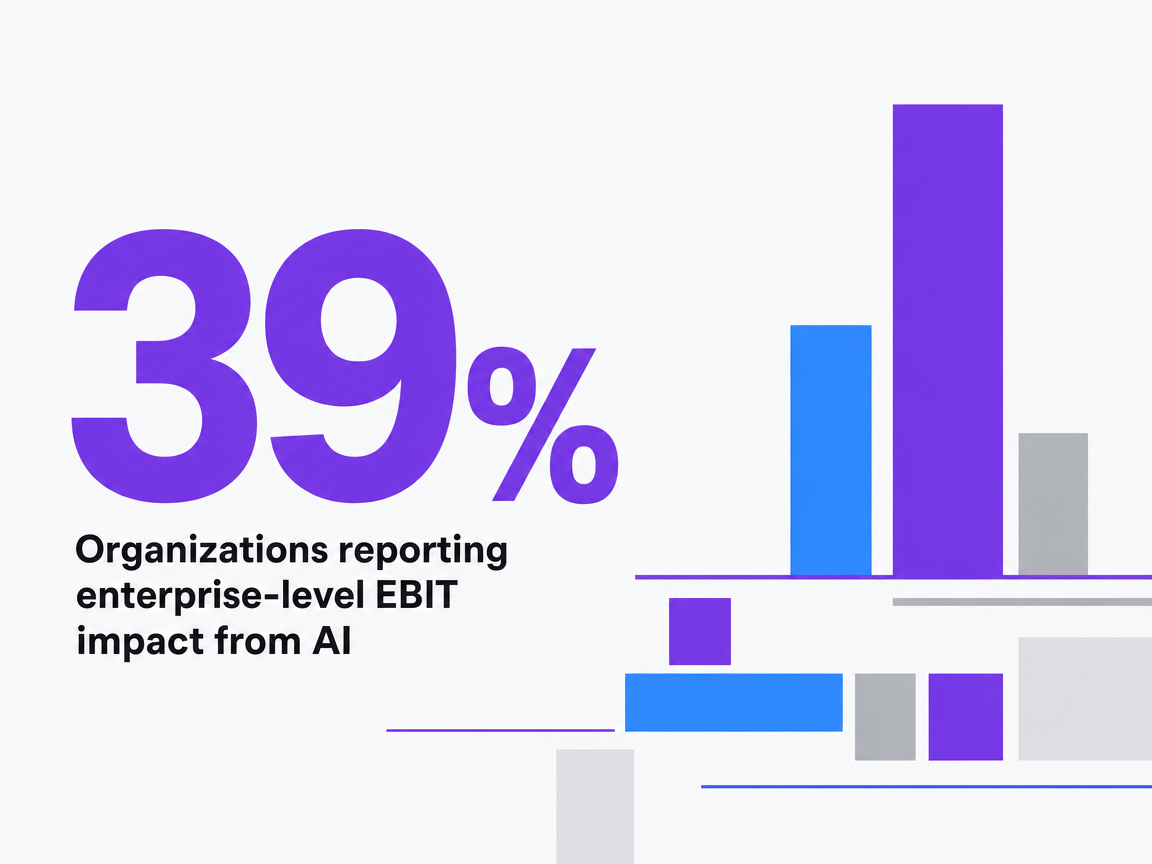 Organizations reporting enterprise-level EBIT impact from AI
Organizations reporting enterprise-level EBIT impact from AI
Frequently Asked Questions
References
- 1.Artificial Intelligence Risk Management Framework (AI RMF 1.0).
- 2.The economic potential of generative AI: The next productivity frontier.
- 3.The State of AI: Global Survey 2025 - McKinsey.
- 4.AI in the workplace: A report for 2025 - McKinsey.
- 5.Productivity and Costs, First Quarter 2026, Revised.
- 6.Advertising, Promotions, and Marketing Managers.
- 7.FTC Releases 2023 Privacy and Data Security Update.
- 8.AI Companies: Uphold Your Privacy and Confidentiality Commitments.
- 9.Artificial Intelligence Risk Management Framework: Generative AI Profile.
- 10.Integrated BEA GDP-BLS Productivity Account.