
Key Takeaways
- Choose domain-level scope for topical mapping and URL-level scope for optimizing high-revenue money pages, since each surfaces different opportunities and fits distinct workflow moments 1.
- Blend three SERP-overlap competitors with two to four client-named commercial rivals rather than loading all ten slots, because a tighter roster produces cleaner gap files with fewer irrelevant queries 1, 2.
- Apply brand exclusion, a volume floor of 20, a KD ceiling matched to domain authority, and remove positions 1-3 to shrink exports from thousands to a workable 150-400 rows 2, 4.
- Score gaps using weighted KD, log-scaled volume, and current position, then multiply by commercial fit tied to margin, page revenue tier, and SERP-verified intent for portfolio-consistent prioritization 3, 4.
- Map every prioritized keyword to a single URL through a machine-readable registry before briefing, and populate eight standard fields so AI or junior writers can execute without rework 5, 11.
- Run a second pass for AI search visibility using Brand Radar and AI Responses to build a topical authority queue alongside the organic brief queue 6.
- Plan cadence against the time math: brief creation dominates portfolio hours, so quarterly is the realistic floor at 40+ clients unless AI compresses the brief phase.
- Guard against brand-noise contamination, cannibalization, intent misclassification, and stale scoring weights through registry checks, SERP audits, and quarterly rubric recalibration 7, 10, 11.
Why Gap Analysis Stalls at Portfolio Scale
Ahrefs' Keyword Gap tool effectively identifies keywords competitors rank for that a target domain does not. However, the challenge arises in translating these findings into actionable content. Agency Heads of SEO often observe that while the initial gap analysis export is sound, the subsequent process of converting these keywords into briefs and published pages frequently falters.
The primary bottleneck occurs in the "translation layer" between the exported spreadsheet and the actual content production. This slowdown is often a result of three critical upstream decisions: scope selection (domain versus URL), competitor mix (SERP overlap versus commercial overlap), and filter thresholds. Incorrect choices in these areas can lead to an overwhelming export of thousands of rows, making prioritization and execution difficult. Conversely, optimizing these configurations can transform the same tool into a powerful engine for generating production-ready content briefs across an entire client portfolio.
Configuration Decisions That Determine Output Quality
Domain-Level Versus URL-Level Scope
The scope selector in Content Gap is a crucial setting often overlooked. Domain-level scope compares an entire target site against up to ten competitor domains, revealing all keywords any competitor ranks for that the target does not 1. This mode is ideal for understanding the overall topical landscape, sizing opportunities, and identifying content clusters missing from a client's site during initial assessments or quarterly refreshes.
In contrast, URL-level scope focuses on a specific page, comparing it against competitor pages. It identifies keywords that top-ranking competitor URLs capture but the target page misses 1. This surgical approach is best for optimizing existing "money pages" (e.g., service pages, category hubs) that are underperforming. The output directly informs on-page revisions, allowing for quicker implementation within the same sprint as a content update.
For portfolio management, a strategic approach involves running a domain-level analysis first to establish a broad topical map. Subsequently, URL-level analysis can be applied to the three to five highest-revenue pages per client to pinpoint immediate optimization gains.
Competitor Selection: SERP Overlap Versus Commercial Overlap
Ahrefs suggests competitors based on organic keyword overlap, but this list should be refined. Often, the domains with the highest SERP overlap are publishers or directories, not direct commercial rivals. Including these can inflate the gap file with informational queries irrelevant to a service business.
A more effective competitor set combines two types: SERP-overlap competitors filtered to those in the same commercial category, and commercial-overlap competitors identified by the client (e.g., direct rivals, brands mentioned by sales teams). The intersection of these two lists typically yields the highest-signal gaps.
While the tool allows up to ten competitors 1, a tighter selection of five to seven (e.g., three SERP-overlap, two to four commercial-overlap) often produces cleaner results with less noise. Adding too many competitors can introduce outlier keywords that are not genuine opportunities for the client 2.
Filter Thresholds That Change Downstream Economics
Applying filters transforms gap analysis from a data dump into an economic decision. The thresholds set during configuration directly impact the time required for downstream review, whether by an analyst or an AI production layer. An unfiltered export can yield over 10,000 keywords, whereas a disciplined application of filters can reduce this to 150-400, making the output manageable for immediate action.
Three filters are particularly impactful. Ahrefs recommends excluding competitor brand names and setting a minimum monthly search volume of 20 2. Brand exclusion can eliminate 20-40% of rows in service verticals. The volume floor is critical: setting it at 0 includes long-tail terms but creates a large review burden; 20 provides a representative demand sample; 50 or 100 tightens the file but risks missing valuable low-volume, high-intent queries in niche markets.
Keyword difficulty (KD) is another key filter. Practitioners often prioritize capping KD early in the review process 4. For domains with moderate authority, a KD ceiling of 30-40 ensures the output focuses on achievable rankings within a six-month timeframe. Higher-authority clients can extend this to 50-60.
Additionally, always exclude keywords where the target already ranks in positions 1-3, as these are not true gaps 2.
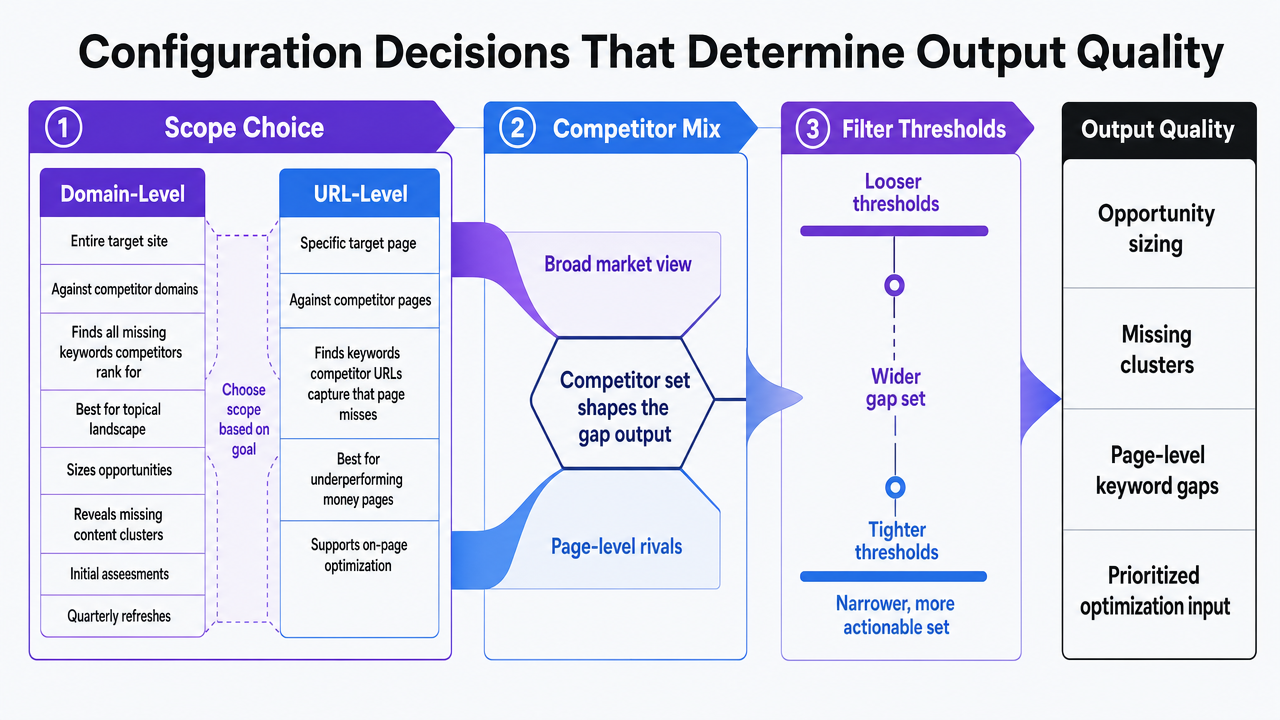 Visualize the comparison between domain-level and URL-level scope choices, competitor mix, and filter thresholds that determine gap output quality
A Prioritization Model That Survives Handoff
Scoring Gaps Against KD, Volume, and Current Position
A filtered gap file is merely a list; a scoring rule transforms it into an actionable plan. This rule ensures consistent prioritization across clients, regardless of who is reviewing the data. Three Ahrefs metrics are central to this: keyword difficulty (KD), monthly search volume, and the target's current ranking position.
KD predicts the effort required to rank 4. Search volume indicates addressable demand, especially after the initial volume floor is set 2. Current position is often overlooked but significantly impacts the investment required; a keyword where the target ranks at position 14 is a different opportunity than one for which it doesn't rank at all.
A practical scoring rubric can weight these inputs. For example, assigning 40% to inverted KD (lower KD scores higher), 30% to log-scaled volume, and 30% to a position bonus for existing rankings between positions 4 and 20 3. Keywords where the target already ranks 1-3 are excluded 2. The specific weights can be adjusted, but consistent application across a portfolio is paramount for comparable and objective prioritization.
Layering Commercial Fit Onto the Raw Metric Score
While metric scores address search behavior, they don't inherently determine a keyword's commercial value to the client. This commercial fit layer must be added, either manually or via rules, to make the priority list meaningful.
Commercial fit is typically a multiplier based on three variables: service-line margin, revenue tier of the target page, and search intent alignment. High-margin services (e.g., estate planning) justify pursuing gaps with weaker raw metrics. A keyword feeding a high-converting page warrants a higher multiplier. Intent alignment distinguishes informational from commercial queries; a keyword with the same volume has different value depending on whether it signals research or buying intent.
Inferring search intent from short queries can be ambiguous 10. A practical workaround is to check the SERP for the keyword. If the top-ranking pages are transactional, the query is transactional. This SERP check prevents misclassification that can lead to content plans that fail to convert 4.
Governance Rules for Automated Prioritization
Automating prioritization across a portfolio is efficient, but it requires robust governance to prevent errors from compounding. Following NIST recommendations for AI-assisted decision-making 7, three rules are crucial for gap prioritization:
- The automated scoring rank and brief queue must be visible to a strategist before writing begins.
- Any keyword promoted into the top decile of the priority list requires a manual SERP check for intent, as the cost of misclassification is highest here.
- Scoring weights should be reviewed quarterly against actual ranking outcomes. If the model consistently promotes underperforming keywords, the rubric needs recalibration.
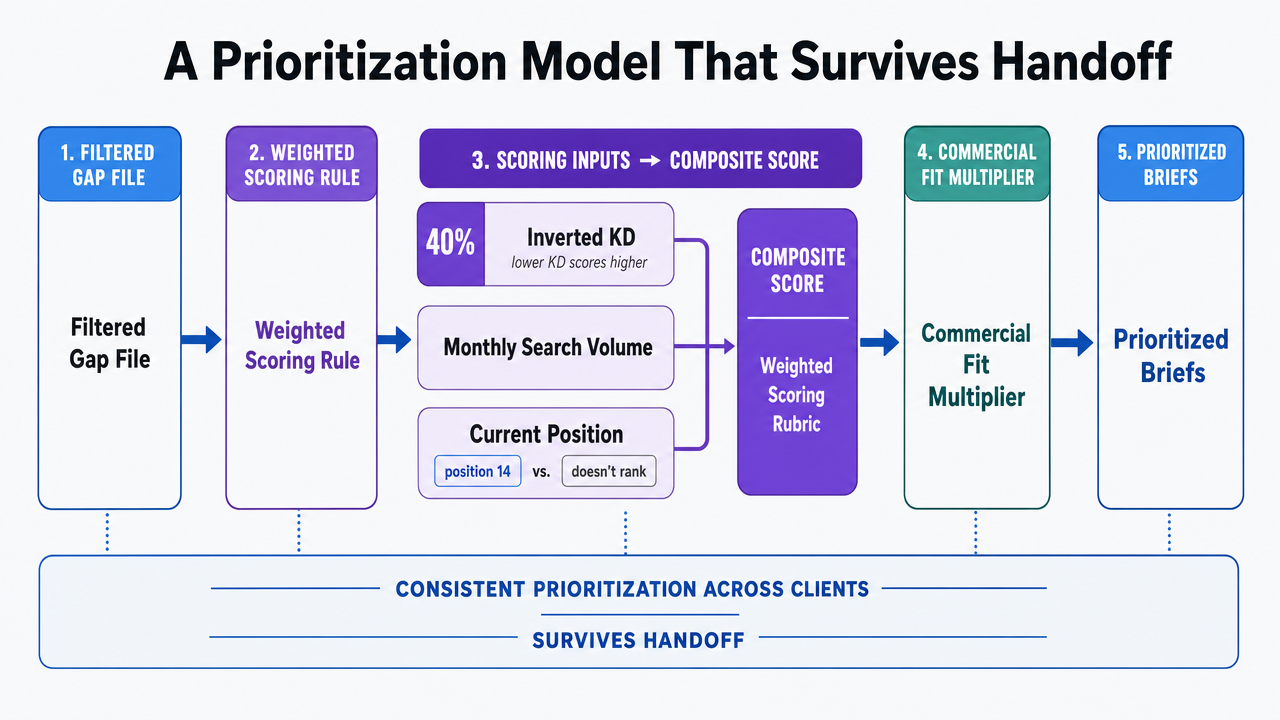 Show the weighted scoring rubric and commercial fit multiplier as a process flow so readers understand how raw metrics become prioritized briefs
Pinpoint and Close Your Competitors’ Keyword Gaps
Test-drive data-driven workflows to identify, fill, and publish content for high-value keyword gaps in real campaigns.
Turning Gap Rows Into Briefs an AI Layer Can Execute
Keyword-to-Page Mapping Before Brief Creation
Before any brief is written, each prioritized gap keyword must be assigned to a single page—either an existing URL for optimization or a new URL. Skipping this step can lead to duplicate briefs for the same keyword or competing pages targeting the same term on the same domain.
The principle is that each page should target a unique primary keyword, enforced by a keyword-to-page registry 11. This registry, a single source of truth per client, lists every primary keyword and its corresponding URL. When a gap keyword is prioritized, it's first checked against this registry. If a close variant is already mapped, it becomes an on-page revision task. Otherwise, it receives a placeholder URL slug and enters the brief queue as a net-new content piece 2.
For AI production at scale, this registry must be machine-readable, such as a database column, rather than relying on a strategist's memory across multiple clients 12.
Brief Fields the Production Layer Needs
A raw keyword from a gap file is not a complete brief. For an AI content layer or junior writer to execute without re-briefing, a fixed set of consistently populated fields is essential 5.
Eight core fields drive the workflow: primary keyword and search volume (from gap export); keyword difficulty and current ranking position (from scoring rubric); assigned URL (from keyword-to-page map); intent classification (from manual SERP check for top-decile keywords); the top three ranking competitor URLs (from Content Gap 1); and service line plus page role (e.g., money page, supporting article) to align with the client's commercial strategy.
Two additional fields enhance the brief: a word-count band based on the median length of top competitor URLs, and a note on keywords to avoid targeting to prevent cannibalization 11. Briefs built with these specifications can ship without strategist review, while missing fields lead to rework and negate automation benefits.
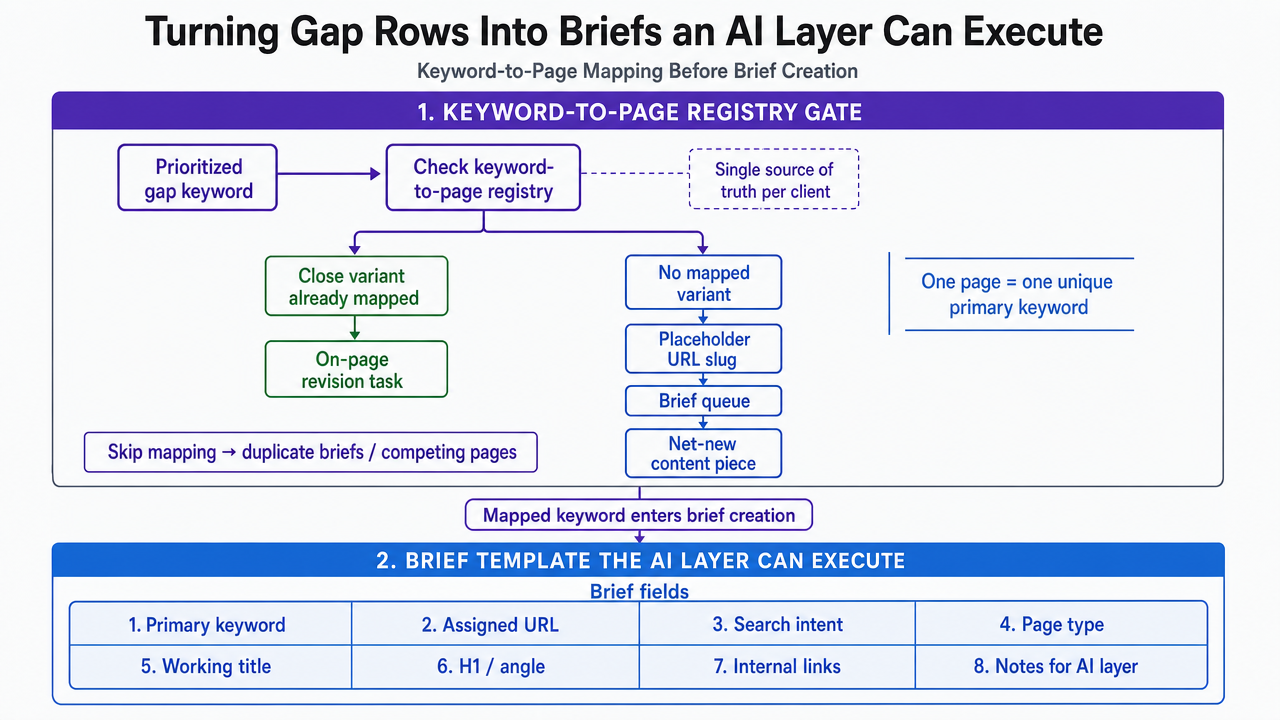 Visualize the eight required brief fields and the keyword-to-page registry check as a structured template
Extending Gap Analysis Into AI Search Visibility
Achieving a page-one ranking is no longer the sole measure of success. A significant portion of high-intent queries now resolve within Google's AI Overviews, ChatGPT answers, and Perplexity citations before users click traditional organic links. Ahrefs addresses this with "brand gap analysis," which assesses discoverability across Google search, AI search, and online mentions, beyond just organic rankings 6.
For agencies managing client portfolios, this introduces a second pass to the workflow. Beyond identifying keywords competitors rank for organically, the second pass focuses on which competitors are cited in AI-generated answers for the client's priority topics. Ahrefs' Brand Radar and AI Responses report track branded keyword visibility, related unbranded searches, and AI citations against competitors 6.
This means a gap file now feeds two output streams: one for traditional organic ranking briefs, and another for a "topical authority queue." The latter comprises pages specifically designed to become sources cited by AI systems. While these queues overlap, they are not identical. A keyword with modest organic volume might still warrant a brief if competitors are being cited in AI answers for that topic while the client remains invisible.
Ignoring this aspect in 2025 means leaving a measurable segment of demand unaddressed. Agencies that focus solely on SERP rankings are optimizing for an incomplete picture, especially in high-consideration verticals like legal and healthcare, where AI-assisted research often precedes conversion queries 6.
If You Manage a Client Portfolio: The Time Math
While the described workflow scales efficiently for a single site, managing it across 15 to 80 clients introduces significant time constraints. The challenge shifts from analytical judgment to managing calendar hours. This section examines the operational implications for a portfolio, focusing on how frequently gap analysis can be run without exceeding delivery capacity.
The workflow's time budget is divided into four blocks:
- Setup (target/competitor entry, scope selection 1)
- Filtering (brand exclusion, volume floor, KD ceiling, existing-rank exclusion 2)
- Prioritization (scoring, commercial-fit multiplier, SERP intent check)
- Brief creation (keyword-to-page registry check, brief field population 11)
Setup is minimal and fixed per client. Filtering becomes faster with practice. Prioritization and brief creation consume the most time, scaling with the number of prioritized keywords.
Consider a portfolio of 40 clients, with a quarterly cadence, generating seven briefs per client per quarter. At one hour per brief, this equates to 280 brief-hours quarterly, excluding setup, filtering, or prioritization. This highlights where AI-assisted brief production becomes invaluable—not for running the gap report itself, but for compressing the brief-creation phase, which is the largest consumer of portfolio budget.
| Variable | Typical Range | Notes |
|---|---|---|
| Clients in portfolio | 15 to 80 | Reader's own count |
| Competitors per client | 5 to 7 (of 10 max) | Trimmed roster per 1 |
| Setup hours per client | 0.5 to 1 | Fixed regardless of output size |
| Filtering hours per client | 0.5 to 1.5 | Shrinks after first pass |
| Prioritization hours per client | 1 to 3 | Scales with row count post-filter |
| Brief creation hours per keyword | 0.5 to 1.5 | Largest single line item |
| Cadence | Quarterly or monthly | Quarterly is the realistic floor at 40+ clients |
Pinpoint and Prioritize High-Impact Keyword Gaps—No Extra Headcount Required
Connect with a strategist to see how leading agencies streamline competitor gap analysis and scale actionable keyword targeting across client portfolios—supported by data-driven, AI-powered workflows.
Common Failure Patterns and How to Catch Them
Four common failure modes can derail portfolio gap analysis, each with a specific diagnostic to catch issues before briefs are deployed.
The first is brand-noise contamination. Even after initial brand exclusion filters, variant spellings or partial matches of competitor brand names can slip through 2. To diagnose, sort the top 50 prioritized rows by keyword string and scan for competitor tokens. If more than three appear in the top decile, the exclusion list needs refinement.
The second is cannibalization during brief creation. This occurs when multiple client managers independently brief pages targeting close variants of the same primary keyword 11. The keyword-to-page registry check, if enforced before brief issuance, is the critical safeguard against this.
The third is intent misclassification, particularly with short, ambiguous queries 10. The manual SERP-check rule for top-decile keywords is the only reliable diagnostic. Skipping this step can lead to a queue of informational briefs being mistakenly treated as commercial opportunities.
The fourth is stale scoring weights. If quarterly reviews show that briefs from the top decile are not outranking those from the middle, it indicates that the prioritization rubric is no longer effective and requires recalibration before the next analysis cycle 7.
Where This Workflow Goes Next
The core functionality of Ahrefs Keyword Gap—handling ten competitors, filtered exports, and the Compare Gap report—is already efficient, completing in minutes 1. The significant evolution in the next two quarters will be in the layer between the export and a published page. This includes making registries machine-readable, versioning scoring rubrics with quarterly reviews against ranking outcomes 7, and standardizing brief templates with the eight essential fields for AI production layers 5. Additionally, the "topical authority queue" for AI Overviews and chat citations will run concurrently with the organic queue 6. Agencies that systematize this translation layer will shift from billing for gap reviews to billing for measurable outcomes. This is the transformation Vectoron is designed to facilitate.
Frequently Asked Questions
References
- 1.How to use Content Gap to find keyword ideas from competitor websites.
- 2.How to Do a Content Gap Analysis [With Template].
- 3.Keyword Research: The Beginner's Guide by Ahrefs.
- 4.How I Do Content Gap Analysis SEO With Ahrefs.
- 5.Ahrefs Guide to Content Creation.
- 6.Brand Gap Analysis: Find Out Why You're Invisible in AI Search.
- 7.AI Risk Management Framework | NIST.
- 8.Searching for studies: A guide to information retrieval for Campbell reviews.
- 9.Privacy in Information Retrieval.
- 10.Improving Query Representations for Dense Retrieval with Pseudo Relevance Feedback.
- 11.SEO Keywords | Ohio State Marketing and Communications.
- 12.SEO Strategy and Keyword Research - Digital Experience Studio.