
Key Takeaways
- AI Overview and answer-engine visibility specialists surface citation share and answer saturation, exposing a third visibility surface that classic rank exports cannot capture 5, 6.
- Enterprise multi-brand platforms handle role-based permissions, tag hierarchy, and API throughput needed once a client roster crosses fifty accounts, per the Forrester Wave Q3 2025 14.
- SERP feature depth and share-of-voice trackers translate scattered position movements into a single volume-weighted number that explains traffic gains without ordinal rank change 2.
- Local pack and device-segmented trackers require ZIP or GBP-centroid granularity and mobile-first views so multi-location clients see which offices are actually losing pack presence 3.
- GSC-blended reporting tools connect rank to clicks and conversions, collapsing reconciliation labor that Google notes will never align exactly across attribution models 7.
- Budget-conscious trackers starting near $49 per month for 250 keywords fit lean rosters of five to twenty accounts but need replacement once AI Overview or ZIP data is required 4.
- Pixel-rank and visibility-weighted trackers calculate on-screen prominence above the fold, explaining why rising ordinal positions sometimes fail to produce rising traffic 5.
- Vectoron sits above the tracking stack as a coordination layer, routing ranked recommendations through approval workflows and closing the loop between rank movement and executed work.
Why position tracking alone stopped proving ROI
A client asking whether their money is working no longer accepts a screenshot of blue-link positions. The search result page has fragmented into classic organic listings, SERP features, local packs, and AI-generated answers, and each surface produces its own visibility economy. Yotpo's 2026 review of keyword tracking tools argues directly that agencies should "stop relying on outdated rankings" and instead measure true visibility, AI Overviews, and pixel-level prominence 5. That reframing matters because a page holding position three under an AI Overview citation panel is not the same asset as a page holding position three on a clean SERP.
Forrester extends the point on the AI surface itself, recommending that teams boost AI citation share and measure answer saturation as first-class visibility metrics 6. Neither of those numbers appears in a traditional rank export.
The second break is attribution. Google's own guidance is explicit that Search Console reports pre-visit search performance while Analytics captures post-click behavior, and the two systems will not reconcile exactly because they use different attribution models 7. Rank movement without that click-to-conversion bridge is a leading indicator, not proof. Any ranking tool worth standardizing on has to feed a reporting chain that ends in sessions, engaged events, and revenue.
The eight-criterion rubric for standardizing a rank-tracking stack
Content Distribution's review of 35 SERP trackers converges on six features that matter when evaluating tools:
- Accuracy
- Check frequency
- Search engine support
- Location support
- Device support
- Pricing
Those six hold up as the base layer of any agency shortlist 3. Two more criteria have become non-negotiable for agencies now reporting ROI in 2026: AI Overview coverage and native blending with Search Console and GA4.
Accuracy governs whether a client trusts the number. Two tools pointed at the same keyword, location, and device will disagree, and the wider the drift, the harder it is to defend a monthly report. Check frequency determines how quickly a tool catches a volatility event or an algorithm shift. Daily checks are the practical floor for money keywords; weekly is acceptable only for long-tail informational sets. Search engine support matters when clients run in markets where Bing carries more than trivial share or where YouTube visibility drives pipeline. Location support at the ZIP or GBP-centroid level, not just city, decides whether a multi-location client's local pack data is usable. Device support has to include mobile as a first-class view rather than a filter tacked onto desktop.
Pricing is the constraint that forces the other five into tradeoffs, especially once tracked-keyword counts cross five figures across a client book 3.
AI Overview coverage is the newer addition. Yotpo's 2026 survey argues explicitly that agencies should stop relying on outdated rankings and instead measure true visibility and AI Overviews 5. A tool that cannot detect whether a page appears as a supporting citation inside an AI Overview is missing an entire visibility surface. The last criterion is GSC and GA4 blending. Google's own documentation frames Search Console as pre-visit search performance data and Analytics as post-click behavior data, with intentional discrepancies between them 7. A rank tool that cannot pull GSC clicks and impressions alongside its own position data forces analysts into manual reconciliation every reporting cycle, which is the labor line item that breaks agency margins first.
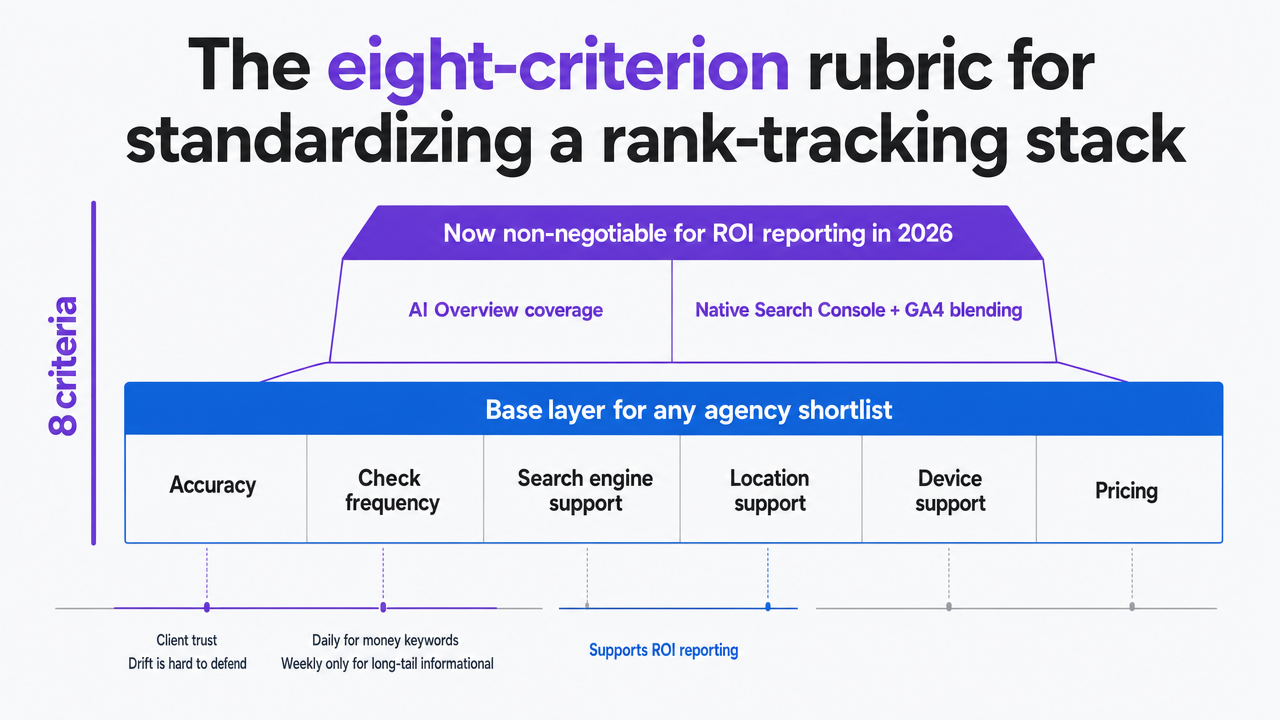 Visualize the eight selection criteria as a structured framework agencies can apply when evaluating rank-tracking tools, directly supporting the section's rubric
The eight tools, scored by the ROI-reporting job each does best
AI Overview and answer-engine visibility specialists
The first category answers a question classic rank exports cannot: whether a client's page is being cited inside an AI Overview or AI Mode response. Google's own documentation confirms that a page must be indexed and eligible for a snippet to appear as a supporting link in AI Overviews, with no additional technical requirements beyond that 11. Tools in this category detect those citations at the query level and quantify how often a domain appears across an AI answer set.
Forrester frames the measurement discipline as answer engine optimization, recommending that teams boost AI citation share to dominate zero-click answers and measure answer saturation to track visibility and impact 6. That translates into two reportable metrics for a client dashboard:
Citation share : Percentage of monitored queries where the client's domain appears as a supporting link.
Answer saturation : Density of citations across the AI response set for a topic cluster.
The three-surface visibility model these tools force onto an agency's reporting is straightforward: classic SERP position, SERP feature or pixel-level prominence, and AI citation share 5, 6. Yotpo's 2026 survey argues that ignoring the third surface leaves ROI on the table because informational queries increasingly resolve inside the AI answer without a click through to any position 5.
Enterprise multi-brand platforms for 50+ client books
Once a client roster crosses fifty accounts, the selection question shifts from features to governance. Enterprise SEO platforms in this tier handle role-based permissions, white-labeled reporting domains, API access for custom dashboards, and dedicated crawl infrastructure that will not throttle under a 500,000-keyword load. The Forrester Wave for SEO Solutions, Q3 2025, evaluates the leading platforms in this bracket and scores them across keyword tracking, technical auditing, and analytics capabilities, giving agency leaders an analyst-grade comparison for high-stakes verticals 14.
Two operational realities separate this tier from mid-market tools:
- Tag hierarchy: an enterprise platform lets an agency segment keywords by client, brand, geography, and campaign simultaneously, so a single query set can roll up to a portfolio view or drill down to a ZIP-level pack. Mid-market tools force a choice.
- Data export fidelity: enterprise platforms expose position, SERP feature, and competitor data through APIs that a BI layer can ingest without CSV gymnastics, which is the difference between a reporting analyst spending two hours or twelve on a monthly client cycle.
Standardizing here costs more per keyword but collapses the labor line that usually breaks agency margins first.
SERP feature depth and share-of-voice trackers
Share of voice is the metric that translates a scatter of individual rank movements into a single number a client's leadership team can absorb. Thruuu's evaluation of SERP tracking tools recommends selecting a platform that can monitor keyword performance, SERP features rankings, and SEO share of voice across Google and Bing rather than positions alone 2. Tools in this category weight each tracked keyword by search volume and estimated click-through by position, then produce a percentage that expresses how much of the available organic attention a domain captures against its named competitor set.
Depth on SERP features matters because a single query might present a featured snippet, a People Also Ask block, a video carousel, a local pack, and an image row above the first blue link. A tracker that only records ordinal position misses whether a client owns the snippet or the video slot, which is often where the click actually goes. The reporting value shows up when a client asks why traffic rose without a position change: the answer is usually that share of voice expanded through a SERP feature capture that the position column cannot see 2.
Local pack and device-segmented trackers
Multi-location clients live or die on local pack visibility, and the trackers built for them start with geography as the primary key rather than an afterthought filter. Content Distribution's review of 35 SERP trackers names location support and device support as two of the six core selection criteria, alongside accuracy, check frequency, engine support, and pricing 3. For a dental group with 40 offices or a home services brand covering 200 service areas, location support has to reach the ZIP or Google Business Profile centroid level; city-level tracking produces averaged numbers that mask which locations are actually failing.
Device segmentation is the second axis. Mobile SERPs present different pack compositions, different feature densities, and different pixel real estate than desktop, and the position that drives calls for a service business is almost always the mobile pack position. A tracker that treats mobile as a checkbox filter on desktop data will systematically over-report visibility for local queries. The reporting output that matters here is a per-location scorecard showing pack presence, pack position, and organic position on mobile, refreshed at least weekly 3.
GSC-blended reporting tools that connect rank to clicks
Rank movement without a click-to-conversion bridge is a leading indicator, not proof of ROI. Google's guidance on combining Search Console and Analytics is explicit: Search Console data describes search performance before the visit, while Analytics captures what users do after landing on the site, and clicks and sessions will not match exactly because the tools use different systems, attribution models, and measurement logic 7. Trackers in this category pull GSC clicks, impressions, and average position into the same view as their own scraped positions, then hand off to GA4 for engaged sessions and conversion events.
The operational value is time saved on reconciliation. When a report cycle starts with rank data in one tab, GSC in another, and GA4 in a third, an analyst spends the first hour of every client review copying numbers into a single spreadsheet. A blended tool collapses that into a pre-built view, which is what allows a single analyst to run monthly reporting for 20 to 30 accounts instead of five to seven.
Zapier's review of rank trackers emphasizes exactly this integration point, noting that modern tools need to plug into broader marketing workflows rather than sit as standalone dashboards 1.
Budget-conscious trackers for lean client rosters
Not every agency is running a 150-client book. For practices between five and twenty accounts, the calculus favors tools priced for smaller tracked-keyword volumes without the enterprise governance layer. Tooltester's 2026 roundup includes both paid tiers starting near $49 per month for 250 keywords and two free options, giving lean agencies a realistic entry point 4. The tradeoff is honest: budget tools typically check less frequently, cover fewer search engines, and expose less granular location targeting than mid-market platforms.
For a boutique agency serving local service businesses on shared markets, weekly checks and city-level location data are often enough to produce defensible client reports. The moment a client asks for AI Overview visibility or ZIP-level pack segmentation, the tool has to be replaced or supplemented. Budget trackers work as the starting stack, not the ending one, and the migration path should be planned before the roster passes the point where manual reconciliation eats a full analyst day per week 4.
Pixel-rank and visibility-weighted trackers
Position one is not what it used to be. On a SERP topped by an AI Overview, a knowledge panel, and a video carousel, the classic first organic result may sit 1,200 pixels below the fold on mobile. Yotpo's 2026 survey introduces pixel rank as the response, urging teams to stop relying on outdated rankings and instead measure true visibility, AI Overviews, and pixel-level prominence 5. Tools in this category calculate the actual on-screen position of a client's result in pixels from the top of the viewport, not its ordinal rank.
The reporting difference is material. A pixel-weighted visibility score can show a client that their position-two result is actually less visible than their position-five result on a different query, because the position-two SERP is stuffed with features above the fold. That reframes the optimization conversation from chasing ordinal gains to buying above-the-fold real estate, which is what actually correlates with click-through. For agencies reporting to marketing leaders who question why rising positions did not produce rising traffic, pixel rank is the missing explanatory variable 5.
Vectoron as the coordination layer above the tracker
The eighth entry is not a rank tracker. Vectoron sits above the tracking stack as an execution platform that consumes rank, GSC, and GA4 data and routes ranked recommendations through a single approval workflow. The distinction matters for agency leaders evaluating where to add tooling: a tracker produces the numbers, and a coordination layer decides what to do about them and executes the approved work across content, technical fixes, and outreach without adding an analyst per account.
The reporting job Vectoron does best is closing the loop between rank movement and executed work. When a tracked keyword drops or a SERP feature is lost, the platform surfaces the recommended response with the strategic reasoning attached, waits for human sign-off, and then executes across the connected channels. That governance model addresses the labor constraint that separates agencies capable of scaling from those stuck hiring one specialist per fifteen accounts. Tracker data becomes an input to action rather than a monthly reporting artifact.
Test live keyword tracking on real campaigns
Measure actual keyword movements and report ROI to clients using real campaign data during your trial period.
Scaling the stack across a client book
Scope note: this section moves from single-account tool selection to portfolio economics for agency leaders modeling per-client cost across 15 to 150 accounts.
The math that breaks agencies first is not accuracy or feature depth. It is the tracked-keyword bill multiplied by the client count. Tooltester's 2026 pricing analysis anchors the shape of that curve with two concrete data points: 250 keywords at $49 per month and 2,500 keywords at $349 per month on a representative platform 4. Costs scale roughly with volume but not linearly, and the gap between mid-market and enterprise-quote tiers widens sharply once portfolios cross the 10,000-keyword threshold.
The table below models per-client capacity against tracked-keyword volume, using the two sourced Tooltester anchors and labeling intermediate tiers as illustrative. Client capacity assumes an average of 50 tracked keywords per account, which agency leaders should adjust to their own mix.
| Keyword volume tier | Monthly cost (representative) | Client capacity at ~50 kw each | Reporting labor implication |
|---|---|---|---|
| 250 keywords | $49 (sourced) 4 | ~5 clients | Manual reconciliation acceptable; one analyst covers the book |
| 1,000 keywords | Illustrative midpoint | ~20 clients | Reconciliation labor starts eating one full day per week |
| 2,500 keywords | $349 (sourced) 4 | ~50 clients | Auto-generated reports required to hold analyst-to-account ratios |
| 10,000+ keywords | Enterprise / quote | 150+ clients | API-fed BI layer replaces per-client dashboards |
Two operational thresholds show up in agency P&Ls at these tiers:
- Around 1,000 tracked keywords, the analyst hours spent copying GSC and rank data into a client deck cross the cost of upgrading to a blended tool.
- Around 10,000 tracked keywords, the platform choice stops being about features and starts being about API throughput and permission governance.
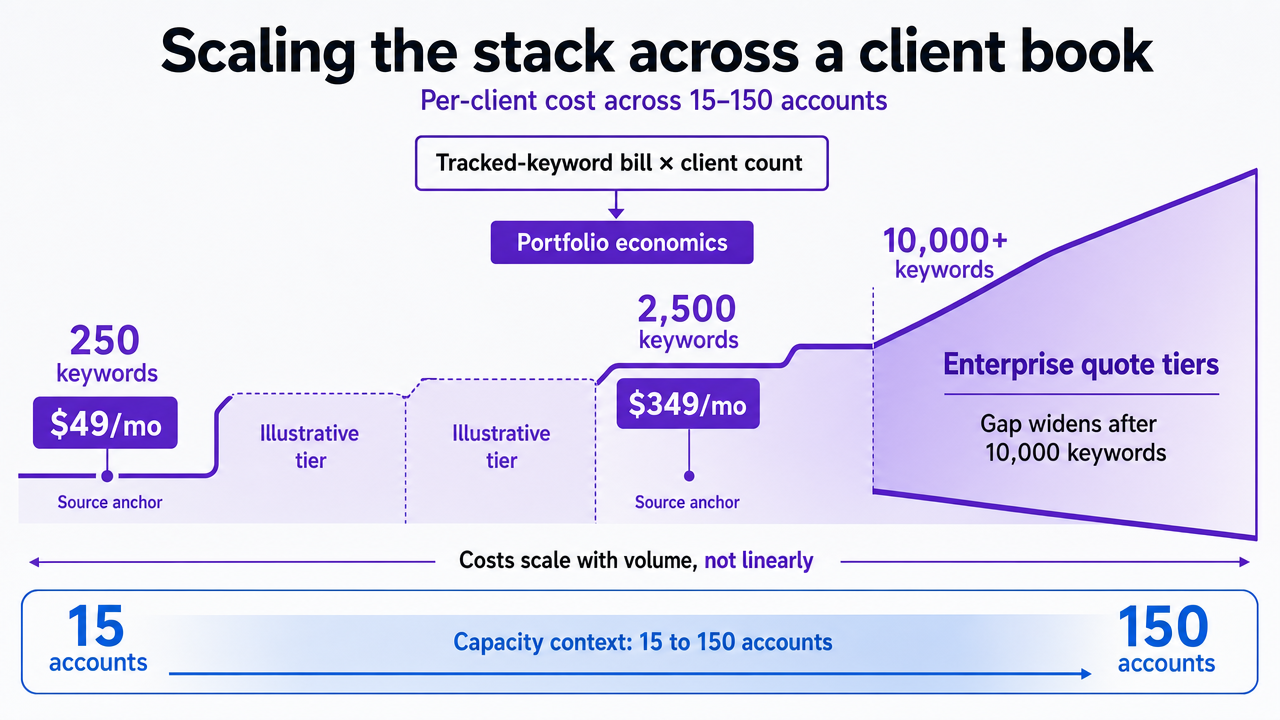 Render the sourced pricing and capacity tiers as a scannable comparison, reinforcing the section's cost-to-capacity model with the exact figures cited in prose
Wiring rank data into a board-ready ROI narrative
A board deck does not care that a keyword moved from position seven to position four. It cares whether that movement produced clicks, whether those clicks converted, and whether the revenue justified the retainer. The reporting chain that connects those three layers is the deliverable, not the rank export itself.
The wiring runs in a fixed sequence:
- Rank tracker data establishes the leading indicator: visibility gained or lost across classic positions, SERP features, and AI citation surfaces.
- Search Console then converts that visibility into pre-visit demand, expressed as clicks and impressions on the queries that actually served the client's pages.
- GA4 picks up the handoff at the landing page and follows the user through engaged sessions, key events, and revenue.
Google's own guidance is explicit that the two systems will not reconcile exactly because they use different attribution models, and reports should treat the discrepancy as expected rather than as a data quality problem 7.
Three metrics belong on the first page of a board-ready deck:
- Visibility change, expressed as share of voice or citation share movement quarter over quarter 2, 6.
- Qualified click volume, pulled from Search Console and filtered to the query clusters the engagement is targeting 7.
- Downstream outcome, measured in GA4 key events tied to those landing pages.
Everything else — position tables, feature captures, competitor overlays — belongs in the appendix as supporting evidence.
The narrative that closes the deck answers one question: what work produced the movement, and what work is queued next. A rank tracker cannot answer that. It requires connecting the visibility data to the executed content, technical, and outreach work that caused the change, which is the reporting artifact clients actually pay retainers to see.
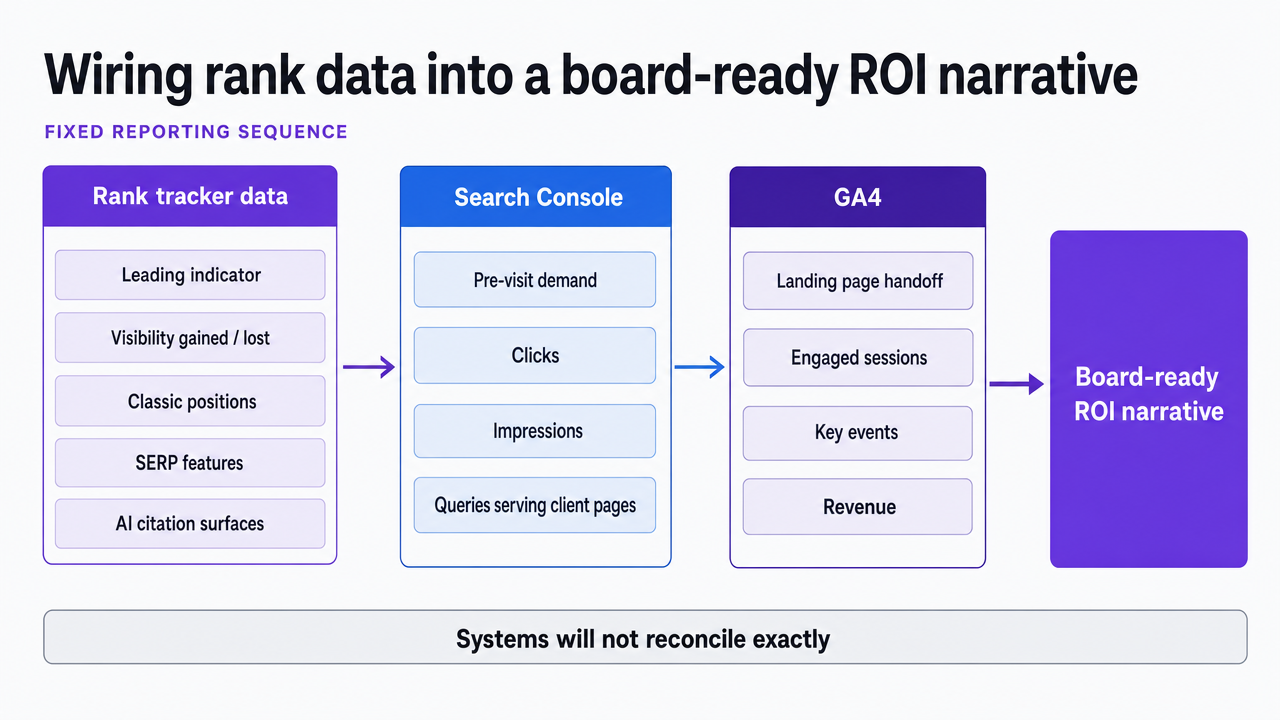 Visualize the fixed reporting sequence from rank data through GSC to GA4 outcomes, directly mirroring the workflow described in the section
See Real-Time Keyword Rankings Aligned With Client ROI
Request a walkthrough of unified keyword tracking, reporting, and approval workflows purpose-built for agencies managing multiple client portfolios at scale.
If you manage multiple locations or a multi-brand portfolio
Scope shift: this section is for agency leaders whose client roster includes multi-location service brands or multi-brand holding companies, where a single account may carry 40 to 400 tracked geographies under one contract.
The selection logic changes at the tag hierarchy. A tracker that treats each location as its own project produces a reporting mess by month three, because rollup views require manual aggregation across dozens of dashboards. The requirement is a platform that lets a single keyword set be tagged simultaneously by brand, market, and location, then queried at any level of that hierarchy without re-scraping. The Forrester Wave for SEO Solutions, Q3 2025, scores enterprise platforms specifically on this kind of segmentation depth alongside keyword tracking and analytics 14.
Two data disciplines separate a workable multi-location stack from a broken one. Location granularity has to reach the ZIP or Google Business Profile centroid level, because city-level averages hide which of a client's 60 offices is actually losing pack presence 3. Device segmentation has to be first-class, because mobile pack composition drives the calls that matter for service businesses. If a portfolio client cannot get a per-location, mobile-first scorecard on demand, the reporting cadence will not survive contract renewal.
Selection guidance by agency profile
Three profiles cover most of the agency market, and each maps to a different anchor tool in the stack:
- Boutique practices under 20 accounts should anchor on a budget tracker with weekly checks and city-level location data, then add a GSC-blended layer once analyst reconciliation crosses one day per week 4, 7.
- Mid-market shops running 20 to 75 accounts should standardize on a share-of-voice platform with SERP feature depth 2 and pair it with an AI Overview visibility tool to cover the third surface Yotpo's 2026 review flags as the current visibility gap 5.
- Enterprise agencies past 75 accounts, or any shop carrying a multi-brand portfolio client, should default to a Forrester Wave-scored platform for governance, API throughput, and tag hierarchy depth 14, then layer a coordination platform above the tracker to close the loop between rank movement and executed work.
The selection question at that scale is not which tracker wins on accuracy. It is which combination holds analyst-to-account ratios above 1:20 without sacrificing report defensibility.
Frequently Asked Questions
References
- 1.The 12 best rank tracker tools.
- 2.The 7 Best SERP Tracking Tools - thruuu.
- 3.We Reviewed 35 SERP Tracker Tools - Content Distribution.
- 4.Best 12 SERP Rank Tracking Tools (2026) & 2 Free Ones!.
- 5.15 Best Keyword Tracking Tools For 2026: AI & Pixel Rank.
- 6.Win Visibility In AI Search With Answer Engine Optimization - Forrester.
- 7.Using Search Console and Google Analytics data for SEO.
- 8.In-Depth Guide to How Google Search Works.
- 9.Search Engine Optimization (SEO) Starter Guide.
- 10.Creating Helpful, Reliable, People-First Content.
- 11.AI Features and Your Website.
- 12.Understanding Core Web Vitals and Google search results.
- 13.Intro to How Structured Data Markup Works.
- 14.The Forrester Wave™: Search Engine Optimization Solutions, Q3 2025.