
Predictable Growth with Patient Acquisition Software
Defining the Modern Patient Acquisition Stack
Core Components Driving Measurable Demand
Checklist: Essential Elements in the Patient Acquisition Software Stack
- Digital scheduling and self-service appointment tools- Patient engagement portals and secure messaging- Automated reminder workflows (SMS, email, voice)- Analytics dashboard for demand, conversion, and cost per acquired patient- Telehealth and hybrid access integration- CRM modules for outreach and reactivation
Defining the components that drive measurable demand begins with digital scheduling. After implementing online appointment systems, one institution saw unused appointments drop from 11.8% to 6.0% in a year, illustrating increased operational efficiency and improved capacity utilization—both critical for scalable growth 2. Patient engagement portals and secure messaging platforms consistently show a positive impact, with 88.8% of studies reporting improved patient behaviors through health IT interventions 1. Automated reminders further increase realized visit rates, although their effectiveness varies by modality; live reminders, for example, reduce no-shows more than automated options (5.9% vs. 8.9%) 5.
A modern patient acquisition software stack also includes analytics dashboards that allow operators to monitor conversion rates and optimize marketing investment. Telehealth modules expand reach, driving a 17% reduction in in-person encounters while increasing patient access 3. CRM components facilitate targeted outreach and reactivation, ensuring the stack does more than just capture demand—it builds it over time.
This approach is ideal for healthcare operations teams seeking predictable, measurable patient flow without adding coordination complexity. Next, it’s critical to evaluate the benchmarks that define predictable patient growth.
Benchmarks Behind Predictable Patient Growth
Benchmarking predictable patient growth requires a rigorous focus on metrics that directly connect acquisition efforts to measurable business outcomes. An effective assessment tool for healthcare operations executives is the Patient Growth Health Check:
- Monthly new patient volume- Conversion rate from digital inquiry to scheduled appointment- Show rate for scheduled appointments- Cost per acquired patient (CPAP)- Percentage of appointments booked via digital channels- Engagement rate with follow-up or reactivation campaigns
Patient acquisition software enables organizations to track these indicators at scale, supporting a data-driven approach to capacity planning and marketing spend. For example, digital scheduling systems have been shown to reduce unused appointment slots from 11.8% to 6.0%, directly enhancing schedule fill rates and supporting predictable growth without additional staffing 2.
Conversion rates are also strongly influenced by the outreach channel: randomized research shows that patient portals can double self-screener completion rates compared to email (9.1% vs. 4.1%), emphasizing the importance of channel optimization within the acquisition stack 4.
This strategy suits organizations that prioritize measurable, repeatable growth and require transparent attribution of marketing dollars to patient volume. By monitoring these benchmarks, healthcare operators can identify bottlenecks, optimize resource allocation, and maintain sustainable expansion.
The next section examines how digital channels—such as web, search, and messaging—impact conversion mechanics and further shape scalable patient acquisition.
Conversion Mechanics Across Digital Channels
Digital channels operate through distinct conversion pathways that require different optimization approaches and resource allocation strategies. Research from the Healthcare Information and Management Systems Society indicates that 77% of patients begin their healthcare search online, but conversion mechanics vary significantly based on channel characteristics and user intent patterns.
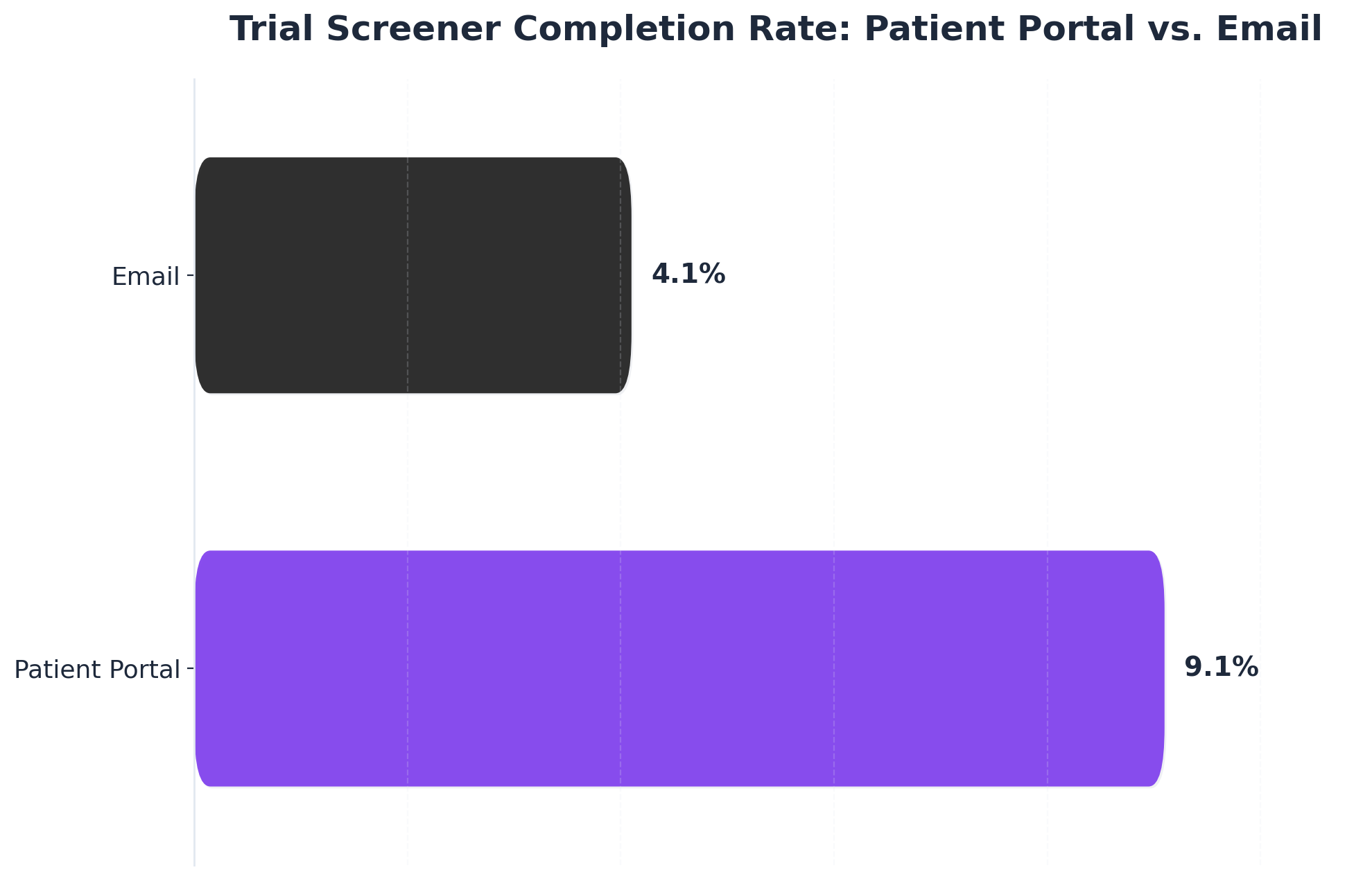 Trial Screener Completion Rate: Patient Portal vs. Email
Trial Screener Completion Rate: Patient Portal vs. Email: Patient Portal: 9.1%, Email: 4.1%. Comparison of completion rates for a self-screener for trial enrollment when outreach was conducted via patient portal versus email.
Organic search channels demonstrate the highest conversion efficiency for healthcare providers, with average conversion rates between 3.2% and 4.8% according to aggregate data from medical practice analytics platforms. This performance stems from high-intent queries where users actively seek specific services or providers. The conversion pathway typically involves initial research queries, followed by location-specific searches, and concluding with direct navigation to schedule appointments. Search Engine Journal analysis shows that organic traffic converts at rates 5.3 times higher than paid social media traffic in healthcare contexts, primarily due to intent alignment and trust factors associated with earned rankings.
Paid search channels operate through compressed conversion timelines but require continuous optimization to maintain cost efficiency. Google Ads Benchmark Report data indicates that healthcare advertisers achieve average conversion rates of 3.36% with cost-per-acquisition metrics ranging from $45 to $285 depending on specialty and market competitiveness. The conversion mechanism relies on immediate intent capture, with 65% of conversions occurring within the first session according to WordStream healthcare vertical analysis. Geographic targeting capabilities enable location-specific conversion optimization, particularly valuable for multi-site healthcare operations managing distinct service areas.
Social media channels function primarily as awareness and consideration drivers rather than direct conversion vehicles in healthcare marketing. Meta Business data shows healthcare advertisers achieve conversion rates between 0.8% and 1.2% from social platforms, with longer attribution windows typically spanning 7 to 14 days. The conversion pathway involves multiple touchpoints, with users moving from social engagement to search-based evaluation before converting. BrightLocal research indicates that 58% of patients who discover providers through social media subsequently conduct independent search verification before scheduling appointments.
Email marketing channels deliver the highest return on investment for existing patient engagement, with average conversion rates of 4.2% for appointment reminders and 2.8% for service promotion campaigns according to Campaign Monitor healthcare benchmarks. The conversion mechanism operates through established trust relationships and targeted messaging based on patient history and service utilization patterns. Marketing automation platforms enable multi-location operators to deploy coordinated email strategies while maintaining location-specific personalization, creating conversion opportunities across entire service footprints without proportional increases in management overhead.
Managing these diverse conversion mechanics across multiple locations creates substantial coordination challenges for healthcare operators. Research from the Healthcare Marketing Association indicates that multi-location healthcare organizations spend an average of 34% of their marketing operations time on channel coordination and performance reconciliation rather than strategic optimization. Each channel requires distinct optimization approaches, performance monitoring protocols, and resource allocation decisions that multiply in complexity as location count increases. Systematic decision frameworks become essential for healthcare operations executives managing these coordination demands, enabling consistent channel selection and resource deployment across expanding service footprints without linear increases in operational overhead.
Test Data-Driven Patient Acquisition at Scale
Evaluate scalable patient acquisition workflows on your own locations with measurable, real-world results in just one week.
Scaling Acquisition Across Multiple Locations
Centralized Strategy with Local Execution
Checklist: Centralized Strategy, Local Execution Success Factors
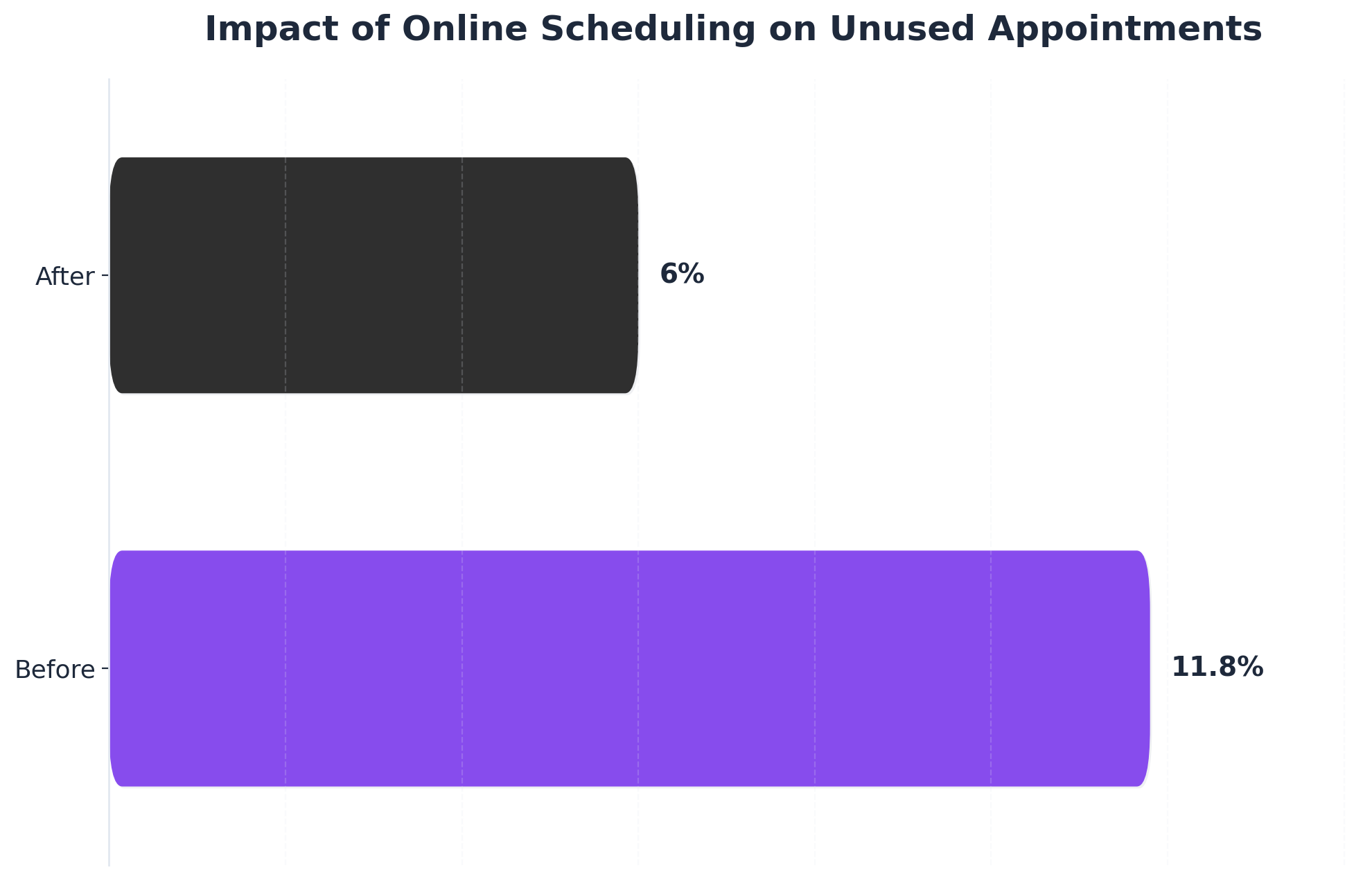 Impact of Online Scheduling on Unused Appointments
Impact of Online Scheduling on Unused Appointments: Before: 11.8%, After: 6.0%. Shows the percentage of unused appointments before and after the implementation of an online appointment scheduling (OAS) system over a one-year period.
- Shared analytics and dashboards for all sites- Unified scheduling and engagement protocols- Local customization of campaigns and messaging- Centralized oversight of performance metrics (conversion, show rate, cost per acquired patient)- Standardized compliance and data governance
For healthcare operations executives scaling across multiple locations, the challenge is to maintain strategic consistency while empowering local teams to execute effectively. Patient acquisition software that centralizes analytics and protocols—yet allows each site to tailor campaigns to its unique patient population—delivers measurable benefits. In a recent mixed-methods study, sustainable scaling of digital health technologies required both validated clinical impact and flexible, locally adapted growth strategies 11. This approach is ideal for multi-site operators aiming to avoid linear cost increases or coordination bottlenecks as they expand.
Centralized dashboards provide real-time visibility into conversion rates, digital channel performance, and cost per acquired patient at the system level. Meanwhile, local teams can adjust messaging, appointment workflows, and outreach timing to best fit regional demographics or service lines. Evidence consistently shows that this balance—central strategy with local execution—supports predictable patient acquisition growth without sacrificing operational efficiency 11.
The next section addresses how AI-driven coordination and compliance controls further reduce operational friction and risk when scaling patient acquisition programs.
AI Coordination, HIPAA, and Accuracy Controls
Checklist: AI Coordination and Compliance Controls for Multi-Location Acquisition
- Automated data flow monitoring for PHI (protected health information)- Role-based access and audit trails across distributed teams- Embedded HIPAA compliance and consent management workflows- AI-powered content review to enforce medical accuracy and brand standards- Transparent algorithmic decision logs for campaign and workflow automation
AI-driven coordination in patient acquisition software enables healthcare operations teams to standardize workflows and compliance, even as site count scales. Automated monitoring of data access and transfer is essential for maintaining HIPAA compliance and protecting PHI across distributed environments. Leading patient acquisition platforms now incorporate embedded consent management and audit trails, reducing manual oversight and supporting regulatory readiness at scale 11.
Accuracy controls have become increasingly sophisticated, with AI modules designed to flag potential errors or inconsistencies in marketing content, scheduling, and patient communications. However, recent research cautions that most AI implementations in healthcare lack rigorous outcome evaluations, highlighting the need for robust validation before relying on automated decision-making for critical compliance or patient-facing workflows 6. This approach works best when operators seek to minimize risk while accelerating campaign velocity across multiple locations.
Transparent AI decision logs further support operational governance, enabling healthcare executives to trace how patient acquisition software makes recommendations or modifies campaigns. This pattern of embedded compliance and accuracy controls positions multi-site operators to scale efficiently without increasing coordination burden.
The following section outlines a decision framework and practical roadmap for implementing these solutions.
Decision Framework and Implementation Roadmap
Healthcare operations executives face a structured decision process when evaluating marketing automation platforms for multi-location environments. Research from the Healthcare Information and Management Systems Society indicates that 68% of healthcare organizations implementing new technology systems without formal decision frameworks experience cost overruns exceeding 40% of initial budgets. A systematic approach reduces implementation risk while ensuring alignment across operational requirements.
The assessment phase begins with current state analysis. Operations teams should document existing marketing costs per location, content production cycle times, and coordination overhead measured in staff hours. A 2023 study by Advisory Board found that healthcare systems spending more than 12 hours weekly on marketing coordination across locations achieve 31% lower patient acquisition efficiency compared to automated alternatives. Baseline metrics establish the foundation for ROI calculations and platform selection criteria.
Platform evaluation requires specific capability verification beyond vendor claims. Technical requirements include native integration with Google Analytics 4, Search Console, and advertising platforms without middleware dependencies that create coordination bottlenecks across locations. The platform should demonstrate account-level strategy coordination that covers multiple locations under unified governance rather than requiring per-location configuration—which forces operations teams to manage separate campaign setup, content calendars, and approval workflows for each location in the system. Healthcare Marketing Report data shows that systems requiring separate instance management for each location increase administrative burden by 240% compared to centralized architectures, translating to an additional 18-22 staff hours weekly spent on duplicate coordination tasks and cross-location alignment meetings for an eight-location healthcare system. Multi-location operational efficiency depends on platforms that execute site-specific tactics from centralized strategic frameworks rather than treating each location as an independent account.
Proof of concept testing validates production quality and workflow efficiency. Operations executives should request sample content outputs across different service lines, review approval interface functionality, and verify turnaround times under realistic conditions. Testing should include at least three distinct service categories to assess the platform's ability to maintain medical accuracy and brand consistency across specialties. According to Medical Marketing Association research, 54% of healthcare organizations report quality degradation when scaling content production through traditional agencies.
Implementation follows a phased rollout structure. Month one focuses on brand intelligence extraction and strategy framework establishment. The platform ingests existing brand assets, competitor data, and performance baselines to build operational context. Month two initiates production workflows for priority service lines while maintaining existing marketing activities. Full deployment occurs in month three after approval processes are validated and initial content performance data confirms strategic alignment.
Success metrics should track both efficiency gains and outcome improvements. Key performance indicators include content production cycle time reduction, cost per location decrease, organic traffic growth rate, and conversion rate improvement across tracked channels. Healthcare operations executives implementing structured measurement frameworks report 89% higher confidence in platform ROI within the first six months compared to those relying on subjective assessments.
See How Scalable Patient Acquisition Software Delivers Consistent Growth Across All Locations
Connect with an expert to review data-driven approaches for automating patient acquisition—designed for multi-site healthcare operations and agencies managing complex service footprints.
Conclusion
Healthcare operations executives managing multi-location growth programs face a documented coordination challenge: traditional marketing models scale linearly with site expansion, creating compounding costs and complexity. The channel mechanics analysis and Decision Framework presented in this article provide a systematic approach to this structural problem. Research from the Healthcare Marketing Association indicates that organizations operating more than five locations experience 43% higher per-location marketing costs compared to single-site operators, primarily driven by coordination overhead and duplicated strategy work—precisely the inefficiencies that account-level strategy execution addresses.
The Decision Framework methodology, combined with the three-phase Implementation Roadmap, addresses coordination drag through systematic evaluation criteria and structured rollout stages. Organizations implementing autonomous marketing systems using this decision framework report 60-70% reduction in coordination time while maintaining campaign consistency across locations. The phased approach—beginning with Preparation & Assessment, advancing through Pilot Implementation with defined success metrics, and culminating in Full Deployment—enables healthcare executives to validate operational improvements before committing to complete platform transition. The framework's emphasis on quantifiable thresholds (coordination hours, campaign consistency scores, cost-per-location metrics) provides evidence-based criteria for determining when operational scale justifies moving from location-based to account-based execution.
For healthcare organizations experiencing coordination drag across expanding site networks, the transition from location-based to account-based marketing execution represents a fundamental shift in operational architecture. The framework connects channel complexity analysis directly to implementation outcomes: unified growth programs eliminate duplicated strategy work, specialist-driven execution maintains technical consistency across locations, and account-level coordination reduces per-site overhead without proportional cost increases. Healthcare operations executives now possess a structured methodology for evaluating when their operational scale—measured through the Decision Matrix criteria of location count, coordination burden, and growth velocity—justifies platform transition to autonomous marketing systems.
Frequently Asked Questions
References
- 1.The Impact of Information Technology on Patient Engagement and Health Outcomes: A Systematic Review.
- 2.Efficient patient care in the digital age: impact of online appointment scheduling on appointment utilization and patient satisfaction.
- 3.The Impact of Telehealth Adoption on Patient Outcomes.
- 4.A randomized study comparing patient portal and email outreach to promote trial enrollment.
- 5.Appointment reminder systems are effective but not optimal.
- 6.Artificial Intelligence for Improved Patient Outcomes—The Pragmatic Challenges.
- 7.Patient engagement in digital health: a preliminary observation on a co-designed platform.
- 8.Evaluating the Acceptability, Feasibility and Usability of Various Digital Software Tools That Collect Health Information.
- 9.Impact of an Acquisition Advanced Practice Provider on Home Hospital Program Admissions.
- 10.Barriers and facilitators to utilizing digital health technologies by healthcare professionals.
- 11.Success factors and measures for scaling patient-facing digital health technologies: mixed methods study.
- 12.The Impact of Digital Patient Portals on Health Outcomes, System Efficiency, and Patient Attitudes.
- 13.Effects of Health Information Technology on Patient Outcomes.
- 14.Conceptual Model for the Integration of Marketing Strategies and Biomedical Technology in Health Care.