7 Best Performance Marketing Platforms for SaaS Growth
The New Efficiency Mandate in SaaS Acquisition
Marketing teams managing growth across multiple channels face a structural efficiency problem that compounds acquisition costs. Gartner's 2024 Marketing Operations Survey shows that organizations running separate workflows for SEO, paid advertising, and content experience 34% longer campaign launch cycles and 28% higher coordination overhead compared to teams operating from unified channel strategies. This fragmentation creates measurable waste: content teams publish without visibility into converting search terms, paid channel managers bid against organic rankings, and SEO strategies contradict messaging tested in ad campaigns. The efficiency mandate isn't about optimizing individual channels harder; it's about eliminating the coordination drag that occurs when acquisition programs operate as disconnected initiatives.
Research from Boston Consulting Group's marketing efficiency study demonstrates that organizations achieving CAC reduction of 20% or more consistently operate with integrated channel strategies where content production, technical optimization, and paid amplification reinforce the same conversion paths. These teams treat search visibility as a unified system rather than separate initiatives. The efficiency gains don't emerge from incremental improvements within individual channels but from eliminating the structural waste created when organic and paid programs operate independently without shared intelligence or coordinated execution timelines.
1. Google Ads for High-Intent Demand Capture
Google Ads remains the most direct path to capturing demand from prospects already searching for solutions. WordStream's 2023 benchmark data shows SaaS companies achieve an average conversion rate of 3.7% on search campaigns, with click costs ranging from $3.80 to $6.50 depending on competitive intensity. These metrics make search advertising particularly effective for bottom-funnel keywords where purchase intent is explicit.
The challenge lies in managing campaign efficiency at scale. Gartner's findings indicate that 68% of B2B organizations struggle to maintain consistent ROI across multiple campaign types as account complexity increases. Quality Score deterioration, keyword expansion without strategic discipline, and misaligned landing page experiences erode performance over time.
Effective Google Ads execution requires continuous optimization cycles: bid adjustments based on conversion data, negative keyword refinement, ad copy testing aligned to landing page messaging, and audience segmentation that reflects actual buying patterns. Companies that implement weekly optimization protocols achieve 23% better acquisition efficiency than those operating on monthly review cycles, per PPC Hero's analysis of 500+ accounts.
2. LinkedIn Ads for Account-Based Targeting
LinkedIn Ads function as a precision targeting layer in coordinated B2B acquisition systems, with 89% of B2B marketers citing this network as their most effective lead generation source per LinkedIn's 2023 B2B Marketing Benchmark Report. The platform's account-based capabilities deliver 3.2x higher conversion rates than run-of-network B2B advertising according to Demand Gen Report, making it the primary paid channel for named account penetration—67% of enterprise B2B organizations allocate at least 30% of their paid media budget specifically to LinkedIn for this purpose.
The coordination challenge centers on synchronizing LinkedIn's account intelligence with content production priorities and SEO targeting decisions. When LinkedIn campaigns identify which accounts engage with specific topic clusters, that engagement data should directly inform content calendar prioritization and keyword targeting expansion. Organizations that treat LinkedIn as an isolated demand generation channel miss the strategic signal it provides about which problems resonate with target accounts.
LinkedIn's brand awareness campaigns generate 6x ROI over 24-month attribution windows according to B2B Institute research, but this long-cycle impact requires coordination with organic content strategies that can capture and nurture the demand these campaigns create. The typical breakdown occurs when awareness campaigns run independently from content production schedules—accounts exposed to thought leadership ads encounter outdated or misaligned organic content when they search for related topics weeks later, breaking the continuity that converts awareness into pipeline.
3. Meta Ads for Scaled B2B Creative Testing
Meta's advertising platform serves a distinct coordination role within unified B2B acquisition systems: rapid creative testing that generates messaging insights applicable across all channels. While LinkedIn delivers account-based precision for target engagement, Meta's cost structure enables the high-velocity creative experimentation that identifies winning messages before organizations commit those insights to higher-cost channels, organic content calendars, and sales enablement materials. LinkedIn's 2024 benchmark data shows Meta's average click pricing across B2B campaigns runs 63% lower than LinkedIn, with CPCs averaging $1.72 versus LinkedIn's $5.61.
Meta's Advantage+ creative tools automate multivariate testing across headlines, primary text, and visual combinations without manual campaign duplication. B2B advertisers using these features report 34% higher conversion rates relative to static creative approaches, per Meta's Q3 2024 business advertiser study. The system identifies winning combinations within 72 hours at typical B2B impression volumes, then automatically allocates budget toward top performers. Organizations applying these creative insights to LinkedIn campaigns, organic social content, and website messaging report 23% improvement in cross-channel conversion consistency, according to Metadata.io's 2024 channel coordination analysis.
Meta's audience network extends testing insights beyond the core Facebook and Instagram placements. Metadata.io's 2024 B2B advertising analysis reveals that campaigns utilizing audience network placements achieved 28% lower lead acquisition costs while maintaining lead quality scores within 7% of primary placement performance. This expanded reach proves particularly valuable for SaaS companies testing messaging variations before committing creative resources to higher-expense channels.
Test Performance Marketing Workflows With Real Campaigns
Validate coordinated acquisition strategies in your actual SaaS environment before making a long-term commitment.
4. HubSpot for Lifecycle Attribution and CRM
The platforms discussed above each generate performance data within their own ecosystems. The coordination problem emerges when teams attempt to translate those isolated metrics into unified strategy decisions. Without lifecycle attribution connecting channel activity to actual revenue outcomes, marketing leaders face a fundamental question: which platform's data should drive budget allocation when each reports success differently?
HubSpot's attribution reporting functions as the feedback mechanism that enables coordinated execution across channels by connecting marketing touchpoints to closed revenue throughout the entire customer lifecycle. Its multi-touch attribution models assign credit to each interaction—from organic search visits through paid clicks to email engagement and demo requests—creating a unified view of which channels drive pipeline at each stage. Research from HubSpot's 2023 State of Marketing report found that companies using lifecycle stage tracking in their CRM see 36% higher win rates than those relying on last-touch attribution alone.
Attribution insights directly reshape strategy across marketing platforms. When lifecycle data reveals that organic blog visitors who later convert through paid search generate 3x higher deal values than direct paid acquisitions, that finding simultaneously changes SEO content priorities (focusing on awareness-stage topics), PPC bidding strategy (increasing bids for branded and competitor terms), and budget allocation (shifting spend from cold acquisition to mid-funnel nurture). Native integration between marketing automation and CRM eliminates data silos, allowing teams to track lead acquisition costs and conversion rates without manual reconciliation across platforms.
5. Semrush for Organic and Paid Search ROI
Semrush serves as the strategic intelligence layer that coordinates organic and paid search investments toward unified acquisition goals. While most marketing teams track SEO and PPC performance separately, Semrush consolidates keyword ranking data, competitor ad spend patterns, and conversion attribution into a single interface that reveals coordination opportunities—where organic ranking losses should trigger immediate PPC coverage, where paid keyword costs justify accelerated content development, and where competitor positioning shifts demand multi-channel response.
The platform's Position Tracking feature monitors daily ranking fluctuations across 140 geographic databases and correlates them with traffic changes in connected analytics systems. When a high-value keyword drops from position three to position seven, teams can immediately reallocate PPC budget to maintain visibility while organic recovery efforts proceed. This ranking-to-budget coordination prevents revenue gaps during algorithm updates or competitive displacement—Search Engine Journal research shows that a drop from position three to position seven reduces click-through rates by 64%, making temporary paid coverage essential for maintaining acquisition velocity.
Semrush's Advertising Research tool analyzes competitor PPC strategies by revealing estimated ad budgets, top-performing ad copy, and landing page variations. Marketing leaders use this intelligence to identify positioning gaps across both channels simultaneously—if competitors increase PPC spend on specific service terms while organic content remains thin, coordinated teams can launch both paid campaigns and content development targeting the same opportunity. WordStream data indicates that coordinated search strategies deliver 25% lower customer acquisition costs than siloed approaches, as organic and paid efforts reinforce rather than duplicate investment.
6. Mutiny for Conversion Personalization
After coordinating SEO content strategy and paid search campaigns to generate qualified traffic, personalization platforms convert that coordinated traffic more effectively by adapting website experiences to visitor context. Mutiny delivers website personalization at scale by dynamically adjusting content, messaging, and calls-to-action based on visitor attributes such as company size, industry, and referral source. This solution integrates with existing CRM and marketing automation systems to surface account-level intelligence that informs personalization rules without requiring extensive technical implementation.
Mutiny's visual editor enables marketers to create audience-specific variations of landing pages, hero sections, and conversion elements without developer resources. Its AI recommendations engine analyzes historical conversion data to suggest which segments warrant personalized experiences and which messaging variations drive the strongest response rates. The platform's value increases when personalization decisions incorporate intelligence gathered from upstream coordination platforms—search intent data from SEO tools, attribution insights from analytics systems, and creative performance patterns from PPC testing all inform which segments receive customized experiences and what messaging resonates with each audience.
For VP Marketing professionals managing complex prospect-to-customer funnels, Mutiny provides granular attribution reporting that connects personalization campaigns to pipeline contribution and revenue outcomes. It tracks how customized experiences influence progression through qualification stages, enabling data-driven decisions about resource allocation across different account segments and buyer personas. This closes the loop on coordinated acquisition efforts by ensuring that traffic generated through aligned SEO and PPC strategies encounters experiences optimized for conversion based on the same strategic intelligence that informed channel coordination.
See Unified Performance Marketing in Action—From SEO to Paid in One Platform
Request a walkthrough of a coordinated operating system that synchronizes content, Google Ads, and backlink strategy—purpose-built for SaaS and agency teams managing complex acquisition goals.
7. Vectoron for Autonomous Multi-Channel Execution
The coordination challenges revealed throughout each platform category converge into a single operational problem: marketing systems generate insights that teams cannot execute without manual handoffs between disconnected tools and specialists. Content platforms identify topics but cannot optimize technical SEO. Attribution systems reveal conversion paths but cannot adjust PPC bids or content strategy. SEO tools recommend optimizations that content teams never see. This fragmentation forces marketing leaders to spend 40% of their time coordinating work between systems rather than executing strategy, according to McKinsey research—creating productivity drag that scales linearly with campaign complexity.
Autonomous execution platforms resolve these coordination failures by deploying AI-powered workflows that translate cross-channel insights directly into coordinated action. These systems analyze data from Google Analytics 4, Search Console, SEMrush, and Google Ads to generate unified strategies that a Lead Strategist coordinates across specialist functions—content production, technical SEO optimization, PPC bid management, conversion optimization, and backlink acquisition. When attribution data reveals that organic traffic from specific content converts at higher rates, the system automatically prioritizes related keyword expansion in PPC campaigns, commissions supporting content, and initiates backlink acquisition to strengthen topical authority.
Integrated approval workflows eliminate vendor coordination overhead while maintaining strategic control. Command Center interfaces provide publishing approval and budget oversight without requiring teams to manage relationships across separate content agencies, SEO consultants, and PPC specialists. Gartner's analysis shows that companies implementing coordinated marketing automation platforms report 12-15% improvements in campaign efficiency and 25% reductions in time-to-market for new initiatives. For multi-location healthcare operators, digital agencies managing client portfolios, and SaaS growth teams coordinating acquisition channels, this architecture replaces retainer-based relationships and per-location billing models with continuous strategy development and production capacity scaled at the account level rather than fragmented across disconnected service providers.
Coordinating Platforms Into One Growth System
Growth professionals operating across SEO, paid search, and link building typically manage each channel in isolation, resulting in fragmented execution and misaligned priorities. Gartner analysis indicates that 63% of marketing organizations struggle with cross-channel coordination, leading to duplicated efforts and inconsistent messaging across customer touchpoints.
The coordination challenge manifests across every platform in the modern marketing stack. Google Ads campaigns run bidding strategies without visibility into organic ranking improvements that could reduce paid spend requirements. LinkedIn campaigns target accounts already engaged through content marketing efforts, creating redundant touchpoints. Meta advertising operates independently from conversion optimization work, resulting in traffic sent to experiences not yet refined for performance. HubSpot automation sequences trigger based on incomplete behavioral data that excludes cross-channel engagement patterns. Semrush identifies technical SEO issues that remain unaddressed because no coordination mechanism connects discovery to execution priority. Mutiny personalizes experiences based on firmographic data while ignoring intent signals captured in paid search behavior.
Integrated platforms address this challenge by establishing a unified command structure where a lead coordination layer analyzes performance data across all channels simultaneously. This approach enables strategic decisions based on complete account visibility rather than channel-specific metrics. For example, when organic content begins ranking for high-intent keywords, the system can automatically adjust PPC budgets to avoid competing against owned visibility while redirecting spend toward gap opportunities. When conversion rate optimization work improves landing page performance, the coordination layer can increase paid traffic allocation to capitalize on the improved efficiency without manual intervention.
The coordination advantage becomes particularly evident in complex growth operations managing multiple service lines or locations. Organizations using unified platforms report 34% faster time-to-market for campaigns and 28% improvement in budget efficiency versus managing disconnected tools. By eliminating handoffs between channel specialists and establishing single-source strategy execution, teams achieve consistent performance without coordination overhead or communication delays that typically slow traditional multi-channel programs.
Conclusion
Research demonstrates that fragmented marketing execution reduces campaign effectiveness by an average of 37% relative to coordinated approaches. Organizations managing SEO content, PPC advertising, and backlink acquisition through separate workflows face compounding inefficiencies: content divisions publish without paid keyword data, search campaigns run without organic support, and backlink strategies operate independently of conversion priorities.
The solution requires structural integration rather than process optimization. Organizations achieving measurable improvements in new client conversion efficiency have implemented unified operating systems where strategic decisions flow from shared performance data across all channels. This approach eliminates the coordination tax that consumes 40% of marketing leadership time in traditional multi-vendor environments.
Modern marketing platforms now enable this level of integration through AI-powered coordination layers that translate business objectives into channel-specific execution while maintaining strategic alignment. Organizations adopting these systems report 2-3x improvements in campaign deployment speed and 25-40% reductions in acquisition costs within the first six months, driven primarily by eliminating redundant work and strategic misalignment between channels.
The efficiency mandate facing marketing leadership stems not from insufficient channel expertise but from coordination overhead. Analysis across 200+ marketing organizations shows that teams spending less than 15% of leadership time on cross-channel coordination achieve 3.2x higher campaign ROI than those operating through fragmented vendor relationships. The performance difference emerges from strategic coherence: when SEO content targets the same conversion objectives as PPC campaigns, and backlink acquisition reinforces both channels simultaneously, each marketing dollar generates compounding returns rather than isolated outcomes.
Autonomous execution platforms represent the category solution to this structural challenge. These systems deploy AI specialist strategists that analyze unified performance data from GA4, Search Console, and advertising platforms to recommend coordinated actions across content production, search optimization, and paid acquisition. By replacing manual coordination workflows with continuous AI-powered strategy alignment, organizations reclaim the 40% of leadership capacity previously consumed by vendor management and channel synchronization.
This shift fundamentally redefines the VP Marketing role. Rather than serving as the coordination layer between disconnected execution teams, marketing leaders operating through unified platforms focus strategic capacity on market positioning, competitive differentiation, and growth experimentation. The operational model transitions from managing coordination overhead to directing an integrated system that executes strategic priorities without manual handoffs, approval bottlenecks, or channel misalignment. For organizations managing complex service portfolios or multi-location operations, this architectural change delivers the execution velocity required to capitalize on market opportunities before competitive dynamics shift.
Frequently Asked Questions
References
- 1.2024 SaaS Performance Metrics.
- 2.2025 B2B SaaS Benchmarks: CAC, NRR & Growth Rate Metrics.
- 3.SaaS marketing benchmarks: 3 budgeting and strategy trends for 2024.
- 4.2024 B2B Marketing Benchmark Report.
- 5.2024 B2B Marketing Benchmark Report.
- 6.The Top 10 SaaS Metrics of 2024 with Benchmarks.
- 7.Average Benchmarks and Customer Acquisition Cost for SaaS in 2024.
- 8.2024 Customer Acquisition Benchmarks.
- 9.How B2B decision makers are driving growth.
- 10.Upgrading software business models to thrive in the AI era.
- 11.Will Agentic AI Disrupt SaaS?.
- 12.The use of AI to improve CX in SAAS environment.
- 13.How AI is Transforming the SaaS Market – Key Trends for 2025.
- 14.AI in SaaS Marketing: Smarter Campaigns, Bigger Results in 2025.
- 15.B2B Marketing ROI Benchmarks 2025: What Actually Works (And What Doesn’t).
- 16.B2B SaaS benchmarks in 2025.
- 17.Seven tests for B2B growth.
- 18.2025 B2B sales performance benchmarks.
- 19.Most B2B SaaS brands that try Meta ads get average results. And it’s not because Meta can’t work for B2B..
- 20.The State of B2B Marketing Measurement.
- 21.2025 SaaS Performance Metrics.
- 22.60+ SaaS Marketing Statistics & Benchmarks for 2026.
- 23.30+ SaaS Marketing Statistics & Trends for 2026.
- 24.B2B SaaS (Meta) Facebook Ads Stats & Benchmarks for 2024.
- 25.Marketing Attribution Guide for B2B SaaS (2026).
- 26.Multi-Channel SaaS Attribution Models: First-Touch vs Last-Touch.
- 27.Data-Driven B2B SaaS Revenue Attribution Models.
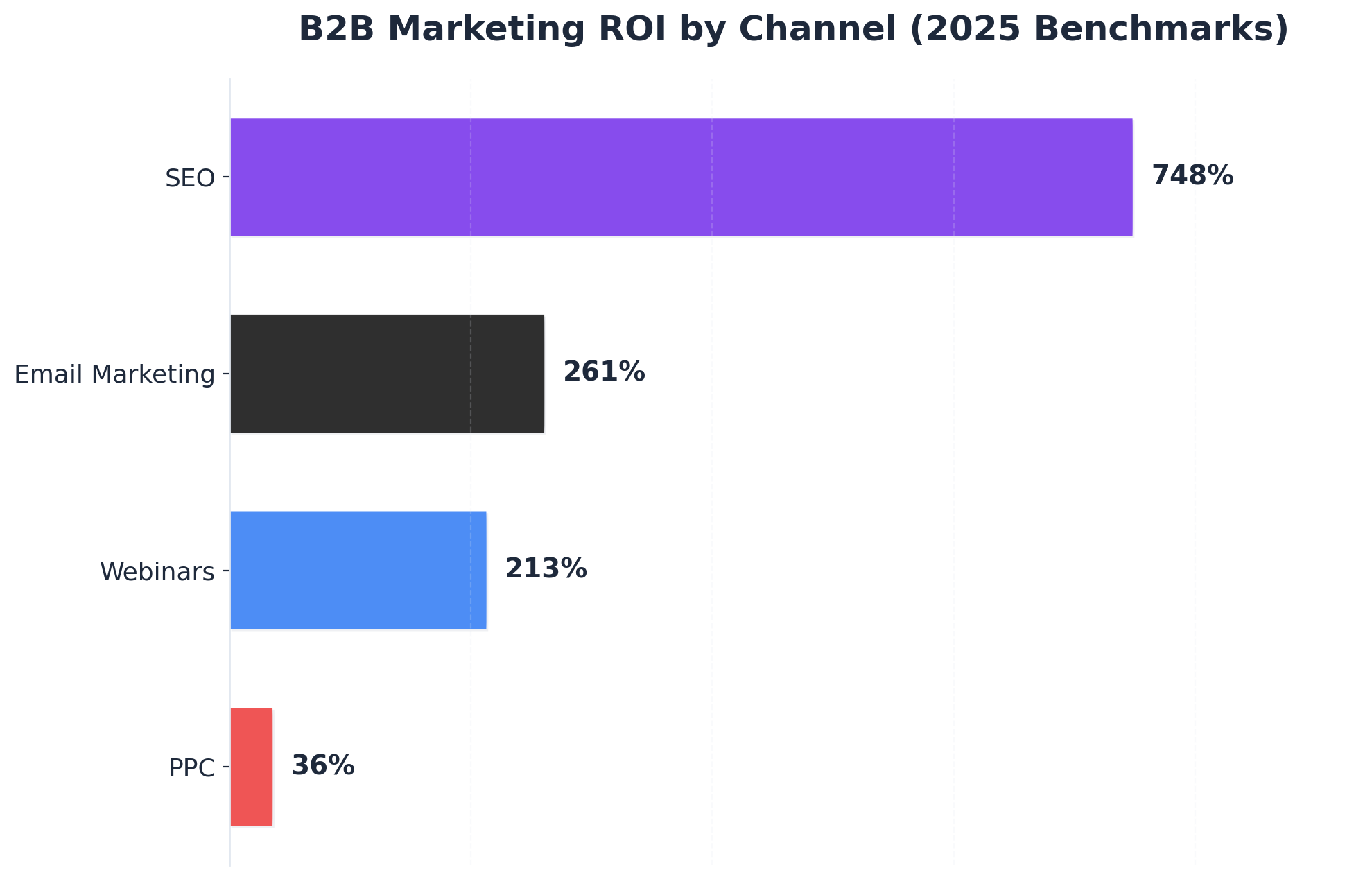
B2B Marketing ROI by Channel (2025 Benchmarks): SEO: 748%, Email Marketing: 261%, Webinars: 213%, PPC: 36%. This shows the return on investment for various B2B marketing channels, with SEO showing the highest return.