
Key Takeaways
- Perplexity replaces stable SERP positions with live retrieval and inline citations, so visibility is measured per answer rather than across a ranked keyword list 2, 7.
- Source selection is shaped by recency filters, the Publishers' Program revenue-sharing layer, and how easily a passage can be extracted from the top of a page 1, 6, 10.
- Agencies should report citation share, mention type, freshness lag, and exclusion rate, supported by a versioned prompt panel and a weekly citation diff log 5, 6.
- Manual surveillance breaks down across larger portfolios, so agency leads should weigh analyst hours against centralized tooling and extend tracking into Pages, Comet Plus, and Computer surfaces 3, 11, 12.
Citation surveillance is not rank tracking with a new label
The phrase "perplexity rank tracking" is often searched as if it describes a position monitor with a new logo. This is a misconception. Perplexity is an answer engine that retrieves live web results and composes a response with inline citations 2, 7. Unlike traditional search engines, there is no stable list of ten blue links to occupy. A URL is either cited, paraphrased without attribution, or absent from the answer entirely, and these three states can change frequently.
This distinction is crucial for how agencies report visibility. Position tracking measures where a page sits on a relatively stable index. Citation surveillance, however, measures whether a page is selected from a live retrieval pool influenced by recency filters 6, publisher partnerships 1, 8, and the extractability of the page itself. The unit of analysis is the answer, not the Search Engine Results Page (SERP), and the key metric is the share of citations across a defined prompt panel, not the average position across a keyword list.
Treating Perplexity as "rankings 2.0" often leads to dashboards that appear familiar but offer little meaningful insight. Instead, approaching it through the lens of citation, freshness, and extraction engineering provides a workflow that agency leads can effectively defend during client renewals. This analysis will explore Perplexity's source selection process, the metrics that replace traditional position tracking, and the measurement stack an agency can implement across its client base without increasing headcount.
What Perplexity actually does when it picks a source
Live retrieval, recency filters, and the freshness tax
Perplexity composes answers from a live web retrieval, not a cached index. Its Sonar documentation describes a web_search tool designed for current information, recent news, and source-grounded research 5. This fundamental design choice redefines what "visibility" means. A page that ranked for a query last quarter might not enter the retrieval pool this week if a newer, competing asset meets the freshness threshold implicitly invoked by the query.
The search-filters documentation explicitly highlights freshness as a primary retrieval control, exposing filters for publication date, last updated date, and recency 6. Agencies should interpret this as a media buyer interprets a targeting parameter: any attribute the system allows filtering on is also weighted internally in default behavior. Queries with temporal phrasing, news framing, or product-comparison intent will place a greater emphasis on recency.
The operational consequence is a "freshness tax" on evergreen assets. A pillar page from 2022 that still ranks well on Google could quietly disappear from Perplexity answers on the same topic by mid-2024 if no visible update signal exists on the page. In this context, last-modified dates, refreshed publish timestamps, updated statistics, and re-cited primary sources are not merely cosmetic edits; they are prerequisites for remaining in the candidate pool for retrieval.
For client reporting, the implication is structural. Agencies should pair every citation audit with a freshness audit of both cited and non-cited URLs covering the same prompt set. A page that consistently loses citations across three consecutive weekly runs without a content change is typically losing due to freshness, not relevance, and the appropriate remediation is a republish workflow rather than a complete rewrite.
Publisher relationships, revenue share, and the citation economy
Source selection within Perplexity is not solely a relevance contest. The Publishers' Program incorporates revenue sharing, API access, and publisher analytics directly linked to how Perplexity cites partner content 1. The company has openly stated that citations have been integral to the product since its inception, and this program formalizes a commercial layer around that citation behavior. Agencies should view this program as a stated preference for a specific class of sources, rather than a public ranking algorithm.
Adoption of this program is expanding. Gannett, for instance, joined the program, emphasizing accurate answers and clear citations to authoritative sources 8. When a publisher of this magnitude enters a citation economy, two key implications arise for others. Firstly, a significant portion of the candidate pool for news-adjacent queries will consist of partner content with structured feeds and analytics visibility that other web content lacks. Secondly, the bar for non-partner sources to be selected for the same query rises, as the cost and measurability of citing a partner are more favorable.
A separate commercial track is also developing around advertising. Perplexity has expressed its desire to maintain an efficient, uncluttered, and unbiased search experience while simultaneously experimenting with ad formats 4. For agency leads, this means "organic citation" within Perplexity exists alongside publisher partnerships and emerging sponsored surfaces, and the boundaries between these categories will continue to evolve.
This context underscores the importance of understanding third-party language. Citation share is a valid metric, but it is not a purely meritocratic signal. Reporting that disregards the partnership layer will overestimate the potential visibility for a non-partner client on news-heavy or commercial-intent prompts.
Extraction bias: what page structure actually gets quoted
Even after a page enters the retrieval pool, the engine must still locate a quotable passage. This is where page structure becomes a dominant factor. A CXL study on Google AI Overviews found that 55% of AI Overview citations originated from the top 30% of a page 10. While this study focused on Google's system, it serves as analogous evidence: answer engines that need to extract a defensible snippet tend to pull from locations where such snippets are most easily accessible.
This pattern aligns with descriptions of Perplexity in neutral coverage. A PMC product review characterizes the system as a search-plus-LLM that generates current, sourced answers with in-text citations 2. Inline citation behavior favors passages that are self-contained, declarative, and positioned prominently within the document. A definition buried beneath three subheadings of preamble is structurally more challenging to cite than the same definition rewritten as the opening paragraph under a question-shaped H2.
Academic research on LLM citation behavior offers a useful caveat: stronger models may be more likely to add citations where humans expect them, but excessive citation insertion can reduce alignment accuracy 9. In practical terms, optimizing for quotability is not about stuffing pages with claim-shaped sentences. Pages that consistently earn citations tend to combine an extractable opening with a verifiable supporting structure, including primary sources and dated evidence that the model can resolve.
For an extraction audit, agencies should evaluate each priority URL based on three criteria:
- The location of the answer to the target prompt within the page
- Whether that passage can stand alone without surrounding context
- Whether the supporting evidence on the page is itself citeable
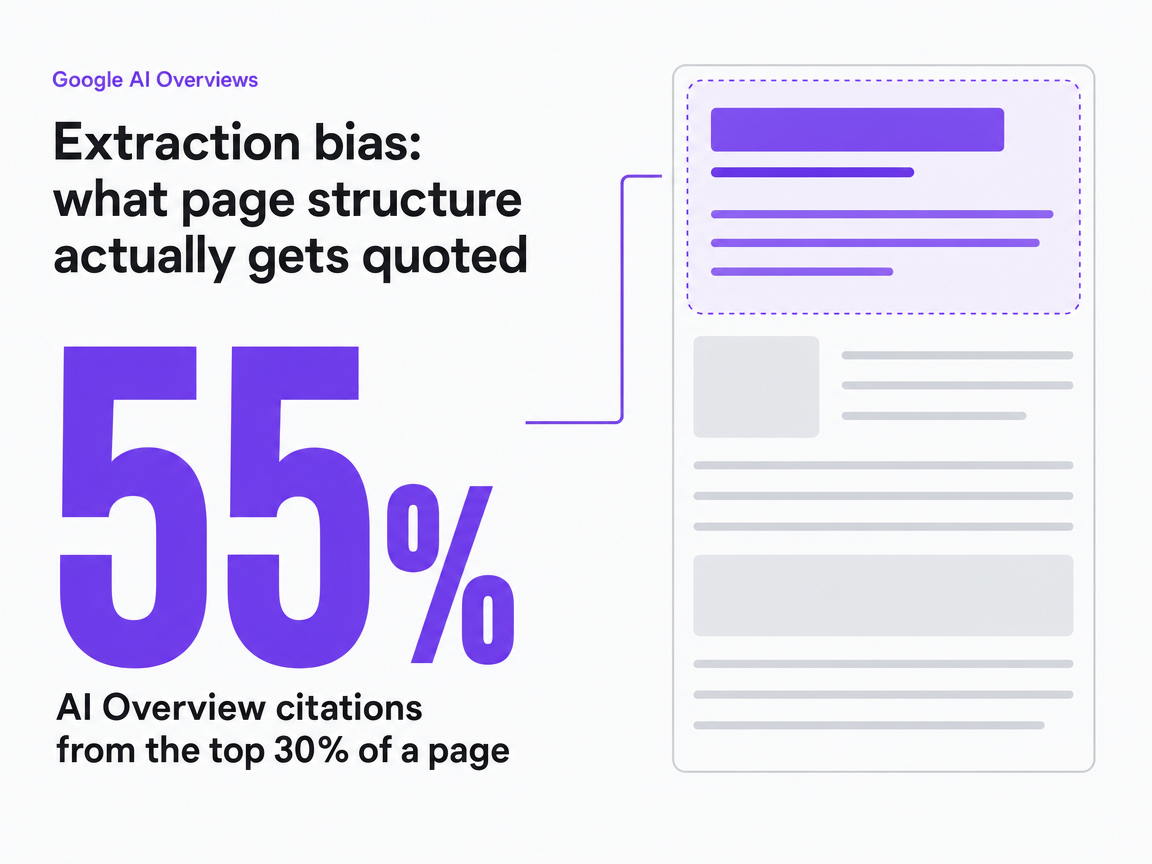 AI Overview citations from the top 30% of a page
AI Overview citations from the top 30% of a page
The metrics that replace position: citation share, mention type, exclusion rate
Citation share versus mention quality
Citation share is the most direct replacement metric for traditional position tracking. Across a defined prompt panel, it measures the percentage of answers in which a client URL appears as a cited source. This metric is quantifiable, stable enough to trend weekly, and directly indicates whether the engine surfaced the page. For most agency dashboards, it becomes the primary reported number.
However, simply counting citations is insufficient. The mention type carries significant strategic weight. A client URL can appear in one of three states:
- A primary citation, anchoring the answer's central claim
- A supporting citation, backing a secondary point
- A paraphrased reference, where the brand name appears in prose without a direct link
Each of these states has a different downstream value, and treating them as a single metric obscures crucial insights.
Academic work on LLM citation behavior further emphasizes the distinction between mere presence and actual quality. Stronger models tend to add citations where humans would expect them, but pushing too hard on citation insertion can reduce alignment accuracy 9. For reporting, this means a rising citation count on weakly relevant prompts is not equivalent to a steady citation count on prompts that align with buyer intent. Agencies that grade mention type alongside share will identify this difference, while those that only count will report noise.
The operational scoring is straightforward: tag every observed citation as primary, supporting, or paraphrased, and track the mix over time. A healthy trend involves shifting the mix toward primary citations on the prompts most important to the client, even if the total share remains flat.
Old metrics, new metrics: a side-by-side
Agency leads presenting a metric shift to clients require a clear visual explanation. The contrast lies between a position-era stack designed for a stable index and a Perplexity-era stack built for live retrieval with explicit recency controls 5, 6 and a publisher layer that influences the candidate pool 1.
| Traditional rank tracking | Perplexity-era tracking |
|---|---|
| Average position on a keyword list | Citation share across a prompt panel |
| SERP feature presence (featured snippet, PAA) | Mention type (primary, supporting, paraphrased) |
| Estimated CTR by position | Freshness lag between content update and citation reentry |
| Index coverage and crawl status | Exclusion rate: prompts where the URL is absent from the answer entirely |
| Competitor position overlap | Partner versus non-partner citation mix on the same prompt |
Comparison grounded in Perplexity's documented live web_search behavior, recency filters, and Publishers' Program structure.
Two columns in the table are particularly important for renewal discussions. Freshness lag transforms the recency filter into a trackable variable, making a republish workflow a reportable lever rather than a vague best practice. Exclusion rate directly identifies failure states. A URL that ranks on Google but never appears in a Perplexity answer for the same prompt set is excluded, not merely low-ranking, and requires a different remediation strategy.
Test advanced rank tracking workflows now
Experience live rank tracking insights and publish content using real search data—no restrictions during your trial.
Building the agency-side measurement stack
Prompt panels that mirror buyer intent
A prompt panel serves as the agency-side equivalent of a keyword list, and the design choices made here dictate whether all subsequent metrics provide signal or noise. The unit of analysis is the actual question a buyer would type or speak into an answer engine, not a broad head term a position tracker would log. For example, "Best workers' comp attorney for warehouse injuries in Phoenix" is a prompt, whereas "Workers comp attorney Phoenix" is a keyword. Perplexity is designed to answer the former 7.
A robust panel for a single client typically covers four categories:
- Category-defining prompts assess brand visibility when the buyer is still exploring options.
- Comparison prompts evaluate brand presence against named competitors.
- Objection prompts test how the brand addresses questions that might delay a decision.
- Branded prompts verify whether owned answers about the brand cite the brand's own pages or third-party coverage.
Panel size should be calibrated to what a weekly run can sustain, rather than what looks ambitious for a quarterly slide. Twenty to forty prompts per client, locked for a quarter and versioned upon change, generates a citation share trend that can withstand normal answer variance. Larger panels may appear thorough but often yield poorer reporting due to an increased noise floor from prompts that do not align with real buyer decisions.
Weekly citation diffs and freshness audits
Once the prompt panel is established, the workflow becomes a recurring log. Each prompt is run on a fixed cadence, the cited URLs are recorded, and the difference from the prior run is reviewed. Three key columns drive this work:
- Which URLs entered the answer this week
- Which URLs exited
- Which URLs experienced a change in mention type
This log, maintained for sixty days, provides the evidence an agency needs to explain actual movement to a client.
The freshness audit runs concurrently with the diff analysis. Sonar's documented filters for publication date, last updated date, and recency confirm that freshness is a retrieval-side control, not a minor signal 6. For every URL that exited the cited pool without a competing content change on the topic, the audit examines the page's last-modified date, the age of cited statistics on the page, and whether the primary sources referenced are still resolvable. A URL that has not been updated in eighteen months and lost three weekly runs consecutively is almost always a candidate for republishing, not rewriting.
The cadence is as important as the method. Weekly is the appropriate interval for most client tiers because Perplexity composes from a live retrieval pool 5, and answer composition can shift within a week for news-adjacent or product-comparison prompts. Monthly cadences obscure the volatility that the workflow is designed to reveal, while daily cadences consume analyst hours on noise. The reportable output should be a concise narrative linked to the diff log, not merely a screenshot of an answer.
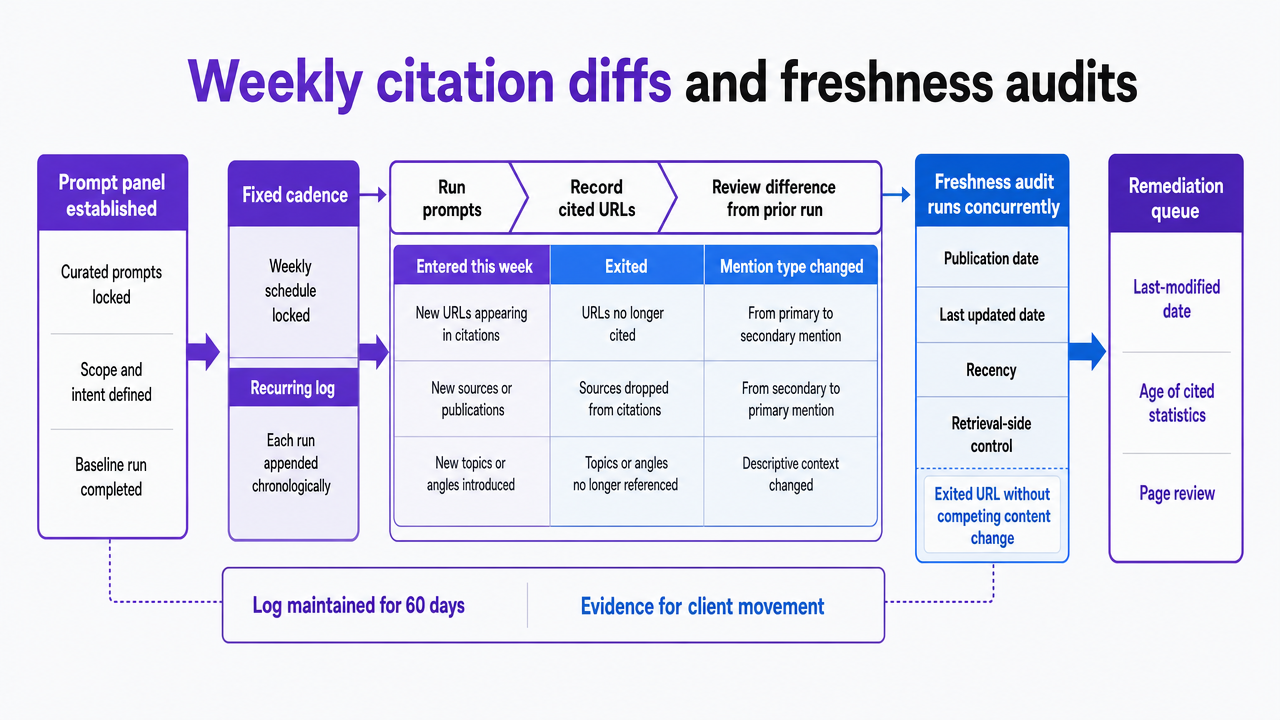 Process infographic visualizing the weekly agency workflow described in the section: prompt panel run, citation diff, freshness audit, and remediation queue
Extraction scoring against the page
The third layer of the measurement stack involves scoring the page itself against the prompt it aims to win. Extraction scoring addresses three questions per priority URL:
- Where on the page does the answer to the target prompt actually reside?
- Can the passage stand alone without its surrounding context?
- Is the supporting evidence on the page itself citeable?
Scoring is binary for each question and tracked over time. A page that buries its answer below three subheadings of preamble, requires surrounding paragraphs for comprehension, and cites no primary sources would score zero. Conversely, a page that opens the relevant section with a declarative answer, functions as a standalone lifted passage, and links to dated primary evidence would score three. The CXL study of Google AI Overviews, used here as analogous evidence, reported that 55% of citations came from the top 30% of a page 10. This pattern aligns with descriptions of Perplexity as a system that produces sourced answers with in-text citations 2, advocating for placing the citeable claim prominently.
The output of extraction scoring is a remediation queue, not a dashboard. URLs scoring zero or one on prompts critical to the client are prioritized for the next sprint. Scoring also completes the feedback loop, as the diff log will indicate whether the revised content re-entered the cited pool in subsequent weeks.
If you manage a client portfolio: consolidation economics
The workflow described above can be managed for a single client by a disciplined senior strategist. However, for an agency head overseeing fifteen to sixty accounts, the question becomes whether that same workflow scales. Manual citation surveillance does not scale linearly. Prompt panels require quarterly maintenance, weekly diffs need a reviewer who can identify shifts in mention type, and freshness audits necessitate cross-referencing against each account's content calendar.
The most realistic way to plan the expenditure is through a worksheet, not a benchmark. Three variables determine the return on investment for centralized tooling: analyst hours per client per week, blended hourly rate, and prompts tracked per client. A fourth variable, audit cadence, acts as a multiplier.
| Portfolio variable | Per-client manual workflow | Centralized AI-assisted workflow |
|---|---|---|
| Prompt panel design and quarterly refresh | Analyst hours × blended rate, per client | One template, versioned per vertical |
| Weekly citation diff log | Hours per prompt × panel size × clients | Automated diff, analyst reviews exceptions |
| Freshness audit on exited URLs | Manual last-modified and source checks | Flagged by recency thresholds 6 |
| Extraction scoring on priority URLs | Manual review against the prompt | Scored against the live retrieval pool 5 |
| Client-facing narrative | Account lead writes from raw log | Account lead edits a generated draft |
Planning worksheet, not a vendor benchmark. Fill the cost columns with your own analyst hours, blended rate, and panel size.
Two structural factors influence the economics. Perplexity composes from a live retrieval pool with documented recency controls 5, 6, meaning the workflow must run weekly to be effective, and weekly cadence is where manual delivery becomes unsustainable. Source selection is also partly shaped by a publisher economy with revenue sharing and analytics access 1, which means the reviewer's judgment regarding exclusion rate and partner-versus-non-partner mix carries strategic weight that automation supports but does not replace. The break-even point typically occurs when a single analyst can no longer maintain the weekly cadence across the client book without a decline in quality. Vectoron is one option agency leads consider when they reach this point, with a $599 per month post-trial price that the worksheet above is designed to be compared against, not a number to directly plug into the table.
See How AI-Driven Rank Tracking Redefines Perplexity Metrics for Agencies
Request a demo to explore advanced rank tracking workflows that quantify perplexity impacts at scale, streamline reporting, and deliver actionable insights across all client portfolios.
The surfaces beyond Answers: Pages, Comet Plus, Computer
Citation surveillance that focuses solely on the default answer pane will overlook Perplexity's expanding ecosystem. Three product surfaces beyond "Answers" each alter the visibility landscape in distinct ways, and an agency tracking strategy that ignores them will present an incomplete picture by the next renewal cycle.
"Pages" is the publishing surface. It transforms research into visually structured, comprehensive content native to Perplexity itself 3. The implication for source URLs is that the platform now hosts long-form artifacts that can become cited objects for adjacent prompts. A client's blog post competing for a category-defining query is no longer competing only against other web pages; it is also competing against "Pages" assembled within the engine, which possess the platform's inherent structural advantages.
"Comet Plus" represents the paid-access layer. Priced at $5 standalone and bundled into Pro and Max tiers, it formalizes a premium content relationship with publishers within the Perplexity ecosystem 11. For non-partner clients, the practical question is which prompts increasingly fall into partner-citation territory and which remain open. This distinction should be integrated into the exclusion-rate column of a weekly diff, rather than being reported separately.
"Computer" extends Perplexity into agentic workflows, breaking down tasks into subtasks and executing them 12. In this context, citations evolve from being end-state impressions to driving downstream action selection within a workflow that the user does not personally compose. Agencies should incorporate agent-mediated prompts into their panels within the next two quarters, as this represents the future direction of buyer behavior.
Where this leaves agency reporting in the next renewal cycle
The reporting layer is where this conversation either succeeds or fails. Clients who renewed last year based on a Google position dashboard will likely not renew next year on the same artifact, because the answer engine they personally use no longer aligns with what the dashboard tracks 2, 7. Agencies that proactively address this conversation will approach renewals with a populated citation share trend, mention-type mix, and freshness lag column, rather than relying on vague discussions about AI search.
Three commitments make this approach defensible:
- The prompt panel is versioned and directly tied to buyer intent, not merely borrowed from a keyword list.
- The diff log is updated weekly, recognizing that a live retrieval pool with explicit recency controls can shift within a week 5, 6.
- The extraction queue closes the loop between audit findings and content team implementations.
Agency leads aiming to implement this across their client base without increasing headcount should evaluate platforms like Vectoron against the provided worksheet, rather than against outdated rank trackers.
Frequently Asked Questions
References
- 1.Introducing the Perplexity Publishers' Program.
- 2.PRODUCT REVIEW / ÉVALUATION DE PRODUIT - PMC - NIH.
- 3.Introducing Perplexity Pages.
- 4.Why we're experimenting with advertising.
- 5.Web Search - Perplexity API.
- 6.Search Filters - Perplexity API.
- 7.Getting started with Perplexity.
- 8.Welcoming Gannett to the Perplexity Publisher Program.
- 9.Aligning Large Language Model Behavior with Human Citation ....
- 10.Where Google AI Overviews Cite From: A 100-Page Study.
- 11.Introducing Comet Plus - Perplexity.
- 12.Introducing Perplexity Computer.