
Key Takeaways
- Autonomous AI marketing platforms replace the strategist seat by coordinating decisions across channels, routing execution, and surfacing prioritized actions rather than static dashboards 2.
- Content production engines absorb first-draft writing, keyword clustering, and on-page formatting, collapsing a monthly editorial retainer into a license fee plus in-house editor time 10.
- PPC bid-management platforms handle bid optimization, negative keyword pruning, and budget pacing at a frequency no account manager can match, leaving only structural and creative decisions in-house.
- Technical SEO platforms run continuous crawls, flag regressions daily, and replace the quarterly audit PDF, though prioritization and implementation routing still require an in-house owner 4.
- ABM and revenue marketing platforms unify account scoring, audience syndication, and pipeline attribution, collapsing the demand gen pod retainer into one license plus a target-list owner 8.
- Link acquisition tools absorb prospecting, outreach sequencing, and placement tracking that filled an outreach analyst's calendar, while pitchable assets and tier-one relationships stay human 9.
- Content intelligence and analytics layers replace the monthly reporting deck by correlating cross-channel data continuously, shifting the in-house role to narrative judgment and asset-level decisions 6.
Why the agency retainer is unbundling into software categories
Two data points frame the next 24 months for SaaS growth marketing directors. Deloitte projects that 35% of point-product SaaS tools will be replaced by AI agents or absorbed into larger agent ecosystems by 2030 1. Forrester forecasts that 15% of agency jobs will be eliminated in 2026 alone, driven by automation, redundancy, and efficiency gains 3. Those numbers describe the same shift from opposite sides of the buyer-seller table: the software stack is consolidating, and the agency labor that wrapped around it is contracting at the same time.
For directors carrying $15K to $60K in monthly retainers, the practical implication is that the agency relationship is no longer a single decision. It is a portfolio of workstreams—content calendars, PPC bid management, technical SEO audits, ABM execution, link acquisition, reporting—each of which now maps to a maturing software category. Forrester's analysts describe the underlying trend as platform convergence, where revenue marketing tools absorb adjacent functions and reduce the coordination tax that fragmented stacks impose 9.
That is the framing this piece uses. Rather than profile seven products, it identifies seven categories that absorb specific agency line items, names what each category replaces, and flags the residual work that still requires a human operator. Directors who run that mapping exercise against their current statement of work tend to find that two or three retainers can be retired inside a quarter, not because software does everything, but because it does enough of the repeatable execution to leave the rest in-house.
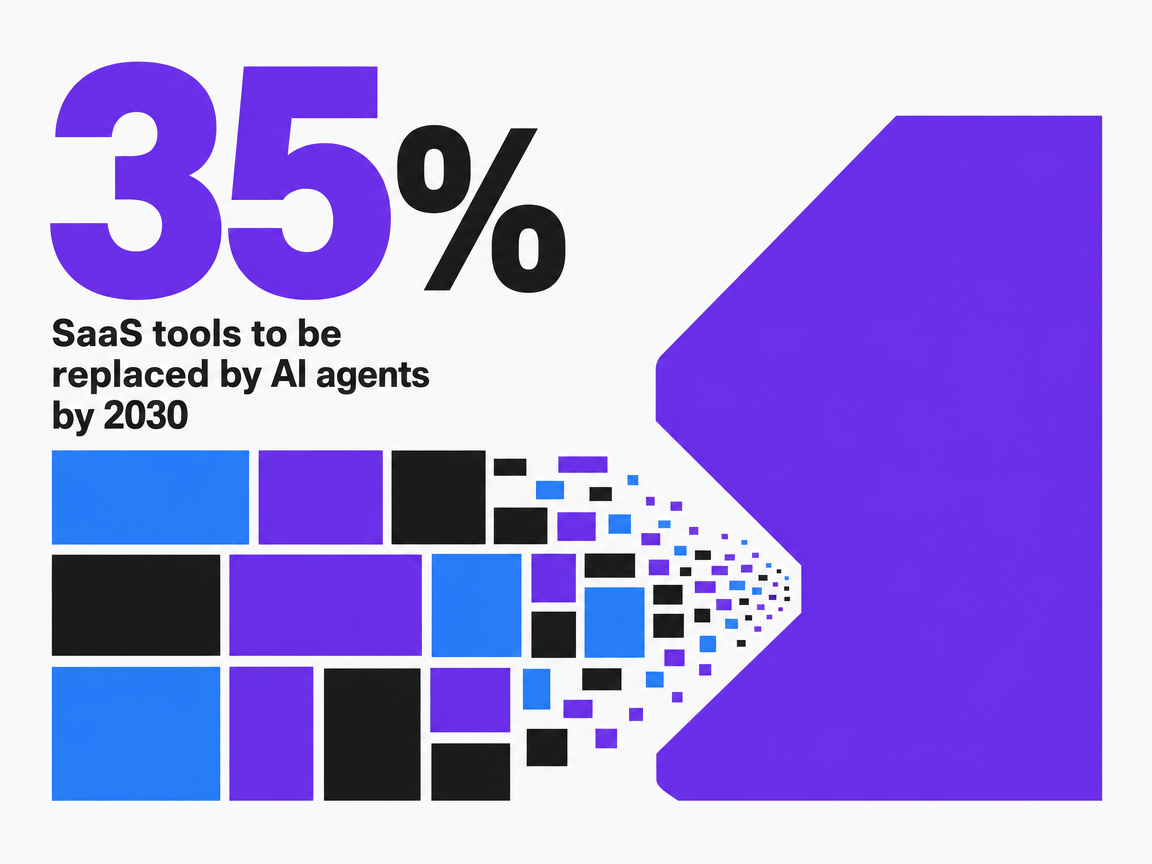 SaaS tools to be replaced by AI agents by 2030
SaaS tools to be replaced by AI agents by 2030
Mapping agency line items to SaaS replacement categories
Before naming categories, directors need a translation layer between what an agency invoices for and what software now does. Most retainers bundle four to seven recurring deliverables under one fee, which is why the cancellation conversation feels binary even when it shouldn't be. Forrester's analysts argue that converged revenue marketing platforms reduce tech sprawl and improve data consistency precisely because they absorb adjacent execution functions that used to live in separate tools or separate vendors 9.
The crosswalk below maps the seven workstreams that show up on nearly every SaaS agency SOW to the software category that now absorbs the bulk of that work.
| Agency workstream (SOW line item) | SaaS replacement category |
|---|---|
| Monthly content calendars and editorial production | Content production engines |
| Paid search and paid social bid management | PPC bid-management platforms |
| Technical SEO audits and on-page optimization | Technical SEO platforms |
| ABM target list building and demand gen execution | ABM and revenue marketing platforms |
| Digital PR and link acquisition outreach | Link acquisition tools |
| Monthly reporting decks and performance analytics | Content intelligence and analytics layers |
| Strategy, prioritization, and cross-channel orchestration | Autonomous AI marketing platforms (coordination layer) |
Two things are worth flagging in the table. The first six rows are point-tool replacements that absorb specific deliverables. The seventh row is the orchestration tier that connects them, which is why platform convergence matters more than tool selection in isolation 9. Directors who treat the seven categories as a sequence rather than a menu tend to consolidate faster.
Autonomous AI marketing platforms: the coordination layer
The autonomous AI marketing platform category does not replace a single agency deliverable. It replaces the strategist seat—the person who decides which content to publish, which keywords to defend, which campaigns to pause, and how the channels feed each other. That is the work most agencies bill as account management or strategy hours, and it is the layer that has historically been hardest to insource because it requires continuous attention across data sources rather than scheduled deliverables.
The category is real, not speculative. The AI agents market is projected to grow from USD 7.84 billion in 2025 to USD 52.62 billion by 2030 11, a trajectory BCG anchors at a 45% compound annual growth rate over the next five years 2. DemandGen Report's trade coverage frames the shift in operational terms: AI agents have moved from simple task automation into roles that resemble a strategic, intelligent workforce coordinating across channels 12.
What separates this category from point tools is multi-agent architecture. A content engine writes. A bid manager bids. An autonomous platform reads the same GA4, Search Console, and ad account data the strategist would read, prioritizes actions across those channels, routes execution to the relevant production workflow, and surfaces decisions for human approval. BCG notes that multi-agent systems tend to outperform single agents on complex tasks because the work is divided across specialized roles with a coordinator on top 2.
For growth directors, the practical test is whether the platform connects to the data sources the strategist already uses and whether it produces prioritized recommendations rather than dashboards. Platforms that stop at reporting are point tools wearing an AI label. Platforms that close the loop—recommend, route to production, track outcome—are operating in the category this section describes, and they are where Vectoron and a small set of comparable systems sit.
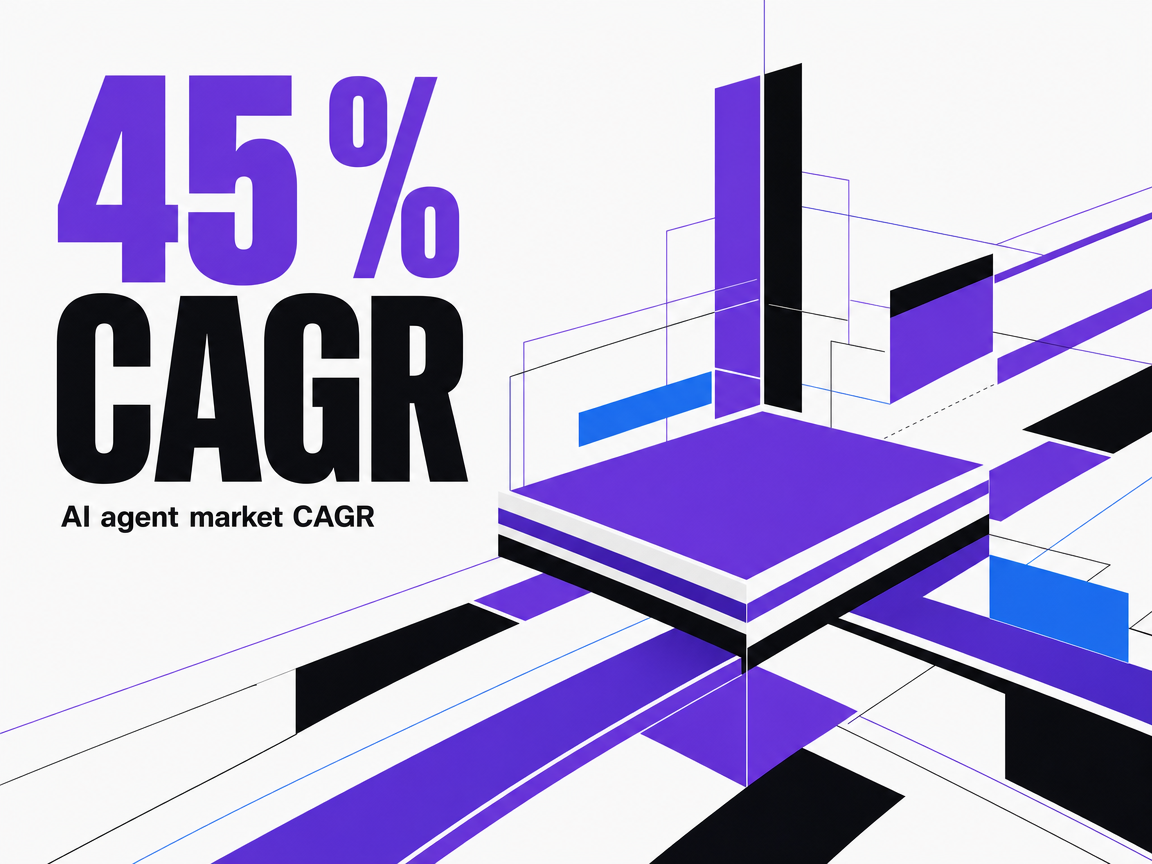
AI agent market CAGR
Content production engines: replacing the monthly editorial retainer
The first agency line item most SaaS growth directors look at canceling is the monthly content retainer. The math is straightforward: a typical content engagement bundles editorial planning, briefing, drafting, editing, and publishing into a fixed scope of eight to twelve pieces, and software now absorbs the production half of that workflow without the briefing cycles. SurveyMonkey's 2025 marketing data shows the behavioral baseline is already established—51% of marketers use AI to optimize content and 43% use it to automate repetitive tasks 10. The adoption question is settled. The remaining question is what level of orchestration the in-house team can sustain.
Content production engines occupy a specific slot in the stack. They take a brief, a keyword target, and a brand input, then produce structured drafts at a cadence the editorial calendar dictates. The better engines layer retrieval against the team's own source material, run topical coverage checks against the SERP, and route output into a review queue rather than dumping it into a doc. That is the work an agency content pod performs week to week.
Forrester's 2025 agency outlook adds a useful caution to the enthusiasm. AI-powered content production will actually decelerate in-housing for some teams because the orchestration expertise required to run the workflow at scale is unevenly distributed across marketing organizations 4. Translation: the software produces drafts; somebody still has to own the editorial standard, the topical strategy, and the publishing rhythm. Teams that buy a content engine without assigning an editor inside the org tend to produce volume that nobody approves and nobody publishes.
The residual human work is narrower than the retainer it replaces. Brief writing, source curation, subject-matter review for technical accuracy, and final editorial approval stay in-house. Keyword clustering, first-draft production, on-page formatting, and meta generation move into the engine. For a SaaS team publishing two to three pieces a week, that split typically collapses a $12K-$25K content retainer into a license fee plus roughly one day of editor time per published piece.
Test Automated Content and PPC Execution Now
Experience live campaign delivery and content publishing without agency delays or added coordination overhead.
PPC bid-management platforms: replacing the paid media account manager
Paid media is the workstream where the gap between an account manager's hourly cost and the software's hourly output is widest. Bid adjustments, negative keyword pruning, audience layering, and budget pacing are decisions a modern PPC platform makes thousands of times a day against signals no human can process at that frequency. The agency seat that owns those decisions is the one this category absorbs first.
The work that moves into software is the operational core of a paid media retainer: bid optimization across Google Ads and the major social platforms, automated negative keyword harvesting, audience signal feeding, budget pacing against monthly caps, and ad rotation testing. McKinsey's 2025 survey reports that organizations are seeing measurable use-case-level cost and revenue benefits from AI deployments, and paid media optimization is one of the cleaner cases because the feedback loop is short and the data is structured 5. Bid platforms read conversion signals, attribution data, and competitive auction dynamics in near real time, then act—no Monday morning optimization call required.
What stays with the in-house operator is narrower than the retainer suggests. Campaign structure decisions, creative direction, landing page strategy, and offer testing remain human work because they require judgment about positioning rather than auction math. A growth director running a consolidated stack typically reviews platform recommendations weekly, approves structural changes, and lets the bid engine handle the daily mechanics that an account manager used to bill for.
Technical SEO platforms: replacing the quarterly audit deliverable
Technical SEO is the workstream where agency deliverables look impressive on paper and deliver the least sustained value. A quarterly audit produces a 60-page PDF, a prioritized issue list, and a follow-up engagement to implement the fixes the audit identified. Software now runs that same audit on a continuous crawl, flags regressions the day they happen, and routes them to the engineering or content owner without an interim presentation.
The work that moves into a technical SEO platform is the operational backbone of an audit retainer: site crawling, index coverage monitoring, schema validation, Core Web Vitals tracking, internal link analysis, log file processing, and broken-link detection. These platforms read the same Search Console and crawl data an agency analyst would pull, then surface prioritized issues against severity and traffic impact. The cadence shifts from quarterly to daily, which matters because most technical regressions are introduced by product releases or CMS changes that no quarterly audit will catch in time.
What stays with the in-house operator is the implementation decision and the prioritization judgment. A platform can flag that 1,400 product pages are returning soft 404s; it cannot decide whether the fix sits with engineering this sprint or content next month. Forrester's 2025 outlook frames this as the orchestration gap that limits pure insourcing—the software produces signal, but somebody inside the org has to own the routing and the trade-offs against other roadmap work 4. Growth directors running a consolidated stack typically review the platform's issue queue weekly, batch fixes by owner, and hold the agency-style audit deck as a quarterly artifact only when the board asks for one.
ABM and revenue marketing platforms: replacing the demand gen pod
ABM is the workstream where agency pods have historically charged the most and delivered the least transparency. A typical demand gen retainer covers target list construction, intent data interpretation, sequenced outbound execution, campaign orchestration across email and paid social, and a monthly readout that ties pipeline back to spend. Revenue marketing platforms now absorb the bulk of that execution layer, which is why Forrester evaluated the category head-to-head across 23 criteria in its Q3 2024 Wave on B2B revenue marketing platforms 8.
The category exists because the underlying tools converged. Forrester's analysts describe the shift as platforms pulling marketing automation, ABM orchestration, and analytics into a unified revenue layer that reduces tech sprawl and improves data consistency versus a fragmented stack 9. For a SaaS growth director, that convergence matters because the demand gen pod's value was largely in stitching those systems together by hand. When the stitching moves into the platform, the pod's hours move with it.
What software absorbs is the operational backbone: account scoring against firmographic and intent signals, audience syndication into LinkedIn and Google Ads, sequenced email and ad orchestration tied to account stage, and pipeline attribution back to source. What stays with the in-house operator is the target account definition, the offer logic, the sales-marketing service level agreement, and the qualitative read on which accounts are actually engaged versus statistically warm. Directors running this consolidation typically replace a multi-headed pod retainer with one platform license and one demand gen manager who owns the target list and the SLA.
Link acquisition tools: replacing the digital PR retainer
Digital PR retainers sell two things: a media list and the labor to pitch it. Link acquisition platforms now absorb most of the list-building and outreach mechanics—prospecting domains by topical authority, validating contact data, sequencing personalized outreach, tracking response rates, and monitoring placement velocity against a target backlink profile. What used to require a junior PR associate working a spreadsheet is now a software workflow with a reply inbox attached.
The agency seat this replaces is the outreach analyst, not the senior strategist. Tools surface link gaps against competitor domains, score prospects by topical relevance and traffic, and run multi-touch sequences that previously consumed a pod's week. Forrester's broader convergence argument applies here as well: tooling that used to live in three places—prospecting, outreach, and reporting—now collapses into one workflow, which is why the labor wrapped around it contracts 9.
What stays human is narrower than directors expect. The pitchable asset—a data study, an executive byline, a proprietary benchmark—still requires editorial judgment to produce. Relationship-led placements at tier-one publications still move through people, not sequences. Growth teams running this consolidation typically keep one in-house owner for asset development and let the platform handle the volume work that filled an outreach analyst's calendar.
See How Leading SaaS Teams Achieve Agency-Quality Execution—Without the Agency
Request a walkthrough of automated, multi-channel marketing orchestration proven to cut campaign turnaround times by 60% and reduce overhead—purpose-built for teams managing complex SaaS or enterprise portfolios.
Content intelligence and analytics layers: replacing the reporting deck
The monthly reporting deck is the agency artifact that survives the longest because it doubles as a relationship tool: forty slides, channel-by-channel commentary, and a narrative tying spend to pipeline. Content intelligence platforms now produce the underlying analysis on a live cadence, which makes the deck itself the deliverable being replaced rather than the data behind it.
Forrester defines content intelligence as the capture, correlation, and analysis of data about content and its consumption, used to drive activation and performance measurement 6. That definition matters because it draws the line between reporting (what happened) and intelligence (what to do next). The category absorbs the analyst hours an agency bills for assembling the deck—pulling GA4 sessions, Search Console queries, ad platform spend, and CRM-stage data into a single view—and replaces them with continuous correlation against content assets and buying signals.
What software handles is the operational work: cross-channel attribution stitching, content-level performance scoring, topical decay detection, buying-signal surfacing from on-site behavior, and anomaly flagging when a channel underperforms its baseline. McKinsey's 2025 survey notes that 64% of respondents say AI is enabling innovation, with use-case-level cost and revenue benefits concentrated in functions where the feedback loop is structured 5. Analytics is one of the cleaner fits because the inputs are already digital.
What stays human is the narrative judgment—deciding which signal warrants a campaign pivot, which underperforming asset deserves a rewrite versus a retirement, and how to present trade-offs to the executive team. The deck does not disappear; it gets shorter, gets built by the platform, and gets reviewed by an in-house operator rather than commissioned from an outside analyst.
Workstream consolidation economics: retainer ranges versus license bands
The consolidation case is not abstract. It comes down to a line-by-line comparison between the retainer fees an agency charges for a workstream and the license band of the software category that absorbs that work. Forrester's convergence argument is grounded in this economic logic: unified platforms reduce tech sprawl and improve data consistency, which compresses the labor wrapped around fragmented stacks 9. McKinsey's 2025 survey adds the upside side of the ledger—organizations report use-case-level cost and revenue benefits where the workflow is structured and the feedback loop is short 5.
The table below frames the comparison at the category level. Specific retainer and license figures vary by vendor, scope, and contract structure, so the bands describe typical ranges rather than fixed prices.
| Workstream | Typical agency retainer band (monthly) | SaaS license band (monthly) |
|---|---|---|
| Content production | Mid four to low five figures | Low to mid four figures |
| PPC bid management | Mid four to low five figures, often plus media percentage | Low to mid four figures |
| Technical SEO | Low to mid four figures, plus audit project fees | Three to low four figures |
| ABM and revenue marketing | Mid four to mid five figures | Mid four to low five figures |
| Link acquisition | Mid four to low five figures | Three to low four figures |
| Reporting and analytics | Bundled into retainers, mid four figures equivalent | Three to low four figures |
| Coordination and strategy | Bundled or low five figures standalone | Mid four to low five figures |
Two patterns hold across the bands. License costs sit below retainer costs in every category, but the delta is narrowest where the agency was already running thin margins and widest where the retainer included senior strategist hours that software now absorbs. Directors building the business case typically pair the license savings with one in-house operator role per two to three consolidated workstreams, which is where the residual cost lands.
What software cannot replace: the residual operator layer
The honest version of the consolidation story is that software absorbs execution, not judgment. Forrester's 2025 outlook on agency transformation makes this point directly: AI-powered content production will actually slow some in-housing efforts because the orchestration expertise required to run these systems at scale is unevenly distributed across marketing organizations 4. The platforms work. The operator layer above them is the constraint.
Four responsibilities stay with the in-house team regardless of how consolidated the stack becomes. Positioning and message architecture—what the company says about itself and to whom—remains a human decision because it requires reading the market, not the dashboard. Editorial standards and brand voice sit with an in-house editor because no engine knows when a draft is technically correct and tonally wrong. Cross-channel trade-offs, the choice between defending an organic position and funding a paid test, require judgment about strategy windows that no platform can weigh. And vendor governance—deciding which platform owns which workstream, when to renegotiate, when to swap—stays with the director.
The shorthand for SaaS growth directors: software replaces the pod, not the operator. Teams that staff one capable owner per two to three consolidated workstreams capture the cost savings without inheriting the orchestration gap Forrester flags.
A 90-day sequencing plan for cutting the first retainer
The consolidation case collapses without a sequence. Directors who try to swap every retainer at once tend to stall on procurement reviews and end up renewing the contracts they meant to cut. A 90-day plan starts with the workstream where the agency margin is thinnest and the software signal is cleanest—usually technical SEO or PPC bid management—because those categories produce measurable output inside a single billing cycle.
- Days 1 through 30 cover the audit: pull the current SOW, map each deliverable to a replacement category using the crosswalk earlier in this piece, and identify the one workstream where the platform license sits cleanly below the retainer band.
- Days 31 through 60 run the parallel test—software and agency operating the same workstream side by side, with the in-house operator reviewing both outputs weekly.
- Days 61 through 90 cancel the retainer, reassign the budget to the license and one operator role, and document the orchestration playbook so the next consolidation moves faster.
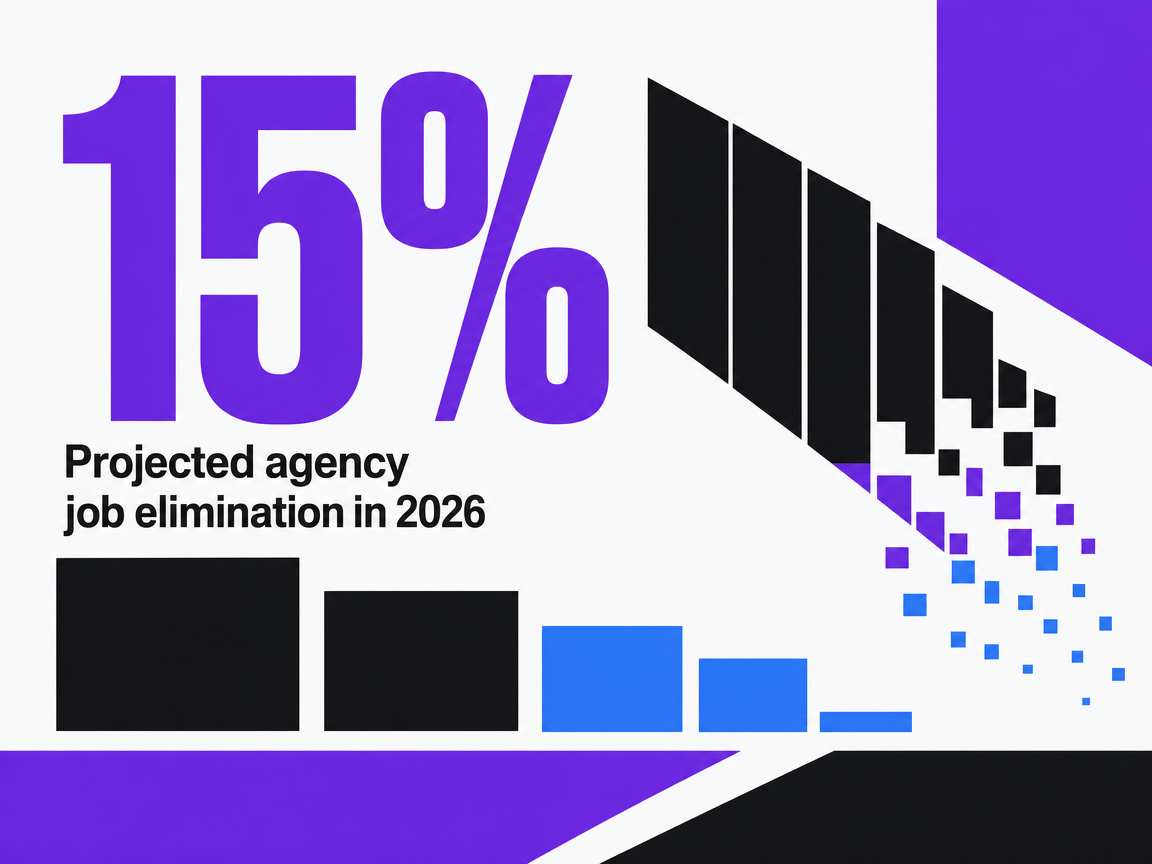 Projected agency job elimination in 2026
Projected agency job elimination in 2026
Frequently Asked Questions
References
- 1.SaaS meets AI agents.
- 2.AI Agents: What They Are and Their Business Impact.
- 3.Predictions 2026: Marketing Agencies Resign Their Agency.
- 4.Predictions 2025: Agencies Jettison Legacy Structures To Form New....
- 5.The State of AI: Global Survey 2025.
- 6.Getting Smart On Content Intelligence.
- 7.Predictions 2025: GenAI, Citizen Developers, And Caution Influence.
- 8.The Forrester Wave™: B2B Revenue Marketing Platforms, Q3 2024 (full evaluation page).
- 9.Converging Platforms For Greater Efficiency: The Rise Of Revenue Marketing Platforms.
- 10.28 AI marketing statistics you need to know in 2025.
- 11.AI Agents Market Report 2025-2030, by Application, Geo, Tech.
- 12.AI Agents Revolutionize B2B Marketing in 2025: From Automation to Strategy.