
Key Takeaways
- An SEO booster, defined by intake outcomes, is an operating layer connecting local search, reviews, page usability, and privacy-safe data capture to signed matters per qualified call.
- Rankings are a weak proxy for revenue; the metric that justifies budget is the conversion rate from qualified calls to signed engagement letters, segmented by practice area and geography.
- Four mechanics determine predictable consultation volume: geographic local visibility, FTC-compliant review velocity 2, usable decision-stage pages 8, and NIST-aligned intake data handling 3, 4.
- Fix intake from the bottom of the funnel upward—consultation conversion, then pages, then reviews, then traffic acquisition—because adding visibility before downstream stages work amplifies existing losses.
Why managing partners are asking the wrong question about search
Most managing partners inquire about their firm's ranking for "money keywords" during marketing reviews. This question is misdirected because rankings alone do not generate revenue; signed matters do. A firm ranking third for a high-volume practice term can still underperform a competitor at position six if its consultation funnel converts qualified callers into retained clients at a lower rate.
This flawed perspective influences how firms seek assistance. An "SEO booster" is often marketed as a ranking accelerator, a backlink package, or a content subscription. However, none of these individual components directly correlate with the outcome a managing partner truly seeks: predictable, qualified consultation volume that aligns with the firm's case-mix targets and substantiation standards.
The legal search market highlights the tangible cost of this misunderstanding. Stanford Legal Design Lab survey data indicates that 17% of respondents first turn to the Internet when facing a legal problem, surpassing friends, family, lawyers, and government agencies as an initial source of help 9. While this figure represents a behavioral baseline from a consumer survey, not a conversion rate, it underscores the significant opportunity firms are vying for at the top of the funnel.
A more pertinent and challenging question for a managing partner is not "where do we rank," but "which search-driven inputs consistently generate signed matters in our desired practice areas, within our compliance constraints, and at a defensible cost?" This article aims to answer that question.
What an SEO booster truly is when intake is the outcome
When defined by its deliverables rather than its sales pitch, an SEO booster is an intake-conversion system. It integrates search visibility as one of several inputs, then meticulously instruments every step from an initial query to a signed engagement letter. This allows the firm to forecast consultation volume by practice area and location. This category is not a mere plugin, a backlink package, or a rank-tracking dashboard. Instead, it serves as the operational layer connecting local search, reputation signals, page-level usability, and privacy-safe data capture to the key metric for managing partners: signed matters per qualified call.
The substantial inbound opportunity underscores the importance of this distinction. The Internet is the primary source for a significant portion of individuals facing legal issues, as evidenced by Stanford Legal Design Lab survey data, which found 17% of respondents identified it as their first resource 9. This positions the search channel as the starting point for more legal problem journeys than any single human or institutional referral path.
A true booster treats this demand as raw potential and identifies where it diminishes. The four mechanics discussed subsequently serve as diagnostic points: local visibility, review velocity within FTC guidelines, usability of decision-stage pages, and intake data handling that respects current privacy expectations.
The four mechanics that make consultation volume predictable
Local visibility tied to qualified-call geography
Local visibility is crucial because legal demand is inherently geographic. A workers' compensation claim in one city is distinct from one in another. A managing partner who views organic traffic as a uniform national pool risks overspending on sessions that cannot convert into matters the firm is licensed and staffed to handle.
The key operational unit is the qualified call, segmented by zip code and practice area, not just the keyword. An effective booster maps the firm's service radius against search terms that generate calls from within that area. It then measures the gap between map-pack impressions, calls placed, and calls that meet the firm's intake criteria. Traffic from outside this radius is considered noise unless a referral arrangement exists to monetize it.
While Stanford Legal Design Lab data confirms the Internet as a first stop for 17% of people with legal problems 9, this demand immediately fragments by location when someone needs a local lawyer. A firm that ranks well in a neighboring county but loses its own city to a competitor with stronger location pages, accurate Google Business Profile categories, and consistent NAP data across legal directories is effectively generating search demand for others.
The diagnostic question is precise: what percentage of calls received this quarter originated from within the firm's target geography, and what percentage of those met intake criteria on the initial call?
Review velocity inside the FTC compliance perimeter
Reviews are the second critical mechanic, as prospective clients use them to differentiate between firms that already rank. FTC consumer guidance advises shoppers to read multiple reviews to avoid relying on a single source 5. This behavior makes both the volume and recency of reviews important intake levers, not just vanity metrics. A firm with a dozen recent reviews from the last quarter will likely convert more effectively than one with two hundred reviews that stopped accumulating eighteen months ago, because prospects consider the dates.
The compliance landscape has become stricter. The FTC's final rule, announced in August 2024, explicitly prohibits four practices previously in a gray area:
- fake or false consumer reviews,
- purchasing positive or negative reviews,
- undisclosed insider reviews, and
- review suppression 2.
Each of these prohibitions addresses tactics previously sold to law firms by lead-gen vendors. For instance, paying a reputation service to generate reviews is now unlawful. A paralegal posting a five-star review without disclosing their employment is also unlawful. Routing dissatisfied clients to private feedback forms while directing satisfied ones to Google, then deleting or burying negative reviews that slip through, is similarly unlawful.
FTC platform guidance imposes an additional operational constraint on well-intentioned review campaigns: solicitation cannot be selective. Requesting reviews only from clients expected to leave positive feedback distorts the public record and violates this guidance 1. The compliant approach involves uniform outreach to every closed matter that meets a defined criterion, such as case resolution within the last 30 days, irrespective of the anticipated review sentiment.
Properly managed, review velocity is a structured process: a defined trigger event, a uniform request template, a neutral landing destination, and a logging system that verifies outreach to the entire cohort. This system also handles negative reviews by responding publicly within a documented service-level window, rather than suppressing them. A booster promising a five-star average without detailing how it adheres to these prohibitions is selling future enforcement risk.
Usability of legal information at the page where decisions happen
The third mechanic is the page itself. Rankings drive clicks, but the page determines whether a call is earned or lost, with documented failure rates. Stanford Law Review research by Hagan concluded that the Internet, as currently designed, often fails individuals seeking legal assistance due to complexity, fragmentation, and unclear pathways to action 8. This finding is empirical, based on observed user behavior on legal information sites, not mere opinion.
For a managing partner, this translates directly into measurable conversion loss. A prospect lands on a personal injury practice page, encounters paragraphs of statute citations, cannot determine if the firm handles their specific injury type, cannot find fee structures or information on next steps, and subsequently leaves. Traffic was acquired, but the matter was lost at the page level.
A decision-stage page must accomplish four things to convert:
- it must clearly confirm the firm handles the specific situation in plain language,
- outline what a prospect can expect in the first seven days,
- make the contact path obvious without requiring scrolling, and
- prominently display trust signals (bar admissions, case-type experience, recent reviews) that aid prospect decision-making.
These requirements do not necessitate removing legal disclaimers, but rather ensuring they are not the first thing a reader sees.
The booster's role here is instrumentation, not copywriting. Metrics such as scroll depth, time-on-page by source, form-start rate, form-completion rate, and call rate from the page, segmented by practice area, identify which pages are losing acquired traffic. Pages with the poorest ratio of qualified entrances to qualified calls should be rewritten first. Pages already converting at a defensible rate should be left alone. Firms that rewrite every practice page on the same schedule waste budget on pages that were not problematic.
Privacy-safe data capture that respects consumer expectations
The fourth mechanic concerns how the firm handles data once a prospect engages. Intake forms, call tracking, chat transcripts, and CRM integrations all collect personal information when prospects are anxious and matters are not yet retained. A 2023 Pew Research Center national survey on data privacy revealed widespread concern about how companies use personal data, with many Americans feeling they have little control over what is collected and how it is utilized 10. This context influences whether a prospect completes or abandons a form.
Survey evidence from George Mason University adds an economic dimension: consumers value digital privacy, and the need for stronger oversight increases when consumers highly value privacy but are poorly informed about data collection practices 7. For a law firm, this implies that opaque tracking on a sensitive intake page suppresses completion rates among the very prospects most likely to retain services.
The NIST Privacy Framework offers a structured approach to managing this risk without guesswork. It is voluntary, designed for diverse environments, and provides organizations with a vocabulary for prioritizing privacy protection activities and outcomes across forms, call tracking, and CRM systems 3, 4. Applied to intake, this means documenting what each field collects, why, its retention period, who within the firm can access it, and how this is disclosed to the prospect at the point of collection.
The conversion benefits are tangible. Shorter forms with clear purpose statements, call-tracking disclosures that align with state bar advertising rules, and cookie practices that do not silently share intake-stage data with ad platforms reduce abandonment and protect the firm from an expanding category of consumer-protection risk.
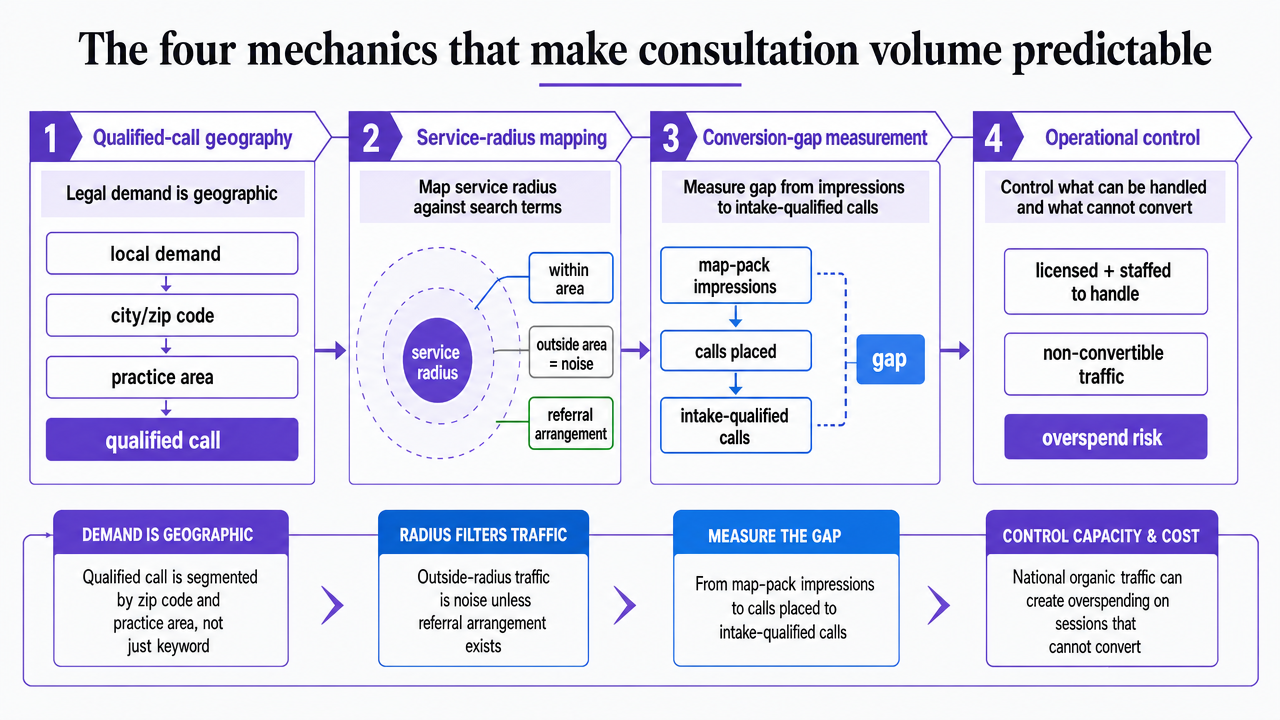 Visualize the four operational mechanics that the section explicitly defines as the framework for predictable consultation volume
Test SEO boosters for measurable case intake gains
Experience live content publishing and see actual lead quality improvements before committing long-term.
What to measure: signed cases per qualified call, not rankings
The key metric for firm operations is signed cases per qualified call, segmented by practice area and origin source. Rankings are, at best, a leading indicator. Sessions and calls are inputs. The conversion rate from a qualified call to a signed engagement letter is the number that justifies the marketing budget in subsequent partner meetings.
A qualified call has a firm-controlled definition: the matter type aligns with the firm's practice areas, the prospect is within the service geography, the statute of limitations or filing window is open, and financial qualifications (insurance, fee structure, conflict check) are met. Calls that fail any of these criteria are considered noise, regardless of how the source channel reported them.
Four metrics belong on the managing partner's dashboard:
- "Qualified calls per 100 organic sessions" assesses whether acquired traffic matches the firm's practice areas.
- "Signed cases per qualified call" measures the intake team's and consultation script's effectiveness in converting suitable prospects.
- "Review velocity per location" indicates whether the trust signals are current enough to compete on search results pages where prospects compare firms before calling 5.
- "Intake-form abandonment by field" identifies which specific question on a form is causing the firm to lose matters it has already paid to acquire.
Rankings can fluctuate without impacting any of these four critical numbers. This is why a booster instrumented for signed matters generates a different action list each quarter compared to one focused solely on keyword position.
A diagnostic sequence for fixing intake in the right order
Most firms attempt to resolve intake issues by addressing the most vocal complaint first, which is rarely the actual constraint. An effective diagnostic sequence progresses from the bottom of the funnel upwards, as a fix at the top will amplify any existing problems further down.
- Begin by examining the consultation-to-signed-matter ratio for each practice area. If phone conversations with prospects are not converting at a defensible rate, increasing traffic will only make the problem more costly. Review a sample of qualified calls from the last 90 days by practice area. This step addresses disqualification scripts, fee disclosure timing, and follow-up cadence.
- The second step focuses on the decision-stage page. Page-level instrumentation reveals which practice pages successfully convert acquired traffic into qualified calls and which merely absorb sessions without producing results. The Stanford Law Review's finding that the Internet often fails legal help-seekers due to complexity, fragmentation, and unclear pathways 8 provides the diagnostic framework: pages that lose traffic almost always exhibit one of these three failures. Prioritize rewriting the worst-performing page, rather than the entire site.
- Third, evaluate the review surface prospects see before calling. The volume, recency, and response patterns, adhering to the FTC's 2024 prohibitions 2, either secure the click from the search results page or direct it to a competitor.
- The final step involves local visibility and category-level search demand. While important, this is addressed last because acquiring more traffic before the three downstream stages are optimized is the most common way firms waste budget.
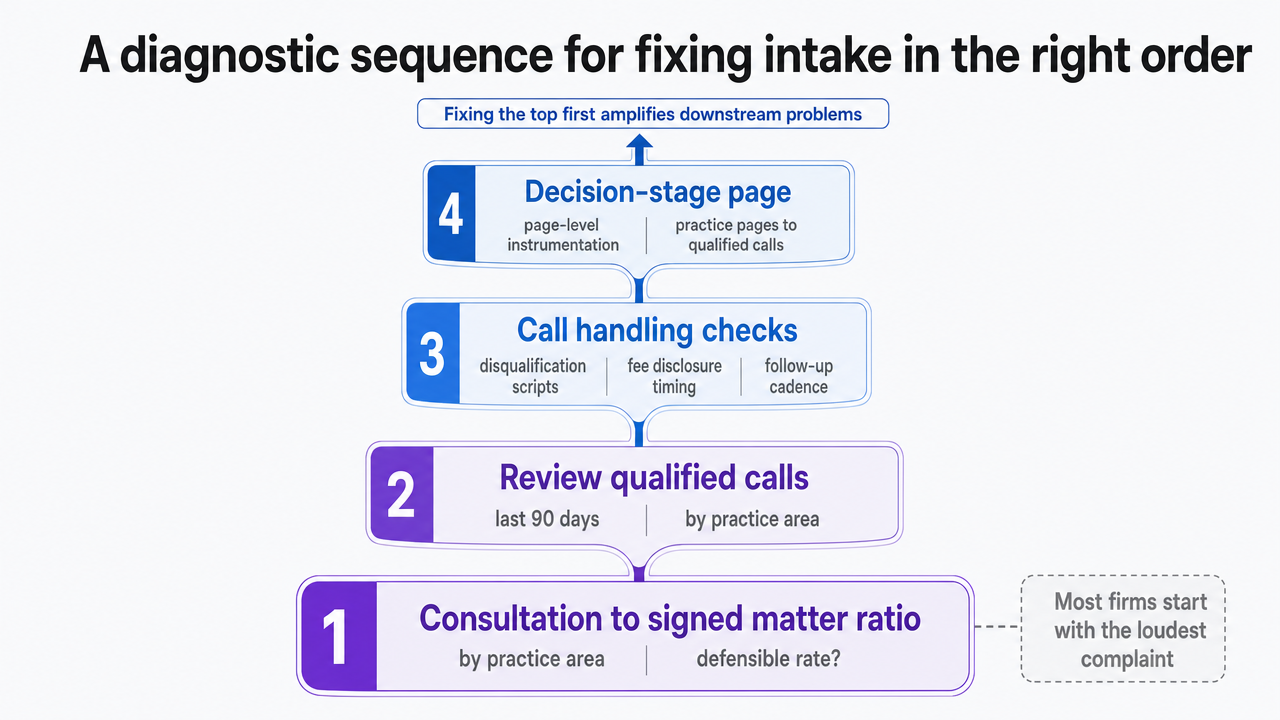 Visualize the bottom-up diagnostic sequence the section prescribes, since this is a clearly defined four-step workflow
If you manage multiple offices: comparing the intake stack across locations
This section is particularly relevant for partners overseeing multiple offices or distinct practice groups within a single metropolitan area. Such firms require a side-by-side comparison of intake performance, as firm-wide averages can mask underperforming locations.
A common pattern among multi-location operators is that one office excels, another struggles, and the firm-wide dashboard presents a mediocre average that fails to prompt decisive action. Breaking down the intake stack by office transforms this average into an actionable list:
- The location with the lowest signed-cases-per-qualified-call ratio receives intake coaching.
- The office with the slowest review velocity undergoes a process audit.
- The location with the highest form abandonment rate gets its pages rewritten.
| Intake stack metric | Office A | Office B | Office C |
|---|---|---|---|
| Qualified calls per 100 organic sessions | Variable by practice mix | Variable by practice mix | Variable by practice mix |
| Signed cases per qualified call | Track quarterly | Track quarterly | Track quarterly |
| Review velocity per location (last 90 days) | Count + recency | Count + recency | Count + recency |
| Intake-form abandonment rate by field | Field-level | Field-level | Field-level |
| Share of qualified calls inside service radius | Geo-filtered | Geo-filtered | Geo-filtered |
The behavioral insight justifying this geographic breakdown is the same finding that informs single-office strategies: 17% of respondents in Stanford Legal Design Lab survey data identified the Internet as their initial source when facing a legal problem 9. This demand arrives location by location, not firm-wide, and an office's ability to capture it depends on local pages, local reviews, and local intake handling, rather than solely on a shared brand.
To ensure an honest comparison, a crucial operating rule is that each office must use the same definition for a qualified call. If Office A considers a voicemail a qualified call while Office B does not, the ratios become incomparable, potentially making the worst-performing location appear to be the best.
See How AI-Driven SEO Boosters Deliver Consistent, Qualified Case Inquiries
Request a walkthrough of platform-driven SEO automation that streamlines intake, tracks cost per qualified lead, and supports multi-location legal teams seeking predictable case pipeline growth.
Human approval gates on reviews, claims, and intake data
Within any booster setup, three workflows carry significant downstream risk and should not be fully automated:
- review solicitation and response,
- claims regarding case outcomes or attorney credentials, and
- intake-stage data handling.
Each of these areas interacts with different regulatory bodies and distinct aspects of client trust.
Review workflows require human approval of the cohort logic before requests are sent. The FTC's 2024 final rule prohibits purchasing positive or negative reviews, undisclosed insider reviews, and review suppression. Additionally, platform guidance forbids soliciting only from clients expected to leave positive feedback 2, 1. An approval gate ensures the request list was generated from a neutral trigger, not filtered by anticipated sentiment, and that public responses to negative reviews are published without edits that misrepresent the matter.
Claims about results, settlements, or experience necessitate partner sign-off before appearing on a page or profile. State bar advertising rules already mandate substantiation; the approval gate is where the firm verifies compliance.
Changes to intake data require legal review because forms, call-tracking disclosures, and CRM fields dictate what the firm collects and how it is used. The NIST Privacy Framework classifies these decisions as governed risk activities, not merely marketing choices 3, 4. This gate prevents an analytics change from inadvertently expanding data collection beyond what the intake page discloses.
How to evaluate a packaged 'booster' offer without buying marketing language
Most booster pitches are presented as decks highlighting rankings, backlinks, and content volume. However, none of these items directly answer the crucial question at signing: how will this contract increase signed matters per qualified call in the firm's target practice areas?
Five questions help distinguish credible offers from mere marketing rhetoric:
- What definition of a qualified call does the vendor use, and does it align with the firm's intake criteria for matter type, geography, and financial qualification? A vendor that counts every form fill as a lead is selling traffic, not intake.
- How does the vendor's review workflow comply with the FTC's 2024 prohibitions on fake reviews, paid reviews, undisclosed insider reviews, and review suppression, and how does it document neutral cohort selection 2, 1?
- What does the vendor measure on the decision-stage page beyond traffic, and which usability failures identified by Stanford Law Review research does it diagnose and rectify 8?
- How does the data-capture layer document field-level purpose, retention, and disclosure against a recognized framework such as NIST's 3, 4?
- Where are the human approval gates for reviews, claims, and intake changes, and who at the firm is responsible for them?
A booster that answers all five questions using operational language, with specific metrics and defined workflows, represents a true system. One that relies on adjectives is merely a subscription. Platforms such as Vectoron are designed to operate such systems under firm approval, rather than just selling abstract concepts.
Frequently Asked Questions
References
- 1.Featuring Online Customer Reviews: A Guide for Platforms.
- 2.Federal Trade Commission Announces Final Rule Banning Fake Reviews and Testimonials.
- 3.NIST Releases Version 1.0 of Privacy Framework.
- 4.Frequently Asked Questions.
- 5.Online Shopping - FTC Consumer Advice.
- 6.Consumer Protection for Online Markets and Large Digital Platforms.
- 7.How Consumers Value Digital Privacy: New Survey Evidence.
- 8.The User Experience of the Internet as a Legal Help Service.
- 9.Data on people's reliance on the Internet for legal problems.
- 10.How Americans View Data Privacy.