
Key Takeaways
- Screaming Frog SEO Spider compresses portfolio-wide audits from hours to minutes through scheduled, template-driven crawls that junior analysts can trigger without reinventing configurations for each client.
- Ahrefs Site Audit runs consistent cloud-based checks across accounts and joins crawl findings to keyword and backlink data, so fixes ship pre-ranked by traffic impact.
- Semrush Site Audit makes junior-analyst work safer by grouping issues with plain-language explanations and delta views, so reviewers see only what changed since the last crawl.
- Surfer scores drafts against live SERP structure in under 15 minutes per brief, letting junior analysts hit numeric targets without senior editors rewriting every draft.
- Clearscope grades content consistently across mixed writer pools and surfaces inventory-wide refresh priorities using grade-to-rank delta rather than editorial gut feel.
- MarketMuse clusters an entire content inventory by topic and produces coverage scores, turning messy client sites into a 90-day work queue of merge, expand, or retire decisions.
- Lighthouse and PageSpeed Insights turn performance debates into scored artifacts, enforcing sub-3-second load and 95% accessibility thresholds as pre-publish gates 6.
- Deque axe DevTools moves WCAG checks into the analyst's browser session, catching non-text and link-purpose failures 2before publish rather than after a complaint.
- Schema App maintains a connected entity graph across a client portfolio, making content retrievable by AI answer engines that are reshaping search behavior 8.
- Vectoron fills the approval-gated execution gap between audit findings and shipped CMS changes, routing junior-analyst drafts through senior review without ticket-by-ticket rework.
The delivery bottleneck has moved from finding issues to shipping fixes
Every agency SEO lead already owns a stack that surfaces broken canonicals, thin pages, missing alt text, and title tags over 55 characters. The audit is not the problem. The problem is what happens between the audit export and the CMS commit, multiplied by 40 client accounts and a mix of junior and senior analysts touching the same work.
Michigan Tech's SEO guide treats site auditing and benchmarking with tools like Ahrefs and Semrush as table stakes for any serious program 12. That baseline is now a floor, not a differentiator. The differentiator is throughput: how many prioritized on-page fixes actually ship per client per week, with what defect rate, and reviewed by whom.
The nine tools worth naming in 2025 solve different pieces of that throughput equation. Some crawl. Some grade content against the SERP. Some enforce accessibility rules that regulated verticals can no longer ignore. One layer, largely missing from most agency stacks, handles the approval-gated execution that turns audit findings into shipped changes without pulling a senior strategist into every ticket.
The three-layer stack: how to read this shortlist
The nine tools below map to three operational layers, not nine parallel feature sets. Reading them as one flat comparison is how agency stacks end up with four overlapping crawlers and no execution capacity.
- Layer one is crawl and audit: portfolio-wide site inspection, technical error surfacing, and competitor benchmarking.
- Layer two is content optimization: SERP-driven scoring, entity coverage, editorial grading against the pages currently ranking.
- Layer three is execution and approval: the queue that turns findings into shipped CMS changes with a senior reviewer in the loop, plus the technical and accessibility checks that gate publish.
Each tool is graded on multi-site management, junior-analyst safety, API access, white-label reporting, and the delivery metric it moves. NYU's analytics curriculum frames the underlying discipline: organize and validate data from crawl and clickstream sources, then link tool outputs to ROI decisions rather than treating audits as ends in themselves 13. That framing is how this shortlist should be read.
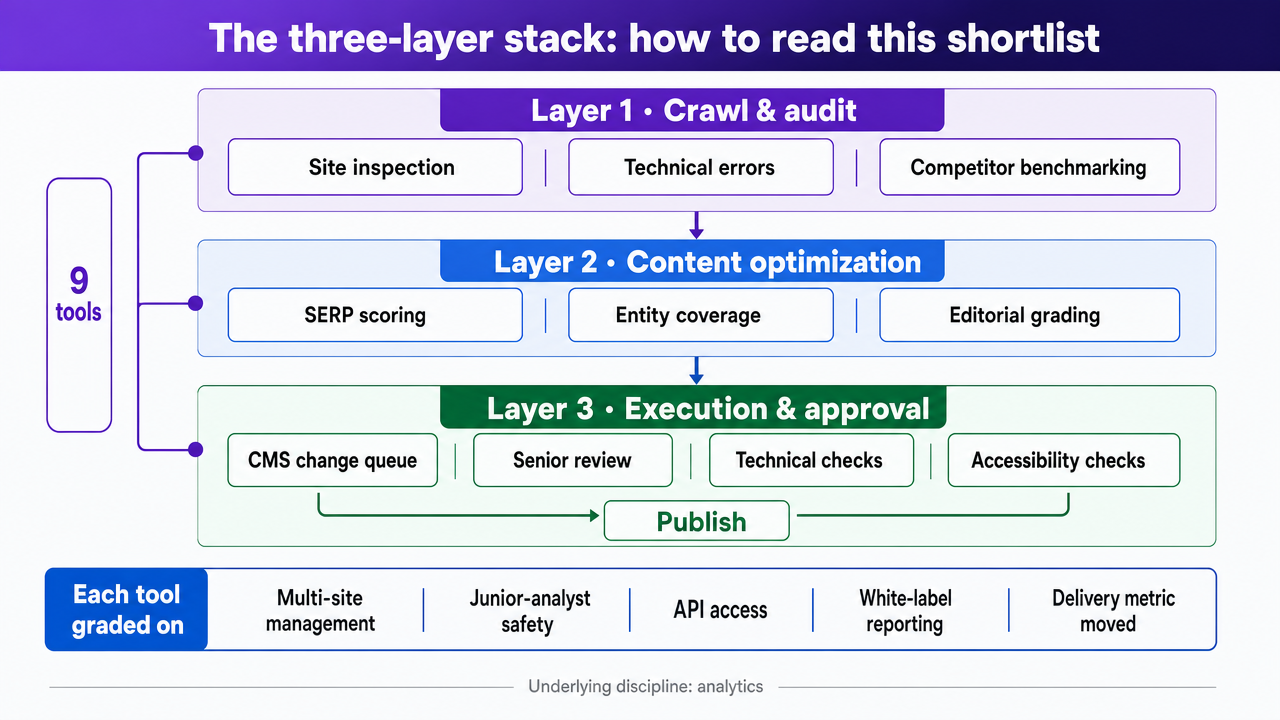 Visualize the three operational layers of the on-page tool stack described in this section, showing how the nine tools are grouped rather than a flat comparison
Crawl and audit layer
Screaming Frog SEO Spider for portfolio-wide crawl intelligence
Screaming Frog remains the reference implementation for desktop crawling at agency scale. A single license crawls unlimited sites, exports to CSV or Google Sheets, and integrates with Search Console and PageSpeed APIs to enrich every URL row with performance and index data. For a Head of SEO running 40 client accounts, the practical value is not the crawl itself but the scheduled, template-driven crawls that a junior analyst can trigger without inventing configurations.
The tool grades well on API access and custom extraction. XPath and CSSPath rules capture client-specific patterns, such as pricing schema on a legal directory or provider bios on a dental group site. Multi-site management is where it strains: license installs are per-machine, so agencies typically pair Screaming Frog with a shared crawl server rather than distributing seats.
The delivery metric it moves is hours per audit. A configured crawl profile turns a four-hour manual review into a 20-minute export, which then feeds the content and execution layers downstream. The U.S. Department of Energy's SEO standards explicitly call for regular sweeps that eliminate redundant, outdated, and trivial content 7, and Screaming Frog's custom filters are how agencies operationalize that sweep across a client portfolio.
Ahrefs Site Audit for competitor-benchmarked technical sweeps
Ahrefs Site Audit sits in the cloud, which is the point. Crawls run on Ahrefs infrastructure, results persist across the account, and every project inherits the same 170-plus issue checks without a machine-specific config drifting between analysts. For agencies, that consistency is what makes junior work reviewable by a senior strategist without re-running the crawl.
The differentiator against Screaming Frog is benchmarking. Ahrefs joins crawl findings to its keyword and backlink index, so an audit report shows not only that a client page has a thin H1 but also which competing URLs currently rank for the target query and what their on-page structure looks like. Michigan Tech's SEO guide names exactly this combination, recommending a comprehensive site audit paired with benchmarking of traffic, keyword rankings, and conversions using Google Analytics, Search Console, and SEO software such as Ahrefs and Semrush 12.
Multi-site management is strong through the workspace and project structure, and white-label PDF exports handle the reporting layer for client-facing decks. API access is respectable but rate-limited on lower plans, which matters for agencies piping audit data into internal dashboards. The delivery metric it moves is prioritized fixes per client per week, because the tool ships issues pre-ranked by traffic impact.
Semrush Site Audit for junior-analyst-safe issue triage
Semrush Site Audit earns its place through triage design. Issues are grouped into errors, warnings, and notices with plain-language explanations attached to each finding, which changes what happens when a junior analyst opens a report. Instead of asking a senior strategist what a hreflang conflict means, the analyst reads the inline explanation and files a ticket with the recommended fix already scoped.
The tool crawls up to a few hundred thousand URLs per project depending on plan tier, schedules weekly recrawls automatically, and pushes deltas so the reviewer sees only what changed since the last audit. That delta view is the workflow shortcut: reviewing changes is faster than re-reading a full report. Multi-site management runs on a project-based structure with role permissions, and the white-label reporting module generates client-branded PDFs on a schedule.
Where Semrush pulls ahead of Ahrefs for high-volume agencies is thematic report packaging. Crawl findings connect to the Position Tracking and On Page SEO Checker modules, so the audit output ties directly to keyword-level recommendations. NYU's analytics curriculum frames this pattern of linking crawl data to clickstream and ROI data as the base discipline of the field 13. Semrush is the tool that operationalizes it for teams that have not built custom BI stacks.
Test AI-powered SEO delivery on live projects
Experience automated on-page SEO execution and track measurable impact before committing to a paid subscription.
Content optimization layer
Surfer for SERP-driven brief and page scoring
Surfer's contribution to an agency stack is speed of brief production. The Content Editor pulls the top 20-30 ranking URLs for a target query, extracts common headings, entities, and word count ranges, then generates a scored brief a writer can work against in under 15 minutes. For agencies producing 40-60 client briefs a month, that compression is the point.
The scoring model rewards entity coverage and structural parity with the current SERP, which turns a subjective editorial judgment into a numeric target junior analysts can hit without a senior reviewer rewriting every draft. Multi-site management runs through organizations and folders, and API access supports piping briefs into project management tools. White-label reporting is thin compared to the crawl layer, which is fine because Surfer sits upstream of client-facing decks.
The delivery metric it moves is briefs shipped per analyst per week. The U.S. Department of Energy's SEO standards call for content that is clear, concise, unique, and authoritative, with regular sweeps of redundant, outdated, and trivial material 7. Surfer operationalizes the first half of that mandate by scoring drafts against live SERP structure before they enter review, catching thin coverage before a senior strategist sees the file.
Clearscope for editorial-grade content grading across writer pools
Clearscope's strength is grading consistency across a heterogeneous writer pool. The tool assigns a letter grade based on term coverage relative to top-ranking pages, and that grade holds whether the draft came from an in-house senior editor or a contract writer on their first assignment. For agencies running distributed content teams, the grade becomes the shared quality language that removes personal editorial preference from the loop.
The reports layer is where Clearscope earns its price against Surfer. Content inventories show every graded page across a client account, its current grade, its target keyword, and its rank position, so a Head of SEO can prioritize refresh work by grade-to-rank delta rather than by gut. That inventory view is how the tool supports what Ohio State's marketing office frames as portfolio-wide metadata discipline: title tags capped at 55 characters, with pipes used to signal brand, applied consistently across every published page 10. A comparison chart of enforceable metadata rules, title tag character limits, pipe conventions for brand signaling, meta description length, and H1 uniqueness, is the artifact an agency should keep beside the Clearscope grade card so junior analysts have a single reference for what ships and what gets sent back.
MarketMuse for entity coverage and content-inventory decisions
MarketMuse takes a different cut at content optimization: it grades an entire content inventory against topical authority targets rather than scoring pages one at a time. The tool crawls a client site, clusters pages by topic, and produces a coverage score that shows where the site is thin, where it competes, and where existing pages should be merged, expanded, or retired.
For agencies inheriting messy client inventories, that clustering is the value. A senior strategist can walk into a new account, run a MarketMuse inventory, and produce a 90-day content plan grounded in what the site already has rather than starting from a blank keyword list. The Personalized Difficulty score adjusts competitive targets to the client's current authority, which keeps junior analysts from pitching keywords the client has no chance of ranking for.
The peer-reviewed study on diabetic retinopathy websites found that SEO performance and readability do not improve automatically without deliberate design choices 1, and MarketMuse's inventory view is what turns that observation into a work queue. Pages flagged for consolidation feed the execution layer; pages flagged for expansion feed Surfer or Clearscope briefs. The delivery metric it moves is decisions per audit hour.
Technical, accessibility, and AI-readiness layer
Lighthouse and PageSpeed Insights for Core Web Vitals enforcement
Lighthouse and PageSpeed Insights earn their spot because they turn subjective performance debates into scored artifacts a junior analyst can attach to a ticket. Both run against any URL, both output the same Core Web Vitals numbers, and both are free, which means the delivery cost is analyst time rather than seat count. For an agency running 40 client sites, that seat economics matters more than a marginally prettier UI.
The University of Washington's web guidance names the enforceable thresholds directly: page load time under 3 seconds, and an accessibility score of 95% or higher, measured through Lighthouse, PageSpeed Insights, and DubBot 6. Those two numbers are the shortest workable definition of a pass condition for a client page. An agency that codifies them into a pre-publish checklist stops arguing about whether a page is fast enough and starts routing failures to a fix queue.
The delivery metric these tools move is defect rate at publish. Lighthouse runs locally in Chrome DevTools, so junior analysts can score a staging URL before it merges. PageSpeed Insights adds field data from real Chrome users on production pages, which flags regressions the lab test misses. Pairing them is the operational move: lab data for gating, field data for monitoring.
Deque axe DevTools for accessibility-aware on-page QA
Accessibility used to sit in a separate compliance workflow. For agencies with clients in healthcare, legal, senior living, or municipal-adjacent services, that separation is no longer defensible. The 2024 ADA Title II final rule sets specific accessibility requirements for web content and mobile apps at state and local governments 5, and while the rule targets public entities, procurement teams at hospitals and university-affiliated clinics are already pushing the same standards into vendor contracts.
axe DevTools by Deque is the tool that puts a WCAG check inside the same browser session where a junior analyst edits page copy. It flags failures against the same POUR framework, Perceivable, Operable, Understandable, Robust, that the accessibility literature treats as the working definition of accessible design 3. The Turkey university hospital study found that the most common accessibility failures on health sites cluster around non-text content, info and relationships, and link purpose 2, which is exactly the failure set axe surfaces first in its default scan.
The systematic review of accessibility engineering shows that formal testing and evaluation processes are what move accessibility from an ad hoc concern to a repeatable quality gate 4. axe DevTools operationalizes that at the analyst desk. The delivery metric it moves is accessibility defects caught before publish rather than after a complaint. Multi-site management runs through Deque's enterprise console for agencies handling scanning across dozens of client domains, and the API supports piping violations into the same ticket queue as crawl and content findings. For an agency treating accessibility as part of on-page SEO rather than a legal review after the fact, that pipeline consolidation is the point.
Schema App for entity markup and AI-answer readiness
AI answer engines do not read pages the way classic crawlers do. They pull entities, relationships, and structured claims, then reconstruct an answer. The Medill Spiegel research on consumer AI search adoption, a study of how consumers are shifting toward AI-based search interfaces rather than an agency revenue benchmark, finds that AI-powered search is reshaping consumer behavior and diminishing the returns from traditional SEO tactics 8. For agencies, that shift changes what on-page markup is for. Schema stopped being a rich-result nice-to-have and became the layer that decides whether a client's content is retrievable by an answer engine at all.
Schema App is the tool that moves an agency from page-by-page JSON-LD hand-coding to a managed schema graph across a client portfolio. The platform links entities across pages so an Organization node references its LocalBusiness locations, its Physician or Attorney nodes, its Service offerings, and its FAQ blocks as one connected graph rather than a scatter of unlinked snippets. For a multi-location dental group or a legal directory with 200 attorney bios, that graph is what makes each entity resolvable by an AI system asking a follow-up question.
Multi-site management runs through workspaces with role-based permissions. The tool deploys schema through a small script that overlays markup at render time, which means a junior analyst can update entity data without opening the CMS or waiting on developer time. White-label reporting is minimal, but that is fine because schema work sits upstream of client-facing narrative. The delivery metric it moves is entities correctly resolved per client, measured through Google's Rich Results Test and Search Console structured data reports rather than a vendor dashboard.
See How Leading Agencies Automate On-Page SEO Workflows at Scale
Request a walkthrough of coordinated, AI-powered on-page optimization—streamlining multi-site delivery, eliminating manual bottlenecks, and maintaining strategic oversight across all client accounts.
Execution and approval layer
Vectoron for approval-gated on-page execution across client accounts
The tools above surface findings. The layer that most agency stacks skip is what happens between the finding and the shipped fix. A crawl report showing 340 pages with title tags over 55 characters is not a delivery outcome. Three hundred and forty rewritten titles, reviewed by a senior strategist, queued to the right CMS, and published without pulling that strategist into every ticket is a delivery outcome.
Vectoron sits at that layer. It ingests findings from the crawl and content tools already in the stack, ranks them by traffic and conversion impact against live client data, drafts the on-page changes, and routes each one through a Command Center where a senior reviewer approves or rejects before anything ships. Junior analysts trigger the workflow. Senior strategists approve the output. Neither writes the ticket by hand.
Multi-site management is native rather than bolted on. Each client account carries its own metadata rules, tone constraints, and approval routing, so the title tag character limit and pipe convention Ohio State's marketing office documents 10gets enforced per account without a shared style guide living in a Google Doc. API access is available for agencies piping approvals into their own project management. The delivery metric it moves is pages shipped per analyst per week at a defined defect rate.
If you manage multiple client portfolios: the delivery-cost math
This section is for Heads of SEO running 15 or more client accounts. Single-site operators can skip to the next.
The traditional pod math sets the baseline. A pod covering 10 to 12 retainers typically carries two to three analysts, a senior strategist, and a shared tool stack. Every added client adds analyst hours for audits, content briefs, and CMS updates, plus senior review hours that scale roughly linearly with ticket volume. The tool stack itself is fixed cost per seat.
The AI-assisted execution model changes which variables scale. Analyst hours per client drop because drafts arrive pre-scored and pre-routed. Senior review hours compress into an approval queue rather than ticket-by-ticket rework. Tool seats consolidate because the execution layer reads from the audit tools rather than duplicating them.
| Variable | Traditional pod | AI-assisted execution |
|---|---|---|
| Analyst hours per client per month | A | A × 0.4 to 0.6 |
| Senior review hours per client per month | S | S × 0.5 |
| Execution platform cost | 0 | $599/mo trial |
| Audit and content tool seats | Unchanged | Unchanged |
Plug in the agency's own analyst and senior blended rates. The math clarifies whether the constraint is tool budget or throughput, and most agencies find the constraint was never the audit tools.
Stitching the nine tools into one production line
Nine tools do not make a stack. A stack is what happens when the crawl exports feed the content graders, the graders feed the execution queue, and the accessibility and performance checks gate publish before anything reaches a client CMS. Most agencies own the tools already. What they lack is the connective tissue that moves a finding from Ahrefs to a scored Surfer brief to a rewritten title tag reviewed by a senior strategist and pushed live.
The sequence that holds up under 40-plus client accounts runs in one direction. Screaming Frog and the two cloud auditors surface the issue set weekly. Surfer, Clearscope, and MarketMuse convert priority pages into scored briefs or refresh tickets. Lighthouse, axe DevTools, and Schema App attach as pre-publish gates: performance under 3 seconds, accessibility score at 95% or higher 6, WCAG failures cleared, entity markup validated. The execution layer routes each change to a senior reviewer, then to the CMS.
Run this way, the stack answers the throughput question the audit tools cannot answer alone. Vectoron sits at the approval seam where most agency workflows still lose hours.
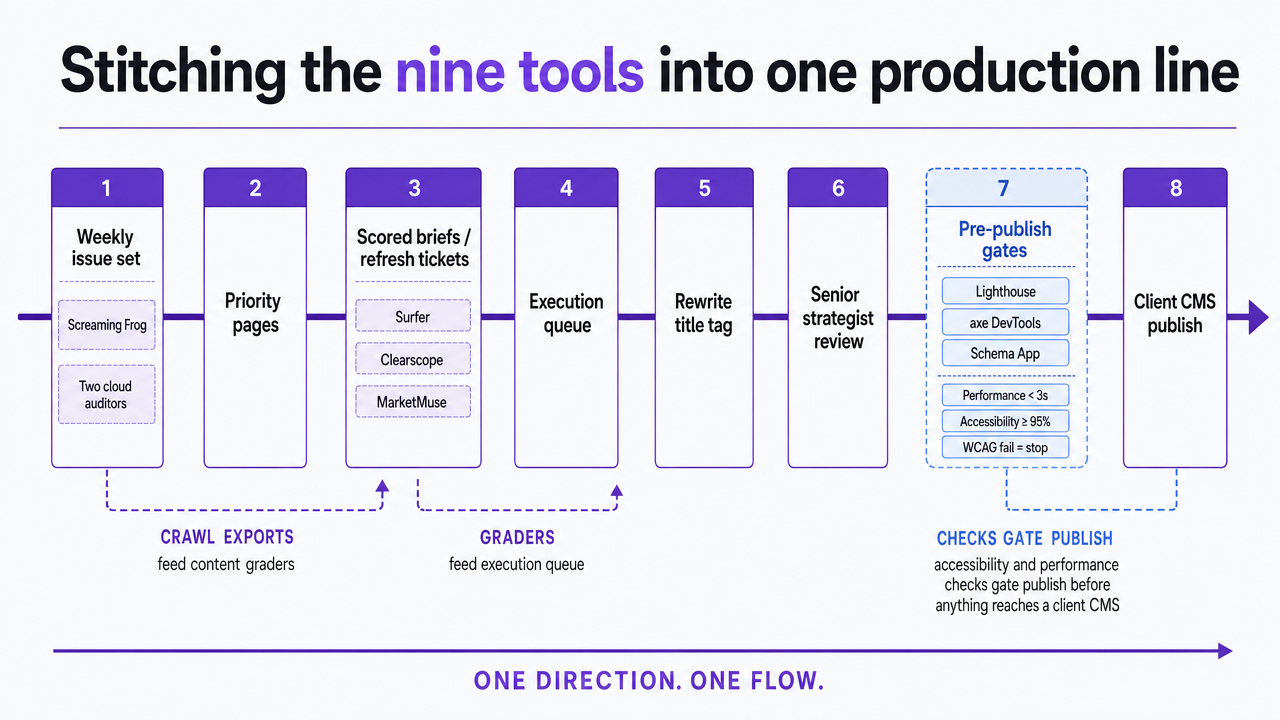 Show the unidirectional production-line workflow described in this section, from crawl outputs through content scoring, pre-publish gates, senior review, and CMS publish
Frequently Asked Questions
References
- 1.Search engine optimization and its association with readability and accessibility in diabetic retinopathy websites.
- 2.Accessibility evaluation of university hospital websites in Turkey.
- 3.An Assessment of Accessibility and Usability of Saudi Online FinTech Websites.
- 4.Accessibility engineering in web evaluation process: a systematic literature review.
- 5.Fact Sheet: New Rule on the Accessibility of Web Content and Mobile Apps Provided by State and Local Governments.
- 6.Website analytics, SEO, and performance optimization.
- 7.Search Engine Optimization Best Practices.
- 8.Consumer Adoption of AI Search Is Accelerating: Implications for Marketers.
- 9.An Analysis of US Academic Medical Center Websites: Usability Study.
- 10.Content Optimization.
- 11.Can we trust academic AI detective? Accuracy and limitations of AI-generated text detection tools in academic publishing.
- 12.Six Ways to Improve Your Site's Ranking (SEO).
- 13.Web Analytics: SEO/SEM, PPC, Email & Clickstream.