
Key Takeaways
- Platform decisions should start by naming the binding constraint: coordination overhead justifies a platform, while strategic judgment or talent gaps do not, and only the first model rewards centralization.
- Throughput economics shift when approval cycle time and reporting build time compress, not just deliverable assembly, which is where the approval-workflow model separates from point tools and standard suites.
- Efficiency alone underperforms as a buying rationale; agencies capturing real margin pair it with a tier upgrade, higher accounts-per-strategist ratio, or a productized engagement 7.
- Reporting must move to revenue contribution and AI-search visibility natively, and governance artifacts — approver, timestamp, source data, AI involvement — should be queryable by default 9, 10, 1, 2.
The bottleneck question agency heads should answer first
Before evaluating any SEO platform cloud, an agency head should name the constraint that actually limits margin. The answer is rarely strategy. It is almost always coordination: briefs stuck in queues, audits redone across clients, reports rebuilt every month, and specialists pulled into work a workflow could carry.
That distinction matters because platforms solve coordination problems well and judgment problems poorly. Forrester argues that modern marketers need a centralized surface for data, workflows, and reporting rather than a patchwork of disconnected tools 13. The case is strongest when an agency's specialists spend more time assembling deliverables than deciding what to ship.
The pressure to centralize is also external. Forrester's Q3 2025 SEO Wave evaluates vendors across 23 criteria spanning workflow automation, AI features, integrations, and reporting 8— a signal of what serious buyers now expect from any platform sitting inside an agency stack.
The rest of this article works through three questions in order: whether platform throughput economics fit the portfolio, whether governance load can be absorbed without slowing delivery, and whether reporting can move past rankings to revenue and AI-search visibility. Agencies that answer those questions before shortlisting vendors tend to buy better.
A decision model: throughput, governance, measurement
Three delivery models compared on what actually constrains margin
Agencies running SEO at scale typically operate one of three delivery models, and the choice between them turns on which constraint is binding: how fast specialists can ship, how much governance the work demands, and what clients now count as proof of value.
- The first model is the point-tool stack. Specialists pull crawl data from one vendor, rank tracking from another, content briefs from a third, and stitch reports together in slides or spreadsheets. Throughput is bounded by manual assembly. Governance is informal. Reporting modernization is slow because every new metric — AI-search visibility, share of answer, revenue attribution — requires another integration the team has to build and maintain.
- The second model is the centralized SEO suite. Forrester's Q3 2025 Wave evaluates leading vendors across 23 criteria covering workflow automation, AI features, integrations, and reporting 8. A suite consolidates data and reduces assembly time, but governance still sits with the specialist, and AI features are typically additive rather than load-bearing in the production loop.
- The third model is an approval-workflow AI platform. Execution is automated under explicit human sign-off, with strategy and production sitting on the same surface. Governance load is absorbed by the workflow — approvals, audit trails, and provenance are recorded by default rather than reconstructed after the fact. Throughput rises because routine deliverables move without specialist hand-holding, and reporting can extend to AI-search and revenue dimensions because the underlying data already flows through one system.
The model that fits an agency is the one that relieves its binding constraint. For most multi-client shops, that constraint is coordination overhead, not headcount or talent.
What centralization actually buys: data, workflow, reporting in one surface
Centralization is often pitched as a tooling consolidation. The more useful framing is delivery consolidation. Forrester's case for an SEO platform rests on integrating search data into broader marketing and product decisions, not on collapsing vendor logos into one invoice 13. The payoff comes from coordinating content, technical SEO, and performance tracking across large sites and many teams on a shared surface.
Three things change when that surface exists. Data stops being version-controlled by spreadsheet. Crawl, content, link, and performance signals sit in one schema, which means a strategist deciding what to ship next week is looking at the same record the analyst is reporting against and the writer is briefed from.
Workflow stops being a chain of handoffs. Briefs, drafts, approvals, and publishing run through one queue with documented states. The approval queue itself becomes the audit trail — useful for client trust, useful for regulators, and useful for a head of SEO trying to figure out where a deliverable stalled across 40 accounts.
Reporting stops being a monthly reconstruction. When data and workflow share a surface, client dashboards can move past keyword rankings to revenue contribution and AI-search visibility without a quarterly rebuild — the direction Forrester argues SEO teams now need to take to prove business value 9.
None of this happens because software was installed. It happens because the delivery model was redesigned around the platform. Agencies that buy the suite but keep the old workflow get the invoice and lose the upside.
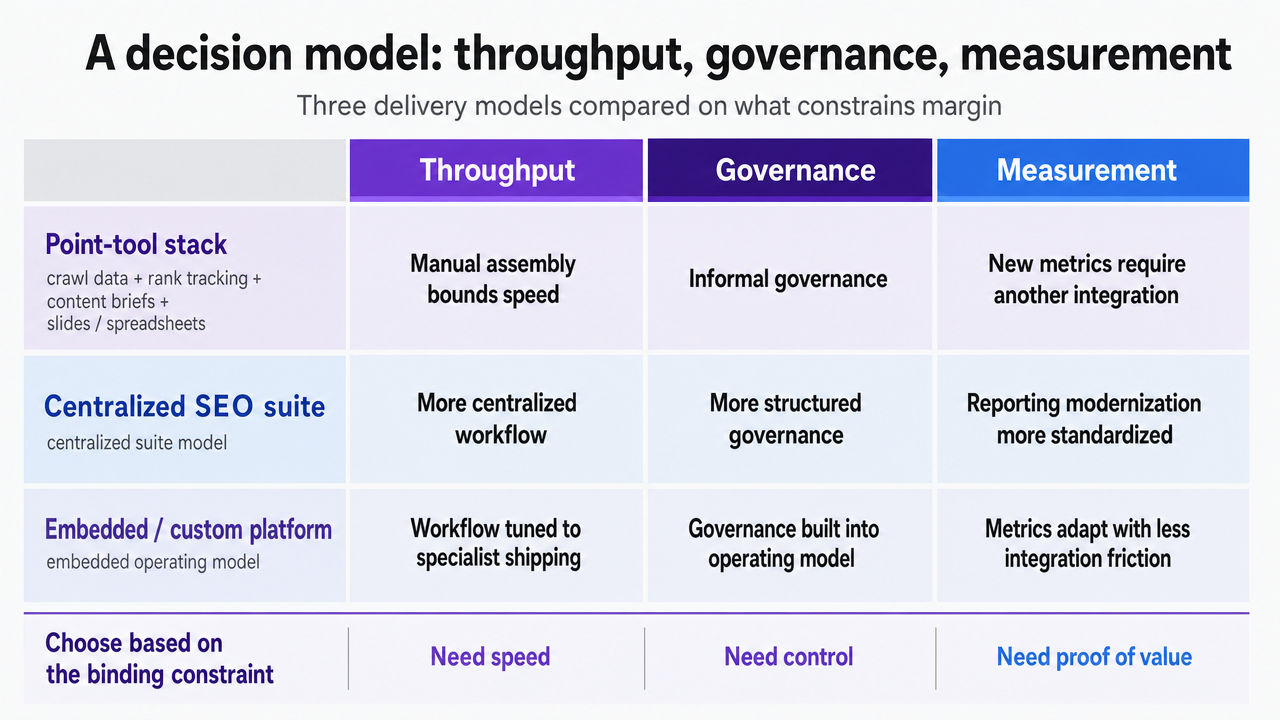 Visualize the three delivery models compared in this section across the binding constraints they relieve, supporting the comparison framework the section explicitly lays out
Throughput economics: accounts per strategist under each model
If you manage a multi-client portfolio, this is where the math changes
This section shifts from single-engagement reasoning to portfolio operations. The reader frame is a head of SEO running 15 to 80 accounts across a bench of specialists, where the binding question is not whether a platform improves any one deliverable but how it changes accounts per strategist across the book.
Throughput in a multi-client agency is governed by four variables:
- how many accounts a strategist carries,
- how many hours each recurring deliverable consumes,
- how long approvals sit between draft and publish,
- and how often audits need to be refreshed.
Software that improves one variable while leaving the others untouched rarely moves margin. The point-tool stack tends to compress audit time but leaves approval cycles and deliverable assembly intact. A centralized suite typically compresses assembly and reporting but does not absorb the approval cycle itself, which is where specialist time concentrates in agencies with mature QA.
McKinsey's 2025 global AI survey found that 80% of respondents set efficiency as an objective for AI adoption, while the subset capturing the most value also set growth or innovation goals 7. The portfolio implication is direct: agencies that buy a platform to shave hours per deliverable, without redesigning what their strategists do with the recovered hours, tend to see throughput rise without account growth following. The platform pays for itself only when freed capacity is redirected into account expansion or higher-tier work.
A variable-only capacity table for portfolio operators
The table below frames capacity in variables rather than dollar figures, because the only honest comparison across delivery models is one an agency head can plug their own numbers into. Forrester's Q3 2025 Wave evaluates SEO solutions across 23 criteria including workflow automation, AI features, and integrations 8— the categories that most directly affect the variables shown here.
| Variable | Point-tool stack | Centralized SEO suite | Approval-workflow AI platform |
|---|---|---|---|
| Accounts per strategist (A) | Baseline | Baseline × suite multiplier | Baseline × workflow multiplier |
| Hours per recurring deliverable (H) | Manual assembly dominant | Assembly compressed; review unchanged | Assembly and routing compressed; review concentrated at approval |
| Approval cycle time (C) | Email or ticket-based, variable | In-suite comments, partial logging | Native queue with documented states and audit trail |
| Audit refresh cadence (R) | Quarterly or ad hoc | Monthly, manual trigger | Continuous, signal-driven |
| Reporting build time (B) | Rebuilt per cycle | Templated, partial automation | Live, including AI-search and revenue dimensions |
Effective capacity per strategist scales roughly as A divided by the sum of H, C, and B across the account base, with R setting the floor on how often the cycle restarts. The point-tool stack tends to hold C and B high. The suite reduces B materially. The approval-workflow model is the only one of the three that directly compresses C, which in most agencies is the largest single tax on strategist time.
Agency heads should run this table against their own time-tracking data before any platform conversation. If C and B together account for more than a third of strategist hours — which is common in shops with 30+ accounts — the model that compresses them is the one worth evaluating, regardless of which vendor logo sits on the demo.
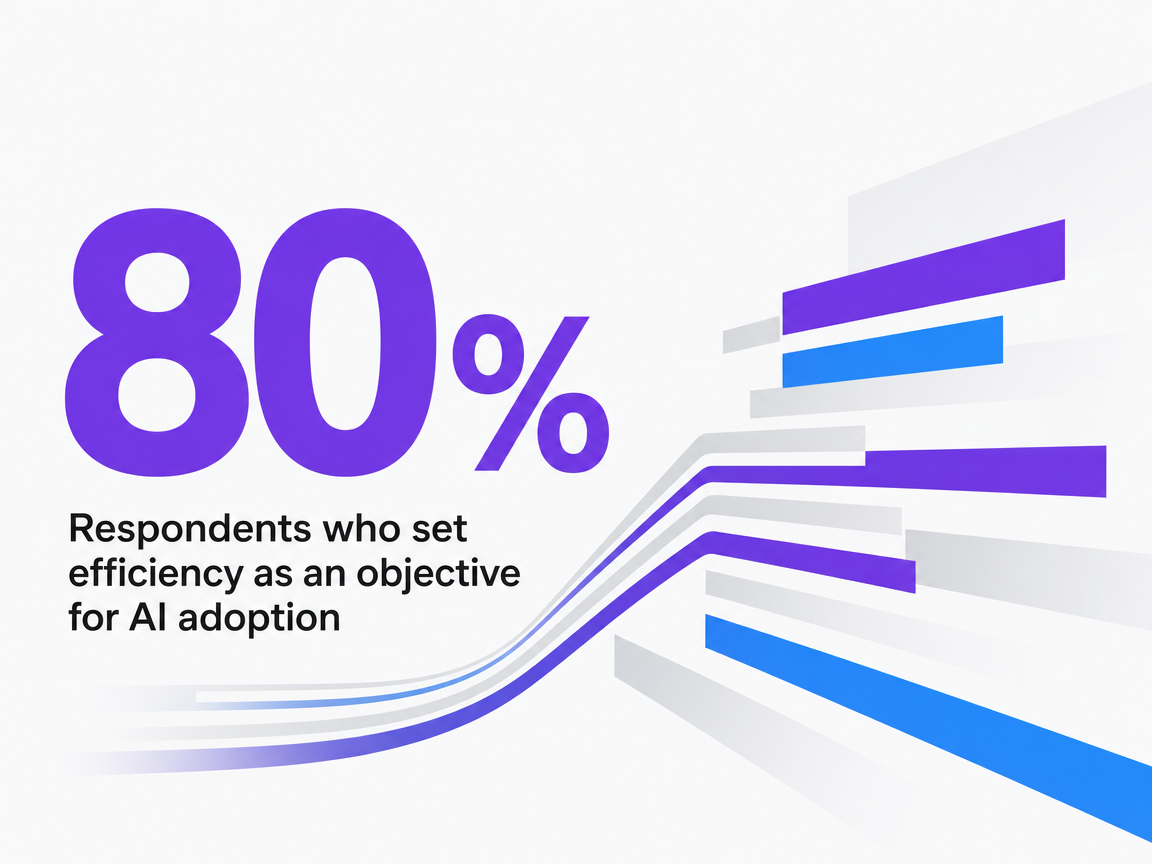 Respondents who set efficiency as an objective for AI adoption
Respondents who set efficiency as an objective for AI adoption
Why efficiency-only platform purchases underperform
Agencies that frame an SEO platform cloud as a cost-reduction project tend to recover hours and lose the upside. The recovered hours go back into the same delivery model, which means lower input cost per deliverable but no change in accounts won, account size, or service tier. The platform pays for itself on the invoice line and stops there.
McKinsey's 2025 global AI survey, which tracks how organizations across functions are using AI and what separates high performers from the rest, found that 80% of respondents set efficiency as an objective for AI adoption, while the subset capturing the most value also set growth or innovation goals 7. The finding is about AI adoption broadly, not SEO platforms specifically, but the pattern transfers cleanly: efficiency alone is a near-universal goal and therefore a weak source of differentiation. The agencies pulling ahead are pairing it with a second objective that changes what the recovered capacity is for.
For a head of SEO, that second objective is usually one of three things:
- Move existing accounts up a tier by adding AI-search visibility tracking, technical depth, or revenue reporting that the old delivery model could not sustain.
- Take on a higher accounts-per-strategist ratio without thinning QA, by routing routine execution through the approval queue instead of the specialist's inbox.
- Or productize a repeatable engagement — programmatic content for multi-location clients, for instance — that was previously uneconomic at agency margins.
None of those outcomes show up in a procurement spreadsheet. They show up in retention cohorts and average revenue per account six to nine months after rollout. Agencies that sign a platform contract without naming which of the three they are pursuing tend to renew it as a line item rather than a margin driver, then wonder why the throughput numbers from the pilot did not translate into book growth.
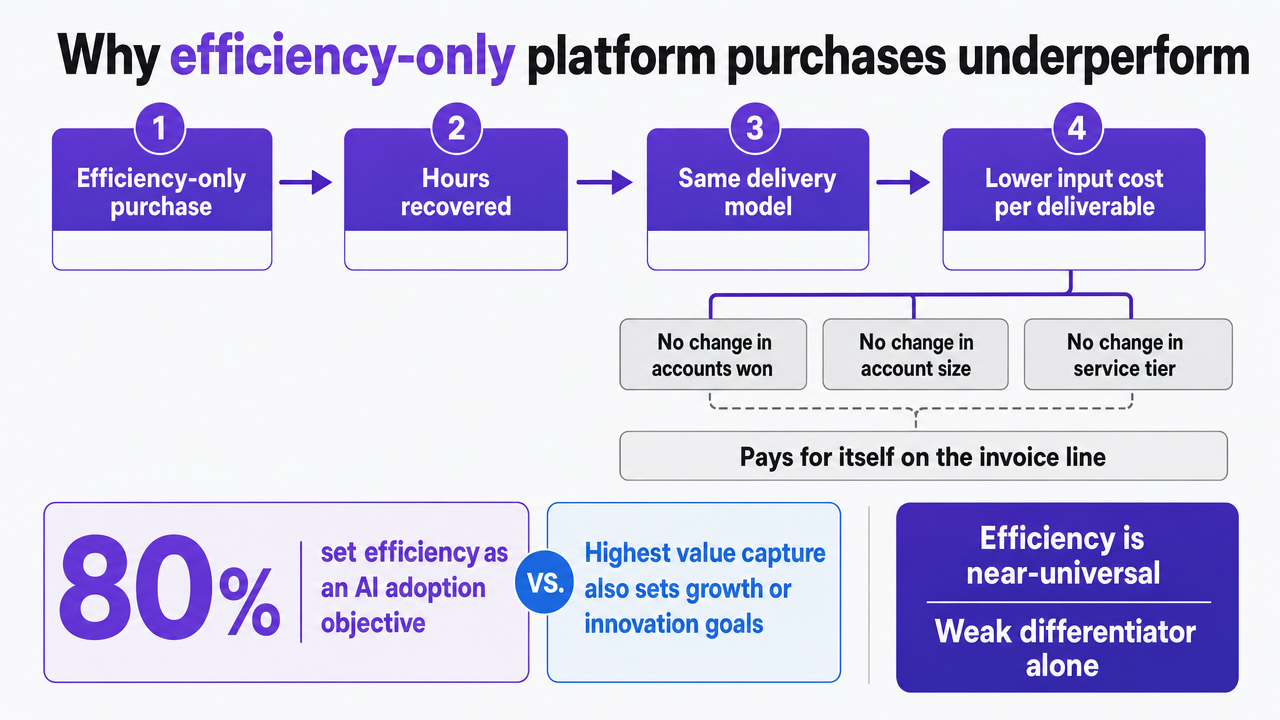 Anchor the McKinsey statistic that 80% of respondents set efficiency as an AI adoption objective, which is cited in nearby prose and supports the section's argument that efficiency alone is a weak differentiator
Test AI-powered SEO workflows risk-free now
Experience full-scale SEO platform automation and publish real campaigns during your trial—no commitment required.
Reporting modernization: from rankings to revenue and AI-search visibility
Client reporting is the part of agency delivery that ages fastest. Monthly decks built around keyword positions and organic sessions still get accepted, but they no longer answer the question clients are actually asking: what did SEO contribute to pipeline, and where does the brand show up when buyers query an AI assistant instead of a search box.
Forrester argues that SEO teams now have to solve a marketing problem, not a ranking problem — proving business value in an era where generative AI is reshaping how discovery happens 9. The same analysts note that genAI-driven search changes are reviving the importance of SEO solutions precisely because legacy ranking metrics no longer capture where visibility is being won or lost 10. Reporting has to follow the buyer, not the algorithm.
For an agency head, that translates into three concrete additions to the client dashboard:
- Revenue contribution, modeled against the accounts and deliverables the agency actually controls.
- AI-search visibility, tracking citations and answer presence across the assistants clients care about.
- And a connection between the two — which content earned which mention, and which mentions drove qualified traffic or booked revenue.
A platform earns its keep here when those views are live rather than rebuilt every cycle. If the strategist is exporting CSVs into a slide template the night before a QBR, the platform did not modernize reporting; it just relocated the spreadsheet. The test is whether the client sees the same record the strategist works from, updated continuously, with the AI-search and revenue dimensions native to the surface rather than bolted on.
Governance load: NIST, FTC, and the cost of unapproved automation
Every platform decision now carries a governance line item that did not exist three years ago. The NIST AI Risk Management Framework, though voluntary, has become the working baseline for documenting how AI-assisted systems are designed, tested, and supervised 1. Its generative AI profile extends that baseline specifically to systems producing content — which is what any SEO platform cloud touching drafts, briefs, or metadata recommendations now is 2. Agency heads who treat these as policy abstractions tend to discover the operational cost the first time a client legal team asks how a piece of published content was produced and approved.
The FTC has made the downside concrete. Its 2024 Operation AI Comply enforcement actions targeted companies that used AI to amplify deceptive or unfair conduct, including overstated performance claims 3. A parallel proposal addressed impersonation through misuse of logos, lookalike sites, and spoofed identities — directly relevant to any agency running AI-assisted outreach or generating brand-voice content at scale 4. The exposure is not theoretical; it sits in the publishing workflow.
A platform absorbs this load when approvals, model provenance, and prompt inputs are logged by default rather than reconstructed during a dispute. A platform adds to the load when AI features ship without sign-off gates, leaving the agency to document supervision after the fact. The practical test before signing: can the platform produce, in one query, the approver, timestamp, source data, and AI involvement for any published deliverable across the book.
Client expectations are pulling agencies toward AI-enabled delivery
The pressure to adopt an SEO platform cloud is not coming primarily from inside the agency. It is coming from the client side of the table, where AI has already changed what marketing teams expect their vendors to bring to the next review.
Deloitte's State of AI in the Enterprise report documents the pace. Worker access to AI rose roughly 50% in 2025, and the share of companies with at least 40% of their AI projects in production is projected to double within six years 11. The survey covers enterprise adoption broadly rather than marketing alone, but the implication for agency delivery is direct: the in-house teams writing the briefs and approving the deliverables are themselves working inside AI-enabled stacks, and they increasingly expect their agency to operate on a comparable surface.
That changes the conversation in three concrete ways:
- Clients ask how AI is used in the work they are paying for, and they want a documented answer rather than a vague reassurance.
- They expect AI-search visibility and content provenance on the dashboard, not as a custom add-on.
- And they benchmark agency turnaround against what their own AI-assisted teams can produce internally, which compresses tolerated cycle times.
An agency still running on disconnected tools and manual reporting can hold a sophisticated client for one renewal on relationship alone. The second renewal turns on whether the delivery model has caught up to what the client already does in-house.
Evaluate How a Cloud-Based SEO Platform Streamlines Agency Workflows
Get a tailored walkthrough of unified SEO cloud solutions designed to centralize approvals, automate execution, and measure impact—purpose-built for agencies managing complex, multi-client portfolios.
Approval-first automation versus autopilot tooling
The category line that matters for agency heads is not AI versus no AI. It is whether the platform requires a human sign-off before anything ships, or whether it publishes on its own and asks the agency to audit after the fact.
Autopilot tooling moves faster on paper. It also concentrates exposure. The FTC's 2024 enforcement against deceptive AI claims targeted companies whose automated systems amplified unfair conduct, and the agency has signaled it will scrutinize the publishing layer, not just the marketing copy 3. NIST's generative AI profile treats human oversight and documented provenance as baseline controls for any system producing content at scale 2. Both point in the same direction: the burden of proof sits with the agency, and reconstructing approval after publication is the expensive way to carry it.
Approval-first automation inverts the order. The platform drafts, ranks, and queues; the strategist approves; the system executes and logs. Throughput still rises because routine work no longer waits on assembly, but the audit trail is a byproduct of the workflow rather than a separate project. For client trust and regulatory posture, that distinction is the category, not a feature.
When a platform cloud is the wrong purchase
The case against adoption is narrower than vendor marketing suggests, but it is real. A platform cloud is the wrong purchase when:
- The agency's binding constraint is strategic judgment rather than coordination. A shop with twelve accounts, three senior strategists, and bespoke deliverables per client does not have a throughput problem a workflow can solve. The platform will compress assembly time the team was not paying for anyway, and the seat cost will outrun the recovered hours.
- Leadership intends to bolt software onto the existing delivery model without redesigning approvals, briefs, or reporting cadence. The pattern McKinsey documented in its 2025 AI survey — that organizations setting only an efficiency objective capture less value than those also pursuing growth or innovation — applies directly 7. Buying the suite without rewriting the workflow tends to produce the invoice and not the margin.
- The third case is timing. Agencies mid-rebrand, mid-acquisition, or actively churning senior specialists should stabilize delivery before introducing a platform migration on top of it. Sequencing matters more than vendor choice.
A short checklist before signing a platform contract
Before a contract goes to procurement, an agency head should be able to answer six questions in writing, each tied to delivery rather than features.
- Binding constraint named. Is the bottleneck coordination, judgment, or talent? Only the first justifies a platform purchase.
- Workflow redesign committed. Which approval cycles, briefs, and reporting cadences will be rewritten before rollout, not after.
- Second objective beyond efficiency. Tier upgrade, accounts-per-strategist target, or productized engagement — specified in numbers 7.
- Reporting modernization in scope. AI-search visibility and revenue contribution native to the dashboard, not bolted on 9, 10.
- Governance artifacts default. Approver, timestamp, source data, and AI involvement queryable for any published deliverable 1, 2.
- Sequencing clear. No concurrent rebrand, acquisition, or senior churn during migration.
Agencies that can answer all six tend to negotiate better contracts and renew on margin rather than habit.
Frequently Asked Questions
References
- 1.AI Risk Management Framework | NIST.
- 2.Artificial Intelligence Risk Management Framework: Generative Artificial Intelligence Profile.
- 3.FTC Announces Crackdown on Deceptive AI Claims and Schemes.
- 4.FTC Proposes New Protections to Combat AI Impersonation of Individuals.
- 5.Marketing and sales soar with generative AI.
- 6.What's the future of generative AI? An early view in 15 charts.
- 7.The State of AI: Global Survey 2025.
- 8.The Forrester Wave™: Search Engine Optimization Solutions, Q3 2025.
- 9.SEO Must Solve Its Marketing Problem - Forrester.
- 10.GenAI Reshapes Shopping And Revives SEO - Forrester.
- 11.The State of AI in the Enterprise - 2026 AI report.
- 12.Predictions 2024: AI Accelerates Agencies' Shift To Solutions - Forrester.
- 13.Every Company Needs An SEO Platform.