
Key Takeaways
- Traditional rank tracking broke because AI Overviews, snippets, and local packs redistributed clicks by feature ownership, so identical positions now deliver far fewer leads than they did before 4.
- Position 1 organic CTR fell from 28% to 19% after AI Overviews rolled out, meaning forecasts built on static CTR tables systematically overstate expected clicks and pipeline 4.
- The strongest fix is a pipeline-impact triage model that fuses position, feature ownership, GSC clicks, and conversion data into revenue-weighted events rather than sorting by keyword volume 5.
- Scaling this across 50-plus accounts requires governance-by-exception, where only threshold-crossing events reach analysts; teams that skip that discipline will burn recovered capacity on low-impact rank noise.
Why Position Data Alone Stopped Predicting Lead Flow
For roughly two decades, the rank tracker sat at the center of every agency SEO workflow. A keyword moved from position 6 to position 3, forecasted click volume rose, and pipeline projections followed. That equation no longer holds. The SERP has been rebuilt around AI Overviews, expanded local packs, and answer-style features that intercept clicks before any blue link gets a shot at them.
Agency SEO leads managing portfolios across legal, healthcare, DSO, home services, and senior living verticals now face a measurement gap. A client can hold the same three keyword positions month over month while organic sessions and form fills decline. The rank export looks stable. The lead volume does not. That disconnect is not a reporting bug; it reflects a click curve that has been redistributed by feature ownership rather than position alone.
Google itself describes ranking as a distributed system of signals rather than a single lever 11, and its own guidance treats result presentation, page experience, and content quality as interacting inputs 9, 10. The practical consequence for portfolio SEO directors is straightforward: tracking competitor positions in isolation now underweights the SERP surfaces where clicks are actually being won and lost. What follows lays out an operating framework built for that new reality, starting with the CTR data that broke the old model.
The CTR Collapse That Broke Traditional Rank Tracking
The click distribution across organic positions has been rewritten. A 2025 analysis of more than 200,000 keywords, comparing performance before and after the wider rollout of AI Overviews, found that Position 1 organic CTR fell from 28% to 19%, and Position 2 dropped from 20.83% to 12.6% 4. That is the same rank, half a click curve away. Any portfolio model that still forecasts traffic by multiplying search volume against a static CTR table is now systematically overstating expected clicks, and by extension, expected leads.
For agency SEO leads, the practical fallout shows up in three places. Weekly rank reports look green while GSC click totals slide. Traffic forecasts built during the pitch cycle overshoot delivery. And competitor gains at Position 2 or 3 no longer translate into predictable losses at Position 1, because the top slot itself has less click volume to defend. The old mental model, where rank movement was a proxy for pipeline movement, has decoupled from the underlying economics.
The study scope matters here. The 200K-keyword sample skews toward informational and mixed-intent queries, and the pre/post comparison isolates the AI Overview rollout as the primary variable 4. Transactional and local-intent queries in verticals like legal intake, dental new-patient search, or emergency home services follow different curves, which is why portfolio SEO directors need vertical-specific CTR baselines rather than a single benchmark applied across every client account.
The takeaway for competitor tracking is narrow and firm: rank change is now a leading indicator that must be validated against click and conversion data before intervention resources get committed. A competitor moving from Position 4 to Position 2 on a keyword sitting under an AI Overview may cost a client far fewer clicks than the same move on a clean SERP. Without that context layer, agencies triage the wrong drops and leave the expensive ones unattended.
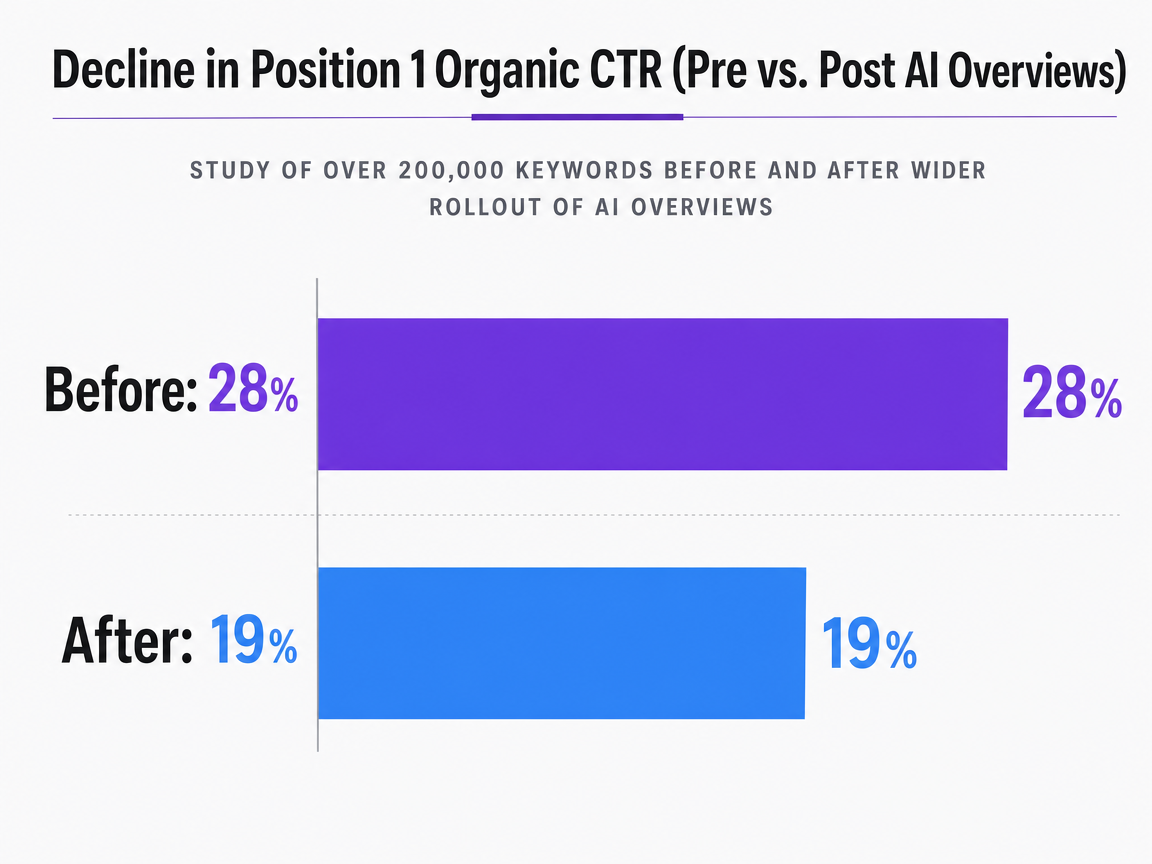 Decline in Position 1 Organic CTR (Pre vs. Post AI Overviews)
Compares the click-through rate for the #1 organic search result before and after the wider rollout of AI Overviews, based on a study of over 200,000 keywords.
Feature-Level Competition as a Separate Workstream
Featured Snippets and Local Packs Compress the Click Curve
Position tracking treats the SERP as a stack of ten links. That model breaks the moment a featured snippet, local pack, or people-also-ask module lands above the fold. Aggregated CTR analysis places the click erosion at roughly 50% for the top organic result when a featured snippet or local pack occupies real estate on the same query 3. A client holding Position 1 with a snippet or map pack overhead is defending a click curve half the size of the same rank on a clean SERP.
For portfolio SEO leads, that reframes what a ranking win actually delivers. A dental group holding Position 1 for "invisalign near me" under a three-pack of competing DSOs is not competing for ten blue-link clicks; they are competing for whatever residual click volume survives after the map pack absorbs local intent. The same asymmetry shows up in legal intake queries where an FAQ-style snippet answers the searcher's question without a click, and in home services queries where the local finder module pulls tap-to-call traffic away from organic entirely.
Feature ownership therefore belongs on the tracking ledger as its own column. Agencies that log only rank position miss the difference between a client who owns the snippet for a bottom-funnel query and a competitor who has quietly taken it. That single feature swap can move more monthly leads than a two-position rank shift, and the standard weekly rank export will not surface it.
AI Overview Citations Change What Winning Looks Like
AI Overviews layered a second click tax on top of the feature erosion agencies were already tracking. An Ahrefs analysis reported that the presence of an AI Overview correlated with a 34.5% lower average CTR across the studied keyword set 15. The scope matters: this is a correlation across queries where Overviews appeared, not a controlled test isolating causation, and coverage skews toward informational and mixed-intent terms rather than pure transactional intake queries.
Even with that caveat, the operational shift for competitor tracking is clear. A competitor cited inside an AI Overview earns brand exposure and, in many cases, the answer-adjacent click, while every ranked result below the Overview competes for a shrunken pool. Winning now means one of three things:
- being the cited source inside the Overview,
- ranking below an Overview where the query still generates a click, or
- targeting queries where Overviews do not trigger at all.
Portfolio SEO directors need three signals logged per priority keyword:
- whether an AI Overview triggers,
- which domains are cited inside it, and
- how citation share moves week over week.
A behavioral health client cited in the Overview for a symptom-based query captures brand recall that no rank position can match on a query where the Overview absorbs the click. A competitor who displaces that citation quietly rewrites the demand funnel for that keyword, and the client's blue-link position export will show no change at all.
Test real-time competitor SERP tracking in action
Monitor and respond to competitor ranking shifts with live data during your trial—no limitations on published output.
A Lead-Loss Triage Model for Competitor SERP Events
Ranking SERP Events by Pipeline Impact, Not Keyword Volume
Most agency rank reports still sort competitor movement by search volume. That ordering is a habit inherited from a decade when volume roughly predicted click flow. It no longer does. A high-volume informational query sitting under an AI Overview can leak fewer clicks per position drop than a mid-volume transactional keyword on a clean SERP, and the triage queue should reflect that inversion.
A workable pipeline-impact score combines four inputs per keyword:
- current position,
- on-SERP feature context (AI Overview present, snippet owner, local pack composition),
- historical conversion rate of clicks from that query, and
- the client's average revenue per closed lead in that service line.
The output is not a traffic estimate; it is an expected weekly revenue exposure if the competitor movement persists. A dental group losing Position 2 for "emergency tooth extraction [city]" on a query with a 6% form-to-consult rate and a $2,400 lifetime patient value ranks above a legal client sliding from Position 3 to Position 5 on a research-intent term with an Overview absorbing most clicks.
That reordering matters because analyst attention is the constrained resource, not tooling. Google's own documentation frames ranking as a distributed system of signals across many surfaces 11, and portfolio SEO leads inherit the same distribution problem at the intervention layer. Triage by pipeline exposure keeps recovery work focused on the events where a competitor gain actually costs the client a booked appointment, a signed retainer, or a scheduled install, rather than the events that look large in a keyword tool but move nothing at the intake desk.
Fusing Position, Feature, and Conversion Signals
The triage score only works if the underlying signals are joined at the keyword level. In practice, that means pulling Search Console query data, rank tracker position and feature flags, and on-site conversion events into a single row per keyword per client, refreshed weekly. Guidance from applied search behavior work makes the same point: query data, user behavior, and conversion tracking have to be analyzed together, not in parallel tools that never touch 5.
Three joins do most of the work:
- Match GSC clicks and impressions against tracked position to expose keywords where rank held but clicks fell, the classic feature-loss signature.
- Tie those queries to landing page conversion rates to isolate drops that reach the form or call, separating traffic decay from intent decay.
- Layer competitor domain data on the same rows to identify which rival captured the feature or the position when the client's clicks moved.
Behavioral signals close the diagnostic loop. Correlational work on ranking factors flags bounce rate and time on site as consistent companions of SERP position 6, which means a keyword where the client still ranks but sees rising bounce is often a leading indicator of the next position loss to a competitor with stronger engagement. Portfolio SEO leads who wire these signals together stop reacting to rank exports and start reacting to revenue-weighted, feature-aware events, which is the only view that scales across 50 or 100 client accounts without a matching headcount increase.
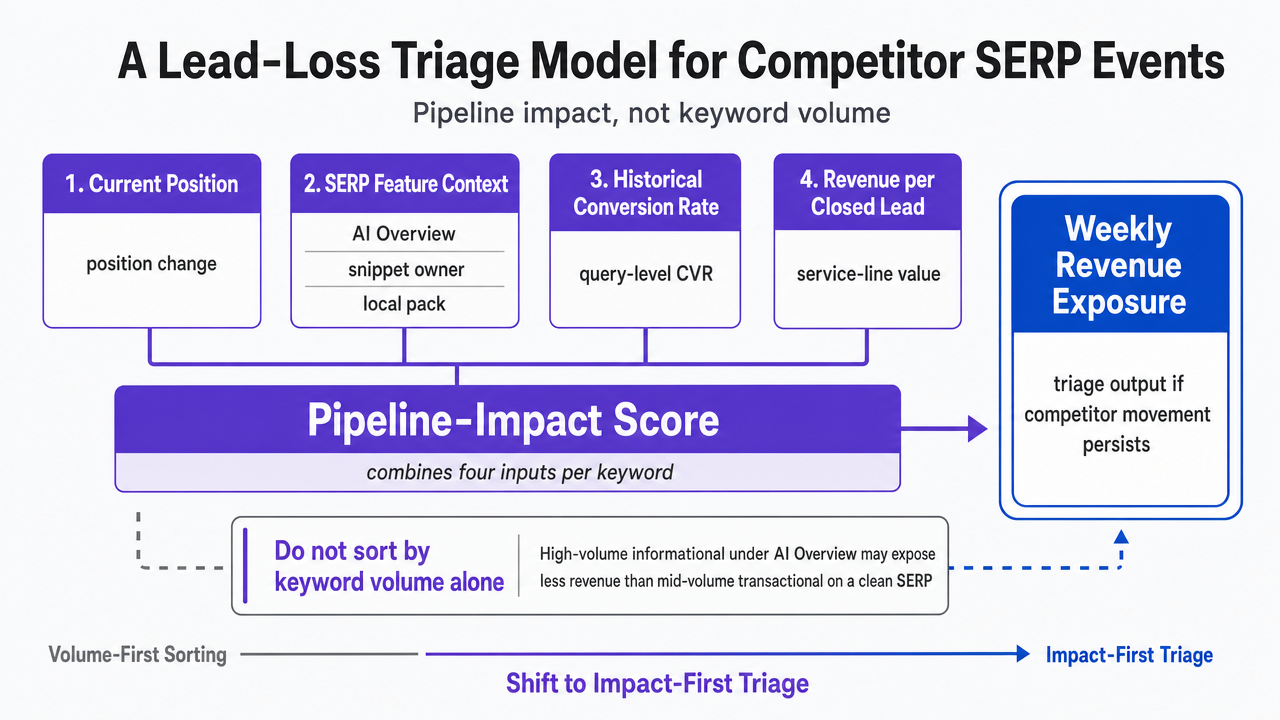 Visualize the four-input pipeline-impact scoring framework described in the section, showing how position, feature context, conversion rate, and revenue per lead combine into a triage output
Diagnosing Why a Competitor Is Actually Winning
Canonical Splits and Duplicate URL Signals
When a competitor holds a position that should belong to a client with equivalent authority and content, the first place to look is inside the client's own URL inventory. Multiple URLs targeting the same intent split ranking signals across pages that Google then has to choose between, and the winning URL is often not the one the agency optimized. Google's guidance is explicit: search engines pick a single canonical URL per piece of content, and mixed signals across duplicates weaken the consolidated page 7.
The diagnostic sequence is short. Pull every URL ranking for the target query across the client's domain in Search Console, then check for common canonical leaks in multi-location and legacy agency-inherited sites:
- tracking parameter variants,
- HTTP/HTTPS pairs,
- www and non-www duplicates, and
- service-page-versus-blog-post overlap.
Google ranks canonicalization signals by strength: 301 redirects carry the most weight, rel=canonical tags are strong, and sitemap inclusion alone is weak 8. Portfolio SEO leads recovering a query from a competitor should consolidate with redirects where the duplicate has no independent value, and reserve canonical tags for cases where both URLs must remain live.
Page Experience Gaps When Content Looks Equivalent
Content parity between a client and a competitor is one of the most misleading signals in the diagnostic queue. Two pages can cover the same subheadings, hit the same word count, and address the same intent, while the competitor still holds the position. Google frames page experience as a bundle of signals rather than a single lever, spanning Core Web Vitals, mobile usability, HTTPS, and intrusive interstitial checks 10.
The practical audit runs on the competitor URL and the client URL side by side. Largest Contentful Paint, Interaction to Next Paint, and Cumulative Layout Shift each get compared on mobile field data, not lab scores. A legal intake page with a 4.2-second LCP loses to a competitor at 1.8 seconds even when the copy is stronger, because the click that never fully loads never converts.
Behavioral correlates reinforce the finding. Bounce rate and time on site sit among the user-behavior metrics that most consistently correlate with SERP position 6. A competitor with a faster, cleaner mobile experience earns better engagement signals on the same query, and the ranking system reads that pattern over time.
E-E-A-T Alignment and Content Depth
When canonical and page experience checks come back clean, the remaining gap is usually quality alignment. Google's ranking systems prioritize helpful, reliable content built for people rather than for search engines, and E-E-A-T informs how that quality is evaluated 9. Human quality raters are instructed to weigh first-hand experience, expertise, authoritativeness, and trust of the content creator when assessing a page 13. Competitor pages that win high-stakes queries in legal, healthcare, and senior living verticals often show clearer author credentials, direct practitioner experience, and stronger site-level reputation signals than the client page they outrank.
The comparison audit is concrete. Winning pages typically show:
- named authors with verifiable credentials,
- on-page evidence of first-hand experience (case results, procedure counts, treatment specifics),
- citation of primary sources, and
- off-site reputation signals like reviews and mentions.
The rater guidelines emphasize that page quality evaluation asks how well a page achieves its stated purpose 14, which for a service-intent page means demonstrating that the provider actually does the work described.
Portfolio SEO leads should treat the E-E-A-T diagnostic as a content brief input, not a checklist. When a competitor consistently wins across a keyword cluster, the recovery play is usually a rebuild of the client page with practitioner-level detail and verifiable authority markers, not a title tag rewrite.
Portfolio Monitoring: Governing 50+ Accounts Without More Analysts
The scope shifts here from single-client diagnosis to portfolio governance. An SEO lead running 50 to 200 accounts cannot manually inspect competitor movement per keyword per client per week. The math breaks before the strategy does. A mid-sized agency tracking 300 keywords per client across 60 accounts is looking at 18,000 keyword rows a week, each of which now carries position, feature ownership, AI Overview status, citation share, GSC clicks, and downstream conversion data. Analyst hours consumed by manual pulls is where portfolio SEO functions bleed capacity.
A variable-driven consolidation model makes the trade-off legible. Portfolio SEO leads can plug their own inputs into the structure below rather than accept invented dollar totals.
| Input | Manual competitor monitoring | Automated feature + position tracking |
|---|---|---|
| Accounts managed | A | A |
| Priority keywords per account | K | K |
| Analyst minutes per keyword per month | 3–5 | 0.2–0.5 (review only) |
| Monthly analyst hours per account | (K × 4) / 60 | (K × 0.35) / 60 |
| Portfolio analyst hours per month | A × (K × 4) / 60 | A × (K × 0.35) / 60 |
| Recoverable capacity per 50 accounts (K=300) | — | ~910 analyst hours/month |
The recoverable capacity line is where the governance argument holds. When ingestion, feature detection, and prioritization run without an analyst in the loop, the human role compresses to reviewing ranked events and approving intervention. Search behavior guidance frames the same point at the data layer: query, behavior, and conversion signals belong in one analytical view rather than in parallel tools that never touch 5. Portfolio SEO leads who wire that view once, then govern by exception, reclaim hours that would otherwise fund the next analyst hire.
Governance-by-exception has a concrete definition. Only competitor SERP events crossing a pipeline-impact threshold surface for review. Everything below the threshold logs to the client dashboard but does not consume analyst attention. The SEO lead's queue becomes a ranked list of revenue-weighted events across the entire book of business, not a stack of per-client rank reports. That is the operating model that scales to 50-plus accounts without a matching increase in headcount, and it holds the specialist's judgment at the approval layer where it actually changes outcomes.
See How Top Agencies Monitor Competitor SERP Movements—Without Scaling Headcount
Get a walkthrough of AI-driven workflows for tracking competitor rankings, surfacing lead threats, and maintaining oversight across high-volume portfolios—purpose-built for agencies managing hundreds of clients.
Defensive Recovery Plays That Reclaim Clicks
Once the triage queue surfaces a high-impact competitor event, the recovery play depends on which surface the click was lost on. Blue-link recovery, snippet recapture, and AI Overview citation work are three different jobs with three different timelines.
Snippet recapture is the fastest lever. Restructure the target page so a direct answer sits in the first 40 to 60 words under a clear question heading, formatted as a paragraph, list, or table that mirrors the snippet type currently held by the competitor. On-SERP presentation changes have a documented feedback effect: keyword-level CTR gains correlated with subsequent position gains in a case study of ranked queries 2. A snippet win compounds because the reclaimed clicks strengthen the same engagement signals that shape future ranking.
Blue-link recovery runs slower. Where diagnostics point to a competitor with stronger practitioner-level detail and trust markers, the play is a content rebuild aligned to how quality is evaluated: named author expertise, first-hand experience, and clear reputation signals 13. Title and description rewrites help defend CTR at the current position while the deeper rebuild ships.
AI Overview citation work is the newest lane. Priority pages should carry crisp, factual passages with clear entity markup and source-worthy claims, since Overviews cite content that reads as authoritative reference material rather than sales copy. Portfolio SEO leads should log citation share weekly and treat displacement from the Overview as a recovery event on par with a two-position blue-link drop.
Where a Competitive Intelligence System Pays Back
The payback shows up in three places on the P&L, and each traces back to the same operating shift: competitor SERP data joined to feature ownership, CTR context, and conversion signals rather than exported as a standalone position table.
- Client retention improves when quarterly business reviews open with revenue-weighted event logs instead of green-red rank grids that no longer track lead flow.
- Analyst capacity compresses because governance-by-exception routes only threshold-crossing events to human review, freeing hours for recovery work rather than reporting.
- Forecast accuracy tightens because traffic models incorporate feature context and AI Overview presence 11, so pitch-cycle projections stop overshooting delivery in verticals where the click curve has thinned.
For agency SEO leads running high-stakes portfolios, the competitive intelligence system is where the specialist's judgment gets applied at the approval layer while ingestion, feature detection, and prioritization run underneath. That is the operating model Vectoron is built around, and it is the model that scales SEO delivery without adding the next analyst hire.
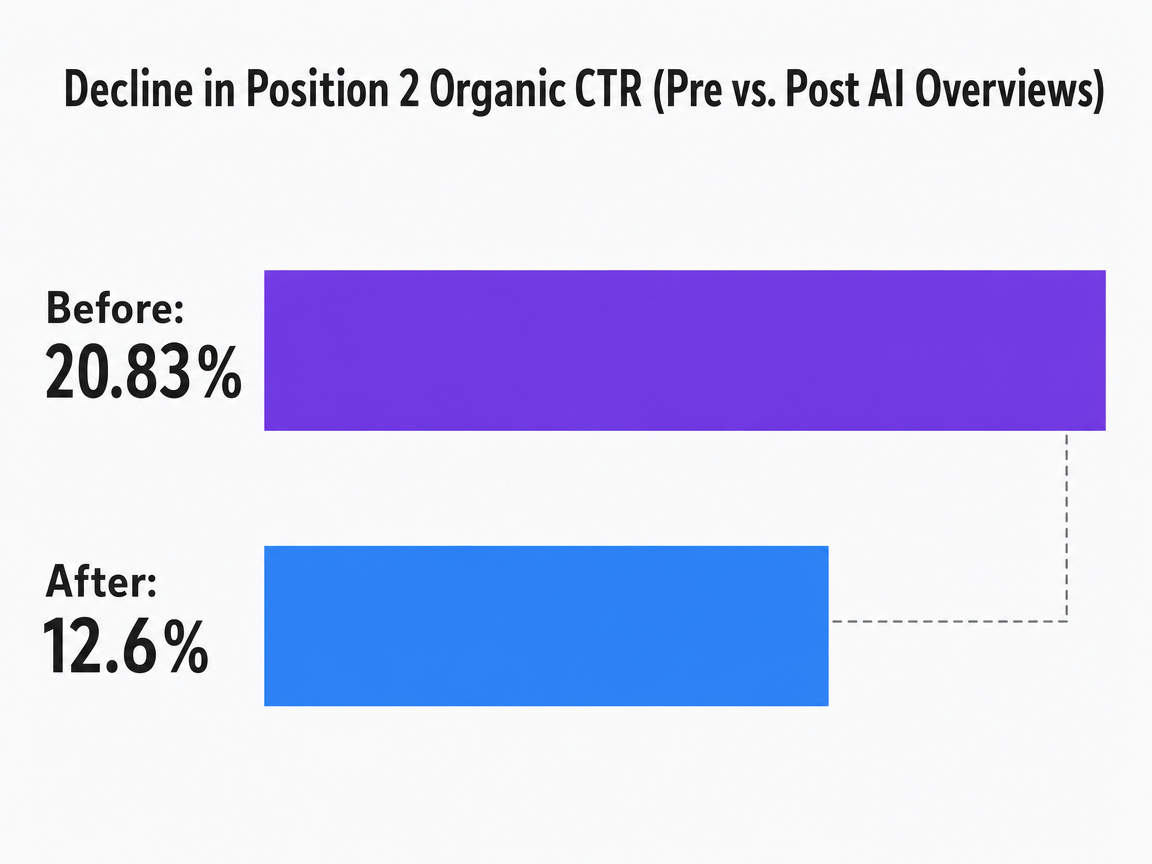 Decline in Position 2 Organic CTR (Pre vs. Post AI Overviews)
Compares the click-through rate for the #2 organic search result before and after the wider rollout of AI Overviews, based on a study of over 200,000 keywords.
Frequently Asked Questions
References
- 1.Use of Web search engines and personalisation in information seeking: students’ experiences.
- 2.CTR Case Study: Click Through Rate Influences Organic Rankings.
- 3.Google's organic click-through rate by search position.
- 4.Google Organic CTR 2025 [New Study of 200K Keywords].
- 5.How to Utilize Search Behavior and User Behavior Data in Your Marketing Strategy.
- 6.How User Behavior Affects Search Rankings.
- 7.Search Engine Optimization (SEO) Starter Guide.
- 8.How to Specify a Canonical with rel="canonical" and Other Methods.
- 9.Creating Helpful, Reliable, People-First Content.
- 10.Understanding page experience in Google Search results.
- 11.A Guide to Google Search Ranking Systems | Documentation.
- 12.Main findings.
- 13.Search Quality Rater Guidelines: An Overview.
- 14.General Guidelines.
- 15.Google AI Overviews decrease CTRs by 34.5%, per new study.